REVIEW 5 major objections 6 minor 2 cited by
Slot-based object-centric visual representations make robot manipulation policies generalize better under lighting, texture, and distractor shifts than global or dense features, even without task-specific pretraining.
Reviewed by Pith at T0; open to challenge. T0 means a machine referee read the full paper against a public rubric. the ladder, T0–T4 →
T0 review · deepseek-v4-flash
2026-08-03 07:00 UTC pith:INQNCSDR
load-bearing objection Useful large-scale benchmark of slot-based object-centric representations for manipulation, but the causal claim is not yet clean: the token-count confound is not controlled. the 5 major comments →
Spotlighting Task-Relevant Features: Object-Centric Representations for Better Generalization in Robotic Manipulation
The pith
A machine-rendered reading of the paper's core claim, the machinery that carries it, and where it could break.
Core claim
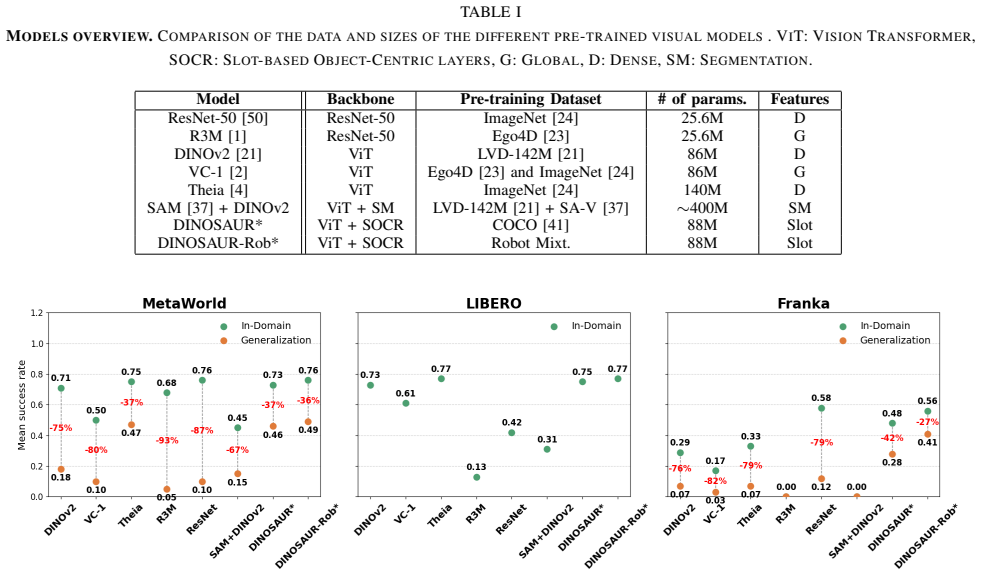
The central discovery is that inserting a slot-based object-centric layer between a frozen vision backbone and a transformer policy changes how well the policy tolerates visual distribution shift. Using DINOSAUR*, which runs Slot Attention on top of frozen DINOv2 features and adds a temporal transformer to propagate slots across frames, the policies match or exceed dense-feature baselines on the training distribution and beat every global and dense baseline under shift, with the smallest relative performance drop. Pretraining the same model on a large mixture of real-world robot demonstrations (DINOSAUR-Rob*) pushes the gains further and makes it the top performer across simulation and real
What carries the argument
The load-bearing component is Slot Attention, a differentiable module that turns a set of dense feature tokens into a small fixed number of object-like vectors ('slots') through iterative cross-attention with a competitive softmax, so that each slot specializes in a distinct part of the image. The paper builds DINOSAUR* by applying this slot layer to features from a frozen self-supervised vision backbone (DINOv2) and adding a transformer layer that passes slot information between timesteps for temporal coherence; DINOSAUR-Rob* is the same architecture given an additional pretraining stage on real robotic demonstration videos. These slots become the visual tokens that the policy transformer a
Load-bearing premise
The entire advantage rests on the assumption that Slot Attention, applied to frozen DINOv2 features, actually separates task-relevant objects from background and distractors under the tested shifts—the paper measures task success, not slot purity, and its limitations section concedes that some slots capture background or distractors.
What would settle it
Give the policy the same frozen backbone but replace Slot Attention with a fixed random grouping of dense tokens into the same number of vectors; if generalization under lighting, texture, and distractor shifts remains just as high, the object-centric structure is not the cause. Alternatively, compute per-slot attention masks under a distractor shift and check whether the slots that drive successful actions are the ones aligned with the manipulated object; if performance survives when object-aligned slots are removed, the filtering story fails.
If this is right
- Object-centric representations give robot-policy designers a practical middle ground between one-vector summaries and dense pixel-level features, with better out-of-distribution success rates and no task-specific tuning.
- Pretraining a slot-based model on large quantities of real robot demonstration data is worthwhile, contradicting earlier assumptions that object-centric methods do not benefit from large-scale pretraining.
- In real-world deployment, a frozen vision backbone plus a slot layer can keep a manipulation policy working when lighting, texture, and clutter change, even if the slot model has never seen robot video.
- The failure of a naive segmentation baseline suggests that masks alone, without spatial coordinates or end-to-end training, are insufficient; object structure needs to be learned jointly with the policy.
- The results point to representation structure as an independent factor in generalization, separate from the choice of vision backbone or pretraining data.
Where Pith is reading between the lines
- If the mechanism is background filtering, then slot purity under shift should predict policy success; one could instrument the Slot Attention maps to test whether the slots that drive successful rollouts are the ones aligned with the manipulated object.
- The results suggest a design heuristic: representation granularity should match the object structure of the task, a principle that may transfer to other control problems beyond tabletop manipulation.
- The paper's own limitation section implies that adding semantic grounding to slots could close the remaining distractor gap, since some slots are currently allocated to background or distractors.
- A natural testable extension is to sweep the number of slots and the backbone scale to find where object-centric structure stops being beneficial; the paper does not explore this boundary.
Editorial analysis
A structured set of objections, weighed in public.
Referee Report
Summary. This paper compares global, dense, and slot-based object-centric visual representations for robotic manipulation policies. The authors introduce an adapted Slot Attention module (DINOSAUR*) pretrained on COCO and optionally on robot video (DINOSAUR-Rob*), and evaluate seven frozen visual representations within a BAKU-based policy architecture on MetaWorld, LIBERO, and a real-world Franka setup. Generalization is tested under distractors, texture changes, and lighting shifts. The central claim is that slot-based object-centric representations outperform global and dense representations in generalization settings, even without task-specific pretraining, and that robot-video pretraining amplifies these benefits.
Significance. If the empirical claim holds, the paper provides evidence that a structured, object-centric bottleneck is a useful inductive bias for robust robotic manipulation, and it would be one of the first large-scale demonstrations of this in realistic control tasks. The study has several strengths: a unified policy architecture with frozen encoders to isolate representation choice, a COCO-only version of the object-centric model as a control for robot-data exposure, a focus analysis, and open-sourced evaluation code. However, the causal interpretation is currently undermined by a token-count confound and by insufficient statistical support for the real-world results.
major comments (5)
- [Table III, Section V-B] Real-world generalization results are reported as point estimates without error bars, confidence intervals, or significance tests; each condition has only 12 rollouts. With n=12, a difference such as DINOSAUR* 0.28 vs DINOv2 0.07 corresponds to roughly 3 vs 1 successful rollouts, and the DINOSAUR-Rob* 0.41 vs 0.07 gap is still based on small counts. Report per-task counts, confidence intervals, and at least a bootstrap or binomial test before claiming that SOCR policies 'consistently achieve the highest success rates' in the real world.
- [Section III, Tables II-III] SOCR policies feed exactly K slot tokens to the BAKU transformer, while dense baselines feed N patch tokens and global baselines feed one token. Because BAKU is a transformer, its behavior depends on sequence length; the observed gains may be due to the information bottleneck or sequence-length regularization rather than object-centric structure. No non-object-centric K-token control is run. SAM+DINOv2 is not a valid control because it is excluded from generalization analysis and was deliberately stripped of spatial information (Section IV-b). Add a control that maps the same dense features to K learned tokens without slot constraints (e.g., a linear projection or learned query bottleneck) and show that the object-centric version outperforms it.
- [Section V-A, LIBERO] The paper states that LIBERO 'does not introduce any distributional shifts for evaluation' and reports only in-domain LIBERO results. Nevertheless, Figure 4 and the conclusion claim 'consistently superior performance ... under distributional shifts' across all environments. As written, LIBERO only supports in-domain performance. Either add LIBERO shift experiments (e.g., texture/lighting/clutter variants) or restrict the generalization claim to MetaWorld and the real world.
- [Section III-b vs Table III] DINOSAUR-Rob* is pretrained on BridgeData V2, Fractal, and DROID, all robot-manipulation video datasets that may share visual and embodiment distribution with the real-world Franka evaluation. The claim that robot pretraining 'amplifies' SOCR benefits is therefore confounded by pretraining data distribution. The paper lacks a robot-pretrained dense or global baseline trained on the same mixture. Add such a baseline (or use an existing robot-pretrained dense representation, e.g., MCR) to isolate the effect of object-centric structure from data exposure.
- [Section VII vs Section VI] The paper attributes SOCR generalization to slots 'filtering task-irrelevant background', but Section VII concedes that slots can bind background and distractors, and no quantitative slot-purity or objectness metric is reported under distribution shifts. Provide segmentation or slot-binding metrics under the tested shifts to substantiate the proposed mechanism rather than relying on anecdotal visualizations.
minor comments (6)
- [Section VI] Typo: 'Figure 1 shows thant' should be 'shows that'.
- [Abstract / Introduction] The acronym SBOCR is used in the abstract and introduction, while SOCR is used elsewhere; standardize to one term.
- [Table I] The SAM+DINOv2 row is labeled 'SM' (segmentation). Clarify in the table caption that this baseline is excluded from generalization analysis, as stated in Section V-B.
- [Section IV-b] The SAM+DINOv2 baseline is described as 'naïve' because it removes spatial information. This design choice is justified later in Section V-A but should be stated earlier to avoid confusion about its representational capacity.
- [Section III] Hyperparameters for Slot Attention (slot count K, number of iterations, temporal transformer architecture, training details) are not reported in the main text. Add a table or appendix describing these settings.
- [Figure 4] The label 'METaworld' is misspelled, and the red numbers indicating relative drops are hard to read; increase font size and caption contrast.
Circularity Check
No significant circularity: the central comparison is an open benchmark with frozen external baselines and a COCO-only object-centric control.
full rationale
This paper is an empirical benchmarking study rather than a derivation chain. The central claim—that slot-based object-centric representations improve generalization—is supported by direct comparisons against external, frozen visual encoders (ResNet, R3M, DINOv2, VC-1, Theia) using a shared policy architecture. The key paired comparison between DINOSAUR* and DINOv2 holds the backbone fixed and adds only the Slot Attention layer, so the improvement is not definitionally built into the comparison. DINOSAUR-Rob* is pretrained on robot video, which creates a distributional-overlap concern, but the paper also reports DINOSAUR*, pretrained only on COCO, which outperforms the dense/global baselines and thus independently supports the object-centric structure claim. No equation equates a predicted quantity with a fitted input, and no load-bearing result is justified solely by self-citation (the reference list contains no author self-citations). The acknowledged limitation that some slots bind background or distractors weakens the proposed filtering mechanism but does not make the empirical result circular. The SAM+DINOv2 exclusion is a design choice, not a circular reduction. The token-count confound noted by skeptics is a legitimate alternative explanation but is not circularity: the paper does not define object-centric success in terms of token count. Overall, the evaluation is externally falsifiable and the central comparison is not forced by construction.
Axiom & Free-Parameter Ledger
free parameters (4)
- Slot count K
- Slot Attention iterations
- Temporal transformer hyperparameters
- Robot mixture pretraining composition =
188k trajectories from BridgeData V2, Fractal, DROID
axioms (5)
- domain assumption Slot Attention pretraining on COCO transfers object decomposition to robot manipulation scenes.
- domain assumption Identical frozen encoders and the same BAKU/ACT observation trunk give a fair comparison across global, dense, and slot features.
- domain assumption Robot-video pretraining (BridgeData V2, Fractal, DROID) improves downstream performance on the held-out Franka tasks.
- domain assumption 12 real-world rollouts per task per condition are sufficient to rank policies.
- domain assumption MetaWorld texture/lighting/distractor shifts are representative of real-world distribution shifts.
read the original abstract
The generalization capabilities of robotic manipulation policies are heavily influenced by the choice of visual representations. Existing approaches typically rely on representations extracted from pre-trained encoders, using two dominant types of features: global features, which summarize an entire image via a single pooled vector, and dense features, which preserve a patch-wise embedding from the final encoder layer. While widely used, both feature types mix task-relevant and irrelevant information, leading to poor generalization under distribution shifts, such as changes in lighting, textures, or the presence of distractors. In this work, we explore an intermediate structured alternative: Slot-Based Object-Centric Representations (SBOCR), which group dense features into a finite set of object-like entities. This representation permits to naturally reduce the noise provided to the robotic manipulation policy while keeping enough information to efficiently perform the task. We benchmark a range of global and dense representations against intermediate slot-based representations, across a suite of simulated and real-world manipulation tasks ranging from simple to complex. We evaluate their generalization under diverse visual conditions, including changes in lighting, texture, and the presence of distractors. Our findings reveal that SBOCR-based policies outperform dense and global representation-based policies in generalization settings, even without task-specific pretraining. These insights suggest that SBOCR is a promising direction for designing visual systems that generalize effectively in dynamic, real-world robotic environments.
Figures


Forward citations
Cited by 2 Pith papers
-
See Less, Specify More: Visual Evidence Budgets for Generalizable VLAs
S2 improves generalization in vision-language-action models by using goal-preserving refined language guidance and explicit visual evidence budgets, raising mean subtask success from 54.2% to 79.0% on eight real-robot...
-
More Structure, Not More Capacity: Object-Centric Representations for Visuomotor Imitation Learning
Frozen object-centric SPOT slots beat matched dense DINO features by 22.4% held-out success on ManiSkill3 PickCube; structure, not token count, drives the gain.
Reference graph
Works this paper leans on
-
[1]
R3m: A universal visual representation for robot manipulation,
S. Nair, A. Rajeswaran, V . Kumar, C. Finn, and A. Gupta, “R3m: A universal visual representation for robot manipulation,” 2022. [Online]. Available: https://arxiv.org/abs/2203.12601
Pith/arXiv arXiv 2022
-
[2]
Where are we in the search for an artificial visual cortex for embodied intelligence?
A. Majumdar, K. Yadav, S. Arnaud, et al. , “Where are we in the search for an artificial visual cortex for embodied intelligence?”
-
[3]
Vip: Towards universal visual reward and representation via value-implicit pre-training,
Y . J. Ma, S. Sodhani, D. Jayaraman, O. Bastani, V . Kumar, and A. Zhang, “Vip: Towards universal visual reward and representation via value-implicit pre-training,” 2023. [Online]. Available: https://arxiv.org/abs/2210.00030
Pith/arXiv arXiv 2023
-
[4]
Theia: Distilling diverse vision foundation models for robot learning,
J. Shang, K. Schmeckpeper, B. B. May, M. V . Minniti, T. Kelestemur, D. Watkins, and L. Herlant, “Theia: Distilling diverse vision foundation models for robot learning,” 2024. [Online]. Available: https://arxiv.org/abs/2407.20179
Pith/arXiv arXiv 2024
-
[5]
Real-world robot learning with masked visual pre-training,
I. Radosavovic, T. Xiao, S. James, P. Abbeel, J. Malik, and T. Darrell, “Real-world robot learning with masked visual pre-training,” 2022. [Online]. Available: https://arxiv.org/abs/2210.03109
Pith/arXiv arXiv 2022
-
[6]
Principles of object perception,
E. S. Spelke, “Principles of object perception,” Cognitive science , vol. 14, no. 1, pp. 29–56, 1990
1990
-
[7]
Building machines that learn and think like people,
B. M. Lake, T. D. Ullman, J. B. Tenenbaum, and S. J. Gershman, “Building machines that learn and think like people,” 2016. [Online]. Available: https://arxiv.org/abs/1604.00289
Pith/arXiv arXiv 2016
-
[8]
G. Jiang, Y . Sun, T. Huang, H. Li, Y . Liang, and H. Xu, “Robots pre- train robots: Manipulation-centric robotic representation from large- scale robot dataset,” arXiv preprint arXiv:2410.22325 , 2024
Pith/arXiv arXiv 2024
-
[9]
The unsurprising effectiveness of pre-trained vision models for control,
S. Parisi, A. Rajeswaran, S. Purushwalkam, and A. Gupta, “The unsurprising effectiveness of pre-trained vision models for control,”
-
[10]
What makes pre-trained visual representations successful for robust manipulation?
K. Burns, Z. Witzel, J. I. Hamid, T. Yu, C. Finn, and K. Hausman, “What makes pre-trained visual representations successful for robust manipulation?” 2023. [Online]. Available: https://arxiv.org/abs/2312.12444
Pith/arXiv arXiv 2023
-
[11]
Object- centric learning with slot attention,
F. Locatello, D. Weissenborn, T. Unterthiner, A. Mahendran, G. Heigold, J. Uszkoreit, A. Dosovitskiy, and T. Kipf, “Object- centric learning with slot attention,” 2020. [Online]. Available: https://arxiv.org/abs/2006.15055
Pith/arXiv arXiv 2020
-
[12]
Bridging the gap to real-world object-centric learning,
M. Seitzer, M. Horn, A. Zadaianchuk, et al. , “Bridging the gap to real-world object-centric learning,” 2023. [Online]. Available: https://arxiv.org/abs/2209.14860
Pith/arXiv arXiv 2023
-
[13]
An investigation into pre-training object-centric representations for reinforcement learning,
J. Yoon, Y .-F. Wu, H. Bae, and S. Ahn, “An investigation into pre-training object-centric representations for reinforcement learning,”
-
[14]
Visuomotor control in multi-object scenes using object-aware representations,
N. Heravi, A. Wahid, C. Lynch, P. Florence, T. Armstrong, J. Tompson, P. Sermanet, J. Bohg, and D. Dwibedi, “Visuomotor control in multi-object scenes using object-aware representations,”
-
[15]
Entity-centric reinforcement learning for object manipulation from pixels,
D. Haramati, T. Daniel, and A. Tamar, “Entity-centric reinforcement learning for object manipulation from pixels,” 2024. [Online]. Available: https://arxiv.org/abs/2404.01220
Pith/arXiv arXiv 2024
-
[16]
N. Watters, L. Matthey, M. Bosnjak, C. P. Burgess, and A. Lerchner, “Cobra: Data-efficient model-based rl through unsupervised object discovery and curiosity-driven exploration,” 2019. [Online]. Available: https://arxiv.org/abs/1905.09275
Pith/arXiv arXiv 2019
-
[17]
Conditional object-centric learning from video,
T. Kipf, G. F. Elsayed, A. Mahendran, A. Stone, S. Sabour, G. Heigold, R. Jonschkowski, A. Dosovitskiy, and K. Greff, “Conditional object-centric learning from video,” 2022. [Online]. Available: https://arxiv.org/abs/2111.12594
Pith/arXiv arXiv 2022
-
[18]
Available: https://arxiv.org/abs/2205.06333
[Online]. Available: https://arxiv.org/abs/2205.06333
-
[19]
Improved baselines with momentum contrastive learning,
X. Chen, H. Fan, R. Girshick, and K. He, “Improved baselines with momentum contrastive learning,” 2020. [Online]. Available: https://arxiv.org/abs/2003.04297
Pith/arXiv arXiv 2020
-
[20]
Emerging properties in self-supervised vision transformers,
M. Caron, H. Touvron, I. Misra, H. J ´egou, J. Mairal, P. Bojanowski, and A. Joulin, “Emerging properties in self-supervised vision transformers,” 2021. [Online]. Available: https://arxiv.org/abs/2104. 14294
2021
-
[21]
Dinov2: Learning robust visual features without supervision,
M. Oquab, T. Darcet, T. Moutakanni, et al. , “Dinov2: Learning robust visual features without supervision,” 2024. [Online]. Available: https://arxiv.org/abs/2304.07193
Pith/arXiv arXiv 2024
-
[22]
Zero-shot object-centric representation learning,
A. Didolkar, A. Zadaianchuk, A. Goyal, M. Mozer, Y . Bengio, G. Martius, and M. Seitzer, “Zero-shot object-centric representation learning,” 2024. [Online]. Available: https://arxiv.org/abs/2408.09162
Pith/arXiv arXiv 2024
-
[23]
Ego4d: Around the world in 3,000 hours of egocentric video,
K. Grauman, A. Westbury, E. Byrne, et al. , “Ego4d: Around the world in 3,000 hours of egocentric video,” 2022. [Online]. Available: https://arxiv.org/abs/2110.07058
Pith/arXiv arXiv 2022
-
[24]
Imagenet large scale visual recognition challenge,
O. Russakovsky, J. Deng, H. Su, et al. , “Imagenet large scale visual recognition challenge,” 2015. [Online]. Available: https://arxiv.org/abs/1409.0575
Pith/arXiv arXiv 2015
-
[25]
An unbiased look at datasets for visuo-motor pre-training,
S. Dasari, M. K. Srirama, U. Jain, and A. Gupta, “An unbiased look at datasets for visuo-motor pre-training,” 2023. [Online]. Available: https://arxiv.org/abs/2310.09289
Pith/arXiv arXiv 2023
-
[26]
Learning transferable visual models from natural language supervision,
A. Radford, J. W. Kim, C. Hallacy, et al. , “Learning transferable visual models from natural language supervision,” 2021. [Online]. Available: https://arxiv.org/abs/2103.00020
Pith/arXiv arXiv 2021
-
[27]
Sold: Slot object-centric latent dynamics models for relational manipulation learning from pixels,
M. Mosbach, J. N. Ewertz, A. Villar-Corrales, and S. Behnke, “Sold: Slot object-centric latent dynamics models for relational manipulation learning from pixels,” 2025. [Online]. Available: https://arxiv.org/abs/2410.08822
Pith/arXiv arXiv 2025
-
[28]
Explainable image recognition via enhanced slot-attention based classifier,
B. Wang, L. Li, J. Zhang, Y . Nakashima, and H. Nagahara, “Explainable image recognition via enhanced slot-attention based classifier,” 2024. [Online]. Available: https://arxiv.org/abs/2407.05616
Pith/arXiv arXiv 2024
-
[29]
R. Kabra, D. Zoran, G. Erdogan, L. Matthey, A. Creswell, M. Botvinick, A. Lerchner, and C. P. Burgess, “Simone: View-invariant, temporally-abstracted object representations via unsupervised video decomposition,” 2021. [Online]. Available: https://arxiv.org/abs/2106.03849
Pith/arXiv arXiv 2021
-
[30]
Carformer: Self-driving with learned object-centric representations,
S. Hamdan and F. G ¨uney, “Carformer: Self-driving with learned object-centric representations,” 2024. [Online]. Available: https: //arxiv.org/abs/2407.15843
Pith/arXiv arXiv 2024
-
[31]
Object-centric slot diffusion,
J. Jiang, F. Deng, G. Singh, and S. Ahn, “Object-centric slot diffusion,” 2023. [Online]. Available: https://arxiv.org/abs/2303.10834
Pith/arXiv arXiv 2023
-
[32]
Slotdiffusion: Object-centric generative modeling with diffusion models,
Z. Wu, J. Hu, W. Lu, I. Gilitschenski, and A. Garg, “Slotdiffusion: Object-centric generative modeling with diffusion models,” 2023. [Online]. Available: https://arxiv.org/abs/2305.11281
Pith/arXiv arXiv 2023
-
[33]
Illiterate dall-e learns to compose,
G. Singh, F. Deng, and S. Ahn, “Illiterate dall-e learns to compose,”
-
[34]
Monet: Unsupervised scene decomposition and representation,
C. P. Burgess, L. Matthey, N. Watters, R. Kabra, I. Higgins, M. Botvinick, and A. Lerchner, “Monet: Unsupervised scene decomposition and representation,” 2019. [Online]. Available: https: //arxiv.org/abs/1901.11390
Pith/arXiv arXiv 2019
-
[35]
Simple unsupervised object-centric learning for complex and naturalistic videos,
G. Singh, Y .-F. Wu, and S. Ahn, “Simple unsupervised object-centric learning for complex and naturalistic videos,” 2022. [Online]. Available: https://arxiv.org/abs/2205.14065
Pith/arXiv arXiv 2022
-
[36]
Object-centric learning for real-world videos by predicting temporal feature similarities,
A. Zadaianchuk, M. Seitzer, and G. Martius, “Object-centric learning for real-world videos by predicting temporal feature similarities,”
-
[37]
A. Kirillov, E. Mintun, N. Ravi, et al. , “Segment anything,” 2023. [Online]. Available: https://arxiv.org/abs/2304.02643
Pith/arXiv arXiv 2023
-
[38]
Available: https://arxiv.org/abs/2110.11405
[Online]. Available: https://arxiv.org/abs/2110.11405
-
[39]
Savi++: Towards end-to-end object- centric learning from real-world videos,
G. F. Elsayed, A. Mahendran, S. van Steenkiste, K. Greff, M. C. Mozer, and T. Kipf, “Savi++: Towards end-to-end object- centric learning from real-world videos,” 2022. [Online]. Available: https://arxiv.org/abs/2206.07764
Pith/arXiv arXiv 2022
-
[40]
Task-oriented hierarchical object decomposition for visuomotor control,
J. Qian, Y . Li, B. Bucher, and D. Jayaraman, “Task-oriented hierarchical object decomposition for visuomotor control,” 2024. [Online]. Available: https://arxiv.org/abs/2411.01284
Pith/arXiv arXiv 2024
-
[41]
Microsoft coco: Common objects in context,
T.-Y . Lin, M. Maire, S. Belongie, L. Bourdev, R. Girshick, J. Hays, P. Perona, D. Ramanan, C. L. Zitnick, and P. Doll ´ar, “Microsoft coco: Common objects in context,” 2015. [Online]. Available: https://arxiv.org/abs/1405.0312
Pith/arXiv arXiv 2015
-
[42]
Available: https://arxiv.org/abs/2306.04829
[Online]. Available: https://arxiv.org/abs/2306.04829
-
[43]
Rt-1: Robotics transformer for real-world control at scale,
A. Brohan, N. Brown, J. Carbajal, et al. , “Rt-1: Robotics transformer for real-world control at scale,” 2023. [Online]. Available: https://arxiv.org/abs/2212.06817
Pith/arXiv arXiv 2023
-
[44]
Composing pre-trained object-centric representations for robotics from
J. Shi, J. Qian, Y . J. Ma, and D. Jayaraman, “Composing pre-trained object-centric representations for robotics from ”what” and ”where” foundation models,” 2024. [Online]. Available: https: //arxiv.org/abs/2404.13474
Pith/arXiv arXiv 2024
-
[45]
Learning generalizable manipulation policies with object-centric 3d representations,
Y . Zhu, Z. Jiang, P. Stone, and Y . Zhu, “Learning generalizable manipulation policies with object-centric 3d representations,” 2023. [Online]. Available: https://arxiv.org/abs/2310.14386
Pith/arXiv arXiv 2023
-
[46]
Learning fine-grained bimanual manipulation with low-cost hardware,
T. Z. Zhao, V . Kumar, S. Levine, and C. Finn, “Learning fine-grained bimanual manipulation with low-cost hardware,” 2023. [Online]. Available: https://arxiv.org/abs/2304.13705
Pith/arXiv arXiv 2023
-
[47]
B. Warner, A. Chaffin, B. Clavi ´e, et al. , “Smarter, better, faster, longer: A modern bidirectional encoder for fast, memory efficient, and long context finetuning and inference,” 2024. [Online]. Available: https://arxiv.org/abs/2412.13663
Pith/arXiv arXiv 2024
-
[48]
Bridgedata v2: A dataset for robot learning at scale,
H. Walke, K. Black, A. Lee, et al. , “Bridgedata v2: A dataset for robot learning at scale,” 2024. [Online]. Available: https: //arxiv.org/abs/2308.12952
Pith/arXiv arXiv 2024
-
[49]
Libero: Benchmarking knowledge transfer for lifelong robot learning,
B. Liu, Y . Zhu, C. Gao, Y . Feng, Q. Liu, Y . Zhu, and P. Stone, “Libero: Benchmarking knowledge transfer for lifelong robot learning,” arXiv preprint arXiv:2306.03310, 2023
Pith/arXiv arXiv 2023
-
[50]
Droid: A large-scale in-the-wild robot manipulation dataset,
A. Khazatsky, K. Pertsch, S. Nair, et al. , “Droid: A large-scale in-the-wild robot manipulation dataset,” 2024. [Online]. Available: https://arxiv.org/abs/2403.12945
Pith/arXiv arXiv 2024
-
[51]
Baku: An efficient transformer for multi-task policy learning,
S. Haldar, Z. Peng, and L. Pinto, “Baku: An efficient transformer for multi-task policy learning,” 2024. [Online]. Available: https: //arxiv.org/abs/2406.07539
Pith/arXiv arXiv 2024
-
[52]
Grounding dino: Marrying dino with grounded pre-training for open-set object detection,
S. Liu, Z. Zeng, T. Ren, et al. , “Grounding dino: Marrying dino with grounded pre-training for open-set object detection,” arXiv preprint arXiv:2303.05499, 2023
Pith/arXiv arXiv 2023
-
[53]
Tracking anything with decoupled video segmentation,
H. K. Cheng, S. W. Oh, B. Price, A. Schwing, and J.-Y . Lee, “Tracking anything with decoupled video segmentation,” in ICCV, 2023
2023
-
[54]
Meta-world: A benchmark and evaluation for multi-task and meta reinforcement learning,
T. Yu, D. Quillen, Z. He, R. Julian, A. Narayan, H. Shively, A. Bellathur, K. Hausman, C. Finn, and S. Levine, “Meta-world: A benchmark and evaluation for multi-task and meta reinforcement learning,” 2021. [Online]. Available: https://arxiv.org/abs/1910.10897
Pith/arXiv arXiv 2021
-
[55]
Quantifying attention flow in transformers,
S. Abnar and W. Zuidema, “Quantifying attention flow in transformers,” 2020. [Online]. Available: https://arxiv.org/abs/2005. 00928
2020
-
[56]
Deep residual learning for image recognition,
K. He, X. Zhang, S. Ren, and J. Sun, “Deep residual learning for image recognition,” 2015. [Online]. Available: https://arxiv.org/abs/ 1512.03385
Pith/arXiv arXiv 2015
-
[57]
An image is worth 16x16 words: Transformers for image recognition at scale,
A. Dosovitskiy, L. Beyer, A. Kolesnikov, et al. , “An image is worth 16x16 words: Transformers for image recognition at scale,” 2021. [Online]. Available: https://arxiv.org/abs/2010.11929
Pith/arXiv arXiv 2021
-
[60]
Grad-cam: Visual explanations from deep networks via gradient-based localization,
R. R. Selvaraju, M. Cogswell, A. Das, R. Vedantam, D. Parikh, and D. Batra, “Grad-cam: Visual explanations from deep networks via gradient-based localization,” International Journal of Computer Vision, vol. 128, no. 2, p. 336–359, Oct. 2019. [Online]. Available: http://dx.doi.org/10.1007/s11263-019-01228-7
-
[62]
Temporally consistent object-centric learning by contrasting slots,
A. Manasyan, M. Seitzer, F. Radovic, G. Martius, and A. Zadaianchuk, “Temporally consistent object-centric learning by contrasting slots,” in Proceedings of the IEEE/CVF Conference on Computer Vision and Pattern Recognition (CVPR) , 2025
2025
-
[2022]
Available: https://arxiv.org/abs/2203.03580
[Online]. Available: https://arxiv.org/abs/2203.03580
-
[2023]
Available: https://arxiv.org/abs/2302.04419
[Online]. Available: https://arxiv.org/abs/2302.04419
-
[2024]
Available: https://arxiv.org/abs/2303.18240
[Online]. Available: https://arxiv.org/abs/2303.18240
discussion (0)
Sign in with ORCID, Apple, or X to comment. Anyone can read and Pith papers without signing in.