Analytic Solution for the Motion of Spinning Particles in Plane Gravitational Wave Spacetime
Pith reviewed 2026-05-16 09:56 UTC · model grok-4.3
The pith
Six conserved quantities from Killing symmetries fully determine the analytic motion of spinning particles in plane gravitational waves.
A machine-rendered reading of the paper's core claim, the machinery that carries it, and where it could break.
Core claim
The Mathisson-Papapetrou-Dixon equations truncated at linear spin order admit closed-form solutions in plane wave spacetimes. A parallel-transported tetrad aligned with the wave propagation direction, together with the spacetime's translational Killing symmetries, generates six conserved quantities. These quantities determine the momentum and spin evolution completely, while the particle's position components are expressed as explicit integrals of the wave profile evaluated at retarded time.
What carries the argument
Parallel-transported tetrad combined with translational Killing symmetries, which generate the six conserved quantities that close the linear-order MPD system.
If this is right
- Transverse and longitudinal motions reduce to single retarded-time integrals of the wave amplitude.
- Spin-induced deviations from geodesics become computable without solving differential equations numerically.
- The same conserved quantities apply uniformly to gravitational memory, Penrose-limit geometries, and high-energy scattering.
- The framework supplies a model-independent baseline for any spin-curvature effect linear in spin.
Where Pith is reading between the lines
- The conserved quantities may serve as exact initial conditions for numerical evolutions in nearby, non-plane-wave spacetimes.
- Extensions to quadratic spin order or to wave profiles with slower fall-off could be checked by comparing against known geodesic limits.
- The integral expressions could be used to compute accumulated phase shifts in interferometers or timing arrays that involve spinning sources.
Load-bearing premise
The Mathisson-Papapetrou-Dixon equations remain accurate when kept only to first order in the particle spin.
What would settle it
Numerical integration of the full nonlinear MPD equations for a concrete plane-wave profile and initial spin four-vector that produces a trajectory differing from the analytic integral expressions already at linear order in spin.
Figures
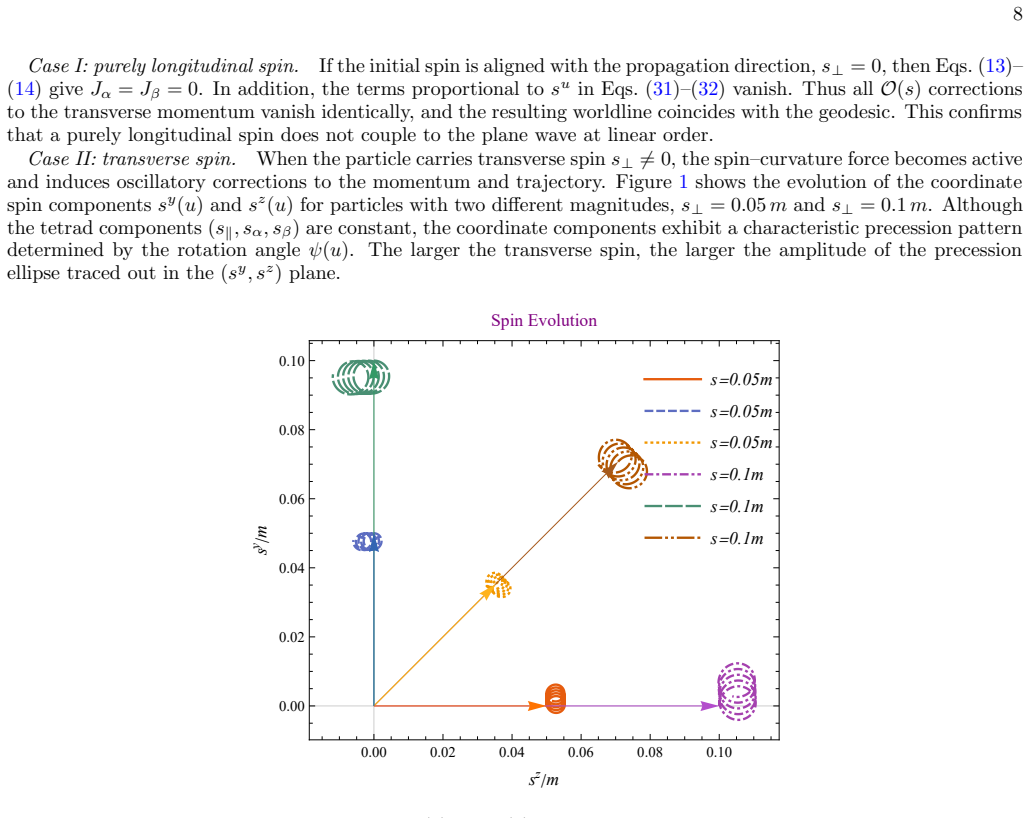

read the original abstract
The interaction between spin and gravitational waves causes spinning bodies to deviate from their geodesics. In this work, we obtain the analytic solution of the Mathisson--Papapetrou--Dixon equations at linear order in the spin for plane gravitational wave spacetimes. Our approach combines a parallel-transported tetrad with the translational Killing symmetries of plane wave spacetimes, yielding six conserved quantities that fully determine the momentum, spin evolution, and worldline. The resulting transverse and longitudinal motions are expressed in closed form as single integrals of the retarded time, providing a unified and model-independent framework for computing spin--curvature-induced deviations. This analytic solution offers a versatile tool for studying spin-dependent effects in gravitational memory, Penrose-limit geometries, and high-energy scattering regimes.
Editorial analysis
A structured set of objections, weighed in public.
Referee Report
Summary. The paper derives an analytic solution to the Mathisson-Papapetrou-Dixon equations at linear order in spin for test particles in exact plane gravitational wave spacetimes. By constructing a parallel-transported tetrad and exploiting the translational Killing vectors of the plane-wave background, six conserved quantities are obtained that reduce the momentum, spin, and worldline evolution to single integrals over retarded time u, yielding closed-form expressions for transverse and longitudinal motions without additional approximations beyond the linear-spin truncation.
Significance. If correct, the result supplies a model-independent analytic framework for spin-curvature deviations in plane-wave geometries, which is useful for gravitational memory effects, Penrose limits, and high-energy scattering. The derivation relies on standard, well-defined constructions (Killing conserved quantities and linear MPD truncation) applied directly to the exact metric, providing reproducible quadratures rather than numerical integration.
minor comments (3)
- The abstract states that the six conserved quantities 'fully determine' the dynamics but does not list them explicitly; adding a short enumeration (e.g., p·k, S·k, etc.) would improve immediate readability.
- The integration for the worldline coordinates is described as 'single integrals over retarded time u'; the manuscript should display the explicit integral expressions for x^μ(u) in a dedicated equation block to facilitate direct use by readers.
- Notation for the plane-wave metric (Brinkmann vs. Rosen form) and the choice of parallel-transported tetrad should be introduced with a brief reminder of the coordinate conventions in §2 before the conserved quantities are derived.
Simulated Author's Rebuttal
We thank the referee for the positive summary, significance assessment, and recommendation of minor revision. No specific major comments were provided in the report.
Circularity Check
Derivation applies standard Killing symmetries and tetrad construction without reduction to self-inputs
full rationale
The paper obtains the analytic solution to the linear-spin MPD equations by exploiting the exact translational Killing vectors of plane-wave spacetimes together with a parallel-transported tetrad. These yield six first integrals that reduce the system to quadratures. Both the Killing conserved quantities and the linear-spin truncation are standard, externally defined constructions that do not depend on the target solution or on any fitted parameters from the present work. No equation is shown to be equivalent to its own inputs by construction, and no load-bearing step relies on a self-citation chain. The derivation is therefore self-contained against external benchmarks.
Axiom & Free-Parameter Ledger
axioms (2)
- domain assumption Mathisson-Papapetrou-Dixon equations truncated at linear order in spin
- standard math Plane gravitational wave spacetimes admit translational Killing vectors
Reference graph
Works this paper leans on
-
[1]
into a parallel–transported pair. We therefore define eµ 2 = ˜eµ 2 cosψ(u)−˜e µ 3 sinψ(u),(21) eµ 3 = ˜eµ 2 sinψ(u) + ˜eµ 3 cosψ(u),(22) and require that the parallel–transport conditions uν g ∇νeµ 2 = 0, u ν g ∇νeµ 3 = 0 (23) hold along the reference geodesicu µ g . A direct computation by expanding ˜e3 µuν g ∇νeµ 2 = 0 yields the simple evolution equati...
-
[2]
Using the metric (9) and dividingu µuµ =−1 by (u u)2 we find 2 dv du + (1−h +) dy du 2 + (1 +h +) dz du 2 −2h × dy du dz du =− m E 2 .(43) In terms of the Cartesian coordinatex,dx/du=−(1 +dv/du)/ √
-
[3]
By integrating once, we obtain x(u) =x(0)− u√ 2 + 1 2 √ 2 Z u 0 du′ " (1−h +(u′)) dy du′ 2 + (1 +h +(u′)) dz du′ 2 −2h ×(u′) dy du′ dz du′ + m E 2 # .(44) Equations (41), (42) and (44) provide the completeO(s) worldline of the spinning test particle in the plane gravitational wave spacetime. To obtain a concrete worldline, the constants (E, J α, Jβ, s∥, s...
-
[4]
B. P. Abbott et al. Prospects for observing and localizing gravitational-wave transients with Advanced LIGO, Advanced Virgo and KAGRA.Living Rev. Rel., 19:1, 2016. doi:10.1007/s41114-020-00026-9. VI
-
[5]
Laser Interferometer Space Antenna
Pau Amaro-Seoane et al. Laser Interferometer Space Antenna. 2 2017. I, VI
work page 2017
-
[6]
K. Andrzejewski. Revisiting the dynamics of a charged spinning body in curved spacetime.Classical and Quantum Gravity, 42(5):055019, March 2025. ISSN 0264-9381, 1361-6382. doi:10.1088/1361-6382/adb2d4. URLhttp://arxiv.org/ abs/2405.13784. arXiv:2405.13784 [gr-qc]. I
-
[7]
Donato Bini and Thibault Damour. Gravitational spin-orbit coupling in binary systems, post-Minkowskian approximation and effective one-body theory.Phys. Rev. D, 96(10):104038, 2017. doi:10.1103/PhysRevD.96.104038. I
-
[8]
Gyroscopes and gravitational waves.Classical and Quantum Gravity, 17(22):4627– 4635, November 2000
Donato Bini and Fernando De Felice. Gyroscopes and gravitational waves.Classical and Quantum Gravity, 17(22):4627– 4635, November 2000. ISSN 0264-9381, 1361-6382. doi:10.1088/0264-9381/17/22/303. URLhttps://iopscience.iop. org/article/10.1088/0264-9381/17/22/303. I
-
[9]
Donato Bini, Christian Cherubini, Andrea Geralico, and Antonello Ortolan. Dixon’s extended bodies and weak gravitational waves.General Relativity and Gravitation, 41(1):105–116, January 2009. ISSN 0001-7701, 1572-9532. doi:10.1007/s10714- 008-0657-x. URLhttp://link.springer.com/10.1007/s10714-008-0657-x
-
[10]
Deviation and precession effects in the field of a weak gravitational wave
Donato Bini, Andrea Geralico, and Antonello Ortolan. Deviation and precession effects in the field of a weak gravitational wave.Physical Review D, 95(10):104044, May 2017. ISSN 2470-0010, 2470-0029. doi:10.1103/PhysRevD.95.104044. URL http://arxiv.org/abs/1705.02794. arXiv:1705.02794 [gr-qc]. I
work page internal anchor Pith review Pith/arXiv arXiv doi:10.1103/physrevd.95.104044 2017
-
[11]
Antonelliet al.(FENICE Collaboration), Nucl
Matthias Blau and Martin O’Loughlin. Homogeneous plane waves.Nucl. Phys. B, 654:135–176, 2003. doi:10.1016/S0550- 3213(03)00055-5. I, IV A, VI
-
[12]
H. Bondi, M. G. J. van der Burg, and A. W. K. Metzner. Gravitational waves in general relativity. 7. Waves from axisymmetric isolated systems.Proc. Roy. Soc. Lond. A, 269:21–52, 1962. doi:10.1098/rspa.1962.0161. VI
-
[13]
Yingxin Chen, Ke Wang, and Chao-Jun Feng. Higher order analysis of the gravitational wave velocity memory effect between two free-falling gyroscopes in the plane wave spacetime.Phys. Rev. D, 111(10):104085, 2025. doi:10.1103/38k7- pwlr. I, VI
-
[14]
Monica Colpi et al. LISA Definition Study Report. 2 2024. I, VI
work page 2024
-
[15]
L. Filipe O. Costa, Georgios Lukes-Gerakopoulos, and Oldˇ rich Semer´ ak. Spinning particles in general relativ- ity: Momentum-velocity relation for the Mathisson-Pirani spin condition.Phys. Rev. D, 97(8):084023, 2018. doi: 10.1103/PhysRevD.97.084023. I
-
[16]
Tim Dietrich, Tanja Hinderer, and Anuradha Samajdar. Interpreting Binary Neutron Star Mergers: Describing the Binary Neutron Star Dynamics, Modelling Gravitational Waveforms, and Analyzing Detections.Gen. Rel. Grav., 53(3):27, 2021. doi:10.1007/s10714-020-02751-6. I
-
[17]
W. G. Dixon. Dynamics of extended bodies in general relativity. I. Momentum and angular momentum.Proceedings of the Royal Society of London. A. Mathematical and Physical Sciences, 314(1519):499–527, January 1970. ISSN 0080-4630. doi:10.1098/rspa.1970.0020. URLhttps://royalsocietypublishing.org/doi/10.1098/rspa.1970.0020. I, II, II, II
-
[18]
Albert Einstein and N. Rosen. On Gravitational waves.J. Franklin Inst., 223:43–54, 1937. doi:10.1016/S0016- 0032(37)90583-0. III
-
[19]
C. W. F. Everitt, D. B. DeBra, B. W. Parkinson, J. P. Turneaure, J. W. Conklin, M. I. Heifetz, G. M. Keiser, A. S. Silbergleit, T. Holmes, J. Kolodziejczak, M. Al-Meshari, J. C. Mester, B. Muhlfelder, V. G. Solomonik, K. Stahl, P. W. Worden, W. Bencze, S. Buchman, B. Clarke, A. Al-Jadaan, H. Al-Jibreen, J. Li, J. A. Lipa, J. M. Lockhart, B. Al- Suwaidan, ...
-
[20]
Scattering of quantum particles by gravitational plane waves.Phys
Jaume Garriga and Enric Verdaguer. Scattering of quantum particles by gravitational plane waves.Phys. Rev. D, 43: 391–401, 1991. doi:10.1103/PhysRevD.43.391. I
-
[21]
Abraham I. Harte. Extended-body motion in black hole spacetimes: What is possible?Physical Review D, 102(12): 124075, December 2020. ISSN 2470-0010, 2470-0029. doi:10.1103/PhysRevD.102.124075. URLhttp://arxiv.org/abs/ 2011.00110. arXiv:2011.00110 [gr-qc]
-
[22]
S. Kessari, D. Singh, R. W. Tucker, and C. Wang. Scattering of spinning test particles by plane gravitational and electromagnetic waves.Class. Quant. Grav., 19:4943–4952, 2002. doi:10.1088/0264-9381/19/19/312. I
-
[23]
2016, Classical and Quantum Gravity, 33, 035010, doi: 10.1088/0264-9381/33/3/035010
Jun Luo et al. TianQin: a space-borne gravitational wave detector.Class. Quant. Grav., 33(3):035010, 2016. doi: 10.1088/0264-9381/33/3/035010. I, VI
-
[24]
Jean-Alain Marck. Parallel-tetrad on null geodesics in Kerr-Newman space-time.Physics Letters A, 97(4):140–142, Au- gust 1983. ISSN 03759601. doi:10.1016/0375-9601(83)90197-4. URLhttps://linkinghub.elsevier.com/retrieve/pii/ 0375960183901974. IV 11
-
[25]
Gravitational waves and spinning test particles
M. Mohseni and H. R. Sepangi. Gravitational waves and spinning test particles.Classical and Quantum Gravity, 17(22): 4615–4625, November 2000. ISSN 0264-9381, 1361-6382. doi:10.1088/0264-9381/17/22/302. URLhttp://arxiv.org/abs/ gr-qc/0009070. arXiv:gr-qc/0009070. I
work page internal anchor Pith review Pith/arXiv arXiv doi:10.1088/0264-9381/17/22/302 2000
-
[26]
On the motion of spinning test particles in plane gravitational waves
M. Mohseni, Robin W. Tucker, and Charles Wang. On the motion of spinning test particles in plane gravitational waves.Classical and Quantum Gravity, 18(15):3007–3017, August 2001. ISSN 0264-9381, 1361-6382. doi:10.1088/0264- 9381/18/15/314. URLhttp://arxiv.org/abs/gr-qc/0308042. arXiv:gr-qc/0308042. I
work page internal anchor Pith review Pith/arXiv arXiv doi:10.1088/0264- 2001
-
[27]
Serguei Ossokine et al. Multipolar Effective-One-Body Waveforms for Precessing Binary Black Holes: Construction and Validation.Phys. Rev. D, 102(4):044055, 2020. doi:10.1103/PhysRevD.102.044055. VI
-
[28]
Spinning test particles in general relativity
Achille Papapetrou. Spinning test particles in general relativity. 1.Proc. Roy. Soc. Lond. A, 209:248–258, 1951. doi: 10.1098/rspa.1951.0200. I, II
-
[29]
Any Space-Time has a Plane Wave as a Limit.Differential Geometry and Relativity, pages 271–275, 1976
Roger Penrose. Any Space-Time has a Plane Wave as a Limit.Differential Geometry and Relativity, pages 271–275, 1976. doi:10.1007/978-94-010-1508-0-23. I, VI
-
[30]
The motion of point particles in curved spacetime
Eric Poisson, Adam Pound, and Ian Vega. The motion of point particles in curved spacetime.Living Reviews in Relativity, 14(1):7, December 2011. ISSN 2367-3613, 1433-8351. doi:10.12942/lrr-2011-7. URLhttp://arxiv.org/abs/1102.0529. arXiv:1102.0529 [gr-qc]. II
work page internal anchor Pith review Pith/arXiv arXiv doi:10.12942/lrr-2011-7 2011
-
[31]
2020, International Journal of Modern Physics A, 35, 2050075, doi: 10.1142/S0217751X2050075X
Wen-Hong Ruan, Zong-Kuan Guo, Rong-Gen Cai, and Yuan-Zhong Zhang. Taiji program: Gravitational-wave sources. Int. J. Mod. Phys. A, 35(17):2050075, 2020. doi:10.1142/S0217751X2050075X. I, VI
-
[32]
R. Rudiger. Conserved quantities of spinning test particles in general relativity. I.Proceedings of the Royal Society of Lon- don. A. Mathematical and Physical Sciences, 375(1761):185–193, March 1981. ISSN 0080-4630. doi:10.1098/rspa.1981.0046. URLhttps://royalsocietypublishing.org/doi/10.1098/rspa.1981.0046. II
-
[33]
R. Rudiger. Conserved quantities of spinning test particles in general relativity. II.Proceedings of the Royal So- ciety of London. A. Mathematical and Physical Sciences, 385(1788):229–239, January 1983. ISSN 0080-4630. doi: 10.1098/rspa.1983.0012. URLhttps://royalsocietypublishing.org/doi/10.1098/rspa.1983.0012. II
-
[34]
R. Sachs. Asymptotic symmetries in gravitational theory.Phys. Rev., 128:2851–2864, 1962. doi:10.1103/PhysRev.128.2851. VI
-
[35]
O. Semerak. Spinning test particles in a Kerr field – I.Monthly Notices of the Royal Astronomical Society, 308(3):863–875, September 1999. ISSN 0035-8711, 1365-2966. doi:10.1046/j.1365-8711.1999.02754.x. URLhttps://academic.oup.com/ mnras/article/308/3/863/973826. I
-
[36]
Precession Caused by Gravitational Waves.Phys
Ali Seraj and Blagoje Oblak. Precession Caused by Gravitational Waves.Phys. Rev. Lett., 129(6):061101, 2022. doi: 10.1103/PhysRevLett.129.061101. I, VI
-
[37]
Viktor Skoup´ y and Georgios Lukes-Gerakopoulos. Spinning test body orbiting around a Kerr black hole: Eccen- tric equatorial orbits and their asymptotic gravitational-wave fluxes.Phys. Rev. D, 103(10):104045, 2021. doi: 10.1103/PhysRevD.103.104045. I
-
[38]
Viktor Skoup´ y and Vojtˇ ech Witzany. Analytic Solution for the Motion of Spinning Particles in Kerr Spacetime.Physical Review Letters, 134(17):171401, April 2025. ISSN 0031-9007, 1079-7114. doi:10.1103/PhysRevLett.134.171401. URL https://link.aps.org/doi/10.1103/PhysRevLett.134.171401. I, IV
-
[39]
Chaos in Schwarzschild space-time: The motion of a spinning particle.Phys
Shingo Suzuki and Kei-ichi Maeda. Chaos in Schwarzschild space-time: The motion of a spinning particle.Phys. Rev. D, 55:4848–4859, 1997. doi:10.1103/PhysRevD.55.4848. I
-
[40]
K. P. Tod, F. de Felice, and M. Calvani. Spinning test particles in the field of a black hole.Nuovo Cim. B, 34:365, 1976. doi:10.1007/BF02728614. II
- [41]
-
[42]
Ke Wang and Chao-Jun Feng. Spin vector deviation and the gravitational wave memory effect between two free-falling gyroscopes in the plane wave spacetimes.Phys. Rev. D, 107(8):084044, 2023. doi:10.1103/PhysRevD.107.084044. I, VI
-
[43]
Geometric deformation and redshift structure caused by plane gravitational waves.Phys
Ke Wang and Chao-Jun Feng. Geometric deformation and redshift structure caused by plane gravitational waves.Phys. Lett. B, 855:138875, 2024. doi:10.1016/j.physletb.2024.138875. III A, III A
-
[44]
Vojtˇ ech Witzany and Gabriel Andres Piovano. Analytic Solutions for the Motion of Spinning Particles near Spherically Symmetric Black Holes and Exotic Compact Objects.Physical Review Letters, 132(17):171401, April 2024. ISSN 0031-9007, 1079-7114. doi:10.1103/PhysRevLett.132.171401. URLhttps://link.aps.org/doi/10.1103/PhysRevLett.132.171401. I, VI
discussion (0)
Sign in with ORCID, Apple, or X to comment. Anyone can read and Pith papers without signing in.