REVIEW 3 major objections 4 minor 5 references
Questioning the Coverage-Length Metric in Conformal Prediction: When Shorter Intervals Are Not Better
T0 review · 3 major / 4 minor · reviewed 2026-08-03 · deepseek-v4-flash
Pith's one-line read A random trick shortens conformal intervals without hurting coverage.
desk verdict Valid formal counterexample to the coverage-length metric; the weak spot is the practical-relevance claim, not the math. read the letter →
The pith
A machine-rendered reading of the paper's core claim, the machinery that carries it, and where it could break.
The reading
What carries the argument
The Prejudicial Trick (PT): at test time, with probability 1−p return a null set, and with probability p return the base conformal interval at adjusted miscoverage rate α′ = 1−(1−α)/p; marginal coverage follows from p(1−α′) = 1−α. The length-reduction condition is the inequality E[L(x,1−α)/(1−α)] > E[∂L/∂α|α=1−α] (derivative) or the secant version connecting E[L(x,1−α)]/(1−α) to the secant slope to u (Corollary 3). These characterize when the average length function is locally concave enough that mixing in nulls helps. The companion diagnostic is interval stability, IS = E_X Var_{A|X,D_ca}(|C_{1−α}(X)|), the expected variance of interval size across repeated runs given the same input and cal
What would settle it
Compute the empirical expected length function E[L(x,α)] on a realistic, naturally misspecified dataset (no artificial bias) and test whether the secant condition (12) holds; if it fails across the range of p, PT will not shorten intervals, and the warning loses practical force. Alternatively, run PT with p chosen adversarially on many real datasets and measure whether average length actually decreases; if it rarely does, the metric-hacking risk is limited.
Extended reading notes
Core claim
On its own terms, the central discovery is that any conformal prediction base algorithm can be transformed by PT into one that maintains marginal coverage—and often conditional coverage too—while strictly reducing expected interval length, provided a local condition on the length function holds. The key identity is p(1−α′) = 1−α, where α′ = 1−(1−α)/p, making the null-fold/proper-fold mixture exactly valid. The sufficient condition (Theorem 10) is that the expected length per unit of coverage at the target level exceeds the derivative of expected length with respect to miscoverage rate; Corollary 3 relaxes the derivative to a secant slope. The paper shows PT is a special case of localized con
Load-bearing premise
The claim that PT is a real risk in practice rests on the assertion (Remark 11) that model misspecification typically satisfies the length-function conditions (Theorem 10/Corollary 3)—an assertion supported only by citations and by experiments where bias is artificially injected, not derived from real misspecification.
Editorial extensions
If this is right
- Evaluation protocols for conformal prediction should report interval stability alongside coverage and length; a reported length improvement with nonzero stability is suspect.
- Methods that introduce randomness at inference time—even implicitly, such as retrained localized scale estimators or randomized tie-breaking—can inflate length comparisons without any real information gain.
- The sufficient conditions give a concrete diagnostic: compute the empirical expected length function E[L(x,α)] and check the derivative/secant condition; if it holds, PT-like behavior is possible.
- Since PT preserves conditional coverage when the base does, gains in conditional coverage are not evidence against PT-like manipulation.
- Model misspecification is flagged as the realistic regime where the length condition holds, so length improvements reported under misspecification deserve extra scrutiny.
Reading between the lines
- If interval stability is adopted as a routine metric, a natural next step is to derive stability guarantees for existing randomized CP variants (e.g., localized CP, randomized tie-breaking) and to calibrate what level of stability is acceptable.
- The PT construction suggests an adversarial test for any new CP method: check whether its per-input interval, conditioned on the algorithm's internal randomness but fixed test point and calibration set, has zero variance; if not, the method may be exploiting the same loophole.
- The length-reduction condition could be connected to the curvature of the conditional quantile function: distributions with heavy tails or non-convex density shapes may be more vulnerable. A testable extension is to see whether PT-style shortcuts are easiest to trigger when residuals are skewed rather than Gaussian.
- One implicit consequence: the standard 'gold standard' of minimizing length given coverage should be replaced by a Pareto-style evaluation with stability as a third axis; papers currently reporting only coverage and length are giving an incomplete picture.
Editorial analysis
A structured set of objections, weighed in public.
Referee Report
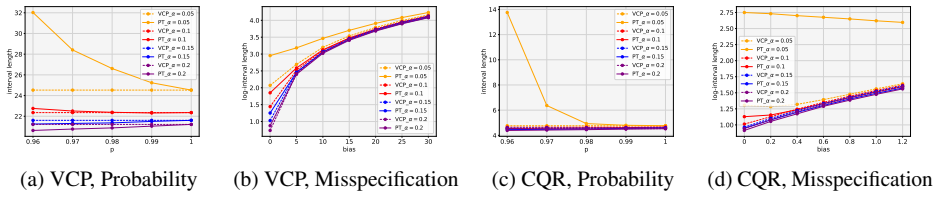
Summary. The paper challenges the sufficiency of the standard coverage-length evaluation in conformal prediction by constructing the Prejudicial Trick (PT): with probability 1−p the algorithm returns a null interval, and with probability p it returns the base algorithm's interval at the adjusted confidence level 1−α′ = (1−α)/p. The coverage identity p(1−α′) = 1−α preserves marginal coverage, and the paper derives sufficient conditions under which PT's expected length is smaller than the base method's (Lemma 1, Theorem 10, Corollary 3), together with a Gaussian failure case (Example 3). It then introduces Interval Stability, a variance-based metric intended to detect the vacuous randomness of PT. Experiments on regression and classification datasets, with artificially added bias to labels, logits, or quantiles, show length reductions while coverage is maintained.
Significance. The paper's formal counterexample is genuine: the coverage identity is exact, the length-reduction conditions are obtained by elementary calculus, and the explicit Gaussian failure case shows the authors are not overclaiming universality. If the results are taken as a cautionary example, the contribution is valuable: it demonstrates that average interval length alone can be gamed by a method that is practically unusable, and the proposed Interval Stability metric is a simple, sensible diagnostic. The paper is also honest about the failure mode. The main weakness is that the practical-relevance claim is bundled with an unproved assertion that model misspecification 'typically satisfies' the sufficient conditions; the experiments only use hand-added bias. Since the central counterexample already stands without that assertion, this is a scope-of-claims problem rather than a fatal flaw.
major comments (3)
- [§3.4, Remark 11; Theorem 1 summary] The assertion that model misspecification 'typically satisfies the sufficient conditions' of Theorem 10/Corollary 3 is not derived. The citations (Wang & Blei 2020; Huang et al. 2023) and the experiments in Table 2 and Appendices D.2.3/D.2.4 concern artificially added bias to labels/logits/quantiles, not naturally occurring misspecification. This claim is load-bearing for the paper's practical warning that real CP workloads are at risk. Please either prove a concrete misspecification model that satisfies Eq. (9)/(12), or clearly restrict the practical claim to the artificial regimes considered.
- [§3.4, Eq. (9) / Theorem 10] The notation for the length function is inconsistent: L(x,1−α) is defined as the length 'with miscoverage α' but is used throughout with the second argument as a confidence level. In Eq. (9), ∂/∂α L(x,α)|_{α=1−α̃} is therefore ambiguous; the proof in Appendix B.5 differentiates G(c)=E L(x,c) with respect to the confidence level c, which is the correct interpretation. The printed equation can be misread with the opposite sign. Please rewrite Eq. (9) and the surrounding text with a consistent convention, e.g., L(x,q) for confidence q and ∂/∂q L(x,q)|_{q=1−α̃}.
- [§4, Eq. (16) / Proposition 2] Proposition 2 states IS(C^PT) = p(1−p)(E L)^2, but Definition 1 requires the variance of the interval length conditional on X. For PT, conditional on X, the length is 0 with probability 1−p and L(x,·) with probability p, so the variance is p(1−p) L(x,·)^2 and the expectation over X is p(1−p) E[L^2], not p(1−p)(E L)^2. The positivity conclusion is unaffected, but the displayed formula is incorrect and should be fixed before the metric's quantitative properties are used.
minor comments (4)
- [Appendix D.2.3] The text says 'we set α=1' for the CQR experiments; presumably this should be α=0.1, consistent with the tables.
- [§3.2] Typo: 'Tabel 1' should be 'Table 1'.
- [§3.4, Corollary 1] The intuition paragraph says misspecification 'results in a non-convex length function,' but the sufficient condition in Corollary 1 is local concavity. A non-convex function is not necessarily locally concave; please make the statement precise.
- [§4, Definition 1] The definition conditions on the calibration dataset D_ca, but the empirical description in Appendix D.2.7 does not state whether D_ca is fixed across repeated runs. Please clarify.
Circularity Check
No significant circularity: PT is a construction whose coverage guarantee is by design and whose length-reduction conditions are genuine sufficient conditions; self-citations are not load-bearing.
full rationale
The paper's central claim is an existence/counterexample claim: the coverage-length metric can be gamed by PT. The coverage guarantee (Theorem 6) is intentionally built into the construction via the identity α' = 1 − (1−α)/p, giving p(1−α') = 1−α; this is an explicit design choice, not a fitted parameter renamed as a prediction. The length-reduction results (Lemma 1, Theorem 10, Corollary 3) are derived sufficient conditions: no parameter is fitted to the target endpoint (expected length), and p is a free existential variable. Example 3 supplies a genuine failure case, so the sufficient conditions are not vacuous or trivially forced. The experiments add artificial bias to labels/logits/quantiles to demonstrate that such conditions can be triggered, and the paper explicitly frames this as an existence demonstration rather than a universal claim. Citations to the authors' own work (e.g., Teng et al. 2022) are contextual and not load-bearing for the main derivation. Remark 11's generality assertion about misspecification is supported only by external citations and is not needed for the core counterexample, so it is an evidence-strength concern rather than circularity. The only notable defect, Proposition 2's displayed formula p(1−p)(E L)^2 instead of p(1−p)E[L^2], is a mathematical typo that does not affect the stated conclusion IS > 0 and is not a circular step. Overall, the derivation chain is self-contained and does not reduce to its inputs.
Assumptions & free parameters
free parameters (3)
- PT probability p =
0.95 (main experiments); 0.96/0.98 (synthetic)
- label/logit bias magnitude =
Dataset-specific: 20 for MEPS-19/20/21, 10 for BIKE, 20 for BLOG-DATA, 10 for BIO, 10 for FACEBOOK-1/2, 5 for CONCRETE/S
- Gaussian mixture mean μ =
20
assumptions (4)
- standard math Exchangeability of calibration and test points
- domain assumption First-order differentiability of the expected length function E[L(x,·;s)]
- ad hoc to paper Model misspecification typically satisfies the sufficient conditions (Eq. 9 or 12)
- standard math Independence of the PT randomization U from the data
Cite this review
Pith. "Pith review of Questioning the Coverage-Length Metric in Conformal Prediction: When Shorter Intervals Are Not Better." pith.science (2026). https://pith.science/paper/BGOQVFXK
@misc{pith2026260121455,
  author       = {Pith},
  title        = {Pith review of: Questioning the Coverage-Length Metric in Conformal Prediction: When Shorter Intervals Are Not Better},
  year         = {2026},
  howpublished = {\url{https://pith.science/paper/BGOQVFXK}},
  note         = {Machine review of arXiv:2601.21455}
}
read the original abstract
Conformal prediction(CP) has become a cornerstone of distribution-free uncertainty quantification, conventionally evaluated by its coverage and interval length. This work critically examines the sufficiency of these standard metrics. We demonstrate that the interval length might be deceptively improved through a counter-intuitive approach termed Prejudicial Trick(PT), while the coverage remains valid. Specifically, for any given test sample, PT probabilistically returns an interval, which is either null or constructed using an adjusted confidence level, thereby preserving marginal coverage. While PT potentially yields a deceptively lower interval length, it introduces practical vulnerabilities: the same input can yield completely different prediction intervals across repeated runs of the algorithm. We formally derive the conditions under which PT achieves these misleading improvements and provide extensive empirical evidence across various regression and classification tasks. Furthermore, we introduce a new metric interval stability which helps detect whether a new CP method implicitly improves the length based on such PT-like techniques. Code is available at https://github.com/benben-cd/PT-Conformal-Prediction.
Figures


Figures from the paper (12 more)



Reference graph
Works this paper leans on
-
[4]
Nabeel Seedat, Alan Jeffares, Fergus Imrie, and Mihaela van der Schaar
URLhttps://arxiv.org/abs/2406.07449. Nabeel Seedat, Alan Jeffares, Fergus Imrie, and Mihaela van der Schaar. Improving adaptive conformal prediction using self-supervised learning, 2023. URL https://arxiv.org/ abs/2302.12238. Adam Fisch, Tal Schuster, Tommi Jaakkola, and Dr.Regina Barzilay. Conformal prediction sets with limited false positives. In Kamali...
arXiv 2023
-
[2018]
doi: 10.1080/01621459.2017.1395341
ISSN 1537-274X. doi: 10.1080/01621459.2017.1395341. URL http://dx.doi. org/10.1080/01621459.2017.1395341. Shai Feldman, Stephen Bates, and Yaniv Romano. Improving conditional coverage via orthogonal quantile regression.Advances in neural information processing systems, 34:2060–2071, 2021. Ahmed M Alaa, Zeshan Hussain, and David Sontag. Conformalized uncon...
arXiv 2017
-
[2019]
use intuitively valid approaches. Proposition 3(Coverage Guarantee).The terms Ui are exchangeable if arbitrary permutation leads to the same distribution, i.e., (U1, ...,U|Ica|+1) d = (Uπ(1), ...,Uπ(|Ica|+1)) with arbitrary permutation π over 1, ...,|Ica + 1|, where d = denotes equivalence in distribution. Suppose that the data pair (xi, yi), i∈ Ica and t...
2009
-
[2020]
Rohan Hore and Rina Foygel Barber
URLhttps://arxiv.org/abs/2006.10288. Rohan Hore and Rina Foygel Barber. Conformal prediction with local weights: randomization enables local guarantees, 2024. URLhttps://arxiv.org/abs/2310.07850. 14 Chhavi Tyagi and Wenge Guo. Multi-label classification under uncertainty: A tree-based confor- mal prediction approach. In Harris Papadopoulos, Khuong An Nguy...
arXiv 2006
-
[2024]
Yu Bai, Song Mei, Huan Wang, Yingbo Zhou, and Caiming Xiong
URLhttps://arxiv.org/abs/2406.18814. Yu Bai, Song Mei, Huan Wang, Yingbo Zhou, and Caiming Xiong. Efficient and differentiable conformal prediction with general function classes, 2022. URL https://arxiv.org/abs/ 2202.11091. 15 Ran Xie, Rina Foygel Barber, and Emmanuel J. Cand`es. Boosted conformal prediction intervals,
arXiv 2022
Reviewed August 3, 2026 · model on record in the stance chip above.
Discussion (0). Sign in to comment.