REVIEW 3 major objections 5 minor 3 references
Localized, High-resolution Geographic Representations with Slepian Functions
T0 review · 3 major / 5 minor · reviewed 2026-08-03 · deepseek-v4-flash
Pith's one-line read Spherical Slepian functions give geographic encoders high resolution exactly where they need it.
desk verdict A genuinely useful new location-encoder basis with real empirical gains, but the headline comparisons are unblinded by cap selection over test coordinates; worth refereeing after a clean re-run. read the letter →
The pith
A machine-rendered reading of the paper's core claim, the machinery that carries it, and where it could break.
The reading
What carries the argument
The defining object is the spherical Slepian basis, the eigenfunctions of a concentration matrix whose entries integrate products of spherical harmonics over the region of interest. For spherical caps this matrix block-diagonalizes by order, so the eigenproblem is tractable even at high bandlimits. The regional Shannon number, approximately equal to the region's area fraction times the square of the bandlimit, counts the well-concentrated modes and becomes the effective information budget. The hybrid encoder concatenates these regional Slepian modes with a coarse global SH representation. For temporal data, the analogous construction uses discrete prolate spheroidal sequences to concentrate
What would settle it
Train a Slepian-based encoder on a localized task whose region is an irregular polygon (e.g., a country outline), computing the concentration basis from that mask without leakage from the test region, and compare against a global SH encoder at matched dimension. If performance fails to beat SH or the basis computation becomes intractable beyond a modest bandlimit, the claimed generalizability and scalability of the method are not supported.
Extended reading notes
Core claim
The paper's central claim is that spatio-spectral concentration is a powerful inductive bias for geographic location encoding. Instead of evaluating all spherical harmonics up to a global bandlimit, which is numerically unstable beyond modest degrees in 32-bit arithmetic, the encoder solves a concentration eigenproblem for a chosen region and keeps the top K modes, where K is the regional Shannon number. These Slepian modes are orthonormal, mutually orthogonal within the region, and ordered coarse-to-fine, concentrating nearly all their energy inside the region. The hybrid Slepian-SH encoder adds a low-degree global SH basis, preserving pole-safety and spherical-distance geometry. The paper
Load-bearing premise
The reported gains assume the region of interest is one or a few spherical caps whose center and radius are manually chosen to cover all training and test splits; for irregular or learned regions the eigenproblem becomes too expensive at high bandlimits, so the computational and accuracy advantages may not carry over.
Editorial extensions
If this is right
- Region-focused location encoders can become more accurate and smaller by substituting concentrated Slepian modes for raised global SH resolution.
- High-resolution local modeling no longer hits the numerical-instability wall of global spherical harmonics; Slepian caps remain stable at bandlimits where SH diverges.
- Global context and local detail can coexist in one encoder, which helps global tasks like species distribution modeling as well as local tasks.
- The same concentration principle extends to time via discrete prolate spheroidal sequences, improving spatio-temporal prediction over Fourier baselines.
- Because the basis is computed once and cached, per-training-step cost stays competitive, making high-resolution encoders practical on ordinary hardware.
Reading between the lines
- If the concentration hypothesis holds generally, the manual cap selection could be replaced by a learned region or a learned mixture of caps, since the main barrier for arbitrary masks is the cost of the eigenproblem.
- The feature-attribution result, where a few Slepian dimensions dominate a 1600-dimensional SH block, suggests that dimension alone is not what drives performance; a controlled comparison with an equally small, task-tuned subset of global SH modes would isolate the role of spatial concentration.
- The masked land-ocean experiment points toward arbitrary-mask Slepians, but a cleaner test would use a mask derived without any boundary leakage; that would establish whether non-cap regions retain the benefits.
- The temporal DPSS result invites testing the same concentration idea in other domains, such as learned regions for climate downscaling or irregular administrative boundaries, to see how far the inductive bias generalizes.
Editorial analysis
A structured set of objections, weighed in public.
Referee Report
Summary. This paper introduces a geographic location encoder based on spherical Slepian functions. The encoder evaluates the top concentrated Slepian modes for a user-specified spherical cap at a high local bandlimit, optionally concatenated with a coarse global spherical-harmonic (SH) component. The authors evaluate the resulting hybrid encoder on California housing regression, Japan prefecture classification, Arctic mean-sea-surface interpolation, OpenBuildings image-augmented regression, SINR species distribution modeling, and a DPSS-based spatio-temporal extension on the ACE climate dataset. Their central claim is that spatio-spectral concentration, rather than raw dimensionality, drives improved accuracy and memory efficiency over global SH and other baselines, with gains robust across architectures.
Significance. The idea is timely and the empirical scope is broad. If the headline comparisons survive a protocol fix, the paper would make a useful contribution: it brings a well-developed tool from geophysics into location encoding, gives a principled capacity-allocation mechanism, and backs it with code, an architecture sweep, and compute-time measurements. The main theoretical ingredients (Shannon number, cap Slepians) are sound, and the Slepian-only vs hybrid ablation is informative. The concern below about ROI selection is the key barrier.
major comments (3)
- [§4.2, §B.3, Tables 1–2] Section 4.2 states: 'Our cap center and radius are manually chosen to encompass all splits of the task-dataset within the target region.' Appendix B.3 gives the concrete values: a 5° cap centered on (37.0°N, 119.5°W) for California Housing and a 10° cap for Japan. Because the cap is chosen using the test split's geography, the Slepian encoder receives a task-specific spatial prior that none of the baselines (SH, Grid, etc.) receive. The paper's central claim in §5 that 'gains in performance come from spatio-spectral concentration' is therefore not separable from information leakage. A re-run is needed in which cap center/radius are chosen from training splits only (or via cross-validation), with test data untouched. Until then Tables 1 and 2 do not substantiate the abstract's general claim.
- [§A.2] Appendix A.2 contains the only experiment with a non-cap mask and explicitly concedes 'a degree of information leakage: the Slepian basis functions are constructed using a coarse coastline mask that shares structural similarity with the evaluation regions.' This admission means the land-ocean result cannot support the paper's general 'region-of-interest' claim for arbitrary regions. Combined with §3.2's statement that arbitrary-region eigenproblems are prohibitive at high bandlimits, the practical method is cap-only. Please qualify the abstract and conclusion accordingly, or supply an arbitrary-mask experiment whose mask is derived independently of the test geography.
- [§3.2, Eq. (4), Table 1, §B.3] Equation (4) selects K=⌈N(R,Lr)⌉ Slepian modes, but the dimensions in Table 1 are inconsistent with the Shannon numbers for the stated caps. For a 5° cap at Lr=40, N ≈ 3.2, yet Table 1 reports 12 Slepian dimensions; similar gaps appear for Japan and MSS. Appendix B.3 says the actual selection uses eigenvalue threshold μ>0.05. Please state the actual selection rule and report K alongside the threshold. The memory-efficiency and 'information-theoretic budget' claims depend on K being close to the Shannon number; if it is 2–4× larger, the theory as stated needs revision.
minor comments (5)
- [Tables 3] Two tables are numbered Table 3: the spatio-temporal DPSS results and the species distribution modeling results. Re-number the appendix table.
- [§5] Section 5 refers to 'Appendix 5' for the architecture sweep; the sweep appears in the appendix but is not labeled 'Appendix 5'.
- [Table 1] Hybrid dimensions in Table 1 (e.g., 112 for CalHousing at Lr=40) indicate a global SH component with Lg=9 (100 dims), not Lg=10 (121 dims) as in Table 2. State Lg explicitly in the table or caption.
- [Figure 3] The monotonicity with cap coverage is expected from construction; it is a sanity check, not independent evidence. Consider softening the 'confirms this' wording.
- [§B.3] For OpenBuildings, specify the actual angular cap radii rather than 'approximately 65% of the maximum spatial extent'.
Circularity Check
Central basis construction is not circular, but main-table ROI selection is unblinded and two supporting analyses reduce to the construction or admit leakage.
-
fitted input called prediction
[Section 4.2, Slepian Encoder Implementation]
"Our cap center and radius are manually chosen to encompass all splits of the task-dataset within the target region."
The ROI (cap center/radius) is selected using the spatial extent of all data splits, including the test split. The Slepian basis is then built on this ROI and evaluated on the same test split, giving Slepian encoders a task-specific regional prior that global-SH and other baselines do not receive. Reported R2/accuracy gains may therefore reflect test-set geography used in model construction rather than spatio-spectral concentration alone; the 'prediction' is not independent of a parameter fit to the evaluation data.
-
self definitional
[Section 5, Figure 3 paragraph]
"We test this by systematically varying cap radius to encompass 10–100% of test points. All points are encoded with the same Slepian-SH hybrid basis, but points outside the cap receive attenuated representations since Slepian functions concentrate their energy within the cap. If spectral concentration truly increases representational capacity, average performance should improve as more test points fall inside the cap region."
Slepian functions are defined, in Eq. 1, as band-limited functions maximizing energy concentration inside the region R. The 'concentration' being tested is therefore built into the basis by construction. Observing that R2 rises as more test points fall inside the cap is a restatement of the construction — the basis allocates capacity inside R and attenuates outside R — rather than an independent confirmation that concentration causes the gain. The global-SH comparison does not provide an equivalent regional prior, so it does not isolate concentration as the causal factor.
1 more flagged steps
-
self definitional
[Appendix A.2, Results]
"Second, our experimental setup for the land-ocean masked Slepian task involves a degree of information leakage: the Slepian basis functions are constructed using a coarse coastline mask that shares structural similarity with the evaluation regions. Although the mask resolution differs substantially from the prediction targets, this circularity may partially inflate the reported gains."
The Slepian mask is derived from coastline/topography data (Earth2014), i.e., from the land-ocean structure that the classification task predicts. The input basis is thus constructed from the target's spatial structure, so the reported F1 gains on coastline and island splits are partly encoded in the construction itself. The paper explicitly uses the word 'circularity' and concedes that the gains may be inflated.
full rationale
The core derivation is not circular: the Slepian concentration eigenproblem (Eq. 2) produces a fixed mathematical basis independent of task labels, and the five benchmark tasks use external datasets. The Shannon-number mode count K follows from the concentration spectrum, not from downstream performance, so the central claim that a concentrated basis can improve localized prediction has independent mathematical and empirical content. The self-citation to Rao et al. (2026) for Shannon-number mode selection is not load-bearing, since the mode count is derived from the spectrum. However, the paper contains three genuinely circular or leaky evaluation components. First, Section 4.2 states that the cap center and radius are manually chosen to encompass all splits, meaning test-split geography is used to construct the Slepian basis while baselines receive no such regional prior; this affects the main tables and prevents the headline 'concentration drives the gains' from being cleanly separated from task-specific ROI information. Second, Figure 3's monotonic improvement with cap coverage is essentially a restatement of the concentration property built into the basis, not a controlled test of concentration versus other explanations. Third, Appendix A.2 explicitly admits that the land-ocean masked-Slepian experiment involves information leakage and uses the word 'circularity,' conceding that the reported gains may be inflated. These issues are partial and largely self-disclosed; they do not reduce the mathematical basis construction to a fit, so the overall circularity is moderate rather than total.
Assumptions & free parameters
free parameters (5)
- Cap center and angular radius per task =
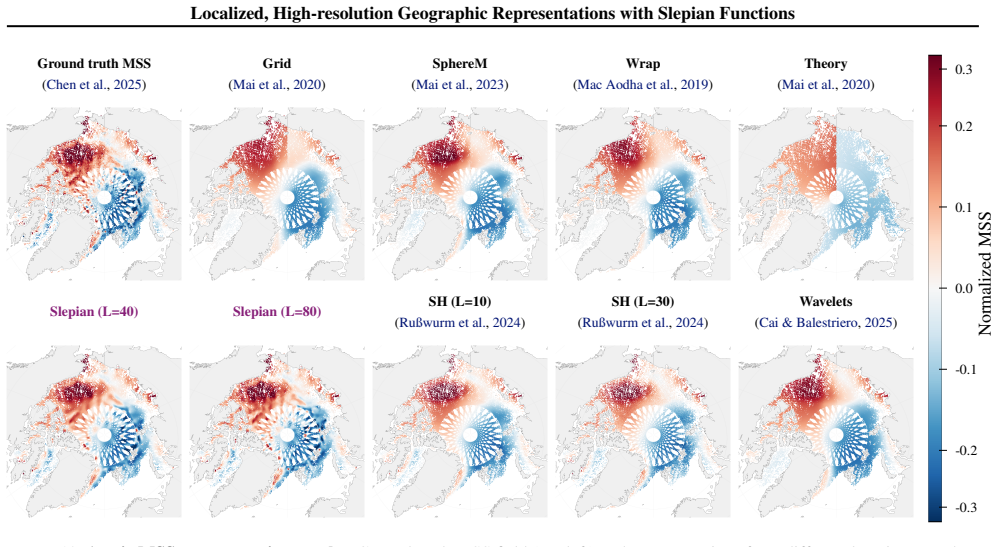
California: 5° cap at (37N,119.5W); Japan: 10° cap at (36N,138E); Arctic: 20° pole cap; species: 25° US + 20° Europe cap
- Local bandlimit Lr =
40, 80, 120 for main tasks; 96 for OpenBuildings
- Eigenvalue threshold for mode selection =
μ > 0.05
- Global SH bandlimit Lg =
10 (species model), 20 (ACE), implicit in hybrid tasks
- DPSS half-bandwidth parameter NW =
NW=15 best; sweep 5 to 50
assumptions (6)
- standard math Spherical harmonics form an orthonormal basis of band-limited functions on S2 (HL dimension (L+1)^2).
- standard math For a cap region, the Slepian concentration matrix block-diagonalizes by order m, and the number of well-concentrated modes is Nθ(Lr) = (1-cosθ)/2 (Lr+1)^2.
- standard math The eigenvalue spectrum of the concentration problem has a sharp transition at the Shannon number.
- standard math Spherical harmonics are analytic at the poles, so finite linear combinations (Slepian functions) are pole-safe.
- domain assumption SINR presence-only training with globally sampled pseudo-negatives is a valid learning setup for species distribution modeling.
- standard math The DPSS eigenvectors of the Toeplitz matrix B provide optimally time-frequency-concentrated sequences with Shannon number Kt ≈ 2NtW.
Cite this review
Pith. "Pith review of Localized, High-resolution Geographic Representations with Slepian Functions." pith.science (2026). https://pith.science/paper/FLUMTUB2
@misc{pith2026260200392,
  author       = {Pith},
  title        = {Pith review of: Localized, High-resolution Geographic Representations with Slepian Functions},
  year         = {2026},
  howpublished = {\url{https://pith.science/paper/FLUMTUB2}},
  note         = {Machine review of arXiv:2602.00392}
}
read the original abstract
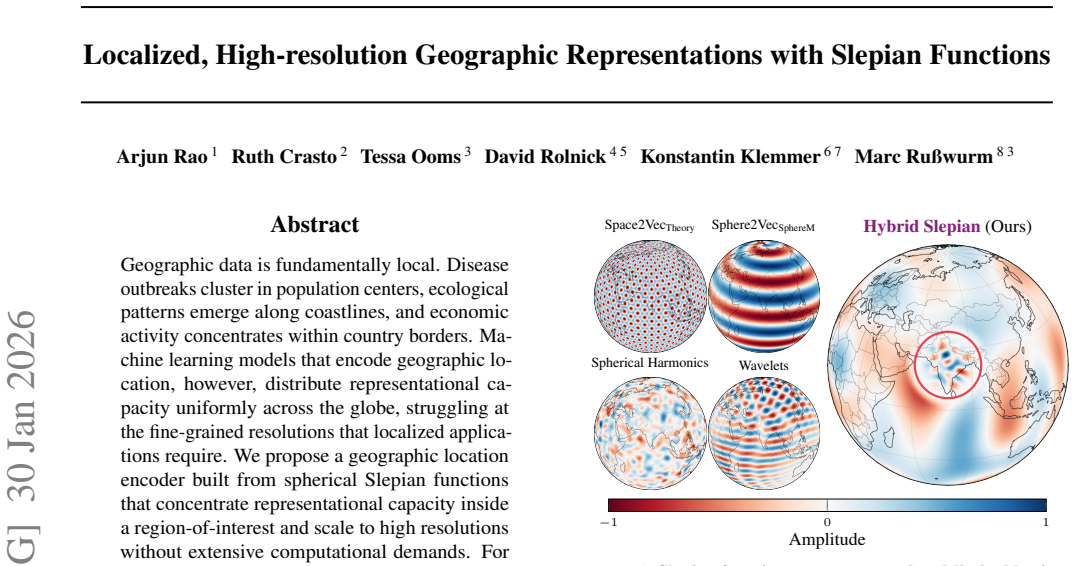
Geographic data is fundamentally local. Disease outbreaks cluster in population centers, ecological patterns emerge along coastlines, and economic activity concentrates within country borders. Machine learning models that encode geographic location, however, distribute representational capacity uniformly across the globe, struggling at the fine-grained resolutions that localized applications require. We propose a geographic location encoder built from spherical Slepian functions that concentrate representational capacity inside a region-of-interest and scale to high resolutions without extensive computational demands. For settings requiring global context, we present a hybrid Slepian-Spherical Harmonic encoder that efficiently bridges the tradeoff between local-global performance, while retaining desirable properties such as pole-safety and spherical-surface-distance preservation. Across five tasks spanning classification, regression, and image-augmented prediction, Slepian encodings outperform baselines and retain performance advantages across a wide range of neural network architectures.
Figures


Figures from the paper (9 more)




Reference graph
Works this paper leans on
-
[2002]
Karimzadeh, M., Wang, Z., and Crooks, J
doi: https://doi.org/10.1007/s00190-002-0216-2. Karimzadeh, M., Wang, Z., and Crooks, J. L. Per- formance and generalizability impacts of incorporat- ing location encoders into deep learning for dynamic PM2.5 estimation.arXiv preprint arXiv:2505.18461, May 2025. URL https://arxiv.org/abs/2505. 18461. Version 2, revised 26 Oct 2025. Khalid, Z., Kennedy, R....
arXiv 2025
-
[2018]
URL https://openreview.net/forum? id=r1gs9JgRZ. Mickisch, D., Klemmer, K., Teng, M., and Rolnick, D. A joint space-time encoder for geographic time-series data. InICLR 2025 Workshop on Machine Learning Multi- scale Processes, 2025. URL https://openreview. net/forum?id=BrsPVXO6f5. Pace, R. K. and Barry, R. Sparse spatial autoregressions. Statistics & Proba...
arXiv 2025
-
[2023]
Chen, W., Mahmood, A., Tsamados, M., and Takao, S
URL https://openreview.net/forum? id=I18BXotQ7j. Chen, W., Mahmood, A., Tsamados, M., and Takao, S. Deep random features for scalable interpolation of spa- tiotemporal data. InThe Thirteenth International Confer- ence on Learning Representations, 2025. URL https: //openreview.net/forum?id=OD1MV7vf41. Chollet, F. Xception: Deep learning with depthwise sepa...
arXiv 2025
Reviewed August 3, 2026 · model on record in the stance chip above.
Discussion (0). Continue with ORCID to comment.