REVIEW 2 major objections 3 minor 43 references
Higher-order Liouvillian exceptional points in the dissipative dynamics of quadratic fermions
T0 review · 2 major / 3 minor · reviewed 2026-08-03 · deepseek-v4-flash
Pith's one-line read A quadratic fermion chain with local loss is exactly solvable and has a Liouvillian exceptional point of order n+1, so its normalized particle number decays as 1/t.
desk verdict A genuinely solvable quadratic-fermion Liouvillian with an order-(n+1) EP, but the universal fractional-gap scaling for intermediate perturbations is only numerically supported. read the letter →
The pith
A machine-rendered reading of the paper's core claim, the machinery that carries it, and where it could break.
The reading
What carries the argument
The engine is the third-quantization mapping, which turns a quadratic Lindblad master equation into a quadratic form in 4n adjoint Majorana fermions with a 4n×4n shape matrix A. For this model, A is block-triangular and its momentum-space block is a non-diagonalizable 2×2 Jordan block at every quasimomentum—the precise source of the Liouvillian's defective nature. A counting rule for Jordan-block size, 1+Σ_j(n_j-ν_{j,k})ν_{j,k}, then gives the exceptional-point order: with n two-dimensional blocks all at the middle occupation, the largest Jordan block has size n+1. The perturbation argument uses the Jordan-form decomposition of the Liouvillian: a d-fermion jump operator acts along the Jordan
What would settle it
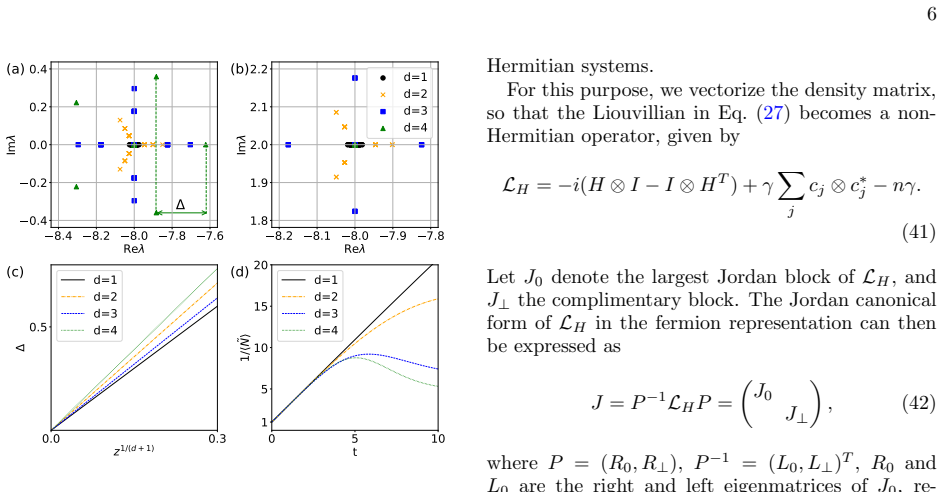
Compute the perturbed Liouvillian spectrum for the n=4 chain with the d=2 perturbation at z=10^{-4}, 10^{-5}, and 10^{-6}; if the gap (the real part of the eigenvalue closest to -nγ) does not scale as z^{1/3}, the claimed fractional scaling fails. A d=3 run should give z^{1/4}.
Extended reading notes
Core claim
The paper establishes that a simple open fermionic system can realize a Liouvillian exceptional point whose order grows with the number of sites, and that this exceptional point controls the long-time physics. For the n-site chain H=-tΣ(c†_j c_{j+1}+h.c.) with local loss L_j=√γ c_j and the hybrid Liouvillian L_Hρ=-i[H,ρ]+γΣ_j c_jρc†_j -nγρ, the eigenvalues are exactly λ_ν=2it Σ_j ν_{j,1} cos(2πj/n)-nγ with ν_{j,1}∈{0,1,2}. The eigenvalue -nγ carries a Jordan block of size n+1, so the exceptional-point order scales with system size and the spectrum is gapless. This exceptional point is the quasisteady state, so it dominates the dynamics: the normalized particle number tends to 1/t at long tim
Load-bearing premise
For intermediate perturbation orders (1<d<n), the paper assumes that the coupling between the large Jordan block and the rest of the spectrum contributes only at higher order and so the gap follows z^{1/(d+1)}; this coupling is not solved analytically and is checked numerically only for n=4.
Editorial extensions
If this is right
- The long-time normalized particle number is universal: for every initial state it behaves as 1/t, while the unnormalized count is e^{-nγt} times a polynomial whose degree is fixed by the initial particle number; this is a direct fingerprint of the n+1-fold exceptional point.
- Without perturbations the Liouvillian spectrum is gapless (all real parts equal -nγ), so the system has no unique steady state, only a quasisteady state at -nγ.
- A perturbation that creates d fermions simultaneously opens a spectral gap Δ∼z^{1/(d+1)}, changing the relaxation from algebraic to exponential with a d-dependent time scale z^{-1/(d+1)}.
- For d=1, adding the reverse jump c†_j makes the model exactly diagonalizable: all exceptional points disappear and the gap is γz^{1/2}; for d=n the off-diagonal coupling vanishes exactly and the gap is z^{1/(n+1)}.
- Because the exceptional point sits at the quasisteady state, the fractional scaling also appears in the dynamics of the normalized particle number, making the higher-order exceptional point detectable by time-resolved particle counting.
Reading between the lines
- Editorial: If the z^{1/(d+1)} scaling holds for arbitrary system size, the relaxation rate becomes increasingly sensitive to perturbation strength as n grows; this suggests a many-body analogue of exceptional-point-enhanced response, though the paper does not discuss sensing.
- Editorial: The exact spectrum is derived with periodic boundary conditions; testing an open chain of a few sites would confirm whether the n+1-dimensional Jordan block survives without translational symmetry, which the paper asserts but does not demonstrate.
- Editorial: The same Jordan-block counting applies to any single-band quadratic fermion chain with uniform local loss, so the construction should generalize to longer-range hopping or multiple orbitals, where the exceptional-point order may be tuned differently.
Signed reviews
Editorial analysis
A structured set of objections, weighed in public.
Referee Report
Summary. The paper studies a class of quadratic fermionic open systems governed by a hybrid Liouvillian that is not trace-preserving. Using the third-quantization formalism of Prosen, the authors solve the Liouvillian spectrum exactly for a tight-binding chain with local loss and periodic boundary conditions. They show that the spectrum is gapless, that the eigenvalue λ0 = -nγ supports a Jordan block of size n+1, and that the normalized particle number decays algebraically as 1/t at long times. They then add perturbations of the form zL_d, where L_d creates d particles, and argue that these break the exceptional point and produce a finite Liouvillian gap scaling as z^{1/(d+1)}. The unperturbed exact solution, the Jordan-chain construction, and the closed-form dynamics are the main technical results.
Significance. If fully established, this would be a valuable analytically solvable example of a many-body Liouvillian exceptional point whose order grows with system size, with a concrete experimentally accessible signature in the algebraic decay of the particle number. The exact spectrum in Eq. (31), the explicit generalized eigenmatrices in Eqs. (35)–(36), and the closed-form dynamics in Eqs. (38)–(39) are concrete, parameter-free results that do not rely on numerics. The perturbative analysis for d=1 (Appendix C) and d=n is also exact. However, the claimed universal fractional gap scaling for intermediate 1<d<n is not analytically established, and the paper itself states that the complementary Jordan block cannot be solved analytically. The strength of the central result is therefore uneven: the unperturbed EP physics is solid, while one of the headline perturbative claims is supported only by n=4 numerics.
major comments (2)
- [Sec. III.B, Eq. (47)] The block-diagonalization of the perturbation is load-bearing, but the statement 'Similarly, we have LT_0 L_d R⊥ = 0' is not proven. Biorthogonality of l_{0,j} to R⊥ does not by itself imply Tr(l_{0,j} L_d r_{ν,k}) = 0 for a general operator L_d, since L_d changes the particle number and can move r_{ν,k} into a sector that overlaps l_{0,j}. Without this off-diagonal block vanishing, the perturbed spectrum is not simply the union of the spectra of J0+zJ0,d and J⊥+zJ⊥,d, and the fractional scaling could be modified by coupling between the blocks. Please provide a proof or an explicit computation of LT_0 L_d R⊥.
- [Sec. III.B, after Eq. (49)] For 1<d<n, the universal gap scaling Δ∼z^{1/(1+d)} rests on the unanalyzed block J⊥,d. The paper states 'an analytical solution of J⊥,d is unattainable' and presents numerical evidence only for n=4 in Fig. 2(c). This is insufficient to establish the claimed universal scaling for arbitrary system size: at λ0=-nγ there are multiple Jordan blocks with different configurations, and zJ⊥,d could in principle couple these blocks and produce shifts of order z or z^{1/2} that would set the spectral gap. An analytic bound on the smallest eigenvalue shift of J⊥,d, or a systematic perturbative treatment, is needed to secure the abstract's claim of perturbation-dependent fractional power-law scalings.
minor comments (3)
- [Eq. (40)] The asymptotic of the normalized particle number is n0/t, not 1/t. For c_{0,n0}=1, the leading numerator and denominator terms are t^{n0-1}/(n0-1)! and t^{n0}/n0!, respectively, giving ⟨Ñ⟩_t ∼ n0/t. The abstract's statement 'approaches 1/t' should be amended accordingly, although the algebraic 1/t decay is preserved up to a constant.
- [Sec. III.B, Fig. 2(c)] Fig. 2(c) shows the gap scaling for n=4 only. For a claim of universal scaling in system size, a discussion of finite-size effects or at least one larger n would be helpful, even if only numerically.
- [Sec. I] There is a typo: 'Liouvllian' should be 'Liouvillian' in the introductory paragraph.
Circularity Check
No significant circularity: the exact Liouvillian spectrum and Jordan-block order are derived from the third-quantized shape matrix, and perturbation scalings follow from the triangular perturbation structure; only the 1<d<n gap scaling rests on unanalysed J⊥,d (a rigor gap, not circularity).
full rationale
The derivation is self-contained rather than circular. The unperturbed Liouvillian spectrum (Eq. (31)) follows from the third-quantized shape matrix A and the Jordan structure of T+(q) (Eq. (29)); the order-(n+1) EP at λ0=-nγ is obtained from the explicit Jordan-chain size formula Eq. (24) with K1=0, K2=n, and is corroborated by the closed-form generalized eigenmatrices Eqs. (35)-(36). None of these steps defines the target in terms of itself. For the perturbation, Eq. (46) derives Ld r0,k ~ r0,d+k from the definition of Ld and the Fock-space resolution of identity, so the block-triangular structure Eq. (47) and the characteristic polynomial Eq. (49)—and hence the z^{1/(1+d)} splitting within J0—are mathematical consequences, not fitted inputs. The paper honestly flags the only gap: for 1<d<n, "an analytical solution of J⊥,d is unattainable. We therefore numerically study the evolution of the Liouvillian spectrum and the scaling of the spectral gap" (Sec. III.B), with Fig. 2(c) at n=4 used as numerical confirmation rather than as a source of fitted constants. That is a correctness/rigor limitation, not circularity. The few self-citations (e.g., Refs. [22,28,29,42]) are contextual and not load-bearing; the load-bearing third-quantization and spectral-theorem results are cited to external work by Prosen [38,39]. No renaming, no ansatz-via-citation, and no self-imported uniqueness theorem occurs.
Assumptions & free parameters
assumptions (4)
- standard math Third quantization maps quadratic fermionic Lindblad/hybrid Liouvillians to quadratic adjoint-fermion forms; the spectrum is determined by the shape matrix and the spectral theorem of Prosen.
- domain assumption The hybrid Liouvillian with partial postselection describes the unnormalized subensemble; for the example a complementary set L'_j=√γ c_j† exists so that Σ(L†L+L'†L')=nγ I.
- domain assumption Restriction to the even-parity sector K+ is sufficient because only even products of Majorana fermions are observable.
- domain assumption For the example, periodic boundary conditions justify Fourier diagonalization; results are stated to be boundary independent.
Cite this review
Pith. "Pith review of Higher-order Liouvillian exceptional points in the dissipative dynamics of quadratic fermions." pith.science (2026). https://pith.science/paper/O6NYG5MZ
@misc{pith2026260200486,
  author       = {Pith},
  title        = {Pith review of: Higher-order Liouvillian exceptional points in the dissipative dynamics of quadratic fermions},
  year         = {2026},
  howpublished = {\url{https://pith.science/paper/O6NYG5MZ}},
  note         = {Machine review of arXiv:2602.00486}
}
read the original abstract
We propose a general class of open fermionic models where quadratic Liouvillians governing the dissipative dynamics feature analytically characterized higher-order exceptional points (EPs). Invoking the formalism of third quantization, we show that, among the multiple EPs of Liouvillian, an EP with its order approaching the system size arises as the dominant modes of the system at long times, leading to a gapless Liouvillian spectrum. By introducing perturbations, in the form of many-body quantum-jump processes, these higher-order EPs break down, leading to finite Liouvillian gaps with fractional power-law scalings. While the power-law scaling is a signature of the higher-order EP, its explicit form is sensitively dependent on the many-body perturbation. Finally, we discuss the long-time dynamics which can serve as detectable signals for the higher-order Liouvillian EPs.
Figures

Reference graph
Works this paper leans on
-
[1]
Kgato,Perturbation Theory of Linear Operators (Springer, 1966)
T. Kgato,Perturbation Theory of Linear Operators (Springer, 1966)
1966
-
[2]
M. V. Berry and D. H. J. O’Dell, Diffraction by volume gratings with imaginary potentials, J. Phys. A: Math. Gen.31, 2093 (1998)
-
[3]
W. D. Heiss, Phases of wave functions and level re- pulsion, The European Physical Journal D - Atomic, Molecular and Optical Physics7, 1 (1999)
1999
-
[4]
Miri and A
M.-A. Miri and A. Al` u, Exceptional points in optics and photonics, Science363, eaar7709 (2019)
2019
-
[5]
K.¨Ozdemir, S
S ¸. K.¨Ozdemir, S. Rotter, F. Nori, and L. Yang, Par- ity–time symmetry and exceptional points in pho- tonics, Nat. Mater.18, 783 (2019)
2019
-
[6]
E. J. Bergholtz, J. C. Budich, and F. K. Kunst, Ex- ceptional topology of non-Hermitian systems, Rev. Mod. Phys.93, 015005 (2021). 10
2021
-
[7]
K. Ding, C. Fang, and G. Ma, Non-Hermitian topol- ogy and exceptional-point geometries, Nat. Rev. Phys.4, 745 (2022)
2022
-
[8]
Ashida, Z
Y. Ashida, Z. Gong, and M. Ueda, Non-Hermitian Physics, Adv. Phys.69, 249 (2020)
2020
Show all 43 references
-
[9]
Z. Li, C. Li, G. Xu, W. Chen, Z. Xiong, H. Jing, J. S. Ho, and C.-W. Qiu, Synergetic positivity of loss and noise in nonlinear non-Hermitian resonators, Sci. Adv.9, eadi0562 (2023)
2023
-
[10]
Assawaworrarit, X
S. Assawaworrarit, X. Yu, and S. Fan, Robust wire- less power transfer using a nonlinear parity–time- symmetric circuit, Nature546, 387 (2017)
2017
-
[11]
K. Bai, L. Fang, T.-R. Liu, J.-Z. Li, D. Wan, and M. Xiao, Nonlinearity-enabled higher-order exceptional singularities with ultra-enhanced signal-to-noise ra- tio, National Science Review10, nwac259 (2023)
2023
-
[12]
C. Xie, K. Sun, K.-D. Wu, C.-F. Li, G.-C. Guo, W. Yi, and G.-Y. Xiang, Chiral switching of many-body steady states in a dissipative Rydberg gas, Sci. Bull. 70, 3345 (2025)
2025
-
[13]
Zhang et al., Exceptional point and hysteresis tra- jectories in cold Rydberg atomic gases, Nat
J. Zhang et al., Exceptional point and hysteresis tra- jectories in cold Rydberg atomic gases, Nat. Com- mun. 16, 3511 (2025)
2025
-
[14]
Kopciuch and A
M. Kopciuch and A. Miranowicz, Liouvillian and Hamiltonian exceptional points of atomic vapors: The spectral signatures of quantum jumps, Phys. Rev. Research 7, 033187 (2025)
2025
-
[15]
Breuer and F
H.-P. Breuer and F. Petruccione, The Theory of Open Quantum Systems (Oxford University Press, Oxford; New York, 2002)
2002
-
[16]
X. Zhan, L. Xiao, Z. Bian, K. Wang, X. Qiu, B. C. Sanders, W. Yi, and P. Xue, Detecting topologi- cal invariants in nonunitary discrete-time quantum walks, Phys. Rev. Lett.119, 130501 (2017)
2017
-
[17]
W. Liu, Y. Wu, C.-K. Duan, X. Rong, and J. Du, Dynamically Encircling an Exceptional Point in a Real Quantum System, Phys. Rev. Lett. 126, 170506 (2021)
2021
-
[18]
J. Li, A. K. Harter, J. Liu, L. de Melo, Y. N. Joglekar, and L. Luo, Nat. Commun.10, 855 (2019)
2019
-
[19]
W. Gou, T. Chen, D. Xie, T. Xiao, T.-S. Deng, B. Gadway, W. Yi, and B. Yan, Phys. Rev. Lett.124, 070402 (2020)
2020
-
[20]
Z. Ren, D. Liu, E. Zhao, C. He, K. K. Pak, J. Li, and G.-B. Jo, Chiral control of quantum states in non- Hermitian spin–orbit-coupled fermions, Nat. Phys. 18, 385 (2022)
2022
-
[21]
Minganti, A
F. Minganti, A. Biella, N. Bartolo, and C. Ciuti, Spectral theory of Liouvillians for dissipative phase transitions, Phys. Rev. A 98, (2018)
2018
-
[22]
Sun and W
K. Sun and W. Yi, Encircling the Liouvillian excep- tional points: a brief review, AAPPS Bull. 34, 22 (2024)
2024
-
[23]
Minganti, A
F. Minganti, A. Miranowicz, R. W. Chhajlany, and F. Nori, Quantum exceptional points of non- Hermitian Hamiltonians and Liouvillians: The ef- fects of quantum jumps, Phys. Rev. A 100, (2019)
2019
-
[24]
Minganti, A
F. Minganti, A. Miranowicz, R. W. Chhajlany, I. I. Arkhipov, and F. Nori, Hybrid-Liouvillian formal- ism connecting exceptional points of non-Hermitian Hamiltonians and Liouvillians via postselection of quantum trajectories, Phys. Rev. A 101, (2020)
2020
-
[25]
Kumar, K
P. Kumar, K. Snizhko, and Y. Gefen, Near-unit efficiency of chiral state conversion via hybrid- Liouvillian dynamics, Phys. Rev. A 104, L050405 (2021)
2021
-
[26]
Khandelwal, W
S. Khandelwal, W. Chen, K. W. Murch, and G. Haack, Chiral Bell-State Transfer via Dissipative Li- ouvillian Dynamics, Phys. Rev. Lett. 133, 070403 (2024)
2024
-
[27]
A. I. Pavlov, Y. Gefen, and A. Shnirman, Topologi- cal transitions in quantum jump dynamics: Hidden exceptional points, Phys. Rev. B 111, 104301 (2025)
2025
-
[28]
Sun and W
K. Sun and W. Yi, Chiral state transfer under de- phasing, Phys. Rev. A 108, 013302 (2023)
2023
-
[29]
H. Gao, K. Sun, D. Qu, K. Wang, L. Xiao, W. Yi, and P. Xue, Photonic Chiral State Transfer near the Liouvillian Exceptional Point, Phys. Rev. Lett.134, 146602 (2025)
2025
-
[30]
W. Chen, M. Abbasi, B. Ha, S. Erdamar, Y. N. Joglekar, and K. W. Murch, Decoherence-Induced Exceptional Points in a Dissipative Superconducting Qubit, Phys. Rev. Lett. 128, 110402 (2022)
2022
-
[31]
W. Chen, M. Abbasi, Y. N. Joglekar, and K. W. Murch, Quantum Jumps in the Non-Hermitian Dy- namics of a Superconducting Qubit, Phys. Rev. Lett. 127, 140504 (2021)
2021
-
[32]
Wu et al., Experimental witness of quan- tum jump induced high-order Liouvillian excep- tional points, Nat
Z.-Z. Wu et al., Experimental witness of quan- tum jump induced high-order Liouvillian excep- tional points, Nat. Commun. (2026)
2026
-
[33]
Sayyad and F
S. Sayyad and F. K. Kunst, Realizing exceptional points of any order in the presence of symmetry, Phys. Rev. Research4, 023130 (2022)
2022
-
[34]
J. T. Gohsrich, J. Fauman, and F. K. Kunst, Excep- tional Points of Any Order in a Generalized Hatano- Nelson Model, arXiv:2403.12018
-
[35]
I. I. Arkhipov, A. Miranowicz, F. Minganti, and F. Nori, Liouvillian exceptional points of any order in dissipative linear bosonic systems: Coherence func- tions and switching between PT and anti- PT sym- metries, Phys. Rev. A 102, 033715 (2020)
2020
-
[36]
I. I. Arkhipov, F. Minganti, A. Miranowicz, and F. Nori, Generating high-order quantum exceptional points in synthetic dimensions, Phys. Rev. A104, 012205 (2021)
2021
-
[37]
Nakanishi and T
Y. Nakanishi and T. Sasamoto, PT phase transition in open quantum systems with Lindblad dynamics, Phys. Rev. A105, 022219 (2022)
2022
-
[38]
Prosen, Third quantization: a general method to solve master equations for quadratic open Fermi systems, New J
T. Prosen, Third quantization: a general method to solve master equations for quadratic open Fermi systems, New J. Phys. 10, 043026 (2008)
2008
-
[39]
Prosen, Spectral theorem for the Lindblad equa- tion for quadratic open fermionic systems, J
T. Prosen, Spectral theorem for the Lindblad equa- tion for quadratic open fermionic systems, J. Stat. Mech. 2010, P07020 (2010)
2010
-
[40]
F. Song, S. Yao, and Z. Wang, Non-Hermitian Skin Effect and Chiral Damping in Open Quantum Sys- tems, Phys. Rev. Lett. 123, 170401 (2019)
2019
-
[41]
Okuma and M
N. Okuma and M. Sato, Quantum anomaly, non- Hermitian skin effects, and entanglement entropy in open systems, Phys. Rev. B 103, 085428 (2021)
2021
-
[42]
Li, Y.-S
T. Li, Y.-S. Zhang, and W. Yi, Engineering dissipa- tive quasicrystals, Phys. Rev. B 105, 125111 (2022). 11
2022
-
[43]
Yang, Q.-D
F. Yang, Q.-D. Jiang, and E. J. Bergholtz, Liouvil- lian skin effect in an exactly solvable model, Phys. Rev. Research 4, 023160 (2022)
2022
Reviewed August 3, 2026 · model on record in the stance chip above.
Discussion (0). Continue with ORCID to comment.