REVIEW 3 major objections 4 minor 1 cited by
Dynamical hair growth in black hole binaries in Einstein-scalar-Gauss-Bonnet gravity
T0 review · 3 major / 4 minor · reviewed 2026-08-03 · deepseek-v4-flash
Pith's one-line read The paper establishes that in Einstein-scalar-Gauss-Bonnet gravity, binary black holes that are initially hairless can dynamically acquire a scalar charge during the inspiral, and argues this process may be observable with third-generation
desk verdict First fully nonlinear NR confirmation of dynamical scalarization in EsGB BBHs, with an honest but model-dependent detectability estimate that should be read as an upper limit. read the letter →
The pith
A machine-rendered reading of the paper's core claim, the machinery that carries it, and where it could break.
The reading
What carries the argument
The machinery is a two-step adiabatic model. First, static spherically symmetric black hole solutions are computed with constant Wald entropy S_W = A_EH/4 + 4 pi lambda^2 f(phi_EH), producing sequences of solutions parameterized by the asymptotic scalar field phi_infinity. Second, the two-body interaction is captured at leading order by the coupled algebraic equations phi_A = Q(S, phi_B)/d and phi_B = Q(S, phi_A)/d, where Q is the scalar charge; the appearance of a nontrivial solution at a critical separation signals dynamical scalarization. The same entropy-conserving sequences feed a post-Newtonian formula for the gravitational-wave dephasing, while the numerical simulations evolve the ful
What would settle it
A full nonlinear numerical-relativity simulation of an equal-mass binary starting from a separation larger than the predicted scalarization radius, with a small scalar seed, that shows the scalar field never grows to the predicted amplitude would falsify the adiabatic model. Observationally, a gravitational-wave event from a binary in the predicted mass/coupling window showing no excess dephasing relative to GR at the sensitivity of a third-generation detector would rule out the detectability claim.
Extended reading notes
Core claim
The central discovery is that in Einstein-scalar-Gauss-Bonnet gravity with the coupling function f(phi) = (1/(2 beta))(1 - exp(-beta phi^2)), a binary of two initially uncharged black holes undergoes a non-perturbative transition: when the separation reaches the scalarization radius d_DS, the scalar field at the horizons grows rapidly and settles to a quasi-equilibrium value, meaning the black holes acquire scalar hair that they did not possess in isolation. The authors confirm this with the first fully nonlinear numerical-relativity simulations of the process, and show that the semi-analytic model based on Wald entropy conservation agrees with the simulations for sufficiently large scalariz
Load-bearing premise
The load-bearing premise is that the inspiral is adiabatic in the sense that the total Wald entropy is conserved while the binary passes through a sequence of static, isolated black hole solutions; if the scalar field's growth time is long compared to the inspiral timescale—as the authors themselves find for small scalarization radii—the predicted radius, charges, and dephasing shift.
Editorial extensions
If this is right
- If a nearly equal-mass binary black hole is in the right mass/coupling window, its inspiraling gravitational-wave signal will accumulate a phase lag relative to a GR waveform, growing most rapidly in the last cycles before merger.
- The scalarization radius is maximized for equal-mass systems and increases as the coupling approaches the isolated scalarization threshold (lambda/M)^2 ~ 0.7255; even a small mass asymmetry substantially shrinks the effect.
- The post-Newtonian dephasing estimate is consistent in order of magnitude with the nonlinear simulations but underestimates the numerical dephasing by a factor of 2-3, so the true signal may be somewhat stronger than the detectability curves suggest.
- For the parameter range studied, dynamical scalarization does not produce a dominant scalar dipole flux; the leading observable is the accumulated phase shift, not the dipole or amplitude change.
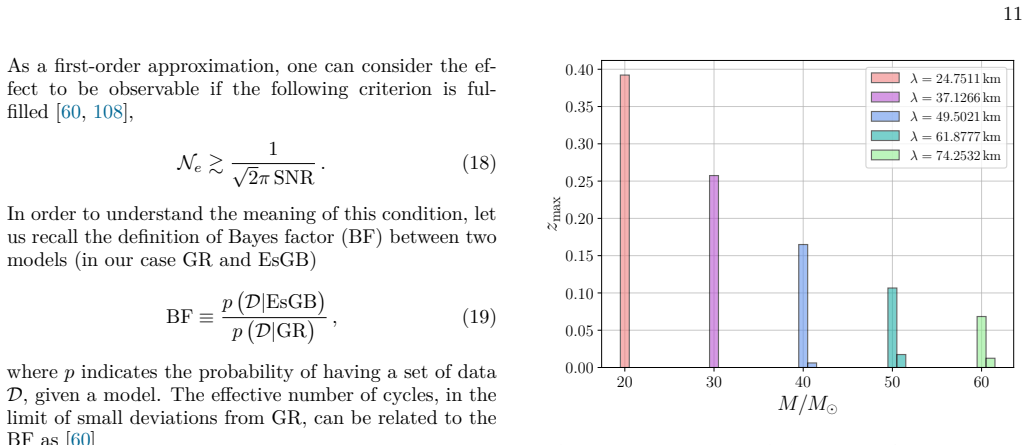
- With third-generation detectors, the effect could be seen at redshifts up to a few tenths for total masses around 20-60 solar masses, with the exact window set by the coupling constant and current pulsar constraints.
Reading between the lines
- If the Wald-entropy adiabatic model holds beyond the quasi-circular, non-spinning case, the same technique could be extended to eccentric orbits or spinning binaries, where the scalarization threshold may shift and the signal could differ qualitatively.
- The narrow coupling window that maximizes detectability coincides with the regime where an isolated black hole is on the verge of scalarizing; a single detected event with no excess dephasing could therefore place tight limits on the coupling in a regime complementary to pulsar timing constraints.
- The authors' finding that smaller scalarization radii fail to reach quasi-equilibrium suggests that real binaries may show a continuous spectrum of hair growth, from full adiabatic development to partial development, which future waveform models will need to interpolate.
Editorial analysis
A structured set of objections, weighed in public.
Referee Report
Summary. The paper studies dynamical scalarization (DS) in Einstein-scalar-Gauss-Bonnet gravity, in which binary black holes initially described by GR acquire scalar charges below a critical separation. It constructs a semi-analytic model based on adiabatic conservation of the total Wald entropy, iteratively solving the two-body scalar-field equations to obtain the scalar charge and horizon scalar field as functions of separation. It then presents fully nonlinear numerical-relativity simulations using the GRFolres/GRChombo code, comparing the apparent-horizon scalar field with the semi-analytic prediction, and reports agreement in the adiabatic regime down to d≈6M. The paper also computes the gravitational-wave dephasing with respect to GR and uses a frequency-domain detectability criterion to argue that DS might be observable with ET in a narrow mass/coupling window near the isolated scalarization threshold.
Significance. If correct, this would be the first fully nonlinear numerical-relativity demonstration of dynamical scalarization in black-hole binaries in EsGB gravity, supported by a simple semi-analytic model that can be used for cheap parameter-space exploration. The NR simulations include convergence tests, two different scalar initial-data choices, and a comparison with the semi-analytic curve that is nontrivial. The detectability estimate, while approximate, translates the strong-field effect into a concrete observational target for third-generation detectors. The paper is squarely within the journal's scope and addresses an active topic. The main weakness is that the constant-entropy assumption underpinning the semi-analytic model and the detectability claim is not directly verified against the numerical data.
major comments (3)
- [Sec. II, Eq. (6); Sec. V, Fig. 10] The semi-analytic model assumes that the total Wald entropy S_W = A_EH/4 + 4πλ² f(φ_EH) is conserved during the inspiral. This assumption is never tested against the NR data: the simulations in Sec. III compare only the apparent-horizon scalar field and do not measure S_W or its components. The dephasing (Eq. 8) and the ET detectability curves (Fig. 10) are built from Q(f) obtained from constant-entropy sequences. If S_W drifts because of scalar/gravitational radiation or the non-stationarity of the horizons, Q(f) and hence the predicted dephasing and z_max shift. Since the detectability claim is a central result, please either compute S_W along the dynamical horizons in the existing runs and verify approximate conservation over the inspiral range used, or quantify how a plausible S_W drift changes the z_max curves. This is a load-bearing assumption, not a cosmetic caveat.
- [Sec. III C, Fig. 6; Abstract] The abstract's unqualified 'consistent results' is stronger than what is demonstrated. For the parameter set used in the detectability study ((λ/M)^2=0.703, β=16), the NR run starts at d=15M, inside the predicted d_DS=19.75M; the large-separation part of φ(d) and the value of d_DS itself are not directly tested for this configuration. The only run beginning outside d_DS is model (ii) with (λ/M)^2=0.688, where the onset of exponential growth is observed near d≈11.71M as predicted. Please either add a simulation for the main detectability parameter starting beyond d_DS, or soften the abstract/conclusions to state that the scalarization radius is directly validated only for (λ/M)^2=0.688 and is otherwise inferred by continuation of the semi-analytic model.
- [Sec. IV, Fig. 8; Sec. V] The PN dephasing formula (Eq. 8) is used to produce the detectability curves, but for the one configuration where both are available the PN dephasing differs from the NR dephasing by a factor 2–3 (Fig. 8). The authors note this and state that PN underestimates the dephasing, but the NR measurement is noisy and the sign/bias is not established across parameter space. Because Fig. 10 and the 'observable with ET' claim rest on the PN prescription, please quantify how z_max changes if the dephasing is rescaled by the observed factor (or by its reciprocal), or otherwise state the resulting systematic uncertainty in the detectability curves. Without this, the narrowness of the claimed mass/coupling window is not robust.
minor comments (4)
- [References, [10]] Reference [10] in the bibliography is corrupted: it contains a raw BibTeX entry beginning '@articleAkyuz:2025seg...' inline with the text 'pp. 041039'. This should be cleaned and converted to a normal citation.
- [Fig. 3 caption] Caption contains a typo: 'repict' should be 'depict'.
- [Sec. IV, text] Typo: 'In additon' should be 'In addition'.
- [Abstract] Consider adding a qualifier such as 'in the adiabatic regime' to the claim of consistency between NR and the semi-analytic model, as done later in the text.
Circularity Check
No circularity: the NR simulations independently confirm the semi-analytic scalarization model, and the detectability estimates are explicitly acknowledged extrapolations rather than fitted predictions.
full rationale
The paper's central claim—that GR-initialized BBH systems in EsGB can dynamically scalarize at a critical separation—rests on two independent legs. The semi-analytic model (Sec. II) constructs Q(S_W, φ∞) from static, isolated, constant-Wald-entropy BH sequences and solves the algebraic system of Eq. (3); the scalarization radius dDS is a derived output, not an input. The NR simulations (Sec. III) solve the full nonlinear EsGB field equations with small scalar seeds, without imposing Eq. (3) or entropy conservation, and observe scalar growth near the semi-analytically predicted dDS. For example, in Fig. 4 the seed field initially decreases and only starts growing after the separation crosses the semi-analytic threshold d=11.71M, so the comparison in Fig. 6 is a genuine cross-check rather than a fit. The dephasing computation in Sec. IV uses the same semi-analytic Q(f) in the PN formula Eq. (8) and compares it to the NR dephasing; this is an internal consistency test, but no target quantity (dephasing, zmax) is used to construct Q(S_W, φ∞) or dDS. The detectability estimate in Sec. V is explicitly presented as an order-of-magnitude extrapolation, and the authors themselves flag the adiabatic approximation's breakdown for small dDS and the factor 2–3 disagreement between PN and NR dephasing; these are limitations and validation gaps, not definitional equivalences. Self-citations appear (e.g., [56] for the coupling, [63] for the two-body system, [86] for the GRFolres code, [89] for NR techniques), but they cite methods and prior results with independent content; none is invoked as a uniqueness theorem or used to forbid alternatives. No equation in the paper reduces to its own input by construction, and no fitted parameter is renamed as a prediction. The most that can be said is that the detectability claim inherits the semi-analytic model's untested constant-entropy assumption, but this is an acknowledged modeling uncertainty, not circularity.
Assumptions & free parameters
free parameters (4)
- λ (EsGB coupling length) =
Scanned: λ = 24.75, 37.13, 49.50, 61.88, 74.25 km; also (λ/M)^2 = 0.688–0.712 in NR runs
- β (coupling-function parameter) =
16, 32, 48, 800 (dimensionless)
- Inspiral end cutoff d=6M =
d_end = 6M
- Sensitivity coefficients s1, s2 =
Not quoted; fitted cubic in φ near 0 from static sequences (Appendix B)
assumptions (6)
- domain assumption The Wald entropy formula S_W = A_EH/4 + 4πλ² f(φ_EH) is the correct black-hole entropy in EsGB.
- domain assumption Total Wald entropy of the binary is conserved during the inspiral.
- domain assumption The scalar field of each companion can be approximated by the leading 1/d term (Eq. 3).
- domain assumption Static, spherically symmetric scalarized BH solutions exist for f(φ)=(1/2β)(1−e^{−βφ²}) and define Q(S,φ∞).
- domain assumption The modified harmonic/puncture formulation of EsGB is well posed and constraint damping removes the initial constraint violations.
- domain assumption No cosmological background scalar field; φ∞ is sourced only by the companion.
Cite this review
Pith. "Pith review of Dynamical hair growth in black hole binaries in Einstein-scalar-Gauss-Bonnet gravity." pith.science (2026). https://pith.science/paper/2BVIB6VB
@misc{pith2026260202650,
  author       = {Pith},
  title        = {Pith review of: Dynamical hair growth in black hole binaries in Einstein-scalar-Gauss-Bonnet gravity},
  year         = {2026},
  howpublished = {\url{https://pith.science/paper/2BVIB6VB}},
  note         = {Machine review of arXiv:2602.02650}
}
read the original abstract
Within the framework of scalar-tensor theories of gravity, certain models can evade classical black hole no-hair theorems. A well-known example is Einstein-scalar-Gauss-Bonnet gravity, where black holes carrying a scalar charge can exist. We find that, within this theory, binary black holes initially described by General Relativity can acquire scalar charges once they reach a critical orbital separation ("dynamical scalarization"). We develop a simple semi-analytic model, based on the adiabatic conservation of the total Wald entropy, to estimate the scalar charge evolution during the binary inspiral. We also run fully nonlinear numerical-relativity simulations for different configurations, finding consistent results. The gravitational-wave phase difference between Einstein-scalar-Gauss-Bonnet and General Relativity waveforms, which we use to assess detectability, is also computed. We find that dynamical scalarization might be observable in nearly equal-mass binary black hole mergers with third-generation ground-based gravitational-wave detectors, in a narrow range of the dimensional coupling of the theory.
Figures


Figures from the paper (7 more)




Forward citations
Cited by 1 Pith paper
-
Scalar memory from compact binary coalescences
In Ricci-coupled scalar-Gauss-Bonnet gravity, the change in scalar charge during binary black hole mergers generates a scalar memory contribution that modifies the total memory signal on observable timescales.
Reference graph
Works this paper leans on
-
[69]
Modeling dynamical scalarization with a resummed post-Newtonian expan- sion,
N. Sennett and A. Buonanno, “Modeling dynamical scalarization with a resummed post-Newtonian expan- sion,”Phys. Rev. D, vol. 93, no. 12, p. 124004, 2016
2016
-
[1]
Our estimate ofzmax must be viewed as an order of magnitude estimate. In realistic systems, the ge- ometrical configuration is not optimal, and the co- variances among different astrophysical parameters would further reduce the BF of EsGB with respect to GR. On the other hand, as shown in Fig. 8, the PN approach seems to underestimate the GW dephas- ing, ...
-
[2]
Making Sense of the Unexpected in the Gravitational-Wave Sky
Fig. 10 does not represent the observability of BH hairs in EsGB in general, but only in the DS sce- nario. In other words, for different component masses and/or different mass ratios, a more promis- ingobservational strategytotest EsGB wouldbeto look for dipole fluxes [112], due to either induced or spontaneous scalarization. In fact, as already discusse...
2022
-
[3]
Explanation of the Perihelion Motion of Mercury from the General Theory of Relativity,
A. Einstein, “Explanation of the Perihelion Motion of Mercury from the General Theory of Relativity,” Sitzungsber. Preuss. Akad. Wiss. Berlin (Math. Phys. ), vol. 1915, pp. 831–839, 1915
1915
-
[4]
The confrontation between general rela- tivity and experiment,
C. M. Will, “The confrontation between general rela- tivity and experiment,”Living Reviews in Relativity, vol. 17, Jun 2014
2014
-
[5]
Fourth Test of General Relativity,
I. I. Shapiro, “Fourth Test of General Relativity,”Phys. Rev. Lett., vol. 13, pp. 789–791, 1964
1964
-
[6]
Observation of Gravitational Waves from a Binary Black Hole Merger,
B. P. Abbottet al., “Observation of Gravitational Waves from a Binary Black Hole Merger,”Phys. Rev. Lett., vol. 116, no. 6, p. 061102, 2016
2016
-
[7]
On The influence of gravitation on the propagation of light,
A. Einstein, “On The influence of gravitation on the propagation of light,”Annalen Phys., vol. 35, pp. 898– 908, 1911
1911
Show all 117 references
-
[8]
A Determination of the Deflection of Light by the Sun’s Gravitational Field, from Observations Made at the To- tal Eclipse of May 29, 1919,
F. W. Dyson, A. S. Eddington, and C. Davidson, “A Determination of the Deflection of Light by the Sun’s Gravitational Field, from Observations Made at the To- tal Eclipse of May 29, 1919,”Phil. Trans. Roy. Soc. Lond. A, vol. 220, pp. 291–333, 1920
1919
-
[9]
Tests of General Relativity with GWTC-3,
R. Abbottet al., “Tests of General Relativity with GWTC-3,” 12 2021
2021
-
[10]
AssumingΛCDMcosmology, the cosmic vol- ume corresponding toz≃0.4is≃15.64 Gpc 3
Gpc−3 yr−1M−1 ⊙ for BBHs with component masses ∼10M ⊙. AssumingΛCDMcosmology, the cosmic vol- ume corresponding toz≃0.4is≃15.64 Gpc 3. There- fore, we can expect a number of∼O(101−10 2)merger events per year in this region. However, only a very small fraction of these events i...
-
[11]
Tests of general relativity with GW150914,
B. P. Abbottet al., “Tests of general relativity with GW150914,”Phys. Rev. Lett., vol. 116, no. 22, p. 221101, 2016. [Erratum: Phys.Rev.Lett. 121, 129902 (2018)]
2016
-
[12]
GWTC-2: Compact Binary Coales- cences Observed by LIGO and Virgo During the First HalfoftheThirdObservingRun,
R. Abbottet al., “GWTC-2: Compact Binary Coales- cences Observed by LIGO and Virgo During the First HalfoftheThirdObservingRun,”Phys. Rev. X,vol.11, p. 021053, 2021
2021
-
[13]
Population of Merging Compact Binaries Inferred Using Gravitational Waves through GWTC-3,
R. Abbottet al., “Population of Merging Compact Binaries Inferred Using Gravitational Waves through GWTC-3,”Phys. Rev. X, vol. 13, no. 1, pp. 011048@ar- ticleAkyuz:2025seg, author = Akyüz, Aleyna and Cor- reia, Alex and Garofalo, Jada and Kacanja, Keisi and Roy, Labani and Son...
2025 arXiv
-
[14]
GWTC-3: Compact Binary Coales- cences Observed by LIGO and Virgo during the Second PartoftheThirdObservingRun,
R. Abbottet al., “GWTC-3: Compact Binary Coales- cences Observed by LIGO and Virgo during the Second PartoftheThirdObservingRun,”Phys. Rev. X,vol.13, no. 4, p. 041039, 2023
2023
-
[15]
GWTC-2.1: Deep extended catalog of compact binary coalescences observed by LIGO and Virgo during the first half of the third observing run,
R. Abbottet al., “GWTC-2.1: Deep extended catalog of compact binary coalescences observed by LIGO and Virgo during the first half of the third observing run,” Phys. Rev. D, vol. 109, no. 2, p. 022001, 2024
2024
-
[16]
Observation of Gravitational Waves from Two Neutron Star–Black Hole Coalescences,
R. Abbottet al., “Observation of Gravitational Waves from Two Neutron Star–Black Hole Coalescences,”As- trophys. J. Lett., vol. 915, no. 1, p. L5, 2021. 16
2021
-
[17]
GWTC-4.0: Updating the Gravitational-Wave Transient Catalog with Observa- tions from the First Part of the Fourth LIGO-Virgo- KAGRA Observing Run,
A. G. Abacet al., “GWTC-4.0: Updating the Gravitational-Wave Transient Catalog with Observa- tions from the First Part of the Fourth LIGO-Virgo- KAGRA Observing Run,” 8 2025
2025
-
[18]
Potential science with GW250114 – the loudest binary black hole merger detected to date,
A. Akyüz, A. Correia, J. Garofalo, K. Kacanja, L. Roy, K. Soni, H. Tan, V. J. Y, A. H. Nitz, and C. D. Capano, “Potential science with GW250114 – the loudest binary black hole merger detected to date,” 7 2025
2025
-
[19]
Tests of grav- itational wave propagation with LIGO-Virgo catalog,
X.-L. Wang, S.-C. Yang, and W.-B. Han, “Tests of grav- itational wave propagation with LIGO-Virgo catalog,” 4 2024
2024
-
[20]
GW250114: Testing Hawking’s Area Law and the Kerr Nature of Black Holes,
A. G. Abacet al., “GW250114: Testing Hawking’s Area Law and the Kerr Nature of Black Holes,”Phys. Rev. Lett., vol. 135, no. 11, p. 111403, 2025
2025
-
[21]
Black Hole Spectroscopy and Tests of General Relativity with GW250114,
A. G. Abacet al., “Black Hole Spectroscopy and Tests of General Relativity with GW250114,” 9 2025
2025
-
[22]
Gravitational collapse and space-time sin- gularities,
R. Penrose, “Gravitational collapse and space-time sin- gularities,”Phys. Rev. Lett., vol. 14, pp. 57–59, 1965
1965
-
[23]
S. W. Hawking and G. F. R. Ellis,The Large Scale Structure of Space-Time. Cambridge Monographs on Mathematical Physics, Cambridge University Press, 2 2023
2023
-
[24]
Penrose’s 1965 singularity theorem: from geodesic incompleteness to cosmic censorship,
K. Landsman, “Penrose’s 1965 singularity theorem: from geodesic incompleteness to cosmic censorship,” Gen. Rel. Grav., vol. 54, no. 10, p. 115, 2022
1965
-
[25]
Planck 2018 results. VI. Cosmolog- ical parameters,
N. Aghanimet al., “Planck 2018 results. VI. Cosmolog- ical parameters,”Astron. Astrophys., vol. 641, p. A6,
2018
-
[26]
The present state of Dirac’s cosmological hypothesis,
P. Jordan, “The present state of Dirac’s cosmological hypothesis,”Z. Phys., vol. 157, pp. 112–121, 1959
1959
-
[27]
Measurements ofΩandΛfrom 42 High Redshift Supernovae,
S. Perlmutteret al., “Measurements ofΩandΛfrom 42 High Redshift Supernovae,”Astrophys. J., vol. 517, pp. 565–586, 1999
1999
-
[28]
Observational evidence from supernovae for an accelerating universe and a cosmo- logical constant,
A. G. Riess and et al., “Observational evidence from supernovae for an accelerating universe and a cosmo- logical constant,”The Astronomical Journal, vol. 116, no. 3, pp. 1009–1038, 1998
1998
-
[29]
On relativistic wave equa- tionsforparticlesofarbitraryspininanelectromagnetic field,
M. Fierz and W. Pauli, “On relativistic wave equa- tionsforparticlesofarbitraryspininanelectromagnetic field,”Proc. Roy. Soc. Lond. A, vol. 173, pp. 211–232, 1939
1939
-
[30]
Nonperturbative strong field effects in tensor - scalar theories of gravita- tion,
T. Damour and G. Esposito-Farese, “Nonperturbative strong field effects in tensor - scalar theories of gravita- tion,”Phys. Rev. Lett., vol. 70, pp. 2220–2223, 1993
1993
-
[31]
Mach’s principle and a rel- ativistic theory of gravitation,
C. Brans and R. H. Dicke, “Mach’s principle and a rel- ativistic theory of gravitation,”Phys. Rev., vol. 124, pp. 925–935, 1961
1961
-
[32]
Mach’s principle and invariance under transformation of units,
R. H. Dicke, “Mach’s principle and invariance under transformation of units,”Phys. Rev., vol. 125, pp. 2163– 2167, 1962
1962
-
[33]
Tensor multiscalar theories of gravitation,
T. Damour and G. Esposito-Farese, “Tensor multiscalar theories of gravitation,”Class. Quant. Grav., vol. 9, pp. 2093–2176, 1992
-
[34]
Kinetically driven quintessence,
T. Chiba, T. Okabe, and M. Yamaguchi, “Kinetically driven quintessence,”Phys. Rev. D, vol. 62, p. 023511, 2000
2000
-
[35]
Second-order scalar-tensor field equations in a four-dimensional space,
G. W. Horndeski, “Second-order scalar-tensor field equations in a four-dimensional space,”Int. J. Theor. Phys., vol. 10, pp. 363–384, 1974
1974
-
[36]
Healthy theories beyond Horndeski,
J. Gleyzes, D. Langlois, F. Piazza, and F. Vernizzi, “Healthy theories beyond Horndeski,”Phys. Rev. Lett., vol. 114, no. 21, p. 211101, 2015
2015
-
[37]
Degenerate Higher-Order Scalar-Tensor (DHOST) theories,
D. Langlois, “Degenerate Higher-Order Scalar-Tensor (DHOST) theories,” in52nd Rencontres de Moriond on Gravitation, pp. 221–228, 2017
2017
-
[38]
Nonexistence of baryon number for static black holes,
J. D. Bekenstein, “Nonexistence of baryon number for static black holes,”Phys. Rev. D, vol. 5, pp. 1239–1246, 1972
1972
-
[39]
Ghost condensation and a consistent infrared modification of gravity,
N. Arkani-Hamed, H.-C. Cheng, M. A. Luty, and S. Mukohyama, “Ghost condensation and a consistent infrared modification of gravity,”JHEP, vol. 05, p. 074, 2004
2004
-
[40]
The Galileon as a local modification of gravity,
A. Nicolis, R. Rattazzi, and E. Trincherini, “The Galileon as a local modification of gravity,”Phys. Rev. D, vol. 79, p. 064036, 2009
2009
-
[41]
Becker, M
K. Becker, M. Becker, and J. H. Schwarz,String the- ory and M-theory: A modern introduction. Cambridge University Press, 12 2006
2006
-
[42]
Asymptotically flat black holes with scalar hair: a review,
C. A. R. Herdeiro and E. Radu, “Asymptotically flat black holes with scalar hair: a review,”Int. J. Mod. Phys. D, vol. 24, no. 09, p. 1542014, 2015
2015
-
[43]
Nonexistence of baryon number for black holes. ii,
J. D. Bekenstein, “Nonexistence of baryon number for black holes. ii,”Phys. Rev. D, vol. 5, pp. 2403–2412, 1972
1972
-
[44]
No-Hair Theorem for the Galileon,
L. Hui and A. Nicolis, “No-Hair Theorem for the Galileon,”Phys. Rev. Lett., vol. 110, p. 241104, 2013
2013
-
[45]
Nonexistence of black holes with noncanonical scalar fields,
A. A. H. Graham and R. Jha, “Nonexistence of black holes with noncanonical scalar fields,”Phys. Rev. D, vol. 89, no. 8, p. 084056, 2014. [Erratum: Phys.Rev.D 92, 069901 (2015)]
2014
-
[46]
Black hole hair in gener- alizedscalar-tensorgravity: Anexplicitexample,
T. P. Sotiriou and S.-Y. Zhou, “Black hole hair in gener- alizedscalar-tensorgravity: Anexplicitexample,”Phys. Rev. D, vol. 90, p. 124063, 2014
2014
-
[47]
Black hole hairs in scalar-tensor gravity and the lack thereof,
L. Capuano, L. Santoni, and E. Barausse, “Black hole hairs in scalar-tensor gravity and the lack thereof,” Phys. Rev. D, vol. 108, no. 6, p. 064058, 2023
2023
-
[48]
No-hair theorems in general relativity and scalar–tensor theories,
S. S. Yazadjiev and D. D. Doneva, “No-hair theorems in general relativity and scalar–tensor theories,”Int. J. Mod. Phys. D, vol. 34, no. 09, p. 2530004, 2025
2025
-
[49]
Black hole hair in gener- alized scalar-tensor gravity,
T. P. Sotiriou and S.-Y. Zhou, “Black hole hair in gener- alized scalar-tensor gravity,”Phys. Rev. Lett., vol. 112, p. 251102, 2014
2014
-
[50]
The power of binary pulsars in test- ing Gauss-Bonnet gravity,
P. Y. Yordanov, K. V. Staykov, S. S. Yazadjiev, and D. D. Doneva, “The power of binary pulsars in test- ing Gauss-Bonnet gravity,”Astron. Astrophys., vol. 687, p. A17, 2024
2024
-
[51]
Con- straining scalarization in scalar-Gauss-Bonnet gravity through binary pulsars,
V. I. Danchev, D. D. Doneva, and S. S. Yazadjiev, “Con- straining scalarization in scalar-Gauss-Bonnet gravity through binary pulsars,”Phys. Rev. D, vol. 106, no. 12, p. 124001, 2022
2022
-
[52]
Constraining spontaneous black hole scalarization in scalar-tensor-Gauss-Bonnet theories with current gravitational-wave data,
L. K. Wong, C. A. R. Herdeiro, and E. Radu, “Constraining spontaneous black hole scalarization in scalar-tensor-Gauss-Bonnet theories with current gravitational-wave data,”Phys. Rev. D, vol. 106, no. 2, p. 024008, 2022
2022
-
[53]
Constraints on Einstein- dilation-Gauss-Bonnet gravity from black hole-neutron star gravitational wave events,
Z. Lyu, N. Jiang, and K. Yagi, “Constraints on Einstein- dilation-Gauss-Bonnet gravity from black hole-neutron star gravitational wave events,”Phys. Rev. D, vol. 105, no. 6, p. 064001, 2022. [Erratum: Phys.Rev.D 106, 069901 (2022), Erratum: Phys.Rev.D 106, 069901 (2022)]
2022
-
[54]
New Gauss-Bonnet Black Holes with Curvature-Induced Scalarization in Extended Scalar-Tensor Theories,
D. D. Doneva and S. S. Yazadjiev, “New Gauss-Bonnet Black Holes with Curvature-Induced Scalarization in Extended Scalar-Tensor Theories,”Phys. Rev. Lett., vol. 120, no. 13, p. 131103, 2018
2018
-
[55]
Breaking black-hole uniqueness at supermassive scales,
A. Eichhorn, P. G. S. Fernandes, A. Held, and H. O. Silva, “Breaking black-hole uniqueness at supermassive scales,”Class. Quant. Grav., vol. 42, no. 10, p. 105006, 2025
2025
-
[56]
Probing su- permassive black hole scalarization with pulsar timing arrays,
C. Smarra, L. Capuano, and A. Kuntz, “Probing su- permassive black hole scalarization with pulsar timing arrays,”Phys. Rev. D, vol. 112, no. 6, p. 064005, 2025. 17
2025
-
[57]
Su- permassive black hole scalarization and effective field theory,
F. Thaalba, P. G. S. Fernandes, and T. P. Sotiriou, “Su- permassive black hole scalarization and effective field theory,” 6 2025
2025
-
[58]
Spin-induced black hole spontaneous scalarization,
A. Dima, E. Barausse, N. Franchini, and T. P. Sotiriou, “Spin-induced black hole spontaneous scalarization,” Phys. Rev. Lett., vol. 125, no. 23, p. 231101, 2020
2020
-
[59]
Spontaneous scalarization of black holes and compact stars from a Gauss-Bonnet coupling,
H. O. Silva, J. Sakstein, L. Gualtieri, T. P. Sotiriou, and E. Berti, “Spontaneous scalarization of black holes and compact stars from a Gauss-Bonnet coupling,”Phys. Rev. Lett., vol. 120, no. 13, p. 131104, 2018
2018
-
[60]
Beyond the sponta- neous scalarization: New fully nonlinear mechanism for the formation of scalarized black holes and its dynami- cal development,
D. D. Doneva and S. S. Yazadjiev, “Beyond the sponta- neous scalarization: New fully nonlinear mechanism for the formation of scalarized black holes and its dynami- cal development,”Physical Review D, 2022
2022
-
[61]
Spin-induced scalarized black holes,
C. A. R. Herdeiro, E. Radu, H. O. Silva, T. P. Sotiriou, and N. Yunes, “Spin-induced scalarized black holes,” Phys. Rev. Lett., vol. 126, no. 1, p. 011103, 2021
2021
-
[62]
Coalescence of binary neutron stars in a scalar- tensor theory of gravity,
M. Shibata, K. Taniguchi, H. Okawa, and A. Buo- nanno, “Coalescence of binary neutron stars in a scalar- tensor theory of gravity,”Phys. Rev. D, vol. 89, no. 8, p. 084005, 2014
2014
-
[63]
Scalarization,
D. D. Doneva, F. M. Ramazanoğlu, H. O. Silva, T. P. Sotiriou, and S. S. Yazadjiev, “Scalarization,” 2022
2022
-
[64]
Pro- jected constraints on scalarization with gravitational waves from neutron star binaries,
L. Sampson, N. Yunes, N. Cornish, M. Ponce, E. Ba- rausse, A. Klein, C. Palenzuela, and L. Lehner, “Pro- jected constraints on scalarization with gravitational waves from neutron star binaries,”Physical Review D, vol. 90, 2014
2014
-
[65]
Neutron-star mergers in scalar-tensor theories of grav- ity,
E. Barausse, C. Palenzuela, M. Ponce, and L. Lehner, “Neutron-star mergers in scalar-tensor theories of grav- ity,”Physical Review D, vol. 87, Apr. 2013
2013
-
[66]
Effective action model of dynamically scalarizing binary neutron stars,
N. Sennett, L. Shao, and J. Steinhoff, “Effective action model of dynamically scalarizing binary neutron stars,” Phys. Rev. D, vol. 96, no. 8, p. 084019, 2017
2017
-
[67]
Dynamical scalarization of neutron stars in scalar- tensor gravity theories,
C. Palenzuela, E. Barausse, M. Ponce, and L. Lehner, “Dynamical scalarization of neutron stars in scalar- tensor gravity theories,”Physical Review D, 2014
2014
-
[68]
Quasiequilibrium sequences of binary neutron stars undergoing dynamical scalarization,
K. Taniguchi, M. Shibata, and A. Buonanno, “Quasiequilibrium sequences of binary neutron stars undergoing dynamical scalarization,”Phys. Rev. D, vol. 91, no. 2, p. 024033, 2015
2015
-
[70]
Nonlinear curvature effects in gravitational waves from inspiralling black hole binaries,
B. Shiralilou, T. Hinderer, S. Nissanke, N. Ortiz, and H. Witek, “Nonlinear curvature effects in gravitational waves from inspiralling black hole binaries,”Phys. Rev. D, vol. 103, no. 12, p. L121503, 2021
2021
-
[71]
Theory-agnostic framework for dynamical scalariza- tion of compact binaries,
M. Khalil, N. Sennett, J. Steinhoff, and A. Buonanno, “Theory-agnostic framework for dynamical scalariza- tion of compact binaries,”Phys. Rev. D, vol. 100, no. 12, p. 124013, 2019
2019
-
[72]
Dynamical scalar- ization during neutron star mergers in scalar-Gauss- Bonnet theory,
H.-J. Kuan, A. T.-L. Lam, D. D. Doneva, S. S. Yazad- jiev, M. Shibata, and K. Kiuchi, “Dynamical scalar- ization during neutron star mergers in scalar-Gauss- Bonnet theory,”Phys. Rev. D, vol. 108, no. 6, p. 063033, 2023
2023
-
[73]
Dynamical scalarization in Schwarzschild binary inspirals,
F.-L. Julié, “Dynamical scalarization in Schwarzschild binary inspirals,” 2023
2023
-
[74]
Numerical binary black hole mergers in dynamical Chern-Simons gravity: Scalar field,
M. Okounkova, L. C. Stein, M. A. Scheel, and D. A. Hemberger, “Numerical binary black hole mergers in dynamical Chern-Simons gravity: Scalar field,”Phys. Rev. D, vol. 96, no. 4, p. 044020, 2017
2017
-
[75]
Post-Newtoniangravitationalandscalar waves in scalar-Gauss–Bonnet gravity,
B. Shiralilou, T. Hinderer, S. M. Nissanke, N. Ortiz, andH.Witek, “Post-Newtoniangravitationalandscalar waves in scalar-Gauss–Bonnet gravity,”Class. Quant. Grav., vol. 39, no. 3, p. 035002, 2022
2022
-
[76]
Post-Newtonian dynam- ics and black hole thermodynamics in Einstein-scalar- Gauss-Bonnet gravity,
F.-L. Julié and E. Berti, “Post-Newtonian dynam- ics and black hole thermodynamics in Einstein-scalar- Gauss-Bonnet gravity,”Phys. Rev. D, vol. 100, no. 10, p. 104061, 2019
2019
-
[77]
Post-Newtonian, Quasi-Circular Binary Inspirals in Quadratic Modified Gravity,
K. Yagi, L. C. Stein, N. Yunes, and T. Tanaka, “Post-Newtonian, Quasi-Circular Binary Inspirals in Quadratic Modified Gravity,”Phys. Rev. D, vol. 85, p. 064022, 2012. [Erratum: Phys.Rev.D 93, 029902 (2016)]
2012
-
[78]
Mea- suring the ringdown scalar polarization of gravitational waves in Einstein-scalar-Gauss-Bonnet gravity,
T. Evstafyeva, M. Agathos, and J. L. Ripley, “Mea- suring the ringdown scalar polarization of gravitational waves in Einstein-scalar-Gauss-Bonnet gravity,”Phys. Rev. D, vol. 107, no. 12, p. 124010, 2023
2023
-
[79]
Dy- namical Descalarization in Binary Black Hole Mergers,
H. O. Silva, H. Witek, M. Elley, and N. Yunes, “Dy- namical Descalarization in Binary Black Hole Mergers,” Phys. Rev. Lett., vol. 127, no. 3, p. 031101, 2021
2021
-
[80]
Spin- induced dynamical scalarization, descalarization, and stealthness in scalar-Gauss-Bonnet gravity during a black hole coalescence,
M. Elley, H. O. Silva, H. Witek, and N. Yunes, “Spin- induced dynamical scalarization, descalarization, and stealthness in scalar-Gauss-Bonnet gravity during a black hole coalescence,”Phys. Rev. D, vol. 106, no. 4, p. 044018, 2022
2022
-
[81]
Dynamical descalarization with a jump during a black hole merger,
D. D. Doneva, A. Vañó-Viñuales, and S. S. Yazadjiev, “Dynamical descalarization with a jump during a black hole merger,”Phys. Rev. D, vol. 106, no. 6, p. L061502, 2022
2022
-
[82]
Dynamics of Spon- taneous Black Hole Scalarization and Mergers in Einstein-Scalar-Gauss-Bonnet Gravity,
W. E. East and J. L. Ripley, “Dynamics of Spon- taneous Black Hole Scalarization and Mergers in Einstein-Scalar-Gauss-Bonnet Gravity,”Phys. Rev. Lett., vol. 127, no. 10, p. 101102, 2021
2021
-
[83]
Well-Posed Formulation of Scalar-Tensor Effective Field Theory,
Á. D. Kovács and H. S. Reall, “Well-Posed Formulation of Scalar-Tensor Effective Field Theory,”Phys. Rev. Lett., vol. 124, no. 22, p. 221101, 2020
2020
-
[84]
Well-posed formula- tion of Lovelock and Horndeski theories,
Á. D. Kovács and H. S. Reall, “Well-posed formula- tion of Lovelock and Horndeski theories,”Phys. Rev. D, vol. 101, no. 12, p. 124003, 2020
2020
-
[85]
Evolution of Einstein- scalar-Gauss-Bonnet gravity using a modified harmonic formulation,
W. E. East and J. L. Ripley, “Evolution of Einstein- scalar-Gauss-Bonnet gravity using a modified harmonic formulation,”Phys. Rev. D, vol. 103, no. 4, p. 044040, 2021
2021
-
[86]
GRFolres: A code for modified gravity simula- tions in strong gravity,
L. Aresté Saló, S. E. Brady, K. Clough, D. Doneva, T. Evstafyeva, P. Figueras, T. França, L. Rossi, and S. Yao, “GRFolres: A code for modified gravity simula- tions in strong gravity,”J. Open Source Softw., vol. 9, no. 98, p. 6369, 2024. 18
2024
-
[87]
Binaryneutronstarmerg- ers in Einstein-scalar-Gauss-Bonnet gravity,
W.E.EastandF.Pretorius, “Binaryneutronstarmerg- ers in Einstein-scalar-Gauss-Bonnet gravity,”Phys. Rev. D, vol. 106, no. 10, p. 104055, 2022
2022
-
[88]
Well- Posedness of the Four-Derivative Scalar-Tensor Theory of Gravity in Singularity Avoiding Coordinates,
L. Aresté Saló, K. Clough, and P. Figueras, “Well- Posedness of the Four-Derivative Scalar-Tensor Theory of Gravity in Singularity Avoiding Coordinates,”Phys. Rev. Lett., vol. 129, no. 26, p. 261104, 2022
2022
-
[89]
Punc- ture gauge formulation for Einstein-Gauss-Bonnet grav- ity and four-derivative scalar-tensor theories in d+1 spacetime dimensions,
L. Aresté Saló, K. Clough, and P. Figueras, “Punc- ture gauge formulation for Einstein-Gauss-Bonnet grav- ity and four-derivative scalar-tensor theories in d+1 spacetime dimensions,”Phys. Rev. D, vol. 108, no. 8, p. 084018, 2023
2023
-
[90]
Signatures from metastable oppositely- chargedblackholebinariesinscalarGauss-Bonnetgrav- ity,
G. Laraet al., “Signatures from metastable oppositely- chargedblackholebinariesinscalarGauss-Bonnetgrav- ity,” 5 2025
2025
-
[91]
Nonlinear studies of binary black hole mergers in Einstein-scalar- Gauss-Bonnet gravity,
M. Corman, J. L. Ripley, and W. E. East, “Nonlinear studies of binary black hole mergers in Einstein-scalar- Gauss-Bonnet gravity,”Phys. Rev. D, vol. 107, no. 2, p. 024014, 2023
2023
-
[92]
Black hole-neutron star mergers in Einstein-scalar-Gauss-Bonnet gravity,
M. Corman and W. E. East, “Black hole-neutron star mergers in Einstein-scalar-Gauss-Bonnet gravity,” Phys. Rev. D, vol. 110, no. 8, p. 084065, 2024
2024
-
[93]
Challenges in the nonlinear evo- lution of unequal mass binaries in scalar-Gauss-Bonnet gravity,
L. Aresté Saló, D. D. Doneva, K. Clough, P. Figueras, and S. S. Yazadjiev, “Challenges in the nonlinear evo- lution of unequal mass binaries in scalar-Gauss-Bonnet gravity,”Phys. Rev. D, vol. 112, no. 8, p. 084022, 2025
2025
-
[94]
Thermody- namics sheds light on black hole dynamics,
M. Cárdenas, F.-L. Julié, and N. Deruelle, “Thermody- namics sheds light on black hole dynamics,”Phys. Rev. D, vol. 97, no. 12, p. 124021, 2018
2018
-
[95]
Black hole binaries in shift-symmetric Einstein-scalar-Gauss- Bonnet gravity experience a slower merger phase,
M. Corman, L. Aresté Saló, and K. Clough, “Black hole binaries in shift-symmetric Einstein-scalar-Gauss- Bonnet gravity experience a slower merger phase,” 11 2025
2025
-
[96]
Radial perturbations of the scalar- ized Einstein-Gauss-Bonnet black holes,
J. L. Blázquez-Salcedo, D. D. Doneva, J. Kunz, and S. S. Yazadjiev, “Radial perturbations of the scalar- ized Einstein-Gauss-Bonnet black holes,”Phys. Rev. D, vol. 98, no. 8, p. 084011, 2018
2018
-
[97]
On the motion of hairy black holes in Einstein-Maxwell-dilaton theories,
F.-L. Julié, “On the motion of hairy black holes in Einstein-Maxwell-dilaton theories,”JCAP, vol. 01, p. 026, 2018
2018
-
[98]
The Dy- namics of general relativity,
R. L. Arnowitt, S. Deser, and C. W. Misner, “The Dy- namics of general relativity,”Gen. Rel. Grav., vol. 40, pp. 1997–2027, 2008
1997
-
[99]
Black hole sensitivities in Einstein-scalar-Gauss-Bonnet grav- ity,
F.-L. Julié, H. O. Silva, E. Berti, and N. Yunes, “Black hole sensitivities in Einstein-scalar-Gauss-Bonnet grav- ity,”Phys. Rev. D, 2022
2022
-
[100]
Black hole entropy is the Noether charge,
R. M. Wald, “Black hole entropy is the Noether charge,” Phys. Rev. D, vol. 48, no. 8, pp. R3427–R3431, 1993
1993
-
[101]
Some properties of Noether chargeandaproposalfordynamicalblackholeentropy,
V. Iyer and R. M. Wald, “Some properties of Noether chargeandaproposalfordynamicalblackholeentropy,” Phys. Rev. D, vol. 50, pp. 846–864, 1994
1994
-
[102]
Calibration of Moving PunctureSimulations,
B. Brügmann, J. A. González, M. Hannam, S. Husa, U. Sperhake, and W. Tichy, “Calibration of Moving PunctureSimulations,”Phys. Rev. D,vol.77, p.024027, 2008
2008
-
[103]
GRChombo: An adaptable numer- ical relativity code for fundamental physics,
T. Andradeet al., “GRChombo: An adaptable numer- ical relativity code for fundamental physics,”J. Open Source Softw., vol. 6, no. 68, p. 3703, 2021
2021
-
[104]
Lessons for adaptive mesh re- finement in numerical relativity,
M. Radia, U. Sperhake, A. Drew, K. Clough, P. Figueras, E. A. Lim, J. L. Ripley, J. C. Aurrekoetxea, T. França, and T. Helfer, “Lessons for adaptive mesh re- finement in numerical relativity,”Class. Quant. Grav., vol. 39, no. 13, p. 135006, 2022
2022
-
[105]
A Single- domain spectral method for black hole puncture data,
M. Ansorg, B. Brügmann, and W. Tichy, “A Single- domain spectral method for black hole puncture data,” Phys. Rev. D, vol. 70, p. 064011, 2004
2004
-
[106]
Gravitational waves frommergingcompactbinaries: Howaccuratelycanone extract the binary’s parameters from the inspiral wave form?,
C. Cutler and E. E. Flanagan, “Gravitational waves frommergingcompactbinaries: Howaccuratelycanone extract the binary’s parameters from the inspiral wave form?,”Phys. Rev. D, vol. 49, pp. 2658–2697, 1994
1994
-
[107]
Solving the initial conditions problem for modified gravity theories,
S. E. Brady, L. Aresté Saló, K. Clough, P. Figueras, and A. P. S., “Solving the initial conditions problem for modified gravity theories,”Phys. Rev. D, vol. 108, no. 10, p. 104022, 2023
2023
-
[108]
Qua- sistationary hair for binary black hole initial data in scalar Gauss-Bonnet gravity,
P. J. Nee, G. Lara, H. P. Pfeiffer, and N. L. Vu, “Qua- sistationary hair for binary black hole initial data in scalar Gauss-Bonnet gravity,”Phys. Rev. D, vol. 111, no. 2, p. 024061, 2025
2025
-
[109]
Inspiral- merger-ringdown waveforms in Einstein-scalar-Gauss- Bonnet gravity within the effective-one-body formal- ism,
F.-L. Julié, L. Pompili, and A. Buonanno, “Inspiral- merger-ringdown waveforms in Einstein-scalar-Gauss- Bonnet gravity within the effective-one-body formal- ism,”Phys. Rev. D, vol. 111, no. 2, p. 024016, 2025
2025
-
[110]
Bayes Factors,
R. E. Kass and A. E. Raftery, “Bayes Factors,”J. Am. Statist. Assoc., vol. 90, no. 430, pp. 773–795, 1995
1995
-
[111]
Post- circular expansion of eccentric binary inspirals: Fourier- domain waveforms in the stationary phase approxima- tion,
N. Yunes, K. G. Arun, E. Berti, and C. M. Will, “Post- circular expansion of eccentric binary inspirals: Fourier- domain waveforms in the stationary phase approxima- tion,”Physical Review D, vol. 80, Oct. 2009
2009
-
[112]
Post-Newtonian phase accuracy require- ments for stellar black hole binaries with LISA,
A. Mangiagli, A. Klein, A. Sesana, E. Barausse, and M. Colpi, “Post-Newtonian phase accuracy require- ments for stellar black hole binaries with LISA,”Phys. Rev. D, vol. 99, no. 6, p. 064056, 2019
2019
-
[113]
Jeffreys,The Theory of Probability
H. Jeffreys,The Theory of Probability. Oxford Classic Texts in the Physical Sciences, 1939
1939
-
[115]
Gwtc-4.0: Pop- ulation properties of merging compact binaries,
R. Abbott, H. Abe, F. Acernese, K. Ackley, C. Adams, N. Adhikari, R. X. Adhikari,et al., “Gwtc-4.0: Pop- ulation properties of merging compact binaries,”The Astrophysical Journal, vol. 960, no. 1, p. 16, 2025
2025
-
[116]
Theoretical Physics Im- plications of Gravitational Wave Observation with Fu- ture Detectors,
K. Chamberlain and N. Yunes, “Theoretical Physics Im- plications of Gravitational Wave Observation with Fu- ture Detectors,”Phys. Rev. D, vol. 96, no. 8, p. 084039, 2017
2017
-
[117]
GRTresna: An open-source code to solve the initial data constraints in numerical relativity,
J. C. Aurrekoetxeaet al., “GRTresna: An open-source code to solve the initial data constraints in numerical relativity,” 1 2025
2025
-
[2020]
652, C4 (2021)]
[Erratum: Astron.Astrophys. 652, C4 (2021)]
2021
Reviewed August 3, 2026 · model on record in the stance chip above.
Discussion (0). Sign in to comment.