REVIEW 4 major objections 5 minor 8 references
FlexRank: Nested Low-Rank Knowledge Decomposition for Adaptive Model Deployment
T0 review · 4 major / 5 minor · reviewed 2026-08-03 · deepseek-v4-flash
Pith's one-line read The paper argues that pretrained models can be decomposed once into nested low-rank submodels, so that a single shared parameter vector delivers near-Pareto-optimal performance at every compute budget.
desk verdict A solid methods paper with a clean linear-model theory and a plausible pipeline, but the deep-network Pareto-recovery claim rests on an unverified fixed-mask assumption that the paper itself discloses. read the letter →
The pith
A machine-rendered reading of the paper's core claim, the machinery that carries it, and where it could break.
The reading
What carries the argument
The central object is a nested mask family: a budget β_k keeps the first r_{k,i} singular components of layer i, with masks ordered so that smaller budgets are subsets of larger ones. The supporting machinery is DataSVD, which minimizes the layer's output reconstruction error on calibration activations and thus induces a per-layer ordering of components; a dynamic-programming (multi-choice knapsack) search that converts per-layer sensitivity scores into one global rank assignment under the assumption that truncation errors add across layers; and a final distillation objective that trains all selected submodels from the original model's logits.
What would settle it
On a small model, train all 10,000 possible submodels independently, then compare the DP-chosen nested masks with the true best mask per budget after distillation; if reselecting ranks after training beats the fixed masks by more than the reported gap, the central approximation is violated. A cheaper proxy is to recompute per-layer sensitivity after distillation and see whether the rank allocations would change.
Extended reading notes
Core claim
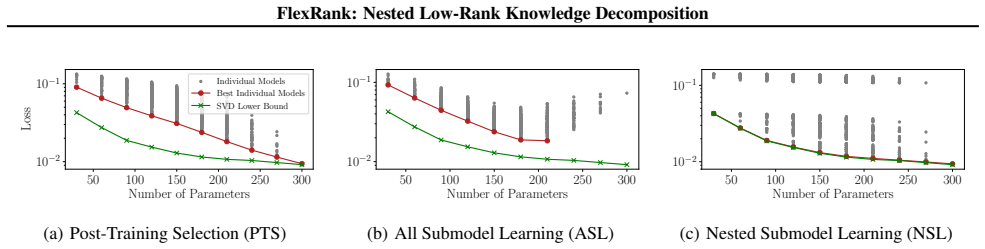
On its own terms, the paper claims that optimal elasticity is achieved by Nested Subspace Learning: when the training objective includes one submodel per rank r, selected by a prefix mask Π_[r], every global minimizer satisfies U Π_[r] V^T = A_r, the best rank-r approximation of the target matrix. That identity fails generically for post-training selection and for all-submodel training, which suffer measurable interference. The method then instantiates this principle on real networks: factorize each pretrained layer with activation-aware SVD, choose a global set of nested rank cuts with dynamic programming, and distill all chosen submodels from the teacher. Empirically, the paper reports tha
Load-bearing premise
The load-bearing premise is that the per-layer rank configuration found on the initial decomposed model stays near-optimal after training, supported by the assumption that truncation errors from different layers add independently.
Editorial extensions
If this is right
- A pretrained model can be decomposed once and serve every deployment budget, eliminating per-budget retraining.
- Nested weight sharing avoids the interference that hurts methods which jointly train arbitrary submodels, so large and small submodels improve together.
- Submodels retain enough knowledge to be fine-tuned for downstream tasks, extending the approach to math and code adaptation.
- The same shared checkpoint yields smoother accuracy-versus-cost trade-offs than existing low-rank compression pipelines.
Reading between the lines
- The fixed-mask approximation could be relaxed into an alternating scheme—search masks, distill, re-search—which might close the residual gap on very large models.
- The nested-prefix principle generalizes beyond low rank: ordered dropout, layer skipping, or gradually quantized bit-widths could adopt the same 'train only nested configurations' rule.
- Because downstream LoRA tuning modifies individual submodels, an open question is whether adapter-trained submodels preserve the global nested ordering.
Editorial analysis
A structured set of objections, weighed in public.
Referee Report
Summary. FlexRank proposes a three-stage pipeline for extracting nested low-rank submodels from a pretrained network. It first factorizes each linear layer using an activation-aware DataSVD initialization, then uses dynamic programming over per-layer sensitivity scores to select a nested chain of rank masks under budget constraints, and finally jointly trains all masked submodels by distillation from the original teacher. The theory section studies a single linear operator and proves that training only the full model (post-training selection) or all subsets (all-subspace learning) is suboptimal, while nested prefix training recovers the truncated SVD Pareto front. Experiments on GPT-2, Llama-3.x, and DINOv3 ViTs report smooth accuracy-versus-parameter-budget trade-offs, with additional LoRA fine-tuning results on math and code tasks.
Significance. The paper has clear practical value if its central approximation holds: it offers a relatively cheap way to obtain a family of shared-weight submodels from one pretrained model, with a linear-time DP for mask selection. I credit the clean separation of PTS/ASL/NSL in the linear setting, the O(L·K) search complexity, the exhaustive MNIST Pareto experiment, and the breadth of architectures evaluated. However, the central deep-network claim is not yet supported at the level asserted: the fixed-mask and additivity assumptions are explicitly acknowledged as approximations but are never directly validated, and the headline accuracy curves lack error bars. The paper's contribution is defensible, but the main claim needs additional evidence or a more careful statement of scope.
major comments (4)
- [§3; §3.3; §4.3 (Theorem 4.3)] The pipeline selects the mask chain M* from the decomposed but untrained model θ0 (Eq. 4) and then fixes the transformations T_{m*_k} while optimizing θ (Sec. 3.3, Eq. 6). Theorem 4.3 proves only that, for a fixed prefix chain [r], the nested objective recovers the truncated SVD of a single linear map; it says nothing about whether the chain chosen from θ0 remains optimal after joint distillation. The exhaustive MNIST experiment (Sec. 3.4, Fig. 3) compares FlexRank against independently trained submodels but does not report whether the initial DP-selected chain is the best chain after training. Since every deployed submodel is constrained to the initially chosen masks, this is load-bearing for the 'recovers the true Pareto front' claim. Please provide a direct re-ranking check — e.g., compare DP-selected chains at θ0 and at the trained θ in a controlled small model — or soften the claim
- [§3.2; §C.2; §5.3 (Fig. 7b)] The DP solves Eq. (4) under the stated assumption that per-layer low-rank truncation errors are additive across layers, and the layer probing evaluates each layer in isolation before combining scores. The manuscript itself notes in Sec. 5.3 that independent layer training fails and that end-to-end training is required to consolidate local into global nestedness, which indicates that cross-layer interactions are non-trivial. No diagnostic is given for the additivity error of the DP objective. Please quantify the gap between the DP-predicted loss and the actual loss of the selected configurations (the exhaustive MNIST setup is a natural place to do this), or provide an upper bound on the interaction term. Without this, the DP may select configurations far from the true Pareto set even if NSL training is optimal for a fixed chain.
- [§5.1; Figs. 4–5; §D.4] The main accuracy curves are single-run results with no error bars, no seeds, and only 10,000 training steps. Given the strong wording ('consistently outperforms', 'within a 5% margin'), uncertainty estimates over seeds or calibration sets are needed before these claims can be evaluated quantitatively. For the ACIP comparison, the tuning budget and hyperparameter search should be stated. Without variance information, the observed differences at low budgets may not be distinguishable from noise.
- [§3.4; Fig. 3] The exhaustive MNIST experiment is a strength, but the text reports only a qualitative statement that FlexRank 'converges to the Pareto front.' Please report a quantitative Pareto gap metric, e.g., average relative loss/accuracy increase over the independently trained DataSVD front, and state the number of runs. This experiment is the only direct evidence for the deep-network Pareto-recovery claim, so its quantitative support is currently thin.
minor comments (5)
- [§B.1] Typo: 'Lebesque' should be 'Lebesgue' in Assumption B.1. Also, in Lemma B.6 the text refers to 'eigenvalues' where 'singular values' is meant.
- [§4.2] The PTS theorem is stated for submodel extraction by subsetting columns of a given factorization. If post-hoc SVD of the trained product UV^T were allowed, PTS would trivially recover the truncated SVD. Please state this restriction explicitly so readers do not misread the theorem.
- [§C.1, Eq. (59)] When Σ_i is singular, Σ^{-1/2} should be understood as the pseudoinverse square root. Please state this to avoid an ill-defined initialization.
- [Fig. 7; Table 1] Figure 7 axes are not labeled in the caption; please add axis labels. In Table 1, the 'Base' row is ambiguous — clarify whether it is the full un-adapted model or the full FlexRank model.
- [§5.3] The statement that 'the third heatmap shows that the c_proj of the central attention layers seems particularly important' would benefit from a quantitative measure of importance (e.g., compression ratio per module) rather than visual inspection alone.
Circularity Check
No circularity: theoretical results are proved from Eckart–Young, and Pareto-recovery claims are tested against independently trained submodels; fixed-mask/additivity assumptions are stated limitations, not disguised inputs.
full rationale
Walking the derivation chain from Sec. 4 through the experiments, I find no step that reduces to its own input by construction. Theorems 4.1–4.3 are proven in the appendix from Eckart–Young–Mirsky, a gauge-parameterization of SVD factorizations, and KKT/convex-analysis arguments; Theorem 4.3's E(U,V,r)=0 is derived, not assumed, because the NSL objective lower-bounds each rank-r term by the unique truncated-SVD error and any global minimizer must attain all lower bounds simultaneously. The nestedness constraint and Eqs. (7)–(10) reformulate the elastic-training objective rather than smuggling in the conclusion. The mask-selection stage (Sec. 3.2) does rest on two explicitly stated approximations—'we make the key approximation that ... the optimal mask structure produced by T*_beta is fixed' and 'we implicitly assume that layers are approximately independent under theta_0. Accordingly, we assume that the error incurred by low-rank approximations is additive across layers'—but the paper labels them as assumptions and then tests them against an external benchmark: the MNIST experiment exhaustively trains all per-layer rank configurations independently and compares FlexRank against that Pareto front, while the large-model results are measured with held-out lm-eval-harness/ImageNet accuracy against SVD, DataSVD, and ACIP baselines. The 'Pareto recovery' claim is therefore a falsifiable empirical claim, not a fit renamed as a prediction. Its main weaknesses—a single small-scale exhaustive check, no re-checking of mask optimality after distillation, short training budgets, and distillation to the same teacher used for initialization—are acknowledged or evident in the paper and are correctness/evidence concerns, not circularity. Separately, Theorem 4.1's proof invokes Assumption B.2 (GD convergence for submodel problems) where full-PTS convergence would be needed; this is an omitted-support issue, not a circular reduction. Self-citations (Fjord, Maestro, Melting Point, Loft) appear only as contextual related work and carry no load-bearing weight; no uniqueness theorem is imported from prior work by the same authors.
Assumptions & free parameters
free parameters (3)
- Distillation weight coefficients alpha_k =
not stated
- Budget set B (number and spacing of budgets) =
K=10 in toy; unspecified for real models
- Calibration dataset size N =
~10^3 samples
assumptions (4)
- domain assumption Per-layer low-rank approximation errors are additive across layers.
- domain assumption The relative importance ordering induced by DataSVD is preserved after distillation training.
- domain assumption Gradient descent converges to a global minimizer for each rank-restricted subproblem.
- domain assumption The pretrained base model is a sufficiently good teacher for all submodels.
Cite this review
Pith. "Pith review of FlexRank: Nested Low-Rank Knowledge Decomposition for Adaptive Model Deployment." pith.science (2026). https://pith.science/paper/OJ7TGTVI
@misc{pith2026260202680,
  author       = {Pith},
  title        = {Pith review of: FlexRank: Nested Low-Rank Knowledge Decomposition for Adaptive Model Deployment},
  year         = {2026},
  howpublished = {\url{https://pith.science/paper/OJ7TGTVI}},
  note         = {Machine review of arXiv:2602.02680}
}
read the original abstract
The growing scale of deep neural networks, encompassing large language models (LLMs) and vision transformers (ViTs), has made training from scratch prohibitively expensive and deployment increasingly costly. These models are often used as computational monoliths with fixed cost, hindering adaptive deployment across different cost budgets. We argue that nested components, ordered by importance, can be extracted from pretrained models and selectively activated within the available computational budget. To this end, our proposed FlexRank method leverages low-rank weight decomposition with nested, importance-based consolidation to extract submodels of increasing capabilities. Our approach enables a "train-once, deploy-everywhere" paradigm offering a graceful trade-off between cost and performance without training from scratch for each budget - advancing practical deployment of large models.
Figures


Figures from the paper (5 more)


Reference graph
Works this paper leans on
-
[1]
Note that the memory complexity is now independent ofNand scales asO(n 2 i )
Online Covariance Estimation:We batch-accumulate Σi = P j xi,jx⊤ i,j by running batches of activations through the model. Note that the memory complexity is now independent ofNand scales asO(n 2 i )
-
[2]
URL https: //aclanthology.org/2025.acl-long.498/
doi: 10.18653/v1/2025.acl-long.498. URL https: //aclanthology.org/2025.acl-long.498/. Chen, P., Yu, H.-F., Dhillon, I., and Hsieh, C.-J. Drone: Data-aware low-rank compression for large nlp models. Advances in neural information processing systems, 34: 29321–29334, 2021. Devvrit, F., Kudugunta, S., Kusupati, A., Dettmers, T., Chen, K., Dhillon, I., Tsvetk...
arXiv 2025
-
[3]
Ma, S., Wang, H., Ma, L., Wang, L., Wang, W., Huang, S., Dong, L., Wang, R., Xue, J., and Wei, F
URL https://openreview.net/forum ?id=PMSNd8xTHp. Ma, S., Wang, H., Ma, L., Wang, L., Wang, W., Huang, S., Dong, L., Wang, R., Xue, J., and Wei, F. The era of 1-bit llms: All large language models are in 1.58 bits.arXiv preprint arXiv:2402.17764, 2024. Meng, F., Wang, Z., and Zhang, M. Pissa: Principal singular values and singular vectors adaptation of lar...
arXiv 2024
-
[6]
whitened
Whitened SVD:We compute the symmetric square root Σ1/2 i via eigen-decomposition and perform SVD on the “whitened” weights ˜θi =θ iΣ1/2 i , yielding ˜θi =P iΛiQ⊤ i . To recover the factors in the original space, we observe that θi = (PiΛiQ⊤ i )Σ−1/2 i . We then initialize the shared factors by symmetrically absorbing the singular valuesΛ i Ui ←P iΛ1/2 i ,...
-
[7]
For each layer l∈ {1,
Layer Probing:We evaluate the model’s sensitivity to rank reduction at each layer independently. For each layer l∈ {1, . . . , L}and each budget βk ∈ ˜B, we instantiate a model where only the l-th layer is transformed by Tβk while all other layers remain at full capacity. We record the resulting performance Rl,k, constructing a sensitivity matrix S∈R L×K
-
[8]
We employ a Dynamic Programming (DP) algorithm to find the rank assignments across layers that maximize the aggregate performance for each global threshold βk
Dynamic Programming Exploration:Using the sensitivity matrix S, we solve for the entire set of optimal configu- rations M simultaneously by framing the search as a Multi-Choice Knapsack Problem (MCKP). We employ a Dynamic Programming (DP) algorithm to find the rank assignments across layers that maximize the aggregate performance for each global threshold...
2025
-
[2021]
URL https://arxiv.org/abs/2104.0 8378. 10 FlexRank: Nested Low-Rank Knowledge Decomposition Penedo, G., Kydl´ıˇcek, H., Lozhkov, A., Mitchell, M., Raffel, C. A., V on Werra, L., Wolf, T., et al. The fineweb datasets: Decanting the web for the finest text data at scale.Ad- vances in Neural Information Processing Systems, 37: 30811–30849, 2024. PyTorch Docu...
arXiv 2024
-
[2025]
Chen, M., Shao, W., Xu, P., Wang, J., Gao, P., Zhang, K., and Luo, P
URL https://openreview.net/forum ?id=AyC4uxx2HW. Chen, M., Shao, W., Xu, P., Wang, J., Gao, P., Zhang, K., and Luo, P. EfficientQAT: Efficient quantization-aware training for large language models. In Che, W., Nabende, J., Shutova, E., and Pilehvar, M. T. (eds.),Proceed- ings of the 63rd Annual Meeting of the Association for Computational Linguistics (Vol...
2025
Reviewed August 3, 2026 · model on record in the stance chip above.
Discussion (0). Continue with ORCID to comment.