REVIEW 4 major objections 5 minor 4 cited by
Memora: A Harmonic Memory Representation Balancing Abstraction and Specificity
T0 review · 4 major / 5 minor · reviewed 2026-08-03 · deepseek-v4-flash
Pith's one-line read A memory pair of stable abstraction plus concrete value, with cue anchors for extra access, lets agents retrieve what they need without reconstructing full histories.
desk verdict Memora is a plausible engineering contribution to agent memory, but its central theoretical claim of strict expressivity over RAG/KG collapses on its own definitions, and the benchmark reporting is under-powered. read the letter →
The pith
A machine-rendered reading of the paper's core claim, the machinery that carries it, and where it could break.
The reading
What carries the argument
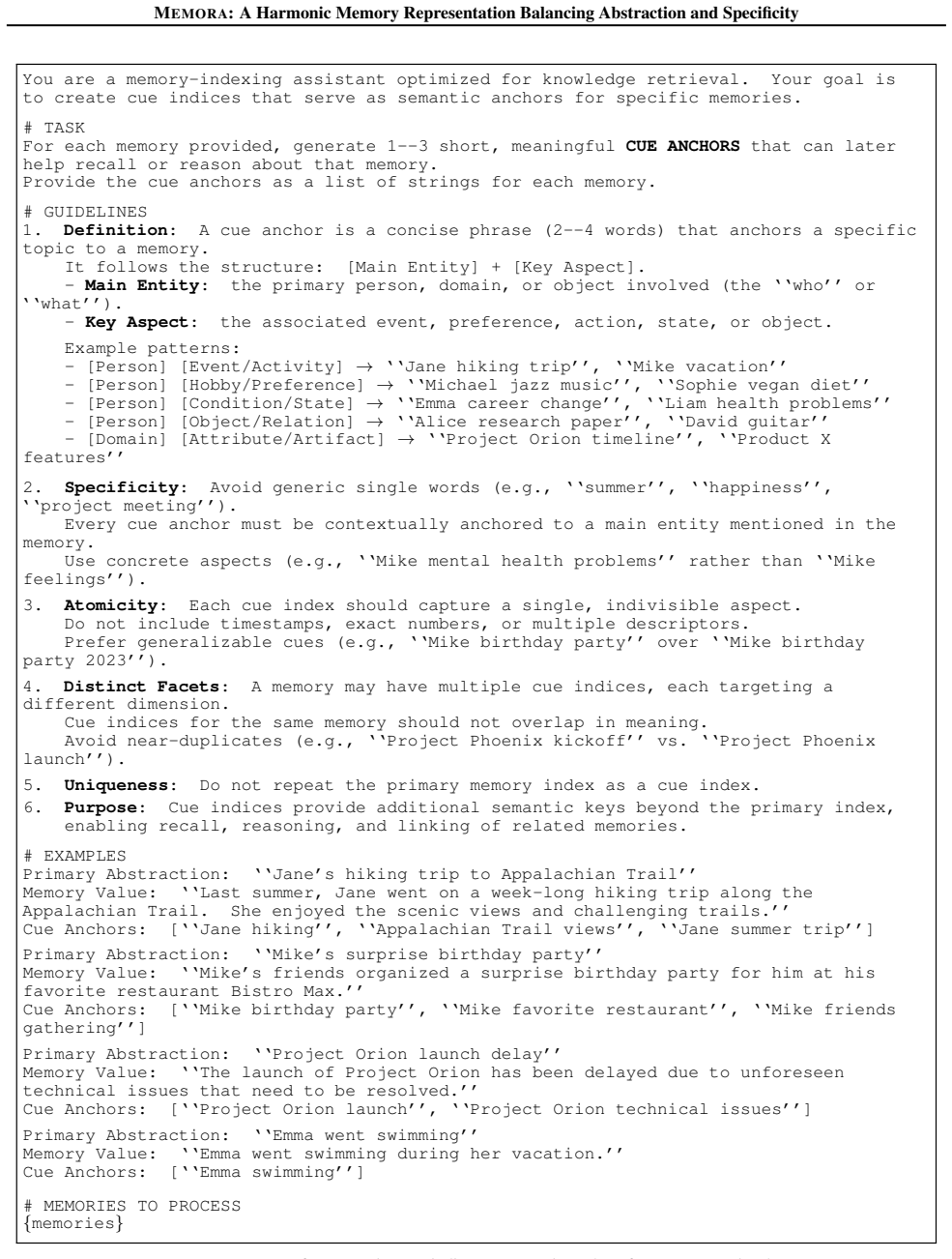
The load-bearing objects are primary abstractions, memory values, and cue anchors. A primary abstraction is the canonical name of a memory entry—the stable concept under which related updates are consolidated; the memory value holds the concrete details; cue anchors are short 'entity + aspect' phrases extracted from the value that give many-to-many access into the entry and connect it to other entries. Together they define an implicit memory graph that requires no explicit edge construction. Retrieval is an MDP over this graph with three actions—REFINE (reformulate the query), EXPAND (pull in frontier entries), STOP (terminate)—so the retriever can actively navigate rather than rely only on
What would settle it
In the Theorem D.5 construction, replace the fixed-k flat retriever with one that returns all entries above a similarity threshold. If that retriever returns exactly the target set N(1), the strictness result fails; similarly, allow the KG retriever's seed set to select by primary abstraction and see whether the same target set becomes reachable.
Extended reading notes
Core claim
The central claim is that a memory entry should be split into a navigation layer and a content layer: a primary abstraction that says what the memory is about and can absorb related updates, and a memory value that keeps the messy, specific detail. Cue anchors then act as additional fine-grained hooks—'Melanie sunset painting' or 'kids pottery cup'—so the same entry can be reached from many perspectives and related entries can be connected without explicit graph edges. A policy-driven retriever treats memory access as a sequence of REFINE, EXPAND, and STOP decisions over this structure, which lets it traverse cue links to relevant non-local memories. The paper supports this with a formal arg
Load-bearing premise
The claim that Memora is strictly more expressive than RAG/KG depends on defining those baselines with a fixed output size k and a fixed single-attachment map; if either constraint is relaxed, the constructed counterexample may no longer separate the frameworks.
Editorial extensions
If this is right
- Curated, abstraction-first memory can beat full-context input: the paper reports 0.863 versus 0.825 on LoCoMo.
- Most of the raw history never needs to enter the context window; the paper reports up to 98% token reduction.
- Policy-guided retrieval is only better when cue anchors exist; removing them makes the policy retriever behave like the semantic retriever, so the navigation gain comes from the structure, not the policy alone.
- If RAG and KG retrieval are special cases, a single memory representation can serve both flat document lookup and relational traversal, simplifying memory-system design.
Reading between the lines
- The formal strictness claim is narrower than it appears: the proof restricts flat retrieval to exactly k results and KG retrieval to a fixed attachment map. A flat retriever allowed a similarity threshold, or a KG retriever whose seed selection can use the abstraction partition, may already realize the target function, so the architecture's practical value may rest more on the empirical results th
- The index-value decoupling suggests a general recipe for any large unstructured store: keep a small set of stable facets for navigation and keep raw specifics behind them. Document QA and tool selection are natural places to test this outside agent memory.
- A testable extension would be to measure whether cue anchors trained on one domain transfer to another: if they encode reusable aspect structure rather than corpus-specific wording, memory construction cost could be amortized across tasks.
Editorial analysis
A structured set of objections, weighed in public.
Referee Report
Summary. The paper introduces MEMORA, an agent memory architecture that pairs primary abstractions with memory values and adds cue anchors to support many-to-many retrieval paths. It also formulates retrieval as a sequential MDP with REFINE/EXPAND/STOP actions, optionally optimized by group-relative policy updates. The authors claim that standard RAG and KG retrieval are special cases of MEMORA, that MEMORA is strictly more expressive than both, and that MEMORA sets a new state-of-the-art on LoCoMo and LongMemEval. The theoretical development is in Section 5 and Appendix D; the empirical evaluation is in Section 6.
Significance. If the theoretical claims were correct, the paper would contribute a useful unifying perspective on memory representations, and the architecture itself is plausible and clearly described. The paper also provides detailed prompts, ablations, and latency measurements, which are valuable. However, the central formal result (strict expressivity) is not established: the proof relies on a definitional restriction of competitor classes that is both contrived and, in the KG case, self-defeating. The empirical claims are weakened by copied baselines, a single LLM judge without variance reporting, and at least one per-category result that contradicts the 'consistently outperforms' wording. The paper's practical ideas may merit further study, but the manuscript as written does not support its central claims.
major comments (4)
- [Appendix D.4, Theorem D.5] Definition D.4 defines KG seed-and-expand retrieval with an arbitrary query-dependent seed set S(q). Take V=M, E=∅, L=0, and π the identity (or any injection). For any retrieval function R*, choose S(q)=π(R*(q)). Then the retrieved set is exactly R*(q), so the KG class already realizes all retrieval functions. Step 4's assertion that π 'cannot simultaneously encode both abstraction-level and cue-level information' is false: an injective π encodes every memory attribute and S(q) selects the target set. The flat top-k impossibility is also definitional: fixing |R(q)|=k while |R*(q)|>k only shows that an exactly-k retriever cannot emit a larger set. A threshold retriever or per-query k realizes R* trivially. Thus Theorem D.5 does not establish strict expressivity; it demonstrates an artifact of Definition D.4.
- [Section 5, Theorem D.6] The claimed efficiency improvement is conditional on B^2 > mN, which the paper itself calls a 'strong requirement' in Appendix D.6. When this inequality fails, the ratio T_RAG/T_Harmo is at most 1, and the 'improvement' disappears. Yet Section 5 states 'principled efficiency improvements through abstraction-first scoping' as a general consequence. The theorem should be stated as a conditional result or the efficiency claim should be qualified accordingly. As written, the theory section supports at most a constant-factor gain under particular index-family assumptions, not a general efficiency advantage.
- [Table 2, Section 6.2.1] The text says MEMORA 'consistently outperforms strong baselines' and reports an average of 87.4%. However, Nemori outperforms MEMORA(P) on single-sn-preference (86.7 vs 83.3) and on single-sn-assistant (92.9 vs 78.6), and Full Context outperforms both MEMORA variants on single-sn-assistant (98.2). The claim of consistency is not supported by the table. The authors should qualify the statement or discuss the per-category trade-offs explicitly.
- [Section 6.1, Table 1] The LoCoMo comparison is not controlled: results for Zep, LangMem, and Nemori are copied from Nan et al. (2025) rather than rerun under the paper's evaluation protocol. The evaluation uses a single LLM judge (GPT-4o-mini) and a fixed seed, with no reruns, confidence intervals, or significance tests. Without rerunning baselines in the same environment or reporting uncertainty, the 'establishes a new state-of-the-art' claim in Section 6.2.1 is not statistically supported. Please provide reruns or at least error bars and a significance assessment.
minor comments (5)
- [Section 6.2.1] 'Superior performance across all four task categories' is only true for the LLM-as-a-judge metric. On BLEU, Full Context beats MEMORA(P) in Multi-hop (0.356 vs 0.337). Please clarify that the claim refers to the primary metric only.
- [Throughout] The spelling is inconsistent: 'Memora' appears in the abstract and conclusion while 'MEMORA' is used elsewhere. Standardize capitalization.
- [Table 2] The 'Context length' column appears to report average retrieved context (2.1k, 2.9k) while Full Context is 115k. Clarify that this is retrieved context, not input context length, to avoid confusion.
- [Section 6.2.4] The GRPO result (0.841 vs 0.836) is described as 'marginally outperforming' but no variance or significance information is given. This should be presented as preliminary only, which the text mostly does, but the figure gives no error bars.
- [Appendix E] The case studies are helpful but anecdotal. They should be explicitly framed as illustrations, not as evidence for the quantitative claims.
Circularity Check
Strict-expressivity claim is forced by Definition D.4: flat RAG is size-locked to exactly k, and KG retrieval's unrestricted query-dependent seed set S(q) already allows an injective π to realize arbitrary retrieval functions.
-
self definitional
[Appendix D.3, Definition D.4(1) and Theorem D.5, Step 3]
"Flat top-k similarity retrieval. There exists a single scoring function s(q,m) such that, for every query q, R(q) = TopK_k({s(q,m) : m∈M}), and therefore |R(q)|=k. ... By definition, any such retriever ... returns exactly k memory entries for every query: |R(q)|=k,∀q∈Q. In contrast, ... R⋆(q)=N(1), where |N(1)|>k by construction. ... Equations (30) and (31) immediately yield a contradiction."
The impossibility is just the definition: the only reason a flat retriever cannot output N(1) is that Definition D.4 locks output cardinality to exactly k, while R⋆ is deliberately built with |N(1)|>k. If k were |N(1)|, or if a threshold/variable-k retriever were allowed, the same flat scoring function realizes R⋆. Thus Step 3 is a restatement of the size-lock in Definition D.4, not a demonstration that flat similarity ranking lacks mixed-key expressivity. The strictness conclusion is produced by the cardinality constraint in the definition.
-
other
[Appendix D.3, Definition D.4(2) and Theorem D.5, Step 4]
"KG seed-and-expand retrieval with fixed attachment. There exists a fixed attachment map π:M→V on a fixed graph G=(V,E) such that, for every query q, R(q)={m∈M: π(m)∈Nbr_L(S(q))}, where S(q)⊆V is a query-dependent seed set ... Crucially, membership in R(q) depends only on the attachment π(m) and the graph structure ... Since π is fixed and single-valued, it cannot simultaneously encode both abstraction-level information and cue-level information without collapsing distinct semantic dimensions."
The definition explicitly allows an arbitrary query-dependent seed set S(q) and leaves π, V, and L unrestricted. Taking V=M, π=id, L=0, and S(q)=N(1) makes the defined KG retriever return exactly R⋆(q). So the claimed 'fixed single-attachment' impossibility is not entailed by the definition; Step 4 ignores the very S(q) term that the definition supplies. The strictness result therefore rests on an unstated additional restriction that the paper does not define or prove, making the theorem's central conclusion an artifact of the chosen class definition rather than a derived property of KG retrieval.
full rationale
The empirical benchmark work (LoCoMo, LongMemEval, ablations, latency) is not circular: it evaluates against external datasets and baselines, and no load-bearing self-citation chain appears. However, the paper's headline theoretical claim—that MEMORA is a unified and 'strictly more expressive' framework than RAG/KG—is made in Section 5 and the abstract, and it rests entirely on Theorem D.5. That theorem's flat-RAG impossibility is Definition D.4(1) restated: the definition forces |R(q)|=k, and the target set is chosen to have size >k, so the contradiction is manufactured by the size-lock. The KG impossibility is even weaker: Definition D.4(2) allows arbitrary query-dependent S(q), so an injective π with L=0 realizes any target set, directly refuting Step 4's claim that π 'cannot simultaneously encode' the required information. Because the central theoretical derivation reduces to these definitional choices, the strictness claim is forced by definition rather than established by proof. The efficiency theorem D.6 is conditional on B²>mN, which the paper itself acknowledges is strong; that is a limitation, not a separate circularity. Overall, the paper's empirical contributions appear independent, but its central formal claim is definitionally constrained, warranting a high circularity score.
Assumptions & free parameters
free parameters (6)
- similarity threshold γ
- top-k k for abstraction retrieval
- retrieval budget B and action costs Cost(a_t)
- redundancy threshold δ and judge weights w1,w2,w3
- GRPO group size G and KL coefficient β
- number of cue anchors per memory =
1–3
assumptions (5)
- domain assumption LLM-based extraction/consolidation functions Fa, J, Fc produce faithful abstractions, values, and cues.
- domain assumption Cosine similarity over primary-abstraction embeddings is a valid measure of conceptual identity for consolidation and retrieval.
- ad hoc to paper Competitor retrieval classes can be restricted to exactly-k flat similarity and fixed single-attachment KG.
- domain assumption ANN index query cost is O(log n) for both MEMORA and flat RAG.
- domain assumption Trajectory-level judge scores Ground, Redundancy, Cost and group-relative advantages improve retrieval.
invented entities (3)
-
Primary abstraction
-
Cue anchor
-
Implicit memory graph
Cite this review
Pith. "Pith review of Memora: A Harmonic Memory Representation Balancing Abstraction and Specificity." pith.science (2026). https://pith.science/paper/D2UVJBL2
@misc{pith2026260203315,
  author       = {Pith},
  title        = {Pith review of: Memora: A Harmonic Memory Representation Balancing Abstraction and Specificity},
  year         = {2026},
  howpublished = {\url{https://pith.science/paper/D2UVJBL2}},
  note         = {Machine review of arXiv:2602.03315}
}
read the original abstract
Agent memory systems must accommodate continuously growing information while supporting efficient, context-aware retrieval for downstream tasks. Abstraction is essential for scaling agent memory, yet it often comes at the cost of specificity, obscuring the fine-grained details required for effective reasoning. We introduce Memora, a harmonic memory representation that structurally balances abstraction and specificity. Memora organizes information via its primary abstractions that index concrete memory values and consolidate related updates into unified memory entries, while cue anchors expand retrieval access across diverse aspects of the memory and connect related memories. Building on this structure, we employ a retrieval policy that actively exploits these memory connections to retrieve relevant information beyond direct semantic similarity. Theoretically, we show that standard Retrieval-Augmented Generation (RAG) and Knowledge Graph (KG)-based memory systems emerge as special cases of our framework. Empirically, Memora establishes a new state-of-the-art on the LoCoMo and LongMemEval benchmarks, demonstrating better retrieval relevance and reasoning effectiveness as memory scales.
Figures


Figures from the paper (4 more)


Forward citations
Cited by 4 Pith papers
-
Control-Plane Placement Shapes Forgetting: An Architectural Study of Agent Memory Across Thirteen System Configurations
An empirical comparison of thirteen control-plane placements in agent memory pipelines identifies three regimes with complementary forgetting recovery on a new 385-case adversarial benchmark, with mutation-time placem...
-
Maestro: Reinforcement Learning to Orchestrate Hierarchical Model-Skill Ensembles
Maestro uses outcome-based RL to train a lightweight policy that orchestrates ensembles of frozen expert models and skills, reporting 70.1% average accuracy across ten multimodal benchmarks and outperforming GPT-5 and...
-
Mi-Memory: A Lifecycle Memory Framework for Personal AI
Mi-Memory proposes a four-role lifecycle framework for personal AI memory with an audit contract of typed evidence, traces, strategy artifacts, and rollback records; modules are benchmarked separately, but the contrac...
-
ActionNex: A Virtual Outage Manager for Cloud Computing
ActionNex is an agentic system for cloud outage management that compresses multimodal signals into critical events, uses hierarchical memory for reasoning, and recommends actions with 71.4% precision on real Azure outages.
Reference graph
Works this paper leans on
-
[1]
- Include specific context (e.g., domain or entity) to avoid vagueness
EpisodicIndex - Create a short index (6--8 words) capturing the main topic or event of the episode. - Include specific context (e.g., domain or entity) to avoid vagueness
-
[2]
* Relevant participants, referred to by name if available
EpisodicValue - Generate 1--3 sentence summary capturing: * Main information of the conversation segment (topic, theme, or event). * Relevant participants, referred to by name if available. * Use original wording when possible. - Focus on ‘‘what happened’’ rather than specific granular details. - Make the summary self-contained and understandable without ...
-
[3]
Generate an updated memory value that combines relevant information from both entries
-
[4]
Analyze if the new entry should update any existing entry based on semantic similarity and content overlap
-
[5]
If an update is needed, determine which candidate entry is best to update
-
[7]
Figure 6.Prompt for deciding whether to update an existing memory entry or create a new one
Decide whether the memory index should be updated to better reflect the combined information. Figure 6.Prompt for deciding whether to update an existing memory entry or create a new one. 13 MEMORA: A Harmonic Memory Representation Balancing Abstraction and Specificity You are a memory-indexing assistant optimized for knowledge retrieval. Your goal is to c...
2023
-
[8]
KG seed-and-expand retrieval with fixed attachment.There exists a fixed attachment map π:M →V on a fixed graphG= (V, E)such that, for every queryq, R(q) ={m∈ M:π(m)∈Nbr L(S(q))}, whereS(q)⊆Vis a query-dependent seed set andNbr L(·)denotes theL-hop neighborhood operator
-
[9]
colorful bowl
Memora retrieval.The retrieval function is realizable by Memora using primary abstractions α(m) and cue anchors Γ(m), including the gated form R∩(q) :={m∈ M:α(m)∈A q} ∩ {m∈ M: Γ(m)∩Cq ̸=∅},(29) where Aq = TopKKA ({s A(q, a) :a∈ A }), C q = TopKKC ({s C(q, c) :c∈ C }). Theorem D.5(Strictness under mixed-key constraints).There exists a Memora retrieval func...
2023
Show all 9 references
-
[2021]
episodes
URL https://arxiv.org/abs/2005. 11401. Li, Z., Song, S., Wang, H., Niu, S., Chen, D., Yang, J., Xi, C., Lai, H., Zhao, J., Wang, Y ., Ren, J., Lin, Z., Huo, J., Chen, T., Chen, K., Li, K., Yin, Z., Yu, Q., Tang, B., Yang, H., Xu, Z.-Q. J., and Xiong, F. Memos: An operating sys...
2005 arXiv
Reviewed August 3, 2026 · model on record in the stance chip above.
Discussion (0). Sign in to comment.