REVIEW 5 major objections 8 minor 52 references
Jointly fitting galaxy and peculiar-velocity clustering on non-linear scales improves cosmological constraints, reaching 3.8% precision on the growth-rate parameter fσ8 in realistic mocks—versus 4.7% from galaxy clustering alone.
Reviewed by Pith at T0; open to challenge. T0 means a machine referee read the full paper against a public rubric. the ladder, T0–T4 →
T0 review · deepseek-v4-flash
2026-08-03 04:58 UTC pith:ROKEGZT7
load-bearing objection A genuinely useful and unusually honest emulator-forecast paper: the 3.8%-vs-4.7% gain in fσ8 is real inside their mocks, but the paper itself admits it is a self-consistency test, not a claim about real-data robustness. the 5 major comments →
Emulating galaxy and peculiar velocity clustering on non-linear scales
The pith
A machine-rendered reading of the paper's core claim, the machinery that carries it, and where it could break.
Core claim
The paper claims that jointly modelling galaxy and peculiar-velocity clustering on non-linear scales produces tighter, unbiased cosmological constraints than galaxy clustering alone. The emulator predicts five redshift-space multipoles—the monopole and quadrupole of the galaxy and velocity auto-correlations plus the dipole of the galaxy-velocity cross-correlation—as a function of cosmological parameters, HOD parameters, and separation. When all five are fitted together on ideal full-sky mocks at z=0.2, all parameters are recovered within 1σ and the fσ8 precision improves from 1.5% to 1.1%. When the same inference is run on realistic mocks that include sparse tracer densities, Gaussian distan
What carries the argument
The load-bearing machinery is a multi-scale Gaussian process emulator whose kernel factorises as the Kronecker product of kernels over cosmology, HOD parameters, and separation, exploiting the Kronecker-product structure of the training grid (88 cosmologies × 600 HOD models). It outputs mean predictions and an emulator covariance for the five correlation-function multipoles; the emulator covariance is added to a cosmic-variance covariance estimated from many small simulation boxes. The observables are measured with pair-count estimators using the flat-sky approximation, which the paper verifies against full-sky measurements. Galaxy assignment uses the standard HOD model with central and sate
Load-bearing premise
The 3.8% result assumes the same HOD model used to build the mocks can absorb all unmodelled small-scale velocity noise without biasing cosmology, and that converting log-distance ratios to velocities with the true cosmology—while the Alcock-Paczynski shift uses a different fiducial cosmology—is harmless; if either gives way, the unbiased 3.8% measurement may not hold for real data.
What would settle it
Build galaxy mocks from a physically different galaxy-halo connection—e.g., abundance matching, assembly-bias HOD, or hydrodynamical simulations—then run the emulator inference; if the recovered cosmological parameters (especially fσ8) shift by more than the claimed uncertainty, the 3.8% precision claim does not transfer to real data. A cheaper check: re-run the realistic-mock fits converting log-distance ratios to velocities using the same fiducial cosmology as the AP distortion instead of the true cosmology; if fσ8 moves by a significant fraction of the 1.8% quoted gain, the result is fragil
If this is right
- Combining galaxy and velocity clustering on non-linear scales tightens constraints on σ8 and w0 relative to either tracer alone, in both ideal and realistic mocks.
- Realistic velocity measurement errors and sparse tracer densities reduce the gain but do not erase it: fσ8 precision improves from 4.7% to 3.8%.
- The flexibility of the HOD model can absorb unmodelled small-scale noise, so cosmological parameters can stay unbiased even when HOD parameters are biased.
- Angular scales as small as 0.33 h⁻¹ Mpc add cosmological information, so correcting small-scale observational systematics such as fibre collisions is worthwhile.
- The velocity-only and cross-correlation-only analyses show larger systematic shifts on fσ8 once realistic noise is included, indicating the joint fit is needed to keep the measurement unbiased.
Where Pith is reading between the lines
- If this transfers to real data, a ~3-4% growth-rate measurement at z≈0.2 would be unusually precise at low redshift, strengthening combined constraints on dark energy and modified gravity when paired with high-redshift probes.
- The paper's own caveat points to the key test: apply the emulator to mocks with velocity bias, assembly bias, or galaxy populations from hydrodynamical simulations; if cosmological recovery becomes biased, the 3.8% claim will not survive contact with real galaxies.
- A cheaper falsifying test is to vary the fiducial cosmology used to convert log-distance ratios to velocities (the paper fixes it to the true cosmology while applying Alcock-Paczynski shifts with a different one); if fσ8 moves by a meaningful fraction of the 1.8% gain, the improvement is partly an artifact of the analysis choice.
- Separating supernova and Tully-Fisher/fundamental-plane velocity samples—different densities and errors—could recover more of the lost gain than the combined sample used here, and is a natural next step.
Editorial analysis
A structured set of objections, weighed in public.
Referee Report
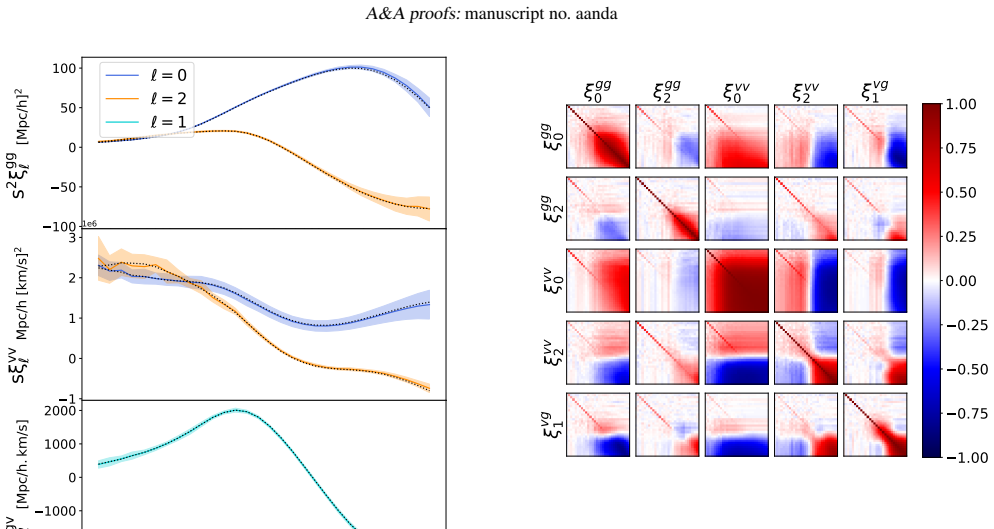
Summary. This paper presents a simulation-based emulator for the redshift-space two-point statistics of galaxies and peculiar velocities on non-linear scales (0.3–60 h⁻¹ Mpc): the galaxy autocorrelation monopole/quadrupole, the velocity autocorrelation monopole/quadrupole, and the galaxy–velocity cross-correlation dipole. Using 88 AbacusSummit cosmologies × 600 HOD models at z = 0.2, the authors build five multi-scale Gaussian-process emulators with a Kronecker-structured kernel and propagate both cosmic variance and emulator error into the likelihood. On a recovery set of 25 Planck2018 full-sky mocks they report unbiased cosmological and HOD parameters, with the joint analysis improving fσ₈ precision from 1.5% (galaxy clustering only) to 1.1%. They then construct realistic mocks reproducing DESI BGS galaxy densities, ZTF SNe + TF/FP velocity-tracer densities, distance-indicator scatter, FKP weights, and Alcock–Paczynski distortions. Fitting these mocks yields biased HOD parameters but, the paper claims, unbiased cosmological parameters, with a joint fσ₈ precision of 3.8% versus 4.7% from galaxy clustering alone. The abstract concludes that velocity statistics add information on non-linear scales, but with diminished returns under realistic measurement conditions.
Significance. The central claim — that galaxy+velocity clustering on non-linear scales improves fσ₈ constraints (3.8% vs 4.7% in realistic mocks) while remaining cosmologically unbiased — is, if established, a useful result for low-redshift peculiar-velocity surveys and for the design of future samples. The paper has real methodological strengths: the emulator is validated against withheld cosmologies/HODs and on 25 independent realisations; the code (MKGpy) and data are public or promised on Zenodo; the covariance treatment, including emulator error and the Percival et al. (2022) precision-matrix correction, is careful; and the limitations are disclosed unusually candidly (§5.1, §5.2). However, the realistic-mock demonstration is a self-consistency test: the mocks share the same HOD formalism as the emulator, the η→v conversion uses the true cosmology, the velocity statistics fit the data poorly (rχ² = 4.3 and 3.0), and the joint fσ₈ estimate shows a systematic shift of ≈3.7σ of the mean. The headline claims are therefore conditional on assumptions that the current validation does not yet test.
major comments (5)
- [Sec. 5.1, Table 3] For the realistic mocks, the velocity-only and galaxy-velocity likelihoods are rejected by the data: rχ² = 4.3 (p ≈ 2×10⁻²⁰) for vv and 3.0 (p ≈ 6×10⁻⁵) for vg. The Gaussian likelihood (Eq. 14) is therefore not a valid description of these measurements, and the per-realisation uncertainties and unbiased-recovery claims from any analysis containing vv or vg are not well grounded. The joint analysis instead gives rχ² = 0.4 (p ≈ 1−10⁻¹⁰), which the authors attribute to overfitting by the HOD parameters (Sec. 5.2): the velocity misfit is masked by parameter flexibility, not explained. Please calibrate the velocity noise model (e.g., correlated or non-Gaussian η errors after FKP weighting, HOD-dependence of the covariance, extra small-scale variance) so that the vv and vg fits are acceptable, and re-check the joint conclusions with the calibrated likelihood.
- [Sec. 5.1, App. B Eqs. (B.4)–(B.5)] The realistic-mock analysis converts log-distance ratios to peculiar velocities using the true Planck18 cosmology while applying the AP distortion with the c003 fiducial cosmology; the text defers study of this effect. In real data the same fiducial enters both conversions via D(z) and H(z) in Eqs. (B.4)–(B.5), so using the truth removes a systematic that any analysis will face. Since the headline 'unbiased cosmological recovery' and the 3.8% fσ₈ figure come from these mocks, this is load-bearing. Please re-run the inference (even on a subset of the 25 mocks) with the η→v conversion computed with the c003 fiducial, and report the effect on the fσ₈ bias, the HOD biases, and the joint gain.
- [Sec. 5.2] The paper states 'our noisy sample is built from the same underlying formalism' as the emulator, and Sec. 6 concludes that 'the HOD model is flexible enough to marginalise over the noisy clustering without biasing the cosmological parameters.' Because the realistic mocks use the same AbacusSummit halos, the same Zheng et al. HOD, and the same training ranges, the validation is an interpolation within the training model class; it does not test robustness to real galaxy–halo connection differences (velocity bias, assembly bias, correlated distance errors). This is the main untested assumption behind the claim of unbiased cosmology in realistic conditions. Please either add a stress test with a galaxy model outside the HOD class (e.g., an HOD with velocity bias, or subhalo abundance matching), or reword the abstract and conclusions to state that unbiasedness and the 3.8% gain are demonstrat
- [Sec. 5.1, Table 3 (fσ₈ row)] In the realistic joint ('tot') analysis, ⟨Δfσ₈⟩ = 1.32×10⁻² with ⟨σ_θ⟩ = 1.78×10⁻². Averaged over 25 realisations the error of the mean is ≈0.36×10⁻², so the shift is ≈3.7 times the expected dispersion of the mean. The text itself concludes this 'point[s] toward a potential systematic bias that could cancel out the statistical gain.' The claimed gain over galaxy-only (0.38×10⁻² reduction in σ) is small compared with this shift, and the abstract's 'cosmological constraints remain unbiased' is stronger than the evidence. Please provide a formal significance test of the fσ₈ shift over the 25 realisations and report the bias-variance budget explicitly.
- [Sec. 4.1, Tables 2–3] The emulator covariance is fixed at the true simulation parameters during inference. In the realistic mocks the HOD MAP moves far from the truth (Table 3: log M₁ biased by ≈7σ, α by ≈2.3σ), so the fixed covariance is not the covariance at the fitted point; this affects both the error bars and the log|C_tot| term in Eq. (14). In addition, σ(Z_θ) < 1 for every parameter in every analysis of both Tables 2 and 3; the authors note this could indicate overestimated uncertainties. With inflated error bars, a real bias (e.g., the fσ₈ shift noted above) is masked. Please report the per-realisation rχ² distribution for each analysis and, for at least a few realisations, rerun the chains evaluating C_tot at the MAP or at each step to check that the quoted 1σ errors are stable.
minor comments (8)
- [Sec. 3.1, Eq. (13)] The S values appear to contain a typo: '10⁵ for ξ_gg²' should presumably be '10⁵ for ξ_vv²', since ξ_gg² was already assigned 10¹ and ξ_vv² is the remaining multipole.
- [Sec. 2.1 vs Secs. 2.3–2.4] The paper states it exclusively uses z = 0.2 snapshots (Sec. 2.1), but the recovery and realistic mocks are described with a radial cut 'corresponding to a redshift range of z ∈ [0, 0.1]' (Sec. 2.3, Fig. 1) and densities matching n(z) within z ∈ [0, 0.1] (Sec. 2.4). Please clarify how a z = 0.2 snapshot is mapped to a z ≤ 0.1 survey; this also bears on the AP and η→v conversions in Sec. 5.1 and on the quoted fσ₈(z = 0.2).
- [Sec. 2.3] Typo: 'The observables we which to emulate' should read 'we wish to emulate'.
- [Sec. 3.2] Typo: 'In the following test we our models' should read 'we test our models'.
- [Sec. 5.1, Table 3; Sec. 5.2] The p-value notation '1−1×10⁻¹⁰' is confusing; write '> 1−10⁻¹⁰' or '≈ 1'. Likewise, 'poor p-values, larger than 1−1×10⁻³' (Sec. 5.2) should be rephrased: p-values near unity indicate overfitting, not a poor fit in the usual sense.
- [Sec. 2.4, Eq. (11)] The units of P_v are given as 'h̄³ Mpc³ km² s⁻²'; the 'h̄' appears to be a typo for 'h⁻³'. Please also define P_g and P_v in one place and check their dimensions.
- [Figs. 2 and 3; text] Notation is inconsistent: Fig. 2's caption and Fig. 3's axis label use 'ξ_gv', while the text and Eq. (3) use 'ξ_vg'. Harmonize throughout.
- [App. B, Eqs. (B.4)–(B.5)] Harmonize the definition of η with Sec. 2.4 (D(z_obs)/D_obs vs D(z_cos)/D(z_obs)) and state the validity range of the low-redshift linearization (at z = 0.2, for v up to ~1000 km/s), since the realistic-mock conversion relies on it.
Circularity Check
No significant circularity: emulator accuracy is checked on held-out cosmologies/HODs; realistic-mock exercise is a disclosed self-consistency test, not a construction-level reduction.
full rationale
The paper's central derivation is not circular under the review rules. The emulator is trained on 88 AbacusSummit cosmologies crossed with 600 HOD models and then tested on 6 unseen cosmologies crossed with 20 unseen HOD models; accuracy is assessed on this held-out test set (Fig. 4) and on 25 recovery-set boxes with independent initial conditions (Fig. 5, Sec. 4). No fitted parameter is relabelled as a prediction, and no equation reduces to its own input by construction. The self-citations to Dumerchat & Bautista (2023, 2024) provide the publicly available MKGpy multi-scale GP framework, but the method is re-tested here and is not used as an unverified uniqueness theorem; the self-citation is therefore minor and not load-bearing. The realistic-mock demonstration in Sec. 5 is best described as a self-consistency test: the mocks are built from the same HOD formalism used to train the emulator and within the emulator's training ranges, as the paper explicitly concedes: 'our noisy sample is built from the same underlying formalism' (Sec. 5.2). It also uses the true underlying cosmology to convert log-distance ratios to velocities while applying AP distortions with a different fiducial (Sec. 5.1). These concessions limit the external validity of the 3.8%-vs-4.7% f-sigma-8 gain and of the claim that HOD flexibility prevents cosmological bias, but they do not make the derivation circular: the f-sigma-8 numbers are outputs of MCMC fits to mock data vectors, not re-labelled fit inputs. The paper additionally flags that robustness against alternative galaxy-halo relations must be tested before applying the emulator to real data (Sec. 5.2, Conclusions). Overall: one minor non-load-bearing self-citation; no significant circularity.
Axiom & Free-Parameter Ledger
free parameters (5)
- Bi-symmetric log transform slope S =
10^1, 10^3, 10^5 (per multipole)
- FKP weighting amplitudes P_g, P_v =
1e4 h^-3 Mpc^3 and 1e9 h^-3 Mpc^3 km^2 s^-2
- GP signal/noise hyperparameters =
688 noise + 16 signal hyperparameters per multipole
- HOD of realistic mocks =
α=1.3, κ=0.8, log10M1=13.7, log10Mcut=12.6, log10σ=-0.35
- Distance-indicator intrinsic scatter f_err =
7% for SnIa, 20% for TF/FP
axioms (6)
- domain assumption The Zheng et al. HOD with central+satellite occupations (Eq. 1) describes the galaxy-halo connection, with satellites assigned to halo particles at their velocities.
- domain assumption AbacusSummit N-body simulations plus CompaSO halo finding accurately represent non-linear matter clustering and halo velocities down to 0.3 h^-1 Mpc.
- domain assumption The flat-sky natural estimator (Eq. 7) is unbiased relative to the full Landy-Szalay estimator on the scales used.
- ad hoc to paper Gaussian-process interpolation across the 88×600 training grid is accurate, and the emulator covariance can be fixed at the true simulation parameters during inference.
- ad hoc to paper Log-distance-ratio errors are uncorrelated Gaussians, and the true underlying cosmology can be used to convert η to peculiar velocity while a different fiducial is used for AP distortions.
- ad hoc to paper The HOD model is flexible enough to absorb unmodelled noise and AP systematics without biasing cosmological parameters.
read the original abstract
We explore the potential of cross-correlating galaxies and peculiar velocities on non-linear scales to enhance cosmological constraints. Leveraging the \textsc{AbacusSummit} simulation suite and the halo occupation distribution (HOD) formalism, we train emulator models to describe the non-linear clustering of galaxies and velocities in redshift space. Our analysis demonstrates that combining galaxy and peculiar velocity clustering, provides tighter constraints on both HOD and cosmological parameters, particularly on $\sigma_8$ and $w_0$. We further apply our models to realistic mock catalogues, reproducing the expected density and peculiar velocity errors of type-Ia supernovae and Tully-Fisher/fundamental plane measurements for the combined ZTF and DESI measurements. While systematic biases arise in the HOD parameters, the cosmological constraints remain unbiased, yielding $3.8\%$ precision measurement on $f\sigma_8$ compared to $4.7\%$ using galaxy clustering alone. We demonstrate that, while combining tracers with realistic velocity measurements still yields improvement, the gains are diminished, highlighting the need for further efforts to reduce velocity measurement uncertainties and correct observational systematics on small scales.
Figures


Reference graph
Works this paper leans on
-
[1]
& Blake, C
Adams, C. & Blake, C. 2017, Monthly Notices of the Royal Astronomical Soci- ety, 471, 839
2017
-
[2]
2021, jcap, 2021, 021
Agarwal, N., Desjacques, V ., Jeong, D., & Schmidt, F. 2021, jcap, 2021, 021
2021
-
[3]
& Paczynski, B
Alcock, C. & Paczynski, B. 1979, Nature, 281, 358
1979
-
[4]
J., Aronica, V ., et al
Bautista, J., Amsellem, A. J., Aronica, V ., et al. 2025
2025
-
[5]
C., Kulkarni, S
Bellm, E. C., Kulkarni, S. R., Graham, M. J., et al. 2019, pasp, 131, 018002
2019
-
[6]
Boruah, S. S., Hudson, M. J., & Lavaux, G. 2020, Monthly Notices of the Royal Astronomical Society, 498, 2703, arXiv:1912.09383 [astro-ph]
Pith/arXiv arXiv 2020
-
[7]
A., Lucey, J
Campbell, L. A., Lucey, J. R., Colless, M., et al. 2014, Monthly Notices of the Royal Astronomical Society, 443, 1231
2014
-
[8]
J., et al
Carr, A., Howlett, C., Amsellem, A. J., et al. 2025
2025
-
[9]
J., Mohammad, F
Chapman, M. J., Mohammad, F. G., Zhai, Z., et al. 2022, Monthly Notices of the Royal Astronomical Society, 516, 617
2022
-
[10]
2020, Astronomy & Astro- physics, 641, A6, arXiv:1807.06209 [astro-ph]
Collaboration, P., Aghanim, N., Akrami, Y ., et al. 2020, Astronomy & Astro- physics, 641, A6, arXiv:1807.06209 [astro-ph]
Pith/arXiv arXiv 2020
-
[11]
H., Tinker, J
DeRose, J., Wechsler, R. H., Tinker, J. L., et al. 2019, The Astrophysical Journal, 875, 69 DESI Collaboration, Abareshi, B., Aguilar, J., et al. 2022, The Astronomical Journal, 164, 207
2019
-
[12]
G., et al
Douglass, K., BenZvi, S., Kim, A. G., et al. 2025
2025
-
[13]
Dumerchat, T. & Bautista, J. 2023, Galaxy clustering multi-scale emulation, arXiv:2311.10425 [astro-ph]
Pith/arXiv arXiv 2023
-
[14]
& Bautista, J
Dumerchat, T. & Bautista, J. 2024, aap, 684, A57
2024
-
[15]
Feldman, H. A., Kaiser, N., & Peacock, J. A. 1994, The Astrophysical Journal, 426, 23, arXiv:astro-ph/9304022
Pith/arXiv arXiv 1994
-
[16]
2013, emcee: The MCMC Hammer, Astrophysics Source Code Library, record ascl:1303.002
Foreman-Mackey, D., Conley, A., Meierjurgen Farr, W., et al. 2013, emcee: The MCMC Hammer, Astrophysics Source Code Library, record ascl:1303.002
2013
-
[17]
H., Eisenstein, D
Garrison, L. H., Eisenstein, D. J., Ferrer, D., Maksimova, N. A., & Pinto, P. A. 2021, Monthly Notices of the Royal Astronomical Society, 508, 575, aDS Bibcode: 2021MNRAS.508..575G
2021
-
[18]
2015, mnras, 446, 578
Guo, H., Zheng, Z., Zehavi, I., et al. 2015, mnras, 446, 578
2015
-
[19]
Hadzhiyska, B., Eisenstein, D., Bose, S., Garrison, L. H., & Maksimova, N. 2021, Monthly Notices of the Royal Astronomical Society, 509, 501, arXiv:2110.11408 [astro-ph]
Pith/arXiv arXiv 2021
-
[20]
Hong, T., Staveley-Smith, L., Masters, K. L., et al. 2019, Monthly Notices of the Royal Astronomical Society, 487, 2061, arXiv:1905.08530 [astro-ph]
Pith/arXiv arXiv 2019
-
[21]
Howlett, C., Said, K., Lucey, J. R., et al. 2022, Monthly Notices of the Royal Astronomical Society, 515, 953, arXiv:2201.03112 [astro-ph]
Pith/arXiv arXiv 2022
-
[22]
2022, Physical Re- view D, 105, 083517
Kobayashi, Y ., Nishimichi, T., Takada, M., & Miyatake, H. 2022, Physical Re- view D, 105, 083517
2022
-
[23]
2020, Physical Review D, 102, 063504
Kobayashi, Y ., Nishimichi, T., Takada, M., Takahashi, R., & Osato, K. 2020, Physical Review D, 102, 063504
2020
-
[24]
V ., Berlind, A
Kravtsov, A. V ., Berlind, A. A., Wechsler, R. H., et al. 2004, apj, 609, 35
2004
-
[25]
Lai, Y ., Howlett, C., Aguilar, J., et al. 2025
2025
-
[26]
Landy, S. D. & Szalay, A. S. 1993, ApJ, 412, 64
1993
-
[27]
2011, Euclid Definition Study Report, arXiv:1110.3193 [astro-ph]
Laureijs, R., Amiaux, J., Arduini, S., et al. 2011, Euclid Definition Study Report, arXiv:1110.3193 [astro-ph]
Pith/arXiv arXiv 2011
-
[28]
Maksimova, N. A., Garrison, L. H., Eisenstein, D. J., et al. 2021, Monthly No- tices of the Royal Astronomical Society, 508, 4017, arXiv:2110.11398 [astro- ph]
Pith/arXiv arXiv 2021
-
[29]
Navarro, J. F., Frenk, C. S., & White, S. D. M. 1997, The Astrophysical Journal, 490, 493, arXiv:astro-ph/9611107 Article number, page 11 of 15 A&A proofs:manuscript no. aanda
Pith/arXiv arXiv 1997
-
[30]
2023, mnras, 522, 606 Peebles P
Paillas, E., Cuesta-Lazaro, C., Zarrouk, P., et al. 2023, mnras, 522, 606 Peebles P. J. E., H. M. G. 1974, Astrophysical Journal Supplement Pellejero Ibañez, M., Stücker, J., Angulo, R. E., et al. 2022, mnras, 514, 3993
2023
-
[31]
J., Friedrich, O., Sellentin, E., & Heavens, A
Percival, W. J., Friedrich, O., Sellentin, E., & Heavens, A. 2022, mnras, 510, 3207
2022
-
[32]
Prada, F., Ereza, J., Smith, A., et al. 2023, The DESI One-Percent Survey: Mod- elling the clustering and halo occupation of all four DESI tracers with Uchuu, arXiv:2306.06315 [astro-ph]
Pith/arXiv arXiv 2023
-
[33]
Qin, F., Blake, C., Howlett, C., et al. 2025
2025
-
[34]
2019, Monthly Notices of the Royal Astronomical Society, 487, 5235
Qin, F., Howlett, C., & Staveley-Smith, L. 2019, Monthly Notices of the Royal Astronomical Society, 487, 5235
2019
-
[35]
E., Howlett, C., Lucey, J
Ross, C. E., Howlett, C., Lucey, J. R., et al. 2025
2025
-
[36]
Saulder, C., Howlett, C., Douglass, K. A., et al. 2023, Monthly Notices of the Royal Astronomical Society, 525, 1106, arXiv:2302.13760 [astro-ph]
Pith/arXiv arXiv 2023
-
[37]
2023, jcap, 2023, 069
Stadler, J., Schmidt, F., & Reinecke, M. 2023, jcap, 2023, 069
2023
-
[38]
J., Blake, C., Qin, F., et al
Turner, R. J., Blake, C., Qin, F., et al. 2025
2025
-
[39]
Turner, R. J., Blake, C., & Ruggeri, R. 2021, arXiv:2101.09026 [astro-ph]
Pith/arXiv arXiv 2021
-
[40]
J., Blake, C., & Ruggeri, R
Turner, R. J., Blake, C., & Ruggeri, R. 2023, Monthly Notices of the Royal As- tronomical Society, 518, 2436
2023
-
[41]
& Dvorkin, C
Valogiannis, G. & Dvorkin, C. 2022, prd, 106, 103509
2022
-
[42]
Villaescusa-Navarro, F., Hahn, C., Massara, E., et al. 2020, The Astrophysical Journal Supplement Series, 250, 2, arXiv:1909.05273 [astro-ph] V ogelsberger, M., Marinacci, F., Torrey, P., & Puchwein, E. 2020, Nature Re- views Physics, 2, 42
Pith/arXiv arXiv 2020
-
[43]
& Zhao, G.-B
Wang, Y . & Zhao, G.-B. 2020, Research in Astronomy and Astrophysics, 20, 158
2020
-
[44]
Webber, J. B. W. 2012, Measurement Science and Technology, 24, 027001
2012
-
[45]
White, S. D. M. & Frenk, C. S. 1991, apj, 379, 52
1991
-
[46]
J., Padmanabhan, N., Eisenstein, D
Xu, X., Cuesta, A. J., Padmanabhan, N., Eisenstein, D. J., & McBride, C. K. 2013, Monthly Notices of the Royal Astronomical Society, 431, 2834
2013
-
[47]
2021, mnras, 502, 3242
Xu, X., Zehavi, I., & Contreras, S. 2021, mnras, 502, 3242
2021
-
[48]
& Porciani, C
Yankelevich, V . & Porciani, C. 2019, mnras, 483, 2078
2019
-
[49]
H., Hadzhiyska, B., Bose, S., & Eisenstein, D
Yuan, S., Garrison, L. H., Hadzhiyska, B., Bose, S., & Eisenstein, D. J. 2022, Monthly Notices of the Royal Astronomical Society, 510, 3301, arXiv:2110.11412 [astro-ph]
Pith/arXiv arXiv 2022
-
[50]
2023, mnras, 522, 3935
Yuan, S., Zamora, A., & Abel, T. 2023, mnras, 522, 3935
2023
-
[51]
L., & Zehavi, I
Zheng, Z., Coil, A. L., & Zehavi, I. 2007, The Astrophysical Journal, 667, 760 1 Aix Marseille Univ, CNRS/IN2P3, CPPM, Marseille, France 2 Institut de Física d’Altes Energies (IFAE), The Barcelona Institute of Science and Tech- nology, Edifici Cn, Campus UAB, 08193, Bellaterra (Barcelona), Spain 3 Université Clermont-Auvergne, CNRS, LPCA, 63000 Clermont-F...
2007
-
[52]
velocity
Gwangjin-gu, Seoul 05006, Republic of Korea 34 CIEMAT, Avenida Complutense 40, E-28040 Madrid, Spain 35 Department of Physics, University of Michigan, 450 Church Street, Ann Arbor, MI 48109, USA 36 University of Michigan, 500 S. State Street, Ann Arbor, MI 48109, USA 37 National Astronomical Observatories, Chinese Academy of Sciences, A20 Datun Road, Chao...
1993
discussion (0)
Sign in with ORCID, Apple, or X to comment. Anyone can read and Pith papers without signing in.