Finite time pseudo-rip singularity in cosmology
Pith reviewed 2026-05-21 14:33 UTC · model grok-4.3
The pith
A finite-time pseudo-rip singularity develops after a super-accelerated phantom phase rather than during deceleration.
A machine-rendered reading of the paper's core claim, the machinery that carries it, and where it could break.
Core claim
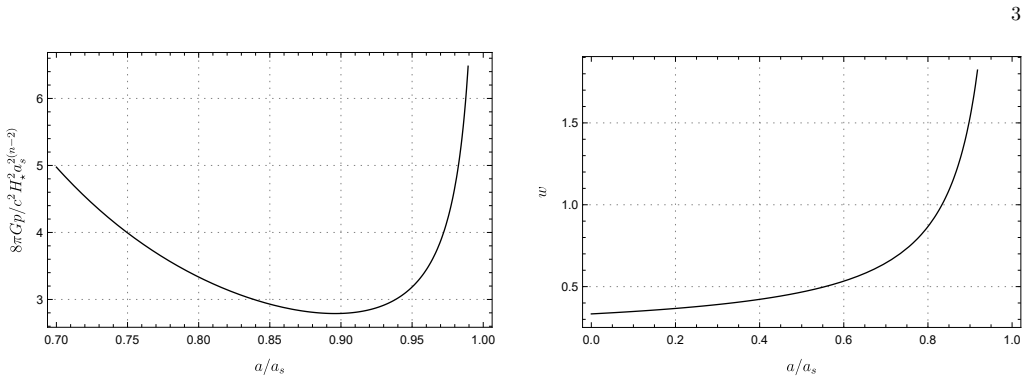
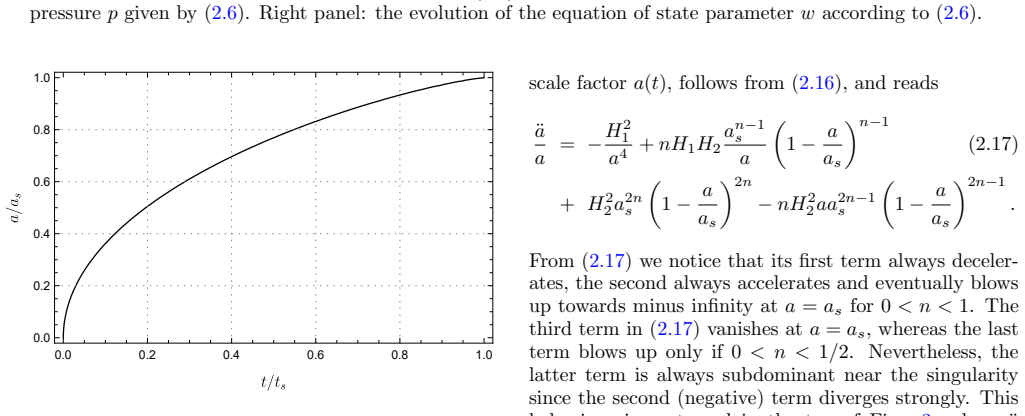
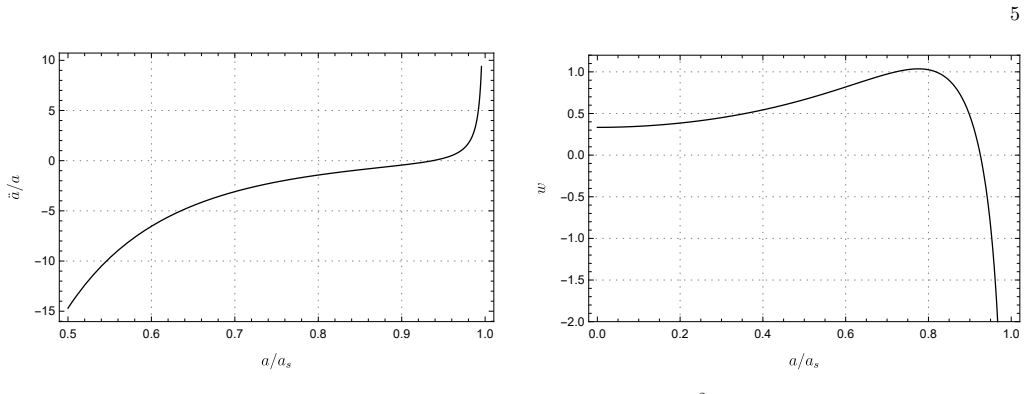
By studying a new decelerating sudden future singularity universe the authors identify a finite time pseudo-rip singularity that occurs in the finite future after a super-accelerated phantom phase. Thorough examination of the energy conditions shows violations of all of them for the FTPR, in contrast to only the dominant energy condition for the SFS. Application of Raychaudhuri averaging establishes that these singularities are weak, consistent with the requirement of geodesic completeness. The models are analyzed for their cosmological horizons in appropriate Penrose diagrams. Finally a concrete FTPR model containing standard radiation and dust fluids is constructed that can mimic the past
What carries the argument
The finite time pseudo-rip singularity, produced by a specific scale-factor form that generates a super-accelerated phantom phase followed by a pressure singularity in finite time while satisfying the FLRW background equations.
If this is right
- The FTPR violates all energy conditions while the SFS violates only the dominant energy condition.
- Both singularities remain weak according to Raychaudhuri averaging and geodesic completeness.
- A model with radiation and dust reproduces the past LambdaCDM expansion history but encounters a future pressure singularity.
- Cosmological horizons for these models can be displayed in Penrose diagrams.
Where Pith is reading between the lines
- If the specific scale factor is not generic, the FTPR may reduce to a tuned case of known sudden singularities.
- Future high-precision expansion data could test whether any observed acceleration deviates toward the predicted phantom phase.
- The construction invites comparison with modified-gravity models that also produce finite-time pressure singularities.
Load-bearing premise
The construction assumes a specific functional form for the scale factor that produces a super-accelerated phantom phase followed by a pressure singularity while still satisfying the background FLRW equations.
What would settle it
Precise measurements of the future expansion rate that either detect or rule out a transition from super-acceleration to a sudden pressure jump at a finite future time.
Figures
read the original abstract
By studying first a new decelerating sudden future singularity (SFS) universe we report finding a novel type of cosmological singularity which we dub a finite time pseudo-rip (FTPR) because unlike for a pseudo-rip, it happens in the finite future of the universe. In contrast to the new SFS model, where the expansion is decelerating before reaching the pressure singularity, the FTPR scenario is preceded by a super-accelerated phantom phase. Our claim is based on the thorough study of the energy conditions showing the violations of all of them for a FTPR, and only the dominant energy one for an SFS. Application of the so-called Raychaudhuri averaging shows that, alike within the requirement of geodesic completeness, these singularities are weak in the sense of this definition. We study the properties of the models including the behaviour of the cosmological horizons presented in the appropriate Penrose diagrams. Finally, we introduce a FTPR model containing standard radiation and dust fluids that can mimic the past expansion history of $\Lambda$CDM though facing a future pressure singularity.
Editorial analysis
A structured set of objections, weighed in public.
Referee Report
Summary. The paper reports the discovery of a novel finite-time cosmological singularity termed finite time pseudo-rip (FTPR). Unlike a standard pseudo-rip, the FTPR occurs at finite future time and is preceded by a super-accelerated phantom phase; it violates all energy conditions. This is contrasted with a new decelerating sudden future singularity (SFS) model that violates only the dominant energy condition. The distinction is realized via explicit scale-factor ansatzes inserted into the FLRW equations. The work further applies Raychaudhuri averaging to classify both singularities as weak, examines horizon behavior in Penrose diagrams, and constructs an FTPR model containing radiation and dust that reproduces the past expansion history of LambdaCDM while terminating in a future pressure singularity.
Significance. If the reported distinction between FTPR and SFS is robust, the manuscript adds a useful example to the classification of finite-time singularities in FLRW cosmologies, particularly by linking expansion history, energy-condition violations, and geodesic completeness. The explicit construction of a two-fluid model that matches LambdaCDM expansion until the future singularity is a concrete strength for potential observational relevance. The use of Raychaudhuri averaging to confirm weakness provides an independent check on the singularities' physical severity.
major comments (1)
- [§3] §3 (FTPR construction) and the associated scale-factor ansatz (Eq. (7) or equivalent): the super-accelerated phantom phase is produced by the specific functional form chosen for a(t). The manuscript provides no demonstration that this phase persists under small deformations of the ansatz or for an open interval of the free parameters; without such a check the claimed distinction from SFS reduces to a property of one isolated family rather than a structurally new singularity class.
minor comments (2)
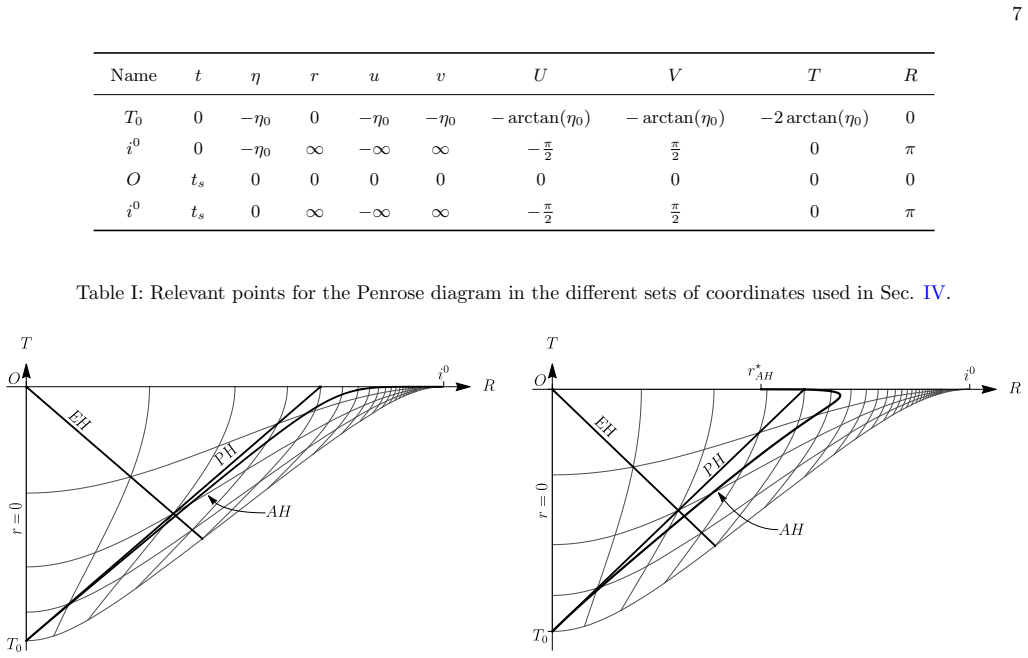
- [Figure 4] Figure 4 (Penrose diagrams): the horizons and singularity loci would be easier to interpret with explicit labels for the conformal boundaries and the location of the pressure singularity.
- The first appearance of the acronyms DEC, WEC, and SEC should be accompanied by their explicit definitions to avoid any ambiguity for readers outside the immediate subfield.
Simulated Author's Rebuttal
We thank the referee for the careful reading and constructive comments on our manuscript. We address the single major comment below.
read point-by-point responses
-
Referee: [§3] §3 (FTPR construction) and the associated scale-factor ansatz (Eq. (7) or equivalent): the super-accelerated phantom phase is produced by the specific functional form chosen for a(t). The manuscript provides no demonstration that this phase persists under small deformations of the ansatz or for an open interval of the free parameters; without such a check the claimed distinction from SFS reduces to a property of one isolated family rather than a structurally new singularity class.
Authors: The scale-factor ansatz of Eq. (7) is chosen to realize an explicit example of a finite-time pseudo-rip preceded by super-accelerated phantom expansion. Direct substitution into the FLRW equations then yields the reported violation of all energy conditions, in contrast to the decelerating SFS model that violates only the dominant energy condition. The distinction is therefore tied to the combination of expansion history and energy-condition violations rather than to an isolated functional form. The ansatz contains free parameters whose range is explored in the two-fluid construction that reproduces the past Lambda-CDM expansion while terminating in the FTPR; the qualitative features persist across this interval. While a general stability analysis under arbitrary deformations lies outside the scope of the present work, the explicit construction, supported by Raychaudhuri averaging and horizon analysis, is sufficient to introduce the new singularity class. revision: no
Circularity Check
No significant circularity; explicit model construction with open ansatzes
full rationale
The paper constructs explicit functional forms for the scale factor a(t) in both the SFS and FTPR cases, substitutes them into the FLRW equations to obtain ρ(t) and p(t), and then computes energy conditions, horizon behavior, and geodesic properties directly from those expressions. The FTPR is introduced by choosing a different a(t) that produces a preceding phantom phase, but this is presented as an illustrative example rather than a derived necessity or first-principles result. No load-bearing step reduces to a self-definition, fitted parameter renamed as prediction, or self-citation chain; the distinctions are realized by transparent parameter choices whose consequences are calculated and stated. External benchmarks such as energy-condition violations and Penrose diagrams are evaluated on the constructed models without circular reduction.
Axiom & Free-Parameter Ledger
free parameters (1)
- scale-factor parameters controlling phantom phase and singularity time
axioms (1)
- domain assumption FLRW metric and standard energy-condition definitions apply to the chosen scale factor
invented entities (1)
-
finite time pseudo-rip singularity
no independent evidence
Lean theorems connected to this paper
-
IndisputableMonolith/Cost/FunctionalEquation.leanwashburn_uniqueness_aczel unclear?
unclearRelation between the paper passage and the cited Recognition theorem.
We propose a new model of SFS … described by the Hubble rate H[a(t)] = … (2.1)
-
IndisputableMonolith/Foundation/AbsoluteFloorClosure.leanreality_from_one_distinction unclear?
unclearRelation between the paper passage and the cited Recognition theorem.
the FTPR scenario is preceded by a super-accelerated phantom phase … violations of all of them for a FTPR
What do these tags mean?
- matches
- The paper's claim is directly supported by a theorem in the formal canon.
- supports
- The theorem supports part of the paper's argument, but the paper may add assumptions or extra steps.
- extends
- The paper goes beyond the formal theorem; the theorem is a base layer rather than the whole result.
- uses
- The paper appears to rely on the theorem as machinery.
- contradicts
- The paper's claim conflicts with a theorem or certificate in the canon.
- unclear
- Pith found a possible connection, but the passage is too broad, indirect, or ambiguous to say the theorem truly supports the claim.
Reference graph
Works this paper leans on
-
[1]
A. G. Riess, A. V. Filippenko, P. Challis, A. Clocchiatti, A. Diercks, P. M. Garnavich, R. L. Gilliland, C. J. Hogan, S. Jha, R. P. Kirshner, B. Leibundgut, M. M. Phillips, D. Reiss, B. P. Schmidt, R. A. Schommer, R. C. Smith, J. Spyromilio, C. Stubbs, N. B. Suntzeff, and J. Tonry, Observational evidence from supernovae for an acceler- ating universe and ...
work page 1998
-
[2]
S. Perlmutter, G. Aldering, G. Goldhaber, R. A. Knop, P. Nugent, P. G. Castro, S. Deustua, S. Fabbro, A. Goo- bar, D. E. Groom, I. M. Hook, A. G. Kim, M. Y. Kim, J. C. Lee, N. J. Nunes, R. Pain, C. R. Penny- packer, R. Quimby, C. Lidman, R. S. Ellis, M. Irwin, R. G. McMahon, P. Ruiz-Lapuente, N. Walton, B. Schae- fer, B. J. Boyle, A. V. Filippenko, T. Mat...
work page 1999
-
[3]
E. Di Valentino, O. Mena, S. Pan, L. Visinelli, W. Yang, A. Melchiorri, D. F. Mota, A. G. Riess, and J. Silk, In the realm of the hubble tension – a review of solutions, Classical and Quantum Gravity38, 153001 (2021)
work page 2021
-
[4]
Weinberg, The cosmological constant problem, Rev
S. Weinberg, The cosmological constant problem, Rev. Mod. Phys.61, 1 (1989)
work page 1989
- [5]
-
[6]
P. Bull, Y. Akrami, J. Adamek, T. Baker, E. Bellini, J. Beltr´ an Jim´ enez, E. Bentivegna, S. Camera, S. Clesse, J. H. Davis, E. Di Dio, J. Enander, A. Heavens, L. Heisenberg, B. Hu, C. Llinares, R. Maartens, E. M¨ ort- sell, S. Nadathur, J. Noller, R. Pasechnik, M. S. Pawlowski, T. S. Pereira, M. Quartin, A. Ricciardone, S. Riemer-Sørensen, M. Rinaldi, ...
work page 2016
-
[7]
L. Perivolaropoulos and F. Skara, Challenges for Λcdm: An update, New Astronomy Reviews95, 101659 (2022)
work page 2022
-
[8]
R. Caldwell, A phantom menace? cosmological conse- quences of a dark energy component with super-negative equation of state, Physics Letters B545, 23 (2002)
work page 2002
-
[9]
R. R. Caldwell, M. Kamionkowski, and N. N. Weinberg, Phantom energy: Dark energy withw=−1 causes a cosmic doomsday, Phys. Rev. Lett.91, 071301 (2003)
work page 2003
-
[10]
M. P. D¸ abrowski, T. Stachowiak, and M. Szyd lowski, Phantom cosmologies, Phys. Rev. D68, 103519 (2003)
work page 2003
-
[11]
S. W. Hawking and G. F. R. Ellis,The Large Scale Struc- ture of Space-Time(Cambridge University Press, 1973) cambridge Books Online
work page 1973
-
[12]
J. D. Barrow, Sudden future singularities, Classical and Quantum Gravity21, L79 (2004)
work page 2004
-
[13]
J. D. Barrow, More general sudden singularities, Classical and Quantum Gravity21, 5619 (2004)
work page 2004
- [14]
-
[15]
M. D¸ abrowski, Are singularities the limits of cosmology?, inMathematical Structures of the Universe, edited by M. Heller, M. Eckstein, and S. Szybka (Copernicus Cen- ter Press, Krak´ ow, 2014) pp. 101–118
work page 2014
-
[16]
P. H. Frampton, K. J. Ludwick, and R. J. Scherrer, Pseudo-rip: Cosmological models intermediate between the cosmological constant and the little rip, Phys. Rev. D85, 083001 (2012)
work page 2012
-
[17]
O. Trivedi and A. V. Timoshkin, Little rip, pseudo rip and bounce cosmology with generalized equation of state in non-standard backgrounds, Eur. Phys. J. C84, 277 (2024)
work page 2024
-
[18]
M. Bouhmadi-L´ opez, A. Errahmani, P. Mart´ ın- Moruno, T. Ouali, and Y. Tavakoli, The little sib- ling of the big rip singularity, International Jour- nal of Modern Physics D24, 1550078 (2015), https://doi.org/10.1142/S0218271815500789
-
[19]
P. H. Frampton, K. J. Ludwick, and R. J. Scherrer, The little rip, Phys. Rev. D84, 063003 (2011)
work page 2011
-
[20]
M. Bouhmadi-L´ opez, P. Gonz´ alez-D´ ıaz, and P. Mart´ ın- Moruno, Worse than a big rip?, Physics Letters B659, 1 (2008)
work page 2008
-
[21]
M. Bouhmadi-L´ opez, P. F. Gonz´ alez-D´ ıaz, and P. Mart´ ın-Moruno, On the generalized chaplygin gas: worse than a big-rip or quiaeter than a sudden singularity?, International Journal of Modern Physics D 17, 2269 (2008)
work page 2008
- [22]
-
[23]
M. P. D¸ abrowski, T. Denkiewicz, and M. A. Hendry, How far is it to a sudden future singularity of pressure?, Phys. Rev. D75, 123524 (2007)
work page 2007
-
[24]
Z. Keresztes, L. Gergely, V. Gorini, U. Moschella, and A. Y. Kamenshchik, Tachyon cosmology, supernovae data, and the big brake singularity, Phys. Rev. D79, 083504 (2009)
work page 2009
-
[25]
Z. Keresztes, L. A. Gergely, A. Y. Kamenshchik, V. Gorini, and D. Polarski, Will the tachyonic universe survive the big brake?, Phys. Rev. D82, 123534 (2010)
work page 2010
-
[26]
M. D¸ abrowski and K. Marosek, Non-exotic conformal structure of weak exotic singularities, General Relativ- ity and Gravitation50, 160 (2018)
work page 2018
- [27]
-
[28]
F. Melia, The apparent (gravitational) horizon in cosmol- ogy, American Journal of Physics86, 585 (2018)
work page 2018
- [29]
-
[30]
P. J. Steinhardt and N. Turok, Cosmic evolution in a cyclic universe, Phys. Rev. D65, 126003 (2002)
work page 2002
- [31]
-
[32]
L. Fern´ andez-Jambrina and R. Lazkoz, Geodesic behav- ior of sudden future singularities, Phys. Rev. D70, 121503 (2004)
work page 2004
-
[33]
F. J. Tipler, Singularities in conformally flat spacetimes, Physics Letters A64, 8 (1977)
work page 1977
-
[34]
A. Kr´ olak, Towards the proof of the cosmic censorship hy- pothesis, Classical and Quantum Gravity3, 267 (1986)
work page 1986
-
[35]
A. K. Raychaudhuri, Theorem for nonrotating singularity-free universes, Phys. Rev. Lett.80, 654 (1998)
work page 1998
-
[36]
M. P. D¸ abrowski, Spacetime averaging of exotic singular- ity universes, Physics Letters B702, 320 (2011)
work page 2011
discussion (0)
Sign in with ORCID, Apple, or X to comment. Anyone can read and Pith papers without signing in.