REVIEW 4 major objections 5 minor 14 references
Synthesizable Molecular Generation via Soft-constrained GFlowNets with Rich Chemical Priors
T0 review · 4 major / 5 minor · reviewed 2026-08-03 · deepseek-v4-flash
Pith's one-line read S3-GFN shows that synthesizability in molecular generation can be learned as a soft, distributional constraint—via contrastive replay of positive and negative SMILES trajectories—rather than hard-coded into reaction-based state spaces, achi
desk verdict Soft-constraint GFlowNet post-training with contrastive replay is a credible, reusable alternative to reaction-based synthesizable generation, but the synthesizability claims need a careful referee to check oracle-dependence and evaluation filtering. read the letter →
The pith
A machine-rendered reading of the paper's core claim, the machinery that carries it, and where it could break.
The reading
What carries the argument
The load-bearing pieces are the relative trajectory balance (RTB) objective, which reweights a pretrained prior toward the reward-scaled posterior, and the contrastive replay loss, which separates positive (synthesizable) and negative (unsynthesizable) trajectories by comparing their sequence-level log-likelihoods. Two replay buffers supply the contrast: D+ stores synthesizable trajectories with reward-prioritized sampling, D− stores unsynthesizable ones uniformly, and local mutations of positives generate additional informative negatives. The contrastive term is applied only during replay, so the reward objective and constraint objective are optimized separately rather than entangled as in
What would settle it
Take the molecules the model labels as positive and pass them through an independent retrosynthesis planner built on a different reaction set, or attempt actual laboratory synthesis of a sample; if the positive ratio or external synthesis-success rate falls well below the claimed 95%, the central claim that the soft constraint induces synthesizability is falsified.
Extended reading notes
Core claim
S3-GFN establishes that synthesizability can be induced at the level of the sampling distribution rather than the state space. Starting from a pretrained SMILES prior, the model is post-trained so that posterior probability is proportional to reward times prior inside the synthesizable set; on-policy updates use relative trajectory balance on positive samples only, while replay updates combine RTB on positives with a contrastive loss that suppresses negative trajectories. The auxiliary loss is what prevents probability mass from leaking into unsynthesizable regions, and the off-policy replay buffers let the model incorporate external search operators such as mutations and genetic search. Acr
Load-bearing premise
The entire training signal—which molecules count as synthesizable—comes from an automated retrosynthesis search procedure; if that oracle is permissive or incomplete, the claimed synthesizability of the model's output inherits its errors.
Editorial extensions
If this is right
- A sequence-based GFlowNet can reach or exceed the synthesizability and reward of reaction-based GFlowNets, without needing a combinatorial reaction action space.
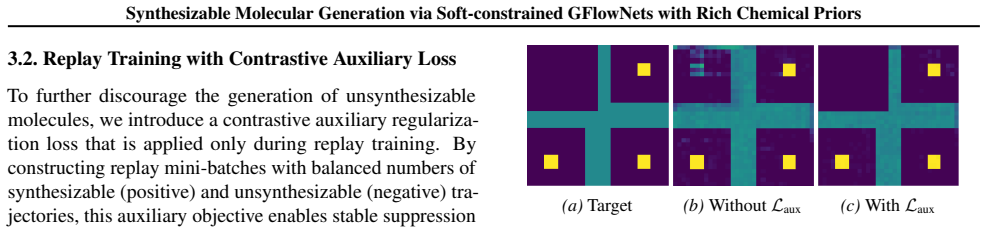
- The contrastive replay loss suppresses unsynthesizable probability mass while preserving shared substructures, avoiding the over-suppression seen with reward shaping.
- When synthesizability constraints change (e.g., a curated reaction set plus drug-likeness filters), the model can realign in about 100 replay-only steps, keeping most of its reward and diversity.
- Off-policy replay makes it straightforward to inject externally discovered high-reward positives (via genetic search) and locally mutated negatives, improving sample-limited optimization.
- Generated molecules receive high success rates under an independent retrosynthesis planning metric—higher than reaction-based baselines—indicating the soft constraint transfers beyond the training reaction set.
Reading between the lines
- The same replay-and-contrast recipe could be applied to other soft constraints (toxicity, ADMET, novelty filters) by changing only the oracle that labels the buffers, not the MDP or the loss.
- If the pretrained prior already carries a strong implicit bias toward synthesizable chemistry, then the contrastive term may be acting mainly at the boundary; a testable prediction is that the required auxiliary coefficient shrinks as the prior improves.
- The reported synthesizability numbers inherit the oracle's definition; a stricter or independent route-finder could lower them, so the headline '≥95%' should be read as '≥95% according to the retrosynthesis heuristic used for labeling'.
- Because negative samples are generated by mutating positives, the model may learn to avoid local neighborhoods of synthesizable molecules; whether this shrinks accessible chemical space relative to reaction-based methods is worth measuring explicitly.
Editorial analysis
A structured set of objections, weighed in public.
Referee Report
Summary. The paper proposes S3-GFN, a sequence-based SMILES GFlowNet that induces synthesizability as a soft distributional constraint. Starting from the pretrained GP-MolFormer prior, the method applies relative trajectory balance (RTB) only to molecules labeled as synthesizable by a retrosynthesis heuristic, and adds a contrastive auxiliary loss over replay buffers of positive and negative samples to suppress unsynthesizable regions. The authors report that S3-GFN achieves over 95% synthesizability, outperforms reaction-based GFlowNets on sEH proxy optimization, structure-based docking benchmarks on five LIT-PCBA targets, and sample-limited PMO tasks, and enables fast adaptation to changed synthesis constraints. The paper includes a 2D grid-world proof of concept, extensive ablations, and released code.
Significance. If the central claim holds, S3-GFN offers a flexible and scalable alternative to reaction-based GFlowNet MDPs by leveraging pretrained SMILES language models, with the ability to adapt to evolving synthesizability constraints without redesigning the action space. The paper's strengths include the broad experimental coverage, the inclusion of an external AiZynthFinder check on the sEH task, the controlled reward-shaping baseline, the off-policy genetic-exploration extension, and the public code release. The main weakness is that the headline synthesizability claim rests on a metric that is partly defined by the same oracle that provides training labels, and raw-output synthesizability is not reported for several benchmark settings. These issues are addressable with additional evaluation and clarification.
major comments (4)
- [§5.1.2, Table 2, Appendix B.3] The abstract's '>=95% synthesizable' claim is not established for the structure-based drug design task. AiZynthFinder success in Table 2 is reported only for the diverse Top-100 candidates after 'negative samples' have been explicitly excluded (Appendix B.3). The synthesizability of the full 64,000-molecule generation distribution is never reported for any LIT-PCBA target. Because the contrastive training explicitly penalizes molecules that the oracle labels negative, the high Top-100 AiZynthFinder rates do not imply that the raw sampler output is >=95% synthesizable. Please report Positive Ratio and/or AiZynthFinder success on the full generated set (before filtering) for all five targets.
- [§5.1.1, Table 1 vs. Abstract] There is an inconsistency in the metric supporting the '>=95%' claim. On sEH, the template-based Positive Ratio is 0.945±0.009 (Table 1), below 95%, while the external AiZynthFinder success on random samples is 0.990±0.008 (Table 6). If AiZynthFinder is the intended operational definition of synthesizability, this should be stated explicitly and reported consistently across all tasks and tables. If Positive Ratio is the intended definition, the headline claim should be revised or the threshold clarified.
- [§3, Problem definition and Algorithm 1] The training signal and the primary 'Positive Ratio' metric both come from the same heuristic retrosynthesis oracle (105 templates + Enamine Stock, max 3 steps). The model is trained to imitate that oracle's labels, so the Positive Ratio is partly enforced by construction and does not independently validate synthesizability. The independent AiZynthFinder result on sEH (0.990 raw) substantially mitigates this concern for that task; extending the same raw-output external evaluation to the SBDD and PMO benchmarks would address the concern for the paper's general claim.
- [Table 2] The baseline numbers for SynFlowNet, RGFN, and RxnFlow are taken from Seo et al. (2025), while S3-GFN is evaluated with the protocol described in Appendix B.3, including Uni-Dock and exclusion of negative samples before Top-100 selection. Please confirm that the docking software, receptor preparation, selection criteria, and exclusion policy are identical for all methods, or explicitly state any differences. If the baseline numbers were produced under a different evaluation pipeline, the performance comparison (especially AiZynthFinder success rates) may be confounded.
minor comments (5)
- [Table 1 / Table 6] Several reported means have zero standard deviation across three runs (e.g., S3-GFN Pos. Top100 sEH 1.009±0.000, Diversity 0.764±0.000). This is surprising for independent runs and should be explained. If it is due to reward saturation and deterministic Top-100 selection, a sentence clarifying this would help.
- [Eq. (4) and Algorithm 1] If the negative replay buffer B− is empty in early training, the contrastive loss Laux in Eq. (4) is undefined. Please state the initialization or fallback behavior (e.g., skip auxiliary loss until B− has samples).
- [Appendix B.5] The sentence 'We omit VE' appears incomplete. It likely refers to omitting a specific oracle from the PMO benchmark; please complete or rephrase.
- [Appendix B.4] There is a typo: 'Lipinski et al. (2012))' has a double closing parenthesis. Also, the curated reaction list would benefit from a table or SMARTS list in the appendix.
- [Figure 3 caption] The caption states 'SFN guarantees 100% validity' but the figure compares SynFlowNet; please use the full method name consistently.
Circularity Check
Partial circularity: the primary Positive Ratio metric uses the same retrosynthesis oracle that supplies the training labels; independent AiZynthFinder checks mitigate on sEH but are reported only on a positive-filtered subset for SBDD.
-
fitted input called prediction
[Section 3 (Problem definition and Algorithm 1), Section 5 (Common setup), Tables 1 and 6]
"we define X′ as the set of molecules possessing at least one valid synthetic route by using a heuristic retrosynthesis search procedure following Seo et al. (2025) ... if I[xi ∈ X′] = 1 then B+ t ← B+ t ∪ {(τi, R(xi))} else D− ← D− ∪ {τi}"
The same X′ oracle is used both to construct the training signal and to compute the reported synthesizability metric. In Algorithm 1, I[x ∈ X′] decides which trajectories enter the positive-only RTB update and which populate D− for the contrastive loss Laux in Eq. 4; the contrastive loss explicitly suppresses negative trajectories relative to positive ones. The 'Positive Ratio' reported in Tables 1 and 6 is then the fraction of generated molecules satisfying the same I[x ∈ X′] condition. Thus high Positive Ratio is partly enforced by construction rather than independently measured. The paper does report AiZynthFinder as a separate, external check — on sEH it is high (0.990), which substantially mitigates the issue — but the raw Positive Ratio on sEH (0.945) is actually below the abstract's
-
other
[Appendix B.3 (structure-based drug discovery, evaluation of Table 2)]
"We excluded negative samples to make sure that the overall evaluations are conducted on synthesizable molecules."
For the SBDD benchmark, AiZynthFinder success in Table 2 is computed only on the diverse Top-100 set after negative samples have been explicitly removed. Since 'negative' is defined by the same retrosynthesis oracle used to generate training labels, these 96–100% AiZynthFinder rates are conditional on the training signal and do not estimate the synthesizability of the raw 64,000-molecule generation distribution. This is an evaluation-selection gap adjacent to circularity: the external metric is applied to a subset already filtered by the training oracle, so the abstract's '≥95% synthesizable' claim is not independently established for SBDD targets.
full rationale
The central derivation — a pre-trained SMILES prior, RTB post-training, and a contrastive replay-buffer loss — is not itself circular: the reward is an independent input, and the auxiliary loss is a genuine regularizer on the sequence policy. No load-bearing self-citation is present: citations to Seo et al. (2025), SynFlowNet, and Kim et al. (2024a) supply methods, benchmarks, or exploration operators, not uniqueness theorems that forbid alternatives. The main circularity risk is that 'synthesizability' is operationally defined by a heuristic retrosynthesis oracle, and that same oracle labels the training buffers while also defining the primary Positive Ratio metric. This makes the Positive Ratio a partially self-predicting quantity, not an independent test of the method's ability to 'induce' synthesizability. The paper partially escapes this by reporting AiZynthFinder, an independent retrosynthesis model, as a second metric; on sEH this is computed on unfiltered random samples and is strong evidence (0.990). For SBDD, however, the AiZynthFinder metric is reported only after excluding negatives, so it does not verify the raw-output synthesizability claim for those targets. Overall the circularity is real but partial and localized to metric construction; the independent AiZynthFinder evidence on one benchmark and the generally self-contained training/evaluation pipeline keep the score moderate.
Assumptions & free parameters
free parameters (6)
- auxiliary loss coefficient α =
0.01 (grid world), 1e-3 (molecular tasks)
- reward temperature β =
25 for sEH/SBDD, 50 for PMO
- replay buffer size =
6400 main, 1024 PMO
- positive buffer eviction rule / reward-prioritized sampling =
heuristic
- genetic offspring count =
32 in S3-GFN (vs 8 in original)
- max synthesis steps / reaction set used by oracle =
3 steps, 105 templates; adaptation 2 steps, 32 curated reactions
assumptions (6)
- standard math RTB and TB objectives are valid GFlowNet objectives: minimizing them to zero gives p(x) ∝ R(x) or p_post ∝ R·p_prior.
- domain assumption Backward distribution is deterministic for SMILES sequence MDP (PB(τ|x)=1).
- domain assumption SMILES token generation defines a valid MDP and the pretrained GP-MolFormer provides a good prior over synthesizable chemistry.
- domain assumption Retrosynthesis search (X′ membership) is a reliable oracle for synthesizability.
- domain assumption AiZynthFinder success is a meaningful independent measure of synthesizability.
- domain assumption Docking scores (Uni-Dock/Vina) are predictive of real binding affinity.
invented entities (2)
-
S3-GFN training objective
-
No new physics/chemistry entities
Cite this review
Pith. "Pith review of Synthesizable Molecular Generation via Soft-constrained GFlowNets with Rich Chemical Priors." pith.science (2026). https://pith.science/paper/H5TVGW6E
@misc{pith2026260204119,
  author       = {Pith},
  title        = {Pith review of: Synthesizable Molecular Generation via Soft-constrained GFlowNets with Rich Chemical Priors},
  year         = {2026},
  howpublished = {\url{https://pith.science/paper/H5TVGW6E}},
  note         = {Machine review of arXiv:2602.04119}
}
abstract
The application of generative models for experimental drug discovery campaigns is severely limited by the difficulty of designing molecules de novo that can be synthesized in practice. Previous works have leveraged Generative Flow Networks (GFlowNets) to impose hard synthesizability constraints through the design of state and action spaces based on predefined reaction templates and building blocks. Despite the promising prospects of this approach, it currently lacks flexibility and scalability. As an alternative, we propose S3-GFN, which generates synthesizable SMILES molecules via simple soft regularization of a sequence-based GFlowNet. Our approach leverages rich molecular priors learned from large-scale SMILES corpora to steer molecular generation towards high-reward, synthesizable chemical spaces. The model induces constraints through off-policy replay training with a contrastive learning signal based on separate buffers of synthesizable and unsynthesizable samples. Our experiments show that S3-GFN learns to generate synthesizable molecules ($\geq 95\%$) with higher rewards in diverse tasks.
Figures


Figures from the paper (8 more)


Reference graph
Works this paper leans on
-
[2]
Fast adaptation We study a setting in which synthesizability constraints are revised after a model has already been trained
Table 5.Protein targets usedand the corresponding PDB ID from the LIT-PCBA dataset used in structure-based drug discovery Target PDB Id Target Name ADRB2 4ldo Beta2 adrenoceptor ALDH1 5l2m Aldehyde dehydrogenase 1 ESR ago 2p15 Estrogen receptorαwith agonist ESR antago 2iok Estrogen receptorαwith antagonist FEN1 5fv7 FLAP Endonuclease 1 B.4. Fast adaptatio...
2012
-
[3]
Each fragment can have one or several possible attachment points
Fragment-based GFN (FragGFN) trainingIn fragment-based GFlowNet formulations, molecules are constructed by sequentially assembling molecular fragments. Each fragment can have one or several possible attachment points. The discrete action space corresponds to jointly choosing an attachment site and a fragment to attach, with an additional stop action to te...
2025
-
[6]
Chemical reactions from US patents (1976- sep2016),
Lowe, D. Chemical reactions from US patents (1976- sep2016),
1976
-
[10]
18 Synthesizable Molecular Generation via Soft-constrained GFlowNets with Rich Chemical Priors C.4
ADRB2, seed 0 Vina: -13.44, QED: 0.92 ADRB2, seed 1 Vina: -13.33, QED: 0.88 ADRB2, seed 2 Vina: -13.84, QED: 0.82 ALDH1, seed 0 Vina: -12.71, QED: 0.90 ALDH1, seed 1 Vina: -12.53, QED: 0.92 ALDH1, seed 2 Vina: -13.16, QED: 0.86 ESR_ago, seed 0 Vina: -12.79, QED: 0.81 ESR_ago, seed 1 Vina: -12.68, QED: 0.82 ESR_ago, seed 2 Vina: -12.67, QED: 0.83 ESR_antag...
-
[12]
(92 bimolecular and 13 unimolecular reactions), which are also used in various reaction-based generation works (Cretu et al., 2025; Seo et al., 2025; Lo et al., 2025). We curate reactions based on domain knowledge to ensure that the retained templates correspond to one-step transformations that are routinely used in medicinal chemistry laboratories. Rare,...
2025
-
[13]
We omit VE To rigorously evaluate sample efficiency, the optimization budget is strictly limited to 10,000 oracle calls
and Therapeutics Data Commons (Huang et al., 2021), including bioactivity predictors (e.g., DRD2, GSK3β) and drug-likeness measures (e.g., QED), all normalized to [0,1] . We omit VE To rigorously evaluate sample efficiency, the optimization budget is strictly limited to 10,000 oracle calls. Performance is primarily assessed via the Area Under the Curve (A...
2021
-
[25]
For the sample-efficient molecule generation task, we adopt β= 50, following Kim et al. (2024a). In Appendix C.2, we investigate how lowering β impacts the trade-off between diversity and rewards in the sEH task. We maintain separate replay buffers for positive and negative samples. In the positive buffer, we apply a reward-based eviction rule: when the b...
2025
-
[64]
Implementation details of genetic explorationWe employ genetic exploration only in the sample-limited setting described in Section 5.3, following the genetic-guided GFlowNet framework of Kim et al. (2024a). Our implementation largely matches the original method, with the key difference that samples generated via genetic operators are incorporated into tra...
2019
Show all 14 references
-
[2012]
W., and Matusik, W
Lo, A., Coley, C. W., and Matusik, W. A genetic algorithm for navigating synthesizable molecular spaces.arXiv preprint arXiv:2509.20719,
-
[2019]
Genetic-guided GFlowNets for sample efficient molecular optimization
Kim, H., Kim, M., Choi, S., and Park, J. Genetic-guided GFlowNets for sample efficient molecular optimization. InNeural Information Processing Systems (NeurIPS), 2024a. Kim, M., Yun, T., Bengio, E., Zhang, D., Bengio, Y ., Ahn, S., and Park, J. Local search GFlowNets. InIntern...
2025
-
[2020]
Sample efficiency matters: a benchmark for practical molecular optimiza- tion.Advances in Neural Information Processing Systems (NeurIPS), 2022a
Gao, W., Fu, T., Sun, J., and Coley, C. Sample efficiency matters: a benchmark for practical molecular optimiza- tion.Advances in Neural Information Processing Systems (NeurIPS), 2022a. Gao, W., Mercado, R., and Coley, C. W. Amortized tree generation for bottom-up synthesis pl...
-
[2024]
B., McLellan, S., Arnold, A., Tu, M
Swanson, K., Liu, G., Catacutan, D. B., McLellan, S., Arnold, A., Tu, M. M., Brown, E. D., Zou, J., and Stokes, J. M. SyntheMol-RL: a flexible reinforcement learning framework for designing novel and synthesizable antibi- otics.bioRxiv, pp. 2025–05,
2025
-
[2025]
S., and Schwaller, P
Guo, J., Sabanza-Gil, V ., Jonˇcev, Z., Luterbacher, J. S., and Schwaller, P. Generative molecular design with steer- able and granular synthesizability control.arXiv preprint arXiv:2505.08774,
-
[2026]
Li, Y ., Zhang, L., and Liu, Z
URL https://arxiv.org/abs/ 2509.16084. Li, Y ., Zhang, L., and Liu, Z. Multi-objective de novo drug design with conditional graph generative model.Journal of cheminformatics, 10(1):33,
Reviewed August 3, 2026 · model on record in the stance chip above.
Discussion (0). Sign in to comment.