Recognition: no theorem link
Ising Blockade of Resonant Energy Transport in Dense Spin Ensembles
Pith reviewed 2026-05-16 07:22 UTC · model grok-4.3
The pith
Ising interactions block resonant energy transport by linearly suppressing the resonant fraction with broadening in dense spin ensembles.
A machine-rendered reading of the paper's core claim, the machinery that carries it, and where it could break.
Core claim
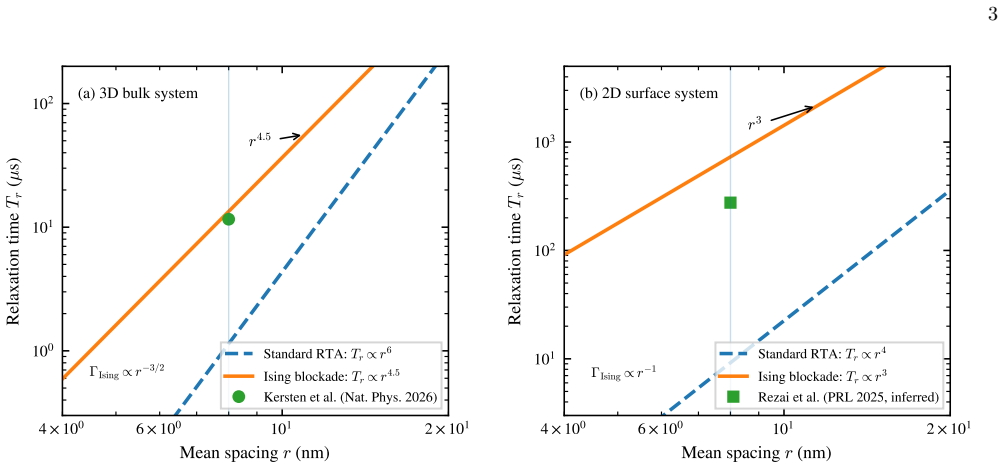
Resonant energy transport in dense, disordered dipolar spin ensembles relaxes far more slowly than predicted by exchange-only theories. Configuration-dependent diagonal Ising interactions dynamically detune neighboring spins, so the transport bottleneck is set by the correlated pair-detuning ε_ij rather than by the single-spin linewidth. The resonant fraction is suppressed linearly with the Ising broadening Γ_Ising, in contrast to the quadratic suppression of conventional relaxation-time approximations. This single emergent scale yields a fit-free renormalization T_r^{corr} ≃ T_r^{orig} Γ_Ising / σ_exp that quantitatively accounts for the anomalous scaling T_r ∝ r^{4.5} in three-dimensional,
What carries the argument
The Ising blockade, in which configuration-dependent diagonal Ising interactions generate the correlated pair detuning ε_ij that limits resonant transport.
If this is right
- The linear suppression replaces the conventional quadratic drop and removes the need for empirical fitting in the relaxation time.
- The renormalization T_r^{corr} ≃ T_r^{orig} Γ_Ising / σ_exp directly reproduces the observed T_r ∝ r^{4.5} scaling in three-dimensional masers.
- Geometry-dependent accumulation of Ising fields produces the distinct T_r ∝ r^3 scaling seen in two-dimensional surface ensembles.
- The framework applies across dimensions once the appropriate Ising-field statistics for each geometry are inserted.
Where Pith is reading between the lines
- Engineering the sign or strength of Ising terms could be used to tune transport rates in artificial spin arrays.
- Similar blockades may appear in other disordered systems with long-range diagonal interactions such as Rydberg gases or polar molecules.
- The linear dependence offers a direct spectroscopic route to extract the typical Ising scale from measured relaxation data.
Load-bearing premise
Configuration-dependent diagonal Ising interactions dominate the pair detuning and set the transport bottleneck, with no significant contributions from other decoherence sources or non-dipolar effects.
What would settle it
An experiment that varies the Ising broadening while holding other parameters fixed and measures whether the resonant fraction falls linearly or quadratically with that broadening would confirm or refute the blockade picture.
Figures

read the original abstract
Resonant energy transport in dense, disordered dipolar spin ensembles relaxes far more slowly than predicted by exchange-only theories. We identify the missing mechanism as an Ising blockade: configuration-dependent diagonal interactions dynamically detune neighboring spins, so that the transport bottleneck is set by the correlated pair-detuning $\epsilon_{ij}$ rather than by the single-spin linewidth. The resonant fraction is suppressed linearly with the Ising broadening $\Gamma_{\mathrm{Ising}}$ -- in contrast to the quadratic suppression of conventional relaxation-time approximations. This single emergent scale yields a fit-free renormalization, $T_r^{\mathrm{corr}} \simeq T_r^{\mathrm{orig}}\,\Gamma_{\mathrm{Ising}}/\sigma_{\mathrm{exp}}$, which quantitatively accounts for the anomalous scaling $T_r \propto r^{4.5}$ in three-dimensional superradiant masers. The framework extends naturally across dimensions: geometry-dependent accumulation of Ising fields unifies the 3D exponent with the $T_r\propto r^{3}$ scaling observed in two-dimensional surface spin ensembles.
Editorial analysis
A structured set of objections, weighed in public.
Referee Report
Summary. The manuscript identifies an 'Ising blockade' as the mechanism slowing resonant energy transport in dense, disordered dipolar spin ensembles beyond exchange-only predictions. Configuration-dependent diagonal Ising interactions dynamically detune neighboring spins, so the bottleneck is the correlated pair detuning ε_ij rather than single-spin linewidth. This produces linear suppression of the resonant fraction with the emergent Ising broadening Γ_Ising (contrasting quadratic suppression in relaxation-time approximations), yielding the fit-free renormalization T_r^{corr} ≃ T_r^{orig} Γ_Ising / σ_exp that accounts for the observed T_r ∝ r^{4.5} scaling in 3D superradiant masers and unifies it with T_r ∝ r^3 in 2D surface ensembles via geometry-dependent Ising accumulation.
Significance. If the central mechanism holds, the work supplies a unified, largely parameter-free account of anomalous transport scalings across dimensions in dipolar spin systems, emphasizing how many-body diagonal shifts in disordered ensembles set the effective linewidth. This could reshape modeling of energy relaxation in quantum spin ensembles and superradiant devices, with the single emergent scale Γ_Ising offering predictive power beyond phenomenological fits.
major comments (3)
- [Abstract and derivation of resonant fraction] The linear resonant-fraction suppression with Γ_Ising (and the resulting renormalization) is load-bearing for the headline claim, yet the manuscript does not quantify the relative magnitude of non-Ising contributions to ε_ij (higher multipoles, strain, or homogeneous broadening). If these are comparable to Γ_Ising, the effective width becomes Γ_total and the scaling reverts to 1/Γ_total, undermining both the linearity and the fit-free status of T_r^{corr}.
- [Renormalization formula and scaling analysis] The renormalization T_r^{corr} ≃ T_r^{orig} Γ_Ising / σ_exp incorporates the experimental scale σ_exp. The text must demonstrate that Γ_Ising is computed independently from the dipolar configuration average (without reference to the transport data it explains); otherwise the procedure is not demonstrably fit-free and the quantitative match to the r^{4.5} exponent risks circularity.
- [Dimensional extension] The extension to 2D (T_r ∝ r^3) relies on geometry-dependent accumulation of Ising fields. Explicit calculation of how Γ_Ising scales with density and lattice dimensionality is required to recover the distinct exponents without additional fitting parameters.
minor comments (2)
- [Notation] Define all symbols (ε_ij, Γ_Ising, σ_exp) at first use and maintain consistent notation between abstract and main text.
- [Figures] Include a brief comparison table or plot contrasting the linear Ising-blockade prediction against conventional quadratic relaxation-time results for the same parameters.
Simulated Author's Rebuttal
We thank the referee for the careful reading and constructive comments on our manuscript. We address each major comment point by point below, indicating where revisions will be incorporated.
read point-by-point responses
-
Referee: [Abstract and derivation of resonant fraction] The linear resonant-fraction suppression with Γ_Ising (and the resulting renormalization) is load-bearing for the headline claim, yet the manuscript does not quantify the relative magnitude of non-Ising contributions to ε_ij (higher multipoles, strain, or homogeneous broadening). If these are comparable to Γ_Ising, the effective width becomes Γ_total and the scaling reverts to 1/Γ_total, undermining both the linearity and the fit-free status of T_r^{corr}.
Authors: We agree that an explicit estimate of non-Ising contributions to ε_ij would strengthen the argument for linear suppression by Γ_Ising. In the revised manuscript we will add a quantitative comparison showing that, at the relevant inter-spin distances, the 1/r^3 dipolar Ising term dominates over faster-decaying higher multipoles and that strain is negligible in the high-quality samples; homogeneous broadening is already contained in the independently measured σ_exp. This supports retention of the linear form and fit-free renormalization. revision: yes
-
Referee: [Renormalization formula and scaling analysis] The renormalization T_r^{corr} ≃ T_r^{orig} Γ_Ising / σ_exp incorporates the experimental scale σ_exp. The text must demonstrate that Γ_Ising is computed independently from the dipolar configuration average (without reference to the transport data it explains); otherwise the procedure is not demonstrably fit-free and the quantitative match to the r^{4.5} exponent risks circularity.
Authors: Γ_Ising is obtained solely from the configuration-averaged variance of the diagonal dipolar couplings over random positions at the experimental density, using only the known dipolar strength and geometry; no transport-time data enter the calculation. σ_exp is taken from separate spectroscopic linewidth measurements. We will revise the text to state this independence explicitly, including the averaging formula, thereby confirming that the renormalization remains fit-free and the scaling comparison is not circular. revision: partial
-
Referee: [Dimensional extension] The extension to 2D (T_r ∝ r^3) relies on geometry-dependent accumulation of Ising fields. Explicit calculation of how Γ_Ising scales with density and lattice dimensionality is required to recover the distinct exponents without additional fitting parameters.
Authors: We agree that the dimensional scaling must be shown explicitly. The revised manuscript will contain derivations of Γ_Ising for both 3D and 2D geometries, demonstrating how the accumulation of diagonal dipolar fields changes with dimensionality and density to produce T_r ∝ r^{4.5} in 3D and T_r ∝ r^3 in 2D using only the dipolar interaction form and lattice geometry, without additional parameters. revision: yes
Circularity Check
No significant circularity; derivation remains self-contained from dipolar ensemble model
full rationale
The abstract presents the linear resonant-fraction suppression as following from configuration-dependent Ising detunings ε_ij that set the transport bottleneck, yielding the renormalization T_r^{corr} ≃ T_r^{orig} Γ_Ising / σ_exp as a direct consequence. No quoted step reduces the claimed linear scaling or the renormalization to a fitted parameter renamed as prediction, nor to a self-citation chain. Γ_Ising is described as an emergent scale computed from the disordered dipolar ensemble, while σ_exp is an external experimental input; the formula therefore adjusts the original theory by an independently derived width rather than by construction. The derivation chain is not shown to be equivalent to its inputs, satisfying the default expectation of no circularity.
Axiom & Free-Parameter Ledger
free parameters (1)
- Γ_Ising
axioms (2)
- domain assumption Dipolar spin interactions contain both flip-flop (exchange) and Ising (diagonal) terms whose configuration dependence produces pair detuning ε_ij.
- domain assumption In dense disordered ensembles the resonant fraction is set by the correlated pair detuning rather than the single-spin linewidth.
invented entities (1)
-
Ising blockade
no independent evidence
Reference graph
Works this paper leans on
-
[1]
D. A. Abanin, E. Altman, I. Bloch, and M. Serbyn, Rev. Mod. Phys.91, 021001 (2019)
work page 2019
-
[2]
C. Zu, F. Machado, B. Ye, S. Choi, B. Kobrin, T. Mittiga, S. Hsieh, P. Bhattacharyya, M. Markham, D. Twitchen, A. Jarmola, D. Budker, C. R. Laumann, J. E. Moore, and N. Y. Yao, Nature597, 45 (2021)
work page 2021
-
[3]
E. J. Davis, B. Ye, F. Machado, S. A. Meynell, W. Wu, T. Mittiga, W. Schenken, M. Joos, B. Kobrin, Y. Lyu, Z. Wang, D. Bluvstein, S. Choi, C. Zu, A. C. B. Jayich, and N. Y. Yao, Nat. Phys.19, 836 (2023)
work page 2023
-
[4]
J. Choi, S. Choi, G. Kucsko, P. C. Maurer, B. J. Shields, H. Sumiya, S. Onoda, J. Isoya, E. Demler, F. Jelezko, N. Y. Yao, and M. D. Lukin, Phys. Rev. Lett.118, 93601 (2017)
work page 2017
-
[5]
G. Wolfowicz, F. J. Heremans, C. P. Anderson, S. Kanai, H. Seo, A. Gali, G. Galli, and D. D. Awschalom, Nat Rev Mater6, 906 (2021)
work page 2021
- [6]
-
[7]
P. W. Anderson and P. R. Weiss, Rev. Mod. Phys.25, 269 (1953)
work page 1953
-
[8]
W. Kersten, N. De Zordo, O. Diekmann, E. S. Red- chenko, A. N. Kanagin, A. Angerer, W. J. Munro, K. Nemoto, I. E. Mazets, S. Rotter, T. Pohl, and J. Schmiedmayer, Nat. Phys.22, 158 (2026)
work page 2026
- [9]
-
[10]
J. Choi, H. Zhou, S. Choi, R. Landig, W. W. Ho, J. Isoya, F. Jelezko, S. Onoda, H. Sumiya, D. A. Abanin, and M. D. Lukin, Phys. Rev. Lett.122, 043603 (2019)
work page 2019
- [11]
-
[12]
N. Y. Yao, C. R. Laumann, S. Gopalakrishnan, M. Knap, M. M¨ uller, E. A. Demler, and M. D. Lukin, Phys. Rev. Lett.113, 243002 (2014)
work page 2014
-
[13]
G. He, B. Ye, R. Gong, Z. Liu, K. W. Murch, N. Y. Yao, and C. Zu, Phys. Rev. Lett.131, 130401 (2023)
work page 2023
-
[14]
A. L. Burin, Phys. Rev. B91, 094202 (2015)
work page 2015
-
[15]
Quantum Transport of Energy in Controlled Synthetic Quantum Magnets
A. Bermudez and T. Schaetz, New J. Phys.18, 083006 (2016), arXiv:1512.03218 [quant-ph]
work page internal anchor Pith review Pith/arXiv arXiv 2016
-
[16]
J. H. Van Vleck, Phys. Rev.74, 1168 (1948)
work page 1948
-
[17]
A. M. Portis, Phys. Rev.91, 1071 (1953)
work page 1953
-
[18]
A. Abragam,The Principles of Nuclear Magnetism, repr ed., International Series of Monographs on Physics No. 32 (Oxford Univ. Pr, Oxford, 2011)
work page 2011
-
[19]
J. R. Klauder and P. W. Anderson, Phys. Rev.125, 912 (1962)
work page 1962
-
[20]
See Supplemental Material for the detailed derivations of the Ising-induced inhomogeneous broadening, the ex- act operator mapping, and the energy cost calculations (2026)
work page 2026
-
[21]
R. H. Dicke, Phys. Rev.93, 99 (1954)
work page 1954
-
[22]
Q. Wu, Y. Zhang, X. Yang, S.-L. Su, C. Shan, and K. Mølmer, Sci. China Phys. Mech. Astron.65, 217311 (2022)
work page 2022
-
[23]
A. Angerer, K. Streltsov, T. Astner, S. Putz, H. Sumiya, S. Onoda, J. Isoya, W. J. Munro, K. Nemoto, J. Schmied- mayer, and J. Majer, Nature Phys14, 1168 (2018)
work page 2018
-
[24]
W. Kersten, N. De Zordo, O. Diekmann, T. Reiter, M. Zens, A. N. Kanagin, S. Rotter, J. Schmiedmayer, and A. Angerer, Phys. Rev. Lett.131, 043601 (2023)
work page 2023
-
[25]
C. L. Degen, F. Reinhard, and P. Cappellaro, Rev. Mod. Phys.89, 035002 (2017)
work page 2017
-
[26]
H. Park, J. Lee, S. Han, S. Oh, and H. Seo, npj Quantum Inf8, 95 (2022)
work page 2022
-
[27]
H. Zhou, J. Choi, S. Choi, R. Landig, A. M. Douglas, J. Isoya, F. Jelezko, S. Onoda, H. Sumiya, P. Cappellaro, H. S. Knowles, H. Park, and M. D. Lukin, Phys. Rev. X 10, 031003 (2020)
work page 2020
-
[28]
L. B. Hughes, S. A. Meynell, W. Wu, S. Parthasarathy, L. Chen, Z. Zhang, Z. Wang, E. J. Davis, K. Mukherjee, N. Y. Yao, and A. C. B. Jayich, Phys. Rev. X15, 021035 (2025)
work page 2025
- [29]
-
[30]
J.-R. Li, K. Matsuda, C. Miller, A. N. Carroll, W. G. Tobias, J. S. Higgins, and J. Ye, Nature614, 70 (2023)
work page 2023
- [31]
-
[32]
T. Yoon, S. Oh, J. Lee, and H. Choi, Mesoscopic Spin Coherence in a Disordered Dark Electron Spin Ensemble (2026), arXiv:2602.17074 [quant-ph]. 5 Supplemental Material S1. SECULAR ISING HAMIL TONIAN AND LOCAL FREQUENCY SHIFT OPERA TOR In the spin-1/2 representation, the secular Ising interaction between dipolar-coupled spins is HIsing = X j<k Qjk Sz j Sz ...
discussion (0)
Sign in with ORCID, Apple, or X to comment. Anyone can read and Pith papers without signing in.