REVIEW 4 major objections 5 minor 55 references
A Hierarchical Bayesian Analysis of Neutron-Skin Thicknesses and Implications for the Symmetry-Energy Slope
T0 review · 4 major / 5 minor · reviewed 2026-08-03 · deepseek-v4-flash
Pith's one-line read A hierarchical Bayesian model combining tin neutron-skin data from ten probes compresses the symmetry-energy slope L to 47.4 ± 1 MeV.
desk verdict A genuinely useful hierarchical framework, but the headline L compression rests on a pseudo-likelihood that ignores the latent band's covariance—treat the narrow numbers as conditional until that step is redone. read the letter →
The pith
A machine-rendered reading of the paper's core claim, the machinery that carries it, and where it could break.
The reading
What carries the argument
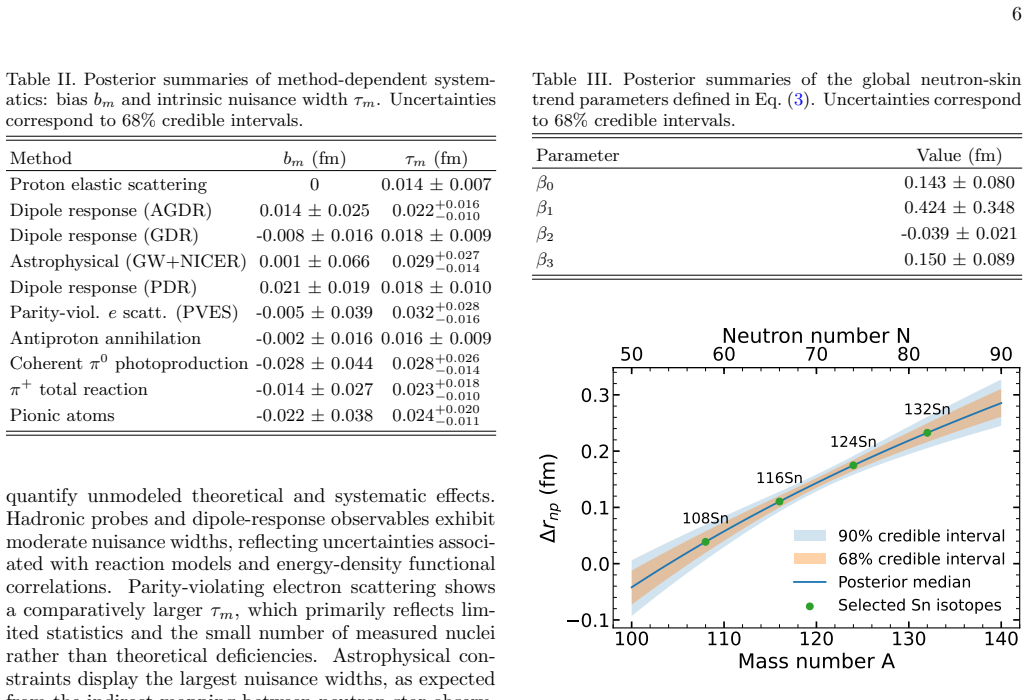
The central object is the latent neutron-skin function Δr_np(A,Z,N) = β0 + β1 I + β2 A^{1/3} + β3 I A^{1/3}, where I=(N−Z)/A is isospin asymmetry — a droplet-model-motivated parametric form. The hierarchical layer adds per-method bias b_m and intrinsic nuisance width τ_m to the measurement equation, so each probe's weight is self-calibrated by the data. The second stage is the 'EDF bridge': the latent posterior-predictive band becomes a pseudo-likelihood, and each energy-density functional is weighted by exp(−χ²/2) computed against the band's median with σ(N) equal to half the 68% credible interval at each neutron number. That weighting yields a discrete posterior over (J,L) and, via kernel-
What would settle it
A direct calculation that replaces the latent-band pseudo-likelihood with full posterior samples of the latent curve, or otherwise accounts for the chain covariance when computing EDF weights; if the 68% interval on L broadens markedly beyond the quoted 46.0–48.0 MeV, the claimed compression is an artifact of the independence assumption. Alternatively, a new high-precision neutron-skin measurement at a far-from-stability tin isotope (e.g., 100Sn or 134Sn) that sits far from the inferred median trend would test the latent form and the EDF weighting.
Extended reading notes
Core claim
The central discovery is that the full collection of 57 published neutron-skin values across ten probe types, when treated with a hierarchical Bayesian model that includes per-method bias parameters and nuisance widths, yields a coherent latent trend for tin isotopes. The trend is monotonic in neutron number, with 68% credible intervals of about ±0.01 fm near A≈120 and growing toward both ends. All inferred method biases are consistent with zero at 1–2σ, implying that apparent tensions among probes are due to scatter rather than offsets. The latent band is then used as a pseudo-observable: each energy-density functional in an ensemble scores a χ² against the median curve with σ(N) taken as h
Load-bearing premise
The load-bearing assumption is that the latent posterior-predictive band can be treated as independent Gaussian constraints at each neutron number when computing the EDF χ², even though the band is a single curve with strongly correlated values; if that correlation were accounted for, the compressed L interval could widen substantially.
Editorial extensions
If this is right
- If the L compression is real, laboratory neutron-skin data alone can pin the sub-saturation symmetry pressure to a few MeV, narrowing the astrophysical equation-of-state landscape without needing neutron-star inputs.
- The Sn isotopic pattern carries the discriminating power, supporting experimental programs that measure skins along long chains rather than on isolated benchmark nuclei.
- The explicit per-method biases and widths provide a quantitative ranking of probes: dipole-response and antiproton data are highly informative, parity-violating electron scattering is currently limited by statistics, and astrophysical mappings act as weak regulators.
- The hierarchical framework can be applied to other heterogeneous observables, such as dipole polarizabilities, charge radii, or mass measurements, that suffer from method-dependent systematics.
Reading between the lines
- A reanalysis that replaces the latent-band pseudo-likelihood with draws from the full posterior of the latent curve — properly propagating the correlation along the Sn chain — could widen the quoted L interval; this would test whether the sub-MeV compression is an artifact of treating the band's points as independent.
- The four-parameter latent form may be too rigid to capture shell or pairing effects at the chain ends; extending the same framework to calcium or lead chains would test whether the trend generalizes.
- The EDF-weighted posterior is conditional on the chosen ensemble; adding or removing even a few functionals could shift the median L, so an ensemble-expansion sensitivity test would quantify the model-class dependence.
- All method biases being consistent with zero may depend on the choice of reference probe; a sensitivity analysis to the pinned method would clarify whether residual absolute-scale ambiguity remains.
Editorial analysis
A structured set of objections, weighed in public.
Referee Report
Summary. The paper develops a hierarchical Bayesian model to synthesize heterogeneous neutron-skin measurements from hadronic, electromagnetic, mesonic, and astrophysical probes. The neutron-skin thickness is represented by a latent function of isospin asymmetry and nuclear size (Eq. 3), with method-dependent bias and nuisance-width parameters. The model is fit to a 57-entry dataset, yielding a posterior-predictive band for the tin isotopic chain (Fig. 2). This band is then used to weight a set of Skyrme energy-density functionals via a chi-square statistic (Eq. 12), producing a weighted posterior in the (J, L) plane. The central quantitative result is a compressed posterior for the symmetry-energy slope, L = 47.41 MeV with 68% interval [46.03, 48.02] MeV, alongside J = 31.96 MeV [31.36, 31.98] MeV (Eq. 16). The paper claims that the Sn isotopic trend, rather than any single nucleus, drives the L constraint.
Significance. If the central result is robust, the paper offers a principled statistical approach for combining heterogeneous nuclear observables and extracts a surprisingly tight constraint on the symmetry-energy slope from Sn neutron skins. The hierarchical treatment of method-dependent systematics, with explicit bias and variance-inflation parameters, is a valuable methodological contribution. The transparent data compilation and the use of a latent intermediate quantity to score EDFs are strengths. However, the headline L precision rests on a statistical assumption (treating the latent band as independent per-neutron-number observations) and on an EDF ensemble of finite, discrete support; both require scrutiny before the quantitative claim can be accepted.
major comments (4)
- [Section V, Eq. (12)] The latent neutron-skin band is a single posterior-predictive curve whose values along the Sn chain are strongly correlated because all pointwise predictions share the same β parameters and the same posterior draws. Equation (12) nevertheless evaluates each EDF with a chi-square that treats each neutron number N as an independent observation with variance σ(N)^2 taken from the 68% interval. This ignores the covariance of the latent curve and can overstate the discriminating power of the band, artificially compressing the EDF weights and hence the L posterior. Please compute the full covariance of the latent posterior predictive over the Sn chain and use a multivariate Gaussian likelihood for EDF weighting, or reweight using full posterior predictive samples. Report the resulting L interval and compare with Eq. (16).
- [Section II D and Section V] Two 208Pb neutron-skin entries derived from neutron-star observations (Refs. [32,33]) enter the global latent fit through Eq. (7) and therefore influence the posterior distribution of the β parameters. The EDF weighting uses only the Sn projection of the latent curve, but that curve is globally informed by these astrophysical entries. The abstract and Sec. VI claim that the L constraint is driven by Sn isotopic trends rather than by any single nucleus; this is not established. Please perform a sensitivity analysis excluding the two astrophysical 208Pb entries (and, as a separate test, all non-Sn data) to quantify how much of the L compression is attributable to indirect astrophysical information.
- [Section II, data collection] The paper states in Sec. II that 'multiple entries for, e.g., 132Sn or 208Pb are treated as features, i.e., independent inputs.' This treats multiple measurements of the same nucleus, sometimes of the same probe type, as statistically independent observations. Such entries are not independent; they share common systematic errors and correlations that are not fully captured by the method-level bias and nuisance-width parameters. This assumption can artificially narrow the latent band and thereby tighten the L posterior. Please model within-nucleus and within-probe correlations, or demonstrate via a leave-one-entry-out (or leave-one-probe-out) analysis that the L constraint is insensitive to this independence assumption.
- [Section V, Eq. (14)] The EDF posterior is a weighted sum of delta functions over a specific ensemble of Skyrme functionals. The reported 68% credible interval for L is therefore conditional on the composition and density of that discrete ensemble; the KDE-smoothed HPD regions in Fig. 4 also depend on the kernel bandwidth. The paper would be strengthened by reporting the discrete weighted empirical distribution, stating the effective number of EDFs with non-negligible weight, and testing sensitivity to the ensemble (e.g., adding more Skyrme parametrizations, removing high-weight EDFs, or varying the KDE bandwidth). Without such checks, the numerical precision quoted in Eq. (16) may reflect the discretization of the model class rather than the actual information contained in the data.
minor comments (5)
- [Section III A, Eq. (3)] The droplet-model derivation leading to Eq. (3) is informal; the A^{1/3} and I A^{1/3} terms are argued by scaling rather than derived from the droplet-model expansion. Please state explicitly that Eq. (3) is an empirical parametric form and justify the omission of higher-order terms, e.g., an I^2 term or an A^{-1/3} term, with posterior-predictive checks or model-comparison diagnostics.
- [Section III A, priors and MCMC] The text says weakly informative priors are used but does not specify the exact prior distributions for β, b_m, and τ_m. For reproducibility, list the prior functional forms and their hyperparameters. Also provide the number of chains, chain length, burn-in, effective sample sizes, and convergence diagnostics (e.g., R-hat) for the affine-invariant ensemble sampler.
- [Section III A, Eq. (8)] Table I lists several asymmetric uncertainties (e.g., 40Ca and 204,206,208Pb p-elastic entries). Equation (8) uses a single σ_{i,exp}; the paper does not state how the asymmetric errors are converted to a symmetric Gaussian width. Specify whether the larger, the average, or a separate treatment is used.
- [Figure 4] The plot uses gray dashed contours for the prior and blue shaded regions for the posterior. The individual EDF points (black dots) with size proportional to weight are not easily distinguishable, and the color scheme may not be accessible to color-blind readers. Consider a viridis or colorblind-safe colormap and a legend explaining marker sizes.
- [References] Several rows of Table I aggregate many references, e.g., [15–21] for multiple PDR and GDR entries. It would improve transparency if each data point were associated with the specific reference (or a short notation in the table) from which the value was taken.
Circularity Check
No significant circularity: the EDF-weighted L constraint is a legitimate two-stage calibration, not a reduction of the fit to its own output.
full rationale
The derivation chain is: Eq. (7)-(8) define the hierarchical likelihood of the measured neutron skins given the latent trend (Eq. 3), method biases, and nuisance widths. MCMC sampling yields the posterior predictive Sn band, formalized in Eqs. (10)-(11). Eq. (12) then computes an EDF chi-square against that latent band, and Eqs. (13)-(14) convert it into weights over a pre-existing, independent EDF ensemble. The EDFs (SIII through SKXS20) are not re-fit to the data; their (J,L) values are fixed inputs from prior calibrations. Thus the reported L = 47.41 MeV (Eq. 16) is a reweighted summary of independent model predictions, not a parameter fitted to the same data it is claimed to predict. The paper itself labels these as 'conditional constraints' and notes they are 'conditional on the EDF ensemble used,' which is an explicit limitation rather than a circular move. The only self-citations (Refs. [53,54]) support the choice of pairing interaction in the HFB code and are not load-bearing for the central L result. The astrophysical 208Pb entries are external data, and the hierarchical model down-weights them through nuisance widths, so they do not make the L posterior identical to an input by construction. The reader's covariance concern about Eq. (12) is a legitimate statistical robustness caveat—treating strongly correlated latent-band points as independent can overstate precision—but it is not a circularity: even if the covariance were accounted for, the EDF weighting would remain a data-to-model calibration rather than a definitional equivalence. No step in the paper reduces an output to an input by construction.
Assumptions & free parameters
free parameters (7)
- β0 (global offset) =
0.143 ± 0.080 fm
- β1 (bulk asymmetry coefficient) =
0.424 ± 0.348 fm
- β2 (A^(1/3) coefficient) =
-0.039 ± 0.021 fm
- β3 (mixed I·A^(1/3) coefficient) =
0.150 ± 0.089 fm
- b_m method biases (9 free; proton-elastic pinned to 0) =
Table II values, e.g., AGDR 0.014 ± 0.025 fm
- τ_m method nuisance widths (10 methods) =
Table II values, e.g., proton-elastic 0.014 ± 0.007 fm
- Prior scale hyperparameters for β, b_m, τ_m =
not specified
assumptions (5)
- domain assumption Gaussian residual model (Eq. 8): ϵ_i ~ N(0, σ_i,exp^2 + τ_m(i)^2)
- ad hoc to paper Four-term linear form Eq. (3) captures the true latent skin across Ca, Zr, Sn, Pb
- domain assumption Multiple entries for same nucleus/probe are independent 'features'
- domain assumption EDF ensemble (28 Skyrme forces) adequately spans physical (J,L) and skin predictions
- ad hoc to paper Per-N independent σ(N) pseudo-likelihood in Eq. (12)
Cite this review
Pith. "Pith review of A Hierarchical Bayesian Analysis of Neutron-Skin Thicknesses and Implications for the Symmetry-Energy Slope." pith.science (2026). https://pith.science/paper/2H2T35PO
@misc{pith2026260204794,
  author       = {Pith},
  title        = {Pith review of: A Hierarchical Bayesian Analysis of Neutron-Skin Thicknesses and Implications for the Symmetry-Energy Slope},
  year         = {2026},
  howpublished = {\url{https://pith.science/paper/2H2T35PO}},
  note         = {Machine review of arXiv:2602.04794}
}
read the original abstract
Neutron-skin thicknesses provide a sensitive probe of the isovector sector of the nuclear equation of state and its density dependence, commonly characterized by the symmetry-energy slope parameter L. A wide variety of experimental and observational methods have been used to extract neutron skins, ranging from hadronic and electromagnetic probes of finite nuclei to inferences from neutron-star observations. Each approach carries distinct theoretical and systematic uncertainties, complicating global interpretations and obscuring genuine physical trends. In this work we present a hierarchical Bayesian framework for the statistically consistent synthesis of heterogeneous neutron-skin constraints. The neutron-skin thickness is modeled as a smooth latent function of isospin asymmetry and nuclear size, while method-dependent bias parameters and intrinsic nuisance widths are introduced to account for unmodeled experimental and theoretical systematics. Focusing on the tin isotopes, we infer probabilistic neutron-skin trends from 100Sn to 140Sn, finding minimal uncertainties near stability and increasing uncertainties toward the proton-rich and neutron-rich extremes. We assess the consistency of nuclear energy-density functionals and obtain conditional constraints on the symmetry-energy parameters. The resulting posterior exhibits a pronounced compression of the symmetry-energy slope parameter L, reflecting the dominant sensitivity of neutron skins to sub-saturation symmetry pressure. We demonstrate that our hierarchical Bayesian framework provides robust and transparent constraints on the sub-saturation isovector sector of the nuclear equation of state.
Figures


Figures from the paper (1 more)

Reference graph
Works this paper leans on
-
[1]
B. A. Brown, Neutron radii in nuclei and the neutron equation of state, Phys. Rev. Lett. 85 (2000) 5296.doi: 10.1103/PhysRevLett.85.5296
-
[2]
S. Typel, B. A. Brown, Neutron radii and the density dependence of the symmetry energy, Phys. Rev. C 64 (2001) 027302.doi:10.1016/S0375-9474(02)00867-9
-
[3]
R. J. Furnstahl, Neutron radii in mean-field mod- els, Nucl. Phys. A 706 (2002) 85.doi:10.1016/ S0375-9474(02)00867-9
2002
-
[4]
M. Centelles, X. Roca-Maza, X. Vi˜ nas, M. Warda, Nu- clear symmetry energy probed by neutron skins and dipole polarizability, Physical Review Letters 102 (2009) 122502.doi:10.1103/PhysRevLett.102.122502
-
[5]
X. Roca-Maza, M. Centelles, X. Vi˜ nas, M. Warda, Neu- tron skin of 208Pb, nuclear symmetry energy, and the parity radius experiment, Physical Review Letters 106 (2011) 252501.doi:10.1103/PhysRevLett.106.252501
-
[6]
C. J. Horowitz, J. Piekarewicz, Neutron star structure and the neutron radius of 208Pb, Phys. Rev. Lett. 86 (2001) 5647.doi:10.1103/PhysRevLett.86.5647
-
[7]
J. M. Lattimer, M. Prakash, Neutron star observations: Prognosis for equation of state constraints, Phys. Rept. 442 (2007) 109.doi:10.1016/j.physrep.2007.02.003
-
[8]
C. J. Horowitz, et al., Neutron star structure and the neutron skin of heavy nuclei, J. Phys. G 41 (2014) 093001. doi:10.1088/0954-3899/41/9/093001
Show all 55 references
-
[9]
Annala, et al., Neutron star radii and equation of state from multimessenger observations, Phys
E. Annala, et al., Neutron star radii and equation of state from multimessenger observations, Phys. Rev. Lett. 120 (2018) 172703.doi:10.1103/PhysRevLett.120.172703
2018 doi
-
[10]
Zenihiro, et al., Direct determination of the neutron skin thicknesses in 40,48Ca from proton elastic scattering atE p = 295 MeV,arXiv:1810.11796
J. Zenihiro, et al., Direct determination of the neutron skin thicknesses in 40,48Ca from proton elastic scattering atE p = 295 MeV,arXiv:1810.11796
-
[12]
Zenihiro, et al., Neutron density distributions of 204,206,208Pb deduced via proton elastic scattering at Ep = 295 MeV, Phys
J. Zenihiro, et al., Neutron density distributions of 204,206,208Pb deduced via proton elastic scattering at Ep = 295 MeV, Phys. Rev. C 82 (2010) 044611.doi: 10.1103/PhysRevC.82.044611
2010 doi
-
[13]
Adhikari, et al., Precision determination of the neutral weak form factor of 48Ca, Phys
D. Adhikari, et al., Precision determination of the neutral weak form factor of 48Ca, Phys. Rev. Lett. 129 (2022) 042501.doi:10.1103/PhysRevLett.129.042501
2022 doi
-
[14]
Adhikari, et al., Accurate determination of the neu- tron skin thickness of 208Pb through parity-violation in electron scattering, Phys
D. Adhikari, et al., Accurate determination of the neu- tron skin thickness of 208Pb through parity-violation in electron scattering, Phys. Rev. Lett. 126 (2021) 172502. doi:10.1103/PhysRevLett.126.172502
2021 doi
-
[15]
Klimkiewicz, et al., Nuclear symmetry energy and neutron skins derived from pygmy dipole resonances, Phys
A. Klimkiewicz, et al., Nuclear symmetry energy and neutron skins derived from pygmy dipole resonances, Phys. Rev. C 76 (2007) 051603(R).doi:10.1103/ PhysRevC.76.051603
2007
-
[17]
Wieland, et al., Search for the pygmy dipole resonance in 120Sn, Phys
O. Wieland, et al., Search for the pygmy dipole resonance in 120Sn, Phys. Rev. Lett. 102 (2009) 092502.doi:10. 1103/PhysRevLett.102.092502
2009
-
[18]
Tamii, et al., Complete electric dipole response and the neutron skin in 208Pb, Phys
A. Tamii, et al., Complete electric dipole response and the neutron skin in 208Pb, Phys. Rev. Lett. 107 (2011) 062502.doi:10.1103/PhysRevLett.107.062502
2011 doi
-
[19]
Roca-Maza, et al., Neutron skin thickness from the measured electric dipole polarizability in 208Pb, Phys
X. Roca-Maza, et al., Neutron skin thickness from the measured electric dipole polarizability in 208Pb, Phys. Rev. C 88 (2013) 024316.doi:10.1103/PhysRevC.88. 024316
2013 doi
-
[20]
N. Paar, D. Vretenar, E. Khan, G. Col` o, Exotic modes of excitation in atomic nuclei far from stability, Rep. Prog. Phys. 70 (2007) 691.doi:10.1088/0034-4885/70/5/R01
2007 doi
-
[21]
Reinhard, W
P.-G. Reinhard, W. Nazarewicz, Information content of the low-energy electric dipole strength, Phys. Rev. C 81 (2010) 051303(R).doi:10.1103/PhysRevC.81.051303
2010 doi
-
[22]
J. Yasuda, , et al., Extraction of anti-analog giant dipole resonance and neutron skin thickness for 208Pb, Progress of Theoretical and Experimental Physics 2013 (6) (2013) 063D02.doi:10.1093/ptep/ptt038
2013 doi
-
[23]
Krasznahorkay, N
A. Krasznahorkay, N. Paar, D. Vretenar, M. N. Harakeh, Anti-analog giant dipole resonances and the neutron skin of nuclei, Physics Letters B 720 (4-5) (2013) 428–432. doi:10.1016/j.physletb.2013.02.043
2013 doi
-
[24]
Roca-Maza, X
X. Roca-Maza, X. Vi˜ nas, M. Centelles, P. Ring, P. Schuck, Neutron skin thickness from the measured electric dipole polarizability in 68Ni, 120Sn, and 208Pb, Phys. Rev. C 92 (2015) 064304.doi:10.1103/PhysRevC. 92.064304
2015 doi
-
[25]
Krmpoti´ c, N
F. Krmpoti´ c, N. Paar, D. Vretenar, Anti-analog giant dipole resonance as a probe of the neutron skin, Phys. 10 Lett B 720 (2013) 428.doi:10.1016/j.physletb.2013. 02.043
2013 doi
-
[26]
N. Paar, D. Vretenar, E. Khan, G. Col` o, Exotic modes of excitation in atomic nuclei far from stability, Rep. Prog. Phys. 70 (2007) 691–793.doi:10.1088/0034-4885/70/ 5/R02
2007 doi
-
[27]
K los, et al., Neutron density distributions from an- tiprotonic 208Pb and 209Bi atoms, Phys
B. K los, et al., Neutron density distributions from an- tiprotonic 208Pb and 209Bi atoms, Phys. Rev. C 76 (2007) 014311.doi:10.1103/PhysRevC.76.014311
2007 doi
-
[28]
Trzci´ nska, J
A. Trzci´ nska, J. Jastrz¸ ebski, P. Lubi´ nski, F. J. Hartmann, R. Schmidt, T. von Egidy, B. K los, Neutron density dis- tributions deduced from antiprotonic atoms, Phys. Rev. Lett. 87 (2001) 082501.doi:10.1103/PhysRevLett.87. 082501
2001 doi
-
[29]
Friedman, Neutron skins of 208Pb and 48Ca from pi- onic probes, Nuclear Physics A 896 (2012) 46–52.doi: 10.1016/j.nuclphysa.2012.09.007
E. Friedman, Neutron skins of 208Pb and 48Ca from pi- onic probes, Nuclear Physics A 896 (2012) 46–52.doi: 10.1016/j.nuclphysa.2012.09.007
2012 doi
-
[30]
Allardyce, C
B. Allardyce, C. Batty, D. Baugh, E. Friedman, G. Hey- mann, M. Cage, G. Pyle, G. Squier, A. Clough, D. Jack- son, S. Murugesu, V. Rajaratnam, Pion reaction cross sections and nuclear sizes, Nuclear Physics A 209 (1) (1973) 1–51.doi:10.1016/0375-9474(73)90049-3
1973 doi
-
[31]
C. M. Tarbert, et al., Neutron skin of 208Pb from coher- ent pion photoproduction, Phys. Rev. Lett. 112 (2014) 242502.doi:10.1103/PhysRevLett.112.242502
2014 doi
-
[32]
Tang, J.-L
S.-P. Tang, J.-L. Jiang, M.-Z. Han, Y.-Z. Fan, D.-M. Wei, Constraints on the phase transition and nuclear symme- try parameters from psr J0740 + 6620 and multimessen- ger data of other neutron stars, Phys. Rev. D 104 (2021) 063032.doi:10.1103/PhysRevD.104.063032
2021 doi
-
[33]
Essick, I
R. Essick, I. Tews, P. Landry, A. Schwenk, Astrophysical constraints on the symmetry energy and the neutron skin of 208Pb with minimal modeling assumptions, Phys. Rev. Lett. 127 (2021) 192701.doi:10.1103/PhysRevLett. 127.192701
2021 doi
-
[34]
W. D. Myers, W. J. Swiatecki, Nuclear masses and de- formations, Annals of Physics 55 (1969) 395–505.doi: 10.1016/0003-4916(69)90202-4
1969 doi
-
[35]
W. D. Myers, W. J. Swiatecki, The nuclear droplet model for arbitrary shapes, Annals of Physics 84 (1974) 186– 210.doi:10.1016/0003-4916(74)90299-1
1974 doi
-
[36]
Danielewicz, Surface symmetry energy in nuclear masses, Nuclear Physics A 727 (2003) 233–268.doi: 10.1016/j.nuclphysa.2003.08.001
P. Danielewicz, Surface symmetry energy in nuclear masses, Nuclear Physics A 727 (2003) 233–268.doi: 10.1016/j.nuclphysa.2003.08.001
2003 doi
-
[37]
Goodman, J
J. Goodman, J. Weare, Ensemble samplers with affine in- variance, Communications in Applied Mathematics and Computational Science 5 (1) (2010) 65–80.doi:10.2140/ camcos.2010.5.65
2010
-
[38]
Foreman-Mackey, D
D. Foreman-Mackey, D. W. Hogg, D. Lang, J. Goodman, emcee: The mcmc hammer, Publications of the Astro- nomical Society of the Pacific 125 (925) (2013) 306–312. doi:10.1086/670067
2013 doi
-
[39]
Beiner, H
M. Beiner, H. Flocard, N. V. Giai, P. Quentin, Nu- clear ground-state properties and self-consistent calcu- lations with the Skyrme interaction: (i). spherical de- scription, Nuc. Phys. A 238 (1) (1975) 29 – 69.doi: 10.1016/0375-9474(75)90338-3
1975 doi
-
[40]
Koehler, Skyrme force and the mass formula, Nuc
H. Koehler, Skyrme force and the mass formula, Nuc. Phys. A 258 (2) (1976) 301 – 316.doi:10.1016/ 0375-9474(76)90008-7
1976
-
[41]
Bartel, P
J. Bartel, P. Quentin, M. Brack, C. Guet, H.-B. Hkans- son, Towards a better parametrisation of Skyrme-like effective forces: A critical study of the skm force, Nuc. Phys. A 386 (1) (1982) 79 – 100.doi:10.1016/ 0375-9474(82)90403-1
1982
-
[42]
Dobaczewski, H
J. Dobaczewski, H. Flocard, J., Hartree-Fock- bogolyubov description of nuclei near the neutron- drip line, Nuc. Phys. A 422 (1) (1984) 103 – 139. doi:10.1016/0375-9474(84)90433-0
1984 doi
-
[43]
Stoitsov, N
M. Stoitsov, N. Schunck, M. Kortelainen, N. Michel, H. Nam, E. Olsen, J. Sarich, S. Wild, Axially deformed solution of the Skyrme-Hartree-Fock-Bogoliubov equa- tions using the transformed harmonic oscillator basis (ii) HFBTHO v2.00d: A new version of the program, Com- puter Ph...
2013 doi
-
[44]
Bennour, P.-H
L. Bennour, P.-H. Heenen, P. Bonche, J. Dobaczewski, H. Flocard, Charge distributions of 208Pb, 206Pb, and 205Tl and the mean-field approximation, Phys. Rev. C 40 (1989) 2834–2839.doi:10.1103/PhysRevC.40.2834
1989 doi
-
[45]
Reinhard, H
P.-G. Reinhard, H. Flocard, Nuclear effective forces and isotope shifts, Nuc. Phys. A 584 (3) (1995) 467 – 488. doi:10.1016/0375-9474(94)00770-N
1995 doi
-
[46]
Chabanat, P
E. Chabanat, P. Bonche, P. Haensel, J. Meyer, R. Scha- effer, A Skyrme parametrization from subnuclear to neu- tron star densities, Nucl. Phys. A 627 (1997) 710.doi: DOI:10.1016/S0375-9474(97)00596-4
1997 doi
-
[47]
Chabanat, P
E. Chabanat, P. Bonche, P. Haensel, J. Meyer, R. Scha- effer, A Skyrme parametrization from subnuclear to neu- tron star densities part II. nuclei far from stabilities, Nuc. Phys. A 635 (1) (1998) 231 – 256.doi:10.1016/ S0375-9474(98)00180-8
1998
-
[48]
Alex Brown, New Skyrme interaction for normal and exotic nuclei, Phys
B. Alex Brown, New Skyrme interaction for normal and exotic nuclei, Phys. Rev. C 58 (1998) 220–231.doi:10. 1103/PhysRevC.58.220
1998
-
[49]
Reinhard, D
P.-G. Reinhard, D. J. Dean, W. Nazarewicz, J. Dobaczewski, J. A. Maruhn, M. R. Strayer, Shape coexistence and the effective nucleon-nucleon interaction, Phys. Rev. C 60 (1999) 014316. doi:10.1103/PhysRevC.60.014316
1999 doi
-
[50]
B. K. Agrawal, S. Shlomo, V. Kim Au, Nuclear matter in- compressibility coefficient in relativistic and nonrelativis- tic microscopic models, Phys. Rev. C 68 (2003) 031304. doi:10.1103/PhysRevC.68.031304
2003 doi
-
[51]
low68” (“hi68
and SKXS20 [52]. A mixed volume-surface pairing interaction is included, as described in Refs. [53, 54]. The HFB calculations were done with a modified version of the code HFBTO code [43]. Each EDF in the ensem- ble supplies the values for the nuclear matter parame- tersJ,Land...
-
[52]
Goriely, M
S. Goriely, M. Samyn, J. Pearson, M. Onsi, Further ex- plorations of Skyrme-Hartree-Fock-Bogoliubov mass for- mulas. iv: Neutron-matter constraint, Nuc. Phys. A 750 (2) (2005) 425 – 443.doi:10.1016/j.nuclphysa. 2005.01.009
2005 doi
-
[53]
Dutra, O
M. Dutra, O. Louren¸ co, J. S. S´ a Martins, A. Delfino, J. R. Stone, P. D. Stevenson, Skyrme interaction and nuclear matter constraints, Phys. Rev. C 85 (2012) 035201.doi: 10.1103/PhysRevC.85.035201
2012 doi
-
[54]
G. F. Bertsch, C. A. Bertulani, W. Nazarewicz, N. Schunck, M. V. Stoitsov, Odd-even mass differences from self-consistent mean field theory, Phys. Rev. C 79 (2009) 034306.doi:10.1103/PhysRevC.79.034306
2009 doi
-
[55]
C. A. Bertulani, J. Valencia, Neutron skins as laboratory constraints on properties of neutron stars and on what we can learn from heavy ion fragmentation reactions, Phys. Rev. C 100 (2019) 015802.doi:10.1103/PhysRevC.100. 015802
2019 doi
-
[56]
B. W. Silverman, Density Estimation for Statistics and Data Analysis, Monographs on Statistics and Applied Probability, Chapman and Hall, London, 1986
1986
-
[57]
D. W. Scott, Multivariate Density Estimation: Theory, Practice, and Visualization, 2nd Edition, Wiley, Hobo- ken, NJ, 2015
2015
Reviewed August 3, 2026 · model on record in the stance chip above.
Discussion (0). Continue with ORCID to comment.