REVIEW 3 major objections 5 minor 7 references
Fluid Reasoning Representations
T0 review · 3 major / 5 minor · reviewed 2026-08-03 · deepseek-v4-flash
Pith's one-line read During extended reasoning, QwQ-32B's internal representations of actions converge to abstract, naming-independent encodings, and steering those encodings measurably changes problem-solving accuracy.
desk verdict A credible descriptive result about representational convergence during extended reasoning, but the key metric is partly self-referential and the causal evidence is statistically fragile; still worth refereeing. read the letter →
The pith
A machine-rendered reading of the paper's core claim, the machinery that carries it, and where it could break.
The reading
What carries the argument
The load-bearing object is the cross-naming representation, defined as the average of centered in-naming representations across all namings (Eq. 3): for each action, one subtracts the mean over actions within a naming, then averages the resulting directions across 14 obfuscated wordings to cancel naming-specific surface features and expose an invariant semantic core. This averaged vector serves both as the target for measuring representational convergence and as the steering/patching vector in the causal experiments. The steering rule itself — a norm-preserving convex combination of the token's hidden state with the target vector — is the mechanism by which the paper injects or subtracts the
What would settle it
Compute the convergence metric with a leave-one-out cross-naming average (exclude the target naming from the mean) and check whether similarity still rises during reasoning; if it does not, the observed convergence is an artifact of the estimator. A second check: steer with cross-naming vectors built from namings never used in the steering set; if held-out accuracy does not improve, the vectors are not naming-invariant.
Extended reading notes
Core claim
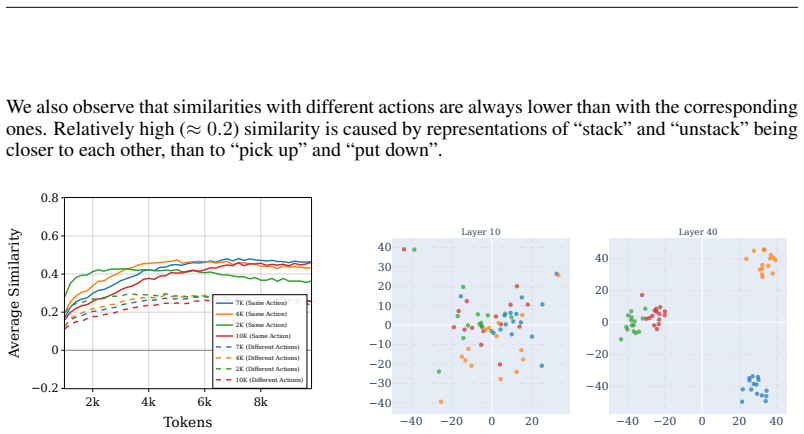
On the paper's own terms, the central discovery is that QwQ-32B dynamically constructs context-specific representational spaces during extended reasoning. Over the course of a 15–20k-token chain of thought on semantically obfuscated BlocksWorld puzzles, hidden-state representations of the same action or predicate across different namings become more similar to each other, more similar to the clean BlocksWorld representations, and more separated from representations of different actions. The paper introduces Fluid Reasoning Representations (FRRs) to name this progressive refinement, and reports causal evidence: positive steering with refined representations, especially cross-naming averages,
Load-bearing premise
The cross-naming representation is an average of centered representations that includes the very naming being compared, and the paper assumes this average cancels surface features while preserving semantic content; if instead that average captures shared syntax, trace position, or a generic action-token direction, the convergence and steering results would not demonstrate symbolic abstraction.
Editorial extensions
If this is right
- If correct, accuracy gains on obfuscated tasks are partly attributable to in-context representational refinement, not just extended search or memorized shortcuts.
- Cross-naming steering transfers task knowledge across wordings, implying learned abstraction is portable across surface forms.
- Base and instruction-tuned models already exhibit the refinement dynamic, so reasoning-model training may mainly supply the long context that lets the dynamic unfold.
- Steering and patching offer a practical handle: model behavior on abstract tasks can be improved or disrupted by editing these refined directions.
Reading between the lines
- I infer that the same convergence dynamic should appear in other fixed-action-space planning domains (e.g., Towers of Hanoi) and in mathematical reasoning with redefined notation, though the paper only tests BlocksWorld.
- A sharper test than the paper's would use leave-one-out cross-naming averages to confirm the convergence is not an artifact of measuring similarity to a mean that includes the measured point.
- If the shared direction in late-layer action vectors (seen in shuffled-control gains) is a generic 'action-ness' component, then part of the steering effect may come from injecting task-generic structure rather than naming-invariant semantics; the paper flags but does not resolve this.
- One could test transfer by computing cross-naming vectors from one set of namings and steering on a held-out naming; the paper's Table 4 hints at heterogeneous per-naming responsiveness that such a design would quantify.
Editorial analysis
A structured set of objections, weighed in public.
Referee Report
Summary. The paper introduces 'Fluid Reasoning Representations' (FRRs) and studies QwQ-32B on Mystery BlocksWorld, a semantically obfuscated planning domain. The authors extract centered action/predicate representations from hidden states at different reasoning timestamps and define cross-naming representations as averages over 15 namings. They report that (i) same-action representations across different namings become more similar over the reasoning trace and move toward clean BlocksWorld representations; (ii) positive steering with refined in-naming and cross-naming vectors improves held-out accuracy, with cross-naming vectors most effective; (iii) symbolic patching with cross-naming vectors outperforms shuffled controls; and (iv) subtracting refined directions degrades accuracy. They conclude that extended reasoning dynamically constructs context-specific, naming-invariant representational spaces, and that this is a key mechanism behind reasoning models' performance on abstract tasks. The paper includes open-source code, multiple naming variants, and a base-model comparison.
Significance. If the findings hold, this is a valuable mechanistic contribution to interpretability of reasoning LLMs: it identifies a concrete representational process—dynamic refinement toward shared symbolic encodings—that could explain part of the reasoning model advantage on obfuscated tasks. The paper has notable strengths: it provides a codebase, uses 15 naming variants, includes leave-one-out pairwise evidence in Fig. 2, compares against clean BlocksWorld in Fig. 4b, and attempts causal validation through steering and patching with controls. However, the central convergence metric and the causal vectors both rely on a cross-naming average that includes the query naming (Eq. 3), and the statistical support for the causal claims is thin once multiple testing is considered. The core idea is plausible and testable, but the current evidence requires additional analyses before the claims are fully supported.
major comments (3)
- [Section 3.2, Eq. (3), Fig. 4a] The main convergence plot measures each naming's centered representation against the cross-naming average defined in Eq. (3), which is computed over all namings including the query naming itself. Since each naming contributes to the average, the similarity at the extraction timestamp has a mechanical self-inclusion component; similarly, the 'different actions' similarity is computed against an average that contains the query action. This inflates the observed convergence and separation. The same cross-naming representations are used as steering vectors in Section 4.1 and as the basis for symbolic patching in Section 4.2, so if the average encodes naming-common surface statistics or trace-position/syntax directions rather than a clean invariant semantic core, the causal conclusions are also affected. Please provide a leave-one-out version of Fig. 4a (and, where feasible, leave-one-out ste
- [Section L, Table 5] The statistical evidence for steering improvements is not robust to multiple testing. Table 5 reports 10 one-sided t-tests at alpha=0.05; 3 are significant, but the smallest p-value is 0.021, which is above a Bonferroni threshold of 0.005. Under 10 independent tests, about 0.5 false positives are expected by chance. The claim in Fig. 6 that 'cross-naming > in-naming >> random' is also not supported by Table 5: at layer 30 cross-naming has p=0.139, and at layer 40 in-naming has p=0.274. Moreover, Figs. 2, 4, and 5 show no confidence intervals or significance tests. Please report adjusted p-values (e.g., Benjamini-Hochberg), provide confidence intervals for the mean improvements, and consider pre-registering or limiting the primary comparisons to avoid selection effects from the reported layer/condition search.
- [Section 4.2, Eq. (6), Fig. 7] The symbolic patching experiment inherits the self-inclusion issue: the 'symbolic' vectors are constructed from the same cross-naming averages of Eq. (3), which include the naming being patched. This makes it difficult to attribute the observed advantage over shuffled control to naming-invariant abstraction rather than to shared naming-specific statistics. In addition, Fig. 7 provides no statistical test; the error bars (s.e. across namings) are descriptive. A leave-one-out variant of the symbolic vectors (excluding the target naming from the average) would directly address the abstraction claim. The paper's existing non-self-referential evidence (Fig. 2 and Fig. 4b) partially supports convergence, but it does not validate the specific vectors used in the causal experiments.
minor comments (5)
- [Section 2.2] The statement that 'some version of Mystery BlocksWorld was present in QwQ-32B's training data' is an inference from shorter traces and manual analysis. This is an important exclusion criterion (naming 3 is dropped), but it is not directly verified. Please soften the claim or provide additional evidence, and discuss how residual partial recognition of other namings could affect the results.
- [Section 3.3] The base-model comparison feeds QwQ-generated traces to the base model. Differences in adaptation speed may reflect distribution shift (base model processing unnatural traces) rather than fundamental model capability. A cleaner comparison would use base-model-generated traces (or at least control for trace difficulty), or the claim should be limited to 'base models can adapt in-context when given a long context'.
- [Section 2.3 vs. Appendix F.1] The main text says the window size is w=100, while Appendix F.1 states '200 is selected to contain at least 10 action mentions.' Please reconcile this inconsistency.
- [Appendix F.1] Minor typo: 'preformed' should be 'performed'.
- [Section 4.1] The notation v_type[a] is introduced without a formal definition; it refers to the three vector types (in-naming, cross-naming, random). Please define it explicitly.
Circularity Check
Cross-naming average in Eq. (3) is self-inclusive, so Fig. 4a convergence and cross-naming steering/patching partially reduce to the estimator; independent pairwise and clean-BlocksWorld controls limit the damage.
-
fitted input called prediction
[Eq. (3), Section 3.2, Fig. 4a]
"To extract the abstract, symbolic meaning of an action (predicate) independent of its surface form, we compute cross-naming representations by averaging centered in-naming representations across all namings: ¯r^{L,T}_a = 1/|N| Σ_{N∈N} ˜r^{N,L,T}_a (3) ... (a) Shows average similarities of centered action/predicate representations from all timestamps in Mystery Blocksworld traces with cross-naming representations extracted at 7k tokens."
The target of the convergence measurement is defined as the average of the very representations being measured. Each naming contributes to the cross-naming average, so same-action similarity rises partly because every query vector is compared with a target containing itself; the 7k target also contains the 7k version of each query naming, so the temporal increase from 2k to 7k is partially mechanical. The paper does not report a leave-one-out variant of Fig. 4a. This does not fully determine the result because Fig. 2 (naming 1 vs. others) and Fig. 4b (clean BlocksWorld) are not self-inclusive, but the headline convergence plot is partly built into the estimator.
-
fitted input called prediction
[Section 4.1, Eq. (3)/(4), Figure 6; Section 4.2, Eq. (6)]
"We collect three types of steering vectors at layer L from the 40 correctly solved puzzles: (1) centered in-naming representations..., (2) cross-naming representations ¯r^{L,T}_a averaged across all namings... Cross-naming representations achieve the highest impact across all layers, reinforcing that these adaptations encode abstract problem structure rather than naming-specific artifacts."
The cross-naming steering vector is averaged over all namings including the naming whose held-out rollouts are being steered. Thus the claimed superiority of 'cross-naming' over 'in-naming' does not demonstrate naming-invariant transfer: the vector can carry the target naming's own in-naming statistics plus smoothing. The same self-inclusive average is used as the 'symbolic' replacement in Section 4.2. Steering still uses held-out puzzles and random/shuffled controls, so it is not a pure tautology, but the 'symbolic abstraction' interpretation is not tested leave-one-out.
full rationale
The most load-bearing representational evidence—Fig. 4a, and the cross-naming steering/patching vectors in Sections 4.1 and 4.2—uses cross-naming representations computed by Eq. (3) as an average over all namings, including the naming being compared, steered, or patched. This makes part of the observed convergence and the apparent cross-naming transfer mechanical: the query is compared to or replaced by a vector that contains the query's own contributions. However, the paper is not wholly circular: Fig. 2 uses naming 1 against all other namings (leave-one-out for the query), and Fig. 4b compares mystery-naming representations to clean BlocksWorld representations, giving independent evidence that some convergent, semantics-independent structure exists. The steering experiments also use held-out puzzles with random and shuffled controls, so the causal effect is not purely a definitional artifact. The self-citations (e.g., Venhoff et al. for centering) are methodological and not load-bearing uniqueness claims. Overall, the central 'convergence to a shared symbolic code' claim is partially inflated by the self-inclusive estimator, but it retains independent support; a leave-one-out version of Eq. (3) would directly resolve the concern.
Assumptions & free parameters
free parameters (4)
- steering scale s =
2/3 (positive steering); symbolic patching uses s ∈ {10, 20}
- steering token window [t_start, t_end) =
[1500, 2500] for positive steering; [2000, 4000] for patching/negative steering
- extraction timestamp for steering vectors =
7k tokens (positive steering); 4k tokens (negative steering)
- analysis layer L=40 =
Layer 40 (layer 30 also checked)
assumptions (5)
- domain assumption Concepts are linearly represented as directions in residual-stream activation space, so additive steering of averaged token hidden states modifies the concept.
- domain assumption Averaging hidden states across token occurrences, traces, and namings preserves the semantic content of an action/predicate and cancels surface-form features.
- ad hoc to paper Mystery naming 3 was present in QwQ-32B training data, based on shorter traces and manual trace analysis.
- domain assumption Successfully solved puzzles used to extract steering vectors are representative of the reasoning process for held-out puzzles.
- domain assumption The 15 mystery namings are independent obfuscations of the same domain, and averaging across them gives a stable symbolic estimate.
Cite this review
Pith. "Pith review of Fluid Reasoning Representations." pith.science (2026). https://pith.science/paper/F7MRSMUG
@misc{pith2026260204843,
  author       = {Pith},
  title        = {Pith review of: Fluid Reasoning Representations},
  year         = {2026},
  howpublished = {\url{https://pith.science/paper/F7MRSMUG}},
  note         = {Machine review of arXiv:2602.04843}
}
read the original abstract
Frontier large language models increasingly solve complex tasks involving abstract concepts through extended test-time thinking. Yet we lack a mechanistic account of how extended thinking changes hidden-state representations over the course of a reasoning trace. We introduce \textit{Fluid Reasoning Representations} (FRRs), a representation-level account of how LLMs organize action and predicate concepts during self-generated reasoning, and test them on obfuscated planning, symbolic, and mathematical tasks where task-relevant words are replaced while problem structure is preserved. Across open-weight base, instruction-tuned, and extended-thinking LLMs, representations of the same action or predicate become more similar across wordings and move toward the corresponding unobfuscated concepts over the reasoning trace. Causal probes show that these representations affect behavior: cross-naming steering improves held-out accuracy beyond Gaussian and shuffled controls, symbolic patching retains more action information than shuffled patching, and subtracting refined directions degrades accuracy; together, these results suggest that extended thinking strengthens a representation dynamic already present at lower magnitude in base and instruction-tuned LLMs. Our codebase is open-sourced \href{https://github.com/AI4Collaboration/Fluid-Reasoning-Representation}{here}.
Figures


Figures from the paper (6 more)


Reference graph
Works this paper leans on
-
[3]
with approximately 100 puzzles per naming (indices 200-300). Each mystery naming provides accuracy measurements under multiple conditions: baseline (no steering), in-naming steering, cross- naming steering, and random Gaussian steering at various layers. Statistical Test.We employ one-sample t-tests to assess whether mean accuracy improvements across myst...
2026
-
[10]
This suggests that certain semantic structures are more amenable to representational refinement than others
demonstrate substantial gains. This suggests that certain semantic structures are more amenable to representational refinement than others. J IMPLEMENTATION DETAILS J.1 STEERING ENGINE We implement steering using PyTorch forward hooks on top of vLLM v0.7.3 v0 Kwon et al. (2023), which provides substantial performance improvements, reducing experiment runt...
2023
-
[11]
show minimal or no improvement from naming-mean steering, while others (Mystery 1, Mystery
-
[2013]
Neel Nanda and Joseph Bloom
URLhttps://proceedings.neurips.cc/paper_files/paper/2013/ file/9aa42b31882ec039965f3c4923ce901b-Paper.pdf. Neel Nanda and Joseph Bloom. Transformerlens, 2022. URLhttps://github.com/ TransformerLensOrg/TransformerLens. Neel Nanda, Andrew Lee, and Martin Wattenberg. Emergent linear representations in world mod- els of self-supervised sequence models. In Yon...
2013
-
[2016]
URLhttps://proceedings.neurips.cc/paper_files/paper/2016/ file/a486cd07e4ac3d270571622f4f316ec5-Paper.pdf. Trenton Bricken, Adly Templeton, Joshua Batson, Brian Chen, Adam Jermyn, Tom Conerly, Nick Turner, Cem Anil, Carson Denison, Amanda Askell, Robert Lasenby, Yifan Wu, Shauna Kravec, Nicholas Schiefer, Tim Maxwell, Nicholas Joseph, Zac Hatfield-Dodds, ...
arXiv 2016
-
[2023]
doi: 10.18653/v1/2023.blackboxnlp-1.2
Association for Computational Linguistics. doi: 10.18653/v1/2023.blackboxnlp-1.2. URL https://aclanthology.org/2023.blackboxnlp-1.2. Christopher Olah. What is a linear representation? what is a multidimensional feature?Trans- former Circuits Thread, 2024. URLhttps://transformer-circuits.pub/2024/ july-update/. OpenAI. Openai o1 system card, 2024. URLhttps...
arXiv 2023
-
[2025]
11 Subhabrata Dutta, Joykirat Singh, Soumen Chakrabarti, and Tanmoy Chakraborty
URLhttps://arxiv.org/abs/2501.12948. 11 Subhabrata Dutta, Joykirat Singh, Soumen Chakrabarti, and Tanmoy Chakraborty. How to think step-by-step: A mechanistic understanding of chain-of-thought reasoning, 2024. URLhttps: //arxiv.org/abs/2402.18312. Nelson Elhage, Neel Nanda, Catherine Olsson, Tom Henighan, Nicholas Joseph, Ben Mann, Amanda Askell, Yuntao B...
arXiv 2024
Reviewed August 3, 2026 · model on record in the stance chip above.
Discussion (0). Continue with ORCID to comment.