REVIEW 3 major objections 6 minor 2 references
Row-Column Separated Attention Based Low-Light Image/Video Enhancement
T0 review · 3 major / 6 minor · reviewed 2026-08-03 · deepseek-v4-flash
Pith's one-line read Row-column mean and max statistics, fed through a small attention module, can supply the global guidance U-Net-based low-light enhancement lacks, matching larger attention models at a fraction of their size.
desk verdict RCSA is a neat, parameter-light module backed by a credible internal ablation, but the paper's two key benchmark margins are not protocol-matched and likely within noise—needs major revision before its superiority claim can stand. read the letter →
The pith
A machine-rendered reading of the paper's core claim, the machinery that carries it, and where it could break.
The reading
What carries the argument
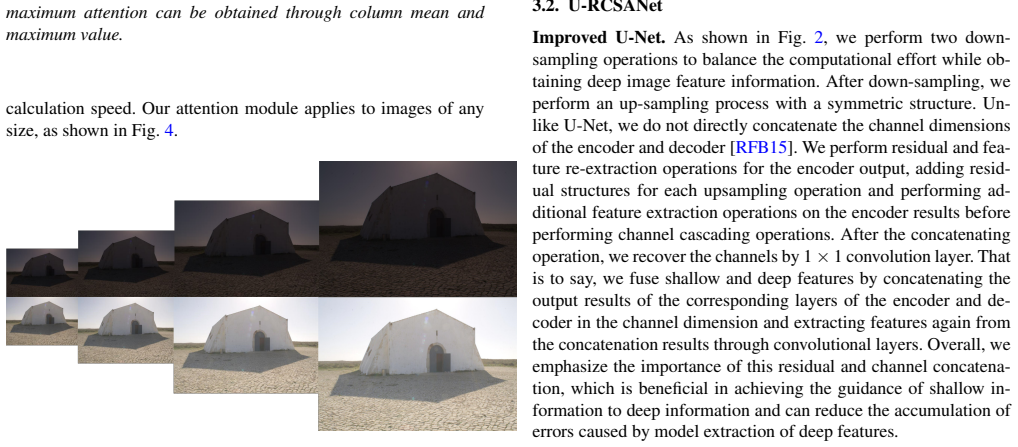
Row-Column Separated Attention (RCSA): from a feature map of size C×H×W, compute F_h_avg, F_w_avg, F_h_max, F_w_max; feed each through softmax attention Φ(x)=Softmax(QK^T/√d)V; multiply the row and column results to get pixel-level attention; blend with a=sigmoid(λ), b=1−sigmoid(λ). This replaces full pixel-to-pixel attention with attention over (2/H+2/W) of the pixels, making it image-size agnostic. Its role is to supply global guidance to the local U-Net features, with the concatenation of U-Net input and output as the module's input.
What would settle it
A controlled re-training of the same U-Net on LOL with RCSA replaced by a parameter-matched pointwise nonlinearity applied to the same row/column summaries (no attention) would show whether the attention operation itself is the source of the gain. Separately, re-running every compared method on the exact 128×128 crops, epoch counts, and loss schedules used here would tell whether the reported margins over published scores are real.
Extended reading notes
Core claim
The paper's central claim is that row- and column-level statistics of a feature map—its per-row and per-column means and maxima—are a sufficient carrier of the global information that low-light enhancement networks need. In the RCSA module, each of these four summaries is passed through an attention operation with learnable query/key/value projections; the row and column attention outputs are multiplied to produce a pixel-level attention map, and the mean and maximum branches are combined with a per-channel adaptive weight. The improved U-Net around it re-extracts features at skip connections and concatenates encoder and decoder outputs so shallow information can correct deep reconstruction.
Load-bearing premise
The load-bearing premise is that averaging and max-pooling each row and column of an internal feature map preserves enough global context to guide local enhancement; if that premise fails, RCSA is just another feature mixer, and the headline comparisons additionally assume published metrics from other models were obtained under the same training and evaluation protocol.
Editorial extensions
If this is right
- RCSA can be inserted after a U-Net-style encoder-decoder to provide global guidance without patch-based cropping, so enhancement can be applied at arbitrary input resolutions.
- The reported ablation implies that the attention module, not just the improved U-Net, is responsible for the large PSNR jump (19.77 to 24.77 with only 0.4M extra parameters).
- Temporal consistency can be encouraged purely through loss design—local brightness-difference minimization and frame-difference self-similarity—rather than explicit optical flow, and the same losses can augment optical-flow-based training.
- The module transfers to other backbones: the paper's experiments show combining RCSA with Uformer or plain U-Net improves both models' metrics, suggesting a reusable plug-in.
- At comparable quality on MIT Adobe FiveK, the model uses roughly one-eighth the parameters of the transformer baseline it is compared with, so the approach points toward low-budget deployment.
Reading between the lines
- If row/column mean and max are truly the carrier of global context, then replacing them with other coarse statistics (variance, median, or learned projections) should not change performance much; a test that varies these summaries could separate "global context" from generic nonlinear feature mixing.
- The raw comparison to other published scores is untested under identical training conditions, so the practical margin over competitors could shrink or grow in a controlled re-run; the internal ablation is the more controlled evidence.
- The paper's stated limitation—deterioration on extremely dark, noisy, or mixed-light inputs, and alteration of normal-light inputs—suggests the method learns a low-light-specific mapping rather than a general illumination prior; extending it to normal-light identity preservation would be a natural next step.
- Because the temporal losses operate on adjacent frames only, a longer-range formulation (e.g., over several frames or with a recurrent memory) is a plausible extension that the paper itself flags as future work.
Editorial analysis
A structured set of objections, weighed in public.
Referee Report
Summary. The paper proposes U-RCSANet for low-light image and video enhancement. The architecture stacks three shared-weight U-RCSA blocks, each composed of an improved U-Net and a newly introduced Row-Column Separated Attention (RCSA) module. RCSA summarizes the feature map by row-wise and column-wise mean and max pooling, applies softmax attention to these compact summaries, and combines the two attention branches with a per-channel adaptive weight. Two additional loss terms for adjacent video frames, a significant-difference loss and a self-similarity loss, are introduced for temporal stability. Experiments are reported on LOL, MIT-Adobe FiveK, and SDSD, together with ablations, a noise-robustness test, a generalization test on LSRW, and user studies. The paper claims that U-RCSANet achieves state-of-the-art or competitive quantitative results with far fewer parameters than recent attention- and transformer-based models, and that the proposed video losses improve temporal consistency without requiring optical flow.
Significance. If the reported results survive a protocol-matched comparison, the paper makes a useful contribution: the RCSA module is conceptually simple and parameter-efficient, and the internal ablations (Table 5 and Table 6) show large gains over a no-attention baseline and over other lightweight attention modules under a common training pipeline. The public code, the across-dataset generalization experiment, and the noise-robustness analysis are commendable. However, the headline superiority claims currently rest on cross-paper baseline metrics that are not obtained under a common evaluation protocol, and on model-selection choices made using the same test set. The central architectural idea is plausible and the internal evidence is supportive, but the quantitative claims need to be re-established under a unified, independent evaluation before they can be accepted as stated.
major comments (3)
- [Sec. 4.1, Tables 1 and 2] The statement 'The metrics of other models in the following experiments are preferentially obtained from published papers' means the headline comparisons are not made under a common protocol. LOL has only 15 test images; at typical per-image PSNR variability, the reported margin over HWMNet (24.77 vs. 24.24, +0.53 dB) is on the order of two standard errors, and the FiveK margin over LLFormer (25.724 vs. 25.753) is 0.029 dB. Differences in color space, border cropping, and full-image vs. patch scoring can easily account for these margins. The authors should rerun all compared methods under one evaluation script and report per-image distributions or confidence intervals, or explicitly downgrade the superiority claims to competitiveness.
- [Sec. 4.1, Table 6] The number of U-RCSA blocks (three) and the staged-loss schedule appear to have been selected after inspecting performance on the 15-image LOL test set. Table 6 reports one/two/three/four block results on the same test set, and the text states that the staged loss 'improved both metrics.' This makes the central LOL number partly self-referential: it is a test-set-selected result, not an independent evaluation. Please add a validation split or cross-validation for architectural choices, or show that the selected configuration is stable across held-out partitions.
- [Sec. 3.1, Eqs. (3)-(4)] The central premise that row/column mean and max statistics 'represent the global information of the feature map' is asserted rather than tested. Table 5 is a useful same-protocol comparison among lightweight attention modules and shows that RCSA helps, and Table 6 shows that both mean and max branches contribute. However, none of the ablations varies the pooling or aggregation strategy while holding capacity roughly constant (e.g., global average pooling, stride-based downsampling, or a fixed-size attention baseline), so the specific 'global row-column statistics' mechanism is not isolated. Please add such an ablation or temper the global-information claim.
minor comments (6)
- [Tables 5 and 7] The no-attention baseline is reported inconsistently: Table 5 gives PSNR 19.768 / SSIM 0.827, while Table 7 gives PSNR 19.77 / SSIM 0.830 for 'Ours w/o RCSA.' Please make the numbers consistent.
- [Eq. (4)] The notation is under-specified: the shapes of Q/K/V after applying Φ to F_h_avg and F_w_avg are not stated, and the '⊗' matrix multiplication that yields pixel-level attention is not defined. Please clarify dimensions and state what d is.
- [Sec. 4.1] The staged-loss schedule is introduced without a dedicated quantitative table. The text says it 'improved both metrics, in particular, PSNR by 2%,' but the supporting numbers should be reported, ideally in a table or in the main ablation section.
- [Sec. 4.3, user study] The statistical statement is unclear: 'All the null hypotheses cannot be rejected at a significance level α of 0.05.' Please specify the exact hypothesis, the test used, and the resulting p-values; as written, the direction of the null hypothesis is unusual and hard to interpret.
- [Data availability] The MIT-Adobe FiveK dataset is attributed to reference '[WXF*21]' in the data availability statement; it should cite [BPCD11].
- [Fig. 5 caption] The phrase 'can be sent to achieve' should be 'can be seen to achieve' or similar.
Circularity Check
No construction-level circularity; reported concerns are external-validity and test-set-selection issues, not circular reasoning.
full rationale
The paper's central claims are empirical and architectural rather than derivational. Equations (1)-(4) define the U-RCSANet mapping and the RCSA computation (row/column mean and max statistics combined through a learned per-channel weight), and no predicted quantity is defined in terms of the target metric or headline result. The learned weight λ in Eq. (4) is a standard trainable balancing parameter, not a fitted value renamed as prediction. The main potential concerns are (a) that baseline metrics are 'preferentially obtained from published papers' (Sec. 4.1), and (b) that the number of stacked U-RCSA blocks (three) was apparently selected after inspecting LOL test-set results in Table 6, with the same number then reported as the final result in Table 1 and Table 7. These are legitimate methodological threats to fair comparison and to unbiased evaluation, but they are not circular in the required sense: there is no equation or construction by which the reported PSNR/SSIM reduces to the design choice. The ablation study in Table 5 provides same-pipeline evidence that adding RCSA improves results over other attention modules. There are no load-bearing self-citations, imported uniqueness theorems, or ansatz-via-citation chains. Under the stated hard rules, the protocol-matching and test-set-selection issues belong to correctness risk, not to circularity. Therefore no circular step is identified and the circularity score is 0.
Assumptions & free parameters
free parameters (4)
- per-channel attention balance lambda_c =
learned during training
- video-loss weights alpha, beta =
2, 2
- TV-loss coefficient in stage 1 =
0.001
- U-RCSA block count =
3
assumptions (3)
- domain assumption Paired low/normal-light training data are well aligned and representative of real low-light conditions.
- ad hoc to paper Mean and maximum values of rows/columns summarize the global information of a feature map.
- standard math Backpropagation and standard deep learning training assumptions.
Cite this review
Pith. "Pith review of Row-Column Separated Attention Based Low-Light Image/Video Enhancement." pith.science (2026). https://pith.science/paper/RVXVNH3Q
@misc{pith2026260207428,
  author       = {Pith},
  title        = {Pith review of: Row-Column Separated Attention Based Low-Light Image/Video Enhancement},
  year         = {2026},
  howpublished = {\url{https://pith.science/paper/RVXVNH3Q}},
  note         = {Machine review of arXiv:2602.07428}
}
read the original abstract
U-Net structure is widely used for low-light image/video enhancement. The enhanced images result in areas with large local noise and loss of more details without proper guidance for global information. Attention mechanisms can better focus on and use global information. However, attention to images could significantly increase the number of parameters and computations. We propose a Row-Column Separated Attention module (RCSA) inserted after an improved U-Net. The RCSA module's input is the mean and maximum of the row and column of the feature map, which utilizes global information to guide local information with fewer parameters. We propose two temporal loss functions to apply the method to low-light video enhancement and maintain temporal consistency. Extensive experiments on the LOL, MIT Adobe FiveK image, and SDSD video datasets demonstrate the effectiveness of our approach. The code is publicly available at https://github.com/cq-dong/URCSA.
Figures


Figures from the paper (7 more)




Reference graph
Works this paper leans on
-
[511]
URL:https://arxiv.org/abs/ 2003.06792
Glasgow, United Kingdom. URL:https://arxiv.org/abs/ 2003.06792. 1, 6 [ZAK∗22a] ZAMIRS. W., ARORAA., KHANS., HAYATM., KHAN F. S., YANGM.-H.: Restormer: Efficient transformer for high- resolution image restoration. InProceedings of the IEEE/CVF Confer- ence on Computer Vision and Pattern Recognition (CVPR)(June 2022), pp. 5728–5739. New Orleans.doi:10.1109/...
arXiv 2003
-
[2023]
URL:https://arxiv.org/abs/2305.13048,arXiv: 2305.13048. 11 [PGC∗17] PASZKEA., GROSSS., CHINTALAS., CHANANG., YANG E., DEVITOZ., LINZ., DESMAISONA., ANTIGAL., LERERA.: Au- tomatic differentiation in pytorch. URL:https://openreview. net/forum?id=BJJsrmfCZ. 5 [RFB15] RONNEBERGERO., FISCHERP., BROXT.: U-net: Convolu- tional networks for biomedical image segme...
arXiv 2015
Reviewed August 3, 2026 · model on record in the stance chip above.
Discussion (0). Continue with ORCID to comment.