REVIEW 4 major objections 6 minor 81 references
FPIC: a new Particle-In-Cell code for stationary and axisymmetric black-hole spacetimes
T0 review · 4 major / 6 minor · reviewed 2026-08-03 · deepseek-v4-flash
Pith's one-line read A new general-relativistic particle-in-cell code, FPIC, tracks collisionless plasma near spinning black holes and reproduces the analytic Blandford-Znajek luminosity for the split-monopole magnetosphere.
desk verdict Serious code paper with a genuinely new hybrid pusher; the BZ validation is solid but not parameter-free, and the Penrose-process claim outruns the evidence. read the letter →
The pith
A machine-rendered reading of the paper's core claim, the machinery that carries it, and where it could break.
The reading
What carries the argument
The argument rests on a few components: spherical Kerr-Schild coordinates, which keep the metric regular at the event horizon and encode the spherical topology; a finite-difference time-domain Yee-grid Maxwell solver with divergence cleaning; a set of particle pushers, including a novel hybrid scheme that monitors the violation of the Hamiltonian energy and dynamically switches between the fast RK4 integrator and the energy-conserving Hamiltonian integrator, using adaptive timesteps; and a volume-weighted charge and current deposition that dominates the interpolation error. For the astrophysical tests, the key comparison is the measured Poynting flux through a sphere near the horizon against
What would settle it
Run the same split-monopole setup with a different plasma injection prescription—for example, a pair-cascade-based source rate, a different multiplicity, or a different temperature—and check whether the measured Blandford-Znajek power as a function of spin still collapses onto the analytic curve; alternatively, stop particle injection after a steady state and see whether the negative-energy electrons inside the ergosphere persist or decay away.
Extended reading notes
Core claim
The central claim is that FPIC is capable of reproducing correctly and accurately fully nonlinear plasma dynamics near rotating black holes. The evidence is a series of validations: neutral and charged particle trajectories conserve Hamiltonian energy well; the vacuum Wald solution relaxes to the expected rotating configuration with the Meissner expulsion of magnetic-field lines; plasma-filled Wald simulations show negative-energy-at-infinity electrons inside the ergosphere, indicating an active Penrose process; and split-monopole simulations produce a Blandford-Znajek luminosity that agrees with analytic high-order predictions after fitting one spin-independent coefficient tied to the magne
Load-bearing premise
The plasma-filled results assume that injecting electron-positron pairs according to the local Goldreich-Julian density, with a fixed multiplicity and temperature, faithfully represents the physical particle supply near the black hole; if this injection is not realistic, the negative-energy Penrose particles and the Blandford-Znajek power could be artifacts of the injection rather than genuine magnetospheric physics.
Editorial extensions
If this is right
- If the central claim holds, FPIC provides a validated path to kinetic, first-principles modeling of black-hole magnetospheres, capturing microphysics that GRMHD cannot.
- The hybrid integrator offers a practical way to improve energy conservation in particle pushers without paying the full cost of an implicit Hamiltonian scheme.
- The measured Blandford-Znajek power for the split monopole, matching analytics over a range of spins, provides a strong benchmark for future GRPIC codes.
- The plasma-filled Wald simulations indicate that Penrose-process negative-energy particles can be produced self-consistently in an ergospheric current sheet.
- The detailed method description supports reproducibility and enables others to build or verify similar codes.
Reading between the lines
- The simplified plasma injection scheme, based on the local Goldreich-Julian density with chosen multiplicity and temperature, is the main uncertainty; varying the injection prescription could test whether the reported Penrose particles and Blandford-Znajek power are robust or artifacts of injection.
- Because the code is axisymmetric (2.5D), three-dimensional instabilities and non-axisymmetric modes are excluded; extending to 3D could change plasmoid dynamics and the quantitative Blandford-Znajek agreement.
- The hybrid-integrator principle, selecting a scheme based on a monitored Hamiltonian error, could be applied to other Hamiltonian systems, including those with radiation reaction or pair-production terms.
- The successful one-parameter match to the perturbative Blandford-Znajek formula suggests that PBZ versus spin could serve as a standard quantitative cross-code benchmark in GRPIC.
Signed reviews
Editorial analysis
A structured set of objections, weighed in public.
Referee Report
Summary. The paper presents FPIC, a new general-relativistic particle-in-cell (GRPIC) code for stationary, axisymmetric black-hole spacetimes. The code solves Maxwell's equations on a spherical Kerr-Schild grid with a Yee/FDTD scheme, deposits charges/currents with metric-weighted volume interpolation, and evolves particles with RK4, implicit midpoint, Hamiltonian, and a new hybrid integrator. The numerical methods are described in detail and validated on neutral and charged particle orbits, the vacuum Wald solution, the plasma-filled Wald configuration, and a split-monopole magnetosphere. The central claims are that the hybrid pusher improves energy conservation at reduced cost, that the plasma-filled Wald simulation shows evidence for the Penrose process through negative-energy-at-infinity particles, and that the split-monopole simulations reproduce the Blandford-Znajek luminosity in agreement with analytic predictions.
Significance. If fully substantiated, FPIC would be a valuable new GRPIC tool for axisymmetric black-hole magnetospheres. The paper contains genuine strengths: independent test-particle benchmarks against known geodesics and Wald-field orbits, a converged vacuum Wald comparison, a resolution study for the split-monopole Poynting flux, and a very detailed description of the numerical algorithms that will help reproducibility. The hybrid integrator idea is interesting and appears to give useful speedups in the neutral-particle tests. However, the headline BZ and Penrose claims are currently supported by weaker evidence than the abstract suggests: the BZ comparison uses a fitted normalization, the pair-plasma injection is an ad hoc prescription with no demonstrated insensitivity, and the Penrose claim is based on negative-energy particles rather than a measured energy flux. These are load-bearing issues for the manuscript's central validation narrative.
major comments (4)
- [Sec. 3.4, Eqs. (50)-(51), Fig. 10] The abstract and Sec. 4 state that FPIC 'successfully reproduce[s] the Blandford-Znajek luminosity.' The comparison is made after a one-parameter fit of κ=0.041 in Eq. (50) to the simulation data. A fitted normalization validates the spin dependence F(Ω_h) but cannot independently validate the absolute luminosity; any overall multiplicative error in the computed Poynting flux is absorbed by κ. Please either constrain κ from the magnetic topology, report the fit uncertainty and explicitly limit the claim to shape agreement, or provide an independent normalization test. As it stands, the 'very good agreement with analytical predictions' is overstated.
- [Secs. 3.3-3.4, injection scheme] The plasma-filled simulations use an ad hoc pair-injection prescription: particles are added where n < M n_GJ, with M=10 (split monopole) or M=3 (Wald), a Maxwell-Jüttner temperature Θ=0.5, and a fixed injection cadence Δt_inj=0.01M. No parameter sweep is presented, and Sec. 4 itself concedes that 'more accurate particle-injection strategies need to be developed and tested.' Because the BZ power and current-sheet structure depend on the plasma supply, an injection rate that is too high or too low could change the toroidal field and hence P_BZ in Eq. (49). The asserted consistency with more detailed injection models (Parfrey et al. 2019; El Mellah et al. 2022; Chen et al. 2025) is not demonstrated in this paper. A sensitivity study over M, Θ, and injection cadence, or a direct comparison with a more physical injection model, is needed before the BZ agreement can be attributed to the magne
- [Sec. 3.3, Penrose process claim] The presence of electrons with negative energy at infinity, ⟨e_∞⟩<0, inside the ergosphere is necessary but not sufficient to establish that the Penrose process is active. The paper does not show that these negative-energy particles actually cross the event horizon, nor does it measure a net outward energy flux associated with their absorption. A flux diagnostic, e.g., the horizon-integrated energy flux carried by particles with e_∞<0, should be provided before claiming that 'the Penrose process is active' in the plasma-filled Wald simulation. Without this, the statement remains suggestive rather than demonstrated.
- [Sec. 3.1.2, Figs. 4-5] The hybrid integrator is validated only for neutral test particles in pure geodesic motion. In a full PIC code, interpolation of electromagnetic fields is expected to dominate the energy error, as the charged-particle tests in Sec. 3.1.3 indicate. To support the claim that the hybrid approach 'guarantees high precision at comparatively small computational costs' in the intended application, it should be demonstrated on charged-particle trajectories with the same field-interpolation scheme used in the PIC runs, or at least on a representative GRPIC configuration. Without such a test, the practical benefit of the hybrid method for FPIC is not established.
minor comments (6)
- [Abstract and Sec. 4] Grammar: 'a code built in this way, i.e., FPIC is to reproduce' appears to be missing 'able'; please revise to 'is able to reproduce.'
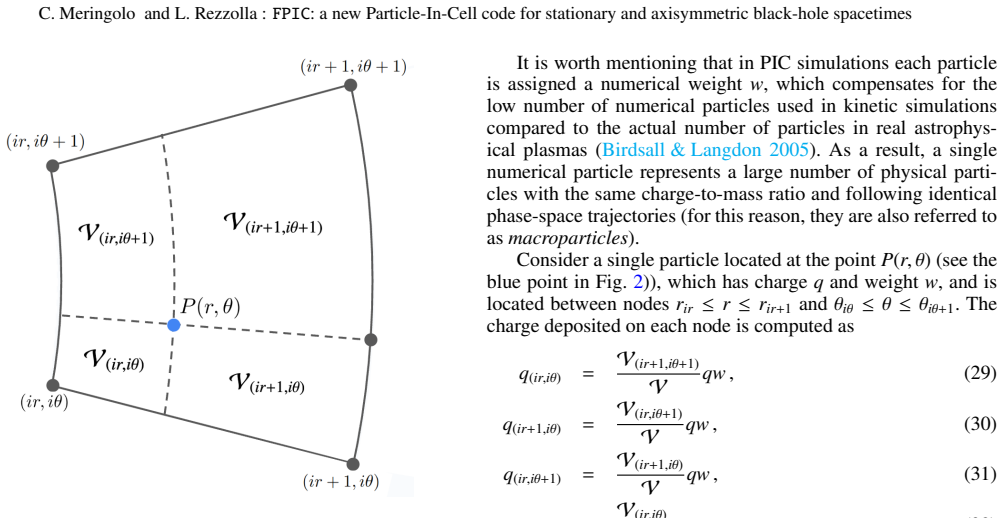
- [Fig. 1 caption] The caption says 'iθ in the radial direction'; this should be the polar/angular direction.
- [Sec. 2.4] The divergence-cleaning procedure is described as 'periodically' solving the Poisson equation every 25 timesteps with 500 Jacobi iterations. Please state the convergence criterion used for the Jacobi solver, or clarify why a fixed iteration count is sufficient.
- [Table C.2 and Sec. 3.1.2] The text says adaptive timesteps are employed in the hybrid schemes, but Table C.2 lists fixed values of Δt for RK4 and Hamiltonian steps. Please clarify how the adaptive step is determined and whether the listed values are upper bounds.
- [Sec. 1] Reference 'Pierre Jacques et al. 2025' appears incomplete (missing journal/page data). Please check the reference list entries for consistency.
- [General] Given the stated goal of reproducibility, consider adding a statement on code availability or a link to a public repository, even if only a limited distribution is planned.
Circularity Check
No load-bearing circularity: the BZ comparison is a calibrated shape test and self-citations are ancillary.
full rationale
The paper's derivation chain is not circular. The particle-pusher tests compare FPIC against known geodesic trajectories (Levin & Perez-Giz 2008; Bacchini et al. 2018; Chen et al. 2025), and the charged-particle runs check Hamiltonian/angular-momentum conservation as a function of resolution, so the hybrid integrator's energy gain is measured rather than assumed. The vacuum Wald test initializes the a*=0 (Schwarzschild) Wald field and relaxes to the Kerr Wald solution, an external analytic benchmark. For the split monopole, the initial condition is the a*=0 limit of the perturbative force-free family (Eqs. B.7-B.15), while the final BZ power must be produced dynamically by the PIC evolution. The comparison against Eq. (51) is primarily a shape test: the spin-dependent function F(Ωh) comes from independent perturbation theory (Armas et al. 2020; Camilloni et al. 2022), and only the amplitude κ=0.041 is fitted (§3.4). This is a calibration, not a derivation from the target result; the absolute luminosity is not independently predicted, but the spin dependence is not forced by construction. The paper explicitly acknowledges the simplified Goldreich-Julian injection scheme and the need for better injection strategies (§4), which is a physical caveat rather than a circular step. Self-citations (Meringolo et al. 2025) provide campaign details and normalization, but the plotted comparison data appear in this paper, so the self-citation is not load-bearing. No uniqueness theorem or ansatz is imported from prior work by the same authors to force the reported agreement.
Assumptions & free parameters
free parameters (6)
- κ =
0.041
- hybrid error thresholds (∂_t eH)_max =
1.5, 0.5, 0.5 (per case)
- eH_max =
1e-15, 1e-12, 1e-12
- ζ0 =
1e3
- multiplicity M =
3 (Wald), 10 (split monopole)
- absorbing boundary parameters (χ0, λ, r_abs) =
1e4, 5, 0.9 r_max
assumptions (7)
- domain assumption 3+1 decomposition and Kerr-Schild coordinates describe the spacetime (lapse α, shift βi, 3-metric γij)
- standard math Maxwell equations in a stationary spacetime written via FIDO variables (Eqs. 5-10)
- domain assumption Yee-grid leapfrog preserves ∇·B=0 to machine precision
- domain assumption Wald and split-monopole analytical solutions are correct initial data
- domain assumption Bacchini et al. (2018) Hamiltonian integrator is exactly energy-preserving in the continuous limit
- domain assumption The perturbation-theory expression Eq. (51) for the BZ power is exact to O(Ω_h^8)
- ad hoc to paper Goldreich–Julian density injection with Maxwell–Jüttner temperature models the pair-plasma supply
Cite this review
Pith. "Pith review of FPIC: a new Particle-In-Cell code for stationary and axisymmetric black-hole spacetimes." pith.science (2026). https://pith.science/paper/HTIPXDO2
@misc{pith2026260207452,
  author       = {Pith},
  title        = {Pith review of: FPIC: a new Particle-In-Cell code for stationary and axisymmetric black-hole spacetimes},
  year         = {2026},
  howpublished = {\url{https://pith.science/paper/HTIPXDO2}},
  note         = {Machine review of arXiv:2602.07452}
}
read the original abstract
In this paper we present a newly developed GRPIC code framework called FPIC, providing a detailed description of the Maxwell-equations solver, of the particle ``pushers'', and of the other algorithms that are needed in this approach. We describe in detail the code, which is written in Fortran and exploits parallel architectures using MPI directives both for the fields and particles. FPIC adopts spherical Kerr-Schild coordinates, which encode the overall spherical topology of the problem while remaining regular at the event horizon. The Maxwell equations are evolved using a finite-difference time-domain solver with a leapfrog scheme, while multiple particle ``pushers'' are implemented for the evolution of the particles. In addition to well-known algorithms, we introduce a novel hybrid method that dynamically switches between the most appropriate scheme based on the violation of the Hamiltonian energy. We first present results for neutral particles orbiting around black holes, both in the Schwarzschild and Kerr metrics, monitoring the evolution of the Hamiltonian error across different integration schemes. We apply our hybrid approach, showing that it is capable of achieving improved energy conservation at reduced computational cost. We apply FPIC to investigate the Wald solution, first in electrovacuum and subsequently in plasma-filled configurations. In the latter case, particles with negative energy at infinity are present inside the ergosphere, indicating that the Penrose process is active. Finally, we present the split-monopole solution in a plasma-filled environment and successfully reproduce the Blandford-Znajek luminosity, finding very good agreement with analytical predictions.
Figures


Figures from the paper (7 more)


Reference graph
Works this paper leans on
-
[1]
Alic , D., Moesta , P., Rezzolla , L., Zanotti , O., & Jaramillo , J. L. 2012, Astrophys. J., 754, 36
2012
-
[2]
Armas, J., Cai, Y., Comp\`ere, G., Garfinkle, D., & Gralla, S. E. 2020, JCAP, 04, 009
2020
-
[3]
Asenjo, F. A. & Comisso, L. 2017, Phys. Rev. Lett., 118, 055101
2017
-
[4]
Y., & Sironi , L
Bacchini , F., Ripperda , B., Chen , A. Y., & Sironi , L. 2018, Astrophys. J., Supp., 237, 6
2018
-
[5]
2019, Astrophys
Bacchini , F., Ripperda , B., Porth , O., & Sironi , L. 2019, Astrophys. J., Supp., 240, 40
2019
-
[6]
Baumgarte , T. W. & Shapiro , S. L. 2010, Numerical Relativity: Solving Einstein's Equations on the Computer (Cambridge, UK: Cambridge University Press)
2010
-
[7]
Beskin , V. S. 1997, Soviet Physics Uspekhi, 40, 659
1997
-
[8]
& Janis, V
Bicak, J. & Janis, V. 1985, Mon. Not. R. Astron. Soc., 212, 899
1985
Show all 81 references
-
[9]
Birdsall , C. K. & Langdon , A. B. 2005, Plasma Physics via Computer Simulation (Reprinted)
2005
-
[10]
Blandford , R. D. & Znajek , R. L. 1977, Mon. Not. R. Astron. Soc., 179, 433
1977
-
[11]
2021, Phys
Bransgrove , A., Ripperda , B., & Philippov , A. 2021, Phys. Rev. Lett., 127, 055101
2021
-
[12]
Camilloni , F., Dias , O. J. C., Grignani , G., et al. 2022, Journal of Cosmology and Astroparticle Physics, 2022, 58
2022
-
[13]
Camilloni , F., Harmark , T., Orselli , M., & Rodriguez , M. J. 2024, Journal of Cosmology and Astroparticle Physics, 2024, 047
2024
-
[14]
& Rezzolla , L
Camilloni , F. & Rezzolla , L. 2025, Astrophys. J. Lett., 982, 10
2025
-
[15]
2015, Mon
Cerutti , B., Philippov , A., Parfrey , K., & Spitkovsky , A. 2015, Mon. Not. R. Astron. Soc., 448, 606
2015
-
[16]
Y., Luepker , M., & Yuan , Y
Chen , A. Y., Luepker , M., & Yuan , Y. 2025, arXiv e-prints, arXiv:2503.04558
2025 arXiv
-
[17]
& Asenjo, F
Comisso, L. & Asenjo, F. A. 2021, Phys. Rev. D, 103, 023014
2021
-
[18]
2021, Theses, Universit \'e Grenoble Alpes [2020-....]
Crinquand, B. 2021, Theses, Universit \'e Grenoble Alpes [2020-....]
2021
-
[19]
2021, Astron
Crinquand , B., Cerutti , B., Dubus , G., Parfrey , K., & Philippov , A. 2021, Astron. Astrophys., 650, A163
2021
-
[20]
2022, Phys
Crinquand , B., Cerutti , B., Dubus , G., Parfrey , K., & Philippov , A. 2022, Phys. Rev. Lett., 129, 205101
2022
-
[21]
2020, Phys
Crinquand , B., Cerutti , B., Philippov , A., Parfrey , K., & Dubus , G. 2020, Phys. Rev. Lett., 124, 145101
2020
-
[22]
M., Mizuno , Y., et al
Cruz-Osorio , A., Fromm , C. M., Mizuno , Y., et al. 2022, Nature Astronomy, 6, 103
2022
-
[23]
M., et al
Cruz-Osorio , A., Meringolo , C., Fromm , C. M., et al. 2025, arXiv e-prints, arXiv:2512.14835
2025
-
[24]
Das , P., Porth , O., & Watts , A. L. 2022, Monthly Notices of the Royal Astronomical Society, 515, 3144
2022
-
[25]
2020, in Journal of Physics Conference Series, Vol
Del Zanna , L., Tomei , N., Bugli , M., & Bucciantini , N. 2020, in Journal of Physics Conference Series, Vol. 1623, Journal of Physics Conference Series, 012004
2020
-
[26]
N., & Gammie , C
Dhruv , V., Prather , B., Wong , G. N., & Gammie , C. F. 2025, Astrophys. J., Supp., 277, 16
2025
-
[27]
K., Mizuno , Y., Fromm , C
Dihingia , I. K., Mizuno , Y., Fromm , C. M., & Rezzolla , L. 2022, arXiv e-prints, arXiv:2206.13184
2022 arXiv
-
[28]
2023, Astron
El Mellah , I., Cerutti , B., & Crinquand , B. 2023, Astron. Astrophys., 677, A67
2023
-
[29]
2022, Astron
El Mellah , I., Cerutti , B., Crinquand , B., & Parfrey , K. 2022, Astron. Astrophys., 663, A169
2022
-
[30]
2022, Astrophys
Event Horizon Telescope Collaboration , Akiyama , K., Alberdi , A., et al. 2022, Astrophys. J. Lett., 930, L12
2022
-
[31]
2019, Astrophys
Event Horizon Telescope Collaboration , Akiyama , K., Alberdi , A., et al. 2019, Astrophys. J. Lett., 875, L1
2019
-
[32]
1986, Journal of Computational mathematics, 4, 279
Feng, K. 1986, Journal of Computational mathematics, 4, 279
1986
-
[33]
2025, Astron
Figueiredo , E., Cerutti , B., & Parfrey , K. 2025, Astron. Astrophys., 700, L19
2025
-
[34]
2020, Phys
Fujibayashi, S., Shibata, M., Wanajo, S., et al. 2020, Phys. Rev. D, 101, 083029
2020
-
[35]
2025, arXiv e-prints, arXiv:2511.17701
Galishnikova , A., Hakobyan , H., Philippov , A., & Crinquand , B. 2025, arXiv e-prints, arXiv:2511.17701
2025
-
[36]
2023, Phys
Galishnikova , A., Philippov , A., Quataert , E., et al. 2023, Phys. Rev. Lett., 130, 115201
2023
-
[37]
& Julian , W
Goldreich , P. & Julian , W. H. 1969, Astrophys. J., 157, 869
1969
-
[38]
2025, arXiv e-prints, arXiv:2510.26019
Gorard , J., Juno , J., & Hakim , A. 2025, arXiv e-prints, arXiv:2510.26019
2025
-
[39]
Gralla , S. E. & Jacobson , T. 2014, Mon. Not. Roy. Astron. Soc., 445, 2500
2014
-
[40]
2002, Geometric numerical integration
Hairer, E., Lubich, C., & Wanner, G. 2002, Geometric numerical integration. Structure-preserving algorithms for ordinary differential equations, 2nd edn. (Springer)
2002
-
[41]
2021, Astrophys
Hirotani , K., Krasnopolsky , R., Shang , H., Nishikawa , K.-i., & Watson , M. 2021, Astrophys. J., 908, 88
2021
-
[42]
2025, Astrophys
Imbrogno , M., Meringolo , C., Cruz-Osorio , A., et al. 2025, Astrophys. J. Lett., 990, L33
2025
-
[43]
2024, Astrophys
Imbrogno , M., Meringolo , C., Servidio , S., et al. 2024, Astrophys. J. Lett., 972, L5
2024
-
[44]
1986, IMA Journal of Numerical Analysis, 6, 381
Iserles, A. 1986, IMA Journal of Numerical Analysis, 6, 381
1986
-
[45]
Kerr, R. P. 1963, Phys. Rev. Lett., 11, 237
1963
-
[46]
& Arai , K
Koide , S. & Arai , K. 2008, Astrophys. J., 682, 1124
2008
-
[47]
Komissarov , S. S. 2004, Mon. Not. R. Astron. Soc., 350, 427
2004
-
[48]
& Perez-Giz , G
Levin , J. & Perez-Giz , G. 2008, Phys. Rev. D, 77, 103005
2008
-
[49]
& Cerutti , B
Levinson , A. & Cerutti , B. 2018, Astron. Astrophys., 616, A184
2018
-
[50]
Luepker , M., Yuan , Y., & Chen , A. Y. 2026, Astrophys. J., 996, 75
2026
-
[51]
C., Tchekhovskoy , A., & Blandford , R
McKinney , J. C., Tchekhovskoy , A., & Blandford , R. D. 2012, Mon. Not. R. Astron. Soc., 423, 3083
2012
-
[52]
2025, Mon
Megale , R., Cruz-Osorio , A., Ficarra , G., et al. 2025, Mon. Not. R. Astron. Soc., 544, 2011
2025
-
[53]
2025, Astrophys
Meringolo , C., Camilloni , F., & Rezzolla , L. 2025, Astrophys. J. Lett., 992, L8
2025
-
[54]
2023, Astrophys
Meringolo , C., Cruz-Osorio , A., Rezzolla , L., & Servidio , S. 2023, Astrophys. J., 944, 122
2023
- [55]
-
[56]
R., Noronha , J., & Philippov , A
Most , E. R., Noronha , J., & Philippov , A. A. 2022, Monthly Notices of the Royal Astronomical Society, 514, 4989
2022
-
[57]
2010, Phys
M \"o sta , P., Palenzuela , C., Rezzolla , L., et al. 2010, Phys. Rev. D, 81, 064017
2010
-
[58]
Nathanail , A., Dhang , P., & Fromm , C. M. 2022, Mon. Not. R. Astron. Soc., 513, 5204
2022
-
[59]
2023, Mon
Niv , I., Bromberg , O., Levinson , A., Cerutti , B., & Crinquand , B. 2023, Mon. Not. R. Astron. Soc., 526, 2709
2023
-
[60]
2019, Phys
Parfrey , K., Philippov , A., & Cerutti , B. 2019, Phys. Rev. Lett., 122, 035101
2019
-
[61]
Penna , R. F. 2015, Phys. Rev. D, 91, 084044
2015
-
[62]
1969, Riv
Penrose , R. 1969, Riv. Nuovo Cimento, 1, 252
1969
-
[63]
R., et al
Pierre Jacques , T., Cupp , S., Werneck , L. R., et al. 2025, 0, 112, 084044
2025
-
[64]
Press, W., Teukolsky, S., Vetterling, W., & Flannery, B. 1992
1992
-
[65]
& Zanotti , O
Rezzolla , L. & Zanotti , O. 2013, Relativistic Hydrodynamics (Oxford University Press)
2013
-
[66]
E., & Narayan , R
Sironi , L., Rowan , M. E., & Narayan , R. 2021, Astrophys. J. Lett., 907, L44
2021
-
[67]
& Spitkovsky , A
Sironi , L. & Spitkovsky , A. 2014, Astrophys. J.l, 783, L21
2014
-
[68]
& Nagataki, S
Tanabe, K. & Nagataki, S. 2008, Phys. Rev. D, 78, 024004
2008
-
[69]
Tchekhovskoy , A., Narayan , R., & McKinney , J. C. 2011, Mon. Not. R. Astron. Soc., 418, L79
2011
-
[70]
Thorne, K. S. & Macdonald, D. 1982, Mon. Not. R. Astr. Soc., 198, 339
1982
-
[71]
A., & Silva , L
Torres , R., Grismayer , T., Cruz , F., Fonseca , R. A., & Silva , L. O. 2024, New Astronomy, 112, 102261
2024
-
[72]
Tu , C. Y. & Marsch , E. 1997, Solar Physics, 171, 363
1997
-
[73]
K., Mizuno, Y., & Rezzolla, L
Uniyal, A., Dihingia, I. K., Mizuno, Y., & Rezzolla, L. 2025, Nature Astron., 1, 8
2025
-
[74]
B., I., Frazin , R
van der Holst , B., Manchester , W. B., I., Frazin , R. A., et al. 2010, Astrophys. J., 725, 1373
2010
-
[75]
2025, Phys
Vos , J., Cerutti , B., Mo \'s cibrodzka , M., & Parfrey , K. 2025, Phys. Rev. Lett., 135, 015201
2025
-
[76]
Wald , R. M. 1974, Phys. Rev. D, 10, 1680
1974
-
[77]
R., Uzdensky , D
Werner , G. R., Uzdensky , D. A., Begelman , M. C., Cerutti , B., & Nalewajko , K. 2018, Mon. Not. R. Astron. Soc., 473, 4840
2018
-
[78]
A., Werner , G
Wong , K., Zhdankin , V., Uzdensky , D. A., Werner , G. R., & Begelman , M. C. 2020, Astrophys. J. Lett., 893, L7
2020
-
[79]
1966, IEEE Transactions on Antennas and Propagation, 14, 302
Yee, K. 1966, IEEE Transactions on Antennas and Propagation, 14, 302
1966
-
[80]
Y., & Luepker , M
Yuan , Y., Chen , A. Y., & Luepker , M. 2025, Astrophys. J., 985, 159
2025
-
[81]
A., Werner, G
Zhdankin, V., Uzdensky, D. A., Werner, G. R., & Begelman, M. C. 2019, Physical review letters, 122, 055101
2019
Reviewed August 3, 2026 · model on record in the stance chip above.
Discussion (0). Continue with ORCID to comment.