Mellin-Space Prony Representability of Linear Viscoelastic Models
Pith reviewed 2026-05-16 06:15 UTC · model grok-4.3
The pith
A viscoelastic modulus has an exact finite Prony series if and only if its Mellin kernel pole lattices align with the integer lattice and residues obey decoupled recurrences.
A machine-rendered reading of the paper's core claim, the machinery that carries it, and where it could break.
Core claim
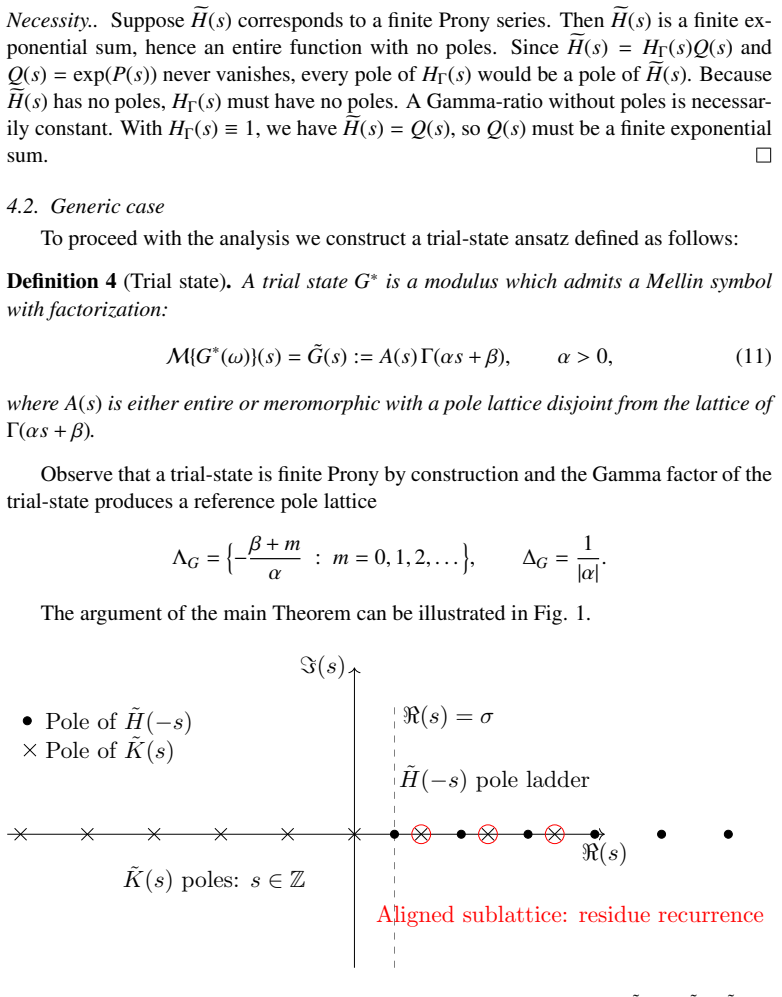
We prove that a viscoelastic modulus admits an exact finite Prony series if and only if the arithmetic pole lattices of its Mellin kernel align with the integer lattice of the constitutive kernel, and the associated residues satisfy decoupled first-order recurrences along aligned sublattices.
What carries the argument
Arithmetic pole lattices of the Mellin kernel together with residue recurrences along aligned sublattices; this geometric alignment decides whether finite Prony representability holds.
If this is right
- Maxwell and standard linear solid networks satisfy the alignment and recurrence conditions and therefore possess exact finite Prony representations.
- Power-law, Cole-Cole, Havriliak-Negami and Zener fractional models violate at least one condition and require infinite Prony ladders.
- Log-normal relaxation spectra also fail the criterion and cannot be realized by finite networks.
- The test supplies both a theoretical taxonomy and a direct computational check on any given modulus.
Where Pith is reading between the lines
- The same lattice-alignment test could be applied to other integral transforms used in rheology to decide discrete representability.
- Numerical schemes might first project a measured spectrum onto the nearest aligned sublattice before fitting residues.
- The Diophantine condition suggests searching for analogous arithmetic constraints in spectra from acoustics or dielectrics.
Load-bearing premise
The Mellin kernels of the modulus functions have only isolated arithmetic pole singularities and no interfering branch cuts or essential singularities.
What would settle it
A viscoelastic function whose Mellin poles lie on aligned arithmetic lattices yet whose residues fail the decoupled recurrence, yet still admits an exact finite Prony series.
Figures
read the original abstract
Linear viscoelastic materials are commonly described by continuous relaxation spectra, yet practical measurements and simulations employ discrete Prony series. In the Laplace frequency domain, the distinction is well understood: rational transfer functions admit finite Prony representations, while fractional models with branch cuts do not. This work provides a complementary and structurally deeper characterization in the Mellin transform domain. We prove that a viscoelastic modulus admits an exact finite Prony series if and only if the arithmetic pole lattices of its Mellin kernel align with the integer lattice of the constitutive kernel, and the associated residues satisfy decoupled first-order recurrences along aligned sublattices. Unlike the Laplace-domain rational/non-rational dichotomy, the Mellin criterion reveals the arithmetic geometry underlying finite representability, which requires Diophantine alignment of infinite pole progressions and the compatibility of their residues. Applying this criterion yields a complete model taxonomy. Classical spring-dashpot networks (Maxwell, standard linear solid) satisfy the alignment and recurrence conditions. In contrast, fractional models (power-law, Cole-Cole, Havriliak-Negami, Zener) and log-normal spectra violate one or both conditions and require infinite Prony ladders for exact representation. The framework thus shifts the question of finite network realizability from an algebraic condition on rational functions to a geometric condition on pole lattices, offering both a theoretical classification and a practical computational test.
Editorial analysis
A structured set of objections, weighed in public.
Referee Report
Summary. The manuscript proves that a viscoelastic modulus admits an exact finite Prony series if and only if the arithmetic pole lattices of its Mellin kernel align with the integer lattice of the constitutive kernel and the associated residues satisfy decoupled first-order recurrences along aligned sublattices. This Mellin-domain criterion is contrasted with the Laplace-domain rational/non-rational distinction and applied to classify classical spring-dashpot networks (Maxwell, standard linear solid) as satisfying the conditions while fractional models (power-law, Cole-Cole, Havriliak-Negami, Zener) and log-normal spectra violate one or both and require infinite Prony ladders.
Significance. If the central theorem holds, the work supplies a geometric characterization of finite Prony representability based on Diophantine lattice alignment and residue recurrences, shifting the question from algebraic rationality in the Laplace domain to arithmetic geometry in the Mellin domain. It yields a complete model taxonomy and a potential computational test, with the proof-based approach and explicit conditions on pole progressions constituting clear strengths.
major comments (2)
- [§3.1, Theorem 3.1] §3.1, Theorem 3.1 (necessity direction): The argument that finite Prony series force purely arithmetic pole lattices without branch cuts or essential singularities is load-bearing for the 'only if' claim. An explicit lemma is needed showing that the Mellin transform of any finite sum of exponentials satisfying the constitutive equation cannot produce non-arithmetic singularities, as the current sketch leaves open the possibility of counterexamples with branch cuts that still admit finite Prony.
- [§4.2] §4.2, taxonomy of fractional models: For the Havriliak-Negami and Cole-Cole cases, the explicit residue calculations demonstrating violation of the decoupled first-order recurrence (e.g., via the formulas following Eq. (18)) should be supplied in full to confirm they fail the alignment condition and necessitate infinite Prony series.
minor comments (2)
- [Abstract] Abstract: The phrase 'arithmetic pole lattices' is introduced without a one-sentence definition; a brief parenthetical gloss on first use would aid readers from the viscoelasticity community.
- [§1] §1: Add a short sentence contrasting the new Mellin criterion with the classical Laplace-domain rational-function test to sharpen the introduction's motivation.
Simulated Author's Rebuttal
We thank the referee for the careful reading and constructive suggestions. The comments identify opportunities to strengthen the necessity proof in Theorem 3.1 and to make the taxonomy calculations fully explicit. We address each point below and will revise the manuscript accordingly.
read point-by-point responses
-
Referee: [§3.1, Theorem 3.1] §3.1, Theorem 3.1 (necessity direction): The argument that finite Prony series force purely arithmetic pole lattices without branch cuts or essential singularities is load-bearing for the 'only if' claim. An explicit lemma is needed showing that the Mellin transform of any finite sum of exponentials satisfying the constitutive equation cannot produce non-arithmetic singularities, as the current sketch leaves open the possibility of counterexamples with branch cuts that still admit finite Prony.
Authors: We agree that the necessity direction requires a fully rigorous demonstration that finite Prony series cannot generate non-arithmetic singularities. The existing sketch proceeds from the constitutive equation and the explicit Mellin transform of a finite exponential sum, but an explicit lemma will eliminate any ambiguity. In the revised manuscript we will insert Lemma 3.2, which states: Let G(t) be a finite sum of exponentials satisfying the linear viscoelastic constitutive relation; then its Mellin transform M(s) possesses only arithmetic pole lattices and is free of branch cuts and essential singularities. The proof will compute the Mellin integral term-by-term, locate the resulting poles, and verify that any deviation from arithmetic progression would contradict the finite-sum assumption. revision: yes
-
Referee: [§4.2] §4.2, taxonomy of fractional models: For the Havriliak-Negami and Cole-Cole cases, the explicit residue calculations demonstrating violation of the decoupled first-order recurrence (e.g., via the formulas following Eq. (18)) should be supplied in full to confirm they fail the alignment condition and necessitate infinite Prony series.
Authors: We accept the request for complete calculations. The original text indicates the violation through the general Mellin-kernel form but does not display every residue step. In the revised Section 4.2 we will expand the discussion following Eq. (18) to include the full residue formulas: for the Cole-Cole model the residues at s = −n + iθ_k produce a recurrence that couples distinct imaginary parts, violating decoupling; for the Havriliak-Negami model the residues involve a non-separable dependence on both real and imaginary indices that likewise fails the first-order decoupled recurrence. These explicit expressions will confirm that both models violate the lattice-alignment and recurrence conditions and therefore require infinite Prony ladders. revision: yes
Circularity Check
Derivation self-contained from standard Mellin-transform residue calculus and Prony-series definitions
full rationale
The central iff claim is obtained by applying the known inversion formula for the Mellin transform to a finite sum of exponentials (Prony series) and extracting the resulting pole lattice and residue recurrence conditions. These steps follow directly from the definition of the Mellin kernel and the arithmetic-progression structure of exponential sums; no fitted parameter is renamed as a prediction, no self-citation supplies a load-bearing uniqueness theorem, and the necessity direction is derived by contraposition on the singularity structure rather than by assumption. The taxonomy of classical and fractional models is presented as an application of the criterion, not as its justification. Consequently the derivation chain does not reduce to its inputs by construction.
Axiom & Free-Parameter Ledger
axioms (2)
- domain assumption Mellin transform converts the constitutive kernel into a function whose singularities are poles arranged in arithmetic progressions
- domain assumption Residues along aligned sublattices obey first-order linear recurrences
Reference graph
Works this paper leans on
-
[1]
G. E. P. Box, Science and statistics, J. Amer. Statist. Assoc. 71 (356) (1976) 791–
work page 1976
-
[2]
doi:10.1080/01621459.1976.10480949
-
[3]
J. Hristov, Response functions in linear viscoelastic constitutive equations and re- lated fractional operators, Mathematical Modelling of Natural Phenomena 14 (3) (2019) 305. doi:10.1051/mmnp/2018067
-
[4]
2010.Fractional Calculus and Waves in Linear Viscoelasticity
F. Mainardi, Fractional Calculus and Waves in Linear Viscoelasticity, Imperial Col- lege Press, 2010. doi:10.1142/p614
-
[5]
A. Bonfanti, J. L. Kaplan, G. Charras, A. Kabla, Fractional viscoelas- tic models for power-law materials, Soft Matter 16 (26) (2020) 6002–6020. doi:10.1039/d0sm00354a
-
[6]
Hristov, Prony’s series and modern fractional calculus, Elsevier, 2022, pp
J. Hristov, Prony’s series and modern fractional calculus, Elsevier, 2022, pp. 187–
work page 2022
-
[7]
doi:10.1016/b978-0-323-90032-4.00005-5
-
[8]
L. Thigpen, G. W. Hedstrom, B. P. Bonner, An Inverse Problem in Viscoelasticity, Springer US, 1983, pp. 897–905. doi:10.1007/978-1-4613-3706-5_57
-
[9]
A. Stankiewicz, On applicability of the relaxation spectrum of fractional maxwell model to description of unimodal relaxation spectra of polymers, Polymers 15 (17) (2023) 3552. doi:10.3390/polym15173552
-
[10]
F. Oberhettinger, Tables of Mellin Transforms, Springer Berlin/Heidelberg, Berlin, Heidelberg, 1974, description based on publisher supplied metadata and other sources
work page 1974
-
[11]
G. R. de Prony, Essai expérimental et analytique, Journal de l’École polytechnique 1 (22) (1795) 24–76
-
[12]
M. Baumgaertel, H. Winter, Interrelation between continuous and discrete relax- ation time spectra, Journal of Non-Newtonian Fluid Mechanics 44 (1992) 15–36. doi:10.1016/0377-0257(92)80043-w
-
[13]
Sur les fonctions absolument monotones.Acta Mathematica, 52:1–66, 1929
S. Bernstein, Sur les fonctions absolument monotones, Acta Mathematica 52 (0) (1929) 1–66. doi:10.1007/bf02592679. 25
-
[14]
A. M. Mathai, R. K. Saxena, H. J. Haubold, The H-Function: Theory and Applica- tions, Springer, New York, 2010. doi:10.1007/978-1-4419-0916-9
-
[15]
C. Fox, The G and H functions as symmetrical Fourier kernels, Transactions of the American Mathematical Society 98 (3) (1961) 395–429. doi:10.2307/1993339
-
[16]
A. A. Inayat-Hussain, New properties of hypergeometric series derivable from Feynman integrals. II. A generalisation of the H-function, Journal of Physics A: Mathematical and General 20 (13) (1987) 4119–4128. doi:10.1088/0305- 4470/20/13/020. URLhttps://doi.org/10.1088/0305-4470/20/13/020
-
[17]
R. P. Boas, Entire Functions, Academic Press, New York, 1954
work page 1954
-
[18]
C. Bardaro, P. L. Butzer, I. Mantellini, G. Schmeisser, A fresh approach to the paley–wiener theorem for mellin transforms and the mellin–hardy spaces, Math. Nachr. 290 (17–18) (2017) 2759–2774. doi:10.1002/mana.201700043
-
[19]
T. Uneyama, Information-theoretical approach to relaxation time distribution in rheology: Log-normal relaxation spectrum model, Nihon Reoroji Gakkaishi 53 (5) (2025) 215–224. doi:10.1678/rheology.53.215. Appendix A. Mellin Transform of Constitutive Identity Appendix A.1. Derivation of the Mellin-space constitutive equation Lemma 2(Mellin transform of the ...
discussion (0)
Sign in with ORCID, Apple, or X to comment. Anyone can read and Pith papers without signing in.