Defect binding-unbinding transition in active nematic membranes
Pith reviewed 2026-05-16 03:50 UTC · model grok-4.3
The pith
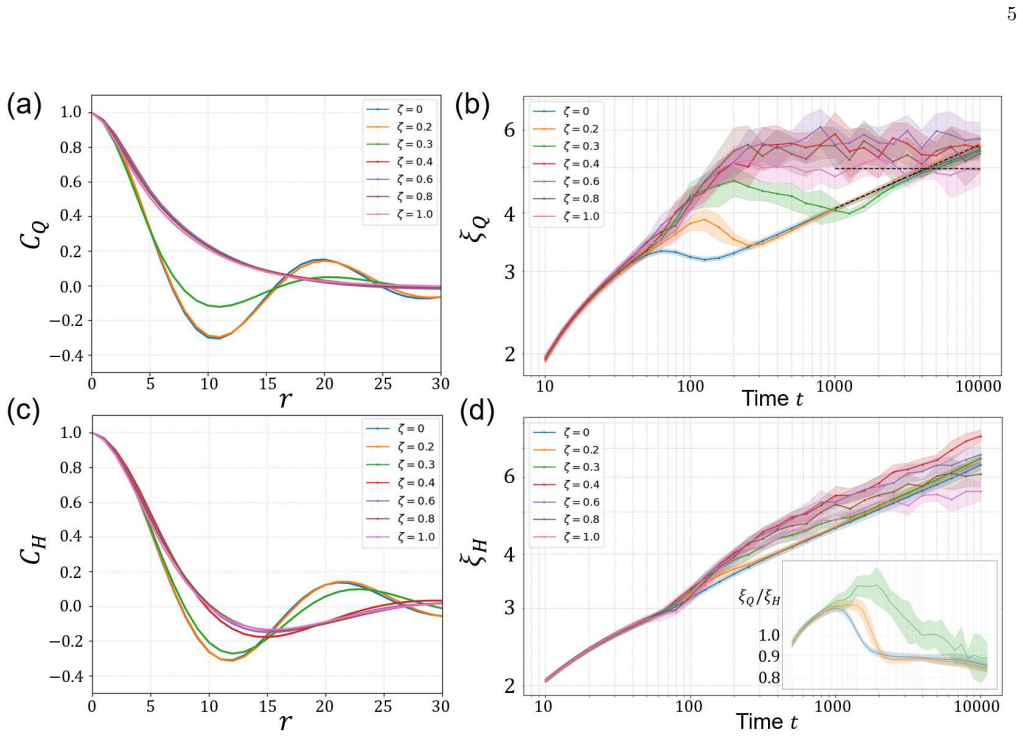
Active nematic membranes undergo a continuous transition from trapped defects to active turbulence at a critical activity scaling as coupling strength squared over bending stiffness.
A machine-rendered reading of the paper's core claim, the machinery that carries it, and where it could break.
Core claim
Simulations of the coupled evolution of the nematic order parameter and membrane height field reveal a continuous transition from a curvature-dominated regime, in which topological defects remain trapped by local deformations, to an activity-dominated regime that exhibits active turbulence. Scaling analysis shows the critical activity threshold ζ_c scales as α²/κ, where α is the coupling constant and κ is the bending stiffness; this relation is confirmed numerically. Even in the turbulent regime, walls in the director field generate characteristic wave-like curvature profiles that maintain significant orientational-geometry correlations.
What carries the argument
The minimal coupled dynamical equations for the nematic order parameter and membrane height, incorporating active stress and anisotropic curvature coupling.
Load-bearing premise
The minimal model of coupled nematic order parameter and membrane height evolution captures the dominant physics of active stress and anisotropic curvature coupling without requiring additional biological or hydrodynamic details.
What would settle it
Numerical or experimental data showing either a discontinuous jump in defect mobility with activity or a critical threshold that deviates from the α²/κ scaling would falsify the continuous transition and the reported scaling relation.
Figures



read the original abstract
We investigate the dynamics of active nematic liquid crystals on deformable membranes, focusing on the interplay between active stress and anisotropic curvature coupling. Using a minimal model, we simulate the coupled evolution of the nematic order parameter and membrane height. We demonstrate a continuous transition from a curvature-dominated regime, where topological defects are trapped by local deformation, to an activity-dominated regime exhibiting active turbulence. A scaling analysis reveals that the critical activity threshold $\zeta_c$ scales as $\alpha^2/\kappa$, where $\alpha$ and $\kappa$ are the coupling constant and bending stiffness, respectively; this relationship is confirmed by our numerical results. Furthermore, we find that significant correlations between the orientational pattern and membrane geometry persist even in the turbulent regime. Specifically, we identify that "walls" in the director field induce characteristic wave-like curvature profiles, providing a mechanism for dynamic coupling between order and shape. These results offer a physical framework for understanding defect-mediated deformation in nonequilibrium biological membranes.
Editorial analysis
A structured set of objections, weighed in public.
Referee Report
Summary. The manuscript investigates the dynamics of active nematic liquid crystals on deformable membranes using a minimal coupled model for the nematic order parameter and membrane height. It reports a continuous transition from a curvature-dominated regime, in which topological defects are trapped by local deformations, to an activity-dominated regime exhibiting active turbulence. A scaling analysis predicts that the critical activity threshold ζ_c scales as α²/κ, with this relation confirmed by numerical simulations. Persistent correlations between the director field and membrane geometry are identified even in the turbulent regime, specifically wave-like curvature profiles induced by walls in the orientational pattern.
Significance. If the central scaling result holds, the work supplies a clean, minimal hydrodynamic-free framework for defect-mediated shape changes in active membranes, with direct relevance to biological systems. The dimensionally consistent balancing argument for ζ_c ~ α²/κ together with its direct numerical verification constitutes a falsifiable prediction that strengthens the claim; the additional observation of geometry-order correlations in the turbulent phase adds mechanistic insight beyond the transition itself.
major comments (2)
- [§3] §3 (scaling analysis): the derivation of ζ_c ~ α²/κ balances active stress against the anisotropic curvature coupling and bending terms, but the precise prefactors and the assumed form of the curvature-coupling stress tensor are not written out explicitly; without these the scaling cannot be checked for hidden parameter dependence.
- [§4.3] §4.3 (numerical results): the location of the transition is identified by the onset of defect unbinding and the appearance of turbulent flow, yet no quantitative criterion (e.g., defect-pair separation threshold or order-parameter correlation length) is stated; this makes the reported numerical confirmation of the scaling relation difficult to reproduce exactly.
minor comments (2)
- [Figure 3] Figure 3: the color scale for membrane height h is not labeled with units or a reference value; adding this would clarify the amplitude of the reported wave-like profiles.
- [§2] The model equations in §2 omit explicit mention of the Frank elastic constants; stating whether they are set to unity or retained as parameters would remove ambiguity in the scaling analysis.
Simulated Author's Rebuttal
We thank the referee for their positive assessment and constructive comments on our manuscript. We address each major comment below and will revise the manuscript accordingly to improve clarity and reproducibility.
read point-by-point responses
-
Referee: [§3] §3 (scaling analysis): the derivation of ζ_c ~ α²/κ balances active stress against the anisotropic curvature coupling and bending terms, but the precise prefactors and the assumed form of the curvature-coupling stress tensor are not written out explicitly; without these the scaling cannot be checked for hidden parameter dependence.
Authors: We agree that the scaling derivation in §3 would benefit from explicit details. In the revised manuscript we will write out the full form of the curvature-coupling stress tensor and show the term-by-term balancing that yields ζ_c ~ α²/κ, including all prefactors, so that any hidden parameter dependence can be verified directly. revision: yes
-
Referee: [§4.3] §4.3 (numerical results): the location of the transition is identified by the onset of defect unbinding and the appearance of turbulent flow, yet no quantitative criterion (e.g., defect-pair separation threshold or order-parameter correlation length) is stated; this makes the reported numerical confirmation of the scaling relation difficult to reproduce exactly.
Authors: We acknowledge the need for a reproducible quantitative criterion. In the revised §4.3 we will define the transition point explicitly, for example as the activity at which the mean defect-pair separation exceeds a fixed fraction of the system size or at which the orientational correlation length falls below a stated threshold; this definition will then be used to locate the numerical points that confirm the ζ_c ~ α²/κ scaling. revision: yes
Circularity Check
No significant circularity in derivation chain
full rationale
The paper performs a scaling analysis on its minimal coupled equations for nematic order and membrane height to obtain the relation ζ_c ~ α²/κ by balancing active stress, anisotropic curvature coupling, and bending rigidity; this analytic result is then checked by direct numerical simulation of defect unbinding. No load-bearing step reduces to a self-definition, a fitted parameter renamed as a prediction, or a self-citation chain. The derivation remains independent of its own outputs and is externally falsifiable within the stated model assumptions.
Axiom & Free-Parameter Ledger
free parameters (3)
- activity strength zeta
- coupling constant alpha
- bending stiffness kappa
axioms (1)
- domain assumption Continuum hydrodynamic description of nematic order parameter and membrane height remains valid across the transition
Lean theorems connected to this paper
-
IndisputableMonolith/Cost/FunctionalEquation.leanwashburn_uniqueness_aczel unclear?
unclearRelation between the paper passage and the cited Recognition theorem.
A scaling analysis reveals that the critical activity threshold ζ_c scales as α²/κ ... F_curv = -α²/(2κ) ∫ |J(q)|²/q⁴
-
IndisputableMonolith/Foundation/RealityFromDistinction.leanreality_from_one_distinction unclear?
unclearRelation between the paper passage and the cited Recognition theorem.
minimal model of coupled nematic order parameter and membrane height evolution
What do these tags mean?
- matches
- The paper's claim is directly supported by a theorem in the formal canon.
- supports
- The theorem supports part of the paper's argument, but the paper may add assumptions or extra steps.
- extends
- The paper goes beyond the formal theorem; the theorem is a base layer rather than the whole result.
- uses
- The paper appears to rely on the theorem as machinery.
- contradicts
- The paper's claim conflicts with a theorem or certificate in the canon.
- unclear
- Pith found a possible connection, but the passage is too broad, indirect, or ambiguous to say the theorem truly supports the claim.
Reference graph
Works this paper leans on
-
[1]
M. C. Marchetti, J.-F. Joanny, S. Ramaswamy, T. B. Liverpool, J. Prost, M. Rao, and R. A. Simha, Rev. Mod. Phys.85, 1143 (2013)
work page 2013
- [2]
-
[3]
C. Bechinger, R. Di Leonardo, H. L¨ owen, C. Reichhardt, G. Volpe, and G. Volpe, Rev. Mod. Phys.88, 045006 (2016)
work page 2016
-
[4]
M. J. Bowick, N. Fakhri, M. C. Marchetti, and S. Ra- maswamy, Phys. Rev. X12, 010501 (2022)
work page 2022
-
[5]
A. Doostmohammadi, J. Ign´ es-Mullol, J. M. Yeomans, and F. Sagu´ es, Nat. Commun.9, 3246 (2018)
work page 2018
-
[6]
L. Balasubramaniam, R.-M. M` ege, and B. Ladoux, Curr. Opin. Genet. Dev.73, 101897 (2022)
work page 2022
- [7]
-
[8]
T. Sanchez, D. T. Chen, S. J. DeCamp, M. Heymann, and Z. Dogic, Nature491, 431 (2012)
work page 2012
-
[9]
H. H. Wensink, J. Dunkel, S. Heidenreich, K. Drescher, R. E. Goldstein, H. L¨ owen, and J. M. Yeomans, Proc. Natl. Acad. Sci. U.S.A.109, 14308 (2012)
work page 2012
-
[10]
L. M. Lemma, S. J. DeCamp, Z. You, L. Giomi, and Z. Dogic, Soft Matter15, 3264 (2019)
work page 2019
- [11]
-
[12]
F. C. Keber, E. Loiseau, T. Sanchez, S. J. DeCamp, L. Giomi, M. J. Bowick, M. C. Marchetti, Z. Dogic, and A. R. Bausch, Science345, 1135 (2014)
work page 2014
-
[13]
P. W. Ellis, D. J. Pearce, Y.-W. Chang, G. Goldsztein, L. Giomi, and A. Fernandez-Nieves, Nat. Phys.14, 85 (2018)
work page 2018
-
[14]
T. B. Saw, A. Doostmohammadi, V. Nier, L. Kocgozlu, S. Thampi, Y. Toyama, P. Marcq, C. T. Lim, J. M. Yeo- mans, and B. Ladoux, Nature544, 212 (2017)
work page 2017
- [15]
-
[16]
Y. Maroudas-Sacks, L. Garion, L. Shani-Zerbib, A. Livshits, E. Braun, and K. Keren, Nat. Phys.17, 251 (2021)
work page 2021
-
[17]
Y. Maroudas-Sacks, S. Suganthan, L. Garion, Y. Ascoli- Abbina, A. Westfried, N. Dori, I. Pasvinter, M. Popovi´ c, and K. Keren, Development152, DEV204514 (2025)
work page 2025
-
[18]
X. Wang, M. Merkel, L. B. Sutter, G. Erdemci-Tandogan, M. L. Manning, and K. E. Kasza, Proc. Natl. Acad. Sci. U.S.A.117, 13541 (2020). 9
work page 2020
-
[19]
N. I. Petridou, S. Grigolon, G. Salbreux, E. Hannezo, and C.-P. Heisenberg, Nat. Cell Biol.21, 169 (2019)
work page 2019
-
[20]
T. Chen, Y. Zhao, X. Zhao, S. Li, J. Cao, J. Guo, W. Bu, H. Zhao, J. s. Du, Y. Cao,et al., Adv. Sci.9, 2104301 (2022)
work page 2022
-
[21]
R. Etournay, M. Merkel, M. Popovi´ c, H. Brandl, N. A. Dye, B. Aigouy, G. Salbreux, S. Eaton, and F. J¨ ulicher, eLife5, e14334 (2016)
work page 2016
-
[22]
G. Erdemci-Tandogan and M. L. Manning, PLoS Com- put. Biol.17, e1009049 (2021)
work page 2021
- [23]
- [24]
- [25]
-
[26]
S. C. Al-Izzi and R. G. Morris, J. Fluid Mech.957, A4 (2023)
work page 2023
-
[27]
S. C. Al-Izzi and R. G. Morris, inSemin. Cell Dev. Biol., Vol. 120 (Elsevier, 2021) pp. 44–52, see this reference for a topical review of active, deformable surfaces in mor- phogenesis
work page 2021
-
[28]
G. Salbreux, F. J¨ ulicher, J. Prost, and A. Callan-Jones, Phys. Rev. Research4, 033158 (2022), this reference pro- vides a comprehensive theoretical treatment of active fluid surfaces
work page 2022
-
[29]
L. A. Hoffmann, L. N. Carenza, J. Eckert, and L. Giomi, Sci. Adv.8, eabk2712 (2022)
work page 2022
-
[30]
Z. Wang, M. C. Marchetti, and F. Brauns, Proc. Natl. Acad. Sci. U.S.A.120, e2220167120 (2023)
work page 2023
- [31]
- [32]
-
[33]
C. Zhu, D. Saintillan, and A. Chern, Proc. R. Soc. A481 (2025)
work page 2025
-
[34]
L. Metselaar, J. M. Yeomans, and A. Doostmohammadi, Phys. Rev. Lett.123, 208001 (2019)
work page 2019
- [35]
- [36]
-
[37]
S. P. Thampi, R. Golestanian, and J. M. Yeomans, EPL 105, 18001 (2014)
work page 2014
-
[38]
G. Napoli and L. Vergori, Phys. Rev. E85, 061701 (2012), see this reference for general treatments of spatial derivatives on curved nematic surfaces
work page 2012
-
[39]
J. Pollard, S. C. Al-Izzi, and R. G. Morris, J. Fluid Mech. 1007, A32 (2025), see this reference for the choice of objective time derivatives and coordinate-invariance of the physics on fluid deformable surfaces
work page 2025
-
[40]
M. Arroyo and A. DeSimone, Phys. Rev. E79, 031915 (2009), see this reference for an exploration of couplings between flow and intrinsic curvature
work page 2009
-
[41]
M. L. Henle and A. J. Levine, Phys. Rev. E81, 011905 (2010), see this reference for the hydrodynamics of fluid membranes with curvature-flow coupling
work page 2010
-
[42]
R. G. Morris and M. S. Turner, Phys. Rev. Lett.115, 198101 (2015), see this reference for the influence of in- trinsic curvature on the mobility of membrane inclusions
work page 2015
- [43]
-
[44]
I. V´ elez-Cer´ on, P. Guillamat, F. Sagu´ es, and J. Ign´ es- Mullol, Proc. Natl. Acad. Sci. U.S.A.121, e2312494121 (2024)
work page 2024
-
[45]
Spontaneous rotation and propulsion of suspended capsules in active nematics
J. Santos, M. M. T. da Gama, and R. C. Coelho, arXiv:2510.17643 (2025)
work page internal anchor Pith review Pith/arXiv arXiv 2025
- [46]
-
[47]
E. J. Hemingway, P. Mishra, M. C. Marchetti, and S. M. Fielding, Soft Matter12, 7943 (2016)
work page 2016
-
[48]
Y. Hirota and N. Uchida, Data and code for: Defect binding-unbinding transition in active nematic mem- branes, https://doi.org/10.5281/zenodo.19394561
discussion (0)
Sign in with ORCID, Apple, or X to comment. Anyone can read and Pith papers without signing in.