REVIEW 3 major objections 5 minor 73 references
TESS planets in known radial velocity cold Jupiter systems: Hot super Earth occurrence is enhanced by cold Jupiters
T0 review · 3 major / 5 minor · reviewed 2026-08-03 · deepseek-v4-flash
Pith's one-line read Stars that host a distant Jupiter-mass planet are about eight times more likely to also host a close-in super-Earth, according to a transit survey of 132 known cold-Jupiter systems.
desk verdict The core enhancement factor (~8x) is credible and novel, but the 87% system fraction is an upper limit built on an admitted unknown multiplicity, and the abstract/full-text numbers disagree. read the letter →
The pith
A machine-rendered reading of the paper's core claim, the machinery that carries it, and where it could break.
The reading
What carries the argument
The load-bearing quantity is the enhancement factor f = η(HSE|CJ)/η(HSE), estimated from the ratio of the five observed transiting hot super-Earths to N̄ = 0.58, the expected number under the null hypothesis. Equation (4) builds N̄ by summing over orbital-period and radius bins the field occurrence rate times the geometric transit probability p_tr = 0.9 R*/a and the pipeline detection efficiency, the latter measured by injecting 200 synthetic transits around each star and recovering them with a BLS search. The posterior on f is a Gamma distribution arising from a Poisson likelihood for the detection count. The geometric transit probability, which assumes isotropic inner-planet inclinations,
What would settle it
Measure the mutual inclinations between hot super-Earths and their outer cold Jupiters in a statistically meaningful sample—using transit-duration ratios, Rossiter–McLaughlin observations, or astrometry. If typical mutual inclinations are small (≲5°) and RV-selected cold Jupiters are preferentially edge-on, the isotropic-transit assumption fails and the enhancement factor is overestimated; if mutual inclinations are large, the enhancement would be even larger. A pipeline-independent check is to run the same TESS search on a metallicity- and brightness-matched sample of field stars without cold
Extended reading notes
Core claim
On the paper's own terms, the central discovery is that the conditional occurrence of hot super-Earths in cold-Jupiter systems, η(HSE|CJ), exceeds the field rate η(HSE) by an order of magnitude. The authors compute the expected number of transiting hot super-Earths in their 132-star sample under the null hypothesis of no correlation, N̄ = 0.58, using Kepler-based field occurrence rates and per-star transit and detection efficiencies determined from injection-recovery simulations. With five planets observed, the Poisson-based posterior gives the enhancement factor f = 8.1^{+4.3}_{-3.2}, and P(f ≤ 1) = 0.1%. Dividing the implied conditional occurrence rate by the sample's average multiplicity
Load-bearing premise
The assumption that the inner super-Earths' orbital inclinations are distributed isotropically, so that p_tr = 0.9 R*/a applies unconditionally, is the load-bearing premise: if inner planets preferentially share the cold Jupiter's orbital plane, the assumed transit probability is too low, N̄ is underestimated, and the measured 8.1× enhancement would shrink.
Editorial extensions
If this is right
- Occurrence-rate models and planet-formation simulations must reproduce an order-of-magnitude enhancement of close-in super-Earths when an outer giant is present, rather than treating the two populations as independent.
- RV-only surveys systematically miss most inner super-Earths in cold-Jupiter systems; combined transit+RV samples are necessary to measure P(SE|CJ), which explains part of the scatter among earlier correlation studies.
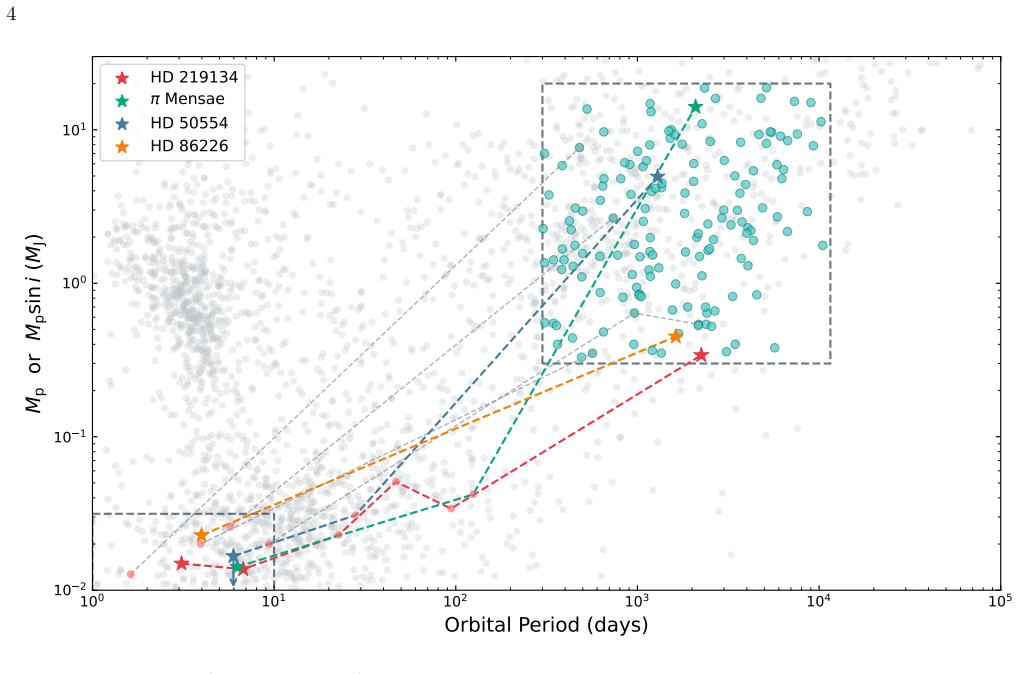
- The large mutual inclinations seen in the two super-Jupiter systems in this sample show that the inner and outer planets need not be coplanar, so the enhancement is a genuine occurrence effect rather than purely a geometric alignment artifact—though the size of the effect still depends on the inclination distribution.
- Targeted searches for transits around known RV giant hosts can be an efficient way to build a statistical sample of multi-planet architectures, since each detected inner planet is a nearly guaranteed co-existing system.
Reading between the lines
- If the isotropic-inclination assumption is wrong and inner super-Earths preferentially align with the cold Jupiter's orbital plane (while RV detection favors edge-on giants), the true transit probability is higher than assumed; N̄ would rise and the 8.1× enhancement would shrink. Mutual-inclination measurements could separate a genuine occurrence boost from an architecture-alignment effect.
- The abstract reports 91% for P(HSE|CJ) while Section 5 and the summary give 87%; the derivation in Eq. (8) uses the sample's average multiplicity, making 87% the better documented figure. The mismatch is not reconciled in the text.
- The detection-efficiency map rests on injection-recovery without visual validation of recovered signals; the authors argue the sample is clean, but any residual false-positive rate would bias N̄ and hence f. An independent re-analysis of the same 132 light curves with a different pipeline would test the robustness.
- The apparent enhancement in the metal-poor subsample (1 of 43 systems) suggests the correlation may not be purely metallicity-driven; extending this TESS-based approach to a larger sample of giants found astrometrically at low metallicity would test whether the boost persists.
Editorial analysis
A structured set of objections, weighed in public.
Referee Report
Summary. This paper constructs a sample of 132 Sun-like stars with RV-detected cold Jupiters, performs a uniform TESS transit search for inner hot super-Earths (1–4 R⊕, P<10 d), and validates two candidates around HD 50554. After injection-recovery completeness and geometric transit probabilities, 5 detected HSEs are compared with an expected field background of Nbar=0.58 from Kepler occurrence rates. A Poisson/Gamma model gives an enhancement factor f=8.1^{+4.3}_{-3.2} with P(f≤1)=0.1%. Dividing the conditional occurrence rate η=1.09 by an assumed multiplicity 5/4 yields a system fraction P(HSE|CJ)≈87%. The paper also explores metallicity and mass sub-samples.
Significance. If correct, this is a direct, well-defined measurement of the inverted conditional probability P(SE|CJ), strongly supporting a positive SE–CJ correlation and providing a useful constraint on formation and dynamical-evolution models. Strengths include the clean RV-selected CJ sample with explicit exclusion criteria, a uniform TESS BLS search with injection-recovery completeness, careful validation of the HD 50554 candidates using photometry, RV, and Gaia astrometry, and transparent Poisson statistics with robustness checks against two independent field occurrence maps and alternative CJ definitions. The core enhancement-factor result is largely independent of the multiplicity step; the system-fraction claim is not.
major comments (3)
- [§5, Eq. (8) and §6.1] The system fraction P(HSE|CJ)≈87% is obtained by dividing η(HSE|CJ)=1.09 by the raw observed multiplicity 5/4=1.25. The text admits the average multiplicity of hot super-Earths is not known. Because 5/4 counts only transiting HSEs actually detected and ignores non-transiting companions and detection incompleteness, it is a lower bound on the true mean multiplicity among HSE hosts. Since P(HSE|CJ)=η/m, using a lower bound for m yields an upper bound on the system fraction: m=2 gives about 55%, and the value ~3 cited in the text gives about 36%. The 87% claim, highlighted in the abstract and §6.1, is therefore not supported as an estimate. Please provide a completeness-corrected multiplicity estimate or explicitly present the result as a sensitivity/upper bound. The supplied abstract's 91% versus §5's 87% must also be reconciled.
- [§3.2, Eq. (2)] The geometric transit probability assumes isotropic inner HSE inclinations. If inner orbits are preferentially aligned with the RV-detected CJ, and if RV detection favors sin i≈1, the effective p_tr is larger than 0.9 R*/a, raising Nbar in Eq. (4) and lowering f. The text acknowledges this possibility and cites large mutual inclinations in π Men and HD 50554, but it does not quantify the effect. Please add a numerical sensitivity test (e.g., a mutual-inclination distribution or a uniform upward factor on p_tr) and propagate the resulting change into f and the formal significance.
- [§5, Eq. (6)] The posterior for f treats Nbar=0.58 as fixed. Nbar inherits uncertainty from the external Kepler occurrence map and from the injection-recovery efficiency map, yet the quoted 68% interval and the p<0.001 statement reflect only Poisson counting noise in N=5. Please marginalize over the uncertainty in Nbar, or at least show how P(f≤1) changes under conservative upward revisions of Nbar (e.g., the 1.3× metallicity correction and a factor-of-two alignment correction). This is needed to support the formal 99.9% claim.
minor comments (5)
- [Abstract/full text] The opening abstract block reports f=6.5^{+3.1}_{-2.3} and a 91% system fraction, while the full-text abstract, §5, and §6.1 report f=8.1^{+4.3}_{-3.2} and 87%. These headline numbers must be aligned before publication.
- [Eq. (6)] The Gamma posterior shape parameter is written as N_NSE+1; this should be N_HSE+1.
- [§6.1] The summary states 'radii of 1.3M⊕ and 1.4M⊕'; the units should be R⊕.
- [§6.2.3] The mass quoted for π Men b, ≈14 M_J, appears inconsistent with the inclination of ≈54° cited in the same paragraph and with published RV minimum masses. Please verify the value and source.
- [Figure 3 / Table 3] The right-panel colorbar label 'Pdet Ptr' should read 'Pdet × Ptr'. In Table 3, the format of the mass upper limits (Mp <5.3 and <10.4 M⊕) is unclear and should be clarified.
Circularity Check
No significant circularity: the enhancement factor is anchored to external Kepler occurrence rates; the 87% system fraction is assumption-sensitive but not a circular fit.
full rationale
The central enhancement claim is anchored externally, not to the paper's own inputs. The null expectation in Eq. (4) is computed using 'the HSE occurrence rate distribution given in Figure 3 of Zhu & Dong (2021), which was derived from the Kepler sample,' and the paper cross-checks with 'the HSE occurrence rates from Figure 6 of Petigura et al. (2018).' Neither rate is fitted to the 132-system RV-CJ sample, so the Poisson comparison of N_HSE=5 against Nbar=0.58 is an independent statistical test. Although Zhu & Dong (2021) shares an author with this paper, it is an externally derived Kepler occurrence rate and therefore counts as independent evidence under the review rules; the self-overlap is not load-bearing. The secondary 87% system fraction in Eq. (8) does use an in-sample value — 'Although the average multiplicity of hot super Earths is not known, we can take the observed average multiplicity of our sample (5/4 = 1.25) as an appropriate estimate' — but this is an explicitly stated sensitivity, not a hidden calibration: the relation P(HSE|CJ)=eta/m is displayed, and m is not fitted to P itself. Changing m changes the system fraction without changing the measured enhancement factor f, so the paper's main result does not reduce to this assumption. The isotropic-inclination assumption in Eq. (2) could bias f if inner HSEs are preferentially aligned with the CJ orbits, but that is a physical modeling assumption, not a definitional/self-citational reduction. The abstract/full-text 91% versus 87% discrepancy is an internal consistency issue, not circularity. Overall, no derivation step is equivalent to its inputs by construction, and the paper is self-contained against external Kepler benchmarks; score is therefore low.
Assumptions & free parameters
free parameters (3)
- Kepler field HSE occurrence map η(HSE) =
0.135 (Zhu & Dong 2021); alternative 0.115 (Petigura et al. 2018)
- Metallicity dependence β =
0.6
- Average HSE multiplicity in CJ systems =
1.25 (5/4)
assumptions (6)
- domain assumption Kepler field HSE occurrence rate applies to the bright TESS RV-CJ sample after a small metallicity correction.
- domain assumption Orbital inclinations of inner HSEs are isotropically distributed and independent of the RV-selected cold Jupiter inclination.
- domain assumption The detected transit candidates are genuine planets.
- standard math The Poisson likelihood with a flat prior in Eq. (6) adequately describes the counting statistics.
- ad hoc to paper The HSE multiplicity of CJ systems can be estimated from the detected sample's 5/4 ratio.
- domain assumption Injection-recovery with fixed limb darkening (0.3,0.3) and no validation of injected signals measures detection efficiency.
Cite this review
Pith. "Pith review of TESS planets in known radial velocity cold Jupiter systems: Hot super Earth occurrence is enhanced by cold Jupiters." pith.science (2026). https://pith.science/paper/ZGS3HPMS
@misc{pith2026260211017,
  author       = {Pith},
  title        = {Pith review of: TESS planets in known radial velocity cold Jupiter systems: Hot super Earth occurrence is enhanced by cold Jupiters},
  year         = {2026},
  howpublished = {\url{https://pith.science/paper/ZGS3HPMS}},
  note         = {Machine review of arXiv:2602.11017}
}
abstract
The correlation between inner super-Earths (SEs) and outer cold Jupiters (CJs) provides an important constraint on the formation and dynamical evolution of planetary systems. Previous studies have suggested a positive connection between these two populations, particularly around metal-rich stars, and proposed that nearly all CJ-hosting stars may also harbor inner SEs. In this work, we use TESS transits to investigate the occurrence of hot super-Earths (HSE; $1$-$4R_\oplus$, $P<10\mathrm{d}$) in systems with known CJs detected by radial velocity. Out of a statistical sample of 132 CJ systems, we identify five transiting HSEs around four stars, including one new candidate (TOI-6965.01) around HD 50554. To enable statistical analysis, we first validate the two candidates around HD 50554 using TESS photometry, archival RV measurements, and Gaia astrometry. After accounting for detection sensitivity and geometric transit probability, we find that the presence of CJs enhances the occurrence rate of HSEs by a factor of $6.5^{+3.1}_{-2.3}$ relative to field stars, with the case of no enhancement being ruled out at 99.9% confidence level. Taking into account the average multiplicity of HSEs, we find that about 91% of CJ systems host at least one HSE. Our results provide strong supporting evidence for a positive HSE-CJ correlation. We also briefly explore the correlation around metal-poor hosts and for specific sub-populations (e.g., warm super Earths or cold super Jupiters).
Figures


Figures from the paper (5 more)


Reference graph
Works this paper leans on
-
[1]
Aller, A., Lillo-Box, J., Jones, D., Miranda, L. F., & Barcel´ o Forteza, S. 2020, A&A, 635, A128, doi: 10.1051/0004-6361/201937118 Anglada-Escud´ e, G., L´ opez-Morales, M., & Chambers, J. E. 2010, ApJ, 709, 168, doi: 10.1088/0004-637X/709/1/168
-
[2]
Badenas-Agusti, M., G¨ unther, M. N., Daylan, T., et al. 2020, AJ, 160, 113, doi: 10.3847/1538-3881/aba0b5
-
[3]
Best, M., Sefilian, A. A., & Petrovich, C. 2024, ApJ, 960, 89, doi: 10.3847/1538-4357/ad0965
-
[4]
2023, A&A, 674, A178, doi: 10.1051/0004-6361/202245040
Bitsch, B., & Izidoro, A. 2023, A&A, 674, A178, doi: 10.1051/0004-6361/202245040
-
[5]
2020, A&A, 643, A66, doi: 10.1051/0004-6361/202038856
Bitsch, B., Trifonov, T., & Izidoro, A. 2020, A&A, 643, A66, doi: 10.1051/0004-6361/202038856
-
[6]
S., Naponiello, L., Pezzetta, E., et al
Bonomo, A. S., Naponiello, L., Pezzetta, E., et al. 2025, A&A, 700, A126, doi: 10.1051/0004-6361/202452523
-
[7]
S., Dumusque, X., Massa, A., et al
Bonomo, A. S., Dumusque, X., Massa, A., et al. 2023, A&A, 677, A33, doi: 10.1051/0004-6361/202346211 14
-
[8]
Bryan, M. L., Knutson, H. A., Lee, E. J., et al. 2019, AJ, 157, 52, doi: 10.3847/1538-3881/aaf57f
Show all 73 references
-
[9]
L., & Lee, E
Bryan, M. L., & Lee, E. J. 2024, ApJL, 968, L25, doi: 10.3847/2041-8213/ad5013 —. 2025, ApJL, 982, L7, doi: 10.3847/2041-8213/adb0bd
2024 doi
-
[10]
A., Bizzarro, M., Latham, D
Buchhave, L. A., Bizzarro, M., Latham, D. W., et al. 2014, Nature, 509, 593, doi: 10.1038/nature13254
2014 doi
-
[11]
1997, ApJL, 474, L115, doi: 10.1086/310444
Shirts, P. 1997, ApJL, 474, L115, doi: 10.1086/310444
1997 doi
-
[12]
2017, ApJ, 834, 17, doi: 10.3847/1538-4357/834/1/17
Chen, J., & Kipping, D. 2017, ApJ, 834, 17, doi: 10.3847/1538-4357/834/1/17
2017 doi
-
[13]
L., McElroy, D
Christiansen, J. L., McElroy, D. L., Harbut, M., et al. 2025, PSJ, 6, 186, doi: 10.3847/PSJ/ade3c2
2025 doi
-
[14]
P., Marcy, G
Cumming, A., Butler, R. P., Marcy, G. W., et al. 2008, PASP, 120, 531, doi: 10.1086/588487
2008 doi
-
[15]
2020, A&A, 642, A31, doi: 10.1051/0004-6361/202038416
Damasso, M., Sozzetti, A., Lovis, C., et al. 2020, A&A, 642, A31, doi: 10.1051/0004-6361/202038416
2020 doi
-
[16]
2025, A&A, 700, A132, doi: 10.1051/0004-6361/202555095 De Rosa, R
Danti, C., Lambrechts, M., & Lorek, S. 2025, A&A, 700, A132, doi: 10.1051/0004-6361/202555095 De Rosa, R. J., Dawson, R., & Nielsen, E. L. 2020, A&A, 640, A73, doi: 10.1051/0004-6361/202038496
2025 doi
-
[17]
P., S´ egransan, D., et al
Delisle, J.-B., Faria, J. P., S´ egransan, D., et al. 2025, A&A, 703, A78, doi: 10.1051/0004-6361/202555445
2025 doi
-
[18]
2014, ApJL, 789, L3, doi: 10.1088/2041-8205/789/1/L3
Dong, S., Zheng, Z., Zhu, Z., et al. 2014, ApJL, 789, L3, doi: 10.1088/2041-8205/789/1/L3
2014 doi
-
[19]
2019, MNRAS, 490, 2262, doi: 10.1093/mnras/stz2688
Espinoza, N., Kossakowski, D., & Brahm, R. 2019, MNRAS, 490, 2262, doi: 10.1093/mnras/stz2688
2019 doi
-
[20]
I., Zhu, W., & Petrovich, C
Espinoza-Retamal, J. I., Zhu, W., & Petrovich, C. 2023, AJ, 166, 231, doi: 10.3847/1538-3881/ad00b9
2023 doi
-
[21]
C., Lissauer, J
Fabrycky, D. C., Lissauer, J. J., Ragozzine, D., et al. 2014, ApJ, 790, 146, doi: 10.1088/0004-637X/790/2/146
2014 doi
-
[22]
P., Vogt, S
Feng, F., Butler, R. P., Vogt, S. S., et al. 2022, ApJS, 262, 21, doi: 10.3847/1538-4365/ac7e57
2022 doi
-
[23]
B., Johnson, S., Bergsten, G
Fernandes, R. B., Johnson, S., Bergsten, G. J., et al. 2025, PASP, 137, 121001, doi: 10.1088/1538-3873/ae215a
2025 doi
-
[24]
A., Marcy, G
Fischer, D. A., Marcy, G. W., Butler, R. P., et al. 2002, PASP, 114, 529, doi: 10.1086/341677
2002 doi
- [25]
-
[26]
2017, AJ, 154, 220, doi: 10.3847/1538-3881/aa9332
Foreman-Mackey, D., Agol, E., Ambikasaran, S., & Angus, R. 2017, AJ, 154, 220, doi: 10.3847/1538-3881/aa9332
2017 doi
-
[27]
W., Lang, D., & Goodman, J
Foreman-Mackey, D., Hogg, D. W., Lang, D., & Goodman, J. 2013, Publications of the Astronomical Society of the Pacific, 125, 306, doi: 10.1086/670067
2013 doi
-
[28]
Frensch, Y. G. C., Lo Curto, G., Bouchy, F., et al. 2023, A&A, 675, A173, doi: 10.1051/0004-6361/202346203
2023 doi
-
[29]
J., Petigura, E
Fulton, B. J., Petigura, E. A., Blunt, S., & Sinukoff, E. 2018, PASP, 130, 044504, doi: 10.1088/1538-3873/aaaaa8
2018 doi
-
[30]
J., Petigura, E
Fulton, B. J., Petigura, E. A., Howard, A. W., et al. 2017, AJ, 154, 109, doi: 10.3847/1538-3881/aa80eb Gaia Collaboration, Vallenari, A., Brown, A. G. A., et al. 2023, A&A, 674, A1, doi: 10.1051/0004-6361/202243940
2017 doi
-
[31]
X., Wang, S., et al
Gan, T., Wang, S. X., Wang, S., et al. 2023, AJ, 165, 17, doi: 10.3847/1538-3881/ac9b12
2023 doi
-
[32]
H., et al
Gandolfi, D., Barrag´ an, O., Livingston, J. H., et al. 2018, A&A, 619, L10, doi: 10.1051/0004-6361/201834289
2018 doi
-
[33]
2017, Nature Astronomy, 1, 0056, doi: 10.1038/s41550-017-0056
Gillon, M., Demory, B.-O., Van Grootel, V., et al. 2017, Nature Astronomy, 1, 0056, doi: 10.1038/s41550-017-0056
2017 doi
-
[34]
M., Seager, S., Huang, C
Guerrero, N. M., Seager, S., Huang, C. X., et al. 2021, ApJS, 254, 39, doi: 10.3847/1538-4365/abefe1
2021 doi
-
[35]
2023, ApJ, 955, 109, doi: 10.3847/1538-4357/acf31d
Guo, K., & Kokubo, E. 2023, ApJ, 955, 109, doi: 10.3847/1538-4357/acf31d
2023 doi
-
[36]
D., & Bakos, G
Hartman, J. D., & Bakos, G. ´A. 2016, Astronomy and Computing, 17, 1, doi: 10.1016/j.ascom.2016.05.006
2016 doi
-
[37]
P., Gandolfi, D., Korth, J., et al
Hatzes, A. P., Gandolfi, D., Korth, J., et al. 2022, AJ, 163, 223, doi: 10.3847/1538-3881/ac5dcb
2022 doi
-
[38]
K., Zhu, W., & Wu, Y
Herman, M. K., Zhu, W., & Wu, Y. 2019, AJ, 157, 248, doi: 10.3847/1538-3881/ab1f70
2019 doi
-
[39]
A., et al
Howard, A., Marcy, G., Johnson, J. A., et al. 2011, in American Astronomical Society Meeting Abstracts, Vol. 217, American Astronomical Society Meeting Abstracts #217, 415.06
2011
-
[40]
X., Burt, J., Vanderburg, A., et al
Huang, C. X., Burt, J., Vanderburg, A., et al. 2018, ApJL, 868, L39, doi: 10.3847/2041-8213/aaef91
2018 doi
-
[41]
J., Dong, R., & Bai, X.-N
Huang, P., Yu, F., Lee, E. J., Dong, R., & Bai, X.-N. 2025, ApJ, 988, 94, doi: 10.3847/1538-4357/addd1f
2025 doi
-
[42]
M., Twicken, J
Jenkins, J. M., Twicken, J. D., McCauliff, S., et al. 2016, in Software and Cyberinfrastructure for Astronomy IV, ed. G. Chiozzi & J. C. Guzman, Vol. 9913, International Society for Optics and Photonics (SPIE), 99133E, doi: 10.1117/12.2233418
2016 doi
-
[43]
Jones, H. R. A., Paul Butler, R., Tinney, C. G., et al. 2002, MNRAS, 333, 871, doi: 10.1046/j.1365-8711.2002.05459.x
2002
-
[44]
Kipping, D. M. 2013, MNRAS, 435, 2152, doi: 10.1093/mnras/stt1435 Kov´ acs, G., Zucker, S., & Mazeh, T. 2002, A&A, 391, 369, doi: 10.1051/0004-6361:20020802
2013 doi
-
[45]
2015, PASP, 127, 1161, doi: 10.1086/683602
Kreidberg, L. 2015, PASP, 127, 1161, doi: 10.1086/683602
2015 doi
-
[46]
2025, AJ, 170, 280, doi: 10.3847/1538-3881/ae070a Lef` evre-Forj´ an, E., & Mulders, G
Kunimoto, M., Bryson, S., Jaffee, D., et al. 2025, AJ, 170, 280, doi: 10.3847/1538-3881/ae070a Lef` evre-Forj´ an, E., & Mulders, G. D. 2025, ApJ, 988, 101, doi: 10.3847/1538-4357/ade715 Lightkurve Collaboration, Cardoso, J. V. d. M., Hedges, C., et al. 2018, Lightkurve: Keple...
2025 doi
-
[47]
J., Fabrycky, D
Lissauer, J. J., Fabrycky, D. C., Ford, E. B., et al. 2011, Nature, 470, 53, doi: 10.1038/nature09760
2011 doi
-
[48]
2022, AJ, 163, 101, doi: 10.3847/1538-3881/ac3d38 15
Lubin, J., Van Zandt, J., Holcomb, R., et al. 2022, AJ, 163, 101, doi: 10.3847/1538-3881/ac3d38 15
2022 doi
-
[49]
2002, The Astrophysical Journal, 580, L171, doi: 10.1086/345520
Mandel, K., & Agol, E. 2002, The Astrophysical Journal, 580, L171, doi: 10.1086/345520
2002 doi
-
[50]
N., & Kawahara, H
Masuda, K., Winn, J. N., & Kawahara, H. 2020, AJ, 159, 38, doi: 10.3847/1538-3881/ab5c1d
2020 doi
- [51]
-
[52]
2015, A&A, 584, A72, doi: 10.1051/0004-6361/201526822
Motalebi, F., Udry, S., Gillon, M., et al. 2015, A&A, 584, A72, doi: 10.1051/0004-6361/201526822
2015 doi
- [53]
-
[54]
2003, A&A, 410, 1039, doi: 10.1051/0004-6361:20031340
Perrier, C., Sivan, J.-P., Naef, D., et al. 2003, A&A, 410, 1039, doi: 10.1051/0004-6361:20031340
2003 doi
-
[55]
A., Marcy, G
Petigura, E. A., Marcy, G. W., Winn, J. N., et al. 2018, AJ, 155, 89, doi: 10.3847/1538-3881/aaa54c
2018 doi
-
[56]
2023, A&A, 678, A107, doi: 10.1051/0004-6361/202346612
Philipot, F., Lagrange, A.-M., Kiefer, F., et al. 2023, A&A, 678, A107, doi: 10.1051/0004-6361/202346612
2023 doi
-
[57]
2006, MNRAS, 373, 231, doi: 10.1111/j.1365-2966.2006.11012.x
Pont, F., Zucker, S., & Queloz, D. 2006, MNRAS, 373, 231, doi: 10.1111/j.1365-2966.2006.11012.x
2006
-
[58]
R., Winn, J
Ricker, G. R., Winn, J. N., Vanderspek, R., et al. 2015, Journal of Astronomical Telescopes, Instruments, and Systems, 1, 014003, doi: 10.1117/1.JATIS.1.1.014003
2015 doi
-
[59]
J., Fulton, B
Rosenthal, L. J., Fulton, B. J., Hirsch, L. A., et al. 2021, ApJS, 255, 8, doi: 10.3847/1538-4365/abe23c
2021 doi
-
[60]
J., Knutson, H
Rosenthal, L. J., Knutson, H. A., Chachan, Y., et al. 2022, ApJS, 262, 1, doi: 10.3847/1538-4365/ac7230
2022 doi
- [61]
-
[62]
C., Israelian, G., & Mayor, M
Santos, N. C., Israelian, G., & Mayor, M. 2001, A&A, 373, 1019, doi: 10.1051/0004-6361:20010648 —. 2004, A&A, 415, 1153, doi: 10.1051/0004-6361:20034469
2001 doi
-
[63]
2021, A&A, 656, A71, doi: 10.1051/0004-6361/202038554
Schlecker, M., Mordasini, C., Emsenhuber, A., et al. 2021, A&A, 656, A71, doi: 10.1051/0004-6361/202038554
2021 doi
-
[64]
G., Oelkers, R
Stassun, K. G., Oelkers, R. J., Paegert, M., et al. 2019, The Astronomical Journal, 158, 138, doi: 10.3847/1538-3881/ab3467
2019 doi
-
[65]
R., Luque, R., et al
Teske, J., D ´ ıaz, M. R., Luque, R., et al. 2020, AJ, 160, 96, doi: 10.3847/1538-3881/ab9f95 Van Zandt, J., Petigura, E. A., Lubin, J., et al. 2025, AJ, 169, 235, doi: 10.3847/1538-3881/adbbed
2020 doi
-
[66]
S., Burt, J., Meschiari, S., et al
Vogt, S. S., Burt, J., Meschiari, S., et al. 2015, ApJ, 814, 12, doi: 10.1088/0004-637X/814/1/12
2015 doi
-
[67]
T., Marcy, G
Wright, J. T., Marcy, G. W., Howard, A. W., et al. 2012, ApJ, 753, 160, doi: 10.1088/0004-637X/753/2/160
2012 doi
-
[68]
2023, Research in Astronomy and Astrophysics, 23, 055022, doi: 10.1088/1674-4527/accb7e
Xiao, G.-Y., Liu, Y.-J., Teng, H.-Y., et al. 2023, Research in Astronomy and Astrophysics, 23, 055022, doi: 10.1088/1674-4527/accb7e
2023 doi
-
[69]
W., & Wyatt, M
Xuan, J. W., & Wyatt, M. C. 2020, MNRAS, 497, 2096, doi: 10.1093/mnras/staa2033
2020 doi
-
[70]
2019, ApJ, 873, 8, doi: 10.3847/1538-4357/ab0205 —
Zhu, W. 2019, ApJ, 873, 8, doi: 10.3847/1538-4357/ab0205 —. 2024, Research in Astronomy and Astrophysics, 24, 045013, doi: 10.1088/1674-4527/ad3132
2019 doi
-
[71]
2021, ARA&A, 59, 291, doi: 10.1146/annurev-astro-112420-020055
Zhu, W., & Dong, S. 2021, ARA&A, 59, 291, doi: 10.1146/annurev-astro-112420-020055
2021 doi
-
[72]
2018, ApJ, 860, 101, doi: 10.3847/1538-4357/aac6d5
Zhu, W., Petrovich, C., Wu, Y., Dong, S., & Xie, J. 2018, ApJ, 860, 101, doi: 10.3847/1538-4357/aac6d5
2018 doi
-
[73]
2018, AJ, 156, 92, doi: 10.3847/1538-3881/aad22a
Zhu, W., & Wu, Y. 2018, AJ, 156, 92, doi: 10.3847/1538-3881/aad22a
2018 doi
Reviewed August 3, 2026 · model on record in the stance chip above.
Discussion (0). Sign in to comment.