REVIEW 5 major objections 5 minor 1 cited by
Control the qubit-qubit coupling with double superconducting resonators
T0 review · 5 major / 5 minor · reviewed 2026-08-03 · deepseek-v4-flash
Pith's one-line read Two fixed superconducting resonators can switch the qubit-qubit coupling from zero to a working two-qubit gate range with only a 50 MHz frequency shift.
desk verdict First experiment on a double-resonator tunable coupler: the qualitative switch-off is real, but the 0-to-5 MHz claim rests on a fitted g12 and an uncalibrated Z-pulse response. read the letter →
The pith
A machine-rendered reading of the paper's core claim, the machinery that carries it, and where it could break.
The reading
What carries the argument
The load-bearing object is the effective-coupling formula g_eff = Σ [gλ1gλ2/Δλβ − gλ1gλ2/Σλβ] + g12, which expresses the qubit-qubit interaction as the sum of each resonator's virtual-exchange and counter-rotating contributions plus the direct capacitance between qubits. The paper uses it to predict a cancellation point between the two resonator frequencies and to fit the measured anti-crossing gaps. The experimental probe is the two-tone anti-crossing splitting (2g_eff) in spectroscopy and the vacuum Rabi oscillation envelope in the time domain.
What would settle it
Measure the qubit-qubit coupling at the claimed switch-off point with a calibrated pulse sequence that corrects Z-pulse distortion and independently determine g12; if a nonzero anti-crossing gap or oscillation envelope persists there, or if the coupling at the 50 MHz-shifted point is below 5 MHz, the claimed cancellation would be called into question.
Extended reading notes
Core claim
In the double-resonator coupler circuit, the effective qubit-qubit interaction is described by the sum over the two resonators of (gλ1gλ2/Δλβ − gλ1gλ2/Σλβ) plus a direct qubit-qubit term. When both qubits sit between the two resonator frequencies, the low-frequency resonator contributes a positive interaction and the high-frequency resonator a negative one; at a particular qubit detuning these cancel. The paper reports observing this cancellation directly: the two-qubit anti-crossing gap falls from about 10 MHz to an invisible level as qubit-1 is swept past qubit-2, and the fitted switch-off point agrees with the formula when the direct coupling is taken as 0.88 MHz. Vacuum Rabi oscillation
Load-bearing premise
The reported 0-to-5 MHz tuning range assumes that the anti-crossing splitting is exactly 2g_eff and that the time-domain Δ|IQ| envelope is a faithful vacuum-Rabi signal; the paper notes that Z-pulse distortion was not calibrated, and measurements were restricted to small pulse amplitudes near 4.637 GHz to avoid that distortion.
Editorial extensions
If this is right
- Two-qubit gates can be turned on with a compact ~50 MHz frequency excursion, so the gate operating point stays close to the sweet spot and flux noise is suppressed.
- The qubit-qubit interaction can be switched off completely without any direct qubit-qubit coupling, which also removes static ZZ interactions.
- No dedicated flux line for a tunable coupler is needed, reducing cryostat cabling and potential noise sources.
- The resonator couplers can be made with narrower coplanar waveguides, shrinking the chip area per qubit in multi-qubit processors.
- The same cancellation mechanism offers a way to scale up two-qubit gates without the overhead of transmon coupler tuning lines.
Reading between the lines
- If the cancellation is robust, the residual ZZ coupling at the switch-off point should be directly measurable with a Ramsey/echo experiment; the paper does not report such a direct measurement, but it is a natural next step.
- The direct coupling g12 = 0.88 MHz is a fitted value chosen to match the data; an independent extraction of g12, for example from a separate sample with resonators far detuned, would test the formula's predictive power.
- With calibrated Z-pulse distortion compensation, the same double-resonator architecture could be operated at larger frequency excursions, extending the gate range beyond 5 MHz.
- The cancellation condition generalizes to other qubit types coupled to two resonator modes, suggesting a design principle for modular multi-qubit chips.
Editorial analysis
A structured set of objections, weighed in public.
Referee Report
Summary. The manuscript reports an experimental study of a double-resonator tunable coupler for two superconducting transmon qubits. The authors measure two-tone spectroscopy anti-crossing gaps and time-domain vacuum-Rabi oscillations as the qubit frequencies are tuned relative to two fixed-frequency resonators. They claim that a roughly 50 MHz shift of the qubit frequencies tunes the effective qubit-qubit coupling from a switching-off point (g_eff ≈ 0) to a two-qubit-gate regime (g_eff > 5 MHz), and that switching off can occur even without a direct qubit-qubit coupling. The supporting theory, Eq. (2), is taken from a prior same-group paper [13], and the direct qubit-qubit coupling g12 = 0.88 MHz is chosen to match the measured switch-off point. The time-domain data are noisy and use a raw readout contrast Δ|IQ| rather than calibrated qubit population; the authors explicitly state that Z-pulse distortion was not calibrated and that the measurements were restricted to small-pulse regimes near 4.637 GHz (Appendix B).
Significance. If the central quantitative claim is established, the paper would provide a useful experimental demonstration of a resonator-based tunable coupler with a potentially small footprint and reduced flux-noise overhead, complementing the more common transmon-coupler architectures. The authors deserve credit for performing both frequency-domain and time-domain measurements across several operating points, and for being transparent about the low SNR, the lack of a Josephson parametric amplifier, and the uncalibrated Z-pulse distortion. However, the headline 0-to-5 MHz tuning range is not yet independently supported: the switch-off point is fixed by fitting g12, the perturbative formula used to convert anti-crossing gaps into g_eff omits the resonator-resonator coupling gab that appears in the starting Hamiltonian, and the time-domain data are qualitative. The experimental observation of a shrinking anti-crossing gap is visible in the data, but the quantitative extraction of g_eff needs a more careful full-Hamiltonian treatment and error analysis before the central claim can be accepted.
major comments (5)
- [Section II, Eq. (1)-(2)] Eq. (2) sums qubit-resonator paths plus a direct g12 term, but the starting Hamiltonian Eq. (1) explicitly includes a resonator-resonator coupling gab (c_a† c_b + c_b† c_a ...). If gab is nonzero, it provides an additional mediation path for qubit-qubit interaction and shifts the switch-off condition. The manuscript gives no bound or estimate for gab, so the derived switch-off point may be systematically displaced. This is load-bearing because the central claim that g_eff passes through zero at the observed bias point depends on Eq. (2). Please either measure/place a bound on gab and include its contribution, or justify its omission quantitatively.
- [Section III, Fig. 3 and text after it] The quantitative anti-crossing-gap analysis assumes that the measured splitting is exactly 2|g_eff| with g_eff given by Eq. (2). The qubit-resonator couplings are stated as ~27-30 MHz while the relevant detunings in the operating range are only ~100-200 MHz (ratios 0.15-0.3), so the perturbative expression Eq. (2) is used outside its strict g/Δ << 1 regime. Because the two resonator contributions are designed to nearly cancel, relative errors from higher-order terms can be amplified and can move the apparent cancellation point. The paper should compare Eq. (2) with a numerical diagonalization of Eq. (1) (or a dispersive Schrieffer-Wolff calculation keeping higher orders) over the fitted parameter range, and show that the extracted g_eff values remain valid.
- [Section III, 'By choosing direct qubit-qubit coupling as 0.88 MHz...'] The direct qubit-qubit coupling g12 = 0.88 MHz is chosen so that the calculated switch-off point coincides with the measured anti-crossing minimum. This makes the agreement a postdiction, not an independent validation of Eq. (2). No independent calibration of g12 (e.g., from a separate two-qubit spectroscopy or electrostatic simulation) is provided, and no error bars are given for the anti-crossing gaps. Statements such as 'reduce to below 2 MHz' and 'almost invisible' are not quantified with statistical uncertainties. Please provide an independent determination of g12 and report uncertainties on the extracted g_eff values.
- [Section IV and Appendix B] The time-domain evidence is explicitly compromised for quantitative purposes: the authors state in Appendix B that Z-pulse distortion was not calibrated and that the vacuum-Rabi measurements were restricted to small-pulse regimes near 4.637 GHz to avoid distortion. The readout signal is plotted as Δ|IQ| = |IQ| - baseline, not as a calibrated qubit population, and the low SNR (no Josephson parametric amplifier, base temperature above 25 mK) is acknowledged. Therefore the time-domain data can support only a qualitative trend of the envelope changing with flux amplitude; they cannot independently confirm the quantitative 0-to-5 MHz tuning claim or the exact location of the switch-off point. The manuscript should either recalibrate the readout and Z-pulse response or explicitly state that the time-domain data are qualitative only.
- [Section III and V] The claim in the abstract and conclusions that 'switching off can be realized without direct qubit-qubit coupling' is not demonstrated experimentally. In the experiment g12 is fitted to be 0.88 MHz, i.e., nonzero, and there is no measurement on a device where g12 is engineered to be zero. The statement is a theoretical consequence of Eq. (2), not an experimental result. Please separate the theoretical prediction from the experimental observation, and note that the experiment only shows switching off for one particular nonzero g12 value.
minor comments (5)
- [Throughout] There are numerous typographical and grammatical errors: 'qubit-qbuit' in Section III, 'Josephosn' in Appendix B, 'respectably' in Fig. 4 caption, and duplicated panel label '(g)' in Fig. 6 caption. A thorough language edit is needed.
- [Figure 3 text] The text says 'If qubit-2 is tuned to about 4.37 GHz' in the paragraph describing Fig. 3(e); this appears inconsistent with the figure's frequency ranges near 4.62-4.63 GHz. Please correct the quoted frequency or clarify the typo.
- [Appendix B, Fig. 8] The Rabi-response phase maps in Fig. 8 use color scales in units of 10^-4 (presumably radians) but the axis label says 'Rabi response phase (rad)' without the scaling factor. Please make the units and scaling explicit.
- [Section II, Eq. (1)] The Hamiltonian is written with factors of 1/2 in front of the resonator and qubit terms; the standard notation usually writes ω a†a without 1/2. This is not incorrect if the convention is defined, but please state the convention explicitly to avoid confusion.
- [References] Reference [13] is the same group's earlier theoretical paper from which Eq. (2) is taken. Since the central analysis depends on that formula, the manuscript should cite it prominently in the derivation and clarify exactly which steps are new in this experimental work compared with [13].
Circularity Check
Fitted g12 explains the 'agreement' of the calculated switch-off point, but the central 0-to-5 MHz tuning claim rests on raw anti-crossing data and is not circular.
-
fitted input called prediction
[Section III (Frequency domain measurement), around Fig. 3]
"By choosing direct qubit-qubit coupling as 0.88 MHz, with the qubit-resonator coupling strength obtained from the anti-crossing gap, the calculated switching off point coincide well the measurement results in Fig.(3)."
The 'calculated switching off point' is the zero of Eq. (2), and Eq. (2) depends linearly on g12. The paper chooses g12 = 0.88 MHz so that this zero coincides with the measured gap minimum; therefore the stated agreement is enforced by construction rather than being an independent prediction. The empirical content that the gap shrinks below ~2 MHz near the same operating point is independent, so the circularity is limited to the theoretical curve's agreement, not to the existence of a switch-off.
full rationale
The derivation chain is mostly empirical rather than circular. The central observation—anti-crossing gaps shrink to below 2 MHz and then grow to about 5–10 MHz as qubit-1 is shifted roughly 50 MHz—is read directly from the two-tone spectra (Fig. 3), and the time-domain vacuum-Rabi envelopes show a similar flattening near the same flux amplitude. These data do not presuppose Eq. (2). The effective-coupling formula Eq. (2) is imported from the same group's earlier paper [13] (Hui Wang et al., PRA 109, 012601), which is a self-citation, but the formula is a standard dispersive effective-Hamiltonian result and is not itself the target observation. The one genuinely circular element is the handling of g12: the paper states that g12 = 0.88 MHz is chosen so that the 'calculated switching off point' matches the measured gap minimum. Since the switch-off point is defined as the zero of Eq. (2), this agreement is a postdiction. This does not undermine the raw observation of a gap minimum, but it means the theoretical curve cannot be read as an independent prediction. The uncalibrated Z-pulse distortion in Appendix B and the omission of gab from Eq. (2) are correctness/robustness concerns, not circularity. Overall score 4.
Assumptions & free parameters
free parameters (2)
- Direct qubit-qubit coupling g12 =
0.88 MHz
- Qubit-resonator couplings gλβ =
~27-30 MHz
assumptions (3)
- domain assumption The effective-coupling formula Eq. (2) from [13] remains valid for the actual circuit parameters.
- domain assumption The two-tone anti-crossing splitting equals 2g_eff.
- domain assumption The time-domain Δ|IQ| envelope is a faithful reflection of vacuum Rabi oscillations.
Cite this review
Pith. "Pith review of Control the qubit-qubit coupling with double superconducting resonators." pith.science (2026). https://pith.science/paper/VOJZIBBK
@misc{pith2026260211576,
  author       = {Pith},
  title        = {Pith review of: Control the qubit-qubit coupling with double superconducting resonators},
  year         = {2026},
  howpublished = {\url{https://pith.science/paper/VOJZIBBK}},
  note         = {Machine review of arXiv:2602.11576}
}
read the original abstract
We experimentally studied the switching off processes in the double-resonator coupler superconducting quantum circuit. In both frequency and time-domain, we observed the variation of qubit-qubit effective coupling by tuning the frequency differences between qubits and the double-resonator coupler. According to the measurement results, by just shifting about 50 MHz of qubits' frequencies, we can tune the effective qubit-qubit coupling strength from switching off point to two qubit gate point (effective coupling larger than 5 MHz) in double-resonator superconducting quantum circuit.The double-resonator (coupler) superconducting quantum circuit has the advantage of simple fabrications, introducing less flux noises, reducing occupancy of dilution refrigerator cables,which might supply a promising platform for future large-scale superconducting quantum processors.
Figures
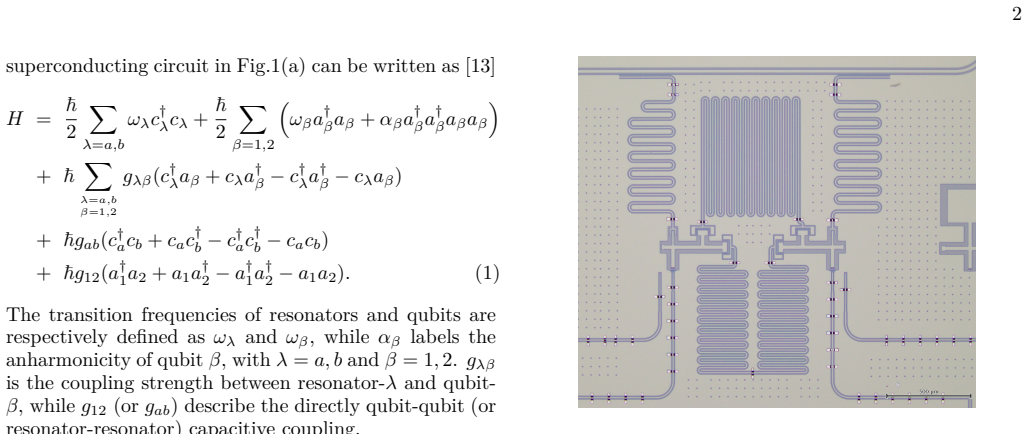


Figures from the paper (4 more)


Forward citations
Cited by 1 Pith paper
-
Purcell-Engineered Hybrid Coupler for Leakage-Suppressed Robust CZ Gates
A transmon-plus-Purcell-filter-plus-notch hybrid coupler reaches simulated CZ F_avg=99.74%, F_min=99.62%, and max leakage 1.6e-3 by selectively damping leakage dressed states.
Reference graph
Works this paper leans on
-
[13]
Ming Gong, Shiyu Wang, Chen Zha, Ming-Cheng Chen, He-Liang Huang, Yulin Wu, Qingling Zhu, Youwei Zhao, Shaowei Li, Shaojun Guo, Haoran Qian, Yangsen Ye, Fusheng Chen, Chong Ying, Jiale Yu, Daojin Fan, 7 Dachao Wu, Hong Su, Hui Deng, Hao Rong, Kaili Zhang, Sirui Cao, Jin Lin, Yu Xu, Lihua Sun, Cheng Guo, Na Li, Futian Liang, V. M. Bastidas, Kae Nemoto, W. ...
2021
-
[1]
Y. Chen, C. Neill, P. Roushan, N. Leung, M. Fang, R. Barends, J. Kelly, B. Campbell, Z. Chen, B. Chiaro, A. Dunsworth, E. Jeffrey, A. Megrant, J. Y. Mutus, P. J. J. ÓMalley, C. M. Quintana, D. Sank, A. Vainsencher, J. Wenner, T. C. White, Michael R. Geller, A. N. Cle- land, and J. M. Martinis, qubit Architecture with High Coherence and Fast Tunable Coupli...
2014
-
[2]
If qubit-2 is tuned to about 4.37 GHz, the anti-crossing gap is almost invisible in Fig.3(e) where the qubit-qubit coupling is turned off
The anti-gap reduce from about 10 MHz (4.58 GHz) in Fig.3(a) and reduce to below 2 MHz in Figs.3(d) and 3(e) (close to 4.62 GHz). If qubit-2 is tuned to about 4.37 GHz, the anti-crossing gap is almost invisible in Fig.3(e) where the qubit-qubit coupling is turned off. By choos- ing direct qubit-qubit coupling as 0.88 MHz, with the qubit-resonator coupling...
2000
-
[3]
X. Li, T. Cai, H. Yan, Z. Wang, X. Pan, Y. Ma, W. Cai, J. Han, Z. Hua, X. Han, Y. Wu, H. Zhang, H. Wang, Yipu Song, Luming Duan, and Luyan Sun, Tunable Coupler for Realizing a Controlled-Phase Gate with Dynamically Decoupled Regime in a Superconducting Circuit, Phys. Rev. Appl. 14, 024070 (2020)
2020
-
[4]
Yuan Xu, Ji Chu, Jiahao Yuan, Jiawei Qiu, Yuxuan Zhou, Libo Zhang, Xinsheng Tan, Yang Yu, Song Liu, Jian Li, Fei Yan, and Dapeng Yu, High-Fidelity, High- Scalability Two-Qubit Gate Scheme for Superconducting Qubits, Phys. Rev. Lett. 125, 240503 (2020)
2020
-
[5]
F. Yan, P. Krantz, Y. Sung, M. Kjaergaard, D. L. Campbell, T. P. Orlando, S. Gustavsson, and W. D. Oliver, Tunable Coupling Scheme for Implementing High-Fidelity Two-qubit Gates, Phys. Rev. Appl. 10, 054062 (2018)
2018
-
[6]
Arute, K
F. Arute, K. Arya, R. Babbush, D. Bacon, J. C. Bardin, R. Barends, R. Biswas, S. Boixo, F. G. S. L. Brandao, D. A. Buell, B. Burkett, Yu Chen, Zijun Chen, B. Chiaro, R. Collins, W. Courtney, A. Dunsworth, E. Farhi, B. Foxen, A. Fowler, C. Gidney, M. Giustina, R. Graff, K. Guerin, S. Habegger, M. P. Harrigan, M. J. Hartmann, A. Ho, M. Hoffmann, T. Huang, T...
2019
-
[7]
Yulin Wu, Wan-Su Bao, Sirui Cao, Fusheng Chen, Ming- Cheng Chen, Xiawei Chen, Tung-Hsun Chung, Hui Deng, Yajie Du, Daojin Fan, Ming Gong, Cheng Guo, Chu Guo, Shaojun Guo, Lianchen Han, Linyin Hong, He- Liang Huang, Yong-Heng Huo, Liping Li, Na Li, Shaowei Li, Yuan Li, Futian Liang, Chun Lin, Jin Lin, Hao- ran Qian, Dan Qiao, Hao Rong, Hong Su, Lihua Sun, ...
2021
Show all 26 references
-
[8]
Y. Sung, L. Ding, J. Braumüller, A. Vepsäläinen, B. Kannan, M. Kjaergaard, A. Greene, G. O. Samach, C. McNally, D. Kim, A. Melville, B. M. Niedzielski, M. E. Schwartz, J. L. Yoder, T. P. Orlando, S. Gustavsson, and W. D. Oliver, Realization of High-Fidelity CZ and ZZ- Free ISW...
2021
-
[9]
Moskalenko, I.A
I.N. Moskalenko, I.A. Simakov, N.N. Abramov, A.A. Grigorev, D.O. Moskalev, A.A. Pishchimova, N.S. Smirnov, E.V. Zikiy, I.A. Rodionov, and I.S. Besedin, High fidelity two-qubit gates on fluxoniums using a tun- able coupler, Npj Quantum Inform. 8, 130 (2022)
2022
-
[10]
— Quantum error correction below the surface code threshold, Nature 638, 920–926 (2025)
Acharya et al. — Quantum error correction below the surface code threshold, Nature 638, 920–926 (2025)
2025
-
[11]
Lacroix et al
N. Lacroix et al. (Google Quantum AI), Scaling and logic in the colour code on a superconducting processor, Na- ture volume 645, pages614–619 (2025)
2025
-
[12]
Tan et al, Experimental Quantum Error Correction be- low the Surface Code Threshold via All-Microwave Leak- age Suppression, Phys. Rev. Lett. 135, 260601 – Pub- lished 22 December, (2025)
2025
-
[14]
Hui Wang, Yan-Jun Zhao , Hui-Chen Sun, Xun-Wei Xu, Yong Li, Yarui Zheng, Qiang Liu, and Rengang Li, Con- trolling the qubit-qubit coupling in the superconducting circuit with double-resonator couplers, Physical review A 109, 012601 (2024)
2024
-
[15]
IBM-Q-Team, IBM-Q-53 Rochester backend specifica- tion v1.2.0, (2020)
2020
-
[16]
D Castellano, W
Yulin Wu, Li-Ping Yang, Ming Gong, Yarui Zheng, Hui Deng, Zhiguang Yan, Yanjun Zhao, Keqiang Huang, A. D Castellano, W. J Munro, K. Nemoto, Dong-Ning Zheng, C.P. Sun, Yu-xi Liu, Xiaobo Zhu, Li Lu, An efficient and compact switch for quantum circuits, npj Quantum Inf. 4, 50 (2018)
2018
-
[17]
Stehlik, D.M
J. Stehlik, D.M. Zajac, D.L. Underwood, T. Phung, J. Blair, S. Carnevale, D. Klaus, G.A. Keefe, A. Carniol, M. Kumph, M. Steffen, and O.E. Dial, Tunable Coupling Architecture for Fixed-Frequency Transmon Supercon- ducting Qubits, Phys. Rev. Lett. 127, 080505 (2021)
2021
-
[18]
McKay, S
D.C. McKay, S. Filipp, A. Mezzacapo, E. Magesan, J.M. Chow, and J.M. Gambetta, Universal Gate for Fixed- Frequency Qubits via a Tunable Bus, Phys. Rev. Appl. 6, 064007(2016)
2016
-
[19]
Hui Wang, Yan-Jun Zhao, Rui Wang, Xun-Wei Xu, Qiang Liu, Jianhua Wang, and Changxin Jin, Frequency Adjustable Resonator as a Tunable Coupler for Xmon Qubits, J. Phys. Soc. Jpn. 91, 104005 (2022)
2022
-
[20]
Yan, Y.-R
Z. Yan, Y.-R. Zhang, M. Gong, Y. Wu, Y. Zheng, S. Li, C. Wang, F. Liang, J. Lin, Y. Xu, C. Guo, L. Sun, C.-Z. Peng, K. Xia, H. Deng, H. Rong, J. Q. You, F. Nori, H. Fan, X. Zhu, and J.-W. Pan, Strongly correlated quan- tum walks with a 12-qubit superconducting processor, Scien...
2019
-
[21]
Rui Li, Kentaro Kubo, Yinghao Ho, Zhiguang Yan, Yasunobu Nakamura, and Hayato Goto,Realization of High-Fidelity CZ Gate Based on a Double-Transmon Coupler, Phys. Rev. X 14, 041050 (2024)
2024
-
[22]
Tian-Ming Li, Jia-Chi Zhang, Bing-Jie Chen, Kaixuan Huang, Hao-Tian Liu, Yong-Xi Xiao, Cheng-Lin Deng, Gui-Han Liang, Chi-Tong Chen, Yu Liu, Hao Li, Zhen- Ting Bao, Kui Zhao, Yueshan Xu, Li Li, Yang He, Zheng- He Liu, Yi-Han Yu, Si-Yun Zhou, Yan-Jun Liu, Xiaohui Song, Dongning...
2025
-
[23]
Hayato Goto, Double-Transmon Coupler: Fast Two- Qubit Gate with No Residual Coupling for Highly De- tuned Superconducting Qubits, Phys. Rev. Appl. 18, 034038 (2022)
2022
-
[24]
J. R. Johansson, P. D. Nation, and F. Nori: ”QuTiP 2: A Python framework for the dynamics of open quantum systems. ”, Comp. Phys. Comm. 184, 1234 (2013) [DOI: 10.1016/j.cpc.2012.11.019]
2013 doi
-
[25]
J. R. Johansson, P. D. Nation, and F. Nori: ”QuTiP: An open-source Python framework for the dynamics of open quantum systems. ”, Comp. Phys. Comm. 183, 1760 (2012) [DOI: 10.1016/j.cpc.2012.02.021]
2012 doi
-
[26]
Gui-Han Liang, Xiao-Hui Song, Cheng-Lin Deng, Xu- Yang Gu, Yu Yan, Zheng-Yang Mei, Si-Lu Zhao, Yi- Zhou Bu, Yong-Xi Xiao, Yi-Han Yu, Ming-Chuan Wang, Tong Liu, Yun-Hao Shi, He Zhang, Xiang Li, Li Li, Jing-Zhe Wang, Ye Tian, Shi-Ping Zhao, Kai Xu, Heng Fan, Zhong-Cheng Xiang, D...
2023
Reviewed August 3, 2026 · model on record in the stance chip above.
Discussion (0). Sign in to comment.