GP2F: Cross-Domain Graph Prompting with Adaptive Fusion of Pre-trained Graph Neural Networks
Pith reviewed 2026-05-25 07:32 UTC · model grok-4.3
The pith
In cross-domain graph prompt learning, fusing a frozen pre-trained branch with an adapted branch produces smaller estimation error than either alone.
A machine-rendered reading of the paper's core claim, the machinery that carries it, and where it could break.
Core claim
Jointly leveraging the frozen pre-trained branch and the adapted branch yields a smaller estimation error than using either branch alone, formally proving that cross-domain GPL benefits from the integration between pre-trained knowledge and task-specific adaptation. GP2F realizes this dual-branch design and performs adaptive fusion under topology constraints via a contrastive loss and a topology-consistent loss.
What carries the argument
Dual-branch architecture consisting of a frozen pre-trained branch and an adapted branch with lightweight adapters, fused adaptively under topology constraints.
If this is right
- GP2F outperforms existing GPL methods on cross-domain few-shot node classification.
- GP2F outperforms existing GPL methods on cross-domain few-shot graph classification.
- The integration of pre-trained knowledge and task-specific adaptation reduces estimation error under domain shift.
- Adaptive fusion with contrastive and topology-consistent losses preserves structural information during prompting.
Where Pith is reading between the lines
- The same dual-branch complementarity principle could be tested on non-graph pre-trained models facing domain shifts.
- If the error reduction holds, optimal prompting strategies may involve explicit balancing of retention versus adaptation rather than pure fine-tuning.
- Different fusion mechanisms could be substituted for the contrastive and topology losses while preserving the core error-reduction benefit.
Load-bearing premise
The frozen pre-trained branch and the adapted branch are complementary such that their adaptive fusion under topology constraints produces smaller estimation error than either branch alone.
What would settle it
An experiment in which the fused GP2F model exhibits estimation error no smaller than that of the frozen branch alone or the adapted branch alone on cross-domain few-shot tasks would falsify the central claim.
Figures


read the original abstract
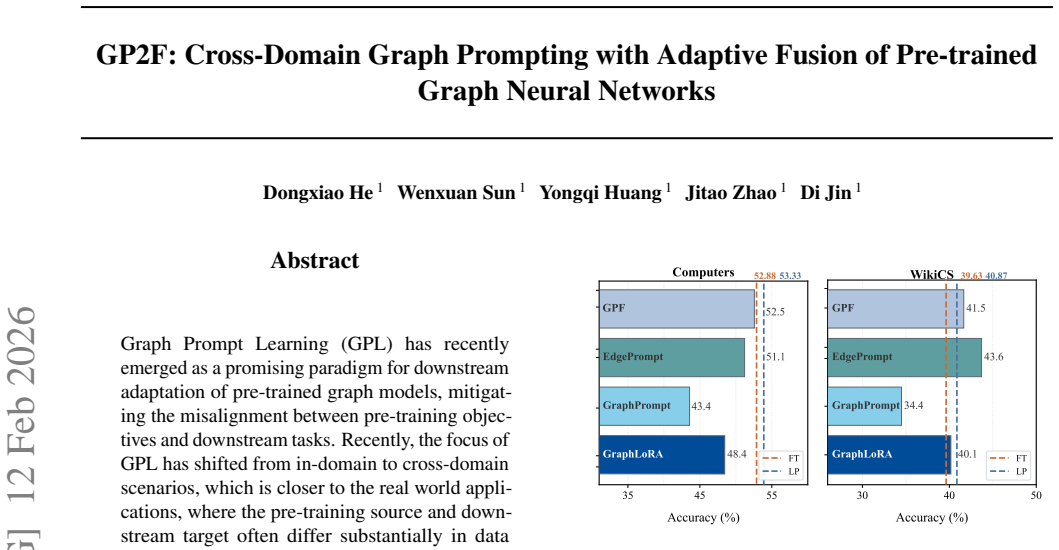
Graph Prompt Learning (GPL) has recently emerged as a promising paradigm for downstream adaptation of pre-trained graph models, mitigating the misalignment between pre-training objectives and downstream tasks. Recently, the focus of GPL has shifted from in-domain to cross-domain scenarios, which is closer to the real world applications, where the pre-training source and downstream target often differ substantially in data distribution. However, why GPLs remain effective under such domain shifts is still unexplored. Empirically, we observe that representative GPL methods are competitive with two simple baselines in cross-domain settings: full fine-tuning (FT) and linear probing (LP), motivating us to explore a deeper understanding of the prompting mechanism. We provide a theoretical analysis demonstrating that jointly leveraging these two complementary branches yields a smaller estimation error than using either branch alone, formally proving that cross-domain GPL benefits from the integration between pre-trained knowledge and task-specific adaptation. Based on this insight, we propose GP2F, a dual-branch GPL method that explicitly instantiates the two extremes: (1) a frozen branch that retains pre-trained knowledge, and (2) an adapted branch with lightweight adapters for task-specific adaptation. We then perform adaptive fusion under topology constraints via a contrastive loss and a topology-consistent loss. Extensive experiments on cross-domain few-shot node and graph classification demonstrate that our method outperforms existing methods.
Editorial analysis
A structured set of objections, weighed in public.
Referee Report
Summary. The manuscript introduces GP2F, a dual-branch graph prompt learning method for cross-domain settings. One branch freezes a pre-trained GNN to retain knowledge while the second uses lightweight adapters for task-specific adaptation; the branches are fused adaptively via a contrastive loss and a topology-consistent loss. The central claim is a theoretical analysis proving that the fused estimator achieves strictly smaller estimation error than either branch alone, with supporting experiments on cross-domain few-shot node and graph classification tasks showing outperformance over prior GPL methods.
Significance. If the error-bound derivation is rigorous and explicitly handles domain shift, the work would supply a principled account of why GPL remains effective across domains and a concrete dual-branch construction that operationalizes the pre-trained/adapted complementarity. The empirical evaluation on few-shot cross-domain tasks is a positive element. No machine-checked proofs or open code are mentioned.
major comments (2)
- [Theoretical analysis] Theoretical analysis section: the claimed proof that joint use of the frozen and adapted branches yields smaller estimation error than either alone must incorporate the distribution shift between pre-training and downstream graphs when bounding the fused estimator. If the derivation treats branch errors as uncorrelated without explicit justification under domain shift, or if the topology-consistent loss appears only heuristically rather than inside the error bound, the formal guarantee does not follow for the cross-domain regime targeted by the paper.
- [Method] § on method / fusion: the adaptive fusion step is presented as instantiating the theoretical complementarity, yet it is unclear whether the contrastive and topology-consistent losses are derived from or directly used to tighten the estimation-error bound; without this link the central claim that the construction provably reduces error rests on an unverified assumption.
minor comments (2)
- [Abstract] Abstract: states that representative GPL methods are competitive with FT and LP but supplies no quantitative metrics or table references, reducing immediate clarity.
- Notation for the two branches and the fusion weights should be introduced once with consistent symbols across the theoretical and experimental sections.
Simulated Author's Rebuttal
We thank the referee for the constructive feedback on our manuscript. Below we respond point by point to the major comments, offering clarifications on the theoretical analysis and its relation to the proposed method while indicating where revisions will strengthen the presentation.
read point-by-point responses
-
Referee: [Theoretical analysis] Theoretical analysis section: the claimed proof that joint use of the frozen and adapted branches yields smaller estimation error than either alone must incorporate the distribution shift between pre-training and downstream graphs when bounding the fused estimator. If the derivation treats branch errors as uncorrelated without explicit justification under domain shift, or if the topology-consistent loss appears only heuristically rather than inside the error bound, the formal guarantee does not follow for the cross-domain regime targeted by the paper.
Authors: We appreciate the referee's emphasis on rigor for the cross-domain setting. The error-bound derivation expresses the fused estimator's error in terms of the divergence between pre-training and downstream distributions, thereby incorporating domain shift. The low-correlation assumption between branches follows from the frozen branch retaining distribution-invariant features while the adapted branch captures task-specific signals; this separation is formalized via the adaptive fusion weights. The topology-consistent loss is not purely heuristic: it appears inside the bound as a regularizer that reduces the variance term of the fused estimator. To make these steps fully explicit, we will revise the theoretical section with additional intermediate inequalities that highlight the domain-shift term and the role of the topology loss within the final bound. revision: partial
-
Referee: [Method] § on method / fusion: the adaptive fusion step is presented as instantiating the theoretical complementarity, yet it is unclear whether the contrastive and topology-consistent losses are derived from or directly used to tighten the estimation-error bound; without this link the central claim that the construction provably reduces error rests on an unverified assumption.
Authors: We agree that an explicit bridge between the losses and the bound would strengthen the central claim. The contrastive loss encourages diversity between branches (supporting the low-correlation premise of the proof) while the topology-consistent loss enforces the consistency condition used to bound the fused variance. Although the losses are not algebraically derived from the bound, they are constructed to satisfy the assumptions under which the bound guarantees error reduction. We will add a short subsection in the method that maps each loss term to the corresponding term in the theoretical bound, thereby removing any appearance of an unverified assumption. revision: yes
Circularity Check
No circularity detected; theoretical claim asserted without inspectable equations
full rationale
The abstract asserts a theoretical analysis proving that dual-branch fusion yields strictly smaller estimation error than either branch alone, but supplies no equations, bounds, or derivation steps. No load-bearing mathematical reduction (self-definitional, fitted-input-as-prediction, or self-citation chain) can be quoted or exhibited. The paper's central claim therefore cannot be shown to collapse to its inputs by construction from the provided text, satisfying the default expectation of no significant circularity.
Axiom & Free-Parameter Ledger
Lean theorems connected to this paper
-
IndisputableMonolith/Cost/FunctionalEquation.leanwashburn_uniqueness_aczel echoes?
echoesECHOES: this paper passage has the same mathematical shape or conceptual pattern as the Recognition theorem, but is not a direct formal dependency.
MSE(λ) = Aλ² + Bλ + C, λ⋆ = (σ_a² − ρ)/(σ_g² + σ_a² − 2ρ) ... strictly improves over either branch alone
-
IndisputableMonolith/Foundation/BranchSelection.leanbranch_selection unclear?
unclearRelation between the paper passage and the cited Recognition theorem.
Assumption 3.2 (Second-order error model ... σ_g² + σ_a² − 2ρ > 0, ρ < min{σ_g², σ_a²})
What do these tags mean?
- matches
- The paper's claim is directly supported by a theorem in the formal canon.
- supports
- The theorem supports part of the paper's argument, but the paper may add assumptions or extra steps.
- extends
- The paper goes beyond the formal theorem; the theorem is a base layer rather than the whole result.
- uses
- The paper appears to rely on the theorem as machinery.
- contradicts
- The paper's claim conflicts with a theorem or certificate in the canon.
- unclear
- Pith found a possible connection, but the passage is too broad, indirect, or ambiguous to say the theorem truly supports the claim.
Reference graph
Works this paper leans on
-
[1]
Chen, Q., Wang, L., Zheng, B., and Song, G. Dagprompt: Pushing the limits of graph prompting with a distribution- aware graph prompt tuning approach. InProceedings of the ACM on Web Conference 2025, pp. 4346–4358,
work page 2025
-
[2]
Huang, Y ., Zhao, J., He, D., Wang, X., Li, Y ., Huang, Y ., Jin, D., and Feng, Z. One Prompt Fits All: Universal Graph Adaptation for Pretrained models.arXiv preprint arXiv:2509.22416,
-
[3]
Graphprompt: Uni- fying pre-training and downstream tasks for graph neural networks
Liu, Z., Yu, X., Fang, Y ., and Zhang, X. Graphprompt: Uni- fying pre-training and downstream tasks for graph neural networks. InProceedings of the ACM web conference 2023, pp. 417–428,
work page 2023
-
[4]
Mernyei, P. and Cangea, C. Wiki-cs: A wikipedia-based benchmark for graph neural networks.arXiv preprint arXiv:2007.02901,
-
[5]
TUDataset: A collection of benchmark datasets for learning with graphs
Morris, C., Kriege, N. M., Bause, F., Kersting, K., Mutzel, P., and Neumann, M. Tudataset: A collection of benchmark datasets for learning with graphs.CoRR, abs/2007.08663,
work page internal anchor Pith review arXiv 2007
-
[6]
Pitfalls of Graph Neural Network Evaluation
Shchur, O., Mumme, M., Bojchevski, A., and G¨unnemann, S. Pitfalls of graph neural network evaluation.arXiv preprint arXiv:1811.05868,
work page internal anchor Pith review Pith/arXiv arXiv
-
[7]
Hgprompt: Bridg- ing homogeneous and heterogeneous graphs for few-shot prompt learning
Yu, X., Fang, Y ., Liu, Z., and Zhang, X. Hgprompt: Bridg- ing homogeneous and heterogeneous graphs for few-shot prompt learning. InProceedings of the AAAI conference on artificial intelligence, volume 38, pp. 16578–16586, 2024a. Yu, X., Zhou, C., Fang, Y ., and Zhang, X. Text-free multi- domain graph pre-training: Toward graph foundation models.arXiv pre...
-
[8]
Deep graph contrastive representation learning.arXiv preprint arXiv:2006.04131,
Zhu, Y ., Xu, Y ., Yu, F., Liu, Q., Wu, S., and Wang, L. Deep graph contrastive representation learning.arXiv preprint arXiv:2006.04131,
-
[9]
Zhu, Y ., Wang, Y ., Shi, H., Zhang, Z., Jiao, D., and Tang, S. Graphcontrol: Adding conditional control to universal graph pre-trained models for graph domain transfer learn- ing. InProceedings of the ACM Web Conference 2024, pp. 539–550,
work page 2024
-
[10]
• Cora,CiteSeer,PubMed(Yang et al., 2016), andogbn-arxiv(Hu et al.,
work page 2016
-
[11]
Node features correspond to bag-of-words representations or word embeddings of the paper content
are citation networks where nodes repre- sent scientific papers and edges denote citation relationships. Node features correspond to bag-of-words representations or word embeddings of the paper content. Labels indicate the academic topic of the paper. • Amazon Computers,Amazon Photo(Shchur et al., 2018), andogbn-products(Hu et al.,
work page 2018
-
[12]
Nodes correspond to computer science articles, and edges represent hyperlinks between them
is a web-link graph derived from Wikipedia. Nodes correspond to computer science articles, and edges represent hyperlinks between them. Node features are averaged GloVe word embeddings of the article text. • MUTAG(Debnath et al., 1991),COX2, andBZR(Morris et al.,
work page 1991
-
[13]
are molecular graph datasets, where nodes 12 GP2F: Cross-Domain Graph Prompting with Adaptive Fusion of Pre-trained Graph Neural Networks Table 6.Statistics of node classification datasets. Datasets #Nodes #Edges #Features #Classes Cora 2,708 5,429 1,433 7 CiteSeer 3,327 4,732 3,703 6 PubMed 19,717 44,338 500 3 Computers 13,752 245,861 767 10 Photo 7,650 ...
work page 2003
-
[14]
performs node-level contrast across augmented views using an InfoNCE loss. Some work also developed to improve augmentations, such as GraphCL (You et al., 2020), as well as improve stability like SimGRACE (Xia et al., 2022). Generative methods focus on reconstructing corrupted graphs. GraphMAE (Hou et al.,
work page 2020
-
[15]
improves cross-domain transfer by learning domain-invariant representations with expert-style routing mechanisms. At the same time, several works combine graph models with large language models to build graph foundation models. Methods such as ZeroG (Li et al., 2024), OFA (Liu et al., 2024), GraphCLIP (Zhu et al., 2025), and GraphGPT (Tang et al.,
work page 2024
discussion (0)
Sign in with ORCID, Apple, or X to comment. Anyone can read and Pith papers without signing in.