REVIEW 3 major objections 7 minor 25 references
SignScene claims that rendering the local scene as a sign-centric abstract top-view map lets a vision-language model ground diverse navigational signs to concrete local paths, achieving 88% grounding accuracy and enabling mapless robot navi
Reviewed by Pith at T0; open to challenge. T0 means a machine referee read the full paper against a public rubric. the ladder, T0–T4 →
A sign-centric abstract map lets a vision-language model turn navigational sign instructions into correct paths 88.6% of the time across nine environment types.
T0 review reviewed 2026-08-02 challenge →
load-bearing objection Solid sign-grounding system with a genuinely useful AToM representation and a credible 101/114 result, but the open-world claim rests on a self-produced benchmark and a two-category path taxonomy that isn't tested outside it. the 3 major comments →
SignScene: Visual Sign Grounding for Mapless Navigation
The pith
A machine-rendered reading of the paper's core claim, the machinery that carries it, and where it could break.
The reading
Core claim
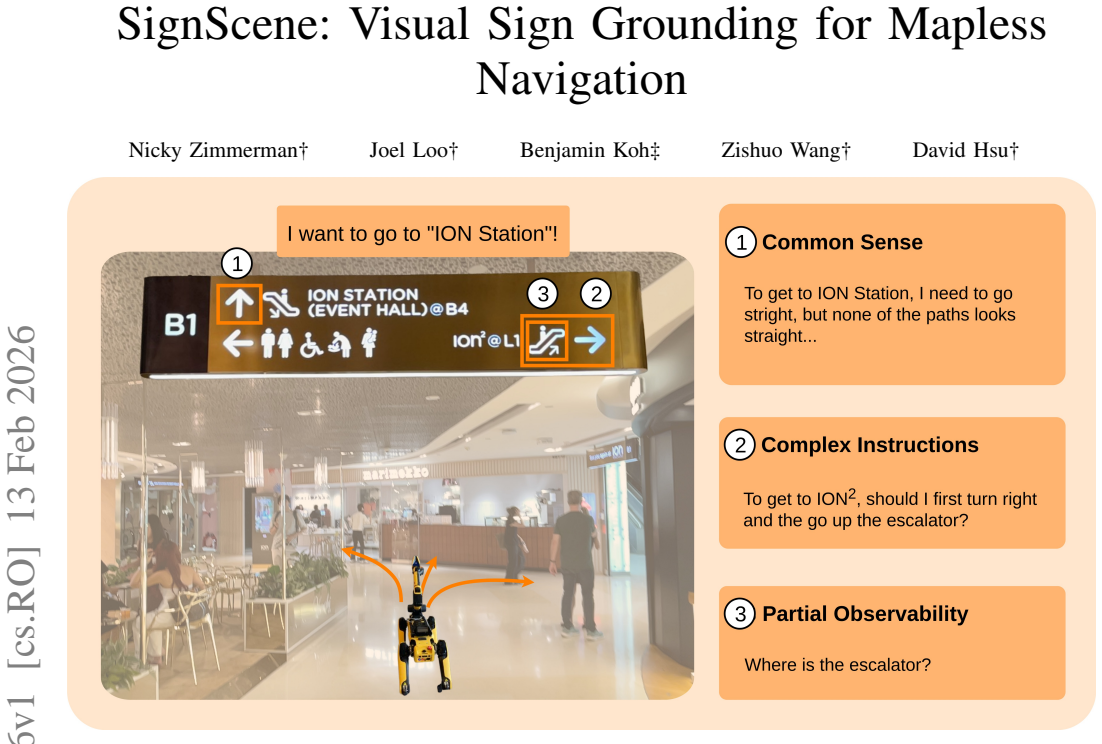
The paper claims that sign grounding can be solved by a vision-language model if the local scene is presented as an Abstract Top-view Map (AToM) centered on the sign and aligned with its viewing direction. AToM stores three kinds of navigation-relevant elements: signs with their parsed content, explicit structures such as stairs and escalators as labeled 3D boxes, and implicit paths as traversable point clouds. Rendered as a simplified 2D top-down diagram with lettered candidate paths and labeled boxes, AToM lets the VLM map an instruction like 'take the escalator' or 'forward-left' to a concrete path. The claim is supported by 101/114 (88.6%) grounding accuracy on a nine-environment benchma
What carries the argument
The Abstract Top-view Map (AToM) is the central object. It converts a metric-semantic 3D map of the local scene into a sign-centric 2D diagram: the map is always centered on the sign, and the upward direction is aligned with the sign's head-on viewing direction. Implicit paths are represented as a polygon with lettered points on convex protrusions (candidate discrete paths), and explicit structures are labeled bounding boxes. This representation carries the argument because it turns abstract instructions into a visual spatial layout that a VLM can reason over; the paper's ablations show that rotating into the sign's frame is critical (accuracy drops from 88% to 65% without it) and that addin
Load-bearing premise
The approach assumes that every path a sign can reference is either a known explicit structure (stairs, escalators, lifts) or an implicit path that appears as a convex protrusion of the traversable ground polygon; signs referencing anything else are outside the representation's vocabulary.
What would settle it
Curate a set of additional navigational signs whose referenced paths are not convex protrusions of the traversable polygon—for example, a sign pointing to a route across an open plaza or through a door not in the fixed structure list—and run SignScene's pipeline on them. If grounding accuracy on these cases drops sharply below the 88% on the original 114 queries, the taxonomy is the load-bearing premise; if accuracy stays high, the representation is more general than the paper claims.
If this is right
- A robot can navigate to a goal in an unseen building, mall, or outdoor area using only signs, RGB images, and odometry—no prebuilt map or expensive sensor suite.
- The sign-grounding problem separates into sign understanding and sign grounding; each can be improved independently, and both are VLM-queried, so progress in VLMs translates directly into better sign grounding.
- The sign-centric AToM can store multiple signs and re-center on the relevant one, so a single local map can service different goal queries.
- The exploration module builds AToM incrementally around a sign, making the approach practical for online deployment despite partial observability.
Where Pith is reading between the lines
- If the taxonomy of paths is incomplete—say, a sign points across an open plaza that produces no convex protrusion—the approach would fail on such cases, so the measured 88% is bounded by that taxonomy.
- Since the paper uses the same VLM for parsing and grounding, part of the accuracy may be model-specific; re-running with a smaller or weaker VLM would reveal how much of the benefit comes from the representation alone.
- The sign-centric alignment principle could transfer to other VLM spatial-reasoning tasks, such as interpreting arrows in human-robot interaction or instructions in augmented-reality overlays, where aligning the reference frame to the instruction's origin may be similarly important.
- The paper's own failure analysis lists object detection, compound-sign parsing, crowded environments, and reasoning failures as remaining bottlenecks, so the headline accuracy should be read as conditional on these components working.
Editorial analysis
A structured set of objections, weighed in public.
Referee Report
Summary. SignScene proposes a VLM-based pipeline for sign grounding: given an RGB observation of a navigational sign and local odometry, it parses the sign into (location, instruction) pairs, builds a sign-centric Abstract Top-view Map (AToM) of the surrounding scene, and queries a VLM to select the path or structure that matches the parsed instruction. The system is evaluated on a self-collected 114-query benchmark spanning nine environment types, reporting 101/114 (88.6%) grounding accuracy, with a no-rotation ablation at 74/114 and a single baseline (ReasonNav) at 30/114. A parsing ablation improves from 38/114 to 93/114. A Spot robot demonstration shows mapless navigation to a goal using only signs. The paper claims that this constitutes open-world sign grounding for mapless navigation.
Significance. If the result holds, the paper makes a useful contribution: AToM is a compact, VLM-friendly representation that lets a robot interpret diverse real-world signs without a prebuilt map. The paper's strengths include the no-rotation ablation (74 to 101 correct), the parsing improvement from 38 to 93 correct, the breadth of environments, and the real Spot demonstration. The authors also give a candid failure analysis and limitations section. However, the open-world claim is contingent on an untested completeness assumption about the two-class path taxonomy, and the headline number comes from a private benchmark with a single mismatched baseline and no error bars. The contribution is defensible if scoped to the tested taxonomy and evaluated more carefully; as stated, the evidence does not fully support 'open world' generalization.
major comments (3)
- [§IV-B, §IV-D] The two-class path model is load-bearing. AToM represents implicit paths only as convex protrusions of the simplified ground polygon and explicit paths only as a fixed-vocabulary set of structures. The paper justifies this taxonomy solely by 'our collected dataset' (Sec. IV-B), and the benchmark is the same 114-query set. No example in Table I or Appendix A tests a sign referencing a straight corridor continuation, an open plaza, floor-marked paths, a bridge, or a tunnel; under the current rendering such a path would have no lettered frontier and could not be selected. The Limitations section (Sec. VI) does not acknowledge this taxonomy risk. Please either narrow the claim to the tested taxonomy or provide external evidence of completeness, e.g., a taxonomy survey of navigational signage or held-out scenes containing non-protruding path types.
- [§V-B, Table I; §IV-C] The headline 101/114 (88.6%) is a point estimate on the authors' own benchmark. There are no confidence intervals, no per-environment variance summaries, and no significance test. The only baseline, ReasonNav, is mismatched by design: it assumes four cardinal directions and planar-geometry path detection, and it does not perform exploration; the paper itself lists these as reasons for its low score. The comparison therefore supports 'better than ReasonNav on this benchmark', not the general claim of 'significantly outperforms baselines'. Moreover, the thresholds τ_dist and τ_angle (Sec. IV-C) were empirically tuned using the same VLMs under test, so the reported number is a selected-best estimate. I recommend reporting confidence intervals or per-environment variance, adding a second baseline (e.g., a semantic top-down map without the abstract rendering), and/or releasing the benchmark.
- [§IV-C, §V-D, Appendix B] Explicit structures are detected only through a fixed vocabulary drawn from the 20-symbol sign dictionary (Listing 1). The paper states that the approach 'naturally extends to larger or open sets', but this is not an evaluation. The failure analysis (Sec. V-D) reports high false-positive and false-negative rates even for a class like 'escalator'. The evidence therefore supports open-world generalization only for the closed set of structures and symbol meanings present in the authors' dictionary and benchmark. Please either demonstrate generalization to held-out structure types or symbols, or soften the 'open-world' framing in the abstract and conclusion.
minor comments (7)
- [Abstract] Typo: 'we formalize this assign grounding' should be 'as sign grounding'.
- [II-B] Typos in Related Work: 'ad VLMS' should be 'and VLMs'; 'topoligical' should be 'topological'; 'bsed' should be 'based'.
- [References] Reference [21] has a malformed author list ('R MapNav Xu'); please correct the citation.
- [§IV-B] The lettered frontier points are introduced in the AToM rendering description but their role in grounding is only explained later in Sec. IV-E; please define the notation earlier for readability.
- [§V-A] The text says 36 sequences were recorded but does not explicitly state how the 114 queries are distributed across them. Please clarify the relationship between sequences and queries.
- [Appendix B] VLM Prompt 2's output dictionary omits 'u-turn' and 'travelator' categories that appear in the symbol dictionary (Listing 1); align the prompt schema with the label list.
- [Table I] Consider adding environment-level totals and success rates so the 'stable across environments' claim is easy to verify from the table alone.
Circularity Check
No circular-by-construction derivation; the 88% result is an empirical benchmark result, with self-produced data and data-driven design choices raising external-validity concerns rather than circularity.
full rationale
I walked the derivation chain from the problem formulation (Sec. III) through AToM (Sec. IV-B), construction (Sec. IV-C), reasoning (Sec. IV-E), and evaluation (Sec. V-B). The reported 101/114 grounding accuracy is obtained by running a VLM over an AToM render, converting the selected letter/object to a 3D subgoal, and picking the multiple-choice option closest to that subgoal (Sec. IV-E). This is an empirical measurement, not a quantity defined as its own input. The AToM two-class path taxonomy and the convex-protrusion heuristic (Sec. IV-B, IV-D) are design assumptions motivated by 'our collected dataset' (Sec. V-A); they limit the class of representable paths and thus the scope of the open-world claim, but they do not define the accuracy number. The viewpoint thresholds in Sec. IV-C are tuned 'through tests with VLMs including GPT-5 and Gemini-2.5-Pro', and the same VLM families are used in evaluation; this is a possible source of optimistic evaluation, but the grounding score is not a fitted parameter renamed as a prediction. The sign-understanding module builds on the authors' prior work [1], but it is re-implemented, ablated, and compared against [1] on the same benchmark (Table II), so the self-citation is not an unverified load-bearing black box. No uniqueness theorem, forbidden-alternative argument, or ansatz is imported solely from self-citations. The paper's own failure analysis and Limitations section acknowledge failures in detection, parsing, mapping, and reasoning, which further indicates the result is contingent on external models rather than forced by construction. The main weaknesses—a self-collected benchmark, no external dataset, and the completeness assumption on path types—are external-validity and overfitting concerns, not circular derivation. Under the rule that circularity requires a specific exhibited reduction (same equation on both sides, or a fitted parameter renamed as a prediction), no such step exists.
Axiom & Free-Parameter Ledger
free parameters (4)
- tau_dist (sign viewpoint distance threshold) =
not reported
- tau_angle (sign viewpoint angular threshold) =
not reported
- Polygon simplification / convex-protrusion parameters =
not reported
- Symbol dictionary and fixed detector vocabulary =
20 labels plus fixed prompt
axioms (7)
- domain assumption Robot has access to RGB observations and odometry
- domain assumption Signs are viewed head-on or the robot can align with them
- ad hoc to paper All navigation-relevant paths fall into two classes: explicit structures and implicit traversable terrain
- ad hoc to paper Discrete paths appear as convex protrusions of the top-down path polygon
- domain assumption A VLM can perform spatial grounding on the sign-centric abstract render
- domain assumption Hand-annotated ground-truth queries and paths are correct
- domain assumption Black-box perception models (GeNIE, Metric3Dv2, GroundingDINO) are sufficiently reliable
invented entities (1)
-
AToM (Abstract Top-view Map)
no independent evidence
Cite this review
Pith. "Pith review of SignScene: Visual Sign Grounding for Mapless Navigation." pith.science (2026). https://pith.science/paper/CKP7OMQF
@misc{pith2026260212686,
  author       = {Pith},
  title        = {Pith review of: SignScene: Visual Sign Grounding for Mapless Navigation},
  year         = {2026},
  howpublished = {\url{https://pith.science/paper/CKP7OMQF}},
  note         = {Machine review of arXiv:2602.12686}
}
read the original abstract
Navigational signs enable humans to navigate unfamiliar environments without maps. This work studies how robots can similarly exploit signs for mapless navigation in the open world. A central challenge lies in interpreting signs: real-world signs are diverse and complex, and their abstract semantic contents need to be grounded in the local 3D scene. We formalize this as sign grounding, the problem of mapping semantic instructions on signs to corresponding scene elements and navigational actions. Recent Vision-Language Models (VLMs) offer the semantic common-sense and reasoning capabilities required for this task, but are sensitive to how spatial information is represented. We propose SignScene, a sign-centric spatial-semantic representation that captures navigation-relevant scene elements and sign information, and presents them to VLMs in a form conducive to effective reasoning. We evaluate our grounding approach on a dataset of 114 queries collected across nine diverse environment types, achieving 88% grounding accuracy and significantly outperforming baselines. Finally, we demonstrate that it enables real-world mapless navigation on a Spot robot using only signs.
Figures


Reference graph
Works this paper leans on
-
[1]
Sign language: Towards sign understanding for robot autonomy.arXiv preprint arXiv:2506.02556, 2025
Ayush Agrawal, Joel Loo, Nicky Zimmerman, and David Hsu. Sign language: Towards sign understanding for robot autonomy.arXiv preprint arXiv:2506.02556, 2025
arXiv 2025
-
[2]
RayFronts: Open- Set Semantic Ray Frontiers for Online Scene Under- standing and Exploration, 2025
Omar Alama, Avigyan Bhattacharya, Haoyang He, Se- ungchan Kim, Yuheng Qiu, Wenshan Wang, Cherie Ho, Nikhil Keetha, and Sebastian Scherer. RayFronts: Open- Set Semantic Ray Frontiers for Online Scene Under- standing and Exploration, 2025. URL https://arxiv.org/ abs/2504.06994
Pith/arXiv arXiv 2025
-
[3]
Human-like Navigation in a World Built for Humans
Bhargav Chandaka, Gloria Wang, Haozhe Chen, Henry Che, Albert Zhai, and Shenlong Wang. Human-like Navigation in a World Built for Humans. InConference on Robot Learning, 2025
2025
-
[4]
Signage-Aware Exploration in Open World using Venue Maps.IEEE Robotics and Automation Letters, 2025
Chang Chen, Liang Lu, Lei Yang, Yinqiang Zhang, Yizhou Chen, Ruixing Jia, and Jia Pan. Signage-Aware Exploration in Open World using Venue Maps.IEEE Robotics and Automation Letters, 2025
2025
-
[5]
Wei Gao, Bo Ai, Joel Loo, David Hsu, et al. Intentionnet: Map-lite visual navigation at the kilometre scale.arXiv preprint arXiv:2407.03122, 2024
Pith/arXiv arXiv 2024
-
[6]
Metric3D v2: A Versatile Monocular Geometric Foundation Model for Zero-Shot Metric Depth and Surface Normal Estimation
Mu Hu, Wei Yin, Chi Zhang, Zhipeng Cai, Xiaoxiao Long, Hao Chen, Kaixuan Wang, Gang Yu, Chunhua Shen, and Shaojie Shen. Metric3D v2: A Versatile Monocular Geometric Foundation Model for Zero-Shot Metric Depth and Surface Normal Estimation. 46:10579– 10596, 2024
2024
-
[7]
Seungchan Kim, Omar Alama, Dmytro Kurdydyk, John Keller, Nikhil Keetha, Wenshan Wang, Yonatan Bisk, and Sebastian Scherer. RA VEN: Resilient Aerial Navigation via Open-Set Semantic Memory and Behavior Adapta- tion.arXiv preprint arXiv:2509.23563, 2025
arXiv 2025
-
[8]
V . I. Levenshtein. Binary codes capable of correcting deletions, insertions, and reversals.Soviet Physics Dok- lady, 10(8):707–710, 1966. Translated from Doklady Akademii Nauk SSSR, 1965, V ol. 163, No. 4, pp. 845– 848
1966
-
[9]
Chengzu Li, Caiqi Zhang, Han Zhou, Nigel Collier, Anna Korhonen, and Ivan Vuli ´c. Topviewrs: Vision-language models as top-view spatial reasoners.arXiv preprint arXiv:2406.02537, 2024
Pith/arXiv arXiv 2024
-
[10]
No map, no problem: A local sensing approach for navigation in human-made spaces using signs
Claire Liang, Ross A Knepper, and Florian T Pokorny. No map, no problem: A local sensing approach for navigation in human-made spaces using signs. In2020 IEEE/RSJ International Conference on Intelligent Robots and Systems (IROS), pages 6148–6155. IEEE, 2020
2020
-
[11]
Perceiving signs for navigation guidance in spaces designed for humans
Claire Liang, Cheng Perng Phoo, Laasya Renganathan, Yingying Yu, Bharath Hariharan, and Hadas Kress- Gazit. Perceiving signs for navigation guidance in spaces designed for humans. InWorkshop on Closing the Academia to Real-World Gap in Service Robotics at Robotics Science and Systems (RSS), 2020
2020
-
[12]
Grounding dino: Marrying dino with grounded pre-training for open- set object detection
Shilong Liu, Zhaoyang Zeng, Tianhe Ren, Feng Li, Hao Zhang, Jie Yang, Qing Jiang, Chunyuan Li, Jianwei Yang, Hang Su, Jun Zhu, and Lei Zhang. Grounding dino: Marrying dino with grounded pre-training for open- set object detection. InComputer Vision – ECCV 2024: 18th European Conference, Milan, Italy, Septem- ber 29–October 4, 2024, Proceedings, Part XLVII...
-
[13]
Scene action maps: Behavioural maps for navigation without metric information
Joel Loo and David Hsu. Scene action maps: Behavioural maps for navigation without metric information. In 2024 IEEE International Conference on Robotics and Automation (ICRA), pages 6354–6360. IEEE, 2024
2024
-
[14]
Open scene graphs for open-world object-goal navigation.Interna- tional Journal of Robotics Research, 2025
Joel Loo, Zhanxin Wu, and David Hsu. Open scene graphs for open-world object-goal navigation.Interna- tional Journal of Robotics Research, 2025
2025
-
[15]
Macenski, T
S. Macenski, T. Moore, DV Lu, A. Merzlyakov, and M. Ferguson. From the desks of ROS maintainers: A sur- vey of modern & capable mobile robotics algorithms in the robot operating system 2.Robotics and Autonomous Systems, 2023
2023
-
[16]
Slam toolbox: Slam for the dynamic world.Journal of Open Source Software, 6(61):2783, 2021
Steve Macenski and Ivona Jambrecic. Slam toolbox: Slam for the dynamic world.Journal of Open Source Software, 6(61):2783, 2021. doi: 10.21105/joss.02783. URL https://doi.org/10.21105/joss.02783
-
[17]
Clio: Real-time task- driven open-set 3d scene graphs.IEEE Robotics and Automation Letters, 2024
Dominic Maggio, Yun Chang, Nathan Hughes, Matthew Trang, Dan Griffith, Carlyn Dougherty, Eric Cristofalo, Lukas Schmid, and Luca Carlone. Clio: Real-time task- driven open-set 3d scene graphs.IEEE Robotics and Automation Letters, 2024
2024
-
[18]
SAM 2: Segment anything in images and videos
Nikhila Ravi, Valentin Gabeur, Yuan-Ting Hu, Rong- hang Hu, Chaitanya Ryali, Tengyu Ma, Haitham Khedr, Roman R ¨adle, Chloe Rolland, Laura Gustafson, Eric Mintun, Junting Pan, Kalyan Vasudev Alwala, Nicolas Carion, Chao-Yuan Wu, Ross Girshick, Piotr Dollar, and Christoph Feichtenhofer. SAM 2: Segment anything in images and videos. InThe Thirteenth Interna...
2025
-
[19]
Jiaming Wang, Diwen Liu, Jizhuo Chen, Jiaxuan Da, Nuowen Qian, Minh Man Tram, and Harold Soh. Ge- nie: A generalizable navigation system for in-the-wild environments.IEEE Robotics and Automation Letters, 10(12):12628–12635, 2025. doi: 10.1109/LRA.2025. 3623038
doi:10.1109/lra.2025 2025
-
[20]
Vision-language navigation: a survey and taxonomy.Neural Computing and Applications, 36(7): 3291–3316, 2024
Wansen Wu, Tao Chang, Xinmeng Li, Quanjun Yin, and Yue Hu. Vision-language navigation: a survey and taxonomy.Neural Computing and Applications, 36(7): 3291–3316, 2024
2024
-
[21]
L Zhang, X Hao, Q Xu, Q Zhang, X Zhang, P Wang, J Zhang, Z Wang, S Zhang, and R MapNav Xu. A novel memory representation via annotated semantic maps for vlm-based vision-and-language navigation.arXiv preprint arXiv:2502.13451, 2025
Pith/arXiv arXiv 2025
-
[22]
Linqing Zhong, Chen Gao, Zihan Ding, Yue Liao, Huimin Ma, Shifeng Zhang, Xu Zhou, and Si Liu. Topv- nav: Unlocking the top-view spatial reasoning potential of mllm for zero-shot object navigation.arXiv preprint arXiv:2411.16425, 2024
Pith/arXiv arXiv 2024
-
[23]
Open3D: A modern library for 3D data processing.arXiv preprint arXiv:1801.09847, 2018
Qian-Yi Zhou, Jaesik Park, and Vladlen Koltun. Open3D: A modern library for 3D data processing.arXiv preprint arXiv:1801.09847, 2018
Pith/arXiv arXiv 2018
-
[24]
Constructing Metric- Semantic Maps Using Floor Plan Priors for Long-Term Indoor Localization
Nicky Zimmerman, Matteo Sodano, Elias Marks, Jens Behley, and Cyrill Stachniss. Constructing Metric- Semantic Maps Using Floor Plan Priors for Long-Term Indoor Localization. 2023
2023
-
[25]
1" : "forward
Nicky Zimmerman, Joel Loo, Ayush Agrawal, and David Hsu. Signloc: Robust localization using navigation signs and public maps.IEEE Robotics and Automation Letters, 2026. Fig. 7:Lobby of large hospital.SignSceneselects the sign in theAToM(highlighted in orange) as being relevant to the query ofmain building pharmacy. It grounds the queried location to a nav...
2026
This paper was first reviewed by deepseek-v4-flash on August 2, 2026.
discussion (0)
Sign in with ORCID, Apple, or X to comment. Anyone can read and Pith papers without signing in.