Enhanced numerical approaches for modeling insoluble surfactants in two-phase flows with the diffuse-interface method
Pith reviewed 2026-05-21 13:36 UTC · model grok-4.3
The pith
Two simple changes to the diffuse-interface method raise the accuracy of insoluble surfactant transport in two-phase flows while keeping mass exactly conserved.
A machine-rendered reading of the paper's core claim, the machinery that carries it, and where it could break.
Core claim
Adopting a formulation of the surfactant transport equation that avoids spatial derivatives of sharply varying fields, together with allowing the delta-function width to be prescribed independently of the interface width, yields higher accuracy for interfacial surfactant transport in diffuse-interface simulations of two-phase flows, while exactly preserving discrete conservation of both fluid and surfactant mass and without degrading interface resolution or adding significant cost.
What carries the argument
Derivative-avoiding reformulation of the surfactant transport equation paired with an independently tunable delta-function width inside the diffuse-interface representation.
If this is right
- Surfactant concentration along the interface is obtained with noticeably smaller numerical error than in standard formulations.
- Both fluid volume and surfactant mass remain conserved to machine precision on the discrete grid.
- Interface-capturing quality stays at the level of conventional diffuse-interface schemes.
- The new challenging test case supplies a reproducible benchmark for comparing future surfactant-transport methods.
- Only modest code changes are needed, so existing diffuse-interface solvers can adopt the improvements quickly.
Where Pith is reading between the lines
- The same derivative-avoiding and width-decoupling ideas could be applied to other interfacial scalar fields such as heat or species concentration in multiphase problems.
- Long-time simulations of surfactant-affected droplet breakup or coalescence might accumulate less error and run more reliably.
- Hybrid schemes that combine the modified diffuse-interface treatment with level-set or volume-of-fluid tracking could be tested for further gains.
- Direct comparison against micro-PIV or fluorescence experiments on surfactant-covered interfaces would provide an external check on the simulated transport.
Load-bearing premise
The set of numerical tests and the newly introduced challenging benchmark case are representative enough to establish that the accuracy gains hold in general without hidden parameter tuning or loss of interface quality in other regimes.
What would settle it
In the challenging test case, if the computed surfactant distribution or interface shape deviates substantially from a reference solution obtained on a much finer mesh or with an independent high-accuracy method, the claimed accuracy improvement would be falsified.
Figures


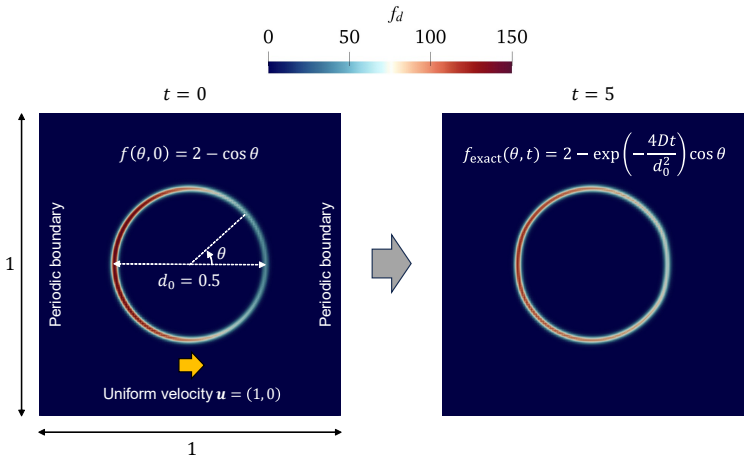


read the original abstract
Surfactants reside at the interface of two-phase flows and significantly influence the flow dynamics. Numerical simulations are essential for a comprehensive understanding of such surfactant-laden flows and require a method that can accurately simulate surfactant transport along the interface. In this study, we focus on interfacial transport models for insoluble surfactants based on the diffuse-interface method and propose two approaches to improve their accuracy: (a) adopting a formulation that avoids the spatial derivatives of variables with sharp gradients and (b) allowing the width of the delta function to be specified independently of the interface width. These approaches are simple and practical in that they do not lead to significant increases in computational cost, implementation complexity, or degradation of interface-capturing accuracy. Moreover, they preserve the discrete conservation of both fluid and surfactant mass. We conduct a series of numerical tests to demonstrate the effectiveness of the proposed approaches. Finally, we present a challenging test case that is difficult to solve accurately and has not been previously discussed. We expect this case to serve as a valuable benchmark for evaluating and comparing the performances of various methods proposed in the literature.
Editorial analysis
A structured set of objections, weighed in public.
Referee Report
Summary. The paper proposes two practical enhancements to diffuse-interface modeling of insoluble surfactants in two-phase flows: (a) a reformulation that avoids explicit spatial derivatives of sharply varying fields, and (b) independent specification of the delta-function width used for surfactant transport from the Cahn-Hilliard interface width. The authors assert that both changes improve accuracy of interfacial surfactant transport, preserve discrete conservation of fluid and surfactant mass, incur negligible extra cost or implementation effort, and do not degrade interface-capturing quality. A new challenging test case is introduced as a community benchmark.
Significance. If the conservation properties and accuracy gains are robustly demonstrated, the work would supply immediately usable improvements to a common class of multiphase-flow codes. The explicit preservation of discrete mass conservation and the introduction of a new benchmark are concrete strengths that could aid reproducibility and method comparison in the field.
major comments (2)
- [Numerical tests and approach (b) formulation] The decoupling of delta-function width from interface width (approach b) introduces an additional length scale whose effect on long-time consistency with the underlying phase-field equilibrium is not secured by the reported tests. The manuscript should demonstrate that this choice does not generate accumulating spurious Marangoni stresses or surfactant redistribution in regimes outside the presented suite (e.g., high capillary-number breakup or extended relaxation).
- [Conservation analysis] The claim that the new approaches preserve discrete conservation of both fluid and surfactant mass must be supported by explicit discrete conservation statements or proofs for the chosen discretization; the abstract alone does not establish that the independent delta width leaves the underlying Cahn-Hilliard evolution unaltered at the discrete level.
minor comments (2)
- [Abstract] Error metrics, grid resolutions, and baseline comparisons used to quantify accuracy improvement should be stated explicitly in the abstract or early results section.
- [Figures] Figure captions should indicate the specific values chosen for the independent delta width in each test so that readers can reproduce the reported behavior.
Simulated Author's Rebuttal
We thank the referee for the constructive comments and positive assessment of the significance of our work. We address each major comment below and outline the revisions we will make to strengthen the manuscript.
read point-by-point responses
-
Referee: [Numerical tests and approach (b) formulation] The decoupling of delta-function width from interface width (approach b) introduces an additional length scale whose effect on long-time consistency with the underlying phase-field equilibrium is not secured by the reported tests. The manuscript should demonstrate that this choice does not generate accumulating spurious Marangoni stresses or surfactant redistribution in regimes outside the presented suite (e.g., high capillary-number breakup or extended relaxation).
Authors: We agree that additional verification of long-time behavior strengthens the claim for approach (b). Our existing tests cover a range of regimes and exhibit no spurious accumulation, but we acknowledge that the referee's suggested cases (high capillary-number breakup and extended relaxation) lie outside the current suite. We will add these simulations to the revised manuscript, confirming that the independent delta width does not produce accumulating spurious Marangoni stresses or unphysical surfactant redistribution while preserving phase-field equilibrium. revision: yes
-
Referee: [Conservation analysis] The claim that the new approaches preserve discrete conservation of both fluid and surfactant mass must be supported by explicit discrete conservation statements or proofs for the chosen discretization; the abstract alone does not establish that the independent delta width leaves the underlying Cahn-Hilliard evolution unaltered at the discrete level.
Authors: We accept this criticism. Although the manuscript states that discrete conservation is preserved and the Cahn-Hilliard equation remains unchanged, we agree that an explicit discrete-level analysis is needed rather than relying on the abstract. In the revised version we will insert a dedicated subsection that provides the discrete conservation statements for fluid mass and surfactant mass under the chosen finite-difference discretization, explicitly verifying that the independent delta-function width leaves the Cahn-Hilliard evolution unaltered at the discrete level. revision: yes
Circularity Check
No circularity in proposed numerical formulations or validation
full rationale
The paper introduces two explicit new numerical formulations for surfactant transport in the diffuse-interface method and validates them via independent test cases that check conservation properties and accuracy. No derivation step reduces a claimed prediction or result to a fitted parameter, self-definition, or self-citation chain; the central improvements are presented as direct changes to the discrete operators and length-scale choices, with performance assessed externally through numerical experiments rather than by construction.
Axiom & Free-Parameter Ledger
axioms (1)
- domain assumption The diffuse-interface method accurately captures interface dynamics when the interface is smoothed over a finite width.
Lean theorems connected to this paper
-
IndisputableMonolith/Foundation/Cost/FunctionalEquation.leanwashburn_uniqueness_aczel unclear?
unclearRelation between the paper passage and the cited Recognition theorem.
adopting a formulation that avoids the spatial derivatives of variables with sharp gradients and (b) allowing the width of the delta function to be specified independently of the interface width
-
IndisputableMonolith/Foundation/Atomicity.leanatomic_tick unclear?
unclearRelation between the paper passage and the cited Recognition theorem.
preserve the discrete conservation of both fluid and surfactant mass
What do these tags mean?
- matches
- The paper's claim is directly supported by a theorem in the formal canon.
- supports
- The theorem supports part of the paper's argument, but the paper may add assumptions or extra steps.
- extends
- The paper goes beyond the formal theorem; the theorem is a base layer rather than the whole result.
- uses
- The paper appears to rely on the theorem as machinery.
- contradicts
- The paper's claim conflicts with a theorem or certificate in the canon.
- unclear
- Pith found a possible connection, but the passage is too broad, indirect, or ambiguous to say the theorem truly supports the claim.
Reference graph
Works this paper leans on
-
[1]
D. Bajpai, V . Tyagi, Laundry detergents: An overview, Journal of Oleo Science 56 (7) (2007) 327–340.doi: 10.5650/jos.56.327
-
[2]
M. Nitschke, S. Costa, Biosurfactants in food industry, Trends in Food Science & Technology 18 (5) (2007) 252–259.doi:https://doi.org/10.1016/j.tifs.2007.01.002. URLhttps://www.sciencedirect.com/science/article/pii/S0924224407000362
-
[3]
A. F. Belhaj, K. A. Elraies, S. M. Mahmood, N. N. Zulkifli, S. Akbari, O. S. Hussien, The effect of surfactant concentration, salinity, temperature, and ph on surfactant adsorption for chemical enhanced oil recovery: a review, Journal of Petroleum Exploration and Production Technology 10 (1) (2020) 125–137.doi:10.1007/ s13202-019-0685-y. URLhttps://doi.or...
-
[4]
O. Massarweh, A. S. Abushaikha, The use of surfactants in enhanced oil recovery: A review of recent advances, Energy Reports 6 (2020) 3150–3178.doi:https://doi.org/10.1016/j.egyr.2020.11.009. URLhttps://www.sciencedirect.com/science/article/pii/S2352484720314347
-
[5]
C. Trellu, E. Mousset, Y . Pechaud, D. Huguenot, E. D. van Hullebusch, G. Esposito, M. A. Oturan, Removal of hydrophobic organic pollutants from soil washing/flushing solutions: A critical review, Journal of Hazardous Materials 306 (2016) 149–174.doi:https://doi.org/10.1016/j.jhazmat.2015.12.008. URLhttps://www.sciencedirect.com/science/article/pii/S03043...
-
[6]
J.-C. Baret, Surfactants in droplet-based microfluidics, Lab Chip 12 (2012) 422–433.doi:10.1039/ C1LC20582J. URLhttp://dx.doi.org/10.1039/C1LC20582J
-
[7]
S. L. Anna, Droplets and bubbles in microfluidic devices, Annual Review of Fluid Mechanics 48 (V olume 48,
-
[8]
URLhttps://www.annualreviews.org/content/journals/10.1146/ annurev-fluid-122414-034425
(2016) 285–309.doi:https://doi.org/10.1146/annurev-fluid-122414-034425. URLhttps://www.annualreviews.org/content/journals/10.1146/ annurev-fluid-122414-034425
-
[9]
N. M. Kovalchuk, M. J. Simmons, Review of the role of surfactant dynamics in drop microfluidics, Advances in Colloid and Interface Science 312 (2023) 102844.doi:https://doi.org/10.1016/j.cis.2023.102844. URLhttps://www.sciencedirect.com/science/article/pii/S0001868623000118
-
[10]
A. Batchvarov, L. Kahouadji, C. R. Constante-Amores, G. F. Norões Gonçalves, S. Shin, J. Chergui, D. Juric, R. V . Craster, O. K. Matar, Three-dimensional dynamics of falling films in the presence of insoluble surfactants, Journal of Fluid Mechanics 906 (2021) A16.doi:10.1017/jfm.2020.796
-
[11]
C. Constante-Amores, A. Batchvarov, L. Kahouadji, S. Shin, J. Chergui, D. Juric, O. Matar, Role of surfactant- induced marangoni stresses in drop-interface coalescence, Journal of Fluid Mechanics 925 (2021) A15.doi: 10.1017/jfm.2021.682. 22
-
[12]
M. Kalli, P. Pico, L. Chagot, L. Kahouadji, S. Shin, J. Chergui, D. Juric, O. Matar, P. Angeli, Effect of surfactants during drop formation in a microfluidic channel: a combined experimental and computational fluid dynamics approach, Journal of Fluid Mechanics 961 (2023) A15.doi:10.1017/jfm.2023.213
-
[13]
C. Constante-Amores, L. Kahouadji, S. Shin, J. Chergui, D. Juric, J. Castrejón-Pita, O. Matar, A. Castrejón- Pita, Impact of droplets onto surfactant-laden thin liquid films, Journal of Fluid Mechanics 961 (2023) A8. doi:10.1017/jfm.2023.224
-
[14]
P. Pico, L. Kahouadji, S. Shin, J. Chergui, D. Juric, O. K. Matar, Surfactant-laden bubble bursting: Dynamics of capillary waves and worthington jet at large bond number, Phys. Rev. Fluids 9 (2024) 083606.doi:10.1103/ PhysRevFluids.9.083606. URLhttps://link.aps.org/doi/10.1103/PhysRevFluids.9.083606
-
[15]
J. Eshima, T. Aurégan, P. K. Farsoiya, S. Popinet, H. A. Stone, L. Deike, Size amplification of jet drops due to insoluble surfactants, Phys. Rev. Fluids 10 (2025) 123604.doi:10.1103/t9k3-dqyc. URLhttps://link.aps.org/doi/10.1103/t9k3-dqyc
-
[16]
T. Dong, W. H. Weheliye, P. Angeli, Laser induced fluorescence studies on the distribution of surfactants dur- ing drop/interface coalescence, Physics of Fluids 31 (1) (2019) 012106.arXiv:https://pubs.aip.org/ aip/pof/article-pdf/doi/10.1063/1.5059554/15978381/012106\_1\_online.pdf,doi:10.1063/ 1.5059554. URLhttps://doi.org/10.1063/1.5059554
-
[17]
Y . Y . Renardy, M. Renardy, V . Cristini, A new volume-of-fluid formulation for surfactants and simulations of drop deformation under shear at a low viscosity ratio, European Journal of Mechanics - B/Fluids 21 (1) (2002) 49–59.doi:https://doi.org/10.1016/S0997-7546(01)01159-1. URLhttps://www.sciencedirect.com/science/article/pii/S0997754601011591
-
[19]
J.-J. Xu, H.-K. Zhao, An eulerian formulation for solving partial differential equations along a moving interface, Journal of Scientific Computing 19 (1) (2003) 573–594.doi:10.1023/A:1025336916176. URLhttps://doi.org/10.1023/A:1025336916176
-
[20]
J.-J. Xu, Z. Li, J. Lowengrub, H. Zhao, A level-set method for interfacial flows with surfactant, Journal of Computational Physics 212 (2) (2006) 590–616.doi:https://doi.org/10.1016/j.jcp.2005.07.016. URLhttps://www.sciencedirect.com/science/article/pii/S0021999105003475
-
[21]
J.-J. Xu, Y . Yang, J. Lowengrub, A level-set continuum method for two-phase flows with insoluble surfactant, Journal of Computational Physics 231 (17) (2012) 5897–5909.doi:https://doi.org/10.1016/j.jcp. 2012.05.014. URLhttps://www.sciencedirect.com/science/article/pii/S0021999112002562
-
[22]
J.-J. Xu, W. Ren, A level-set method for two-phase flows with moving contact line and insoluble surfactant, Journal of Computational Physics 263 (2014) 71–90.doi:https://doi.org/10.1016/j.jcp.2014.01. 012. URLhttps://www.sciencedirect.com/science/article/pii/S0021999114000394
-
[23]
J.-J. Xu, W. Shi, M.-C. Lai, A level-set method for two-phase flows with soluble surfactant, Journal of Compu- tational Physics 353 (2018) 336–355.doi:https://doi.org/10.1016/j.jcp.2017.10.019. URLhttps://www.sciencedirect.com/science/article/pii/S0021999117307726 23
-
[25]
M. Muradoglu, G. Tryggvason, Simulations of soluble surfactants in 3d multiphase flow, Journal of Computa- tional Physics 274 (2014) 737–757.doi:https://doi.org/10.1016/j.jcp.2014.06.024. URLhttps://www.sciencedirect.com/science/article/pii/S0021999114004318
-
[26]
S. Shin, J. Chergui, D. Juric, L. Kahouadji, O. K. Matar, R. V . Craster, A hybrid interface tracking – level set technique for multiphase flow with soluble surfactant, Journal of Computational Physics 359 (2018) 409–435. doi:https://doi.org/10.1016/j.jcp.2018.01.010. URLhttps://www.sciencedirect.com/science/article/pii/S0021999118300202
-
[27]
P.-H. Chiu, Y .-T. Lin, A conservative phase field method for solving incompressible two-phase flows, Journal of Computational Physics 230 (1) (2011) 185–204.doi:https://doi.org/10.1016/j.jcp.2010.09.021. URLhttps://www.sciencedirect.com/science/article/pii/S0021999110005243
-
[28]
S. Mirjalili, C. B. Ivey, A. Mani, Comparison between the diffuse interface and volume of fluid methods for simulating two-phase flows, International Journal of Multiphase Flow 116 (2019) 221–238.doi:https:// doi.org/10.1016/j.ijmultiphaseflow.2019.04.019. URLhttps://www.sciencedirect.com/science/article/pii/S0301932218309030
-
[29]
S. Mirjalili, C. B. Ivey, A. Mani, A conservative diffuse interface method for two-phase flows with provable boundedness properties, Journal of Computational Physics 401 (2020) 109006.doi:https://doi.org/10. 1016/j.jcp.2019.109006. URLhttps://www.sciencedirect.com/science/article/pii/S0021999119307119
-
[30]
S. Mirjalili, A. Mani, Consistent, energy-conserving momentum transport for simulations of two-phase flows using the phase field equations, Journal of Computational Physics 426 (2021) 109918.doi:https://doi. org/10.1016/j.jcp.2020.109918. URLhttps://www.sciencedirect.com/science/article/pii/S0021999120306926
-
[31]
S. S. Jain, Accurate conservative phase-field method for simulation of two-phase flows, Journal of Computational Physics 469 (2022) 111529.doi:https://doi.org/10.1016/j.jcp.2022.111529. URLhttps://www.sciencedirect.com/science/article/pii/S0021999122005915
-
[32]
S. Mirjalili, M. A. Khanwale, A. Mani, Assessment of an energy-based surface tension model for simulation of two-phase flows using second-order phase field methods, Journal of Computational Physics 474 (2023) 111795. doi:https://doi.org/10.1016/j.jcp.2022.111795. URLhttps://www.sciencedirect.com/science/article/pii/S0021999122008580
-
[33]
H. Hwang, S. S. Jain, A robust phase-field method for two-phase flows on unstructured grids, Journal of Com- putational Physics 507 (2024) 112972.doi:https://doi.org/10.1016/j.jcp.2024.112972. URLhttps://www.sciencedirect.com/science/article/pii/S0021999124002213
-
[34]
J. Kim, Numerical simulations of phase separation dynamics in a water–oil–surfactant system, Journal of Colloid and Interface Science 303 (1) (2006) 272–279.doi:https://doi.org/10.1016/j.jcis.2006.07.032. URLhttps://www.sciencedirect.com/science/article/pii/S0021979706006345
-
[35]
R. G. M. van der Sman, S. van der Graaf, Diffuse interface model of surfactant adsorption onto flat and droplet interfaces, Rheologica Acta 46 (1) (2006) 3–11.doi:10.1007/s00397-005-0081-z. URLhttps://doi.org/10.1007/s00397-005-0081-z
-
[36]
H. Liu, Y . Zhang, Phase-field modeling droplet dynamics with soluble surfactants, Journal of Computational Physics 229 (24) (2010) 9166–9187.doi:https://doi.org/10.1016/j.jcp.2010.08.031. URLhttps://www.sciencedirect.com/science/article/pii/S002199911000478X 24
-
[37]
Automatic reconstruction of parametric building models from indoor point clouds
K. Erik Teigen, P. Song, J. Lowengrub, A. V oigt, A diffuse-interface method for two-phase flows with soluble surfactants, Journal of Computational Physics 230 (2) (2011) 375–393.doi:https://doi.org/10.1016/j. jcp.2010.09.020. URLhttps://www.sciencedirect.com/science/article/pii/S0021999110005231
work page doi:10.1016/j 2011
-
[38]
S. Gu, H. Zhang, Z. Zhang, An energy-stable finite-difference scheme for the binary fluid-surfactant system, Journal of Computational Physics 270 (2014) 416–431.doi:https://doi.org/10.1016/j.jcp.2014.03. 060. URLhttps://www.sciencedirect.com/science/article/pii/S0021999114002472
-
[39]
P. K. Farsoiya, S. Popinet, H. A. Stone, L. Deike, Coupled volume of fluid and phase field method for direct numerical simulation of insoluble surfactant-laden interfacial flows and application to rising bubbles, Phys. Rev. Fluids 9 (2024) 094004.doi:10.1103/PhysRevFluids.9.094004. URLhttps://link.aps.org/doi/10.1103/PhysRevFluids.9.094004
-
[40]
H. Hao, X. Li, T. Liu, H. Tan, Enhanced profile-preserving phase-field model of two-phase flow with surfactant interfacial transport and marangoni effects, Journal of Computational Physics 536 (2025) 114058.doi:https: //doi.org/10.1016/j.jcp.2025.114058. URLhttps://www.sciencedirect.com/science/article/pii/S0021999125003419
-
[41]
H. Hao, X. Li, L. Xu, T. Liu, H. Tan, Profile-preserving phase-field model for surfactant transport and adsorption- desorption in two-phase flow systems, Journal of Computational Physics 546 (2026) 114510.doi:https: //doi.org/10.1016/j.jcp.2025.114510. URLhttps://www.sciencedirect.com/science/article/pii/S0021999125007922
-
[42]
S. S. Jain, A model for transport of interface-confined scalars and insoluble surfactants in two-phase flows, Jour- nal of Computational Physics 515 (2024) 113277.doi:https://doi.org/10.1016/j.jcp.2024.113277. URLhttps://www.sciencedirect.com/science/article/pii/S0021999124005254
-
[43]
Y . Hu, A diffuse interface–lattice boltzmann model for surfactant transport on an interface, Applied Mathematics Letters 111 (2021) 106614.doi:https://doi.org/10.1016/j.aml.2020.106614. URLhttps://www.sciencedirect.com/science/article/pii/S0893965920302998
-
[44]
S. Yamashita, S. Matsushita, T. Suekane, Conservative transport model for surfactant on the interface based on the phase-field method, Journal of Computational Physics 516 (2024) 113292.doi:https://doi.org/10. 1016/j.jcp.2024.113292. URLhttps://www.sciencedirect.com/science/article/pii/S0021999124005400
-
[45]
K. Yang, T. Aoki, Weakly compressible navier-stokes solver based on evolving pressure projection method for two-phase flow simulations, Journal of Computational Physics 431 (2021) 110113.doi:https://doi.org/ 10.1016/j.jcp.2021.110113. URLhttps://www.sciencedirect.com/science/article/pii/S002199912100005X
-
[46]
M. Sussman, P. Smereka, S. Osher, A level set approach for computing solutions to incompressible two-phase flow, Journal of Computational Physics 114 (1) (1994) 146–159.doi:https://doi.org/10.1006/jcph. 1994.1155. URLhttps://www.sciencedirect.com/science/article/pii/S0021999184711557
-
[47]
M. S. Dodd, A. Ferrante, A fast pressure-correction method for incompressible two-fluid flows, Journal of Com- putational Physics 273 (2014) 416–434.doi:https://doi.org/10.1016/j.jcp.2014.05.024. URLhttps://www.sciencedirect.com/science/article/pii/S0021999114003702
-
[48]
C.-W. Shu, S. Osher, Efficient implementation of essentially non-oscillatory shock-capturing schemes, Journal of Computational Physics 77 (2) (1988) 439–471.doi:https://doi.org/10.1016/0021-9991(88)90177-5. URLhttps://www.sciencedirect.com/science/article/pii/0021999188901775 25
-
[49]
C. Min, On reinitializing level set functions, Journal of Computational Physics 229 (8) (2010) 2764–2772. doi:https://doi.org/10.1016/j.jcp.2009.12.032. URLhttps://www.sciencedirect.com/science/article/pii/S0021999109007189
-
[50]
C. Min, F. Gibou, A second order accurate level set method on non-graded adaptive cartesian grids, Journal of Computational Physics 225 (1) (2007) 300–321.doi:https://doi.org/10.1016/j.jcp.2006.11.034. URLhttps://www.sciencedirect.com/science/article/pii/S0021999106005912
-
[51]
G.-S. Jiang, D. Peng, Weighted eno schemes for hamilton–jacobi equations, SIAM Journal on Scientific Com- puting 21 (6) (2000) 2126–2143.arXiv:https://doi.org/10.1137/S106482759732455X,doi:10.1137/ S106482759732455X. URLhttps://doi.org/10.1137/S106482759732455X
-
[52]
J. AHRENS, B. GEVECI, C. LAW, 36 - paraview: An end-user tool for large-data visualization, in: C. D. Hansen, C. R. Johnson (Eds.), Visualization Handbook, Butterworth-Heinemann, Burlington, 2005, pp. 717– 731.doi:https://doi.org/10.1016/B978-012387582-2/50038-1. URLhttps://www.sciencedirect.com/science/article/pii/B9780123875822500381
-
[53]
W. J. Rider, D. B. Kothe, Reconstructing volume tracking, Journal of Computational Physics 141 (2) (1998) 112–152.doi:https://doi.org/10.1006/jcph.1998.5906. URLhttps://www.sciencedirect.com/science/article/pii/S002199919895906X
-
[54]
R. J. LeVeque, High-resolution conservative algorithms for advection in incompressible flow, SIAM Journal on Numerical Analysis 33 (2) (1996) 627–665.arXiv:https://doi.org/10.1137/0733033,doi:10.1137/ 0733033. URLhttps://doi.org/10.1137/0733033
-
[55]
A continuum method for modeling surface tension , journal =
J. Brackbill, D. Kothe, C. Zemach, A continuum method for modeling surface tension, Journal of Computational Physics 100 (2) (1992) 335–354.doi:https://doi.org/10.1016/0021-9991(92)90240-Y. URLhttps://www.sciencedirect.com/science/article/pii/002199919290240Y 26
discussion (0)
Sign in with ORCID, Apple, or X to comment. Anyone can read and Pith papers without signing in.