Recognition: no theorem link
texttt{GPUmonty}: A GPU-accelerated relativistic Monte Carlo radiative transfer code
Pith reviewed 2026-05-15 22:00 UTC · model grok-4.3
The pith
GPUmonty achieves a 12-fold speedup in relativistic Monte Carlo radiative transfer by offloading superphoton calculations to the GPU.
A machine-rendered reading of the paper's core claim, the machinery that carries it, and where it could break.
Core claim
By porting photon generation, sampling, tracking, and scattering to the GPU using the SIMT model, GPUmonty delivers roughly 12 times faster execution than the CPU version while preserving statistical accuracy, as confirmed by tests on optically thin synchrotron spheres and GRMHD simulation data where errors stay under one percent.
What carries the argument
The concurrent processing of superphotons on GPU threads via CUDA, replacing the sequential loop of the original grmonty code.
Load-bearing premise
The parallel execution on the GPU maintains the same statistical properties and convergence as the original sequential Monte Carlo algorithm without introducing any biases or artifacts.
What would settle it
Running the same input data through both codes and finding that the GPU version produces spectra differing by more than one percent or fails to show the N to the power of minus one half scaling with number of superphotons.
Figures




read the original abstract
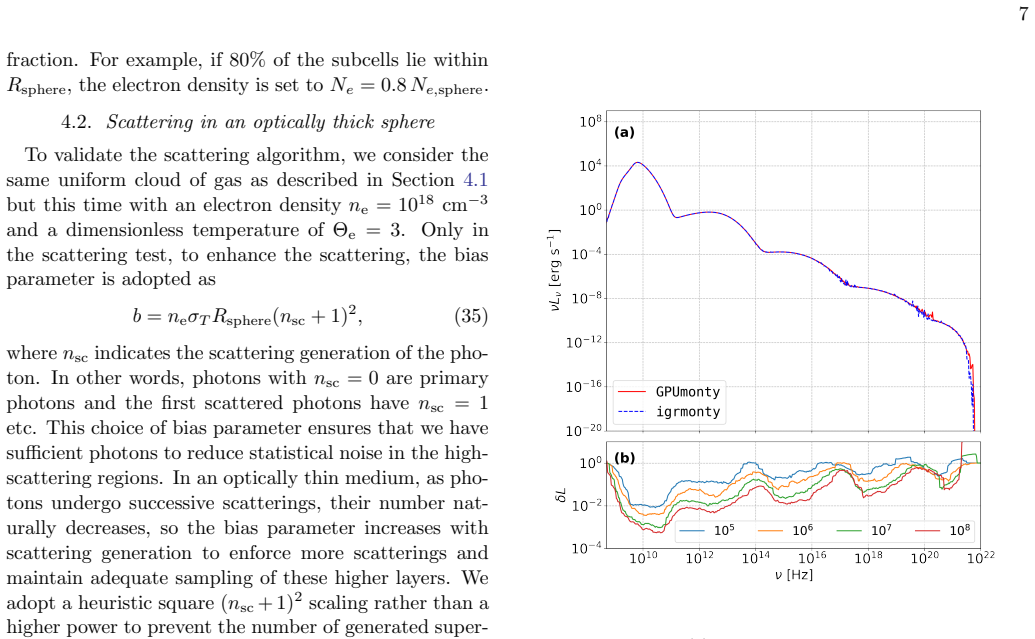
We introduce $\texttt{GPUmonty}$, a CUDA/C-based Monte Carlo radiative transfer code accelerated using graphics processing units (GPUs). $\texttt{GPUmonty}$ derives from the CPU-based code $\texttt{grmonty}$ and offloads the most computationally expensive stages of the calculation -- superphoton generation, sampling, tracking, and scattering -- to the GPU. Whereas $\texttt{grmonty}$ handles photons sequentially, $\texttt{GPUmonty}$ processes large numbers of superphotons concurrently, leveraging the single-instruction, multiple-thread (SIMT) execution model of modern GPUs. Benchmarks demonstrate a speedup of about $12\times$ relative to the original CPU implementation on a single GPU, with runtime limited primarily by register pressure rather than compute or memory bandwidth saturation. We validate the implementation through analytic tests for a optically thin synchrotron sphere, as well as comparisons with $\texttt{igrmonty}$ for scattering synchrotron sphere and GRMHD simulation data. Relative errors remain below a percent level and convergence is consistent with the expected $N_{\rm s}^{-1/2}$ Monte Carlo scaling. By significantly reducing computational costs, GPUmonty enables the extensive parameter space surveys and faster spectra modeling required to interpret horizon-scale observations of supermassive black holes. $\texttt{GPUmonty}$ is publicly available under the GNU General Public License.
Editorial analysis
A structured set of objections, weighed in public.
Referee Report
Summary. The manuscript introduces GPUmonty, a CUDA/C-based GPU-accelerated Monte Carlo radiative transfer code derived from the CPU code grmonty. It offloads superphoton generation, sampling, tracking, and scattering to the GPU for concurrent SIMT processing. Benchmarks report a 12× speedup on a single GPU limited by register pressure. Validation consists of analytic tests on an optically thin synchrotron sphere plus direct comparisons to igrmonty on scattering spheres and GRMHD data, with relative errors below 1% and explicit confirmation of N_s^{-1/2} Monte Carlo convergence.
Significance. If the reported speedup and accuracy hold, the work enables substantially faster spectra modeling and broader parameter-space surveys required for interpreting horizon-scale observations of supermassive black holes. Direct wall-clock benchmarks without fitted parameters, preservation of statistical convergence properties, and public release under the GNU GPL are clear strengths that enhance reproducibility and community utility.
minor comments (1)
- [Abstract] Abstract: the phrase 'a optically thin synchrotron sphere' is grammatically incorrect and should read 'an optically thin synchrotron sphere'.
Simulated Author's Rebuttal
We thank the referee for their supportive review, clear summary of the work, and recommendation to accept the manuscript. No major comments were raised in the report.
Circularity Check
No significant circularity
full rationale
The paper presents an implementation and benchmark of a GPU port of the existing grmonty Monte Carlo code. All central claims (12x speedup, <1% relative error, N_s^{-1/2} convergence) are established by direct wall-clock timing on hardware and by explicit numerical comparisons to analytic solutions plus the original CPU code. No equations, fitted parameters, or self-citations are used to derive the reported performance or correctness; the results are empirical measurements outside any closed derivation loop.
Axiom & Free-Parameter Ledger
axioms (1)
- domain assumption The single-instruction multiple-thread (SIMT) execution model of modern GPUs is suitable for concurrent superphoton tracking without altering Monte Carlo statistics.
Forward citations
Cited by 1 Pith paper
-
Sensitivities of Black Hole Images from GRMHD Simulations
Differentiable GRMHD image sensitivities create a structured error landscape that supports gradient-based parameter recovery for black hole imaging under idealized and noisy conditions.
Reference graph
Works this paper leans on
-
[1]
Canfield, E., Howard, W. M., & Liang, E. P. 1987, ApJ, 323, 565, doi: 10.1086/165853
-
[2]
2013, ApJ, 777, 13, doi: 10.1088/0004-637X/777/1/13
Chan, C.-k., Psaltis, D., & ¨Ozel, F. 2013, ApJ, 777, 13, doi: 10.1088/0004-637X/777/1/13
-
[3]
2024, Journal of Open Source Software, 9, 7273, doi: 10.21105/joss.07273
Chang, D. 2024, Journal of Open Source Software, 9, 7273, doi: 10.21105/joss.07273
-
[4]
Davelaar, J., Ryan, B. R., Wong, G. N., et al. 2023, MNRAS, 526, 5326, doi: 10.1093/mnras/stad3023
-
[5]
Dolence, J. C., Gammie, C. F., Mo´ scibrodzka, M., & Leung, P. K. 2009, The Astrophysical Journal Supplement Series, 184, 387, doi: 10.1088/0067-0049/184/2/387 Event Horizon Telescope Collaboration, Akiyama, K.,
-
[6]
Alberdi, A., et al. 2019a, ApJ, 875, L1, doi: 10.3847/2041-8213/ab0ec7 Event Horizon Telescope Collaboration, Akiyama, K.,
-
[7]
Alberdi, A., et al. 2019b, The Astrophysical Journal, 875, L5, doi: 10.3847/2041-8213/ab0f43 Event Horizon Telescope Collaboration, Akiyama, K.,
-
[8]
Algaba, J. C., et al. 2021, The Astrophysical Journal Letters, 910, L12, doi: 10.3847/2041-8213/abe71d Event Horizon Telescope Collaboration, Akiyama, K.,
-
[9]
Alberdi, A., et al. 2022a, ApJL, 930, L12, doi: 10.3847/2041-8213/ac667410.3847/2041- 8213/ac667510.3847/2041-8213/ac6429 Event Horizon Telescope Collaboration, Akiyama, K.,
-
[10]
2022b, The Astrophysical Journal Letters, 930, L16, doi: 10.3847/2041-8213/ac6672
Alberdi, A., et al. 2022b, The Astrophysical Journal Letters, 930, L16, doi: 10.3847/2041-8213/ac6672
-
[11]
Fishbone, L. G., & Moncrief, V. 1976, ApJ, 207, 962, doi: 10.1086/154565
-
[12]
D., Akiyama, K., Blackburn, L., et al
Johnson, M. D., Akiyama, K., Blackburn, L., et al. 2023, Galaxies, 11, 61, doi: 10.3390/galaxies11030061
-
[13]
D., Akiyama, K., Baturin, R., et al
Johnson, M. D., Akiyama, K., Baturin, R., et al. 2024, in Society of Photo-Optical Instrumentation Engineers (SPIE) Conference Series, Vol. 13092, Space Telescopes and Instrumentation 2024: Optical, Infrared, and Millimeter Wave, ed. L. E. Coyle, S. Matsuura, & M. D. Perrin, 130922D, doi: 10.1117/12.3019835
- [14]
-
[15]
Kawashima, T., Ohsuga, K., & Takahashi, H. R. 2023, ApJ, 949, 101, doi: 10.3847/1538-4357/acc94a
-
[16]
S., C´ ardenas-Avenda˜ no, A., & Palumbo, D
Keeble, L. S., C´ ardenas-Avenda˜ no, A., & Palumbo, D. C. M. 2025, PhRvD, 111, 103042, doi: 10.1103/PhysRevD.111.103042
-
[17]
Landau, L. D., & Lifschits, E. M. 1975, Course of Theoretical Physics, Vol. Volume 2, The Classical Theory of Fields (Oxford: Pergamon Press)
work page 1975
-
[18]
Leung, P. K., Gammie, C. F., & Noble, S. C. 2011, ApJ, 737, 21, doi: 10.1088/0004-637X/737/1/21
-
[19]
Mihalas, D., & Mihalas, B. W. 1984, Foundations of radiation hydrodynamics Mo´ scibrodzka, M., & Gammie, C. F. 2018, MNRAS, 475, 43, doi: 10.1093/mnras/stx3162
-
[20]
Moscibrodzka, M. A., & Yfantis, A. I. 2023, The Astrophysical Journal Supplement Series, 265, 22, doi: 10.3847/1538-4365/acb6f9 Naethe Motta, P., Nemmen, R., & Joshi, A. 2026,
-
[21]
S., & C´ ardenas-Avenda˜ no, A
GPUmonty, Zenodo, doi: 10.5281/zenodo.18884082 Naethe Motta, P., Prather, B. S., & C´ ardenas-Avenda˜ no, A. 2025, The Astrophysical Journal, 995, 56, doi: 10.3847/1538-4357/ae16a0
-
[22]
Palumbo, D. C. M., Gelles, Z., Tiede, P., et al. 2022, The Astrophysical Journal, 939, 107, doi: 10.3847/1538-4357/ac9ab7
-
[23]
2019, The Astrophysical Journal Supplement Series, 243, 26, doi: 10.3847/1538-4365/ab29fd
Porth, O., Chatterjee, K., Narayan, R., et al. 2019, The Astrophysical Journal Supplement Series, 243, 26, doi: 10.3847/1538-4365/ab29fd
-
[24]
2021, The Journal of Open Source Software, 6, 3336, doi: 10.21105/joss.03336
Prather, B., Wong, G., Dhruv, V., et al. 2021, The Journal of Open Source Software, 6, 3336, doi: 10.21105/joss.03336
-
[25]
S., Dexter, J., Moscibrodzka, M., et al
Prather, B. S., Dexter, J., Moscibrodzka, M., et al. 2023, The Astrophysical Journal, 950, 35, doi: 10.3847/1538-4357/acc586
-
[26]
Schnittman, J. D., & Krolik, J. H. 2013, ApJ, 777, 11, doi: 10.1088/0004-637X/777/1/11
-
[27]
Sharma, A., Medeiros, L., Wong, G. N., et al. 2025, Astrophys. J., 985, 40, doi: 10.3847/1538-4357/adc104
-
[28]
Swope, W. C., Andersen, H. C., Berens, P. H., & Wilson, K. R. 1982, The Journal of Chemical Physics, 76, 637, doi: 10.1063/1.442716
-
[29]
2022, Journal of Open Source Software, 7, 4457, doi: 10.21105/joss.04457
Tiede, P. 2022, Journal of Open Source Software, 7, 4457, doi: 10.21105/joss.04457
-
[30]
Wong, G. N., et al. 2022, Astrophys. J. Supp., 259, 64, doi: 10.3847/1538-4365/ac582e 13
-
[31]
Yfantis, A. I., Mo´ scibrodzka, M. A., Wielgus, M., Vos, J. T., & Jimenez-Rosales, A. 2024, Astronomy &; Astrophysics, 685, A142, doi: 10.1051/0004-6361/202348230
-
[32]
Younsi, Z., Wu, K., & Fuerst, S. V. 2012, Astronomy &; Astrophysics, 545, A13, doi: 10.1051/0004-6361/201219599
discussion (0)
Sign in with ORCID, Apple, or X to comment. Anyone can read and Pith papers without signing in.