REVIEW 2 major objections 3 minor 46 references
A compression pipeline that shrinks LLMs by 70–80%, paired with a world-model-augmented offloading controller, lets mobile edge devices run LLM service at near-cloud quality while cutting per-query energy by half and latency by 12–30%.
Reviewed by Pith at T0; open to challenge. T0 means a machine referee read the full paper against a public rubric. the ladder, T0–T4 →
T0 review · deepseek-v4-flash
2026-08-02 23:27 UTC pith:L5CCV4VJ
load-bearing objection The ECLD headline claim is contradicted by the paper's own Table I, and the online QoS metrics are partly circular; the world-model-PPO part is the stronger half, but as written the central deployment claim doesn't hold. the 2 major comments →
Compact LLM Deployment and World Model Assisted Offloading in Mobile Edge Computing
The pith
A machine-rendered reading of the paper's core claim, the machinery that carries it, and where it could break.
Core claim
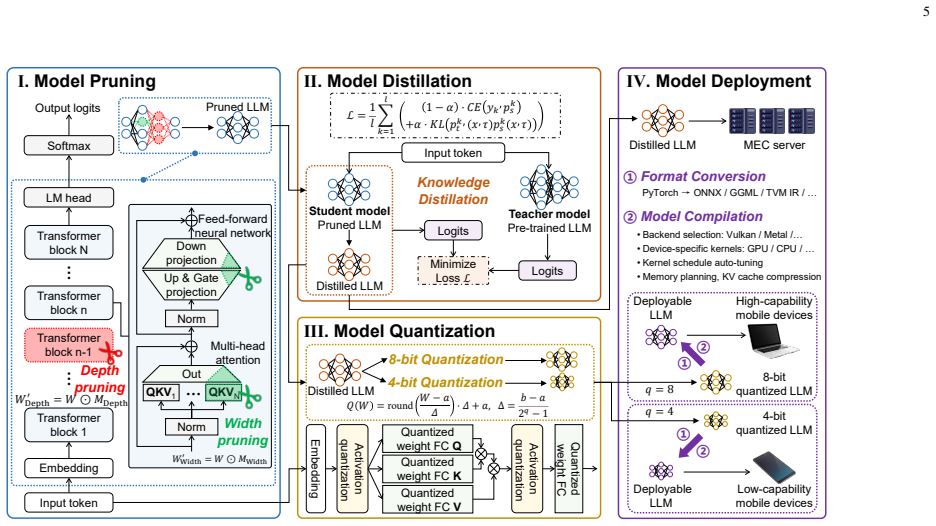
The paper's central claim is that model footprint and reactive offloading—the two obstacles to edge LLM service—can be solved together. The ECLD pipeline scores layers, heads, neurons, and embedding dimensions, prunes width and depth, distills the pruned model back toward the teacher, and quantizes to 4-bit or 8-bit per device, producing measurable, hardware-aware local variants. Using those profiles, the paper minimizes long-run latency under energy, accuracy, and hallucination constraints with world model-augmented PPO: a recurrent state-space model predicts next states and rewards, sharpens critic targets, and supplies imagined rollouts for the actor. On three 8–12B models, the pipeline k
What carries the argument
The two load-bearing objects are the ECLD pipeline and the world model-PPO controller. ECLD applies a combined pruning mask (elementwise product of width and depth masks over layers, heads, neurons, and embedding dimensions), a distillation loss blending cross-entropy with temperature-softened teacher–student KL divergence, and hardware-aware 4-bit/8-bit quantization. The controller is a recurrent state-space world model whose predictions form mixed temporal-difference targets for the critic and short imagined rollouts for an auxiliary actor loss. The pipeline converts a monolithic model into measurable local variants; the controller converts those measurements into an offloading-ratio and t
Load-bearing premise
The load-bearing premise is that splitting an inference task between a small local model and a large edge model produces accuracy and hallucination rates that are simple weighted averages of the two models' rates, with the weights just being the fraction of data sent to the edge; if real split inference does not behave that way, the quality constraints are not measuring what the paper says they measure.
What would settle it
Run the same prompt suite on a real device–edge pair at pure local, pure edge, and a grid of offload ratios (e.g., α = 0, 0.25, 0.5, 0.75, 1), computing accuracy and hallucination with the paper's token-aligned embedding similarity; if the results deviate systematically from the straight lines of Eq. (28), or if token alignment frequently fails, then constraints (30e)–(30f) are not enforcing the quality guarantee they name.
If this is right
- Storage drops of 70–80% mean 8–12B parameter models can be deployed on devices that cannot even fit an 8-bit quantized baseline, expanding the set of edge hardware that can host an LLM.
- Per-query energy is roughly halved at the model level, so communication and scheduling, not local compute, become the next bottleneck in the edge system.
- The world model-PPO policy converges in about half the episodes of vanilla PPO, implying that fewer real-world interactions are needed to learn a good offloading policy in a dynamic network.
- The learned dynamic policy keeps accuracy above the required floor and hallucination below the ceiling while achieving 12–30% lower average latency than vanilla PPO as the number of mobile users grows from 2 to 5.
- Across three backbones, the ECLD variants preserve within about ten points of original accuracy while using much less storage, so they can act as cheap, deployable stand-ins for full-scale LLMs in latency-sensitive applications.
Where Pith is reading between the lines
- The paper's QoS math depends on Equation (28), which blends local and edge accuracy and hallucination linearly in the offload fraction α. A natural extension is to measure real split-inference quality at several α values; if the measured curves are not convex combinations, the learned policy's 'constraint satisfaction' is an artifact of the reward design rather than a property of actual generation
- The online hallucination metric compares local tokens against the edge model's tokens, not against ground truth. Under that definition, a policy can satisfy Hmax while both local and edge models hallucinate on the same facts; testing the final responses against a factual benchmark would separate consistency from truthfulness.
- The same world-model scaffolding could generalize to other split-execution decisions, such as choosing among several compact model variants on a device, or deciding how many speculative tokens to generate locally while the edge verifies—where imagined rollouts might infer the latency–quality trade-off without extra online exploration.
- The 12–30% latency gain is demonstrated with two to five users and a single edge server; stress tests with heterogeneous devices, bursty traffic, and non-stationary channel conditions would show whether the gain persists outside the tested regime.
Editorial analysis
A structured set of objections, weighed in public.
Referee Report
Summary. The paper proposes a two-part system for mobile edge computing with LLMs. First, ECLD combines structured pruning, knowledge distillation, and low-bit quantization to produce compact edge-deployable LLMs. Second, the paper formulates a joint offloading and power-control problem under latency, energy, accuracy, and hallucination constraints, and solves it with world model-PPO, a PPO variant augmented by an RSSM-based world model. Experiments are reported on Llama-3.1-8B, Qwen3-8B, and Mistral-12B, claiming 70-80% storage reduction, up to 50% energy reduction, largely preserved accuracy, often reduced hallucination, about 50% faster convergence, 15.8% reward improvement, and 12-30% latency reduction.
Significance. If the claims held, the paper would offer a timely integrated framework for edge LLM deployment and QoS-aware offloading. It has some genuine strengths: the offline evaluation uses external benchmarks (WebQuestionsSP and SelfCheckGPT) rather than being purely circular; the experimental setup includes real hardware (H200, Jetson Nano, Xiaomi 10 Ultra); and the RL component is compared against standard baselines. However, the central empirical claim of the deployment half is contradicted by the paper's own Table I, and the online QoS evaluation rests on an unvalidated linear blending assumption. As presented, the significance of the contribution is not established.
major comments (2)
- [Abstract; Table I; §VI-B] The abstract claims that ECLD 'largely preserves accuracy and often lowers hallucination,' and §VI-B2 states that ECLD models 'consistently achieve higher accuracy than those compressed only by quantization or pruning.' Table I contradicts both claims. For Qwen3-8B, accuracy drops from 68.21 to 36.35, which is below the quantization-only baseline (67.51) and barely above the pruning+distillation baseline (37.01). Its hallucination rate rises from 0.77 to 0.97, which is worse than every non-ECLD baseline except pruning+distillation. For Mistral-12B, hallucination rises from 0.52 to 0.87 (+67%). Thus two of the three backbones fail the 'largely preserving accuracy and often lowering hallucination' headline, and the 'consistently' statement in §VI-B2 is false for Qwen3-8B. The concluding statement in §VII that ECLD 'substantially reduces model size and energy consumption while largely prese
- [§IV-D, Eq. (28)] The effective slot-wise accuracy and hallucination are modeled as linear blends, e.g., tilde A_k(t) = alpha_k(t) A_MEC + (1-alpha_k(t)) A_local. This assumes that splitting an inference task at an arbitrary data fraction yields output quality equal to the convex combination of the two model qualities. No evidence or reference is provided for this assumption. Moreover, Eqs. (25)-(27) require token-level alignment between the local and MEC outputs, but LLM outputs typically differ in length and tokenization, so the per-token cosine similarity in Eqs. (26)-(27) is not well-defined without a specified alignment procedure. Because constraints (30e)-(30f) and the online accuracy/hallucination results in Fig. 10 depend on these metrics, the claim that world model-PPO 'satisfies the accuracy and hallucination constraints' is not actually established.
minor comments (3)
- [Table I] The energy consumption unit 'W ˚ uh' appears to be a typo; it should likely be 'Wh' or 'μWh'. Also, the accessibility column mixes comma formatting inconsistently (e.g., 15,316.53 vs 3,336.18), which should be unified.
- [§VI-B2] The text says the ECLD Llama-3.1-8B accuracy is 'close to the original model (i.e., 68.21%),' but Table I lists the original Llama-3.1-8B accuracy as 70.30. The value 68.21 in Table I is the original Qwen3-8B accuracy. This cross-reference error reduces confidence in the reported numbers.
- [§IV-D, Eqs. (25)-(27)] The online accuracy and hallucination definitions assume that the local and MEC responses can be token-aligned into M_k(t) corresponding tokens. The paper should specify how outputs of different lengths are aligned, and how the hallucination threshold gamma is chosen.
Circularity Check
Online QoS metrics define accuracy/hallucination as similarity to the edge server, making 'approaching always-offload quality' an artifact of Eq. (28).
specific steps
-
self definitional
[Section IV-D2, Eqs. (26)-(28); claimed in Section VI-B6 (Fig. 10) and the abstract]
"we treat the full-scale LLM running at the MEC server as a high-quality reference and compare local responses against MEC responses for each MLU. ... The semantic accuracy of local inference at time slot t is defined as A_k(t) = 1/M_k(t) Σ_j ψ(e(rMEC_{k,j}(t)), e(rlocal_{k,j}(t))) (26). ... The hallucination rate is defined as the fraction of local tokens whose semantic similarity to the MEC output falls below a given threshold γ (27). ... Since the offloading ratio α_k(t) determines how each task is split between local processing and MEC offloading, the effective slot-wise accuracy and halluc"
A_k(t) and H_k(t) are defined as semantic similarity between the local model's output and the MEC server's full-scale LLM output. Hence A_MEC and H_MEC in Eq. (28) are the server compared with itself, i.e., 1 and 0, and increasing the offload ratio α_k(t) mechanically drives \tilde A_k(t) toward 1 and \tilde H_k(t) toward 0. The paper's claims that the learned policy 'approaches the always-offload upper bound' and delivers 'near-cloud-level generation quality' therefore reduce to the policy choosing α close to 1, not to an independent measurement of accuracy or hallucination. The QoS constraints (30e)-(30f) and the reward penalties in Eq. (48) are evaluated on this same self-referential metric, so 'satisfying the accuracy and hallucination constraints' is partly guaranteed by construction.
full rationale
The offline ECLD model evaluation is not circular: accuracy and hallucination are measured on external benchmarks (WebQuestionsSP, SelfCheckGPT) via Eqs. (23)-(24), and storage/energy results are hardware measurements, so the compression half stands on evidence quality rather than definitional identity. No load-bearing self-citation or imported uniqueness theorem was found; author self-citations such as [4], [35], and [44] provide context or parameter settings, not the derivation of the central results. The circularity is concentrated in the online QoS metric used for the offloading/RL half. Eqs. (26)-(27) define per-slot 'accuracy' and 'hallucination' as token-level semantic similarity to the MEC server's full-scale model, and Eq. (28) makes effective QoS a linear blend weighted by the offload ratio. Since the server compared with itself gives A_MEC=1 and H_MEC=0, 'approaching always-offload quality' is equivalent to increasing α, so the headline claim that world-model-PPO 'satisfies the accuracy and hallucination constraints and approaches the generation quality of always-offloading' is partly tautological. The latency and convergence improvements (50% faster convergence, 12-30% latency reduction) are not affected by this circularity. Separately, Table I's Qwen3-8B row (accuracy 68.21 to 36.35, hallucination 0.77 to 0.97) contradicts the abstract's 'largely preserving accuracy and often lowering hallucination' and Section VI-B2's 'consistently achieve higher accuracy' statement, but that is a correctness/evidence problem, not a circularity, and is flagged here only for completeness.
Axiom & Free-Parameter Ledger
free parameters (12)
- Pruning threshold theta_pru =
Not reported
- Distillation balance alpha =
Not reported
- Distillation temperature tau =
Not reported
- Hallucination similarity threshold gamma =
Not reported
- World-model TD mix lambda_wm =
0.5
- Imagination loss coefficient eta =
0.3
- Imagination rollout length H =
3
- Entropy coefficient beta_ent =
0.001
- Reward penalty coefficient omega =
Not reported
- World-model loss weights lambda_r, beta =
1 (both)
- PPO clip epsilon / discount gamma =
0.1 / 0.99
- Actor/critic learning rate =
1e-5
axioms (6)
- domain assumption An LLM inference task is bit-divisible: offloading a fraction alpha_k(t) of X_k(t) bits yields linearly scaled local/edge latencies and energies (Eqs. 14, 20, 22).
- domain assumption Effective accuracy and hallucination of a partially offloaded task equal the alpha_k-weighted average of local and edge metrics (Eq. 28).
- domain assumption Local and MEC outputs can be tokenized into M_k(t) aligned tokens and their per-token embedding cosine similarity measures accuracy/hallucination (Section IV-D.2, Eqs. 26-27).
- domain assumption The full-scale LLM at the MEC server is a high-quality reference whose responses define correct and hallucinated content.
- domain assumption The RSSM world model trained with LWM (Eq. 35) produces predictions accurate enough that mixed TD targets and imagination rollouts improve PPO without destabilizing on-policy updates.
- standard math PPO with the clipped surrogate (Eq. 32) converges to a near-optimal policy for this MDP.
read the original abstract
This paper investigates compact large language model (LLM) deployment and world-model-assisted inference offloading in mobile edge computing (MEC) networks. We first propose an edge compact LLM deployment (ECLD) framework that jointly applies structured pruning, low-bit quantization, and knowledge distillation to construct edge-deployable LLM variants, and we evaluate these models using four complementary metrics: accessibility, energy consumption, hallucination rate, and generalization accuracy. Building on the resulting compact models, we formulate an MEC offloading optimization problem that minimizes the long-term average inference latency subject to per-device energy budgets and LLM-specific quality-of-service constraints on effective accuracy and hallucination. To solve this problem under unknown and time-varying network dynamics, we develop a world model-proximal policy optimization (PPO) algorithm, which augments an on-policy PPO algorithm with a learned recurrent world model that provides improved value targets and short imagination rollouts. Extensive experiments on Llama-3.1-8B, Qwen3-8B, and Mistral-12B show that ECLD compresses base models by about 70-80% in storage (i.e., from 15.3 GB to 3.3 GB for Llama-3.1-8B) and reduces per-query energy consumption by up to 50%, while largely preserving accuracy and often lowering hallucination compared with quantization-only or pruning-only baselines. Moreover, they also show that world model-PPO speeds up convergence by about 50%, improves the final reward by 15.8% over vanilla PPO, and reduces average inference latency by 12-30% across different user populations, while satisfying the accuracy and hallucination constraints and approaching the generation quality of always-offloading with much of the efficiency of local execution.
Figures



Reference graph
Works this paper leans on
-
[1]
Generative ai agents with large language model for satellite networks via a mixture of experts transmission,
R. Zhang, H. Du, Y . Liu, et al., “Generative ai agents with large language model for satellite networks via a mixture of experts transmission,” IEEE J. Sel. Areas Commun. , vol. 42, no. 12, pp. 3581–3596, 2024
2024
-
[2]
Deep generative model and its applications in efficient wireless network management: A tutorial and case study,
Y . Liu, H. Du, D. Niyato, et al. , “Deep generative model and its applications in efficient wireless network management: A tutorial and case study,” IEEE Wireless Commun. Mag. , vol. 31, no. 4, pp. 199–207, 2024
2024
-
[3]
Language models are few-shot learners,
T. Brown, B. Mann, N. Ryder, et al. , “Language models are few-shot learners,” Proc. NeurIPS , vol. 33, pp. 1877–1901, 2020
1901
-
[4]
Toward democratized generative ai in next-generation mobile edge networks,
R. Zhang, J. He, X. Luo, et al. , “Toward democratized generative ai in next-generation mobile edge networks,” IEEE Netw. , vol. 39, no. 6, pp. 251–260, 2025
2025
-
[5]
Mobile edge intelligence for large language models: A contemporary survey,
G. Qu, Q. Chen, W. Wei, et al. , “Mobile edge intelligence for large language models: A contemporary survey,” IEEE Commun. Surveys Tuts., 2025
2025
-
[6]
Beyond the cloud: Edge inference for generative large language models in wireless networks,
X. Zhang, J. Nie, Y . Huang, et al. , “Beyond the cloud: Edge inference for generative large language models in wireless networks,” IEEE Trans. Wireless Commun., vol. 24, no. 1, pp. 643–658, 2024
2024
-
[7]
Llm-pruner: On the structural pruning of large language models,
X. Ma, G. Fang, and X. Wang, “Llm-pruner: On the structural pruning of large language models,” Proc. NeurIPS , vol. 36, pp. 21702–21720, 2023
2023
-
[8]
Survey on knowledge distillation for large language models: methods, evaluation, and application,
C. Y ang, Y . Zhu, W. Lu, et al. , “Survey on knowledge distillation for large language models: methods, evaluation, and application,” ACM Trans. Intell. Syst. Technol. , vol. 16, no. 6, pp. 1–27, 2025
2025
-
[9]
Smoothquant: Accurate and efficient post-training quantization for large language models,
G. Xiao, J. Lin, M. Seznec, et al., “Smoothquant: Accurate and efficient post-training quantization for large language models,” in Proc. ICML , pp. 38087–38099, PMLR, 2023
2023
-
[10]
Large language models (llms) inference offloading and resource allocation in cloud-edge computing: An active inference approach,
Y . He, J. Fang, F. R. Y u,et al., “Large language models (llms) inference offloading and resource allocation in cloud-edge computing: An active inference approach,” IEEE Trans. Mobile Comput. , vol. 23, no. 12, pp. 11253–11264, 2024
2024
-
[11]
Efficient acceleration of deep learning inference on resource-constrained edge devices: A review,
M. M. H. Shuvo, S. K. Islam, J. Cheng, et al., “Efficient acceleration of deep learning inference on resource-constrained edge devices: A review,” Proc. IEEE , vol. 111, no. 1, pp. 42–91, 2022
2022
-
[12]
Securing federated diffusion model with dynamic quantization for generative ai services in multiple-access artificial intelligence of things,
J. He, B. Lai, J. Kang, et al. , “Securing federated diffusion model with dynamic quantization for generative ai services in multiple-access artificial intelligence of things,” IEEE Internet Things J. , vol. 11, no. 17, pp. 28064–28077, 2024
2024
-
[13]
Edgeshard: Efficient llm inference via collaborative edge computing,
M. Zhang, X. Shen, J. Cao, et al. , “Edgeshard: Efficient llm inference via collaborative edge computing,” IEEE Internet Things J. , 2024
2024
-
[14]
A review on edge large language models: Design, execution, and applications,
Y . Zheng, Y . Chen, B. Qian, et al. , “A review on edge large language models: Design, execution, and applications,” ACM Comput. Surv. , vol. 57, no. 8, pp. 1–35, 2025
2025
-
[15]
Qos-constrained medium access prob- ability optimization in wireless interference-limited networks,
J. Tian, H. Zhang, D. Wu, et al., “Qos-constrained medium access prob- ability optimization in wireless interference-limited networks,” IEEE Trans. Commun., vol. 66, no. 3, pp. 1064–1077, 2018
2018
-
[16]
J. Lee, S. Park, J. Kwon, et al. , “Exploring the trade-offs: Quantization methods, task difficulty, and model size in large language models from edge to giant,” arXiv:2409.11055, 2024
Pith/arXiv arXiv 2024
-
[17]
Sparsegpt: Massive language models can be accurately pruned in one-shot,
E. Frantar and D. Alistarh, “Sparsegpt: Massive language models can be accurately pruned in one-shot,” in Proc. ICML , pp. 10323–10337, PMLR, 2023
2023
-
[18]
Qlora: Efficient finetuning of quantized llms,
T. Dettmers, A. Pagnoni, A. Holtzman, et al., “Qlora: Efficient finetuning of quantized llms,” Proc. NeurIPS , vol. 36, pp. 10088–10115, 2023
2023
-
[19]
Low-rank few-shot adaptation of vision- language models,
M. Zanella and I. Ben Ayed, “Low-rank few-shot adaptation of vision- language models,” in Proc. IEEE CVPR , pp. 1593–1603, 2024
2024
-
[20]
Deep learning for intelligent wireless networks: A comprehensive survey,
Q. Mao, F. Hu, and Q. Hao, “Deep learning for intelligent wireless networks: A comprehensive survey,” IEEE Commun. Surveys Tuts. , vol. 20, no. 4, pp. 2595–2621, 2018
2018
-
[21]
A drl agent for jointly optimizing computation offloading and resource allocation in mec,
J. Chen, H. Xing, Z. Xiao, et al. , “A drl agent for jointly optimizing computation offloading and resource allocation in mec,” IEEE Internet Things J. , vol. 8, no. 24, pp. 17508–17524, 2021
2021
-
[22]
Meta-dt: Offline meta-rl as con- ditional sequence modeling with world model disentanglement,
Z. Wang, L. Zhang, W. Wu, et al. , “Meta-dt: Offline meta-rl as con- ditional sequence modeling with world model disentanglement,” Proc. NeurIPS, vol. 37, pp. 44845–44870, 2024
2024
-
[23]
Daydreamer: World models for physical robot learning,
P . Wu, A. Escontrela, D. Hafner, et al., “Daydreamer: World models for physical robot learning,” in Proc. CoRL , pp. 2226–2240, PMLR, 2023
2023
-
[24]
Cardreamer: Open-source learning platform for world model based autonomous driving,
D. Gao, S. Cai, H. Zhou, et al. , “Cardreamer: Open-source learning platform for world model based autonomous driving,” IEEE Internet Things J. , 2024
2024
-
[25]
The effectiveness of world models for continual reinforcement learning,
S. Kessler, M. Ostaszewski, M. Bortkiewicz, et al., “The effectiveness of world models for continual reinforcement learning,” in Proc. CoLLAs , pp. 184–204, PMLR, 2023
2023
-
[26]
Birds in cages: Edge inference allocation for distributed llm deployment,
J. Zhu, L. Zhao, F. Xiao, et al., “Birds in cages: Edge inference allocation for distributed llm deployment,” in Proc. IEEE/ACM IWQoS , pp. 1–6, IEEE, 2025
2025
-
[27]
Edge and terminal cooperation enabled llm deployment optimization in wireless network,
W. Zhao, W. Jing, Z. Lu, et al., “Edge and terminal cooperation enabled llm deployment optimization in wireless network,” in Proc. IEEE/CIC ICCC Workshops, pp. 220–225, 2024
2024
-
[28]
Pushing large language models to the 6g edge: Vision, challenges, and opportunities,
Z. Lin, G. Qu, Q. Chen, et al. , “Pushing large language models to the 6g edge: Vision, challenges, and opportunities,” IEEE Commun. Mag. , vol. 63, no. 9, pp. 52–59, 2025
2025
-
[29]
A matching game for llm layer deployment in heterogeneous edge networks,
B. Picano, D. T. Hoang, and D. N. Nguyen, “A matching game for llm layer deployment in heterogeneous edge networks,” IEEE Open J. Commun. Soc. , vol. 6, pp. 3795–3805, 2025
2025
-
[30]
Edge-llm: A collaborative framework for large language model serving in edge computing,
F. Cai, D. Y uan, Z. Y ang, et al. , “Edge-llm: A collaborative framework for large language model serving in edge computing,” in Proc. IEEE ICWS, pp. 799–809, 2024
2024
-
[31]
Decentralized llm deployment in mobile edge computing networks,
D. Xu, L. Duan, J. Zhu, et al., “Decentralized llm deployment in mobile edge computing networks,” Authorea Preprints, 2025
2025
-
[32]
Compact lan- guage models via pruning and knowledge distillation,
S. Muralidharan, S. Turuvekere Sreenivas, R. Joshi, et al., “Compact lan- guage models via pruning and knowledge distillation,” Proc. NeurIPS , vol. 37, pp. 41076–41102, 2024
2024
-
[33]
World model-based learning for long-term age of information minimization in vehicular networks,
L. Wang, R. Shelim, W. Saad, et al. , “World model-based learning for long-term age of information minimization in vehicular networks,” arXiv:2505.01712, 2025
Pith/arXiv arXiv 2025
-
[34]
Mobiworld: World models for mobile wireless network,
H. Chai, Y . Y uan, and Y . Li, “Mobiworld: World models for mobile wireless network,” arXiv:2507.09462, 2025
Pith/arXiv arXiv 2025
-
[35]
World models for cognitive agents: Transforming edge intelligence in future networks,
C. Zhao, R. Zhang, J. Wang, et al., “World models for cognitive agents: Transforming edge intelligence in future networks,” arXiv:2506.00417, 2025
Pith/arXiv arXiv 2025
-
[36]
G. Liu, Y . Liu, R. Zhang, et al. , “Dwm-ro: Decentralized world models with reasoning offloading for swipt-enabled satellite-terrestrial hetnets,” arXiv:2511.05972, 2025
Pith/arXiv arXiv 2025
-
[37]
Hape: Hardware-aware llm pruning for efficient on-device inference optimization,
W. Zhao, L. Zou, Z. Wang, et al. , “Hape: Hardware-aware llm pruning for efficient on-device inference optimization,” ACM Trans. Des. Autom. Electron. Syst. , 2025
2025
-
[38]
Llm pruning and distillation in practice: The minitron approach,
S. Sharath Turuvekere, M. Saurav, J. Raviraj, et al. , “Llm pruning and distillation in practice: The minitron approach,” arXiv:2408.11796, 2024
Pith/arXiv arXiv 2024
-
[39]
Agile-quant: Activation-guided quantization for faster inference of llms on the edge,
X. Shen, P . Dong, L. Lu, , et al. , “Agile-quant: Activation-guided quantization for faster inference of llms on the edge,” in Proc. AAAI , vol. 38, pp. 18944–18951, 2024
2024
-
[40]
Halo: Hardware-aware quantization with low critical-path-delay weights for llm acceleration,
R. Juneja, S. Aggarwal, S. Huda, et al. , “Halo: Hardware-aware quantization with low critical-path-delay weights for llm acceleration,” arXiv:2502.19662, 2025
arXiv 2025
-
[41]
TVM: An automated End-to-End optimizing compiler for deep learning,
T. Chen, T. Moreau, Z. Jiang, et al. , “TVM: An automated End-to-End optimizing compiler for deep learning,” in Proc. OSDI, (Carlsbad, CA), pp. 578–594, USENIX Association, Oct. 2018
2018
-
[42]
The value of semantic parse labeling for knowledge base question answering,
W.-t. Yih, M. Richardson, C. Meek, et al., “The value of semantic parse labeling for knowledge base question answering,” in Proc. ACL (Short Papers), pp. 201–206, 2016
2016
-
[43]
Selfcheckgpt: Zero-resource black-box hallucination detection for generative large language models,
P . Manakul, A. Liusie, and M. Gales, “Selfcheckgpt: Zero-resource black-box hallucination detection for generative large language models,” in Proc. EMNLP 2023 , pp. 9004–9017, 2023
2023
-
[44]
Energy efficiency maximization in ris-assisted swipt networks with rsma: A ppo-based approach,
R. Zhang, K. Xiong, Y . Lu, et al. , “Energy efficiency maximization in ris-assisted swipt networks with rsma: A ppo-based approach,” IEEE J. Sel. Areas Commun. , vol. 41, no. 5, pp. 1413–1430, 2023
2023
-
[45]
Ris-assisted wireless powered mec: Multiple access design and resource allocation,
L. Lv, H. Luo, L. Y ang, et al. , “Ris-assisted wireless powered mec: Multiple access design and resource allocation,” IEEE Trans. Wireless Commun., 2024
2024
-
[46]
Joint robust power control and task scheduling for vehicular offloading in cloud-assisted mec networks,
Z. Liu, J. Su, J. Wei, et al. , “Joint robust power control and task scheduling for vehicular offloading in cloud-assisted mec networks,” IEEE Trans. Netw. Sci. Eng. , vol. 12, no. 2, pp. 698–709, 2025
2025
discussion (0)
Sign in with ORCID, Apple, or X to comment. Anyone can read and Pith papers without signing in.