REVIEW 2 major objections 5 minor 25 references
Aerial scans stay occlusion-free in unknown environments by repairing viewpoints and connecting segments in real time.
Reviewed by Pith at T0; open to challenge. T0 means a machine referee read the full paper against a public rubric. the ladder, T0–T4 →
FC-Vision keeps aerial scanning drones occlusion-free by repairing viewpoints and searching clean-sensing connectors in real time, improving coverage by up to 55.32%.
T0 review reviewed 2026-08-02 challenge →
load-bearing objection A solid engineering contribution with a real overclaim: the 'continuous occlusion-free' guarantee is not actually checked along the segments. the 2 major comments →
FC-Vision: Real-Time Visibility-Aware Replanning for Occlusion-Free Aerial Target Structure Scanning in Unknown Environments
The pith
A machine-rendered reading of the paper's core claim, the machinery that carries it, and where it could break.
The reading
Core claim
FC-Vision's central discovery is that occlusion-free aerial structure scanning in unknown environments can be decomposed into two tractable subproblems: a hybrid sampling-and-optimization viewpoint repair that preserves intended coverage with minimal deviation, and a Φ-A* search that connects viewpoints in 5-DoF space while enforcing field-of-view cleanliness at every expansion. The key enabler is the lifted-state design: the search stays in 3D positions, but each node is lifted to a (position, pitch, yaw) configuration via interpolation between endpoint attitudes, then corrected by a bounded constant-time occlusion-aware attitude adjustment. The experiments claim near-complete coverage (up
What carries the argument
Φ-A*: an A* search over a 3D voxel grid of camera positions, where each expanded node is lifted to a 5-DoF camera configuration (position plus pitch and yaw) by interpolating between the segment's endpoint attitudes, checked for collision and field-of-view cleanliness, and corrected via a constant-time bounded attitude adjustment when occluded. It is what makes segment-level occlusion avoidance computationally feasible: 3D search avoids the combinatorial explosion of 5D grids, while the lifting and correction enforce clean sensing at low cost. The other load-bearing piece is the hybrid sampling-and-optimization viewpoint repair, which uses FoV-truncated spherical sampling plus analytic posit
Load-bearing premise
The continuous clean-observability guarantee along each connector rests on checking visibility only at discrete 3D search nodes (0.1 m apart) and on a heuristic constant-time attitude correction that assumes a single occluder boundary; an occluder located strictly between two checked nodes, or a case violating the single-boundary monotonicity, could break the guarantee.
What would settle it
Construct a thin occluder (e.g., a vertical panel) positioned so that the straight line between two adjacent Φ-A* grid nodes passes through it while both nodes themselves pass the visibility test (because at each node the line to the target clears the panel's edge). Run the vehicle along the returned connector and observe the target in the camera image; if the target disappears mid-segment, the continuous clean-sensing claim is falsified.
If this is right
- If the central claim holds, a drone can perform single-pass scans of structures in cluttered, partially unknown environments without costly re-flights.
- Existing scanning pipelines can gain occlusion awareness as a drop-in layer, since the method consumes and outputs the same 5-DoF path representation.
- The visibility-cache acceleration suggests that repeated occlusion checks in replanning can be amortized to near A* speed, making the guarantee affordable onboard.
- Coverage and occlusion metrics in simulation and real flights improve by tens of percentage points with a modest flight-time increase (about 6–38%).
- The two-level decomposition makes the otherwise non-convex joint path-and-visibility optimization solvable under strict latency budgets.
Where Pith is reading between the lines
- The paper checks visibility at discrete 3D nodes and uses interpolated attitudes; a thin occluder lying strictly between two checked nodes could in principle slip through, so the 'continuous clean observability' guarantee is only as strong as the grid resolution and the monotonicity assumption behind the attitude correction.
- The constant-time attitude correction assumes a single-boundary transition; scenarios with multiple simultaneous occluders around the frustum boundary might require more than a bisection and could degrade the real-time bound.
- The plug-in framing suggests that any upstream planner's nominal path can serve as the 'intent' — the same repair logic could be repurposed for tracking or inspection tasks that already produce viewpoint sequences.
- A testable extension is to benchmark against a planner that enforces visibility at every continuous point along the segment (e.g., via dense raycasting) to measure how much the discrete check costs in practice.
Editorial analysis
A structured set of objections, weighed in public.
Referee Report
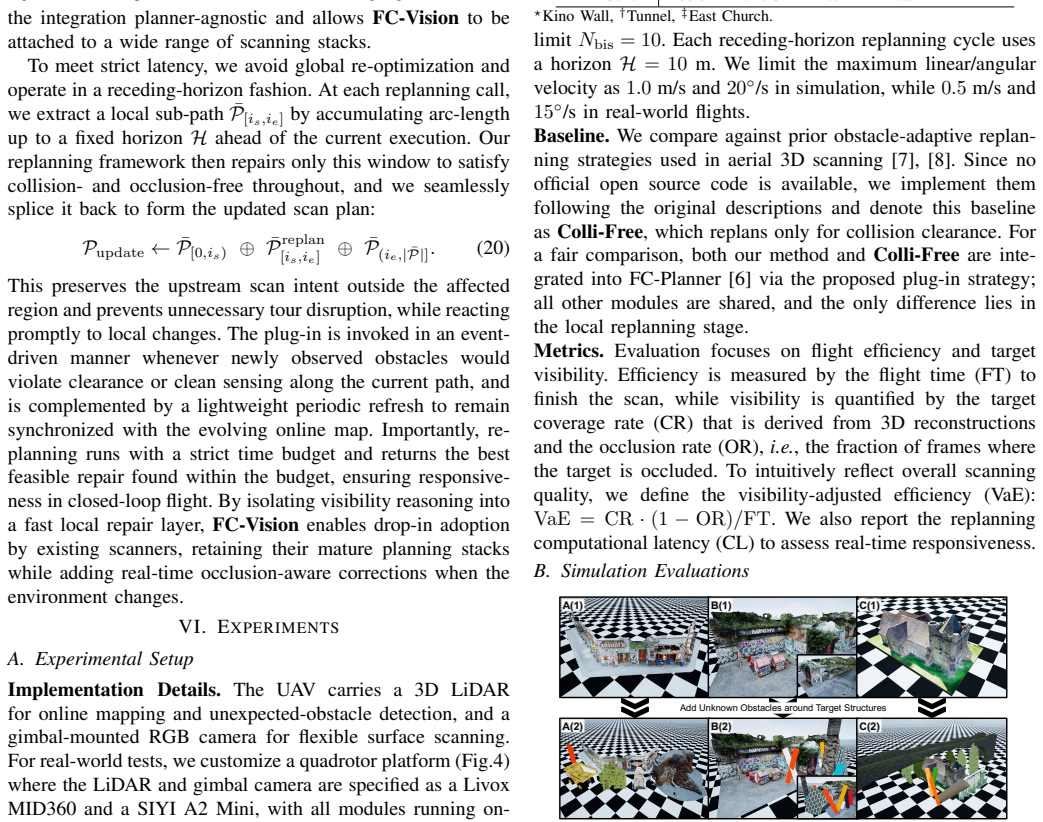
Summary. The paper presents FC-Vision, a real-time visibility-aware replanning layer for aerial structure scanning in unknown environments. It decomposes the replanning problem into two levels: (1) Level-I repair of viewpoints that are occluded by newly appeared obstacles, using FoV-truncated sampling, analytic position refinement, and local orientation bisection, plus coverage-equivalent set completion and intent-preserving tour reordering; (2) Level-II connection of consecutive viewpoints via a new Φ-A* search that keeps the discrete search in 3D while lifting each node to a 5-DoF configuration by interpolating pitch and yaw, with a constant-time occlusion-aware attitude correction and a visibility cache. The method is integrated as a plug-in into an existing scanning system (FC-Planner). Simulation and real-world experiments report large coverage gains (up to +55.32%) and reductions in occlusion ratio (down to near zero) at replanning latencies of 22–34 ms, compared to a collision-only baseline. The code is publicly released.
Significance. If the underlying claims hold, this paper makes a valuable practical contribution: it directly addresses the gap between collision-free navigation and occlusion-free target sensing in online aerial scanning, and demonstrates real-time feasibility on embedded hardware. The two-level decomposition is a sensible engineering approach, and the experimental evidence, including real-world flights, supports the practical utility of the system. The open-source code and reproducible evaluation are strengths. However, the central 'occlusion-free guarantee' is stated much more strongly than what the algorithm verifies: cleanliness is checked only at discrete search nodes, and the local attitude-correction heuristic rests on an unproved monotonicity assumption. Thus the paper's main theoretical claim is not rigorously established, although the empirical effectiveness is plausible.
major comments (2)
- [§V-B, Algorithm 1 and Eq. (3)] The paper claims connectors have 'continuous clean target observability along the segment' (Introduction, Section V-B, Conclusion), and Eq. (3) requires Occ(γ_k, O_hat) = 0 over the whole segment. However, Algorithm 1 only performs VisCleanTest (and optional AttCorrect) at discrete 3D grid nodes with Δp = 0.1 m. The returned connector is a piecewise-linear 3D chain with per-node attitude annotations; visibility is never evaluated along the straight segment between adjacent nodes, nor along the continuous attitude interpolation. An occluder lying between two checked nodes can make the segment occluded, and the online map is itself voxelized at 0.1 m, so such a case is not pathological. The 'guarantee' therefore does not follow from the algorithm as written. Please either (a) prove that the discrete checks imply continuous cleanliness under the stated discretization and sensor geometry, or
- [§V-B, 'Bounded Constant-time Occlusion-aware Attitude Correction'] The paper asserts that 'o* induces a single-boundary feasibility transition with respect to the pitch and yaw axes, enabling a short bisection' and calls the correction 'constant-time'. This monotonicity is not proved and is not generally true: the FoV frustum is the intersection of five half-spaces, and as pitch/yaw vary, the feasible set can be non-convex and disconnected. AttCorrect only inspects a constant-size local voxel set and the closest sample to the 'most violated' plane; after correcting for that plane, a second occluder that was not in O_loc may become the new violator, so the bisection can converge to an infeasible configuration. Thus the claim that the output of AttCorrect is occlusion-free is not established. This directly affects the 'occlusion-free along the entire segment' guarantee. Please provide a formal argument for the monotonicity assumption, or clearly label Att
minor comments (5)
- [§V-A, Eq. (14)–(15)] The symbol λ_d is used in both Eq. (14) and Eq. (15) but with different normalizations (|S_i| vs. |U|). This is confusing; please use distinct notation or clarify the scaling. Also, the greedy selection in Eq. (15) does not specify how ties are broken, which could affect reproducibility.
- [§VI-A] The paper reports averages over 10 runs in Table I but no standard deviations or statistical significance tests. Given the high variance of coverage/occlusion metrics in stochastic environments, include error bars or at least report min/max to assess reliability.
- [§V-B, Eq. (18)] The interpolation ρ in Eq. (18) is based only on Euclidean distance to the endpoints; it ignores obstacles and the actual path shape. This can cause the lifted attitude to point into an occluder even when a small attitude adjustment would be feasible. The paper partially handles this with AttCorrect, but the interaction between Φ and AttCorrect is not analyzed. A brief remark on this limitation would help.
- [Global] There are several typographical issues: 'Our Position' in Section II-B should likely be 'Our Position' or 'Our Approach'; 'UA V' appears with inconsistent spacing (e.g., 'UA Vs', 'UA V'); Table references use periods ('Table.I', 'Table.II') rather than standard 'Table I'. These are minor but should be cleaned.
- [§V-C, Eq. (20)] The splicing notation '⊕' is not defined, and the equality 'P_update ← ...' mixes set and sequence operations. Please define this notation explicitly.
Circularity Check
No significant circularity: the visibility constraints are enforced by the algorithm and the measured results are external; the main caveat is a discrete-vs-continuous correctness gap, not circularity.
full rationale
The paper's central derivation is a two-level constrained optimization (Eq. 1 decomposed into viewpoint repair, Eq. 2, and segment search, Eq. 3). The algorithm explicitly enforces collision and occlusion constraints at viewpoints and at Φ-A* expansion nodes, then evaluates coverage and occlusion from reconstructed frames/flight data against a collision-only baseline on the same host system. No parameter is fitted to the evaluation metrics, and the experimental CR/OR/VaE numbers are outputs of running the system, not quantities assumed by the optimizer. The self-citations to FC-Planner [6] and FlyCo [24] are used as host planner and trajectory backend, respectively; they are not invoked to justify the visibility layer's correctness, and the same host is shared with the baseline. The most plausible concern is a soundness gap: Algorithm 1 validates visibility only at discrete 3D nodes and locally corrected attitudes, while the Introduction and Conclusion claim 'continuous clean target observability along the segment.' That is an unsupported quantifier leap from finite grid checks to the continuum, and the asserted monotonicity enabling constant-time bisection is not proved. However, this is a correctness/robustness issue, not a circularity: the claimed guarantee is stronger than what the algorithm proves, but it is not defined in terms of the discrete checks, nor is any predicted quantity statistically forced by construction. Under the rule that circularity requires a specific reduction (Eq. X = Eq. Y by construction, or a fitted parameter renamed as prediction), no such step is present.
Axiom & Free-Parameter Ledger
free parameters (5)
- λ_d (viewpoint selection weight) =
5.0
- λ_heu (Φ-A* heuristic weight) =
10.0
- Δp (search step / voxel size) =
0.1 m
- N_bis (bisection iterations) =
10
- H (replanning horizon) =
10 m
axioms (5)
- domain assumption The online map O_hat correctly represents all relevant occluders at the time of replanning.
- domain assumption The FoV frustum can be modeled as the intersection of five half-spaces (Eq. 7).
- ad hoc to paper Validating clean sensing at discrete Φ-A* nodes (Δp = 0.1 m) with local attitude correction guarantees occlusion-free along the continuous segment.
- ad hoc to paper The nearest violating obstacle o* induces a single-boundary feasibility transition, making the 2D bisection monotone and constant-time.
- domain assumption The intended target surface S is obtained by aggregating the FoVs of the nominal viewpoints, and covering S is equivalent to preserving the scan intent.
Cite this review
Pith. "Pith review of FC-Vision: Real-Time Visibility-Aware Replanning for Occlusion-Free Aerial Target Structure Scanning in Unknown Environments." pith.science (2026). https://pith.science/paper/AEJWDBMI
@misc{pith2026260213720,
  author       = {Pith},
  title        = {Pith review of: FC-Vision: Real-Time Visibility-Aware Replanning for Occlusion-Free Aerial Target Structure Scanning in Unknown Environments},
  year         = {2026},
  howpublished = {\url{https://pith.science/paper/AEJWDBMI}},
  note         = {Machine review of arXiv:2602.13720}
}
read the original abstract
Autonomous aerial scanning of target structures is crucial for practical applications, requiring online adaptation to unknown obstacles during flight. Existing methods largely emphasize collision avoidance and efficiency, but overlook occlusion-induced visibility degradation, severely compromising scanning quality. This study proposes FC-Vision, an on-the-fly visibility-aware replanning framework that proactively and safely prevents target occlusions while preserving full target coverage and efficiency of the original plan. Our approach explicitly enforces dense surface-visibility constraints to regularize replanning behavior in real-time via an efficient two-level decomposition: occlusion-free viewpoint repair that maintains coverage with minimal deviation from the nominal scan, followed by segment-wise clean-sensing connection in 5-DoF space. A plug-in integration strategy is also presented to seamlessly interface \textbf{FC-Vision} with existing UAV scanning systems without architectural changes. Comprehensive simulation and real-world evaluations show that \textbf{FC-Vision} consistently improves scanning quality under unexpected occluders, delivering a maximum coverage gain of 55.32% and a 73.17% reduction in the occlusion ratio, while achieving real-time performance with a moderate increase in flight time. The code has been released at https://github.com/FC-Family/FC-Vision.
Figures




Reference graph
Works this paper leans on
-
[1]
Review of robotic infrastructure inspection systems,
D. Lattanzi and G. Miller, “Review of robotic infrastructure inspection systems,”J. Infrastruct. Syst., vol. 23, no. 3, p. 04017004, 2017
2017
-
[2]
Predrecon: A prediction- boosted planning framework for fast and high-quality autonomous aerial reconstruction,
C. Feng, H. Li, F. Gao, B. Zhou, and S. Shen, “Predrecon: A prediction- boosted planning framework for fast and high-quality autonomous aerial reconstruction,” in2023 IEEE ICRA, 2023, pp. 1207–1213
2023
-
[3]
Three-dimensional coverage path planning via viewpoint resampling and tour optimization for aerial robots,
A. Bircher, M. Kamel, K. Alexis, M. Burri, P. Oettershagen, S. Omari, T. Mantel, and R. Siegwart, “Three-dimensional coverage path planning via viewpoint resampling and tour optimization for aerial robots,” AUTON ROBOT, vol. 40, no. 6, pp. 1059–1078, 2016
2016
-
[4]
Hierarchical coverage path planning in complex 3d environments,
C. Cao, J. Zhang, M. Travers, and H. Choset, “Hierarchical coverage path planning in complex 3d environments,” in2020 IEEE ICRA. IEEE, 2020, pp. 3206–3212
2020
-
[5]
A uav-based sparse viewpoint planning framework for detailed 3d modelling of cultural heritage monuments,
Z. Wu, P. Marais, and H. R ¨uther, “A uav-based sparse viewpoint planning framework for detailed 3d modelling of cultural heritage monuments,” ISPRS J. Photogramm. Remote Sens, vol. 218, pp. 555–571, 2024
2024
-
[6]
Fc- planner: A skeleton-guided planning framework for fast aerial coverage of complex 3d scenes,
C. Feng, H. Li, M. Zhang, X. Chen, B. Zhou, and S. Shen, “Fc- planner: A skeleton-guided planning framework for fast aerial coverage of complex 3d scenes,” in2024 IEEE ICRA. IEEE, 2024, pp. 8686– 8692
2024
-
[7]
Online coverage and inspection planning for 3d modeling,
S. Song, D. Kim, and S. Jo, “Online coverage and inspection planning for 3d modeling,”AUTON ROBOT, vol. 44, no. 8, pp. 1431–1450, 2020
2020
-
[8]
An adaptive inspection planning approach towards routine monitoring in uncertain environments,
V . K. Viswanathan, Y . Bai, S. Fredriksson, S. Satpute, C. Kanellakis, and G. Nikolakopoulos, “An adaptive inspection planning approach towards routine monitoring in uncertain environments,”arXiv preprint arXiv:2510.24554, 2025
arXiv 2025
-
[9]
Robust real-time uav replanning using guided gradient-based optimization and topological paths,
B. Zhou, F. Gao, J. Pan, and S. Shen, “Robust real-time uav replanning using guided gradient-based optimization and topological paths,” in2020 IEEE ICRA. IEEE, 2020, pp. 1208–1214
2020
-
[10]
Ego-planner: An esdf- free gradient-based local planner for quadrotors,
X. Zhou, Z. Wang, H. Ye, C. Xu, and F. Gao, “Ego-planner: An esdf- free gradient-based local planner for quadrotors,”IEEE RA-L, vol. 6, no. 2, pp. 478–485, 2020
2020
-
[11]
You only plan once: A learning-based one-stage planner with guidance learning,
J. Lu, X. Zhang, H. Shen, L. Xu, and B. Tian, “You only plan once: A learning-based one-stage planner with guidance learning,”IEEE RA-L, vol. 9, no. 7, pp. 6083–6090, 2024
2024
-
[12]
Perception-aware receding horizon navigation for mavs,
Z. Zhang and D. Scaramuzza, “Perception-aware receding horizon navigation for mavs,” in2018 IEEE ICRA. IEEE, 2018, pp. 2534– 2541
2018
-
[13]
Perception-aware path plan- ning for uavs using semantic segmentation,
L. Bartolomei, L. Teixeira, and M. Chli, “Perception-aware path plan- ning for uavs using semantic segmentation,” in2020 IEEE/RSJ IROS. IEEE, 2020, pp. 5808–5815
2020
-
[14]
Gfm-planner: Perception-aware trajectory planning with geometric feature metric,
Y . Lin, X. Zhang, Y . Liu, D. Wang, and H. Lu, “Gfm-planner: Perception-aware trajectory planning with geometric feature metric,” arXiv preprint arXiv:2507.16233, 2025
Pith/arXiv arXiv 2025
-
[15]
Integrated motion planner for real-time aerial videography with a drone in a dense environment,
B. Jeon, Y . Lee, and H. J. Kim, “Integrated motion planner for real-time aerial videography with a drone in a dense environment,” in2020 IEEE ICRA. IEEE, 2020, pp. 1243–1249
2020
-
[16]
Elastic tracker: A spatio-temporal trajectory planner for flexible aerial tracking,
J. Ji, N. Pan, C. Xu, and F. Gao, “Elastic tracker: A spatio-temporal trajectory planner for flexible aerial tracking,” in2022 IEEE ICRA. IEEE, 2022, pp. 47–53
2022
-
[17]
Adaptive tracking and perching for quadrotor in dynamic scenarios,
Y . Gao, J. Ji, Q. Wang, R. Jin, Y . Lin, Z. Shang, Y . Cao, S. Shen, C. Xu, and F. Gao, “Adaptive tracking and perching for quadrotor in dynamic scenarios,”IEEE Transactions on Robotics, vol. 40, pp. 499–519, 2023
2023
-
[18]
Sampling-based view planning for 3d visual coverage task with unmanned aerial vehicle,
W. Jing, J. Polden, W. Lin, and K. Shimada, “Sampling-based view planning for 3d visual coverage task with unmanned aerial vehicle,” in 2016 IEEE/RSJ IROS. IEEE, 2016, pp. 1808–1815
2016
-
[19]
Coverage path planning with adaptive viewpoint sampling to construct 3d models of complex structures for the purpose of inspection,
R. Almadhoun, T. Taha, D. Gan, J. Dias, Y . Zweiri, and L. Seneviratne, “Coverage path planning with adaptive viewpoint sampling to construct 3d models of complex structures for the purpose of inspection,” in2018 IEEE/RSJ IROS. IEEE, 2018, pp. 7047–7054
2018
-
[20]
Adaptive view planning for aerial 3d reconstruc- tion,
C. Peng and V . Isler, “Adaptive view planning for aerial 3d reconstruc- tion,” in2019 IEEE ICRA. IEEE, 2019, pp. 2981–2987
2019
-
[21]
De Berg, O
M. De Berg, O. Cheong, M. Van Kreveld, and M. Overmars,Computa- tional geometry: algorithms and applications. Springer, 2008
2008
-
[22]
C. H. Papadimitriou and K. Steiglitz,Combinatorial optimization: algorithms and complexity. Courier Corporation, 1998
1998
-
[23]
Solving the sequential ordering problem with auto- matically generated lower bounds,
I. T. Hern ´adv¨olgyi, “Solving the sequential ordering problem with auto- matically generated lower bounds,” inOperations Research Proceedings 2003: Selected Papers of the International Conference on Operations Research (OR 2003) Heidelberg, September 3–5, 2003. Springer, 2004, pp. 355–362
2003
-
[24]
C. Feng, G. Zheng, T. Zhuang, Y . Wu, F. He, H. Li, J. Zheng, S. Shen, and B. Zhou, “Flyco: Foundation model-empowered drones for autonomous 3d structure scanning in open-world environments,”arXiv preprint arXiv:2601.07558, 2026
arXiv 2026
-
[25]
Airsim: High-fidelity visual and physical simulation for autonomous vehicles,
S. Shah, D. Dey, C. Lovett, and A. Kapoor, “Airsim: High-fidelity visual and physical simulation for autonomous vehicles,” inField and service robotics: Results of the 11th international conference. Springer, 2017, pp. 621–635
2017
This paper was first reviewed by deepseek-v4-flash on August 2, 2026.
discussion (0)
Sign in with ORCID, Apple, or X to comment. Anyone can read and Pith papers without signing in.