Recognition: 1 theorem link
· Lean TheoremLarge elements and advanced beamformers for increased field of view in 2-D ultrasound matrix arrays
Pith reviewed 2026-05-15 21:23 UTC · model grok-4.3
The pith
Larger elements with advanced beamformers double the field of view in 2D ultrasound matrix arrays while preserving resolution.
A machine-rendered reading of the paper's core claim, the machinery that carries it, and where it could break.
Core claim
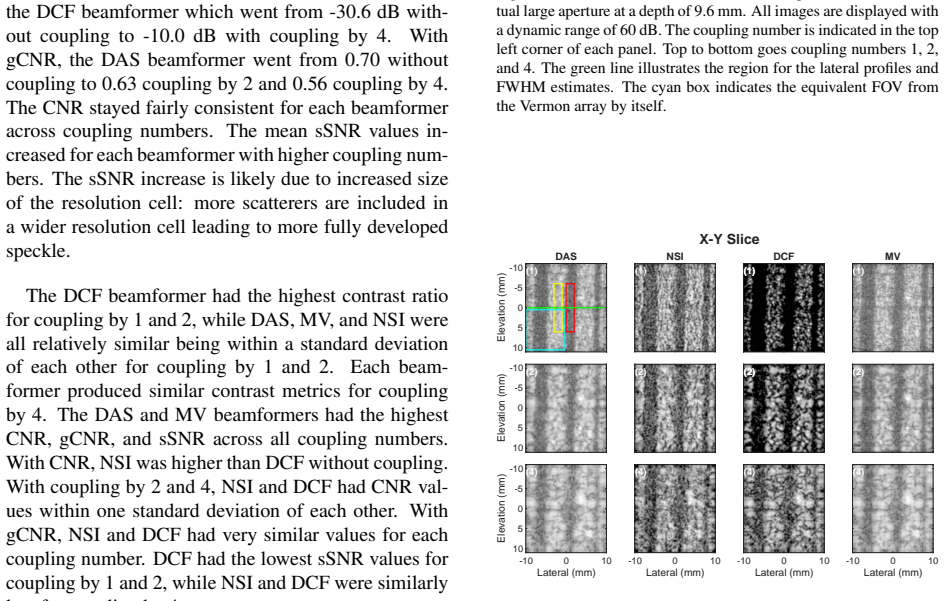
By coupling up to four neighboring elements, the authors create an effective element pitch four times larger than the original array while halving the number of independent channels needed for a given aperture. When Null Subtraction Imaging or Directional Coherence Factor beamformers replace standard delay-and-sum, the resulting three-dimensional point-spread functions retain main-lobe width and exhibit reduced grating-lobe levels, thereby doubling the usable field of view without resolution loss. The same performance holds in physical phantom data collected with a virtual large aperture and in live rabbit-liver images.
What carries the argument
Electronic coupling of adjacent transducer elements to enlarge effective pitch, paired with Null Subtraction Imaging (NSI) and Directional Coherence Factor (DCF) beamformers that suppress grating lobes arising from the increased pitch.
If this is right
- Resolution remains constant for coupling factors up to four, directly doubling the lateral field of view.
- Element count can be reduced by a factor of four while still forming a usable three-dimensional image.
- NSI and DCF beamformers outperform both delay-and-sum and minimum-variance methods under the larger-pitch condition.
- The same coupling-plus-advanced-beamformer strategy applies to row-column, sparse, or diverging-lens architectures.
Where Pith is reading between the lines
- Clinical 3D ultrasound systems could become smaller and less expensive if the virtual-aperture results translate to real large-element hardware.
- The approach may extend the usable depth range in abdominal imaging by allowing wider apertures without increasing channel count.
- Portable or lower-cost matrix probes become feasible for point-of-care 3D scanning once the physical fabrication step is validated.
Load-bearing premise
Electronically coupling elements and translating the array to synthesize a virtual large aperture accurately reproduces the acoustic field and grating-lobe behavior that a single physically fabricated large-element matrix array would produce inside tissue.
What would settle it
Fabricate a physical matrix array whose individual elements are four times wider than the original 1024-element probe, drive it with the same channel count, and measure whether its in-vivo resolution and grating-lobe levels match the virtual-aperture results reported here.
Figures




read the original abstract
Three-dimensional (3D) ultrasound promises various medical applications for abdominal, obstetrics, and breast imaging. However, ultrasound matrix arrays have extremely high element counts limiting their field of view (FOV). Current reduced element count architectures, such as row-column arrays, diverging lenses, or sparse arrays, suffer from limited resolution and high side- and grating-lobe levels. This work seeks to demonstrate an increased field-of-view using a reduced element count array design. The approach is to increase the element size and use advanced beamformers to maintain image quality. The delay and sum (DAS), Null Subtraction Imaging (NSI), directional coherence factor (DCF), and Minimum Variance (MV) beamformers were compared. K-wave simulations of the 3D point-spread functions (PSF) of NSI, DCF, and MV display reduced side lobes and narrowed main lobes compared to DAS. Experiments were conducted using a multiplexed 1024-element matrix array on a Verasonics 256 system. Elements were electronically coupled to imitate a larger pitch and element size. Then, a virtual large aperture was created by using a positioning system to collect data in sections with the matrix array. Resolution and contrast was also assessed on a rabbit liver in vivo. Resolution was maintained using coupling numbers up to four, doubling the FOV while reducing the element count. The NSI and DCF beamformers demonstrated the best resolution performance in simulations, in a phantom with the virtual aperture, and in vivo on a rabbit liver. Our results demonstrate how larger matrix arrays could be constructed with larger elements, with resolution maintained by advanced beamformers.
Editorial analysis
A structured set of objections, weighed in public.
Referee Report
Summary. The manuscript proposes increasing the field of view (FOV) in 2-D ultrasound matrix arrays by enlarging element size (via electronic coupling of a 1024-element array) while employing advanced beamformers (NSI, DCF, MV) to preserve resolution and suppress side/grating lobes relative to DAS. k-Wave simulations of 3-D PSFs demonstrate narrower main lobes and lower side lobes for NSI/DCF/MV; experiments synthesize a virtual large aperture through mechanical positioning, with resolution and contrast assessed on phantoms and in vivo rabbit liver. The central claim is that coupling factors up to 4 maintain resolution, double the FOV, and reduce element count, with NSI and DCF performing best across simulations, phantom, and in vivo data.
Significance. If the electronic-coupling proxy is shown to be acoustically representative, the work would offer a practical route to larger-FOV 3-D matrix arrays with manageable channel counts and improved image quality via beamforming, directly addressing a key limitation for abdominal, obstetric, and breast applications. The combination of simulation, phantom, and in vivo validation plus direct comparison of four beamformers is a strength.
major comments (3)
- [Methods (electronic coupling and virtual aperture)] Methods section on electronic coupling and virtual aperture: the central claim that coupling up to factor 4 'imitates a larger pitch and element size' and thereby doubles FOV while maintaining resolution rests on an unvalidated acoustic equivalence; electronic coupling leaves the physical radiating surface unchanged, so element directivity, near-field curvature, and grating-lobe levels remain those of the original small elements. This proxy does not replicate the target monolithic large-element array, undermining extrapolation to fabricated devices.
- [Results] Results (simulations, phantom, and in vivo): quantitative resolution and contrast metrics are reported without error bars, statistical tests, or explicit exclusion criteria, so the claim that 'resolution was maintained' up to coupling factor 4 cannot be rigorously assessed; the absence of these details is load-bearing for the cross-condition performance ranking of NSI/DCF versus DAS/MV.
- [Discussion/Conclusions] Discussion or conclusions: the manuscript does not address the mismatch between the tested proxy (unchanged physical aperture) and true large-element arrays, nor does it provide supporting simulations of physically enlarged elements to bound the error in PSF, side-lobe, or grating-lobe predictions.
minor comments (2)
- [Abstract] Abstract: the term 'coupling numbers' is used without prior definition; replace with 'coupling factors' and state the exact factor values (e.g., 2, 4) for clarity.
- [Figures] Figure captions and text: ensure all PSF plots include scale bars, dynamic-range labels, and explicit comparison to the uncoupled baseline so readers can directly verify the 'maintained resolution' claim.
Simulated Author's Rebuttal
We thank the referee for their constructive and detailed feedback, which has identified important areas for clarification and strengthening of the manuscript. We have prepared point-by-point responses to the major comments and will incorporate revisions to address the concerns about the electronic coupling proxy, statistical reporting, and discussion of limitations.
read point-by-point responses
-
Referee: Methods section on electronic coupling and virtual aperture: the central claim that coupling up to factor 4 'imitates a larger pitch and element size' and thereby doubles FOV while maintaining resolution rests on an unvalidated acoustic equivalence; electronic coupling leaves the physical radiating surface unchanged, so element directivity, near-field curvature, and grating-lobe levels remain those of the original small elements. This proxy does not replicate the target monolithic large-element array, undermining extrapolation to fabricated devices.
Authors: We acknowledge that electronic coupling is a proxy that does not physically enlarge the radiating surface and therefore preserves the directivity and near-field characteristics of the original small elements. The approach is intended to demonstrate the effect of increased effective pitch on FOV and channel count reduction for beamforming purposes. In the revised manuscript, we will expand the Methods section to explicitly describe this distinction and its implications. We will also add new k-Wave simulations that model monolithic large elements (with adjusted width and directivity) and directly compare their PSFs and grating-lobe levels to the coupled-element case, thereby bounding the approximation error. revision: yes
-
Referee: Results (simulations, phantom, and in vivo): quantitative resolution and contrast metrics are reported without error bars, statistical tests, or explicit exclusion criteria, so the claim that 'resolution was maintained' up to coupling factor 4 cannot be rigorously assessed; the absence of these details is load-bearing for the cross-condition performance ranking of NSI/DCF versus DAS/MV.
Authors: We agree that the absence of error bars, statistical tests, and explicit exclusion criteria limits the rigor of the quantitative claims. In the revised manuscript we will add error bars (standard deviation across repeated simulations or acquisitions) to all resolution and contrast metrics, include appropriate statistical comparisons (e.g., repeated-measures ANOVA with post-hoc tests) between beamformers and coupling factors, and state the data exclusion criteria in the Methods section. These additions will allow readers to evaluate the maintenance of resolution up to coupling factor 4 with greater confidence. revision: yes
-
Referee: Discussion or conclusions: the manuscript does not address the mismatch between the tested proxy (unchanged physical aperture) and true large-element arrays, nor does it provide supporting simulations of physically enlarged elements to bound the error in PSF, side-lobe, or grating-lobe predictions.
Authors: We thank the referee for highlighting this omission. The revised Discussion section will explicitly address the acoustic differences between the electronic-coupling proxy and monolithic large-element arrays, including effects on directivity and grating lobes. To bound the associated errors, we will incorporate additional k-Wave simulations of physically enlarged elements and report comparative PSF, main-lobe width, and side-lobe metrics. This will provide a quantitative assessment of the proxy's fidelity and will be referenced in the Conclusions. revision: yes
Circularity Check
No circularity; results from direct simulation and experimental validation
full rationale
The paper reports k-Wave PSF simulations comparing DAS, NSI, DCF, and MV beamformers, followed by multiplexed-array experiments with electronic coupling (factors 1-4) and mechanical translation to form a virtual aperture, plus in-vivo rabbit-liver imaging. No equations, fitted parameters, or self-citations are invoked to derive the central claims; resolution and contrast metrics are measured directly from the acquired data. The work is therefore self-contained against external benchmarks and receives the default non-circularity finding.
Axiom & Free-Parameter Ledger
Lean theorems connected to this paper
-
IndisputableMonolith/Cost/FunctionalEquation.leanwashburn_uniqueness_aczel unclear?
unclearRelation between the paper passage and the cited Recognition theorem.
B(θ) = H(θ)G(θ) ... F{A(x,y)} = W sinc(W kx/2) × H sinc(H ky/2) ... minimum F-number derived from element directivity
What do these tags mean?
- matches
- The paper's claim is directly supported by a theorem in the formal canon.
- supports
- The theorem supports part of the paper's argument, but the paper may add assumptions or extra steps.
- extends
- The paper goes beyond the formal theorem; the theorem is a base layer rather than the whole result.
- uses
- The paper appears to rely on the theorem as machinery.
- contradicts
- The paper's claim conflicts with a theorem or certificate in the canon.
- unclear
- Pith found a possible connection, but the passage is too broad, indirect, or ambiguous to say the theorem truly supports the claim.
Reference graph
Works this paper leans on
-
[1]
T. Jouleh, S. Kotopoulis, G. Dimcevski, E. Tjora, O. H. Gilja, S. V . Meling, E. W. Søfte- land, I. K. Nordaas, Comparison of two- and three-dimensional ultrasound for volume estimation of the meal-stimulated gallbladder, Journal of Ultrasonography 25 (2025) 31–31. doi:doi:10.15557/JoU.2025.0031
-
[2]
L. Y an, L. Ren, Y . Li, Y . Luo, Inter-observer vari- ation in two-dimensional and three-dimensional ultrasound measurement of papillary thyroid mi- crocarcinoma, Cancer Imaging 23 (2023) 94. doi:doi:10.1186/s40644-023-00613-3
-
[3]
A. Shoma, A. Moutamed, M. Ameen, A. Ab- delwahab, Ultrasound for Accurate Mea- surement of Invasive Breast Cancer Tumor Size, The Breast Journal 12 (2006) 252–256. doi:doi:10.1111/j.1075-122X.2006.00249.x
-
[4]
Q. Huang, Z. Zeng, A Review on Real-Time 3D Ultrasound Imaging Technology, BioMed Research International 2017 (2017) 6027029. doi:doi:10.1155/2017/6027029
-
[5]
O. H. Gilja, T. Hausken, A. Berstad, S. Øde- gaard, Measurements of organ volume by ul- trasonography, Proceedings of the Institution of Mechanical Engineers, Part H: Journal of Engineering in Medicine 213 (1999) 247–259. doi:doi:10.1243/0954411991534951
-
[6]
J. Y u, H. Y oon, Y . M. Khalifa, S. Y . Emelianov, Design of a V olumetric Imaging Sequence Using a V antage-256 Ultrasound Research Platform Mul- tiplexed With a 1024-Element Fully Sampled Ma- trix Array, IEEE Transactions on Ultrasonics, Fer- roelectrics, and Frequency Control 67 (2020) 248–
work page 2020
-
[7]
doi:doi:10.1109/TUFFC.2019.2942557
-
[8]
A. Chavignon, B. Heiles, V . Hingot, C. Orset, D. Vivien, O. Couture, 3D Transcranial Ultra- sound Localization Microscopy in the Rat Brain With a Multiplexed Matrix Probe, IEEE Transac- tions on Biomedical Engineering 69 (2022) 2132–
work page 2022
-
[9]
doi:doi:10.1109/TBME.2021.3137265
-
[10]
B. Savord, R. Solomon, Fully sampled ma- trix transducer for real time 3D ultrasonic imag- ing, in: IEEE Symposium on Ultrasonics, 2003, volume 1, 2003, pp. 945–953 V ol.1. doi:doi:10.1109/ULTSYM.2003.1293556
-
[11]
J. M. Rothberg, T. S. Ralston, A. G. Rothberg, J. Martin, J. S. Zahorian, S. A. Alie, N. J. Sanchez, K. Chen, C. Chen, K. Thiele, D. Gros- jean, J. Y ang, L. Bao, R. Schneider, S. Schaetz, C. Meyer, A. Neben, B. Ryan, J. R. Petrus, J. Lut- sky, D. McMahill, G. Corteville, M. R. Hage- man, L. Miller, K. G. Fife, Ultrasound-on-chip platform for medical imag...
-
[12]
P . Acar, L. Battle, Y . Dulac, M. Peyre, H. Dubourdieu, S. Hascoet, M. Groussolles, C. V ayssière, Real-time three-dimensional foetal echocardiography using a new transab- dominal xMA TRIX array transducer, Archives of Cardiovascular Diseases 107 (2014) 4–9. doi:doi:10.1016/j.acvd.2013.10.003
-
[13]
K.-Q. Zhao, T. G. Bjastad, K. Kristo ffersen, Er- ror analysis of subaperture processing in 1-D ultra- sound arrays, IEEE Transactions on Ultrasonics, Ferroelectrics, and Frequency Control 62 (2015) 663–672. doi:doi:10.1109/TUFFC.2014.006822
-
[14]
Z. Y u, M. A. Pertijs, G. C. M. Meijer, A programmable analog delay line for Micro- beamforming in a transesophageal ultrasound probe, in: 2010 10th IEEE International Conference on Solid-State and Integrated Circuit Technology, 2010, pp. 299–301. doi:doi:10.1109/ICSICT.2010.5667749
-
[15]
L. Castrignano, P . Tortoli, G. Matrone, M. Crocco, A. S. Savoia, A. Ramalli, On the Impact of Microbeamformers in 3-D High Frame Rate Ultrasound Imaging: A Simulation Study, IEEE Transactions on Biomedical Engineering 72 (2025) 1941–1950. doi:doi:10.1109/TBME.2025.3529198
-
[16]
J. Kang, D. Go, I. Song, Y . Y oo, Wide Field- of-View Ultrafast Curved Array Imaging Us- ing Diverging Waves, IEEE Transactions on Biomedical Engineering 67 (2020) 1638–1649. doi:doi:10.1109/TBME.2019.2942164
-
[17]
S. H. Kim, B. I. Choi, K. W. Kim, K. H. Lee, J. K. Han, Extended Field-of-View Sonography, Jour- nal of Ultrasound in Medicine 22 (2003) 385–394. doi:doi:10.7863/jum.2003.22.4.385
-
[18]
T. C. Poon, R. N. Rohling, Three-dimensional extended field-of-view ultrasound, Ultrasound 17 in Medicine & Biology 32 (2006) 357–369. doi:doi:10.1016/j.ultrasmedbio.2005.11.003
-
[19]
C. Wachinger, W. Wein, N. Navab, Three- Dimensional Ultrasound Mosaicing, in: N. Ay- ache, S. Ourselin, A. Maeder (Eds.), Medical Im- age Computing and Computer-Assisted Interven- tion MICCAI 2007, Springer, Berlin, Heidel- berg, 2007, pp. 327–335. doi:doi: 10.1007/978-3- 540-75759-7_40
-
[20]
A. Ramalli, E. Boni, E. Roux, H. Liebgott, P . Tortoli, Design, Implementation, and Med- ical Applications of 2-D Ultrasound Sparse Ar- rays, IEEE Transactions on Ultrasonics, Ferro- electrics, and Frequency Control 69 (2022) 2739–
work page 2022
-
[21]
doi:doi:10.1109/TUFFC.2022.3162419
-
[22]
J. A. Jensen, M. Schou, L. T. Jørgensen, B. G. Tomov, M. B. Stuart, M. S. Traberg, I. Taghavi, S. H. Øygaard, M. L. Ommen, K. Steenberg, E. V . Thomsen, N. S. Panduro, M. B. Nielsen, C. M. Sørensen, Anatomic and Functional Imaging Using RowColumn Arrays, IEEE Transactions on Ultrasonics, Ferroelectrics, and Frequency Control 69 (2022) 2722–2738. doi:doi:1...
- [23]
-
[24]
doi:doi:10.1109/IUS54386.2022.9957272
- [25]
-
[26]
doi:doi:10.1109/TUFFC.2025.3526523
-
[27]
M. Caudoux, O. Demeulenaere, J. Porée, J. Sauvage, P . Mateo, B. Ghaleh, M. Flesch, G. Ferin, M. Tanter, T. De ffieux, C. Pa- padacci, M. Pernot, Curved Toroidal Row Column Addressed Transducer for 3D Ultra- fast Ultrasound Imaging, IEEE Transactions on Medical Imaging 43 (2024) 3279–3291. doi:doi:10.1109/TMI.2024.3391689
-
[28]
H. Favre, M. Pernot, M. Tanter, C. Papadacci, Boosting transducer matrix sensitivity for 3D large field ultrasound localization microscopy using a multi-lens di ffracting layer: a simulation study, Physics in Medicine & Biology 67 (2022) 085009. doi:doi:10.1088/1361-6560/ac5f72
-
[29]
H. Favre, M. Pernot, M. Tanter, C. Pa- padacci, Transcranial 3D ultrasound localization microscopy using a large element matrix array with a multi-lens di ffracting layer: an in vitro study, Physics in Medicine & Biology 68 (2023) 075003. doi:doi:10.1088/1361-6560/acbde3
-
[30]
N. Haidour, H. Favre, P . Mateo, J. Reydet, A. Bizé, L. Sambin, J. Dai, P .-M. Chiaroni, B. Ghaleh, M. Pernot, M. Tanter, C. Papadacci, Multi- lens ultrasound arrays enable large scale three- dimensional micro-vascularization characteriza- tion over whole organs, Nature Communica- tions 16 (2025) 9317. doi:doi: 10.1038/s41467- 025-64911-z
-
[31]
Y . Paul, D. Barthez, R. Léveillé, V . Peter, D. Scrivani, Side Lobes and Grating Lobes Artifacts in Ultrasound Imaging, V eterinary Radiology & Ultrasound 38 (1997) 387–393. doi:doi:10.1111/j.1740-8261.1997.tb02104.x
-
[32]
M. Gardner, R. J. Miller, M. L. Oelze, Grat- ing lobe mitigation on large-pitch arrays using null subtraction imaging, Ultrasonics 140 (2024) 107302. doi:doi:10.1016/j.ultras.2024.107302
-
[33]
A. Agarwal, J. Reeg, A. S. Podkowa, M. L. Oelze, Improving Spatial Resolution Using Incoherent Subtraction of Receive Beams Having Di fferent Apodizations, IEEE Transactions on Ultrasonics, Ferroelectrics, and Frequency Control 66 (2019) 5–17. doi:doi:10.1109/TUFFC.2018.2876285
-
[34]
Z. Kou, R. J. Miller, M. L. Oelze, Grating Lobe Reduction in Plane-Wave Imaging With Angular Compounding Using Subtraction of Coherent Sig- nals, IEEE Transactions on Ultrasonics, Ferro- electrics, and Frequency Control 69 (2022) 3308–
work page 2022
-
[35]
doi:doi:10.1109/TUFFC.2022.3217993
-
[36]
M. Y ociss, K. Brown, K. Hoyt, Null Sub- traction Beamforming for Improved V essel Res- olution in V olumetric Contrast-Enhanced Ultra- sound, in: 2021 IEEE International Ul- trasonics Symposium (IUS), 2021, pp. 1–4. doi:doi:10.1109/IUS52206.2021.9593368. 18
-
[37]
X. Wu, W.-N. Lee, Directional Coherence Fac- tor for V olumetric Ultrasound Imaging with Ma- trix Arrays, IEEE Transactions on Ultrasonics, Ferroelectrics, and Frequency Control (2025) 1–1. doi:doi:10.1109/TUFFC.2025.3557519
-
[38]
J. F. Synnevag, A. Austeng, S. Holm, Adap- tive Beamforming Applied to Medical Ultrasound Imaging, IEEE Transactions on Ultrasonics, Ferroelectrics, and Frequency Control 54 (2007) 1606–1613. doi:doi:10.1109/TUFFC.2007.431
-
[39]
J. Foiret, X. Cai, H. Bendjador, E.-Y . Park, A. Ka- maya, K. W. Ferrara, Improving plane wave ultrasound imaging through real-time beamfor- mation across multiple arrays, Scientific Re- ports 12 (2022) 13386. doi:doi: 10.1038/s41598- 022-16961-2
-
[40]
V . Perrot, M. Polichetti, F. V array, D. Garcia, So you think you can DAS? A viewpoint on delay- and-sum beamforming, Ultrasonics 111 (2021) 106309. doi:doi:10.1016/j.ultras.2020.106309
-
[41]
E. Martin, Y . T. Ling, B. E. Treeby, Sim- ulating Focused Ultrasound Transducers Using Discrete Sources on Regular Cartesian Grids, IEEE Transactions on Ultrasonics, Ferroelectrics, and Frequency Control 63 (2016) 1535–1542. doi:doi:10.1109/TUFFC.2016.2600862
-
[42]
B. E. Treeby, J. Budisky, E. S. Wise, J. Jaros, B. T. Cox, Rapid calculation of acoustic fields from arbitrary continuous-wave sources, The Journal of the Acoustical Society of America 143 (2018) 529–537. doi:doi:10.1121/1.5021245
-
[43]
J. R. McCall, A. Chavignon, O. Couture, P . A. Dayton, G. F. Pinton, Element Po- sition Calibration for Matrix Array Transduc- ers with Multiple Disjoint Piezoelectric Pan- els, Ultrasonic Imaging 46 (2024) 139–150. doi:doi:10.1177/01617346241227900
-
[44]
Z. Kou, M. R. Lowerison, Q. Y ou, Y . Wang, P . Song, M. L. Oelze, High-Resolution Power Doppler Using Null Subtraction Imaging, IEEE Transactions on Medical Imaging 43 (2024) 3060–
work page 2024
-
[45]
doi:doi:10.1109/TMI.2024.3383768
-
[46]
A. Rodriguez-Molares, O. M. H. Rindal, J. Dhooge, S.-E. Måsøy, A. Austeng, M. A. Lediju Bell, H. Torp, The Generalized Contrast- to-Noise Ratio: A Formal Definition for Lesion Detectability, IEEE Transactions on Ultrasonics, Ferroelectrics, and Frequency Control 67 (2020) 745–759. doi:doi:10.1109/TUFFC.2019.2956855
-
[47]
R. Wagner, S. Smith, J. Sandrik, H. Lopez, Statis- tics of Speckle in Ultrasound B-Scans, IEEE Transactions on Sonics and Ultrasonics 30 (1983) 156–163. doi:doi:10.1109/T-SU.1983.31404
-
[48]
P .-C. Li, M.-L. Li, Adaptive imaging us- ing the generalized coherence factor, IEEE Transactions on Ultrasonics, Ferroelectrics, and Frequency Control 50 (2003) 128–141. doi:doi:10.1109/TUFFC.2003.1182117
-
[49]
R. Paridar, B. M. Asl, Spatially Smoothed Adaptive Null Subtraction Imaging Applied to Coherent Plane Wave Compounding, IEEE Sensors Journal 24 (2024) 16688–16698. doi:doi:10.1109/JSEN.2024.3386791
-
[50]
X. Y an, X. Y ang, L. Jing, W. Guo, Y . Wang, X. Su, Y . Wang, A Contrast-Enhanced Null Subtraction Imaging Method using Dy- namic DC Bias in Ultrafast Ultrasound imag- ing, IEEE Transactions on Ultrasonics, Fer- roelectrics, and Frequency Control (2025) 1–1. doi:doi:10.1109/TUFFC.2025.3558017
-
[51]
C. Errico, J. Pierre, S. Pezet, Y . Desailly, Z. Lenkei, O. Couture, M. Tanter, Ultrafast ul- trasound localization microscopy for deep super- resolution vascular imaging, Nature 527 (2015) 499–502. doi:doi:10.1038/nature16066. 19
discussion (0)
Sign in with ORCID, Apple, or X to comment. Anyone can read and Pith papers without signing in.