REVIEW 3 major objections 5 minor 19 references
Enabling Low-Latency Machine learning on Radiation-Hard FPGAs with hls4ml
T0 review · 3 major / 5 minor · reviewed 2026-08-03 · deepseek-v4-flash
Pith's one-line read A 32-to-2 autoencoder runs on a radiation-hard FPGA in 25 ns, making on-detector ML compression practical for LHCb's PicoCal readout.
desk verdict The real contribution is a working hls4ml backend for Microchip SmartHLS; the radiation-hardness framing overreaches what the device actually provides, and the abstract's 'inherently protected logic' claim is contradicted by the paper's own Section 6.3. read the letter →
The pith
A machine-rendered reading of the paper's core claim, the machinery that carries it, and where it could break.
The reading
What carries the argument
The load-bearing object is the hardware-aware autoencoder: a single dense layer with a ReLU activation that maps 32 input samples directly to a 2-dimensional latent space, designed so the encoder is the only on-detector component. Aggressive quantization to 10-bit weights (with 16-bit activations) lets the multiplications be implemented with general-purpose 4-input lookup tables rather than scarce DSP or math blocks, which is what makes the design small and fast. The enabling software mechanism is a new backend that automatically translates trained models into HLS projects for the SmartHLS compiler, producing HDL for the flash-based PolarFire FPGA family whose configuration memory is immune
What would settle it
Irradiate a prototype of the synthesized autoencoder on a PolarFire FPGA at the fluences expected in LHCb Upgrade II and check whether the latent-space outputs remain correct: a single SEU anywhere in the data path that changes a latent value would disprove the 'inherently protected logic' claim. Alternatively, find in the FPGA documentation the protected region's physical extent and SEU immunity.
Extended reading notes
Core claim
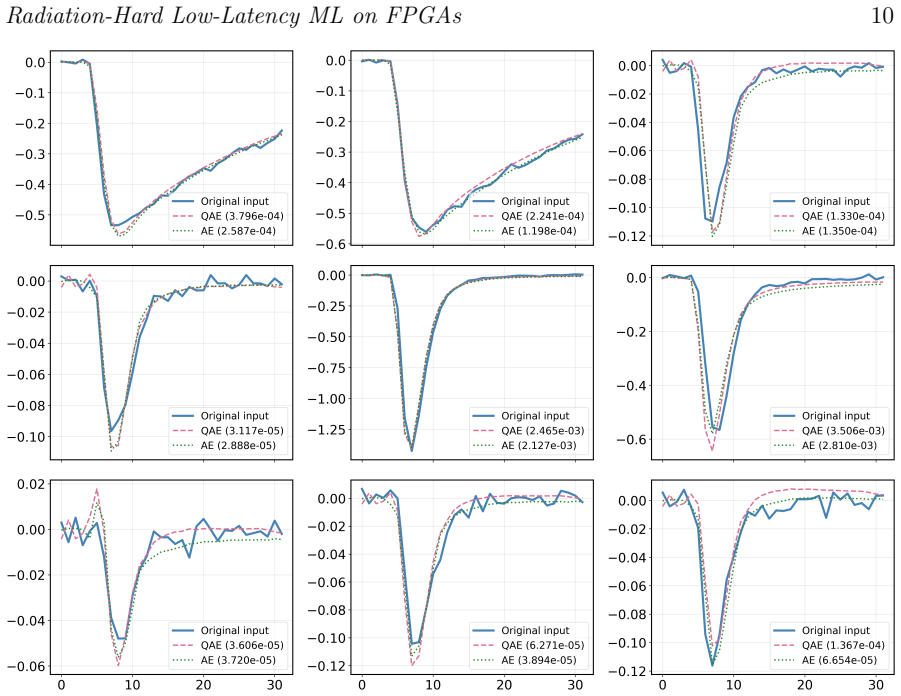
The central discovery is that a 32-to-2 autoencoder, trained on simulated PicoCal pulses and quantized to fixed-point arithmetic (<16,6> activations, <10,4> weights), reconstructs pulse shapes well enough that a constant-fraction-discrimination timestamp extracted from the compressed pulses is roughly twice as precise as from the original 32-sample pulses. Synthesized on a PolarFire FPGA, the encoder runs in 4 clock cycles at 160 MHz (25 ns), with an initiation interval of 4 cycles and per-channel resource usage of 3.1% of the FPGA's lookup tables and 0.3% of its math blocks. Because the model is so small, the authors argue it can be placed in the FPGA's inherently protected logic, making th
Load-bearing premise
The load-bearing premise is that the PolarFire FPGA has an inherently radiation-protected region of user logic large enough for the autoencoder, so the design is radiation-hard without extra mitigation — but the paper also states that user logic is not natively protected against single-event upsets.
Editorial extensions
If this is right
- If the central claim holds, the PicoCal front-end can compress each channel's 32-sample readout into two 10-bit numbers with 25 ns latency and 40 MHz throughput, within the 160 MHz / 4-cycle budget.
- Scaling to 8 channels per FPGA would use roughly 25% of the lookup tables and 2.4% of the math blocks, leaving most of the device available for readout, aggregation, and control logic.
- The autoencoder acts as a denoiser: CFD timing from compressed pulses is about twice as precise as from raw 32-sample pulses, so compression can improve rather than degrade time reconstruction.
- The new backend gives the high-energy physics community an automated, open-source path from trained models to radiation-hard FPGAs, at least for dense and ReLU layers.
- The co-design methodology — architecture, quantization, and physical placement together — suggests other ultra-low-latency on-detector tasks (anomaly detection, pile-up tagging) could fit in similar resource envelopes.
Reading between the lines
- The paper does not prove the 'inherently protected logic' claim: §6.3 concedes that user logic fabric is not natively SEU-immune, so the radiation-hardness argument rests on the existence of a protected region that is asserted but not documented or tested; a direct irradiation test of the data path would settle this.
- Because the encoder is only 32-to-2, an even simpler 32-to-1 regression to the timestamp has comparable or better timing precision (σ=0.13 vs 0.15); the latent-space version earns its extra output only if downstream clustering uses the full pulse shape.
- The backend currently supports only dense layers and ReLU activations; extending it to convolutional or recurrent layers would be needed before this path generalizes beyond simple compressors.
- A testable extension would be to evaluate quantization against downstream physics metrics (cluster energy resolution, pile-up rejection) rather than MSE alone, since the latent space's amplitude-dominated axes suggest MSE may not capture everything that matters.
Editorial analysis
A structured set of objections, weighed in public.
Referee Report
Summary. The paper reports a design study for an ML-based data compression system targeting the Microchip PolarFire FPGA, intended for the LHCb Upgrade II PicoCal front-end. The authors develop a 32-to-2 autoencoder for calorimeter pulse shapes, apply quantization-aware training to reduce weights to 10 bits, and introduce a new hls4ml backend for the SmartHLS compiler targeting PolarFire. Post-synthesis results on an MPF100T device show a latency of 4 clock cycles (25 ns at 160 MHz), an initiation interval of 4 cycles, and low resource use (3.12% LUTs, 0.30% math blocks per channel). Based on these numbers, the paper claims that the design can be placed within the FPGA's 'inherently protected logic' and therefore constitutes an ultra-fast, radiation-hard ML application.
Significance. If the radiation-hardness claim were substantiated, this would be a noteworthy contribution: it would be the first hls4ml backend for a flash-based, radiation-tolerant FPGA family, and the reported latency/resource figures would demonstrate a practical path for on-detector ML compression. The engineering work—backend development, quantization study, and synthesis flow—is plausible and potentially useful to the HEP community. However, the central significance claim rests on the 'radiation-hard ML application' framing, which the manuscript itself undermines: user logic in PolarFire is stated not to be SEU-protected, and the synthesis results are only from co-simulation, not hardware measurements. The open-source backend and design study retain value, but the headline claims are overstated.
major comments (3)
- [Abstract; §6.1; §6.3; §7] The claim that the model can be placed in 'inherently protected logic' and thus constitutes a radiation-hard ML application is internally contradicted. Section 6.3 explicitly states that 'the user logic fabric is not natively protected against SEUs affecting the data path' and that only the flash-based configuration memory is SEU-immune, yet the abstract and Section 7 assert placement in 'inherently protected logic' and 'inherently radiation-hard logic fabric.' No datasheet reference, placement constraint, or fault-injection result is provided to establish the existence of a protected user-logic region. Since the title and abstract's central claim depends on this premise, the claim must either be removed/reframed as 'SEU-immune configuration memory' or substantiated with concrete evidence (e.g., PolarFire documentation, floorplanning constraints, SEE test data).
- [§5.2, §6 (Discussion), §7] The paper consistently refers to an 'end-to-end demonstration' and, in the conclusion, to a 'demonstrated reality,' but the results are based on Software/Hardware co-simulation of the post-synthesis design, as admitted in Section 6. The abstract's phrasing 'synthesis ... indicates' is accurate, but the conclusion and abstract's 'viable ... application' wording overstate the evidence. Actual hardware validation—programming the FPGA, running data through it, measuring latency/resource utilization—has not been performed. This needs to be reflected consistently in the abstract and conclusion, not only in one sentence of the discussion.
- [§6.1, Table 1] The claim that 'the resources utilized are low enough that the model can be placed within the inherently protected logic' is presented as a direct consequence of low utilization, but this is not sufficient. Even if a physically protected region existed, the paper does not demonstrate that the synthesized design was actually placed there (no placement constraints, PDC files, or floorplanning analysis) nor that the region has the capacity and routing resources for the 3,385 LUTs and 1,545 DFFs. The logical step 'small therefore placeable in protected region' is missing the actual placement result.
minor comments (5)
- [Throughout] Several typographical issues: 'qunatized' (§3.3), 'he distribution' (caption of Figure 7), 'Polar Fire' (§1), 'T able 1' (Table header), and inconsistent use of 'rising time' vs 'rise time'. A copyedit pass is recommended.
- [§1, §3.2] The manuscript assumes a 32-sample, 16-bit digitized pulse, but the text states the final SPIDER sample count is yet to be determined (8–32). The authors acknowledge this, but the abstract and conclusion do not; the assumed input format should be clearly designated as a working assumption throughout the claims.
- [§3.6, Figure 4] The constant-bias correction for the CFD timing residuals is fitted on the training set and applied to the test set. This is methodologically sound, but the paper should explicitly state that this correction is a calibrated offset, not a learned parameter of the autoencoder, to avoid any reader confusion about possible leakage.
- [§5.1] The description of the new hls4ml backend would benefit from a brief code snippet or diagram showing how a user invokes the backend and the supported layer types. As written, the practical interface and limitations are described only in prose.
- [§6.2] The claim that the new backend 'will be made publicly available' is hard to verify; the Code Availability section points to a pull request URL. This is acceptable for a preprint, but the reference should be updated once the pull request is merged or a stable repository link exists.
Circularity Check
No circularity in the derivation chain; the radiation-hardness claim is weakened by an internal contradiction, but that is a correctness issue, not a circular one.
full rationale
The central derivation is self-contained. The autoencoder is trained only on MSE reconstruction loss; the timing and rise-time validation is performed on a held-out test set, so the reported factor-of-two width improvement is an emergent property, not a training target. The only fitted quantities in the validation are constant CFD bias offsets, subtracted from the mean estimated on the training set; these affect only the mean, not the width, so they cannot force the claimed timing improvement. The quantization study is an empirical scan of MSE versus bit width, and the 10-bit choice is not presented as a prediction derived from the hardware results. The new hls4ml-SmartHLS backend is checked for bit-for-bit agreement with the established hls4ml C-simulation flow; that is a consistency cross-check, not a self-referential reduction. Citations to prior hls4ml work are ordinary tool references and are not load-bearing uniqueness claims. The main weakness is in §6.3, which explicitly states that the user logic fabric is not natively protected against SEUs and that TMR/correction may still be required, contradicting the abstract and §6.1 claim that the model can be placed in 'inherently protected logic.' This is an overclaim or unsupported premise, but it is not a derivation that reduces to its own inputs. No equation is equivalent to a fitted parameter by construction, and no self-citation is load-bearing.
Assumptions & free parameters
free parameters (6)
- Latent space dimensionality =
2
- Weight fixed-point width =
10 bits (<10,4>)
- Activation/input fixed-point width =
16 bits (<16,6>)
- Downsampling parameters =
start sample 380, step 9 (32 samples from 1024)
- CFD bias corrections =
mean residual per condition (training set)
- Training hyperparameters (learning rate, batch size, early stopping) =
lr=1e-3, batch=32, patience=5, max 20 epochs
assumptions (5)
- domain assumption The Geant4-based PicoCal simulation reproduces realistic pulse shapes for Run 5 conditions, including geometry, material, and readout electronics.
- domain assumption The manual downsampling of 1024-sample waveforms to 32 samples is representative of the final PicoCal digitizer readout.
- ad hoc to paper Microchip PolarFire has a region of 'inherently protected logic' where user design logic can be placed and thereby made SEU-tolerant.
- domain assumption SmartHLS and Libero post-synthesis timing/resource estimates are accurate for the target device.
- domain assumption LHCb Upgrade II front-end requirements (40 MHz bunch crossing, 160 MHz clock, 8 channels per FPGA) are correct.
invented entities (1)
-
Inherently protected logic region of PolarFire FPGA
Cite this review
Pith. "Pith review of Enabling Low-Latency Machine learning on Radiation-Hard FPGAs with hls4ml." pith.science (2026). https://pith.science/paper/SSACXWAE
@misc{pith2026260215751,
  author       = {Pith},
  title        = {Pith review of: Enabling Low-Latency Machine learning on Radiation-Hard FPGAs with hls4ml},
  year         = {2026},
  howpublished = {\url{https://pith.science/paper/SSACXWAE}},
  note         = {Machine review of arXiv:2602.15751}
}
read the original abstract
This paper presents an end-to-end demonstration of a viable, ultra-fast, radiation-hard machine learning (ML) application on FPGAs, which could be used in future high-energy physics experiments. We present a three-fold contribution, with the PicoCal calorimeter, planned for the LHCb Upgrade II experiment, used as a test case. First, we develop a lightweight autoencoder to compress a 32-sample timing readout, representative of that of the PicoCal, into a two-dimensional latent space. Second, we introduce a systematic, hardware-aware quantization strategy and show that the model can be reduced to 10-bit weights with minimal performance loss. Third, as a barrier to the adoption of on-detector ML is the lack of support for radiation-hard FPGAs in the High-Energy Physics community's standard ML synthesis tool, hls4ml, we develop a new backend for this library. This new back-end enables the automatic translation of ML models into High-Level Synthesis (HLS) projects for the Microchip PolarFire family of FPGAs, one of the few commercially available and radiation hard FPGAs. We present the synthesis of the autoencoder on a target PolarFire FPGA, which indicates that a latency of 25 ns can be achieved. We show that the resources utilized are low enough that the model can be placed within the inherently protected logic of the FPGA. Our extension to hls4ml is a significant contribution, paving the way for broader adoption of ML on FPGAs in high-radiation environments.
Figures


Figures from the paper (4 more)


Reference graph
Works this paper leans on
-
[1]
Zurbano Fernandez et al
I. Zurbano Fernandez et al. High-Luminosity Large Hadron Collider (HL-LHC): Technical design report. 10/2020, 12 2020
2020
-
[2]
Radiation effects in the lhc experiments: Impact on detector performance and operation.CERN Yellow Reports: Monographs, Geneva: CERN, pages 87–122, 2021
Ian Dawson, F Faccio, M Moll, and A Weidberg. Radiation effects in the lhc experiments: Impact on detector performance and operation.CERN Yellow Reports: Monographs, Geneva: CERN, pages 87–122, 2021
2021
-
[3]
Physics case for an LHCb Upgrade II - Opportunities in flavour physics, and beyond, in the HL-LHC era
Roel Aaij et al. Physics case for an LHCb Upgrade II - Opportunities in flavour physics, and beyond, in the HL-LHC era. 8 2018
2018
-
[4]
Framework TDR for the LHCb Upgrade II: Opportunities in flavour physics, and beyond, in the HL-LHC era. 2021
2021
-
[5]
Spider, a waveform digitizer asic for picosecond timing in lhcb picocal, 2025
Ludovic Alvado, Nicolas Arveuf, Edouard Bechetoille, Guillaume Blanchard, Dominique Breton, Baptiste Joly, Laurent Leterrier, Jihane Maalmi, Samuel Manen, Herv´ e Mathez, Christophe Sylvia, Philippe Vallerand, and Richard Vandaele. Spider, a waveform digitizer asic for picosecond timing in lhcb picocal, 2025
2025
-
[6]
Fast inference of deep neural networks in FPGAs for particle physics.JINST, 13(07):P07027, 2018
Javier Duarte et al. Fast inference of deep neural networks in FPGAs for particle physics.JINST, 13(07):P07027, 2018
2018
-
[7]
Farah Fahim, Benjamin Hawks, Christian Herwig, James Hirschauer, Sergo Jindariani, Nhan Tran, Luca P Carloni, Giuseppe Di Guglielmo, Philip Harris, Jeffrey Krupa, et al. hls4ml: An open-source codesign workflow to empower scientific low-power machine learning devices.arXiv preprint arXiv:2103.05579, 2021. REFERENCES22
arXiv 2021
-
[8]
Machine learning at the energy and intensity frontiers of particle physics.Nature, 560(7716):41–48, 2018
Alexander Radovic, Mike Williams, David Rousseau, Michael Kagan, Daniele Bonacorsi, Alexander Himmel, Adam Aurisano, Kazuhiro Terao, and Taritree Wongjirad. Machine learning at the energy and intensity frontiers of particle physics.Nature, 560(7716):41–48, 2018
2018
Show all 19 references
-
[9]
Searching for new physics with deep autoencoders.Phys
Marco Farina, Yuichiro Nakai, and David Shih. Searching for new physics with deep autoencoders.Phys. Rev. D, 101:075021, Apr 2020
2020
-
[10]
Decoding photons: Physics in the latent space of a bib-ae generative network.EPJ Web Conf., 251:03003, 2021
Buhmann, Erik, Diefenbacher, Sascha, Eren, Engin, Gaede, Frank, Kasieczka, Gregor, Korol, Anatolii, and Kr¨ uger, Katja. Decoding photons: Physics in the latent space of a bib-ae generative network.EPJ Web Conf., 251:03003, 2021
2021
-
[11]
On the optimal design of triple modular redundancy logic for sram-based fpgas
F Lima Kastensmidt, Luca Sterpone, Luigi Carro, and M Sonza Reorda. On the optimal design of triple modular redundancy logic for sram-based fpgas. InDesign, Automation and Test in Europe, pages 1290–1295. IEEE, 2005
2005
-
[12]
Technical report, CERN, Geneva, 2021
Framework TDR for the LHCb Upgrade II. Technical report, CERN, Geneva, 2021
2021
-
[13]
Agostinelli et al
S. Agostinelli et al. Geant4 simulation toolkit.Nuclear Instruments and Methods in Physics Research Section A: Accelerators, Spectrometers, Detectors and Associated Equipment, 506(3):250–303, 2003
2003
-
[14]
The lhcb picocal.Nuclear Instruments and Methods in Physics Research Section A: Accelerators, Spectrometers, Detectors and Associated Equipment, 1079:170608, 2025
Aleksandar Bordelius. The lhcb picocal.Nuclear Instruments and Methods in Physics Research Section A: Accelerators, Spectrometers, Detectors and Associated Equipment, 1079:170608, 2025
2025
-
[15]
TensorFlow: Large-scale machine learning on heterogeneous systems, 2015
Mart ´ ın Abadi et al. TensorFlow: Large-scale machine learning on heterogeneous systems, 2015. Software available from tensorflow.org
2015
-
[16]
Keras.https://keras.io, 2015
Fran¸ cois Chollet et al. Keras.https://keras.io, 2015
2015
-
[17]
Gedcke and W.J
D.A. Gedcke and W.J. McDonald. A constant fraction of pulse height trigger for optimum time resolution.Nuclear Instruments and Methods, 55:377–380, 1967
1967
-
[18]
Fkeras: A sensitivity analysis tool for edge neural networks.ACM J
Olivia Weng, Andres Meza, Quinlan Bock, Benjamin Hawks, Javier Campos, Nhan Tran, Javier Mauricio Duarte, and Ryan Kastner. Fkeras: A sensitivity analysis tool for edge neural networks.ACM J. Auton. Transport. Syst., 1(3), July 2024
2024
-
[19]
Faq: Mitigating the impact of faults in the weight memory of dnn accelerators through fault-aware quantization
Muhammad Abdullah Hanif and Muhammad Shafique. Faq: Mitigating the impact of faults in the weight memory of dnn accelerators through fault-aware quantization. arXiv e-prints, pages arXiv–2305, 2023
2023
Reviewed August 3, 2026 · model on record in the stance chip above.
Discussion (0). Sign in to comment.