REVIEW 5 major objections 6 minor 54 references
Unveiling and quantifying the topology-dependent pre-melting of nanoparticles
T0 review · 5 major / 6 minor · reviewed 2026-08-04 · deepseek-v4-flash
Pith's one-line read In faceted cobalt nanoparticles, stepped {01-11} facets begin to melt roughly 200 K before flat {0001} facets, a size-independent offset that overturns the usual picture of premelting as an isotropic liquid shell.
desk verdict Facet-resolved premelting in Co nanoparticles is a genuine and useful observation, but the 205 K offset and the τc model are weaker than the abstract implies. read the letter →
The pith
A machine-rendered reading of the paper's core claim, the machinery that carries it, and where it could break.
The reading
What carries the argument
The key tool is an unsupervised machine-learning classifier of local atomic environments. Each atom's neighborhood is represented by a bispectrum descriptor vector; hierarchical Gaussian Mixture Models built from low-temperature snapshots define reference classes for bulk, {0001} facets, {01-11} facets, edges, and vertices; and a Mahalanobis-distance 'distortion score' labels atoms as in-class or outlier along the heating trajectory. The outlier fraction's derivative maximum defines the global melting temperature, while the temperature where each facet class loses its atoms defines facet-specific melting temperatures. This classification -- rather than a geometric order parameter -- is what
What would settle it
Run the same heating simulations with an independently fitted interatomic potential (or direct ab initio molecular dynamics below the melting point) and check whether the {01-11} facets still melt ~200 K before {0001}; alternatively, resolve facet disorder in faceted Co nanoparticles by in-situ transmission electron microscopy and look for the predicted ordering.
Extended reading notes
Core claim
On the paper's own terms, the central discovery is that melting of a faceted hcp Co nanoparticle begins on the least stable facets: stepped {01-11} surfaces disorder first, with vertex atoms diffusing around 400 K, and their characteristic melting temperature sits consistently ~205 K below that of the flat {0001} facets, regardless of particle size. This ordering matches the surface-energy hierarchy (2.13 versus 2.38 J/m^2): the facet that costs less energy to expose melts later. Extrapolating facet melting temperatures to infinite size gives 1065 K and 1371 K for the two facet types, while global melting temperatures collapse onto a Gibbs-Thomson line with a bulk intercept of 1771 K. The pa
Load-bearing premise
The entire conclusion depends on the machine-learned interatomic potential's relative surface energies of the two facet families; the paper provides no independent validation against a second potential or experiment, and if the potential mis-orders or exaggerates the 0.25 J/m² difference, the ~205 K facet gap is a simulation artifact.
Editorial extensions
If this is right
- Premelting in faceted nanoparticles must be modeled facet-by-facet, not as a uniform liquid shell; the isotropic-shell picture misses a ~200 K spread in local melting temperatures.
- The facet-melting offset is independent of particle size, so the anisotropy persists down to the smallest particles studied (587 atoms).
- The 2D Gibbs-Thomson extension gives facet-specific melting temperatures as a function of facet area, with infinite-surface limits of 1065 K and 1371 K.
- The critical liquid-layer thickness grows linearly with particle size, which explains the non-monotonic size dependence of the critical fraction of disordered atoms (minimum near 3000 atoms).
- For the smallest nanoparticles, the flat {0001} facets gate global melting: the whole particle cannot melt until those facets disorder.
Reading between the lines
- If the size-independent facet gap is generic, other hexagonal close-packed metals with similar surface-energy ordering (e.g., Ti, Zr, Mg, Zn) should show the same hierarchy; running the same protocol on those metals would test the mechanism.
- Because the outlier-based classification is parameter-light and unsupervised, it could be reused to track facet-resolved evolution in other thermally activated phenomena, such as sublimation, oxidation, or catalytic restructuring, without retuning thresholds.
- If the 2D Gibbs-Thomson scaling is confirmed by experiment, a single measurement at one particle size would fix facet melting temperatures for all sizes, giving a practical design rule for the thermal stability of faceted nanocrystals.
Signed reviews
Editorial analysis
A structured set of objections, weighed in public.
Referee Report
Summary. The paper reports molecular dynamics simulations of hcp Co nanoparticles (587–5333 atoms per Table S1) heated to melting with a q-SNAP machine-learned potential, and uses a hierarchical GMM/Mahalanobis-distance classifier to label atoms as bulk, facet, edge, vertex, or outlier. The authors find that stepped {01-11} facets lose their crystalline class at lower temperatures than flat {0001} facets, with a reported offset of about 205 K that is claimed to be size-independent. They also fit global melting temperatures to a 3D Gibbs–Thomson relation with a bulk intercept of 1771 K, fit facet characteristic temperatures to a 2D Gibbs–Thomson relation, and propose a model for the critical outlier fraction τc based on a critical liquid-layer thickness lc that grows linearly with nanoparticle size. The central thesis is that premelting is facet-selective and anisotropic, contradicting the isotropic uniform-liquid-shell picture.
Significance. If the central claim is correct, the paper would be a valuable step beyond isotropic premelting models, showing facet-resolved surface melting in a metallic nanoparticle and a facet-resolved extension of the Gibbs–Thomson relation. The global melting analysis is well cross-checked: the structural melting points correlate with heat-capacity maxima (Fig. 3), and the 3D Gibbs–Thomson fit is clean, giving a bulk intercept of 1771 K close to the experimental Co value. The descriptor-based classification approach is also potentially useful for analyses where standard order parameters struggle. However, the main quantitative claim—the size-independent 205 K offset—rests on the facet-classifier response and is not independently validated against a facet-resolved order parameter. In addition, the τc model is partly circular, and several internal numerical inconsistencies weaken the presentation. The manuscript is therefore promising but needs substantial revision before the central claim can be accepted.
major comments (5)
- [§II.C, Fig. 7, Methods c] The facet 'melting' temperatures are defined from the fraction of atoms that remain assigned to a facet class under a Mahalanobis-distance classifier. The paper itself states (§II.A, Fig. 1B) that a migrating vertex atom and nearby surface atoms are classified as outliers, and that surface diffusion begins near 400 K on stepped facets. Thus, atoms leave the {01-11} class not only upon melting but also upon surface diffusion and thermal broadening. Since stepped facets are more open and lower-coordinated, they will lose class membership at lower temperatures even if they remain crystalline. No independent facet-resolved order parameter (bond-order, Lindemann, or a-CNA) is provided to show that the atoms leaving the {01-11} class are liquid-like. The 205 K offset and its size independence may therefore be a mobility artifact. Please add a facet-resolved structural order parameter or otherw
- [Abstract vs. §II.C and Conclusion] The headline number is inconsistent. The abstract states that stepped {01-11} facets melt 'nearly 150 K below' flat {0001} facets, while the Introduction says 'nearly 200 Kelvin lower', §II.C reports a value of 205 K, and the Conclusion repeats 'nearly 200 Kelvin'. Since this offset is the central quantitative claim, the discrepancy must be corrected and the single value used consistently.
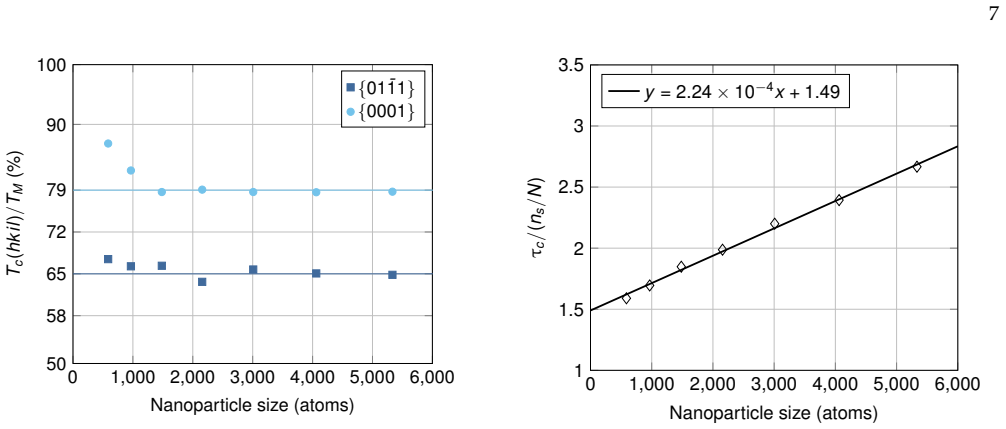
- [§II.C, Table S1] The claim that the difference between characteristic temperatures 'remains constant irrespective of the nanoparticle size, with a value of 205 K' is not supported by the tabulated data. From Table S1, Tc({0001}) − Tc({01-11}) equals 236, 210, 169, 219, 188, 201, and 210 K for the seven sizes. The spread is 169–236 K, i.e., about ±30 K around the mean and a 67 K range. This should be reported with uncertainties and the 'constant' claim reframed, e.g., as a weak or no size trend, rather than an invariant offset.
- [§II.D, Eqs. (10)–(18), Figs. 5 and 11] The τc 'model' is largely circular. lc is defined via Eq. (10) from the same τc and ns/N values it is intended to explain, then fitted linearly to N (Fig. 11), and finally inserted into Eq. (18) with a hand-tuned δ = 1.13 to 'reproduce' τc(N) in Fig. 5. Because lc is derived from τc, the agreement is not an independent test. The non-monotonic minimum near N ≈ 3000 follows algebraically from a linearly growing lc multiplied by N^{-1/3}, and is not a prediction. The authors already note that the linear lc(N) relation is not verified for N > 6000; this should be stated more prominently and the model presented as an empirical parametrization rather than a validated theory.
- [§II.D, Fig. 9] The 2D Gibbs–Thomson fit for the {0001} facet excludes the two smallest nanoparticles without explanation (shaded points in Fig. 9). The extrapolated infinite-facet temperature Tc,∞ = 1371 K and the resulting ratio Tc,∞/TM,∞ = 0.77 depend on this exclusion. Please justify the exclusion (e.g., finite-size crossover) or show that the fit is robust to including all points, or report the sensitivity of the intercept to this choice.
minor comments (6)
- [Abstract and Introduction] The nanoparticle size range is inconsistent: the full-text abstract says '500 to 6000 atoms', the Introduction says '587 to 6847 atoms', and Table S1 lists sizes 587 to 5333. Please use one consistent range and ensure the figures and tables agree.
- [§II.B] Typo: 'strong depnedency' should be 'strong dependence'.
- [Fig. 13 caption] Typo: 'Distorsion' should be 'Distortion'.
- [§II.C, Fig. 8] The text states that for the 587-atom NP 'Tc ≈ T20' for {0001}, but Table S1 gives Tc = 1059 K and T20 = 1204 K. The intended statement appears to be that T20 ≈ TM (1204 vs 1220 K). Please correct.
- [Methods c] The classifier is trained at temperatures up to 400 K, yet the text says that at 400 K vertex atoms begin to diffuse. If 400 K frames are included in training, diffusing atoms may contaminate the reference distributions. Please clarify whether such frames were excluded or justify their inclusion.
- [Methods c, Discussion] The unimodal-Gaussian assumption for the Mahalanobis distance is not rigorously verified, as acknowledged in §II.D. This limitation should also be stated in the Conclusion, since it directly affects the interpretation of Tc as a melting temperature.
Circularity Check
Partial circularity: the τc(N) 'model' reparametrizes the same τc data from which lc is defined, and facet 'melting' temperatures are classifier declassification temperatures, so the 205 K facet gap is not independently validated as thermodynamic premelting.
-
fitted input called prediction
[Section II.D, Eqs. (10)-(18), Fig. 11]
"τc = n0/N = nslc/N, where n0 is the number of outliers and ns is the number of surface atoms at T = 0. Thus, τc/(ns/N) = lc. ... Using the linear relation of lc with N shown in Fig. 11 and using δ = 1.13, we can model analytically the evolution of τc as a function of N, as shown in the solid line of Fig. 5."
lc is defined by Eq. 10 as the measured τc rescaled by ns/N, so Fig. 11's linear fit is a fit to the very data the model claims to explain. Inserting that fit into Eq. 18 with a hand-adjusted δ=1.13 yields a τc(N) that is algebraically tied to the input fit; the minimum near N≈3000 follows from the assumed N^{-1/3} × (linear in N) form and the fitted slope/intercept, not from a new prediction. The 'good agreement' is therefore a reparametrization of the MD τc values, not independent confirmation.
-
self definitional
[Section II.C Eq. (3), Fig. 7; Methods c; Sec. II.A]
"The temperature corresponding to the maximum slope of the sigmoid function is termed the characteristic temperature Tc. ... To ensure accurate classification, the training temperature must be low enough so that surface diffusion has not yet started, as diffusing atoms would no longer correspond to their original classes."
Facet 'melting' is operationalized as the decline in the fraction of atoms that remain assigned to a facet class (Eq. 3), and the Methods state that diffusing atoms no longer correspond to their original classes; Sec. II.A adds that a migrating vertex atom and nearby surface atoms are classified as outliers. Thus Tc measures the temperature at which atoms leave a low-temperature structural class, which includes mobility/diffusion, not a demonstrated liquid transition. The conclusion that {01¯11} facets 'melt' ~205 K before {0001} is a restatement of the class-depletion curves under a classifier that declassifies mobile atoms; no facet-resolved Lindemann, bond-order, or a-CNA check confirms the depleted atoms are liquid.
full rationale
The paper is not globally circular: global melting temperatures are cross-checked against heat-capacity maxima (Fig. 3), and the TM vs N^-1/3 line (Fig. 4) is an honest empirical correlation with a reasonable bulk intercept. The q-SNAP potential is self-cited, but nearly identical DFT-PBE surface energies are quoted, so the facet energetics argument does not rest solely on a self-citation chain; no uniqueness theorem is invoked. However, two load-bearing steps reduce to their own inputs. First, the analytic model for the critical outlier fraction τc is circular: Eq. 10 defines lc from τc, Fig. 11 fits lc(N), and Eq. 18 with δ=1.13 converts that fitted line back into τc(N), so the 'reproduction' of the minimum is built into the algebra. Second, the central facet-resolved 'melting' temperatures are fit parameters of the atom-in-class fraction curves, and the classifier explicitly removes diffusing atoms from their classes; the 205 K offset between {01¯11} and {0001} is therefore a measured property of class depletion, but its interpretation as thermodynamic premelting is a definitional labeling not independently validated. These issues warrant a partial-circularity score of 6, while acknowledging that the underlying MD observations and size-scaling fits contain real, non-vacuous content.
Assumptions & free parameters
free parameters (6)
- δ (layer-thickness correction) =
1.13
- lc(N) linear fit: slope and intercept =
2.24×10^-4 per atom; intercept 1.49
- 3D Gibbs–Thomson slope a (constant C) =
a = 4588 K (Fig. 4 fit)
- 2D Gibbs–Thomson slopes and intercepts per facet =
intercepts 1065 K ({01¯11}), 1371 K ({0001})
- Sigmoid parameters L, k, b, Tc (Eq. 3) =
per size and facet; only Tc reported (Table S1)
- Mahalanobis threshold (distortion score cutoff) =
not reported numerically
assumptions (6)
- domain assumption The q-SNAP potential faithfully represents high-temperature melting and the relative surface energies of the two Co facet families
- domain assumption Bispectrum descriptors (BSO(4), jmax=4, Rcut=5 Å) capture the order–disorder differences tracked by the classifier
- ad hoc to paper Class distributions are (approximately) unimodal Gaussians for Mahalanobis distances to be valid
- domain assumption Heating at 100 ps per 10 K approximates quasi-static melting
- domain assumption Outlier atoms are liquid-like and form a uniform shell of thickness tc
- domain assumption Gibbs–Thomson spherical approximation applies to hexagonal nanoparticles
Cite this review
Pith. "Pith review of Unveiling and quantifying the topology-dependent pre-melting of nanoparticles." pith.science (2026). https://pith.science/paper/HNOT4KKE
@misc{pith2026260216250,
  author       = {Pith},
  title        = {Pith review of: Unveiling and quantifying the topology-dependent pre-melting of nanoparticles},
  year         = {2026},
  howpublished = {\url{https://pith.science/paper/HNOT4KKE}},
  note         = {Machine review of arXiv:2602.16250}
}
abstract
The melting of metallic nanoparticles is governed by surface premelting, a phenomenon traditionally modeled as the isotropic growth of a uniform liquid shell. Challenging this classical view, we report facet-dependent premelting in hexagonal close-packed Co nanoparticles, arising from the structural heterogeneity of their surface. In molecular dynamics simulations (587 to 13047 atoms), the onset of surface mobility is observed as low as 20% of the bulk melting point, driven by the early disordering of stepped $\{01\bar{1}1\}$ facets. These facets consistently melt nearly 150 K below flat $\{0001\}$ facets, regardless of particle size. We show that both surface and facet melting temperatures scale with nanoparticle size through the Gibbs-Thomson effect, and determine a size-dependent critical liquid layer thickness that triggers complete melting of the nanoparticle, which saturates near three atomic layers. Our results confirm recent experimental observations of surface premelting and extend the framework to anisotropic particles with facet-orientation-dependent behavior.
Figures


Figures from the paper (8 more)




Reference graph
Works this paper leans on
-
[1]
Y . A. Koksharov , Magnetic nanoparticles , 197 (2009). [2] D. Guo, G. Xie, and J. Luo, J. Phys. D: Appl. Phys. 47, 013001 (2013)
2009
-
[3]
A. v . Teijlingen, S. A. Davis, and S. R. Hall, Nanoscale Advances 2, 2347 (2020)
2020
-
[4]
S. L. Lai, J. R. A. Carlsson, and L. H. Allen, Applied Physics Letters 72, 1098 (1998)
1998
-
[5]
used here. c. Structural analysis The bispectrum descriptors are used to train the classifier at low temperatures. The pur- pose of this initial step is to define the classes of atoms (e.g., bulk, facets, edges, and vertices). To ensure ac- curate classification, the training temperature must be low enough so that surface diffusion has not yet started, as di...
2022
-
[6]
Pawlow, Zeitschrift f ¨ur Physikalische Chemie 65U, 1 (1909)
P . Pawlow, Zeitschrift f ¨ur Physikalische Chemie 65U, 1 (1909)
1909
-
[7]
Bideault, J
M. Bideault, J. Creuze, R. Asahi, and E. Wimmer, Phys. Rev . Mater.8, 123803 (2024)
2024
-
[8]
Reiss and I
H. Reiss and I. B. Wilson, Journal of Colloid Science 3, 551 (1948)
1948
-
[9]
Tammann, Zeitschrift f ¨ur anorganische und allgemeine Chemie 157, 321 (1926)
G. Tammann, Zeitschrift f ¨ur anorganische und allgemeine Chemie 157, 321 (1926)
1926
Show all 54 references
-
[10]
S. L. Lai, J. Y . Guo, V . Petrova, G. Ramanath, and L. H. Allen, Phys. Rev . Lett.77, 99 (1996)
1996
-
[11]
P . R. Couchman and W. A. Jesser, Nature 269, 481 (1977)
1977
-
[12]
K. K. Nanda, Pramana - J Phys 72, 617 (2009)
2009
-
[13]
A. P . Chernyshev , Materials Chemistry and Physics 112, 226 (2008)
2008
-
[14]
H. M. van Pinxteren and J. W. M. Frenken, Surface Science 275, 383 (1992)
1992
-
[15]
Pedemonte, G
L. Pedemonte, G. Bracco, R. Beikler, E. Taglauer, A. Robin, and W. Heiland, Surface Science Proceedings of the 7th International Conference on Nanometer-Scale Science and Technology and the 21st European Conference on Surface Science, 532-535, 13 (2003)
2003
-
[16]
Baletto and R
F. Baletto and R. Ferrando, Rev . Mod. Phys. 77, 371 (2005)
2005
-
[17]
Carnevali, F
P . Carnevali, F. Ercolessi, and E. Tosatti, Phys. Rev . B 36, 6701 (1987)
1987
-
[18]
J. P . Perdew, K. Burke, and M. Ernzerhof, Phys. Rev . Lett. 77, 3865 (1996), publisher: American Physical Society
1996
-
[19]
Isolated nanoparticles can be simulated at the atomic scale using molecular dynamics (MD) [ 16] (see Meth- ods)
and computationally [5, 20]. Isolated nanoparticles can be simulated at the atomic scale using molecular dynamics (MD) [ 16] (see Meth- ods). The main challenge for accurate MD simulations is the realism of the interatomic potential used to de- scribe interactions between atom...
-
[20]
X. Liu, X. Wen, and R. Hoffmann, ACS Catal. 8, 3365 (2018)
2018
-
[21]
V . V . Matveev , D. A. Baranov , G. Y . Yurkov , N. G. Akatiev , I. P . Dotsenko, and S. P . Gubin, Chemical Physics Letters 422, 402 (2006)
2006
-
[22]
Farkaˇs and N
B. Farkaˇs and N. H. de Leeuw, Nanotechnology 31, 195711 (2020)
2020
-
[23]
P . M. Larsen, S. Schmidt, and J. Schiøtz, Modelling Simul. Mater. Sci. Eng. 24, 055007 (2016)
2016
-
[24]
Stukowski, Modelling Simul
A. Stukowski, Modelling Simul. Mater. Sci. Eng. 20, 045021 (2012)
2012
-
[25]
G. J. Ackland and A. P . Jones, Phys. Rev . B 73, 054104 (2006)
2006
-
[26]
Mickel, S
W. Mickel, S. C. Kapfer, G. E. Schr¨oder-Turk, and K. Mecke, The Journal of Chemical Physics 138, 044501 (2013)
2013
-
[27]
Essajai, A
R. Essajai, A. Rachadi, M. Qjani, A. Mzerd, and N. Has- sanain, Chemical Physics 526, 110441 (2019)
2019
-
[28]
Delgado-Callico, K
L. Delgado-Callico, K. Rossi, R. Pinto-Miles, P . Salzbrenner, and F. Baletto, Nanoscale 13, 1172 (2021)
2021
-
[29]
Barron, G
H. Barron, G. Opletal, R. D. Tilley , and A. S. Barnard, Catal. Sci. Technol. 6, 144 (2016)
2016
-
[30]
A. S. Barnard, Reports on Progress in Physics 73, 086502 (2010)
2010
-
[31]
Roncaglia and R
C. Roncaglia and R. Ferrando, Journal of Chemical Infor- mation and Modeling 63, 459 (2023)
2023
-
[32]
Telari, A
E. Telari, A. Tinti, M. Settem, L. Maragliano, R. Ferrando, and A. Giacomello, ACS nano 17, 21287 (2023)
2023
-
[33]
A. P . Bart´ok, R. Kondor, and G. Cs ´anyi, Phys. Rev . B 87, 184115 (2013)
2013
-
[34]
Rapetti, M
D. Rapetti, M. Delle Piane, M. Cioni, D. Polino, R. Fer- rando, and G. M. Pavan, Communications Chemistry 6, 143 (2023)
2023
-
[35]
Cioni, M
M. Cioni, M. Delle Piane, D. Polino, D. Rapetti, M. Crippa, E. A. Irmak, S. Van Aert, S. Bals, and G. M. Pavan, Ad- vanced Science 11, 2307261 (2024)
2024
-
[36]
W. Z. Polak, Computational Materials Science 201, 110882 (2022)
2022
-
[37]
C. Zeni, K. Rossi, T. Pavloudis, J. Kioseoglou, S. de Giron- coli, R. E. Palmer, and F. Baletto, Nature Communications 12, 6056 (2021)
2021
-
[38]
A. P . Bart´ok, M. C. Payne, R. Kondor, and G. Cs ´anyi, Phys. Rev . Lett.104, 136403 (2010). 11
2010
-
[39]
Allera, A
A. Allera, A. M. Goryaeva, P . Lafourcade, J.-B. Maillet, and M.-C. Marinica, Computational Materials Science 231, 112535 (2024)
2024
-
[40]
Lafourcade, J.-B
P . Lafourcade, J.-B. Maillet, C. Denoual, E. Duval, A. Allera, A. M. Goryaeva, and M.-C. Marinica, Computational Ma- terials Science 230, 112534 (2023)
2023
-
[41]
A. M. Goryaeva, C. Lapointe, C. Dai, J. D ´er`es, J.-B. Maillet, and M.-C. Marinica, Nat Commun 11, 4691 (2020)
2020
-
[42]
T. D. Swinburne, Phys. Rev . Lett. 131, 236101 (2023)
2023
-
[43]
A. E. Poisvert, C. Lapointe, A. M. Goryaeva, L. Kurpaska, J. S. Wr ´obel, and M.-C. Marinica, Physical Review Materi- als 9, 093604 (2025)
2025
-
[44]
Buffat and J.-P
P . Buffat and J.-P . Borel, Phys. Rev . A13, 2287 (1976), pub- lisher: American Physical Society
1976
-
[45]
and is similar to the behavior modeled in the context of surface segregation in bimetallic nanoparticles [46]. Finally , we note an advantage of the present algorithm to describe the nanoparticle melting with far greater pre- cision than traditional approaches such as a-CNA [ ...
-
[46]
Fern ´andez Guillermet, Int J Thermophys 8, 481 (1987)
A. Fern ´andez Guillermet, Int J Thermophys 8, 481 (1987)
1987
-
[47]
Lapujoulade, Surface Science Reports 20, 195 (1994)
J. Lapujoulade, Surface Science Reports 20, 195 (1994)
1994
-
[48]
Kryshtal, S
A. Kryshtal, S. Bogatyrenko, and O. Khshanovska, Nano Letters 23, 6354 (2023), pMID: 37418684
2023
-
[49]
Creuze, F
J. Creuze, F. Berthier, and B. Legrand, Segregation and phase transitions in reduced dimension: From bulk to clus- ters via surfaces, in Nanoalloys: Synthesis, Structure and Properties, edited by D. Alloyeau, C. Mottet, and C. Ricol- leau (Springer London, London, 2012) pp. 227–257
2012
-
[50]
F. A. Lindemann, Physikalische Zeitschrift 11, 609 (1910)
1910
-
[51]
MedeA 3.8; MedeA is a registered trademark of Materials Design, Inc., San Diego, USA. (2023)
2023
-
[52]
A. P . Thompson, H. M. Aktulga, R. Berger, D. S. Bolin- tineanu, W. M. Brown, P . S. Crozier, P . J. in ’t V eld, A. Kohlmeyer, S. G. Moore, T. D. Nguyen, R. Shan, M. J. Stevens, J. Tranchida, C. Trott, and S. J. Plimpton, Com- puter Physics Communications 271, 108171 (2022)
2022
-
[53]
A. P . Thompson, L. P . Swiler, C. R. Trott, S. M. Foiles, and G. J. Tucker, Journal of Computational Physics 285, 316 (2015)
2015
-
[54]
M. A. Wood and A. P . Thompson, J. Chem. Phys. 148, 241721 (2018)
2018
-
[55]
Hubert and M
M. Hubert and M. Debruyne, WIREs Computational Statis- tics 2, 36 (2010). Supporting information Unveiling and quantifying the topology-dependent pre-melting of nanoparticles Marthe Bideault, 1, 2 Arnaud Allera, 3 Ryoji Asahi,4 J´er ˆome Creuze, 5 and Erich Wimmer 6, 7 1Materi...
2010
Reviewed August 4, 2026 · model on record in the stance chip above.
Discussion (0). Continue with ORCID to comment.