Comet-type periodic motions and their out-of-plane bifurcations in the Earth-Moon CR3BP: a computational symplectic analysis
Pith reviewed 2026-05-15 21:42 UTC · model grok-4.3
The pith
Comet-type periodic orbits continue analytically from Keplerian motions and bifurcate vertically in the Earth-Moon CR3BP.
A machine-rendered reading of the paper's core claim, the machinery that carries it, and where it could break.
Core claim
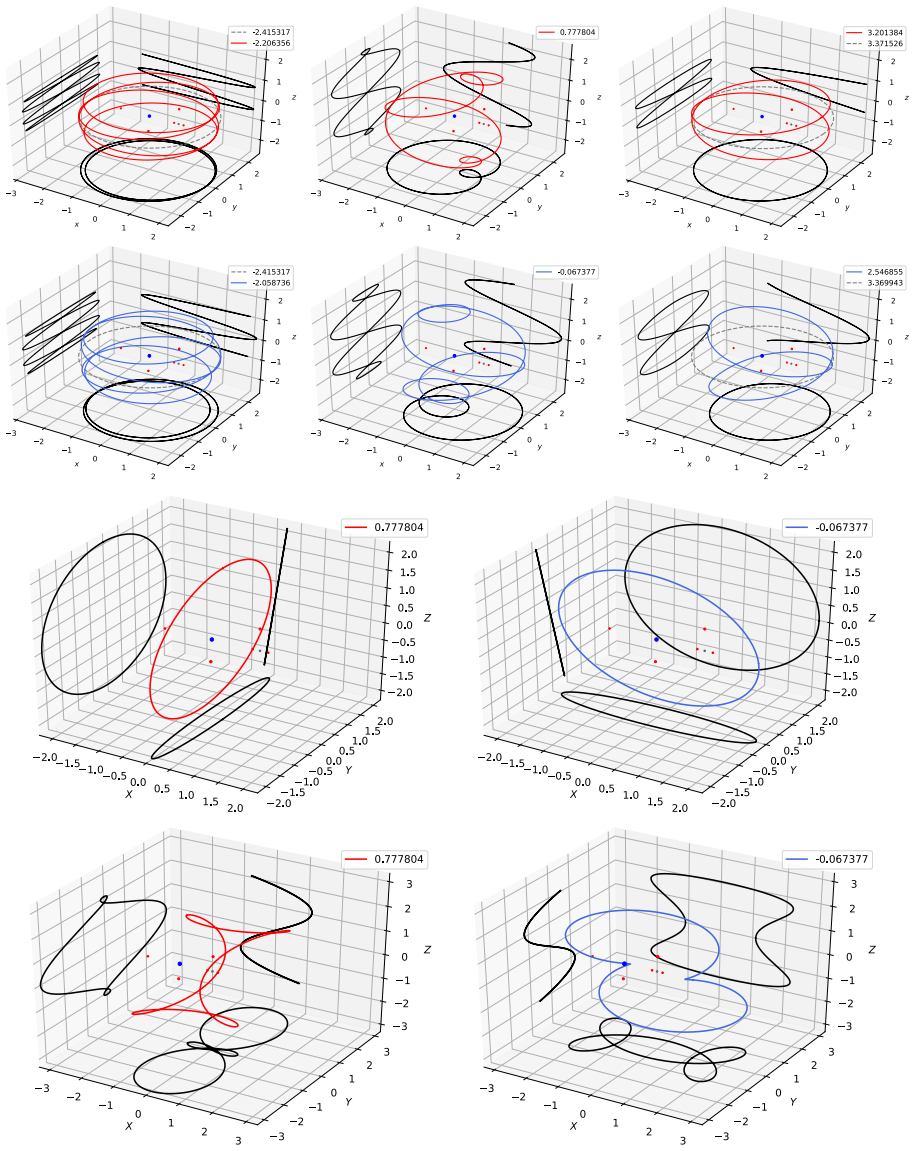
Comet-type periodic orbits are generated from very large retrograde and direct circular Keplerian motions around the common center of mass of the primaries. Their existence is proven by the classical Poincaré continuation method, which also determines the Conley-Zehnder index defined as a Maslov index using a crossing form. In the Earth-Moon CR3BP, a corrector-predictor technique explores the two families, computes stability indices, identifies vertical self-resonant bifurcations of multiplicity up to six, investigates the bifurcated spatial solutions and their resonances with Earth and Moon, and illustrates the connections via symplectic invariant bifurcation graphs including bridge familes
What carries the argument
The Poincaré continuation method applied to large Keplerian motions, combined with the Conley-Zehnder index to track stability and vertical self-resonant bifurcations in symplectic bifurcation graphs.
If this is right
- The comet-type orbits have stability indices that locate the vertical bifurcation points.
- Bifurcations of higher order periods up to six produce spatial periodic solutions.
- The bifurcated orbits include ones in resonance with the Earth and the Moon.
- Bifurcation graphs based on symplectic invariants show topological connections between branches and bridge families.
Where Pith is reading between the lines
- The method could extend to other restricted three-body problems with different primary masses.
- The resonant spatial orbits may inform trajectory design for spacecraft in the Earth-Moon system.
- The symplectic topology of the bifurcation diagram might reveal additional global structures in the phase space.
Load-bearing premise
The Poincaré continuation from large-amplitude Keplerian motions remains valid without collisions or loss of periodicity for the Earth-Moon mass parameter.
What would settle it
Direct numerical integration of a continued orbit that either collides with a primary or fails to close periodically at the Earth-Moon mass ratio would contradict the existence claim.
Figures




read the original abstract
Comet-type periodic orbits of the circular restricted three-body problem (CR3BP) are periodic solutions that are generated from very large retrograde and direct circular Keplerian motions around the common center of mass of the primaries. In this paper we first provide an analytical proof of the existence of the comet-type periodic orbits by using the classical Poincar\'e continuation method. Within this analytical approach, we also determine the Conley-Zehnder index, defined as a Maslov index using a crossing form. Then, by applying a standard corrector-predictor technique, we explore numerically the two families of comet orbits within the Earth-Moon CR3BP. We compute their stability indices, identify vertical self-resonant bifurcations of higher order periods (of multiplicity from integer multiples up to six), investigate the vertically bifurcated spatial periodic solutions, and discuss their orbital characteristics. We also describe the orbits that are in resonance with the Earth and the Moon. We illustrate our main results in the form of bifurcation graphs, based on symplectic invariants, that provide a topological overview of the connections of the bifurcated branches, including bridge families.
Editorial analysis
A structured set of objections, weighed in public.
Referee Report
Summary. The manuscript proves the existence of comet-type periodic orbits in the CR3BP by applying the classical Poincaré continuation theorem to large-amplitude retrograde and direct Keplerian motions around the barycenter. It computes the associated Conley-Zehnder indices via a crossing-form definition of the Maslov index. The work then numerically continues the two families in the Earth-Moon CR3BP using a standard corrector-predictor scheme, evaluates their stability indices, locates vertical self-resonant bifurcations of multiplicity up to six, examines the resulting spatial periodic solutions and Earth-Moon resonances, and presents the global structure through bifurcation diagrams constructed from symplectic invariants.
Significance. When the continuation and numerical results are valid, the paper supplies a rigorous symplectic foundation for comet-type orbits and their out-of-plane bifurcations in the Earth-Moon problem. The combination of an existence proof independent of the specific mass parameter, explicit Conley-Zehnder index calculations, and topological bifurcation graphs based on symplectic invariants offers a clear organizational framework that is useful for further dynamical studies and mission-related orbit design.
major comments (2)
- [Analytical existence proof (Poincaré continuation)] The analytical continuation section invokes the non-collision hypothesis of Poincaré’s theorem for the limiting Keplerian orbits at the Earth-Moon mass parameter; an explicit lower bound on the minimal distance to either primary (or a direct verification that the continued solutions remain collision-free) would make the applicability of the theorem fully transparent.
- [Numerical families and bifurcation graphs] In the numerical continuation and bifurcation analysis, the identification of vertical self-resonant bifurcations up to multiplicity six relies on the stability-index zero crossings; the manuscript should state the precise numerical tolerance used to declare a resonance and confirm that the symplectic invariants distinguish bridge families from other connections without ambiguity.
minor comments (3)
- [Abstract] The abstract phrase “higher order periods (of multiplicity from integer multiples up to six)” is slightly awkward; rephrasing to “periods that are integer multiples of the base period, up to multiplicity six” would improve readability.
- [Figures] All bifurcation diagrams should include explicit axis labels for the stability indices and the Conley-Zehnder index values along each branch.
- [Numerical results] A short table summarizing the periods, stability indices, and bifurcation multiplicities for the principal families would help readers compare the retrograde and direct branches.
Simulated Author's Rebuttal
We thank the referee for the constructive comments and the recommendation for minor revision. The suggestions improve the clarity of the analytical and numerical sections without altering the core results. We address each major comment below and have incorporated the requested details into the revised manuscript.
read point-by-point responses
-
Referee: [Analytical existence proof (Poincaré continuation)] The analytical continuation section invokes the non-collision hypothesis of Poincaré’s theorem for the limiting Keplerian orbits at the Earth-Moon mass parameter; an explicit lower bound on the minimal distance to either primary (or a direct verification that the continued solutions remain collision-free) would make the applicability of the theorem fully transparent.
Authors: We agree that an explicit lower bound strengthens the transparency of the non-collision hypothesis. In the revised manuscript we have added a short calculation deriving a uniform lower bound on the minimal distance to either primary for the limiting large-amplitude Keplerian orbits. The bound is expressed in terms of the mass parameter and the orbital amplitude; for the Earth-Moon mass ratio it remains strictly positive, confirming that the continued solutions stay collision-free and that Poincaré’s theorem applies directly. revision: yes
-
Referee: [Numerical families and bifurcation graphs] In the numerical continuation and bifurcation analysis, the identification of vertical self-resonant bifurcations up to multiplicity six relies on the stability-index zero crossings; the manuscript should state the precise numerical tolerance used to declare a resonance and confirm that the symplectic invariants distinguish bridge families from other connections without ambiguity.
Authors: We have added the precise numerical tolerance (10^{-8}) used to identify zero crossings of the stability indices in the revised text. We have also expanded the discussion of the bifurcation diagrams to explain that the Conley-Zehnder indices and the associated symplectic invariants provide a topological distinction: bridge families are uniquely characterized by their index jumps and connectivity in the global bifurcation graph, separating them unambiguously from other resonant connections. revision: yes
Circularity Check
Derivation relies on classical Poincaré continuation and standard numerical methods without self-referential reduction
full rationale
The paper's central existence proof invokes the classical Poincaré continuation theorem applied to large-amplitude Keplerian motions at the Earth-Moon mass parameter, which is an independent result from the literature and does not reduce to any input defined within the paper. The Conley-Zehnder index is obtained from the standard crossing-form definition. Subsequent numerical continuation of the two families, stability indices, and vertical bifurcations up to multiplicity six are generated directly from the CR3BP vector field via corrector-predictor search; no parameter is fitted to prior outputs of the same work, no self-citation chain is load-bearing, and no ansatz or uniqueness claim is smuggled in. The derivation chain is therefore self-contained against external benchmarks.
Axiom & Free-Parameter Ledger
free parameters (1)
- mass parameter μ
axioms (2)
- standard math Poincaré continuation theorem applies to the Hamiltonian vector field of the CR3BP
- domain assumption Primaries move in circular orbits about their common center of mass
Reference graph
Works this paper leans on
-
[1]
Albers P., Fish J.W., Frauenfelder U., van Koert O.: The Conley–Zehnder indices of the rotating Kepler problem. Math. Proc. Camb. Phil. Soc. 154(2), 243–260 (2013) https://doi.org/10. 1017/S0305004112000515
work page 2013
-
[2]
Arnold V .I., Avez A.:Ergodic Problems of Classical Mechanics. New York, Benjamin (1968)
work page 1968
-
[3]
Aydin C.: From Babylonian lunar observations to Floquet multipliers and Conley–Zehnder Indices. J. Math. Phys. 64(8) (2023) https://doi.org/10.1063/5.0156959
-
[4]
Aydin C.: The Conley–Zehnder indices of the spatial Hill three-body problem . Celest. Mech. Dyn. Astron. 135(32) (2023) https://doi.org/10.1007/s10569-023-10134-7
-
[5]
Aydin C.: Exploration of vertical self-resonant bifurcations from Distant Retrograde Orbits (DROs) in the Earth-Moon Circular Restricted Three-Body Problem (CR3BP) . (2025) https://arxiv. org/abs/2508.17286
-
[6]
Aydin C., Batkhin A.: Studying network of symmetric periodic orbit families of the Hill problem via symplectic invariants. Celest. Mech. Dyn. Astron. 137(12) (2025) https://doi.org/10.1007/ s10569-025-10241-7
work page 2025
-
[7]
Celestial Mechanics 25, 195–217 (1981) https://doi.org/10.1007/BF01230520
Belbruno E.A.: A new family of periodic orbits for the restricted problem . Celestial Mechanics 25, 195–217 (1981) https://doi.org/10.1007/BF01230520
-
[8]
Ce- lestial Mechanics 25, 397–415 (1981) https://doi.org/10.1007/BF01234179
Belbruno E.A.: A new regularization of the restricted three-body problem and an application . Ce- lestial Mechanics 25, 397–415 (1981) https://doi.org/10.1007/BF01234179
-
[9]
The Astronomical Journal 72(2), 202–213 (1967)
Bray T.A., Goudas C.L.: Doubly Symmetric Orbits about the Collinear Lagrangian Points . The Astronomical Journal 72(2), 202–213 (1967)
work page 1967
-
[10]
Broucke R.A.: Periodic orbits in the restricted three-body problem with Earth–Moon masses. Tech. Rep. 32-1168, Jet Propulsion Laboratory (1968)
work page 1968
-
[11]
In Russian, Institute of Applied Mathematics, Moscow, Preprint No
Bruno A.D.: Simple periodic solutions of the restricted three-body problem in the Sun-Jupiter case. In Russian, Institute of Applied Mathematics, Moscow, Preprint No. 66 (1993)
work page 1993
-
[12]
In Russian, Institute of Applied Mathematics, Moscow, Preprint No
Bruno A.D.: Zero-multiple and retrograde periodic solutions of the restricted three-body problem. In Russian, Institute of Applied Mathematics, Moscow, Preprint No. 93 (1996)
work page 1996
-
[13]
Conley C. , Zehnder E.: Morse-type index theory for flows and periodic solutions for Hamiltonian Equations. Comm. Pure Appl. Math. 37(2), 207–253 (1984) https://doi.org/10.1002/cpa. 3160370204
work page doi:10.1002/cpa 1984
-
[14]
Physica D: Nonlinear Phenomena 470 (2024) https://doi.org/ 10.1016/j.physd.2024.134426 34
Cors J.M., Garrido M.: Symmetric comet-type periodic orbits in the elliptic three-dimensional re- stricted (N + 1)-body problem. Physica D: Nonlinear Phenomena 470 (2024) https://doi.org/ 10.1016/j.physd.2024.134426 34
-
[15]
Doedel E.J., Romanov V .A., Paffenroth R.C., Keller H.B., Dichmann D.J., Gal ´an-Vioque J., Van- derbauwhede A.: Elemental Periodic Orbits Associated with the Libration Points in the Circular Restricted 3-BODY Problem. Internat. J. Bifur. Chaos 17, 2625–2677 (2007) https://doi.org/ 10.1142/S0218127407018671
-
[16]
Eliashberg Y ., Givental A., Hofer H.:Introduction to symplectic field theory. GAFA 2000 (Tel Aviv,
work page 2000
-
[17]
Geom. Funct. Anal., Special olume, Part II(2000), 560–673 https://doi.org/10.1007/ 978-3-0346-0425-3_4
work page 2000
-
[18]
Feagin T.: High-order explicit Runge-Kutta methods using m-symmetry. Neural, Parallel, and Sci- entific Computations 20, 437–458 (2012) https://hdl.handle.net/10657.1/2296
work page 2012
-
[19]
Franz C.J., Russell R.P.: Database of Planar and Three-Dimensional Periodic Orbits and Fam- ilies Near the Moon. J. Astronaut. Sci. 69, 1573–1612 (2022) https://doi.org/10.1007/ s40295-022-00361-9
work page 2022
-
[20]
Ginzburg V . L.: The Conley conjecture. Ann. of Math. (2) 172(2), 1127–1180 (2010)
work page 2010
-
[21]
Hofer H., Wysocki K., Zehnder E.: Finite Energy Foliations of Tight Three-Spheres and Hamilto- nian Dynamics. Ann. of Math. (2) 157(1), 125–255 (2003) https://doi.org/10.4007/annals. 2003.157.125
-
[22]
IET Conference Proceedings (2022) https://doi.org/10.1049/ icp.2022.0544
Johnson S.K., Mortensen D.J., Chavez M.A., Woodland C.L.: Gateway – a communications plat- form for lunar exploration . IET Conference Proceedings (2022) https://doi.org/10.1049/ icp.2022.0544
-
[23]
(2025) https://arxiv.org/abs/2512.03849
Joung C., Koh D., van Koert O.: Bifurcations of Highly Inclined Near Halo Orbits using Moser Regularization. (2025) https://arxiv.org/abs/2512.03849
-
[24]
Nonlinearity 38(2) (2025) https://doi.org/10.1088/1361-6544/ada7ba
Joung C., van Koert O.: Computational symplectic topology and symmetric orbits in the restricted three-body problem. Nonlinearity 38(2) (2025) https://doi.org/10.1088/1361-6544/ada7ba
-
[25]
Physica D 112, 1–39 (1998) https://doi.org/10.1016/S0167-2789(97)00199-1
Lamb J.S.W., Roberts J.A.G.: Time-reversal symmetry in dynamical systems: A survey. Physica D 112, 1–39 (1998) https://doi.org/10.1016/S0167-2789(97)00199-1
-
[26]
J of Astronaut Sci 50, 389–409 (2002) https://doi.org/10.1007/BF03546245
Lara M., Scheeres D.J.: Stability Bounds for Three-Dimensional Motion Close to Asteroids . J of Astronaut Sci 50, 389–409 (2002) https://doi.org/10.1007/BF03546245
-
[27]
Journal of Topology and Analysis (2026) https://doi.org/10.1142/S1793525326500238
Lee D.: Conley-Zehnder Indices of Spatial Rotating Kepler Problem . Journal of Topology and Analysis (2026) https://doi.org/10.1142/S1793525326500238
-
[28]
Chinese Journal of Aero- nautics 31, 1559–1567 (2018) https://doi.org/10.1016/j.cja.2018.04.012
Liu L., Hu C.: Scheme design of the CHANG’E-5T1 extended mission . Chinese Journal of Aero- nautics 31, 1559–1567 (2018) https://doi.org/10.1016/j.cja.2018.04.012
- [29]
-
[30]
Celest Mech Dyn Astr 104, 307–318 (2009) https://doi.org/ 10.1007/s10569-009-9213-6
Llibre J., Roberto L.A.: New doubly-symmetric families of comet-like periodic orbits in the spatial restricted (N + 1)-body problem. Celest Mech Dyn Astr 104, 307–318 (2009) https://doi.org/ 10.1007/s10569-009-9213-6
-
[31]
11 Under review as a conference paper at ICLR 2026 Ricky T
Llibre J., Stoica C.: Comet- and Hill-type periodic orbits in restricted (N + 1)-body problems. Journal of Differential Equations 250(3), 1747–1766 (2011) https://doi.org/10.1016/j.jde. 2010.08.005 35
-
[32]
Celestial Mechanics and Dynamical Astronomy 133 (2021) https://doi.org/10.1007/s10569-021-10052-6
Llibre J., Pas ¸ca D., Valls C.: The circular restricted 4-body problem with three equal primaries in the collinear central configuration of the 3-body problem . Celestial Mechanics and Dynamical Astronomy 133 (2021) https://doi.org/10.1007/s10569-021-10052-6
-
[33]
Oxford University Press, 3rd edition (2017)
McDuff D., Salamon D.: Introduction to Symplectic Toplogy. Oxford University Press, 3rd edition (2017)
work page 2017
-
[34]
Journal of Differential Equations 39, 2–38 (1981)
Meyer K.R.: Periodic Solutions of the N-Body Problem. Journal of Differential Equations 39, 2–38 (1981)
work page 1981
-
[35]
Celestial Mechanics 23, 69–81 (1981) https://doi.org/10.1007/BF01228545
Meyer K.R.: Periodic orbits near infinity in the restricted N-body problem. Celestial Mechanics 23, 69–81 (1981) https://doi.org/10.1007/BF01228545
-
[36]
Meyer K.R.: Comet like periodic orbits in the N-body problem. Journal of Computational and Ap- plied Mathematics 52, 337–351 (1994) https://doi.org/10.1016/0377-0427(94)90365-4
-
[37]
Meyer K.R., Hall G.R., Offin D.: Introduction to Hamiltonian Dynamical Systems and the N-Body Problem. Second Edition. Springer (2009)
work page 2009
-
[38]
Moreno A., Aydin C., van Koert O., Frauenfelder U., Koh D.: Bifurcation Graphs for the CR3BP via Symplectic Methods . J. Astronaut. Sci. 71(51) (2024) https://doi.org/10.1007/ s40295-024-00462-7
work page 2024
-
[39]
Transactions of the American Math- ematical Society 13(1), 96–108 (1912)
Moulton F.R.: A Class of Periodic Orbits of Superior Planets. Transactions of the American Math- ematical Society 13(1), 96–108 (1912)
work page 1912
-
[40]
Astrophys Space Sci 361 (2016) https://doi.org/10.1007/s10509-016-2713-4
Papadakis D.: Families of three-dimensional periodic solutions in the circular restricted four-body problem. Astrophys Space Sci 361 (2016) https://doi.org/10.1007/s10509-016-2713-4
-
[41]
Topology 32(4), 827–844 (1993) https: //doi.org/10.1016/0040-9383(93)90052-W
Robbin J., Salamon D.: The Maslov index for paths . Topology 32(4), 827–844 (1993) https: //doi.org/10.1016/0040-9383(93)90052-W
-
[42]
Robin I.A., Markellos V .V .:Numerical determination of three-dimensional periodic orbits gener- ated from vertical self-resonant satellite orbits . Celest. Mech. 21, 395–434 (1980) https://doi. org/10.1007/BF01231276
-
[43]
Institute of Physics Publishing, Bristol and Philadelphia, 4th edition (2005)
Roy A.E.: Orbital Motion. Institute of Physics Publishing, Bristol and Philadelphia, 4th edition (2005)
work page 2005
-
[44]
Springer-Verlag Berlin Heidelberg (1995)
Siegel C.L., Moser J.K.: Lectures on Celestial Mechanics . Springer-Verlag Berlin Heidelberg (1995)
work page 1995
-
[45]
Academic Press, New York (1967)
Szebehely V .: Theory of Orbits - The Restricted Problem of Three Bodies . Academic Press, New York (1967)
work page 1967
-
[46]
AAS/AIAA Astrodynamics Specialist Conference, AAS 23-241 (2023)
Williams J., Dawn T.F., Batcha A.L.: A History of Orion Mission Design, Copernicus Software Development, and the Artemis I Trajectory. AAS/AIAA Astrodynamics Specialist Conference, AAS 23-241 (2023)
work page 2023
-
[47]
Zimovan-Spreen E.M., Howell K.C., Davis D.C.: Near rectilinear halo orbits and nearby higher- period dynamical structures: orbital stability and resonance properties. Celest. Mech. Dyn. Astron. 132(28) (2020) https://doi.org/10.1007/s10569-020-09968-2 CENGIZ AYDIN INSTITUT F ¨UR MATHEMATIK , U NIVERSIT ¨AT HEIDELBERG , G ERMANY E-mail address: cengiz.aydi...
discussion (0)
Sign in with ORCID, Apple, or X to comment. Anyone can read and Pith papers without signing in.