Docking and Persistent Operations for a Resident Underwater Vehicle
Pith reviewed 2026-05-15 21:23 UTC · model grok-4.3
The pith
A resident mini-class ROV achieves 90 percent autonomous docking success and completes inspection missions in four minutes at 90 m depth by fusing acoustic and visual navigation.
A machine-rendered reading of the paper's core claim, the machinery that carries it, and where it could break.
Core claim
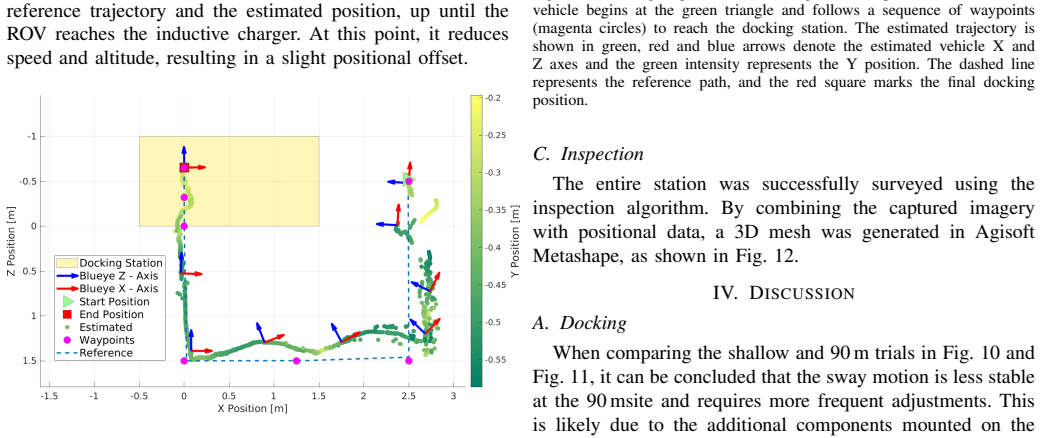
The system consists of a docking station and mini-class ROV deployed at 90 m depth; the vehicle uses onboard processing to navigate autonomously with USBL signals, dock via ArUco marker-based visual localisation fused in an Extended Kalman Filter, and execute local inspection routines, achieving a 90 percent autonomous docking success rate and completing full missions within four minutes.
What carries the argument
Fusion of USBL acoustic positioning and ArUco marker visual localisation inside an Extended Kalman Filter to produce accurate pose estimates for autonomous docking and inspection.
If this is right
- Untethered resident operations at depth become practically feasible.
- Full local inspection missions can be finished in four minutes without surface intervention.
- Scalable and lower-cost underwater monitoring networks can be built around docking stations.
- Persistent autonomous presence replaces the need for repeated vessel deployments.
Where Pith is reading between the lines
- Longer-duration deployments lasting weeks or months could be tested to measure mechanical wear and battery cycling.
- Similar navigation fusion might extend to tasks such as cable inspection or sample collection on the same platform.
- Data from repeated missions could feed into models that predict optimal docking schedules under changing currents.
- Multiple docked vehicles could share a single surface buoy for data relay, reducing per-vehicle support costs.
Load-bearing premise
USBL signals and ArUco markers stay reliable enough for the Extended Kalman Filter to maintain accurate navigation at 90 m depth across repeated missions in variable ocean conditions.
What would settle it
Repeated trials at 90 m depth that produce a docking success rate well below 90 percent or inspection missions that exceed four minutes because of navigation drift or lost marker visibility.
Figures




read the original abstract
Our understanding of the oceans remains limited by sparse and infrequent observations, primarily because current methods are constrained by the high cost and logistical effort of underwater monitoring, relying either on sporadic surveys across broad areas or on long-term measurements at fixed locations. To overcome these limitations, monitoring systems must enable persistent and autonomous operations without the need for continuous surface support. Despite recent advances, resident underwater vehicles remain uncommon due to persistent challenges in autonomy, robotic resilience, and mechanical robustness, particularly under long-term deployment in harsh and remote environments. This work addresses these problems by presenting the development, deployment, and operation of a resident infrastructure using a docking station with a mini-class Remotely Operated Vehicle (ROV) at 90 m depth. The ROV is equipped with enhanced onboard processing and perception, allowing it to autonomously navigate using USBL signals, dock via ArUco marker-based visual localisation fused through an Extended Kalman Filter, and carry out local inspection routines. The system demonstrated a 90 % autonomous docking success rate and completed full inspection missions within four minutes, validating the integration of acoustic and visual navigation in real-world conditions. These results show that reliable, untethered operations at depth are feasible, highlighting the potential of resident ROV systems for scalable, cost-effective underwater monitoring.
Editorial analysis
A structured set of objections, weighed in public.
Referee Report
Summary. The manuscript presents the development and real-world deployment of a resident underwater infrastructure consisting of a docking station and a mini-class ROV operating at 90 m depth. The ROV integrates USBL acoustic signals with ArUco marker-based visual localization fused through an Extended Kalman Filter to enable autonomous navigation, docking, and local inspection routines. It reports a 90% autonomous docking success rate and full inspection missions completed within four minutes, claiming validation of untethered persistent operations for scalable underwater monitoring.
Significance. If the reported performance is reproducible under quantified ocean conditions, the work would constitute a practical contribution to marine robotics by demonstrating feasible long-term resident ROV operations without continuous surface support. It directly addresses autonomy and robustness challenges in harsh environments, with potential to reduce costs and increase frequency of ocean observations.
major comments (2)
- [Abstract and Results] The central performance claim of a 90% autonomous docking success rate (Abstract) is presented as an aggregate figure without the total number of trials, explicit success/failure criteria, per-trial localization error statistics, or logged environmental parameters (currents, visibility, acoustic conditions at depth). This information is load-bearing for evaluating whether the USBL+ArUco EKF fusion is robust or dependent on favorable trials.
- [Navigation and Localization] The weakest assumption—that USBL signals and ArUco markers remain reliable at 90 m depth over repeated missions—is not supported by quantitative analysis of filter performance (e.g., innovation sequences, covariance bounds, or failure-mode logs) under variable conditions.
minor comments (2)
- [Figures] Figure captions and trajectory plots should include scale bars, depth references, and explicit indication of success/failure trials for clarity.
- [Results] The manuscript would benefit from a brief table summarizing trial counts, success rates, and environmental ranges.
Simulated Author's Rebuttal
We thank the referee for the constructive and detailed comments. We address each major point below and will revise the manuscript accordingly to improve clarity and substantiation of the reported results.
read point-by-point responses
-
Referee: [Abstract and Results] The central performance claim of a 90% autonomous docking success rate (Abstract) is presented as an aggregate figure without the total number of trials, explicit success/failure criteria, per-trial localization error statistics, or logged environmental parameters (currents, visibility, acoustic conditions at depth). This information is load-bearing for evaluating whether the USBL+ArUco EKF fusion is robust or dependent on favorable trials.
Authors: We agree that the aggregate 90% success rate would benefit from additional context to allow readers to assess robustness. In the revised manuscript we will expand the results section to report the total number of autonomous docking trials conducted during the deployment, provide explicit success and failure criteria (including position and orientation tolerances for physical docking), include summary per-trial localization error statistics, and describe the environmental conditions at the site based on available measurements from the deployment. revision: yes
-
Referee: [Navigation and Localization] The weakest assumption—that USBL signals and ArUco markers remain reliable at 90 m depth over repeated missions—is not supported by quantitative analysis of filter performance (e.g., innovation sequences, covariance bounds, or failure-mode logs) under variable conditions.
Authors: The repeated successful completion of inspection missions provides empirical evidence of reliability under the encountered conditions. We will revise the navigation section to include quantitative EKF performance analysis drawn from the available mission data, such as innovation sequences, covariance bounds, and discussion of observed failure modes, to more directly support the assumption of signal and marker reliability at depth. revision: yes
Circularity Check
No significant circularity; results from physical deployment and measured success rates
full rationale
The manuscript presents an engineering system description and reports empirical outcomes from real-world deployment of a resident ROV at 90 m depth, including a measured 90 % autonomous docking success rate and four-minute inspection missions. No mathematical derivations, model equations, fitted parameters, or predictions are claimed; the central claims rest on direct experimental observation rather than any chain that reduces to self-defined inputs, self-citations, or ansatzes. The reader's assessment of score 1.0 is consistent with this finding, as the work contains no load-bearing theoretical steps that could exhibit circularity.
Axiom & Free-Parameter Ledger
axioms (1)
- standard math Extended Kalman Filter provides suitable state estimation when combining USBL and visual measurements under approximately Gaussian noise
Reference graph
Works this paper leans on
-
[1]
The Blue Economy: Overview and EU Policy Framework,
F. Scholaert, V . Margaras, M. Pape, A. Wilson, and C. Kloecker, “The Blue Economy: Overview and EU Policy Framework,”European Parliament, 2020
work page 2020
-
[2]
Inspection and Maintenance of Indus- trial Infrastructure with Autonomous Underwater Robots,
F. Nauert and P. Kampmann, “Inspection and Maintenance of Indus- trial Infrastructure with Autonomous Underwater Robots,”Frontiers in Robotics and AI, vol. 10, p. 1240276, 2023
work page 2023
-
[3]
Monitoring of Underwater Critical Infrastructures: The Nord Stream and Other Recent Case Studies,
G. Soldi, D. Gaglione, S. Raponi, N. Forti, E. d’Afflisio, P. Kowalski, L. M. Millefiori, D. Zissis, P. Braca, P. Willett, A. Maguer, S. Carniel, G. Sembenini, and C. Warner, “Monitoring of Underwater Critical Infrastructures: The Nord Stream and Other Recent Case Studies,”IEEE Aerospace and Electronic Systems Magazine, vol. 38, no. 10, pp. 4–24, 2023
work page 2023
-
[4]
Future Vision for Autonomous Ocean Observations,
C. Whitt, J. Pearlman, B. Polagye, F. Caimi, F. Muller-Karger, A. Cop- ping, H. Spence, S. Madhusudhana, W. Kirkwood, L. Grosjean,et al., “Future Vision for Autonomous Ocean Observations,”Frontiers in Marine Science, vol. 7, p. 697, 2020
work page 2020
-
[5]
Portable and Flexible Seabed Station with a Fly-Out Vehicle,
A. Vasilijevic, “Portable and Flexible Seabed Station with a Fly-Out Vehicle,” inOCEANS 2024 - Singapore, (Singapore, Singapore), pp. 1– 6, IEEE, Apr. 2024
work page 2024
-
[6]
Blueye Robotics, “Blueye X3 Underwater ROV.” https://www. blueyerobotics.com/rov/x3, 2025. Accessed: 2025-07-01
work page 2025
-
[7]
EvoLogics S2C R USBL Positioning and Communication System
EvoLogics, “EvoLogics S2C R USBL Positioning and Communication System.” https://www.evologics.com/usbl, 2025. Accessed: 2025-06-30
work page 2025
-
[8]
Oculus M750d Dual-Frequency Multibeam Sonar
Blueprint Subsea, “Oculus M750d Dual-Frequency Multibeam Sonar.” https://www.blueprintsubsea.com/oculus/oculus-m-series, 2025
work page 2025
-
[9]
LUMA Underwater Optical Communication Modem
Hydromea, “LUMA Underwater Optical Communication Modem.” https://www.hydromea.com/luma-underwater-communication, 2025. Accessed: 2025-06-30
work page 2025
-
[10]
W. Linked, “DVL A50 Doppler Velocity Log.” https://waterlinked.com/ shop/dvl-a50-1248, 2025. Accessed: 2025-07-14
work page 2025
-
[11]
S. USB, “250W Subsea Power Puck (SPP).” https://e-sea.bluelogic.no/ main.aspx?page=article&artno=BB9867. Accessed: 2025-06-30
work page 2025
-
[12]
Getting Started with Jetson Nano Developer Kit
NVIDIA Corporation, “Getting Started with Jetson Nano Developer Kit.” https://developer.nvidia.com/embedded/learn/ get-started-jetson-nano-devkit, 2024. Accessed: 2025-07-01
work page 2024
-
[13]
From Virtual Waters to Real Oceans: A Simulation-Driven Approach to ROV Control System Design,
A. G. Waldum, M. Fossdal, E. A. Basso, and M. Ludvigsen, “From Virtual Waters to Real Oceans: A Simulation-Driven Approach to ROV Control System Design,” in2025 IEEE Underwater Technology (UT), pp. 1–10, 2025
work page 2025
-
[14]
Design and Use Paradigms for Gazebo, an Open-Source Multi-Robot Simulator,
N. Koenig and A. Howard, “Design and Use Paradigms for Gazebo, an Open-Source Multi-Robot Simulator,” in2004 IEEE/RSJ International Conference on Intelligent Robots and Systems (IROS) (IEEE Cat. No.04CH37566), vol. 3, pp. 2149–2154 vol.3, 2004
work page 2004
-
[15]
Control System for ROV Minerva 2
E. Holven, “Control System for ROV Minerva 2.” https://ntnuopen.ntnu. no/ntnu-xmlui/handle/11250/2564521, 2018. Accessed: 16 June 2025
work page 2018
-
[16]
Enhancing the Navigation and Fault Detection in small Remotely Operated Vehicles (ROVs)
R. Alham, “Enhancing the Navigation and Fault Detection in small Remotely Operated Vehicles (ROVs).” https://ntnuopen.ntnu.no/ ntnu-xmlui/handle/11250/3155842, 2024
work page 2024
-
[17]
Guidance, Navigation and Control System for Au- tonomous Docking of Unmanned Underwater Vehicles,
B.-M. Mosl ˚att, “Guidance, Navigation and Control System for Au- tonomous Docking of Unmanned Underwater Vehicles,” master’s thesis, Norwegian University of Science and Technology (NTNU), Department of Marine Technology, Trondheim, Norway, 2024
work page 2024
-
[18]
Design and Prototyping of a Universal Docking Station for Small Underwater Vehicles
S. Sudmann, “Design and Prototyping of a Universal Docking Station for Small Underwater Vehicles.” https://ntnuopen.ntnu.no/ntnu-xmlui/ handle/11250/3093883, 2023. Accessed: 16 June 2025
work page 2023
-
[19]
G. Bradski, “The OpenCV Library,”Dr . Dobb’s Journal of Software Tools, 2000
work page 2000
-
[20]
Markers and Dictionaries, Detection of ArUco Markers
S. Garrido and A. Panov, “Markers and Dictionaries, Detection of ArUco Markers.” https://docs.opencv.org, n.d. Accessed: 16 June 2025
work page 2025
- [21]
-
[22]
Accessed: 2025-07-01
work page 2025
-
[23]
R. M. Salinas and B. Magyar, “Aruco ROS 2 Documentation.” https: //aruco-ros2.readthedocs.io/en/latest/index.html, 2011–2025. Accessed: 2025-07-14
work page 2011
-
[24]
A Generalized Extended Kalman Filter Imple- mentation for the Robot Operating System,
T. Moore and D. Stouch, “A Generalized Extended Kalman Filter Imple- mentation for the Robot Operating System,” inIntelligent Autonomous Systems 13(E. Menegatti, N. Michael, K. Berns, and H. Yamaguchi, eds.), pp. 335–348, Cham: Springer International Publishing, 2016
work page 2016
-
[25]
Toward Reliable Underwater Docking in Dynamic Environments
A. Waldum, G. Kasparavi ˇci¯ut˙e, L. F. T. G ¨unzel, B.-M. Mosl ˚att, O. Pizarro, and M. Ludvigsen, “Toward Reliable Underwater Docking in Dynamic Environments.” Manuscript submitted for publication to IEEE Journal of Oceanic Engineering, 2025. 9
work page 2025
discussion (0)
Sign in with ORCID, Apple, or X to comment. Anyone can read and Pith papers without signing in.