REVIEW 3 major objections 5 minor 6 references
Lepton and photon energy scale and resolution corrections based on the minimization of an analytical likelihood: IJazZ2.0
T0 review · 3 major / 5 minor · reviewed 2026-08-02 · deepseek-v4-flash
Pith's one-line read The paper argues that an analytical, error-function-based likelihood can replace random smearing in Z->ll calibration, recovering scale and resolution parameters with unbiased estimates and large CPU gains.
desk verdict Useful calibration tool, but the 'exact' claim is overstated: Eq. 9 is a first-order approximation and Eq. 15 as printed is dimensionally wrong; still worth a serious referee. read the letter →
The pith
A machine-rendered reading of the paper's core claim, the machinery that carries it, and where it could break.
The reading
What carries the argument
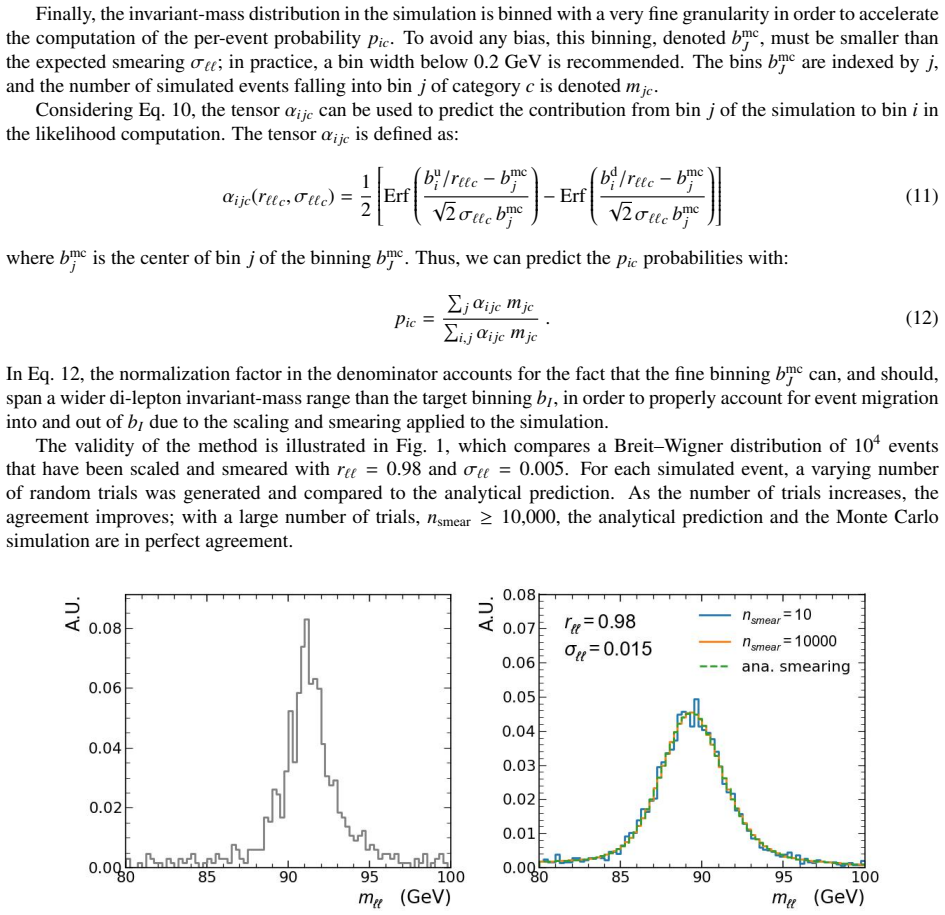
The key object is the tensor alpha_ijc (Eq. 11): for each di-lepton category c, the probability that a simulated event in fine bin j migrates to data bin i after applying scale r and resolution sigma, expressed with error functions. It turns the binned likelihood into a smooth, differentiable function of r and sigma, so automatic differentiation can compute gradients exactly. For photons, the observable V_DY (Eq. 24) replaces the invariant mass, making the same machinery applicable to Z->mumu-gamma events. The relative-pT variable r_pT = pT/m_ll is the workaround that removes category-migration biases when calibration categories depend on lepton transverse momentum.
What would settle it
A concrete check: generate Z->ll events with a much larger injected resolution (for example sigma_l = 5-10%) and fit the parameters; if the recovered scale or resolution drifts beyond the reported uncertainty, the Gaussian approximation of Eq. (9) is falsified. Alternatively, compute the exact distribution of m_ll from the product of two independent Gaussian-smearing factors and compare it to the assumed Gaussian shape; any visible deviation at the resolution values used in real experiments would bound the method's validity.
Extended reading notes
Core claim
The central claim is that Eqs. (9) and (11), which model each simulated di-lepton event's smeared mass as a Gaussian with mean r_ll times the Monte Carlo mass and width r_ll sigma_ll times that same mass, and which bin this Gaussian via error functions, yield a likelihood whose fitted parameters are unbiased and whose covariance is accurate. The error-function tensor alpha_ijc turns the binned convolution into a dense but differentiable operation, so gradients can be computed exactly. A relative-pT variable r_pT = pT/m_ll is introduced to avoid biases when categories depend on lepton pT, and a two-step fit (scale first, then resolution) recovers injected parameters in realistic Drell-Yan sim
Load-bearing premise
The whole fit rests on approximating the smeared di-lepton invariant mass as Gaussian with mean r_ll times the Monte Carlo mass and width r_ll sigma_ll times that mass (Eq. 9); because m_ll is a product of two Gaussian-smeared pT values, this is only exact in a small-resolution limit, and the paper does not quantify where it breaks.
Editorial extensions
If this is right
- Lepton energy scale and resolution can be simultaneously extracted per category with exact gradients, making large-scale multi-parameter calibrations (100+ parameters, 20M events) run in minutes instead of days.
- Finite-MC-statistics uncertainties are propagated to the fitted parameters through an analytic linear-response formula, so the fit reports correct total uncertainties even when simulation size is limiting.
- pT-dependent calibrations become usable without bias by rebinning in r_pT rather than absolute pT, and correcting scale before measuring resolution.
- Photon energy scale can be measured in Z->mumu-gamma events using the same likelihood, with a small iterative correction for the V_DY approximation.
- The same analytical machinery can run on any framework supporting automatic differentiation, including GPUs, making it well suited for the precision-calibration environment of a large collider experiment.
Reading between the lines
- The Gaussian form of Eq. (9) is a first-order approximation; if the lepton pT resolution is large, the exact product-of-Gaussians distribution will deviate, so the claimed unbiasedness likely has a regime bound in resolution fraction.
- The V_DY bias for photon resolution smearing above ~2% (Sections 5.4.1-5.4.2) suggests a two-pass strategy: fit resolution from Z->ee events, then smear the simulation and re-fit the photon scale, rather than extracting both simultaneously.
- The method's speed opens the possibility of per-event calibration as a function of many variables at once, something that was previously prohibitive with random smearing.
- A natural stress test is to run the same likelihood with a non-Gaussian smearing model (e.g., a double-sided Crystal Ball); the error-function integral approach may be generalizable beyond Gaussian shapes.
Signed reviews
Editorial analysis
A structured set of objections, weighed in public.
Referee Report
Summary. The paper presents an analytical likelihood method (IJazZ2.0) for extracting per-category lepton energy scale and resolution corrections from Z→ℓℓ decays, replacing random-smearing convolution with a fully differentiable error-function-based likelihood. The central formulas are the per-lepton Gaussian smearing model (Eq. 4), the combination rules for dilepton scale and resolution (Eq. 6), the Gaussian form of the smeared invariant mass (Eq. 9), and the tensor α_ijc that maps finely binned simulation to data bins (Eq. 11). The method is validated with a toy Breit–Wigner MC and a realistic Pythia Z→ℓℓ sample, showing unbiased parameter recovery at σ_sim=1.5%. A relative-pT categorization is introduced to mitigate migration biases. The approach is extended to photon energy calibration using Z→µµγ decays via a new observable V_DY (Eq. 24), with an iterative fitting procedure and a documented set of biases for large resolutions and pT cuts. The paper also derives an analytical formula for MC-statistical uncertainties (Eqs. 15–19) and reports large CPU gains from automatic differentiation.
Significance. If the derivation were exact as claimed, the method would be a valuable, fast, and numerically stable calibration tool for LHC precision measurements. The paper has concrete strengths: it ships reproducible software on PyPI, demonstrates the CPU gain quantitatively, validates the likelihood against random-smearing, and explicitly documents some limitations in the photon case (Sec. 5.4). The analytical treatment of finite-MC-statistics uncertainties is an ambitious and useful contribution. However, the central Gaussian propagation step (Eq. 9) is only a first-order approximation, and the exactness claim is not supported; the MC-uncertainty derivative (Eq. 15) appears to be missing a normalization factor. These issues affect the core claim of unbiased parameter recovery and accurate uncertainties. With corrections and additional validation, the method could become a solid contribution.
major comments (3)
- [§2.3, Eq. (9)] Eq. (9) is presented as a consequence of Eqs. (4) and (6), but it is not exact. From Eq. (1), m_ll² ∝ p_T1 p_T2; under independent Gaussian smearing of each p_T (Eq. 4), the conditional distribution of m_ll is that of a constant times the square root of a product of two Gaussians, which is not Gaussian. To second order in σ, the mean is shifted by ≈ −m_mc sqrt(r1 r2)(σ1²+σ2²)/8 and the distribution is skewed. Eq. (9) is therefore a first-order delta-rule approximation that is never stated or quantified. Since the α tensor (Eq. 11) and the likelihood (Eq. 12) inherit this Gaussian form, the extracted r_b and σ_b and their Hessian uncertainties carry the neglected bias. The Pythia validation uses σ_sim=1.5%, where the bias is ~5×10⁻⁵ relative and invisible; it does not test larger resolutions (high-|η| electrons, high-pT muons). Please either prove the Gaussian form or explicitly introduce
- [§3, Eq. (15)] The derivative of the NLL with respect to the MC bin content m_jc is missing a normalization factor. With p_ic = A_ic/S_c, A_ic = Σ_j α_ijc m_jc, S_c = Σ_i A_ic, the correct derivative is δnll/δm_jc = (1/S_c)[ n_c Σ_i α_ijc − Σ_i n_ic α_ijc / p_ic ]. Eq. (15) as written lacks the 1/S_c factor; the stated definitions n_c ≡ Σ_i n_ic and p_c ≡ Σ_i p_ic (=1) do not repair the dimensional inconsistency. Because Eq. (19) and the validation in Fig. 4 build on this derivative, please correct Eq. (15), verify against the code, and confirm that Fig. 4 was produced with the corrected formula.
- [§4, Fig. 7] The claim of unbiased parameter recovery is qualified only by the first-pT-bin bias, but the relative-pT recasting procedure itself is heuristic: the absolute-pT bin edges are reconstructed from average relative-pT values, and the two-step fit fixes scale before extracting smearing. The paper asserts this 'closely reproduces' the original categories without a quantitative comparison. Given that the method is intended for differential calibration, please provide a quantitative check of the recast bin accuracy (e.g., bin-by-bin differences in injected parameters or in fitted parameters versus the original absolute-pT categorization).
minor comments (5)
- [Abstract and Introduction] The phrase 'exact analytical treatment' is too strong. Consider wording such as 'analytic treatment within a Gaussian-smearing approximation'.
- [Eq. (6)] The notation for the resolution combination is garbled: 'σℓℓc =0.5× q σℓ2 b1 +σ ℓ2 b2' should be typeset as σℓℓc = 0.5√(σℓ_b1² + σℓ_b2²).
- [Sec. 5.4, Fig. 10] The 'naive bias prediction' is described only verbally. Please provide the exact formula used to produce the dashed curve so the reader can reproduce it.
- [Sec. 4, second fit] The statement that the second fit converges to the same smearing parameters as the first 'because no correlations are introduced' in the absolute-pT case could be expanded: a short explanation of why relative-pT introduces correlations would help.
- [References] Reference [3] is the software repository; it would be useful to mention the version number and a DOI if available.
Circularity Check
No circularity: the free likelihood parameters are fitted against independent injected/pseudo-data decalibrations, and the only self-citation is the non-load-bearing software reference.
full rationale
The derivation chain is self-contained and does not reduce any predicted quantity to an input of the fit. The scale and resolution parameters r_lb and sigma_lb appear as free parameters of the multinomial negative log-likelihood (Eqs. 7-8), with the expected probabilities built from the analytic error-function smearing tensor alpha_ijc (Eqs. 10-12). These parameters are then extracted by maximum likelihood and compared to separately injected decalibration and smearing values in toy and Pythia-based pseudo-data; the validation is therefore a standard closed-loop parameter-recovery check, not a recycling of fitted quantities as predictions. The V_DY construction for photons (Eqs. 22-25) is derived from event kinematics and a first-order Taylor expansion, and its agreement with simulation is a check of that approximation rather than an output that was used to define the fit. The self-citation [3] is only the PyPI software distribution and carries no theoretical load. The only substantive concern is non-circular: Eq. 9 propagates single-lepton Gaussian pT smearing to m_ll as a Gaussian with width r_ll sigma_ll m_mc, which is a first-order approximation not stated or quantified in the paper; this affects the accuracy of the method at large resolutions or kinematic cuts, but it is a modeling approximation, not a case where a claimed prediction is identical to a fitted input by construction.
Assumptions & free parameters
free parameters (6)
- Per-category scale parameters r_lb =
fitted by likelihood
- Per-category smearing parameters sigma_lb =
fitted by likelihood
- Lepton category binning N_B and bin edges
- Adaptive binning defaults (min 100 events/category; N_bins=min(N^(1/3), DeltaM/0.5 GeV); fine MC width <0.2 GeV) =
defaults
- Relative-pT bin mapping and recast to absolute pT
- Photon V_DY fit window and pT-gamma selection =
pT_gamma>25 GeV; 80<m_mu_mu_gamma<100 GeV
assumptions (7)
- standard math Analytical Gaussian-bin integrals via error functions and covariance from inverse Hessian are valid.
- domain assumption Residual data/MC energy differences follow a Gaussian smearing model (Eq. 4).
- domain assumption Delta_eta and Delta_phi are perfectly measured and contribute no smearing or bias to m_ll.
- domain assumption Single-lepton corrections combine to a Gaussian di-lepton mass distribution via Eqs. 6 and 9.
- domain assumption The binned data are multinomially distributed and the MC histogram m_jc is a faithful template (Eqs. 7 and 12).
- ad hoc to paper V_DY is a valid photon-calibration observable with an additive scale shift (Eqs. 24-25).
- ad hoc to paper Relative pT = pT/m_ll categorization removes migration biases, and the recast absolute-pT binning is representative.
Cite this review
Pith. "Pith review of Lepton and photon energy scale and resolution corrections based on the minimization of an analytical likelihood: IJazZ2.0." pith.science (2026). https://pith.science/paper/KPAYV4PY
@misc{pith2026260217300,
  author       = {Pith},
  title        = {Pith review of: Lepton and photon energy scale and resolution corrections based on the minimization of an analytical likelihood: IJazZ2.0},
  year         = {2026},
  howpublished = {\url{https://pith.science/paper/KPAYV4PY}},
  note         = {Machine review of arXiv:2602.17300}
}
abstract
We present a novel method to determine lepton energy scale and resolution corrections by means of an analytical likelihood maximization applied to Drell--Yan \(Z \to \ell\ell\) events. The approach relies on an exact analytical treatment of the Gaussian energy smearing model, avoiding random-number-based convolution techniques. This formulation results in a fully differentiable likelihood enabling the use of automatic differentiation algorithms, and thus a substantial reduction in computational cost. The method, implemented in the \ijazz software, allows the simultaneous extraction of scale and resolution parameters across multiple lepton categories defined by detector or kinematic variables. We validate the technique using toy Monte Carlo studies and realistic Pythia-based simulations, demonstrating unbiased parameter recovery and accurate uncertainty estimates. Particular attention is given to categorizations involving lepton transverse momentum, for which a relative-\(p_T\) strategy is introduced to mitigate biases induced by category migration and kinematic correlations. The method is further adapted to photon-energy scale measurement in \(Z \to \mu^+\mu^-\gamma\) decays. Compared to conventional approaches, the analytical method improves numerical stability, robustness of the minimization, and computational performance, making it well suited for large-scale precision calibration tasks at the LHC.
Figures


Figures from the paper (8 more)


Reference graph
Works this paper leans on
-
[1]
Navas, et al
S. Navas, et al. (Particle Data Group), Review of particle physics, Phys. Rev. D 110 (2024) 030001. doi:10. 1103/PhysRevD.110.030001
2024
-
[2]
A. G. Baydin, B. A. Pearlmutter, A. A. Radul, J. M. Siskind, Automatic differentiation in machine learning: a sur- vey, Journal of Machine Learning Research 18 (2018) 1–43. URL:http://jmlr.org/papers/v18/17-468. html
2018
-
[3]
Couderc, P
F. Couderc, P. Gaigne, O. Sahin, IJazZ: I Just AnalyZe the Z, 2025. URL:https://pypi.org/project/ ijazz/, python package distributed via PyPI
2025
-
[4]
doi:10.1088/1748-0221/16/05/P05014.arXiv:2012.06888
CMS Collaboration, Electron and photon reconstruction and identification with the CMS experiment at the CERN LHC, JINST 16 (2021) P05014. doi:10.1088/1748-0221/16/05/P05014.arXiv:2012.06888
arXiv 2021
-
[5]
Abadi, A
M. Abadi, A. Agarwal, P. Barham, E. Brevdo, Z. Chen, C. Citro, G. S. Corrado, A. Davis, J. Dean, M. Devin, S. Ghemawat, I. Goodfellow, A. Harp, G. Irving, M. Isard, Y . Jia, R. Jozefowicz, L. Kaiser, M. Kudlur, J. Lev- enberg, D. Mané, R. Monga, S. Moore, D. Murray, C. Olah, M. Schuster, J. Shlens, B. Steiner, I. Sutskever, K. Talwar, P. Tucker, V . Vanho...
2015
-
[6]
C. Bierlich, S. Chakraborty, N. Desai, L. Gellersen, I. Helenius, P. Ilten, L. Lönnblad, S. Mrenna, S. Prestel, C. T. Preuss, T. Sjöstrand, P. Skands, M. Utheim, R. Verheyen, A comprehensive guide to the physics and usage of pythia 8.3, 2022. URL:https://arxiv.org/abs/2203.11601.arXiv:2203.11601. 17
arXiv 2022
Reviewed August 2, 2026 · model on record in the stance chip above.
Discussion (0). Continue with ORCID to comment.