Hartree shift and pairing gap in ultracold Fermi gases in the framework of low-momentum interactions
Pith reviewed 2026-05-25 07:31 UTC · model grok-4.3
The pith
A momentum-dependent interaction scaled with the Fermi momentum yields third-order Hartree shift and pairing gap results that match known weak-coupling corrections in ultracold Fermi gases.
A machine-rendered reading of the paper's core claim, the machinery that carries it, and where it could break.
Core claim
Using a low-momentum interaction that matches contact-interaction phase shifts up to a Fermi-momentum-scaled cutoff inside self-consistent Bogoliubov perturbation theory, the Hartree shift and pairing gap are obtained to third order; the results reproduce established weak-coupling corrections and show reasonable agreement with experiment and Monte-Carlo calculations closer to unitarity.
What carries the argument
Momentum-dependent interaction reproducing s-wave phase shifts of a contact interaction up to a cutoff scaled with the Fermi momentum, inside a diagrammatic self-consistent Bogoliubov many-body perturbation theory.
If this is right
- In the weak-coupling regime the third-order results are well converged and recover the Gor'kov-Melik-Barkhudarov corrections for the gap and the Galitskii result for the Hartree shift.
- Near unitarity the Nambu-Gor'kov self-energy remains only partially converged but still produces values consistent with existing experiments and quantum Monte-Carlo simulations.
- The same framework can be refined by adding higher-order diagrams or adapted to neutron-matter calculations.
Where Pith is reading between the lines
- The cutoff scaling with density could be varied to test sensitivity of the gap and shift to the precise ultraviolet regularization.
- Direct comparison of the computed self-energy at several intermediate coupling strengths against newer quantum Monte-Carlo data would quantify the remaining truncation error.
- The method's diagrammatic structure naturally lends itself to finite-temperature extensions that could be checked against thermodynamic measurements in trapped gases.
Load-bearing premise
The chosen momentum-dependent interaction captures the essential low-energy scattering physics when its cutoff is scaled with the Fermi momentum and the added self-consistency conditions correctly extend the perturbative expansion.
What would settle it
A calculation at a weak-coupling value of the interaction strength where the third-order gap or Hartree shift deviates from the Gor'kov-Melik-Barkhudarov or Galitskii analytic results by more than a few percent would show the method fails to converge as claimed.
Figures




read the original abstract
In this paper we consider a two-component gas of fermions on the BCS side of the BCS-BEC crossover at zero temperature. We use a momentum dependent interaction that reproduces the s-wave scattering phase shifts of a contact interaction up to a momentum cutoff that is scaled with the Fermi momentum. Using a diagrammatic formulation of Bogoliubov many-body perturbation theory, suitably augmented by self-consistency conditions, we obtain the Hartree shift and the pairing gap to third order. In the weak-coupling regime, our results are not only well-converged but also agree with the well-established Gor'kov-Melik-Barkhudarov corrections for the gap and the Galitskii result for the Hartree shift. Near the unitary regime, our results for the Nambu-Gor'kov self-energy are less converged, but there is still reasonable agreement with experiments as well as with quantum Monte-Carlo results. Perspectives for improvements and applications of this approach to neutron matter are discussed.
Editorial analysis
A structured set of objections, weighed in public.
Referee Report
Summary. The paper computes the Hartree shift and pairing gap at T=0 for a two-component Fermi gas on the BCS side of the crossover using a momentum-dependent low-momentum interaction that matches s-wave phase shifts of a contact interaction up to a cutoff scaled with k_F. It employs a self-consistent diagrammatic formulation of Bogoliubov many-body perturbation theory to third order in the Nambu-Gor'kov formalism. Results show good convergence and agreement with Gor'kov-Melik-Barkhudarov gap corrections and Galitskii Hartree shift in weak coupling; near unitarity convergence is poorer but agreement with experiment and QMC remains reasonable. Perspectives for neutron-matter applications are noted.
Significance. If the central results hold, the work demonstrates a controlled perturbative framework for incorporating low-momentum interactions into self-consistent diagrammatic calculations of the BCS-BEC crossover, recovering established weak-coupling benchmarks while providing a route to systematic higher-order corrections. The explicit discussion of applications to neutron matter is a strength.
major comments (2)
- [Abstract] Abstract: the momentum-dependent interaction is defined to reproduce contact phase shifts only up to a cutoff scaled with the Fermi momentum. This choice renders the effective interaction explicitly density-dependent (k_F ~ n^{1/3}), unlike the physical contact interaction with fixed scattering length a. The resulting density dependence is load-bearing for the unitary-regime claims, as it may alter the self-consistent Nambu-Gor'kov self-energy and extracted gap without being a controlled approximation to the fixed-a system.
- [Abstract] Abstract: poorer convergence of the Nambu-Gor'kov self-energy is reported near unitarity, yet the manuscript still asserts 'reasonable agreement' with QMC and experiment. Without quantitative convergence diagnostics (e.g., cutoff variation, order-by-order changes, or error estimates) in the results section, the robustness of the unitary-regime comparison cannot be assessed.
minor comments (1)
- Notation for the self-consistent equations and the precise definition of the cutoff scaling should be clarified with an explicit equation in the methods section.
Simulated Author's Rebuttal
We thank the referee for the careful reading of our manuscript and the constructive comments. We respond to each major comment below.
read point-by-point responses
-
Referee: [Abstract] Abstract: the momentum-dependent interaction is defined to reproduce contact phase shifts only up to a cutoff scaled with the Fermi momentum. This choice renders the effective interaction explicitly density-dependent (k_F ~ n^{1/3}), unlike the physical contact interaction with fixed scattering length a. The resulting density dependence is load-bearing for the unitary-regime claims, as it may alter the self-consistent Nambu-Gor'kov self-energy and extracted gap without being a controlled approximation to the fixed-a system.
Authors: The density dependence arising from scaling the cutoff with k_F is a deliberate and standard feature of low-momentum interaction approaches (as used in nuclear physics contexts, including the neutron-matter applications noted in the manuscript). It ensures the cutoff remains above the relevant Fermi-sea momenta at each density, improving perturbative convergence. The model is not presented as an exact reproduction of a fixed-a contact interaction at all densities but as an effective description matching s-wave phase shifts up to the cutoff. The unitary regime is accessed by taking the scattering length to infinity while retaining the cutoff scaling. We will add a clarifying sentence to the abstract noting this density dependence by construction. revision: partial
-
Referee: [Abstract] Abstract: poorer convergence of the Nambu-Gor'kov self-energy is reported near unitarity, yet the manuscript still asserts 'reasonable agreement' with QMC and experiment. Without quantitative convergence diagnostics (e.g., cutoff variation, order-by-order changes, or error estimates) in the results section, the robustness of the unitary-regime comparison cannot be assessed.
Authors: The referee correctly identifies that the current text relies on qualitative statements about convergence near unitarity. We will revise the results section to include quantitative diagnostics: specifically, plots or tables showing the variation of the gap and Hartree shift with the cutoff prefactor (Lambda = c k_F) and the changes between second- and third-order results at unitarity. These will support the assessment of 'reasonable agreement' with QMC and experiment. revision: yes
Circularity Check
No significant circularity; derivation uses independent perturbation theory matched to external benchmarks
full rationale
The paper applies standard diagrammatic Bogoliubov many-body perturbation theory (augmented by self-consistency) to a low-momentum interaction chosen to reproduce contact-interaction phase shifts up to a scaled cutoff. In the weak-coupling limit the computed Hartree shift and gap are shown to recover the independent Galitskii and Gor'kov-Melik-Barkhudarov results; near unitarity they are compared to external QMC and experimental data. No equation reduces by construction to a fitted parameter, self-citation, or input ansatz, and no uniqueness theorem or prior self-work is invoked to force the outcome.
Axiom & Free-Parameter Ledger
axioms (1)
- domain assumption Bogoliubov many-body perturbation theory applies to the zero-temperature BCS-side Fermi gas
Lean theorems connected to this paper
-
IndisputableMonolith/Cost/FunctionalEquation.leanwashburn_uniqueness_aczel unclear?
unclearRelation between the paper passage and the cited Recognition theorem.
momentum dependent interaction that reproduces the s-wave scattering phase shifts of a contact interaction up to a momentum cutoff that is scaled with the Fermi momentum... diagrammatic formulation of Bogoliubov many-body perturbation theory... Nambu-Gor'kov self-energy
-
IndisputableMonolith/Foundation/AbsoluteFloorClosure.leanreality_from_one_distinction unclear?
unclearRelation between the paper passage and the cited Recognition theorem.
scale the cutoff Λ with the Fermi momentum k_F
What do these tags mean?
- matches
- The paper's claim is directly supported by a theorem in the formal canon.
- supports
- The theorem supports part of the paper's argument, but the paper may add assumptions or extra steps.
- extends
- The paper goes beyond the formal theorem; the theorem is a base layer rather than the whole result.
- uses
- The paper appears to rely on the theorem as machinery.
- contradicts
- The paper's claim conflicts with a theorem or certificate in the canon.
- unclear
- Pith found a possible connection, but the passage is too broad, indirect, or ambiguous to say the theorem truly supports the claim.
Reference graph
Works this paper leans on
-
[1]
We need a function that computes for givenk F and ∆: (a) the effective chemical potentialµ ∗ and the first-order mean fieldU (1) k such that k3 F 3π2 = Z d3k (2π)3 v2 k .(39) where theuandvfactors are computed with the given ∆ and not with ∆ (1). (b) the first-order gap ∆ (1). (c) the second-order mean fieldU (2) and gap ∆(2). (d) the third-order gap ∆(3)...
-
[2]
Find the self-consistent value of ∆ by solving the non-linear equation ∆ = ∆(1) + ∆(2) + ∆(3) .(40)
-
[3]
Illustration of the self-consistent procedure Let us illustrate the procedure defined by Eq
ComputeU (3) [diagrams (3.1)-(3.4)] to obtain the mean field shift U=U (1) +U (2) +U (3) .(41) B. Illustration of the self-consistent procedure Let us illustrate the procedure defined by Eq. (40) in a specific case. We choose (k Fa)−1 =−2, corresponding to a relatively weak coupling where one expects pertur- bation theory to converge. The HFB solution cor...
-
[4]
1(a), corresponding to a factorG (0) αβ(k, ω)
As usual with Fermions, we draw the matrix Green’s function as a line with an arrow, see Fig. 1(a), corresponding to a factorG (0) αβ(k, ω)
-
[5]
The interaction vertices generated by the two-body interaction term ˆHint are diagonal in the Nambu indices. If one of the in- and outgoing Fermion lines has Nambu index 1, the other line must have Nambu index 2 (and vice versa), as shown in Fig. 1(b). Each interaction is associated with a factor of−V k+p′ 2 , k′+p 2 , where the negative sign comes from Eq. (8)
-
[6]
1(c), and they are associated with a factor of−H mf,αβ(k)
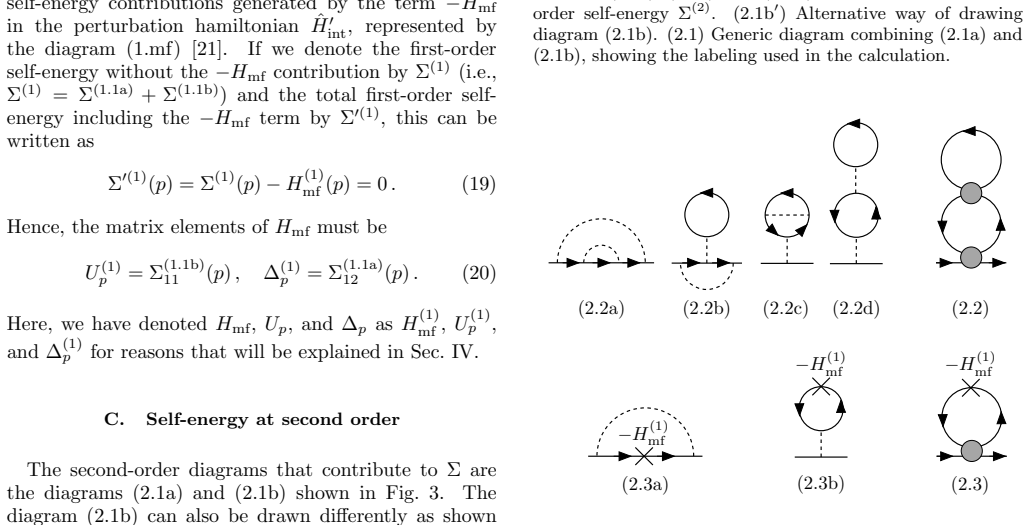
The interaction vertices generated by the one-body interaction term− ˆHmf are represented by a cross as shown in Fig. 1(c), and they are associated with a factor of−H mf,αβ(k)
-
[7]
Each vertex conserves energy and momentum, the remainingN i unconstrained energies and momenta are integrated over with a factori Ni /(2π)4Ni, un- constrained Nambu indices are summed over, and each closed Fermion loop gives rise to a factor (−1). 13
-
[8]
If a loop contains only one propagatorG (0) 11 or G(0) 22 , it is necessary to multiply it by a factore iηω ore −iηω, respectively (withη→0 +) [21], such that the result of the integration overωis±2πiv 2 k, whereas forG (0) 12 andG (0) 21 the result of theωinte- gration is−2πiu kvk, independently of such a factor. Appendix B: Symmetry properties of the se...
-
[9]
− B1B2B3A4A5 E2345(ω−E − 145) − A1B2B3A4A5 E2345(ω+E −
-
[10]
− A1A2A3B4B5 E2345(ω+E − 145) + B1A2A3A4A5 (ω−E − 123)(ω−E − 145) − A1B2B3B4B5 (ω+E − 123)(ω+E −
-
[11]
(C10) The five momenta are not independent but they have to satisfyp+k 1 =k 2 +k 3 =k 4 +k 5, i.e., we can choose, e.g.,k 1,k 2, andk 4 as integration variables. Denoting the vertices in each diagram (3.2i) byV (3.2i) A ,V (3.2i) B , and V (3.2i) C , we can write the contribution of diagram (3.2i) as Σ(3.2i) αβ (ω) = Z d3k1 (2π)3 Z d3k2 (2π)3 Z d3k4 (2π)3...
-
[12]
+ A1A2B3B4A5 E2345(ω−E − 145) + B1A2B3B4A5 E2345(ω+E −
-
[13]
+ B1B2A3A4B5 E2345(ω+E − 145) − A1B2A3B4A5 (ω−E − 123)(ω−E − 145) + B1A2B3A4B5 (ω+E − 123)(ω+E −
-
[14]
(C10), but theAandB(i.e.,uandv) factors in the numerators appear in different combinations
(C17) We see the same energy denominators as in Eq. (C10), but theAandB(i.e.,uandv) factors in the numerators appear in different combinations. Again, we can choose three out of the five momentak 1 . . .k5 as integration variables, the two remaining momenta are then deter- mined by the relationshipsp−k 1 =k 3 −k 2 =k 5 −k 4. Analogously to Eq. (C11), we w...
-
[15]
M. J. H. Ku, A. T. Sommer, L. W. Cheuk, and M. W. Zwierlein, Revealing the Superfluid Lambda Transition in the Universal Thermodynamics of a Unitary Fermi Gas, Science335, 563 (2012)
work page 2012
-
[16]
M. Horikoshi, M. Koashi, H. Tajima, Y. Ohashi, and M. Kuwata-Gonokami, Ground-State Thermodynamic Quantities of Homogeneous Spin-1/2 Fermions from the BCS Region to the Unitarity Limit, Phys. Rev. X7, 041004 (2017)
work page 2017
-
[17]
G. Calvanese Strinati, P. Pieri, G. R¨ opke, P. Schuck, and M. Urban, The BCS-BEC crossover: From ultra- cold Fermi gases to nuclear systems, Phys. Rep.738, 1 (2018)
work page 2018
-
[18]
G. A. Baker, Neutron matter model, Phys. Rev. C60, 054311 (1999)
work page 1999
-
[19]
J. Stewart, J. Gaebler, and D. Jin, Using photoemission spectroscopy to probe a strongly interacting Fermi gas, Nature454, 744 (2008)
work page 2008
-
[20]
L. P. Gor’kov and T. K. Melik-Barkhudarov, Contribu- tion to the theory of superfluidity in an imperfect Fermi gas, Zh. Exp. Teor. Fiz.40, 1452 (1961)
work page 1961
-
[21]
A. Gezerlis and J. Carlson, Strongly paired fermions: Cold atoms and neutron matter, Phys. Rev. C77, 032801 (2008)
work page 2008
-
[22]
H. Biss, L. Sobirey, N. Luick, M. Bohlen, J. J. Kinnunen, G. M. Bruun, T. Lompe, and H. Moritz, Excitation Spec- trum and Superfluid Gap of an Ultracold Fermi Gas, Phys. Rev. Lett.128, 100401 (2022)
work page 2022
- [23]
-
[24]
M. Urban and S. Ramanan, Low-momentum interactions for ultracold Fermi gases, Phys. Rev. A103, 063306 (2021)
work page 2021
-
[25]
S. Ramanan and M. Urban, Screening and antiscreening of the pairing interaction in low-density neutron matter, Phys. Rev. C98, 024314 (2018)
work page 2018
-
[26]
P. Pieri and G. C. Strinati, Strong-coupling limit in the evolution from BCS superconductivity to Bose-Einstein condensation, Phys. Rev. B61, 15370 (2000)
work page 2000
-
[27]
C. A. R. S´ a de Melo, M. Randeria, and J. R. Engelbrecht, Crossover from BCS to Bose superconductivity: Transi- tion temperature and time-dependent Ginzburg-Landau theory, Phys. Rev. Lett.71, 3202 (1993)
work page 1993
-
[28]
S. K. Bogner, A. Schwenk, R. J. Furnstahl, and A. Nogga, Is nuclear matter perturbative with low-momentum in- teractions?, Nucl. Phys. A763, 59 (2005)
work page 2005
-
[29]
A. Schwenk, B. Friman, and G. E. Brown, Renormal- ization group approach to neutron matter: quasiparticle interactions, superfluid gaps and the equation of state, Nucl. Phys. A713, 191 (2003)
work page 2003
-
[30]
P.-L. Taillat and H. Kurkjian, A low-energy effec- tive Hamiltonian for Landau quasiparticles (2025), arXiv:2511.15938 [cond-mat.quant-gas]
-
[31]
M. Urban and S. Ramanan, Neutron pairing with medium polarization beyond the Landau approximation, Phys. Rev. C101, 035803 (2020)
work page 2020
-
[32]
V. Palaniappan, S. Ramanan, and M. Urban, Equation of state of superfluid neutron matter with low-momentum interactions, Phys. Rev. C107, 025804 (2023)
work page 2023
-
[33]
V. Palaniappan, S. Ramanan, and M. Urban, Induced three-neutron interactions with low cutoffs for dilute neu- tron matter, Phys. Rev. C111, 035803 (2025)
work page 2025
-
[34]
Tabakin, Inverse Scattering Problem for Separable Po- tentials, Phys
F. Tabakin, Inverse Scattering Problem for Separable Po- tentials, Phys. Rev.177, 1443 (1969)
work page 1969
-
[35]
J. R. Schrieffer,Theory of Superconductivity(W. A. Ben- jamin, New York, 1964)
work page 1964
- [36]
- [37]
-
[38]
A. Schirotzek, Y.-i. Shin, C. H. Schunck, and W. Ketterle, Determination of the Superfluid Gap in Atomic Fermi Gases by Quasiparticle Spectroscopy, Phys. Rev. Lett. 101, 140403 (2008)
work page 2008
- [39]
-
[40]
R. Haussmann, W. Rantner, S. Cerrito, and W. Zwerger, Thermodynamics of the BCS-BEC crossover, Phys. Rev. A75, 023610 (2007)
work page 2007
-
[41]
S. K. Bogner, R. J. Furnstahl, and A. Schwenk, From low-momentum interactions to nuclear structure, Prog. Part. Nucl. Phys.65, 94 (2010)
work page 2010
-
[42]
S. Ramanan and M. Urban, BEC-BCS Crossover in Neu- tron Matter with Renormalization Group based Effective Interactions, Phys. Rev. C88, 054315 (2013)
work page 2013
-
[43]
S. Ramanan and M. Urban, Pairing in pure neutron mat- ter, Eur. Phys. J. ST230, 567 (2021)
work page 2021
- [44]
-
[45]
V. M. Galitskii, The energy spectrum of a non-ideal Fermi gas, Sov. Phys. JETP34, 104 (1958)
work page 1958
-
[46]
A. L. Fetter and J. D. Walecka,Quantum Theory of Many-Particle Systems(McGraw-Hill, New York, 1971)
work page 1971
-
[47]
C. Wellenhofer, C. Drischler, and A. Schwenk, Effective field theory for dilute Fermi systems at fourth order, Phys. Rev. C104, 014003 (2021)
work page 2021
-
[48]
Tinkham,Introduction to superconductivity (McGraw-Hill, 1975)
M. Tinkham,Introduction to superconductivity (McGraw-Hill, 1975)
work page 1975
discussion (0)
Sign in with ORCID, Apple, or X to comment. Anyone can read and Pith papers without signing in.