REVIEW 1 major objections 3 minor 33 references
Simulating quantum measurements without superposition devices
T0 review · 1 major / 3 minor · reviewed 2026-08-02 · deepseek-v4-flash
Pith's one-line read This paper claims that every noisy projective measurement in dimension d admits a simulation using only fixed-basis (no-superposition) devices exactly up to visibility (H_d − 1)/(d − 1).
desk verdict A genuinely new intermediate measurement class with an elegant Haar construction, but the exact-threshold proof has a fixable gap in the state-simulation equivalence; the result is very likely correct via the known JM bound. read the letter →
The pith
A machine-rendered reading of the paper's core claim, the machinery that carries it, and where it could break.
The reading
What carries the argument
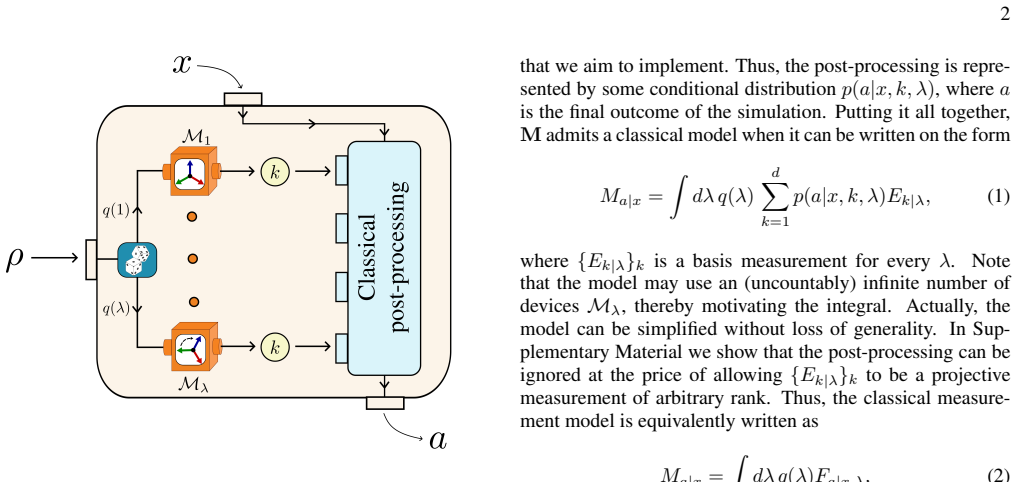
The central object is the classical measurement model: a hidden variable λ with distribution q(λ) chooses a rank-one basis measurement {E_{k|λ}}_k, and a classical post-processing p(a|x,k,λ) produces the target POVM M_{a|x} = ∫ dλ q(λ) Σ_k p(a|x,k,λ) E_{k|λ}. The paper shows the post-processing can be absorbed into higher-rank commuting projectors without loss of generality. The threshold proof leverages a one-to-one equivalence between classical models for trace-1 measurements and classical models for the corresponding state ensemble, combined with a Haar-measure construction in which the post-processing selects the basis vector that best matches the target.
What would settle it
For d = 3 the claimed threshold is 5/12 ≈ 0.4167. Directly searching for a classical model of all depolarized projective measurements at visibility 0.42, without relying on the state-simulation equivalence, would falsify the claim if such a model is found.
Extended reading notes
Core claim
The paper's discovery is the exact critical visibility v* = (H_d − 1)/(d − 1) for the set of all projective measurements in d-dimensional quantum theory under depolarizing noise. Below this visibility, every basis measurement can be reproduced by an ensemble of single-basis devices followed by classical post-processing; above it, no such classical model exists. The proof works through a one-to-one correspondence, for trace-1 measurements, between classical measurement simulability and the classical state simulability of the associated state ensemble. Alongside the threshold, the paper shows that classical measurement models form a convex, closed set strictly between commutative measurements
Load-bearing premise
The exact threshold rests on the claim that a classical model for a set of trace-1 measurements is equivalent to a classical model for the corresponding set of states; this equivalence requires the hidden-variable weights to form a properly normalized conditional distribution, which the trace-1 condition alone does not guarantee.
Editorial extensions
If this is right
- Below the threshold v* = (H_d − 1)/(d − 1), every projective measurement in dimension d is classically simulable; above it, at least some projective measurements require genuine superposition resources in the simulating device.
- Classical measurement models are strictly intermediate: every commuting set is classical, every classical set is jointly measurable, and both inclusions are strict for d ≥ 2.
- Classical simulability of a pair of measurements implies they admit a non-disturbing sequential implementation, a property joint measurability alone does not guarantee.
- The same simulation construction gives a loss threshold η* = d(1−v)/(d−1) for v > 1/2, extending the classical model to inefficient detectors.
- Finite sets of measurements admit both constructive (linear-programming) and falsifying (state-discrimination witness) methods for classical simulability, with explicit visibility bounds for SIC-POVMs and mutually unbiased bases.
Reading between the lines
- A natural extension is to test whether the measurement–state equivalence persists for non-trace-1 POVMs; the paper's SIC-POVM counterexample suggests the hierarchy shifts when the trace condition is dropped, so the exact threshold for all POVMs may differ from v*.
- The witness framework could be adapted to certify that a specific physical device genuinely requires superposition, for example by scanning the visibility of an implemented depolarized measurement set and locating the transition where the classical bound is crossed.
- Because the threshold coincides with the joint measurability threshold for all von Neumann measurements, it may also serve as a benchmark for other resource theories where superposition-free simulation is the free operation, such as steering or state discrimination under no-superposition constraints.
Editorial analysis
A structured set of objections, weighed in public.
Referee Report
Summary. The paper introduces classical measurement models for sets of POVMs, in which a hidden variable selects one of several devices that each perform a fixed-basis projective measurement, followed by classical post-processing. The main results are (i) an exact depolarization threshold v*=(H_d-1)/(d-1) below which all d-dimensional projective measurements admit such a model and above which they do not; (ii) a corresponding loss threshold; (iii) numerical linear-programming/SDP methods for constructing and falsifying classical models for finite sets; and (iv) an operational application showing that classical simulability of a pair of measurements implies a non-disturbing sequential implementation. The proofs use Haar-averaged constructions and a claimed equivalence with the authors' earlier classical-state-simulation model. The paper is clearly written and includes a public code repository.
Significance. If the threshold result is fully established, the paper provides a clean quantitative separation between classically simulable measurement sets and those requiring superposition devices, and it identifies a new hierarchy: classical models imply non-disturbance, which implies joint measurability. The explicit Haar-based construction, the loss-threshold formula, the numerical LP/SDP methods, and the reproducible code are all valuable contributions. The main proof gap is localized to the upper-bound direction of the central threshold; it is likely repairable by invoking the known joint-measurability threshold for all projective measurements cited in the paper itself.
major comments (1)
- [SM2, Implication 2 (Eqs. (2.7)–(2.9))] The proof that classical simulability of trace-1 measurements implies classical state simulability does not go through. From Eq. (2.8), Tr M_{a|x}=1 gives Eq. (2.9), i.e. ∫dλ Σ_k q(λ)p(a|x,k,λ)=1. This only fixes the λ-average of the trace of τ_{a,x|λ}=Σ_k p(a|x,k,λ)E_{k|λ}; it does not imply Σ_k p(a|x,k,λ)=1 for each λ. The state-simulation model of Ref. [13] requires one fixed prior q(λ) and normalized commuting conditional states for every state label. If one uses q_{a,x}(λ)=q(λ)s_{a,x}(λ), s_{a,x}(λ)=Σ_k p(a|x,k,λ), the hidden-variable distribution depends on (a,x), which is not the model of [13]. Thus the 'necessary' direction of Implication 4 is unproven, and the upper bound v≤v* in Eq. (3) is not established as written. Because classicality implies joint measurability, the upper bound can be recovered from the JM threshold cited in Refs. [16,24]; please either provide a correct pr
minor comments (3)
- [End Matter, p.5 and Table I] The sentence 'the linear program outperforms the analytical models derived in the main text for sets in dimension d=3,5,7' is contradicted by Table I: for d=5, M2 gives numerical 0.4614 < analytical 0.5, and for d=7, M2 gives 0.3488 < 0.5. Only d=3 M2 and d=7 M4 outperform the corresponding analytic values. Please correct the statement.
- [SM5, instrument definition below Eq. (5.1)] The definition I_a^†(X)=tr(X |a><a|⊕0_d) M_a is typeset in a way that mixes a scalar factor with an operator expression. Please write the instrument explicitly, e.g. I_a(ρ)=tr(ρ M_a)(|a><a|⊕0_d), so that the dual is unambiguous.
- [Table I caption] The caption says 'the one in (3), denoted with †', but for the d=2 rows the value 0.5 is the analytical pair-of-measurements model, not Eq. (3). Please clarify which entries correspond to Eq. (3) and which to the pair model.
Circularity Check
No significant circularity: the central threshold is derived analytically via a Haar construction, not fitted; the main risk is a normalization gap in SM2 implication 2, which is a proof gap rather than a circular reduction.
full rationale
The exact visibility v*=(H_d-1)/(d-1) is not obtained by fitting any parameter to the target data. The lower-bound (sufficiency) direction is an explicit construction in SM2: the Haar-random basis simulation (2.13)-(2.21) computes the visibility directly from the integral (2.20) and produces a classical measurement model for every v≤v*. This step is self-contained. The upper-bound (necessity) direction is intended to follow from SM2 implications 2 and 4: if M_v is classically simulable then the corresponding states E_v are classically simulable, and [13] gives the state-simulation threshold. [13] is authored by three of the present authors, so there is a self-citation; however, the same threshold is externally known as the joint-measurability threshold for all von Neumann measurements [16,24], and the paper proves classical⇒JM, so the value v* is not solely an internally defined output. The manuscript should be flagged for a derivation gap rather than circularity: from a classical measurement model, Tr M_{a|x}=1 only implies ∫dλ Σ_k q(λ)p(a|x,k,λ)=1, i.e. normalization on λ-average; it does not imply Σ_k p(a|x,k,λ)=1 pointwise for each λ, which is needed for a fixed-q state model with normalized conditional states. Thus SM2's implication 2 is not established as written. This is a correctness risk in the upper-bound proof, not a circular reduction: the measurement model is not defined in terms of the state model, and no fitted quantity is renamed as a prediction.
Assumptions & free parameters
assumptions (6)
- domain assumption A measurement device without superposition features is modelled as a projective measurement in a fixed orthonormal basis, plus arbitrary classical post-processing.
- domain assumption The set of all noisy projective measurements is jointly measurable exactly up to visibility v*=(H_d-1)/(d-1) and loss efficiency η*=d(1-v)/(d-1), per [16,24].
- domain assumption The classical simulation threshold for quantum states, H_d-1/(d-1), established by the authors in [13], is correct.
- standard math Haar-measure integral identities for nearest-basis probabilities from [11-13] are correct.
- standard math Any stochastic matrix decomposes into a convex combination of deterministic strategies (Theorem 1 of [17]).
- domain assumption For extremal POVMs, non-disturbance without classical randomness reduces to commutation, as shown in [22].
Cite this review
Pith. "Pith review of Simulating quantum measurements without superposition devices." pith.science (2026). https://pith.science/paper/ACI3DNE3
@misc{pith2026260217462,
  author       = {Pith},
  title        = {Pith review of: Simulating quantum measurements without superposition devices},
  year         = {2026},
  howpublished = {\url{https://pith.science/paper/ACI3DNE3}},
  note         = {Machine review of arXiv:2602.17462}
}
read the original abstract
Superposition is the core feature that sets quantum theory apart from classical physics. Here, we investigate whether sets of quantum measurements can be modelled by using only devices that are classical, in the sense that they only resolve orthogonal measurement outcomes. This leads us to introduce classical measurement models, which we show to be intermediate between the notion of commutative measurements and joint measurability. Towards understanding these models we (i) identify exact noise and loss rates at which all projective measurements admit a classical model, (ii) propose numerical methods to construct classical models for finite sets of measurements, and (iii) show how to construct witnesses of genuine superposition properties in quantum measurements. In addition, we show that classical measurement models also have operational implications in non-disturbance tasks where sequential quantum measurements are implemented with classical side-information. Our work provides a new approach to the role of superposition in quantum measurements.
Figures


Reference graph
Works this paper leans on
-
[13]
G. Cobucci, A. Bernal, M. J. Renner, and A. Tavakoli, Operationally classical simulation of quantum states (2025), arXiv:2502.01440 [quant-ph]
arXiv 2025
-
[1]
Streltsov, G
A. Streltsov, G. Adesso, and M. B. Plenio, Colloquium: Quan- tum coherence as a resource, Rev. Mod. Phys.89, 041003 (2017)
2017
-
[2]
Gühne, E
O. Gühne, E. Haapasalo, T. Kraft, J.-P. Pellonpää, and R. Uola, Colloquium: Incompatible measurements in quantum informa- tion science, Rev. Mod. Phys.95, 011003 (2023)
2023
-
[3]
M. M. Wolf, D. Perez-Garcia, and C. Fernandez, Measurements incompatible in quantum theory cannot be measured jointly in any other no-signaling theory, Phys. Rev. Lett.103, 230402 (2009)
2009
-
[4]
M. T. Quintino, T. Vértesi, and N. Brunner, Joint measura- bility, einstein-podolsky-rosen steering, and bell nonlocality, Phys. Rev. Lett.113, 160402 (2014)
2014
-
[5]
R. Uola, C. Budroni, O. Gühne, and J.-P. Pellonpää, One-to-one mapping between steering and joint measurability problems, Phys. Rev. Lett.115, 230402 (2015)
2015
-
[6]
Oszmaniec, L
M. Oszmaniec, L. Guerini, P. Wittek, and A. Acín, Simulat- ing positive-operator-valued measures with projective measure- ments, Phys. Rev. Lett.119, 190501 (2017)
2017
-
[7]
S. Khandelwal and A. Tavakoli, Simulating quantum instru- ments with projective measurements and quantum postprocess- ing, Physical Review Letters135, 10.1103/bhr5-g71p (2025)
Show all 33 references
-
[8]
Cobucci, R
G. Cobucci, R. Brinster, S. Khandelwal, H. Kampermann, D. Bruß, N. Wyderka, and A. Tavakoli, Maximally non- projective measurements are not always symmetric informa- tionally complete (2025), arXiv:2508.03652 [quant-ph]
2025
-
[9]
Brinster, P
R. Brinster, P. Tirler, S. Khandelwal, M. Meth, H. Kam- permann, D. Bruß, R. Blatt, M. Ringbauer, A. Tavakoli, and N. Wyderka, Robust certification of non-projective mea- surements: theory and experiment (2025), arXiv:2511.04446 [quant-ph]
2025 arXiv
-
[10]
Guerini, J
L. Guerini, J. Bavaresco, M. Terra Cunha, and A. Acín, Opera- tional framework for quantum measurement simulability, Jour- nal of Mathematical Physics58, 10.1063/1.4994303 (2017)
2017 doi
-
[11]
R. F. Werner, Quantum states with einstein-podolsky-rosen cor- relations admitting a hidden-variable model, Phys. Rev. A40, 4277 (1989)
1989
-
[12]
S. J. Jones, H. M. Wiseman, and A. C. Doherty, Entangle- ment, einstein-podolsky-rosen correlations, bell nonlocality, and steering, Phys. Rev. A76, 052116 (2007)
2007
-
[14]
Zhang and E
Y . Zhang and E. Chitambar, Exact steering bound for two-qubit werner states, Phys. Rev. Lett.132, 250201 (2024)
2024
-
[15]
M. J. Renner, Compatibility of generalized noisy qubit mea- surements, Phys. Rev. Lett.132, 250202 (2024)
2024
-
[17]
A. S. Davis, Markov chains as random input automata, The American Mathematical Monthly68, 264 (1961)
1961
-
[19]
Code for classical simulation of sets of quantum measure- ments and witness (2026),https://github.com/ GabrieleCobucci/classical_measurement_ sets
2026
-
[20]
miraheze.org/wiki/Compound_of_five_ tetrahedra
Compound of five tetrahedra (2025),https://polytope. miraheze.org/wiki/Compound_of_five_ tetrahedra
2025
-
[21]
Durt, B.-G
T. Durt, B.-G. Englert, I. Bengtsson, and K. ˙Zy- czkowski, On mutually unbiased bases, International Journal of Quantum Information08, 535 (2010), https://doi.org/10.1142/S0219749910006502
2010 doi
-
[22]
Heinosaari and M
T. Heinosaari and M. M. Wolf, Nondisturbing quan- tum measurements, Journal of Mathematical Physics51, 10.1063/1.3480658 (2010)
2010 doi
-
[23]
Bernal, G
A. Bernal, G. Cobucci, M. J. Renner, and A. Tavakoli, Absolute dimensionality of quantum ensembles, Physical Review Letters 133, 10.1103/physrevlett.133.240203 (2024)
2024 doi
-
[24]
R. Uola, T. Moroder, and O. Gühne, Joint measurability of gen- eralized measurements implies classicality, Physical Review Letters113, 10.1103/physrevlett.113.160403 (2014)
2014 doi
-
[25]
J. Barrett, Nonsequential positive-operator-valued measure- ments on entangled mixed states do not always violate a bell inequality, Physical Review A65, 10.1103/physreva.65.042302 (2002)
2002 doi
-
[26]
M. L. Almeida, S. Pironio, J. Barrett, G. Tóth, and A. Acín, Noise robustness of the nonlocality of entangled quantum states, Physical Review Letters99, 10.1103/phys- revlett.99.040403 (2007)
2007 doi
-
[27]
J. M. Renes, R. Blume-Kohout, A. J. Scott, and C. M. Caves, Symmetric informationally complete quantum measurements, Journal of Mathematical Physics45, 2171–2180 (2004)
2004
-
[28]
R. Uola, A. C. Costa, H. C. Nguyen, and O. Gühne, Quan- tum steering, Reviews of Modern Physics92, 10.1103/revmod- phys.92.015001 (2020)
2020 doi
-
[29]
Peres, Neumark’s theorem and quantum inseparability, Foundations of Physics20, 1441 (1990)
A. Peres, Neumark’s theorem and quantum inseparability, Foundations of Physics20, 1441 (1990). 7 SM 1: Simulation protocol without post-processing In this appendix, we show that the post-processing rule in the definition of the classical model for measurement can be omitted wi...
1990
-
[30]
Iftr Ma|x ̸= 1, the models for classical simulation of states and classical simulation of measurements are not equivalent. Now callM v ={vM a|U + 1−v d 11}U∈SU(d) the the set of all rank-1 measurements ofd-dimensional Hilbert space subject to white noise andE v ={v U|a⟩ ⟨a|U† ...
-
[31]
The set of measurementsM v is classically simulable⇐ ⇒The set of statesE v is classically simulable
-
[32]
Proof of implication 1 Consider that we have an ensemble of statesE={ρ x}m x=1 for which it is possible to find a classical simulation model [13], i.e. ρx = Z dλ q(λ)τx|λ,where[τ x|λ, τx′|λ] = 0.(2.1) The commutation property implies that it is possible to decompose the states...
-
[33]
Notice that a classical model requires the set of values{q(λ)p(k|a, x, λ)}k,λ to be a proper probability distribution over(k, l)for each(a, x)
Proof of implication 2 In order to prove that the set of statesE={ρ (a,x) :=M a|x}a,x associated to the measurementsM={M a|x}a,x is classically simulable, let us restate the simulation model in (2.1) as ρ(a,x) = Z dλ q(λ)τa,x|λ = Z dλ q(λ) dX k=1 p(k|a, x, λ) ϕk|λ ϕk|λ = Z dλ ...
-
[34]
Consider the SIC-POVMM={M a}4 a=1 in dimensiond= 2[27]
Proof of inequivalence 3 To prove that, iftr Ma|x ̸= 1, the classical simulation models for measurements (2.4) and for states (2.1) [13] are not equivalent, we will use a specific example. Consider the SIC-POVMM={M a}4 a=1 in dimensiond= 2[27]. Let{|ψ a⟩}4 a=1 be the fiducial ...
-
[35]
ifM v is simulable, the associated set of statesE v is also classically simulable
Proof of equivalence 4 We can parametrize the setM v considering thed-dimensional computational basis{|a⟩} d a=1 and all possible unitariesU∈ SU(d), Mv = Na|U =v U|a⟩ ⟨a|U† + 1−v d 11 U∈SU(d) .(2.12) 10 The necessary condition comes directly from implication 2, sinceTr Na|U = ...
Reviewed August 2, 2026 · model on record in the stance chip above.
Discussion (0). Continue with ORCID to comment.