REVIEW 3 major objections 6 minor 1 cited by
Near-optimality of conservative driving in discrete systems
T0 review · 3 major / 6 minor · reviewed 2026-08-02 · deepseek-v4-flash
Pith's one-line read For a Markov jump process (a system hopping between discrete states), driving with conservative forces alone costs at most twice the minimal entropy production — on any network, at any distance from equilibrium.
desk verdict A clean factor-two bound on conservative vs. optimal driving, worth serious refereeing, but the abstract overclaims a 4/3 bound and the convexity proof of ρ is missing. read the letter →
The pith
A machine-rendered reading of the paper's core claim, the machinery that carries it, and where it could break.
The reading
What carries the argument
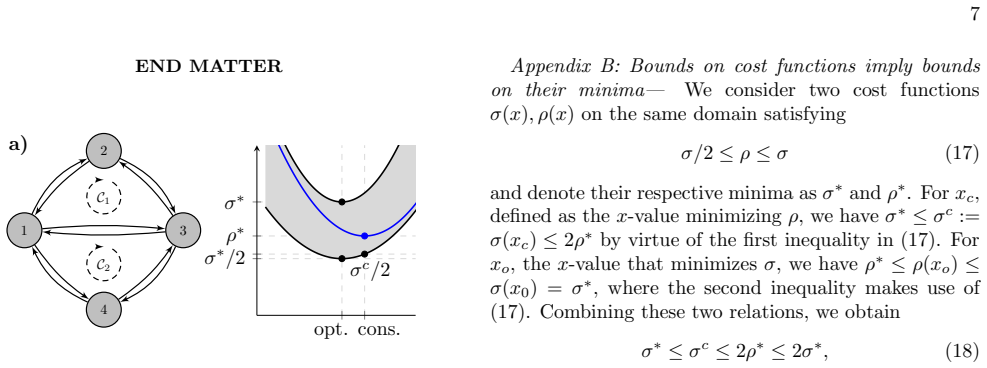
The load-bearing device is the auxiliary cost function ρ = Σ_{i,j} ω_ij C(F_ij) with C(x) = x sinh(x/2) − 2[cosh(x/2) − 1], where ω_ij = κ_ij √(p_i p_j) is the timescale of the transition between neighboring states and F_ij the thermodynamic force on that edge. It does two things at once: it brackets the entropy production rate pointwise, σ/2 ≤ ρ ≤ σ, and — unlike σ — its minimizer is conservative, since differentiating with respect to a cycle current j_C yields ∂_{j_C} ρ = Σ_{(ij)∈C} F_ij = 0, exactly the condition that the cycle affinity vanish. The proof (Appendix B) is a generic sandwich: given two cost functions on the same domain with σ/2 ≤ ρ ≤ σ, their minima satisfy σ* ≤ σ_c ≤ 2ρ* ≤
What would settle it
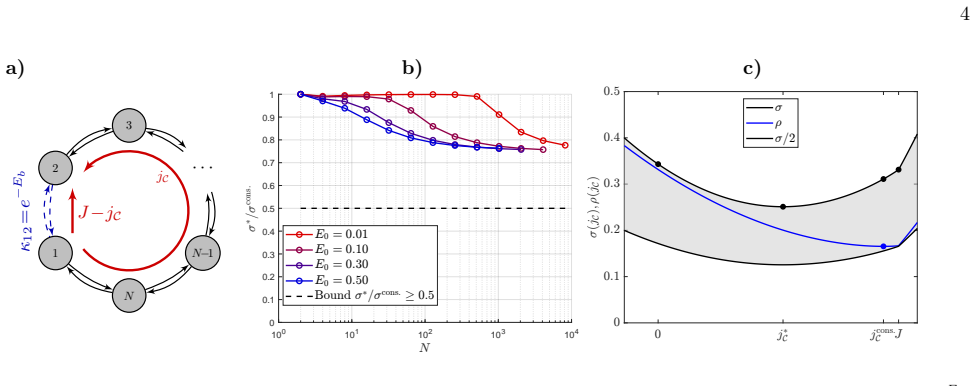
Fix any network with at least one cycle, fix the symmetric rate factors κ_ij, and prescribe the target probability current; numerically minimize entropy production over all forces and over conservative forces only. Any instance with σ_cons > 2σ* (σ*/σ_cons < 1/2) refutes the theorem; none should exist if the proof holds. For the abstract's sharper claim, a single instance with σ*/σ_cons < 3/4 — the ring example's 0.76 does not reach it — would refute the factor-4/3 statement without touching the factor-two result.
Extended reading notes
Core claim
For any Markov network with fixed, non-optimizable transition timescales, the cheapest conservative protocol for the same task costs at most twice the minimal entropy production — σ* ≤ σ_cons ≤ 2σ* and S_cons/2 ≤ S* ≤ S_cons — on any network. The engine is an auxiliary cost ρ (Eq. 8), σ/2 ≤ ρ ≤ σ, that — unlike σ — is minimized by conservative forces, its stationarity condition per cycle current being exactly vanishing cycle affinity (Eq. 13); a sandwich argument transfers the pointwise inequality to the minima. In the worked example, a unicyclic network with one large energy barrier, the optimal protocol balances barrier crossing with a bulk cycle current, a ~32% gain over conservative driv
Load-bearing premise
The factor-two theorem rests on two premises the text asserts but does not prove — that the auxiliary cost ρ is convex, so the configuration with all cycle affinities zero is its true global minimizer, and that optimizing cycle currents decouples instant by instant — since the sandwich bound fails if either is false, even though the convexity is in fact elementary to verify.
Editorial extensions
If this is right
- For any discrete network whose transition timescales are individually fixed, a controller restricted to conservative driving is guaranteed to stay within a factor of two of minimal dissipation, independent of network size, topology, number of cycles, and distance from equilibrium.
- Near equilibrium the optimal and conservative protocols coincide — their difference first appears at order F³ — so the extra power of nonconservative cycle forces only becomes significant far from equilibrium.
- In the ring-with-barrier model, optimal nonconservative driving beats the best conservative protocol by roughly 32% for large networks, because it splits probability flow between the direct route across the barrier and the bulk of the ring, while the conservative protocol mostly avoids the barrier.
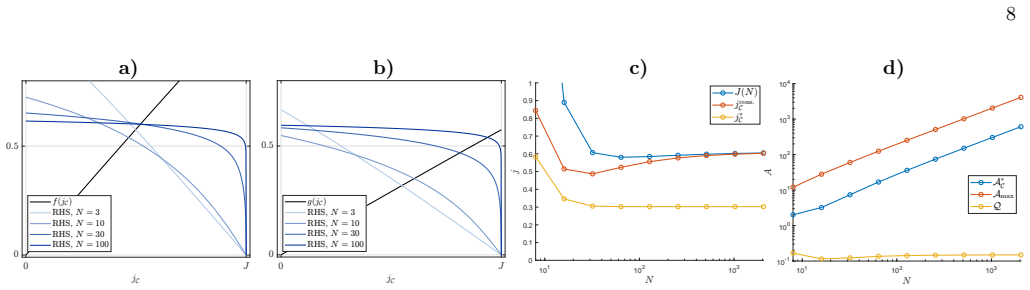
- The large-N limit of that transport problem does not reduce to the continuum Langevin optimal-transport problem where conservative forces are optimal: the optimal cycle affinity grows linearly with N, so the nonconservative advantage survives the thermodynamic limit.
- Tighter constraints — fewer optimizable force degrees of freedom — amplify the value of the extra degrees of freedom that nonconservative forces provide, suggesting optimal nonconservative driving is the generic case in strongly constrained real systems.
Reading between the lines
- Gap in the proof: the paper asserts that ρ is convex (one sentence before Eq. 8) but never demonstrates it, and the factor-two bound needs the stationary point of Eq. (13) to be the global minimizer of ρ. The gap looks fillable — each edge contribution C(F) has second derivative cosh(F/2)/2 + F·sinh(F/2)/4 > 0, and the currents feasible at fixed ṗ form an affine set — but as written the proof lea
- The abstract's stronger claims (factor 4/3, a saturating example, and a proven weaker-factor generalization to other load-sharing parametrizations) do not match the body, which proves the factor of two and lists those generalizations as future work. A numerical search over multi-cycle networks with heterogeneous κ would show whether ratios below the ring example's 0.76 exist and whether 1/2 is eve
- The sandwich template is portable: any control problem with two cost functions c ≤ c' ≤ Kc, where the simpler subclass happens to minimize c', inherits a factor-K near-optimality theorem; each new rate parametrization would need its own convexity check.
- Read as a design principle, the factor-two ceiling says conservative controllers are the right first attempt: measure the dissipation gap, and invest in implementing cyclic driving only when the gap approaches the ceiling. Conversely, coarse-grained models of network-driven machines that exclude cycle currents could systematically overestimate achievable efficiency by up to a factor of two.
Signed reviews
Editorial analysis
A structured set of objections, weighed in public.
Referee Report
Summary. The paper studies finite-state Markov jump processes with fixed symmetric transition rates κ_ij(t) and optimizes the entropy production over the antisymmetric forces A_ij(t). Its main theorem (Eq. (9)) claims that for any prescribed time evolution, the best conservative protocol (zero cycle affinities) has an entropy production rate σ_cons satisfying σ* ≤ σ_cons ≤ 2σ*, where σ* is the true minimum, and hence total dissipation is within a factor of two. The proof introduces an auxiliary cost ρ (Eq. (8)) with σ/2 ≤ ρ ≤ σ; the ρ-minimizer is shown (Appendix C) to satisfy the conservative condition Σ F_ij = 0, and Appendix B converts the pointwise cost bound into the main inequality. A unicyclic example with an energy barrier is analyzed numerically, giving σ*/σ_cons ≈ 0.76. The supplied abstract promises a stronger 4/3 bound and saturation, which the body does not prove.
Significance. If the factor-two theorem is correct, it is a clean, topology-independent statement: giving up nonconservative driving costs at most a factor of two in dissipation, regardless of network size or distance from equilibrium. This usefully complements Ref. [28] and explains why conservative protocols are near-optimal. The proof strategy, based on the auxiliary cost ρ and the sandwich in Appendix B, is elegant and machine-checkable in principle. The paper also includes a concrete model illustrating an O(1) improvement. However, as submitted, the advertised stronger claims in the abstract are unsupported, and a key convexity step in the proof is omitted.
major comments (3)
- [Abstract; Main result (Eq. (9))] The supplied abstract claims a stronger result than the body proves: it states that a conservative protocol exists whose dissipation is at most 4/3 times the optimum, with a saturating energy-barrier example, and that a weaker numerical factor is proved for general load-sharing parametrizations. The main text proves only σ_cons ≤ 2σ* (Eq. (9)); the full-text abstract itself says 'at most twice', and the Discussion explicitly leaves a tighter bound as an open problem. No 4/3 theorem, saturating example, or load-sharing bound appears in the body. The advertised central claim is therefore unsupported and the abstract must be corrected (or the missing results proved).
- [Main result, after Eq. (8); Appendix C] The sandwich in Appendix B, σ* ≤ σ_c ≤ 2ρ* ≤ 2σ* (Eq. (18)), requires x_c to be a global minimizer of ρ over the allowed cycle currents. The text asserts 'Like σ, ρ is a convex measure' but gives no proof, and Appendix C only derives the stationary condition ∂_{j_C}ρ = Σ_{(ij)∈C} F_ij (Eq. (13)). Without convexity of ρ in the cycle currents, stationarity need not identify the global minimum, so the identification ρ* = ρ(x_c) that feeds the theorem could fail. The convexity is elementary (the per-edge cost has positive second derivative in the edge current, and cycle currents enter affinely), but it must be stated before Eq. (9) is used.
- [Discussion and outlook] The abstract additionally promises a 'weaker numerical factor for a more general class of rate parametrizations with different load-sharing factors'. The body contains no such theorem: the Discussion merely says the parametrization 'can, e.g., be generalized' and does not state a bound. Either prove the load-sharing generalization or remove the claim from the abstract.
minor comments (6)
- [Abstract] The full-text abstract (factor two) differs from the metadata abstract (4/3); synchronize the versions after the content is corrected.
- [Main result] The inequality C(x) ≥ (x/2)sinh(x/2) used for σ/2 ≤ ρ is stated without proof; a one-line verification would help the reader.
- [Discussion and outlook] 'parametrization adapted in this work' should be 'adopted'.
- [Fig. 2(b)] The 'optimized J' is not defined in the caption; specify the optimization criterion in the caption or main text.
- [Appendix B] σ_c is not explicitly identified with σ_cons of the main text; define x_c as the conservative configuration.
- [Appendix D] Eq. (22): the bound |A*_C|/2 ≤ N follows because the sum has N terms each with |tanh| ≤ 1; the intermediate step is worth spelling out.
Circularity Check
No circularity: Eq. (9) is derived from a self-contained auxiliary-cost argument, and the only self-citation is expressly non-load-bearing.
full rationale
The central bound (9), σ* ≤ σ_cons ≤ 2σ*, is obtained by introducing the auxiliary cost ρ in Eq. (8), proving the pointwise inequality σ/2 ≤ ρ ≤ σ via C(x) ≥ (x/2)sinh(x/2), and showing in Appendix B that two cost functions satisfying this inequality have minima obeying σ_c ≤ 2σ*. The key input is the claim that the configuration minimizing ρ is conservative. That is derived, not assumed: 'An explicit calculation (see Appendix C) results in a condition on the optimal parameters F_ij, 0 = ∂_{j_C} ρ = Σ_{(ij)∈C} F_ij' (Eq. (13)), which is precisely the vanishing-cycle-affinity condition (7). The result is therefore not an input to the derivation. The only self-citation, Ref. [35] ('In preparation'), is explicitly not load-bearing: the text says 'Here, we only use the property that ρ is minimized by conservative forces, which is derived below.' The absence of a convexity proof for ρ is a technical gap that could affect the global-minimum step in Appendix B, but it is not circularity: the paper asserts convexity ('Like σ, ρ is a convex measure') and then separately computes the stationarity condition, so the target theorem is not assumed. Similarly, the discrepancy between the abstract's '4/3' claim and the body's factor-two proof, as well as the Discussion's statement that attaining the bound is an 'open problem', are internal-consistency issues, not circularity. No fitted parameter is relabeled as a prediction, and no load-bearing argument reduces to a self-citation chain.
Assumptions & free parameters
free parameters (3)
- J (transported current in the example) =
0.5824 for E_0 = 0.3; numerically optimized per N
- E_0 (barrier energy density) =
swept over {0.01, 0.10, 0.30, 0.50}
- κ_ij (symmetric rate matrix of the example) =
1 for bulk edges, e^{-E_b} for the barrier edge
assumptions (6)
- domain assumption Rates are parametrized as k_ij = κ_ij e^{A_ij/2} with fixed, time-independent symmetric part κ_ij ≥ 0 (Eq. (3)).
- domain assumption The cost is the total entropy production, Eq. (2), which under the parametrization becomes σ = Σ ω_ij F_ij sinh(F_ij/2) (Eq. (4)).
- standard math ρ is a convex measure of distance to equilibrium, so its stationary point is its global minimizer.
- standard math The cycle-current optimization decouples pointwise in time.
- standard math Cycle-basis calculus: current degrees of freedom decompose via fundamental cycles, with ∂_{j_C} = Σ_{(ij)∈C} ∂_{j_ij} (Eqs. (15)-(16)).
- domain assumption The bound |A*_C| ≤ 2(N-2) from Ref. [28].
invented entities (1)
-
ρ — auxiliary cost functional, Eq. (8): ρ = Σ ω_ij C(F_ij) with C(x) = x sinh(x/2) − 2[cosh(x/2) − 1]
Cite this review
Pith. "Pith review of Near-optimality of conservative driving in discrete systems." pith.science (2026). https://pith.science/paper/P32QSYIV
@misc{pith2026260218321,
  author       = {Pith},
  title        = {Pith review of: Near-optimality of conservative driving in discrete systems},
  year         = {2026},
  howpublished = {\url{https://pith.science/paper/P32QSYIV}},
  note         = {Machine review of arXiv:2602.18321}
}
read the original abstract
Transferring a physical system from an initial to a final state while minimizing energetic losses is an interdisciplinary control problem that bridges stochastic thermodynamics and optimal transport theory. Recent research typically considers problems in which the optimal solution is realized via conservative forces, but whether this situation applies depends on the problem's constraints. In systems with complex topologies like discrete networks, the optimal, dissipation-minimizing protocol involves applying nonconservative forces along cycles if the timescales of the transitions in the network are fixed. We show that although nonconservative driving is optimal in this setting, a conservative protocol always exists whose dissipation is at most 4/3 times the optimum. This finding is complemented with an example modeling transport across an energy barrier, which saturates this bound. We also prove near-optimality of conservative driving with a weaker numerical factor for a more general class of rate parametrizations with different load-sharing factors, stimulating the idea that optimality of nonconservative driving might be a generic phenomenon: As fewer degrees of freedom can be optimized, additional degrees of freedom due to adding nonconservative forces become more significant.
Figures

Figures from the paper (1 more)
Forward citations
Cited by 1 Pith paper
-
Optimal Finite-Time Control of Nonreciprocal Brownian Dimers: Thermodynamic Anomaly and Multiple Transitions
Exact optimal control of two nonreciprocally coupled Brownian particles in moving harmonic traps is oscillatory, and unbounded work extraction appears beyond a critical time unless the trap range or active force is re...
Reference graph
Works this paper leans on
-
[28]
Remlein and U
B. Remlein and U. Seifert, Optimality of nonconserva- tive driving for finite-time processes with discrete states, Physical Review E103, L050105 (2021)
2021
-
[1]
Monge, Memoire sur la theorie des deblais et des rem- blais, Histoire de l’Academie Royale des Sciences de Paris (1781)
G. Monge, Memoire sur la theorie des deblais et des rem- blais, Histoire de l’Academie Royale des Sciences de Paris (1781)
-
[2]
Benamou and Y
J.-D. Benamou and Y. Brenier, A computational fluid mechanics solution to the Monge-Kantorovich mass transfer problem, Numer. Math.84, 375 (2000)
2000
-
[3]
Villani,Optimal Transport: Old and New, Grundlehren der mathematischen Wissenschaften (Springer Berlin Heidelberg, 2008)
C. Villani,Optimal Transport: Old and New, Grundlehren der mathematischen Wissenschaften (Springer Berlin Heidelberg, 2008)
2008
-
[4]
Aurell, C
E. Aurell, C. Mej ´ ıa-Monasterio, and P. Muratore- Ginanneschi, Optimal Protocols and Optimal Transport in Stochastic Thermodynamics, Physical Review Letters 106, 250601 (2011)
2011
-
[5]
Aurell, K
E. Aurell, K. Gaw¸ edzki, C. Mej ´ ıa-Monasterio, R. Mo- hayaee, and P. Muratore-Ginanneschi, Refined Second Law of Thermodynamics for Fast Random Processes, Journal of Statistical Physics147, 487 (2012)
2012
-
[6]
Nakazato and S
M. Nakazato and S. Ito, Geometrical aspects of en- tropy production in stochastic thermodynamics based on Wasserstein distance, Phys. Rev. Research3, 043093 (2021)
2021
-
[7]
Van Vu and K
T. Van Vu and K. Saito, Thermodynamic Unification of Optimal Transport: Thermodynamic Uncertainty Rela- tion, Minimum Dissipation, and Thermodynamic Speed Limits, Physical Review X13, 011013 (2023)
2023
Show all 38 references
-
[8]
Oikawa, Y
S. Oikawa, Y. Nakayama, S. Ito, T. Sagawa, and S. Toy- abe, Experimentally achieving minimal dissipation via thermodynamically optimal transport, Nature Commu- nications16, 10424 (2025)
2025
-
[9]
A. Dechant, Minimum entropy production, detailed balance and Wasserstein distance for continuous-time Markov processes, Journal of Physics A: Mathematical and Theoretical55, 094001 (2022)
2022
-
[10]
Schnakenberg, Network theory of microscopic and macroscopic behavior of master equation systems, Re- views of Modern Physics48, 571 (1976)
J. Schnakenberg, Network theory of microscopic and macroscopic behavior of master equation systems, Re- views of Modern Physics48, 571 (1976)
1976
-
[11]
T. L. Hill,Free Energy Transduction and Biochemical Cycle Kinetics(Springer New York, 1989)
1989
-
[12]
Hatano and S.-i
T. Hatano and S.-i. Sasa, Steady-state thermodynamics of Langevin systems, Phys. Rev. Lett.86, 3463 (2001)
2001
-
[13]
Maes and K
C. Maes and K. Netoˇ cn` y, Minimum entropy produc- tion principle from a dynamical fluctuation law, J. Math. Phys.48, 053306 (2007)
2007
-
[14]
Dechant, S.-i
A. Dechant, S.-i. Sasa, and S. Ito, Geometric decomposi- tion of entropy production in out-of-equilibrium systems, Phys. Rev. Research4, L012034 (2022)
2022
-
[15]
Yoshimura, A
K. Yoshimura, A. Kolchinsky, A. Dechant, and S. Ito, Housekeeping and excess entropy production for general nonlinear dynamics, Physical Review Research5, 013017 (2023)
2023
-
[16]
Deg¨ unther and U
J. Deg¨ unther and U. Seifert, Anomalous relaxation from a non-equilibrium steady state: An isothermal analog of the Mpemba effect, Europhysics Letters139, 41002 (2022)
2022
-
[17]
Dieball, G
C. Dieball, G. Wellecke, and A. Godec, Asymmetric ther- mal relaxation in driven systems: Rotations go opposite ways, Physical Review Research5, L042030 (2023)
2023
-
[18]
Strasberg, G
P. Strasberg, G. Schaller, T. Brandes, and M. Esposito, Thermodynamics of a Physical Model Implementing a Maxwell Demon, Physical Review Letters110, 040601 (2013)
2013
-
[19]
A. C. Barato and U. Seifert, Coherence of biochemical os- cillations is bounded by driving force and network topol- ogy, Physical Review E95, 062409 (2017)
2017
-
[20]
N. Ohga, S. Ito, and A. Kolchinsky, Thermodynamic Bound on the Asymmetry of Cross-Correlations, Phys- ical Review Letters131, 077101 (2023)
2023
-
[21]
S. A. M. Loos and S. H. L. Klapp, Irreversibility, heat and information flows induced by non-reciprocal interactions, New Journal of Physics22, 123051 (2020)
2020
-
[22]
Kneˇ zevi´ c, T
M. Kneˇ zevi´ c, T. Welker, and H. Stark, Collective motion of active particles exhibiting non-reciprocal orientational interactions, Scientific Reports12, 19437 (2022)
2022
-
[23]
Fodor, R
´E. Fodor, R. L. Jack, and M. E. Cates, Irreversibility and Biased Ensembles in Active Matter: Insights from Stochastic Thermodynamics, Annual Review of Con- 6 densed Matter Physics13, 215 (2022)
2022
-
[24]
Dechant and E
A. Dechant and E. Lutz, Fundamental limits on nonequi- librium sensing, Nature Communications16, 10227 (2025)
2025
-
[25]
G. Lan, P. Sartori, S. Neumann, V. Sourjik, and Y. Tu, The energy–speed–accuracy trade-off in sensory adapta- tion, Nature physics8, 422 (2012)
2012
-
[26]
Ito and T
S. Ito and T. Sagawa, Maxwell’s demon in biochemical signal transduction with feedback loop, Nature Commu- nications6, 7498 (2015)
2015
-
[27]
S. A. M. Loos, S. Monter, F. Ginot, and C. Bechinger, Universal Symmetry of Optimal Control at the Mi- croscale, Physical Review X14, 021032 (2024)
2024
-
[29]
Ilker, ¨O
E. Ilker, ¨O. G¨ ung¨ or, B. Kuznets-Speck, J. Chiel, S. Deffner, and M. Hinczewski, Shortcuts in Stochastic Systems and Control of Biophysical Processes, Physical Review X12, 021048 (2022)
2022
-
[30]
Nagayama, K
R. Nagayama, K. Yoshimura, and S. Ito, Infinite variety of thermodynamic speed limits with general activities, Physical Review Research7, 013307 (2025)
2025
-
[31]
Muratore-Ginanneschi, C
P. Muratore-Ginanneschi, C. Mej ´ ıa-Monasterio, and L. Peliti, Heat Release by Controlled Continuous-Time Markov Jump Processes, Journal of Statistical Physics 150, 181 (2013)
2013
-
[32]
Seifert,Stochastic thermodynamics(Cambridge Uni- versity Press, Cambridge, England, 2025)
U. Seifert,Stochastic thermodynamics(Cambridge Uni- versity Press, Cambridge, England, 2025)
2025
-
[33]
Esposito and C
M. Esposito and C. Van Den Broeck, Three Detailed Fluctuation Theorems, Physical Review Letters104, 090601 (2010)
2010
-
[34]
Delvenne and G
J.-C. Delvenne and G. Falasco, Thermokinetic relations, Physical Review E109, 014109 (2024)
2024
-
[35]
Dechant and J
A. Dechant and J. Van der Meer, In preparation
-
[36]
M. E. Fisher and A. B. Kolomeisky, Molecular motors and the forces they exert, Physica A: Statistical Mechan- ics and its Applications274, 241 (1999)
1999
-
[37]
A. B. Kolomeisky and M. E. Fisher, Molecular Motors: A Theorist’s Perspective, Annual Review of Physical Chem- istry58, 675 (2007)
2007
-
[38]
Zimmermann and U
E. Zimmermann and U. Seifert, Efficiencies of a molec- ular motor: A generic hybrid model applied to the F 1 -ATPase, New Journal of Physics14, 103023 (2012). 7 END MA TTER a) 1 2 4 3 C1 C2 opt. cons. σ∗/2 ρ∗ σ∗ σc/2 FIG. 3. a) A Markov network with two fundamental cycles C1 =...
2012
Reviewed August 2, 2026 · model on record in the stance chip above.
Discussion (0). Continue with ORCID to comment.