REVIEW 2 major objections 3 minor 1 cited by
Quantum Error Correction and Dynamical Decoupling: Better Together or Apart?
T0 review · 2 major / 3 minor · reviewed 2026-08-02 · deepseek-v4-flash
Pith's one-line read Logical dynamical decoupling improves quantum error correction exactly when it suppresses a larger fraction of the uncorrectable Pauli errors than the unsuppressed sector carries, and a simple stabilizer-dressing rule can enforce that condi
desk verdict A solid WEP-based analysis of LDD+QEC/QED in an effective Pauli model; the central theorem is exact and the math checks out, but the single-p_DD reduction and missing numerical reproducibility details are the real soft spots. read the letter →
The pith
A machine-rendered reading of the paper's core claim, the machinery that carries it, and where it could break.
The reading
What carries the argument
Weight enumerator polynomials (WEPs): generating polynomials that count phase-stripped Pauli errors by weight within subsets defined by the stabilizer code, the recovery map, and the decoupling group. Every fidelity expression in the paper reduces to ratios of WEPs evaluated at z=p/(3-3p). The comparison theorems hinge on the ratio of uncorrectable-error WEP to total-sector WEP in the suppressed versus unsuppressed sector; a ratio-symmetry argument applied to a linear-fractional function yields the exact superiority condition.
What would settle it
Run a LDD+QEC memory experiment on a code whose chosen decoupling group fails the beta=alpha condition (no minimum-weight uncorrectable error is suppressed) and see whether the hybrid protocol still beats QEC-only at small p; the theorems predict it cannot. A direct test of the model itself is to compare the predicted and measured scaling of logical failure probability with p for different decoupling groups: if a single p_DD cannot reproduce the observed curves, the effective-Pauli premise fails.
Extended reading notes
Core claim
The paper's central claim is that logical dynamical decoupling and quantum error correction are complementary exactly when the decoupling group is chosen to suppress the errors the decoder cannot fix. For ideal recovery the hybrid protocol outperforms QEC-only if and only if the conditional density of uncorrectable Pauli errors is larger in the LDD-suppressed sector than in the unsuppressed sector (Theorem 2). At small physical error rate a sufficient condition is that at least one minimum-weight uncorrectable error is suppressed; if not, multiplying an LDD generator by a stabilizer changes which errors are suppressed without changing its logical action and can restore the advantage (Theorem
Load-bearing premise
The entire comparison rests on the assumption that noise during the wait interval is fully described by a weight-dependent Pauli channel, that decoupling uniformly rescales every anticommuting error by a single number p_DD, and that the decoupling pulses add no new errors.
Editorial extensions
If this is right
- If the criterion holds, LDD+QEC strictly outperforms QEC-only for any fixed suppression strength p_DD < 1 and all sufficiently small p, and the advantage survives small recovery imperfections by continuity.
- Stabilizer dressing gives an explicit procedure to fix a bad decoupling group: multiply a generator by a stabilizer that anticommutes with a minimum-weight uncorrectable error, and the sufficient condition holds.
- For error detection, the analogous exact criterion (Theorem 4) tells when LDD+QED improves both conditional fidelity and acceptance probability; when the decoupling group is the full logical Pauli group, the hybrid always wins.
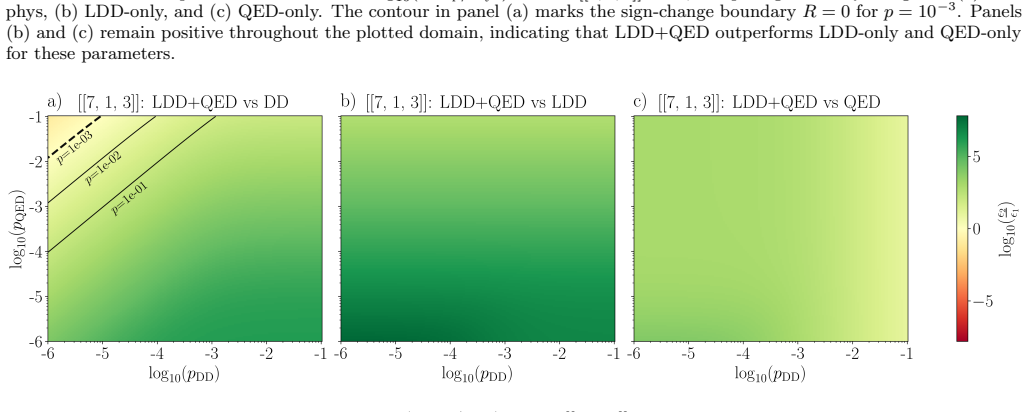
- The numerical maps for the [[7,1,3]] and [[13,1,3]] codes show that a code can exhibit an asymptotic hybrid advantage or lose it depending on whether the chosen LDD group suppresses minimum-weight uncorrectable errors, so code, decoder, and decoupling group must be co-designed.
Reading between the lines
- A testable prediction: for any fixed code and recovery map, scanning all stabilizer-equivalent LDD generator pairs and computing the two WEP ratios should reproduce the paper's exact ordering at every p, not only asymptotically — a cheap way to benchmark the criterion on hardware.
- The framework suggests an optimization loop: use the WEP formulas as a cost function to search over decoupling groups and decoders for a given noise spectrum, which could be integrated with pulse-engineering models that refine p_DD.
- The scalar p_DD assumption is the most fragile point; if pulse imperfections introduce correlated or non-Pauli errors, the sector-fraction criterion may need to be replaced by a channel-adapted measure, and the paper's exact thresholds would become approximate.
- For multi-round fault-tolerant operation, the single-cycle advantage may accumulate or wash out depending on how LDD interleaves with repeated syndrome extraction; extending the criterion to a full fault-tolerant cycle is a natural next step the paper leaves open.
Editorial analysis
A structured set of objections, weighed in public.
Referee Report
Summary. The manuscript analyzes hybrid memory protocols that combine logical dynamical decoupling (LDD) with one round of quantum error correction (QEC) or quantum error detection (QED). Under an effective Pauli depolarizing model with physical error probability p, a single DD suppression parameter p_DD, and recovery/readout imperfection rates p_QEC and p_QED, the authors derive closed-form weight-enumerator-polynomial (WEP) fidelities for DD-phys, QEC-only, LDD-only, and LDD+QEC (Theorem 1, Eq. (22)), and analogous acceptance/conditional-fidelity formulas for LDD+QED (Lemma 6). For ideal recovery/readout they prove exact comparison criteria: LDD+QEC beats QEC-only iff the uncorrectable-error fraction is larger in the LDD-suppressed sector than in the unsuppressed sector (Theorem 2, Eq. (29)); for QED, a parallel criterion is given in Theorem 4. In the low-p regime, Theorem 3 gives a sufficient condition based on suppressing at least one minimum-weight uncorrectable error, together with a stabilizer-dressing procedure. Numerical case studies for [[7,1,3]], [[5,1,3]], [[13,1,3]], and [[4,2,2]] codes map regions of advantage in the (p_DD, p_QEC/p_QED) plane.
Significance. If the results stand, this is a useful and unifying theoretical contribution. The WEP framework reduces a complicated protocol comparison to a small set of code-dependent polynomials, and the exact two-sector fraction criterion of Theorem 2 is a crisp, checkable design rule. The paper also correctly emphasizes that hybrid advantage is not automatic and depends on the recovery/detection map, the code, and the LDD group. The internal algebra in Theorems 1–4 and the reductions to QEC-only, LDD-only, and DD-phys appear coherent and complete. The main limitation is physical: the practical reach of the criteria is conditional on the single-p_DD reduction of LDD, which is explicitly acknowledged but not microscopically validated. This is the central load-bearing assumption for the paper's practical claims.
major comments (2)
- [Section II C, Eq. (5)] The entire comparison framework rests on the assumption that the effect of LDD is fully captured by one scalar p_DD multiplying the probabilities of all errors in Pn \ G^⊥, followed by renormalization, with no new error mechanisms introduced. Theorem 2's exact 'iff' and Theorem 3's sufficient condition are internal to this model. Real LDD pulses have finite width, calibration errors, and frequency-dependent suppression; residual errors need not factor into a single p_DD, and the effective channel can be non-Pauli or weight-dependent in a way that this model excludes. The authors acknowledge this limitation in Section VI, but no microscopic derivation, simulation of a concrete pulse sequence, or experimental estimate is provided. Since the practical claims ('better together', design rule) depend on this reduction, I ask for either (a) a derivation or numerical validation for a concrete ro
- [Theorem 3, part 2] The stabilizer-dressing statement is formulated for a general nontrivial Pauli subgroup G, not only for LDD groups G=π(L). In the proof, after choosing g in a decomposition G={I,g}G1, the authors replace g by gS with S∈π(S). If g itself lies in π(S), the dressed element can be the identity, changing the order of G and invalidating the construction. For the main LDD application G=π(L) this cannot occur because π(L)∩π(S)={I}, so the central claim is unaffected. However, the theorem as stated needs an additional assumption (e.g., g∉π(S)) or a separate treatment of the degenerate case G⊆π(S).
minor comments (3)
- [Notation throughout] The symbol S is heavily overloaded: it denotes the stabilizer group, the WEP tag for the suppressed sector in Tables I–II, and appears in expressions like S-̸C and S-St. This makes equations such as Eq. (22) and Theorem 3 unnecessarily hard to parse. Renaming one of these (e.g., using G^⊥-complement tags) would improve readability.
- [Section III G4, Example 1] Example 1, which illustrates F_Hyb < F_QEC in the β>α regime, is described only verbally ('any code with d=7 and a suboptimal decoding map...'). Since the example is used to show that the β>α regime can occur in a natural setting, please either instantiate it with a concrete stabilizer code and decoder, or explicitly label it as an abstract consistency scenario.
- [Section V] The numerical section does not include a data/code availability statement. Given the many heat maps and group-optimization scans, providing scripts or a detailed table of all parameters and decoding maps would be valuable for reproducibility.
Circularity Check
No significant circularity: the central criteria are algebraic consequences of the stated Pauli/LDD model, with only an acknowledged model-to-physics gap.
full rationale
The derivation chain is self-contained within the explicitly stated effective-Pauli model. Theorem 1/Eq. (22) is obtained by inclusion-exclusion accounting for the protocol's definitions; Theorem 2/Eq. (29) follows by applying Lemma 3 to the algebraic form of Eq. (22), so the sector-fraction criterion is a derived mathematical equivalence, not an input assumption or a renamed fit. Theorem 3's sufficient condition is derived from asymptotic WEP ratios, and its stabilizer-dressing step is a constructive algebraic fact: if a weight-alpha uncorrectable error has nonzero syndrome, some stabilizer anticommutes with it, so replacing a generator g by gS moves that error into the suppressed sector. Theorem 4 is the analogous QED derivation. The parameters p, p_DD, p_QEC/p_QED are model inputs scanned in the numerics; the numerical section evaluates the closed-form formulas and no data are fitted, so there is no fitted-input-called-prediction step. Self-citations (e.g., refs 25-28) supply motivation and prior LDD/QED context, but no load-bearing theorem or uniqueness claim is imported from them to force the conclusions. The paper explicitly acknowledges the main limitation: real DD may not reduce to a single p_DD, and connecting microscopic noise/control errors to the effective parameters is left for future work (Section VI). That is a model-to-physics validity concern, not a circular reduction. I therefore find no step in which a claimed result is equivalent to its inputs by construction.
Assumptions & free parameters
free parameters (3)
- p_DD =
scanned values 0.1, 0.01, 0.001; not fitted
- p_QEC =
scanned values incl. 0, 0.01, sqrt(p), and plane sweeps; not fitted
- p_QED =
scanned values incl. 0 and sqrt(p); not fitted
assumptions (6)
- standard math Stabilizer code formalism: S is an elementary Abelian 2-group, the recovery map D satisfies D(0)=I and syn(D(σ))=σ for all σ.
- domain assumption Wait-interval noise is a depolarizing Pauli channel: a weight-w error has probability (1-p)^(n-w)(p/3)^w (Eq. 5).
- domain assumption DD suppresses all errors outside G^⊥ by a single multiplicative factor p_DD, followed by renormalization, and introduces no new errors.
- domain assumption Decoder failure model: on a nontrivial syndrome, with probability p_QEC a uniformly random syndrome-consistent recovery is applied; trivial syndrome leaves the state unchanged.
- domain assumption QED readout model: with probability p_QED the syndrome is uniformly random; a detected error accepted through readout failure produces a uniformly random logical Pauli.
- domain assumption Single memory cycle with perfect encoding; performance is the probability of no logical fault, shown equal to entanglement fidelity for logical Pauli channels.
Cite this review
Pith. "Pith review of Quantum Error Correction and Dynamical Decoupling: Better Together or Apart?." pith.science (2026). https://pith.science/paper/L7ZCLAU6
@misc{pith2026260219042,
  author       = {Pith},
  title        = {Pith review of: Quantum Error Correction and Dynamical Decoupling: Better Together or Apart?},
  year         = {2026},
  howpublished = {\url{https://pith.science/paper/L7ZCLAU6}},
  note         = {Machine review of arXiv:2602.19042}
}
abstract
Quantum error correction/detection (QEC/QED) and dynamical decoupling (DD) are tools for protecting quantum information. A natural goal is to combine them to outperform either approach alone. Such a benefit is not automatic: physical DD can conflict with encoded subspace, and QEC performance is governed by the errors that survive decoding, not just those DD suppresses. We analyze a hybrid memory cycle where DD is implemented logically (LDD) using normalizer elements of an $[[n,k,d]]$ stabilizer code, followed by a round of syndrome measurement and recovery (or, in the detection setting, postselection on a trivial syndrome). In an effective Pauli model with physical error probability $p$, LDD suppression factor $p_{DD}$, and recovery imperfection rate $p_{QEC}$ (or $p_{QED}$), we derive closed-form entanglement-fidelity expressions for QEC-only, QED-only, LDD-only, physical DD, and the hybrid LDD+QEC protocol. The formulas are expressed via a small set of code-dependent weight enumerator polynomials, making the role of the decoder and the LDD group explicit. For ideal recovery LDD+QEC outperforms QEC-only iff the conditional fraction of uncorrectable Pauli errors is larger in the LDD-suppressed sector than in the unsuppressed sector. In the low-noise regime, a sufficient design rule guaranteeing hybrid advantage is that LDD suppresses at least one minimum-weight uncorrectable Pauli error for the chosen recovery map. We show how stabilizer-equivalent choices of LDD generators can enforce this condition. We supplement our analysis with numerical results for the $[[7,1,3]]$ Steane code and a $[[13,1,3]]$ code, mapping regions of hybrid-protocol advantage in parameter space beyond the small-$p$ regime. Our work illustrates the need for co-design of the code, decoder, and logical decoupling group, and clarifies the conditions under which the hybrid LDD+QEC protocol is advantageous.
Figures


Figures from the paper (11 more)


Forward citations
Cited by 1 Pith paper
-
Correlated Coherent Errors in Stabilizer Codes: A General Cumulant Framework and Interference-Based Error Suppression
For a stabilizer code with an ideal error-correction gadget, correlated coherent Z-noise induces an exact logical channel whose performance depends on the chosen stabilizer eigenspace; choosing that eigenspace optimal...
Reference graph
Works this paper leans on
-
[1]
Acceptance occurs iff the true syndrome is trivial, i.e., iff E′ ∈π(SL)
Ideal readout (probability 1−p QED). Acceptance occurs iff the true syndrome is trivial, i.e., iff E′ ∈π(SL). The corresponding acceptance weight is̸S-StL +p DDS-StL
-
[2]
Independently ofE ′, the protocol accepts with probability 2k−n, so the corresponding acceptance weight is 2k−n(̸S +p DDS)
Random readout (probabilityp QED). Independently ofE ′, the protocol accepts with probability 2k−n, so the corresponding acceptance weight is 2k−n(̸S +p DDS). Multiplying by the respective branch probabilities and adding yields Eq. (80). Dividing by the total weight̸S + pDDS gives Eq. (79). Conditional logical infidelity: We now count accepted events that...
-
[3]
Whenp QEC >0, an error that would otherwise be correctable can still lead to logical failure if the recovery step fails
Imperfect recovery Realistic implementations of QEC are imperfect, and even phenomenologically small recovery failure rates can qualitatively change which error mechanisms dominate the logical failure probability. Whenp QEC >0, an error that would otherwise be correctable can still lead to logical failure if the recovery step fails. Consequently, the logi...
-
[4]
An interesting question is what happens when this condition is violated
LDD+QEC vs QEC-only: examples whenβ > α A clean sufficient condition for an asymptotic hybrid- protocol advantage is given by part 1 of Theorem 3: if the leading uncorrectable weight in the unsuppressed sector and in the suppressed sector coincide (β=α), then for sufficiently smallpthe hybrid protocol satisfiesF Hyb > FQEC (for any fixed 0≤p DD <1). An in...
-
[5]
Conditioned on acceptance, we necessarily haveE ′ ∈π(SL)
Ideal readout (probability 1−p QED). Conditioned on acceptance, we necessarily haveE ′ ∈π(SL). Such an accepted error produces a logical fault iff it is a non-stabilizer logical Pauli, i.e., iffE ′ ∈ π(SL)\π(S), whose WEP contribution is̸S-L + pDDS-L. Thus the ideal-readout branch contributes the logical-fault weight (1−p QED)(̸S-L +p DDS-L).(81)
-
[6]
ideal QED
Random readout (probabilityp QED). Acceptance occurs with probability 2 k−n irrespective ofE ′. (i) IfE ′ ∈π(SL)\π(S) (non-stabilizer logical), then whenever we accept we keep a state with a nontrivial logical Pauli applied, so this contributes 2k−npQED(̸S-L +p DDS-L).(82) (ii) IfE ′ /∈π(SL) (detected error), then an acceptance event corresponds to a read...
-
[7]
Each panel compares four strategies: physical DD on a single unencoded qubit (DD-phys), LDD-only on the encoded block, QEC-only, and the hybrid LDD+QEC protocol
Ideal recovery regime (pQEC = 0) Figure 1 shows the logical failure probability as a function of the physical Pauli error probabilitypfor three suppression strengthsp DD ∈ {0.1,0.01,0.001}in the ideal-recovery settingp QEC = 0. Each panel compares four strategies: physical DD on a single unencoded qubit (DD-phys), LDD-only on the encoded block, QEC-only, ...
-
[8]
For a single-logical-qubit stabilizer code, an LDD group is specified by a choice of (X L, ZL) in the normalizer
Dependence on the LDD generating set The performance of LDD+QEC depends not only on the code and the recovery map, but also on the specific representatives chosen for the logical generators that define the LDD group. For a single-logical-qubit stabilizer code, an LDD group is specified by a choice of (X L, ZL) in the normalizer. Multiplying either represe...
Show all 73 references
-
[9]
Ideal recovery regime (pQEC = 0) Figure 4 shows the logical failure probability as a function ofpfor representative suppression strengths pDD ∈ {0.1,0.01,0.001}with perfect recovery (p QEC = 0). As in the Steane-code example, both QEC-only and LDD+QEC exhibit the higher-order ...
-
[10]
2(c), we now examine the regime in whichp QEC is not negligible relative top
Imperfect recovery As we did for the Steane code in Fig. 2(c), we now examine the regime in whichp QEC is not negligible relative top. Figure 5 illustrates this regime by again settingp QEC = √p. Recall that in this case, the pQECpcontribution scales asp 3/2 and can compete wi...
-
[11]
7 illustrates the ideal-recovery regime for the [[5,1,3]] code: we takep DD ∈ {0.1,0.01,0.001}and set pQEC = 0
Ideal recovery regime (pQEC = 0) Fig. 7 illustrates the ideal-recovery regime for the [[5,1,3]] code: we takep DD ∈ {0.1,0.01,0.001}and set pQEC = 0. Asp→0, the finite distance of the code implies that QEC-based strategies exhibit higher-order scaling than unencoded DD. In par...
-
[12]
As a representative example, Fig
Imperfect recovery regime (pQEC >0) We next move beyond the ideal-recovery regime by allowing recovery faults. As a representative example, Fig. 8 setsp QEC = √pat fixedp DD = 0.01. This choice lies outside the hypothesisp QEC = 0 of Theorem 3 and can also fall outside the sca...
-
[13]
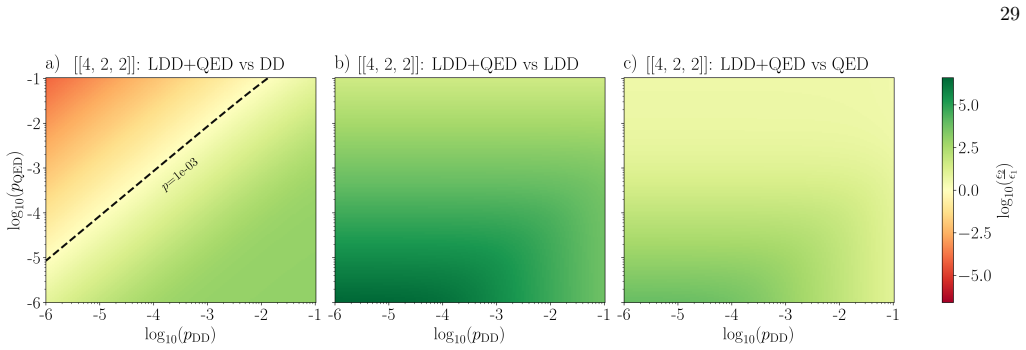
Ideal detection regime (pQED = 0) Fig. 10 compares the conditional logical failure probability (i.e., 1−Fconditioned on acceptance) for the [[4,2,2]] code in the perfect-detection settingp QED = 0, forp DD ∈ {0.1,0.01,0.001}. VaryingpDD primarily shifts the crossover locations...
-
[14]
better together
Imperfect detection regime (pQED >0). We next relax the perfect-detection assumption and allowp QED >0. As a representative example, Fig. 12 setsp QED = √pat fixedp DD = 0.01. This lies outside the hypotheses of Theorem 4. In the plotted range, the hybrid protocol remains favo...
-
[15]
BecauseD(0) =π(I), every stabilizer is trivially correctable, soπ(S)⊂ ˜Ec
This never results in a logical error (independent ofp QEC). BecauseD(0) =π(I), every stabilizer is trivially correctable, soπ(S)⊂ ˜Ec. 2.E ′ ∈ ˜Ec \π(S):E ′ is a correctable (non-stabilizer) error, so syn(E ′)̸= 0, and its WEP contribution is C. There are two cases: (a) With ...
-
[16]
Thus, this branch contributes with weight L
Nontrivial logical errors occur whether or not the decoder acts. Thus, this branch contributes with weight L. 4.(a) The uncorrectable but detectable errors have weight̸C-D and are converted into logical errors with probability 1−p QEC. 2.(b) The correctable errors have weight ...
-
[17]
(D2)] has size |S ∗||π(S)|= 2 2(n−k) = 256, i.e., the decoder again corrects exactly one stabilizer coset per syndrome
With this decoding map, ˜Ec [Eq. (D2)] has size |S ∗||π(S)|= 2 2(n−k) = 256, i.e., the decoder again corrects exactly one stabilizer coset per syndrome. Each corrected error is stabilizer-equivalent to one of the 16 weight-0 through weight-1 Pauli strings listed in Table V as ...
-
[18]
Gaitan,Quantum Error Correction and Fault Tolerant Quantum Computing(Taylor & Francis Group, Boca Raton, 2008)
F. Gaitan,Quantum Error Correction and Fault Tolerant Quantum Computing(Taylor & Francis Group, Boca Raton, 2008)
2008
-
[19]
Lidar and T
D. Lidar and T. Brun, eds.,Quantum Error Correction (Cambridge University Press, Cambridge, UK, 2013)
2013
-
[20]
B. M. Terhal, Quantum error correction for quantum memories, Reviews of Modern Physics87, 307 (2015)
2015
-
[21]
P. W. Shor, Scheme for reducing decoherence in quantum computer memory, Phys. Rev. A52, R2493 (1995)
1995
-
[22]
A. M. Steane, Error correcting codes in quantum theory, Phys. Rev. Lett.77, 793 (1996)
1996
-
[23]
Vaidman, L
L. Vaidman, L. Goldenberg, and S. Wiesner, Error prevention scheme with four particles, Physical Review A54, R1745 (1996)
1996
-
[24]
Knill and R
E. Knill and R. Laflamme, Theory of quantum error- correcting codes, Phys. Rev. A55, 900 (1997)
1997
-
[25]
A. R. Calderbank, E. M. Rains, P. M. Shor, and N. J. A. Sloane, Quantum error correction via codes overgf(4), IEEE Transactions on Information Theory44, 1369 (1998)
1998
-
[26]
Knill, R
E. Knill, R. Laflamme, and L. Viola, Theory of quantum error correction for general noise, Phys. Rev. Lett.84, 2525 (2000)
2000
-
[27]
Kribs, R
D. Kribs, R. Laflamme, and D. Poulin, Unified and generalized approach to quantum error correction, Phys. Rev. Lett.94, 180501 (2005). 33
2005
-
[28]
Poulin, Stabilizer formalism for operator quantum error correction, Phys
D. Poulin, Stabilizer formalism for operator quantum error correction, Phys. Rev. Lett.95, 230504 (2005)
2005
-
[29]
Bacon, Operator quantum error-correcting subsystems for self-correcting quantum memories, Phys
D. Bacon, Operator quantum error-correcting subsystems for self-correcting quantum memories, Phys. Rev. A73, 012340 (2006)
2006
-
[30]
Viola and S
L. Viola and S. Lloyd, Dynamical suppression of decoherence in two-state quantum systems, Phys. Rev. A58, 2733 (1998)
1998
-
[31]
Duan and G.-C
L.-M. Duan and G.-C. Guo, Suppressing environmental noise in quantum computation through pulse control, Physics Letters A261, 139 (1999)
1999
-
[32]
Zanardi, Symmetrizing evolutions, Physics Letters A 258, 77 (1999)
P. Zanardi, Symmetrizing evolutions, Physics Letters A 258, 77 (1999)
1999
-
[33]
Vitali and P
D. Vitali and P. Tombesi, Using parity kicks for decoherence control, Physical Review A59, 4178 (1999)
1999
-
[34]
Shiokawa and D
K. Shiokawa and D. A. Lidar, Dynamical decoupling using slow pulses: Efficient suppression of 1/fnoise, Physical Review A69, 030302 (2004)
2004
-
[35]
Khodjasteh and D
K. Khodjasteh and D. A. Lidar, Fault-tolerant quantum dynamical decoupling, Physical Review Letters95, 180501 (2005)
2005
-
[36]
G. S. Uhrig, Keeping a quantum bit alive by optimized π-pulse sequences, Phys. Rev. Lett.98, 100504 (2007)
2007
-
[37]
J. R. West, B. H. Fong, and D. A. Lidar, Near-optimal dynamical decoupling of a qubit, Phys. Rev. Lett.104, 130501 (2010)
2010
-
[38]
Wang and R.-B
Z.-Y. Wang and R.-B. Liu, Protection of quantum systems by nested dynamical decoupling, Phys. Rev. A 83, 022306 (2011)
2011
-
[39]
G. T. Genov, D. Schraft, N. V. Vitanov, and T. Halfmann, Arbitrarily accurate pulse sequences for robust dynamical decoupling, Phys. Rev. Lett.118, 133202 (2017)
2017
-
[40]
C. Yi, L. Kim, and M. Marvian, Faster randomized dynamical decoupling, Physical Review Letters136, 010601 (2026)
2026
-
[41]
H. K. Ng, D. A. Lidar, and J. Preskill, Combining dynamical decoupling with fault-tolerant quantum computation, Phys. Rev. A84, 012305 (2011)
2011
-
[42]
Viola, Quantum control via encoded dynamical decoupling, Physical Review A66, 012307 (2002)
L. Viola, Quantum control via encoded dynamical decoupling, Physical Review A66, 012307 (2002)
2002
-
[43]
D. A. Lidar, Towards fault tolerant adiabatic quantum computation, Phys. Rev. Lett.100, 160506 (2008)
2008
-
[44]
G. A. Paz-Silva and D. A. Lidar, Optimally combining dynamical decoupling and quantum error correction, Sci. Rep.3, 1530 (2013)
2013
-
[45]
Vezvaee, V
A. Vezvaee, V. Tripathi, M. Morford-Oberst, F. Butt, V. Kasatkin, and D. A. Lidar, Demonstration of high- fidelity entangled logical qubits using transmons, Nature Communications 10.1038/s41467-026-70011-3 (2026)
2026 doi
-
[46]
Quiroz and D
G. Quiroz and D. A. Lidar, Optimized dynamical decoupling via genetic algorithms, Phys. Rev. A88, 052306 (2013)
2013
-
[47]
Suter and G
D. Suter and G. A. ´Alvarez, Colloquium: Protecting quantum information against environmental noise, Rev. Mod. Phys.88, 041001 (2016)
2016
-
[48]
Cywi´ nski, R
L. Cywi´ nski, R. M. Lutchyn, C. P. Nave, and S. Das Sarma, How to enhance dephasing time in superconducting qubits, Phys. Rev. B77, 174509 (2008)
2008
-
[49]
T. J. Green, J. Sastrawan, H. Uys, and M. J. Biercuk, Arbitrary quantum control of qubits in the presence of universal noise, New Journal of Physics15, 095004 (2013)
2013
-
[50]
Pokharel and D
B. Pokharel and D. A. Lidar, Demonstration of algorithmic quantum speedup, Physical Review Letters 130, 210602 (2023)
2023
-
[51]
P. S. Mundada, A. Barbosa, S. Maity, Y. Wang, T. Merkh, T. M. Stace, F. Nielson, A. R. R. Carvalho, M. Hush, M. J. Biercuk, and Y. Baum, Experimental benchmarking of an automated deterministic error- suppression workflow for quantum algorithms, Physical Review Applied20, 024034 (2023)
2023
-
[52]
B¨ aumer, V
E. B¨ aumer, V. Tripathi, A. Seif, D. Lidar, and D. S. Wang, Quantum Fourier Transform Using Dynamic Circuits, Physical Review Letters133, 150602 (2024)
2024
-
[53]
Singkanipa, V
P. Singkanipa, V. Kasatkin, Z. Zhou, G. Quiroz, and D. A. Lidar, Demonstration of algorithmic quantum speedup for an abelian hidden subgroup problem, Physical Review X15, 021082 (2025)
2025
-
[54]
Acharyaet al., Quantum error correction below the surface code threshold, Nature638, 920 (2025)
R. Acharyaet al., Quantum error correction below the surface code threshold, Nature638, 920 (2025)
2025
-
[55]
Bluvstein, A
D. Bluvstein, A. A. Geim, S. H. Li, S. J. Evered, J. P. Bonilla Ataides, G. Baranes, A. Gu, T. Manovitz, M. Xu, M. Kalinowski, S. Majidy, C. Kokail, N. Maskara, E. C. Trapp, L. M. Stewart, S. Hollerith, H. Zhou, M. J. Gullans, S. F. Yelin, M. Greiner, V. Vuleti´ c, M. Cain, an...
2026
-
[56]
Vezvaee, C
A. Vezvaee, C. Benito, M. Morford-Oberst, A. Bermudez, and D. A. Lidar, Surface code scaling on heavy- hex superconducting quantum processors (2025), arXiv:2510.18847 [quant-ph]
2025
-
[57]
Shor and R
P. Shor and R. Laflamme, Quantum analog of the macwilliams identities for classical coding theory, Phys. Rev. Lett.78, 1600 (1997)
1997
-
[58]
E. M. Rains, Quantum shadow enumerators, IEEE Transactions on Information Theory45, 2361 (1999)
1999
-
[59]
Reimpell and R
M. Reimpell and R. F. Werner, Iterative optimization of quantum error correcting codes, Phys. Rev. Lett.94, 080501 (2005)
2005
-
[60]
A. S. Fletcher, P. W. Shor, and M. Z. Win, Optimum quantum error recovery using semidefinite programming, Phys. Rev. A75, 012338 (2007)
2007
-
[61]
R. L. Kosut, A. Shabani, and D. A. Lidar, Robust quantum error correction via convex optimization, Physical Review Letters100, 020502 (2008)
2008
-
[62]
Knill, Fault-tolerant postselected quantum computation: Schemes, arXiv.org (2004), quant- ph/0402171
E. Knill, Fault-tolerant postselected quantum computation: Schemes, arXiv.org (2004), quant- ph/0402171
2004
-
[63]
Knill, Quantum computing with realistically noisy devices, Nature434, 39 (2005)
E. Knill, Quantum computing with realistically noisy devices, Nature434, 39 (2005)
2005
-
[64]
NumPy Developers, numpy.polynomial.polynomial.Polynomial — NumPy v2.4 Manual (2025)
2025
-
[65]
A. M. Steane, Active stabilization, quantum computation, and quantum state synthesis, Phys. Rev. Lett.78, 2252 (1997)
1997
-
[66]
Ryan-Anderson, J
C. Ryan-Anderson, J. G. Bohnet, K. Lee, D. Gresh, A. Hankin, J. P. Gaebler, D. Francois, A. Chernoguzov, D. Lucchetti, N. C. Brown, T. M. Gatterman, S. K. Halit, K. Gilmore, J. Gerber, B. Neyenhuis, D. Hayes, and R. P. Stutz, Realization of real-time fault-tolerant quantum err...
2021
-
[67]
S. Yu, J. Bierbrauer, Y. Dong, Q. Chen, and C. H. Oh, All the stabilizer codes of distance 3, IEEE Transactions on Information Theory59, 5179 (2013). 34
2013
-
[68]
C. H. Bennett, D. P. DiVincenzo, J. A. Smolin, and W. K. Wootters, Mixed-state entanglement and quantum error correction, Phys. Rev. A54, 3824 (1996)
1996
-
[69]
Laflamme, C
R. Laflamme, C. Miquel, J. P. Paz, and W. H. Zurek, Perfect quantum error correcting code, Phys. Rev. Lett. 77, 198 (1996)
1996
-
[70]
Chao and B
R. Chao and B. W. Reichardt, Quantum error correction with only two extra qubits, Phys. Rev. Lett.121, 050502 (2018)
2018
-
[71]
A. D. C´ orcoles, E. Magesan, S. J. Srinivasan, A. W. Cross, M. Steffen, J. M. Gambetta, and J. M. Chow, Demonstration of a quantum error detection code using a square lattice of four superconducting qubits, Nature Communications6, 6979 (2015)
2015
-
[72]
Pokharel and D
B. Pokharel and D. Lidar, Better-than-classical Grover search via quantum error detection and suppression, npj Quantum Information10(2024)
2024
-
[73]
Prabhu and B
P. Prabhu and B. W. Reichardt, Distance-four quantum codes with combined postselection and error correction, Phys. Rev. A110, 012419 (2024)
2024
Reviewed August 2, 2026 · model on record in the stance chip above.
Discussion (0). Continue with ORCID to comment.