REVIEW 5 major objections 5 minor 53 references
Self-Configurable Mesh-Networks for Scalable Distributed Submodular Bandit Optimization
T0 review · 5 major / 5 minor · reviewed 2026-08-02 · deepseek-v4-flash
Pith's one-line read Multi-agent coordination can stay near-optimal even when each agent only hears a few one-hop neighbors and the network may be disconnected.
desk verdict ANACONDA is a genuine step forward for distributed submodular bandit coordination, but the anytime claim in Theorem 2 outruns the proof. read the letter →
The pith
A machine-rendered reading of the paper's core claim, the machinery that carries it, and where it could break.
The reading
What carries the argument
The central device is the Value of Coordination (VoC), a per-agent information-theoretic overlap metric defined as the difference between an agent's standalone value and its marginal contribution given its neighbors' actions. The proof that VoC is monotone and submodular in the neighbor set relies on the objective being 2nd-order submodular, which licenses the reduction of neighbor selection to online submodular maximization. The algorithm ANACONDA alternates two EXP3-based routines: ACTSEL samples the agent's action and NEISEL samples up to α_i neighbors, each maintaining separate weight vectors. The approximation analysis ties the team's suboptimality directly to the sum of the agents' VoC
What would settle it
Run a two-agent coverage task with overlapping but not nested fields of view, engineered so the objective is submodular but not 2nd-order submodular; if neighbor selection under NEISEL exhibits linear rather than sublinear regret relative to the oracle-optimal neighbor, Lemma 3 is refuted.
Extended reading notes
Core claim
The central claim is that the communication graph itself can be optimized online to improve coordination, rather than being a fixed constraint. For objectives that are normalized, monotone, submodular, and 2nd-order submodular, the paper defines the Value of Coordination VoC_f,t(a_i,t; N_i,t) = f(a_i,t) − f(a_i,t | {a_j,t}_{j∈N_i,t}), and shows it is monotone and submodular in the neighbor set. This turns neighbor selection into a cardinality-constrained submodular bandit problem, solved by NEISEL, that runs in parallel with the action-selection bandit ACTSEL. The paper proves that the team's asymptotic approximation ratio is at least max(1−κ_f, 1/(1+βκ_f)), where κ_f is the curvature of f a
Load-bearing premise
The load-bearing premise is that the objective function is 2nd-order submodular, a stronger diminishing-returns condition than plain submodularity; if the objective is merely submodular, the Value of Coordination may fail to be submodular and the neighbor-selection regret bound does not follow.
Editorial extensions
If this is right
- Teams of cameras, sensors, or robots can coordinate near-optimally using only one-hop messages and bandwidth-limited links, so scalability no longer requires a connected overlay or multi-hop relays.
- The anytime guarantees mean the team retains a strictly positive performance floor even before convergence, which matters for time-critical deployments where communication latency limits the number of decision rounds.
- Because the network is self-configured online, agents can join or leave without centrally re-optimizing the topology, so the approach suits dynamic and ad-hoc teams.
- The bound improves as the Value of Coordination increases, giving a quantitative justification for spending communication budget on neighbors whose information overlaps most with the agent's own action.
Reading between the lines
- Beyond the paper's claims, one could test whether NEISEL still improves over fixed neighbor heuristics when the objective is only submodular but not 2nd-order submodular; the proof would break, but the heuristic may still work in practice.
- The VoC metric measures redundancy between an agent and its neighbors; this suggests an extension where agents also optimize their out-neighborhoods (who they transmit to), not just who they listen to, which the paper leaves unaddressed.
- The anytime bound hints at a practical scheduling rule: in a fixed time budget, agents should prioritize neighbor selection over action refinement, since VoC enters the bound immediately; this is a conjecture from the bound structure, not a result proven in the paper.
Editorial analysis
A structured set of objections, weighed in public.
Referee Report
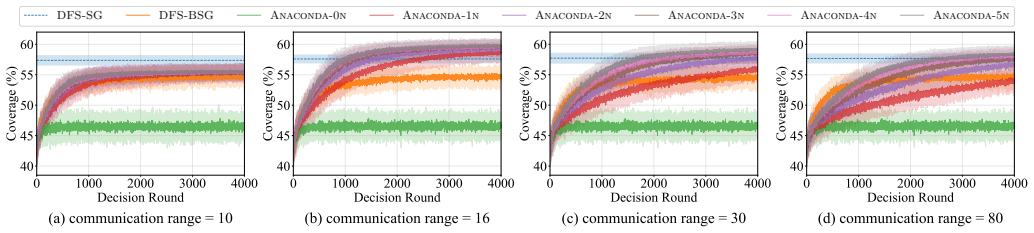
Summary. The paper studies multi-agent submodular maximization under bandit feedback and strict one-hop communication constraints. It proposes ANACONDA, a fully distributed algorithm in which each agent runs an EXP3-based action selector (ACTSEL) and an EXP3-based neighbor selector (NEISEL), choosing up to α_i communication neighbors per round. The Value of Coordination (VoC) is introduced to quantify the benefit of a neighbor set; the paper proves VoC is monotone submodular under 2nd-order submodularity of f, and then derives a priori (Theorem 1), a posteriori (Theorem 2), and asymptotic (Theorem 3) approximation bounds, along with convergence-time bounds (Theorem 4). Simulations in camera coverage tasks compare NEISEL against nearest/random neighbors and ANACONDA against DFS-SG/DFS-BSG, with and without communication delays.
Significance. If the anytime bounds were correct, this would be a meaningful advance: it would be the first distributed algorithm that actively optimizes communication neighborhoods for bandit submodular coordination, works on directed/disconnected topologies, and has O(|N|^2) convergence time in sparse networks. The VoC construction is an interesting information-theoretic device, and the release of code and the delay-aware simulations are genuine strengths. However, the central anytime guarantee currently rests on proofs that deliver only horizon-averaged bounds, and there are missing assumptions on reward normalization. The underlying algorithm and average-case regret framework are plausible, but the main 'anytime, strictly positive' claim needs either a correct proof or a substantial restatement.
major comments (5)
- [§IV-B, Theorem 2; Appendix A, Eqs. (30), (41)–(42)] Theorem 2 claims a per-time lower bound on E[f(A_t)] with β defined in Eq. (18) as a per-time expectation ratio. The proof starts from the cumulative inequality Eq. (30), divides by Σ_t f(A_t), and bounds only the cumulative ratio (Σ_t Σ_i f(a_i,t | ...))/(Σ_t f(A_t)). Since ACTSEL/NEISEL are non-stationary—the distributions at t depend on the evolving neighbor sets—the per-time ratio is t-dependent and cannot be identified with the cumulative ratio without an additional argument. Thus the advertised 'anytime' and 'strictly positive at all times' bound is not established; the argument supports at most a Cesàro-average statement. The \tilde O term in Eq. (17) is also placed in the denominator as if it were a number, which makes the finite-T reading unclear.
- [§IV-A, Theorem 1; Appendix A, Eqs. (34)–(35)] The theorem is stated as E[f(A_t)] ≥ ..., but the proof derives a bound on the time average (1/T)Σ_t E[f(A_t)]. In Eq. (34) the term (1/T)Σ_t f(A_t) is replaced by E[f(A_t)] with no stationarity or ergodicity argument; the action distributions are not constant in t. Consequently Eq. (14) is at best a bound on the Cesàro average over the horizon, not an anytime per-round bound. This also propagates to the combined Theorem 3, which takes the maximum of Theorem 1 and Theorem 2.
- [Appendix B, Proposition 2 and Theorem 4] The conversion from regret to convergence is off by a square. Lemmas 2 and 3 give average error \tilde O(√(|V|/T)) (and similarly with α^2|M|). To make this ≤ ε requires T = Ω(1/ε^2), not T ≥ |V||N|^2/ε as stated in Proposition 2. Theorem 4 and Corollary 1 therefore should have 1/ε^2 in the denominator. As written, the claimed convergence-time scaling in ε is incorrect.
- [Algorithms 2 and 3, lines 7 and 9; Lemmas 2 and 3] Both ACTSEL and NEISEL normalize rewards to [0,1] but never specify the normalization constant or a uniform bound on f. EXP3's O~(√T) regret bound holds only when rewards are in a known bounded range. If the normalization divisor is data-dependent (e.g., based on observed rewards), it multiplies the regret by an unknown factor; if it is a known global bound, that bound should be stated in Problem 1 and in the theorems. Without this, the regret bounds in Lemmas 2–3 and all downstream guarantees are not controlled.
- [§II, Definition 2 and Lemma 1] The reduction of NEISEL to online submodular maximization depends on Lemma 1, which uses 2nd-order submodularity. This is a strictly stronger condition than ordinary submodularity, and the paper does not discuss which application classes satisfy it. The simulations state only that the coverage objective is submodular (Section VII and [3]) and do not verify Definition 2. If the experimental f is not 2nd-order submodular, Lemma 1 and the NEISEL regret guarantee do not apply to the reported experiments. This restriction should be prominently stated or the simulation objective verified.
minor comments (5)
- [Lemma 3] The learning rate is written as η_i^n = sqrt(2 log|M_i|/(|V_i|T)), but Algorithm 3 line 1 has |M_i|T in the denominator. Please correct the typo.
- [§VI] The text says "We defer the description of the former simulations to Appendix V"; this should be Appendix E.
- [§IV-B, Eq. (17)] Using \tilde O notation inside a denominator is informal. Please provide an explicit finite-T bound or state the limit version separately.
- [Figure 2] The axis label "Curvature5f" appears garbled; it should be κ_f.
- [Abstract] There is a typo: "V alue of Coordination" should be "Value of Coordination".
Circularity Check
No significant circularity: the central guarantees are derived from external bandit/submodular results and the paper's own definitions; self-citations are positional, not load-bearing.
full rationale
Walking the derivation chain, the load-bearing ingredients are external: EXP3's regret bound [46], the online submodular maximization regret bound [51], curvature [50], and 2nd-order submodularity [44], [45]. The Value of Coordination (Def. 3) is defined in terms of f, but Proposition 1 and Theorem 1 use it as a measurable quantity inside a regret-based lower bound; they do not define VoC in terms of the claimed conclusion. Lemma 1 (VoC submodularity) is not an imported uniqueness or ansatz: it is proved directly from Definition 2, and Definition 2 is an explicit external property, not a self-referential one. Self-citations [1], [21], [43] are used for contextual positioning, preliminary-work comparison, or benchmark construction; the main theorems do not reduce to those citations. The cited [53, Eq. (15)] is an elementary submodular inequality, not the target result, so it does not create circularity. Theorem 2's β is an a posteriori ratio of the algorithm's own realized marginals to its realized value; this makes the bound data-dependent but not circular, and no parameter is fitted to make the theorem pass. The most serious concern in the manuscript is a proof-rigor gap—Theorems 1 and 2 are stated per-time but derived from horizon-averaged cumulative inequalities—but that is a correctness issue, not a circularity reduction, and it does not raise the circularity score under the stated rules. Overall, the derivation is self-contained relative to its stated assumptions, and no step reduces by construction to its own inputs.
Assumptions & free parameters
free parameters (1)
- Reward normalization bound for ACTSEL and NEISEL
assumptions (5)
- domain assumption f is normalized, non-decreasing, submodular, and 2nd-order submodular
- domain assumption Agents can evaluate f on any subset of their own and neighbors' actions (semi-bandit feedback)
- standard math EXP3 achieves O(sqrt(KT log K)) regret against adversarial reward sequences
- standard math Cardinality-constrained online submodular maximization can be decomposed into alpha_i independent bandit instances with approximation factor rho(kappa, alpha)
- standard math A fixed agent ordering [i-1] exists for the telescoping argument
Cite this review
Pith. "Pith review of Self-Configurable Mesh-Networks for Scalable Distributed Submodular Bandit Optimization." pith.science (2026). https://pith.science/paper/QD766M7R
@misc{pith2026260219366,
  author       = {Pith},
  title        = {Pith review of: Self-Configurable Mesh-Networks for Scalable Distributed Submodular Bandit Optimization},
  year         = {2026},
  howpublished = {\url{https://pith.science/paper/QD766M7R}},
  note         = {Machine review of arXiv:2602.19366}
}
read the original abstract
We study how to scale distributed bandit submodular coordination under realistic communication constraints in bandwidth, data rate, and connectivity. We are motivated by multi-agent tasks of active situational awareness in unknown, partially-observable, and resource-limited environments, where the agents must coordinate through agent-to-agent communication. Our approach enables scalability by (i) limiting information relays to only one-hop communication and (ii) keeping inter-agent messages small, having each agent transmit only its own action information. Despite these information-access restrictions, our approach enables near-optimal action coordination by optimizing the agents' communication neighborhoods over time, through distributed online bandit optimization, subject to the agents' bandwidth constraints. Particularly, our approach enjoys an anytime suboptimality bound that is also strictly positive for arbitrary network topologies, even disconnected. To prove the bound, we define the Value of Coordination (VoC), an information-theoretic metric that quantifies for each agent the benefit of information access to its neighbors. We validate in simulations the scalability and near-optimality of our approach: it is observed to converge faster, outperform benchmarks for bandit submodular coordination, and can even outperform benchmarks that are privileged with a priori knowledge of the environment.
Figures


Figures from the paper (4 more)



Reference graph
Works this paper leans on
-
[3]
Distributed submodular maximization on partition matroids for planning on large sensor networks,
M. Corah and N. Michael, “Distributed submodular maximization on partition matroids for planning on large sensor networks,” inIEEE Conference on Decision and Control (CDC), 2018, pp. 6792–6799
2018
-
[1]
Bandit submodular maximization for multi-robot coordination in unpredictable and partially observable environments,
Z. Xu, X. Lin, and V . Tzoumas, “Bandit submodular maximization for multi-robot coordination in unpredictable and partially observable environments,” inRobotics: Science and Systems (RSS), 2023
2023
-
[2]
Decentralized active information acquisition: Theory and application to multi-robot SLAM,
N. Atanasov, J. Le Ny, K. Daniilidis, and G. J. Pappas, “Decentralized active information acquisition: Theory and application to multi-robot SLAM,” inIEEE Inter. Conf. Rob. Auto. (ICRA), 2015, pp. 4775–4782
2015
-
[4]
Coordination of groups of mobile autonomous agents using nearest neighbor rules,
A. Jadbabaie, J. Lin, and A. Morse, “Coordination of groups of mobile autonomous agents using nearest neighbor rules,”IEEE Transactions on Automatic Control (TAC), vol. 48, no. 6, pp. 988–1001, 2003
2003
-
[5]
Distributed subgradient methods for multi- agent optimization,
A. Nedic and A. Ozdaglar, “Distributed subgradient methods for multi- agent optimization,”IEEE Transactions on Automatic Control (TAC), vol. 54, no. 1, pp. 48–61, 2009
2009
-
[6]
(2025) XBee 3 Zigbee 3 RF Module Specifications
Digi International. (2025) XBee 3 Zigbee 3 RF Module Specifications. Accessed: Dec. 2025. [Online]. Available: https://www.digi.com/products/embedded-systems/digi-xbee/ rf-modules/2-4-ghz-rf-modules/xbee3-zigbee-3#specifications
2025
-
[7]
(2025) StreamCaster Lite 5200 (SL5200) MANET Radio Specifications
Silvus Technologies. (2025) StreamCaster Lite 5200 (SL5200) MANET Radio Specifications. Accessed: Dec. 2025. [Online]. Available: https://silvustechnologies.com/products/streamcaster-lite-5200/
2025
-
[8]
T. F. Internet. (2025) Wifi 6 vs wifi 6e: Unlocking faster, more reliable connectivity. Accessed: Dec. 2025. [Online]. Available: https://tachus.com/wifi-6-vs-wifi-6e/
2025
Show all 53 references
-
[9]
Temporal logic task planning and intermittent connectivity control of mobile robot networks,
Y . Kantaros, M. Guo, and M. M. Zavlanos, “Temporal logic task planning and intermittent connectivity control of mobile robot networks,” IEEE Transactions on Automatic Control (TAC), vol. 64, no. 10, pp. 4105–4120, 2019
2019
-
[10]
Lattimore and C
T. Lattimore and C. Szepesvári,Bandit Algorithms. Cambridge University Press, 2020
2020
-
[11]
Near-optimal sensor placements in gaussian processes: Theory, efficient algorithms and empirical stud- ies,
A. Krause, A. Singh, and C. Guestrin, “Near-optimal sensor placements in gaussian processes: Theory, efficient algorithms and empirical stud- ies,”Jour. Mach. Learn. Res. (JMLR), vol. 9, pp. 235–284, 2008
2008
-
[12]
Efficient infor- mative sensing using multiple robots,
A. Singh, A. Krause, C. Guestrin, and W. J. Kaiser, “Efficient infor- mative sensing using multiple robots,”Journal of Artificial Intelligence Research (JAIR), vol. 34, pp. 707–755, 2009
2009
-
[13]
Multi-target visual tracking with aerial robots,
P. Tokekar, V . Isler, and A. Franchi, “Multi-target visual tracking with aerial robots,” inIEEE/RSJ International Conference on Intelligent Robots and Systems (IROS), 2014, pp. 3067–3072
2014
-
[14]
Distributed submodular maximization with limited information,
B. Gharesifard and S. L. Smith, “Distributed submodular maximization with limited information,”IEEE Transactions on Control of Network Systems (TCNS), vol. 5, no. 4, pp. 1635–1645, 2017
2017
-
[15]
The role of information in distributed resource alloca- tion,
J. R. Marden, “The role of information in distributed resource alloca- tion,”IEEE Transactions on Control of Network Systems (TCNS), vol. 4, no. 3, pp. 654–664, 2017
2017
-
[16]
The impact of information in distributed submodular maximization,
D. Grimsman, M. S. Ali, J. P. Hespanha, and J. R. Marden, “The impact of information in distributed submodular maximization,”IEEE Trans. Ctrl. Netw. Sys. (TCNS), vol. 6, no. 4, pp. 1334–1343, 2019
2019
-
[17]
Resilient active informa- tion acquisition with teams of robots,
B. Schlotfeldt, V . Tzoumas, and G. J. Pappas, “Resilient active informa- tion acquisition with teams of robots,”IEEE Transactions on Robotics (TRO), vol. 38, no. 1, pp. 244–261, 2021
2021
-
[18]
Jacobi-style iteration for distributed submodular maximization,
B. Du, K. Qian, C. Claudel, and D. Sun, “Jacobi-style iteration for distributed submodular maximization,”IEEE Transactions on Automatic Control (TAC), vol. 67, no. 9, pp. 4687–4702, 2022
2022
-
[19]
Distributed strategy selection: A sub- modular set function maximization approach,
N. Rezazadeh and S. S. Kia, “Distributed strategy selection: A sub- modular set function maximization approach,”Automatica, vol. 153, p. 111000, 2023
2023
-
[20]
Optimal algorithms for submodular maximization with distributed constraints,
A. Robey, A. Adibi, B. Schlotfeldt, H. Hassani, and G. J. Pappas, “Optimal algorithms for submodular maximization with distributed constraints,” inLearn. for Dyn. & Cont. (L4DC), 2021, pp. 150–162
2021
-
[21]
Communication- and computation-efficient distributed submodular optimization in robot mesh networks,
Z. Xu, S. S. Garimella, and V . Tzoumas, “Communication- and computation-efficient distributed submodular optimization in robot mesh networks,”IEEE Transactions on Robotics (TRO), 2025
2025
-
[22]
An analysis of approximations for maximizing submodular set functions–II,
M. L. Fisher, G. L. Nemhauser, and L. A. Wolsey, “An analysis of approximations for maximizing submodular set functions–II,” in Polyhedral combinatorics, 1978, pp. 73–87
1978
-
[23]
A threshold ofln(n)for approximating set cover,
U. Feige, “A threshold ofln(n)for approximating set cover,”Journal of the ACM (JACM), vol. 45, no. 4, pp. 634–652, 1998
1998
-
[24]
Distributed resilient submodular action selection in adversarial environments,
J. Liu, L. Zhou, P. Tokekar, and R. K. Williams, “Distributed resilient submodular action selection in adversarial environments,”IEEE Robotics and Automation Letters (RAL), vol. 6, no. 3, pp. 5832–5839, 2021
2021
-
[25]
Execution order matters in greedy algorithms with limited information,
R. Konda, D. Grimsman, and J. R. Marden, “Execution order matters in greedy algorithms with limited information,” inAmerican Control Conference (ACC), 2022, pp. 1305–1310
2022
-
[26]
Submodular function maximization,
A. Krause and D. Golovin, “Submodular function maximization,” Tractability: Practical Approaches to Hard Problems, vol. 3, 2012
2012
-
[27]
An online algorithm for maximizing submodular functions,
M. Streeter and D. Golovin, “An online algorithm for maximizing submodular functions,”Adv. Neu. Inf. Proc. Sys., vol. 21, 2008
2008
-
[28]
Online learning of assign- ments,
M. Streeter, D. Golovin, and A. Krause, “Online learning of assign- ments,”Adv. Neu. Info. Proc. Sys. (NeurIPS), vol. 22, 2009
2009
-
[29]
Online prediction under submodular constraints,
D. Suehiro, K. Hatano, S. Kijima, E. Takimoto, and K. Nagano, “Online prediction under submodular constraints,” inInternational Conf. on Algorithmic Learning Theory (ALT), 2012, pp. 260–274
2012
-
[30]
Online submodular maximiza- tion under a matroid constraint with application to learning assignments,
D. Golovin, A. Krause, and M. Streeter, “Online submodular maximiza- tion under a matroid constraint with application to learning assignments,” arXiv preprint:1407.1082, 2014
2014 arXiv
-
[31]
Online continuous submodular maximization,
L. Chen, H. Hassani, and A. Karbasi, “Online continuous submodular maximization,” inInternational Conference on Artificial Intelligence and Statistics (AISTATS). PMLR, 2018, pp. 1896–1905
2018
-
[32]
Online continuous submodular maximization: From full-information to bandit feedback,
M. Zhang, L. Chen, H. Hassani, and A. Karbasi, “Online continuous submodular maximization: From full-information to bandit feedback,” Adv. Neu. Info. Proc. Sys. (NeurIPS), vol. 32, 2019
2019
-
[33]
Online submodular coordination with bounded tracking regret: Theory, algorithm, and applications to multi-robot coordination,
Z. Xu, H. Zhou, and V . Tzoumas, “Online submodular coordination with bounded tracking regret: Theory, algorithm, and applications to multi-robot coordination,”IEEE Robotics and Automation Letters (RAL), vol. 8, no. 4, pp. 2261–2268, 2023
2023
-
[34]
Maximizing a monotone submodular function subject to a matroid constraint,
G. Calinescu, C. Chekuri, M. Pál, and J. V ondrák, “Maximizing a monotone submodular function subject to a matroid constraint,”SIAM Journal on Computing, vol. 40, no. 6, pp. 1740–1766, 2011
2011
-
[35]
Decentralized submodular maximization: Bridging discrete and continuous settings,
A. Mokhtari, H. Hassani, and A. Karbasi, “Decentralized submodular maximization: Bridging discrete and continuous settings,” inInterna- tional Conference on Machine Learning (ICML), 2018, pp. 3616–3625
2018
-
[36]
Black box submodular maximization: Discrete and continuous settings,
L. Chen, M. Zhang, H. Hassani, and A. Karbasi, “Black box submodular maximization: Discrete and continuous settings,” inInter. Conf. Arti. Intel. Stats. (AISTATS). PMLR, 2020, pp. 1058–1070
2020
-
[37]
Near-optimal online learning for multi-agent submodular coordination: Tight approximation and communication efficiency,
Q. Zhang, Z. Wan, Y . Yang, L. Shen, and D. Tao, “Near-optimal online learning for multi-agent submodular coordination: Tight approximation and communication efficiency,”arXiv preprint:2502.05028, 2025
2025 arXiv
-
[38]
Asyn- chronous distributed optimization via admm with efficient communica- tion,
A. I. Rikos, W. Jiang, T. Charalambous, and K. H. Johansson, “Asyn- chronous distributed optimization via admm with efficient communica- tion,” inIEEE Conference on Decision and Control (CDC), 2023, pp. 7002–7008
2023
-
[39]
Distributed quantized average consensus in open multi-agent systems with dynamic communication links,
J. Hu, K. H. Johansson, and A. I. Rikos, “Distributed quantized average consensus in open multi-agent systems with dynamic communication links,”arXiv preprint:2508.05895, 2025
2025 arXiv
-
[40]
The END: Estimation network design for games under partial-decision information,
M. Bianchi and S. Grammatico, “The END: Estimation network design for games under partial-decision information,”IEEE Transactions on Control of Network Systems (TCNS), vol. 11, no. 4, pp. 2200–2212, 2024
2024
-
[41]
Racer: Rapid collaborative exploration with a decentralized multi-uav system,
B. Zhou, H. Xu, and S. Shen, “Racer: Rapid collaborative exploration with a decentralized multi-uav system,”IEEE Transactions on Robotics (TRO), vol. 39, no. 3, pp. 1816–1835, 2023
2023
-
[42]
SlideSLAM: Sparse, lightweight, decen- tralized metric-semantic slam for multirobot navigation,
X. Liu, J. Lei, A. Prabhu, Y . Tao, I. Spasojevic, P. Chaudhari, N. Atanasov, and V . Kumar, “SlideSLAM: Sparse, lightweight, decen- tralized metric-semantic slam for multirobot navigation,”IEEE Trans- actions on Robotics (TRO), vol. 41, pp. 6529–6548, 2025
2025
-
[43]
Performance-aware self-configurable multi- agent networks: A distributed submodular approach for simultaneous coordination and network design,
Z. Xu and V . Tzoumas, “Performance-aware self-configurable multi- agent networks: A distributed submodular approach for simultaneous coordination and network design,” inIEEE Conference on Decision and Control (CDC), 2024, pp. 5393–5400
2024
-
[44]
A characterization of a cone of pseudo-boolean functions via supermodularity-type inequalities,
Y . Crama, P. L. Hammer, and R. Holzman, “A characterization of a cone of pseudo-boolean functions via supermodularity-type inequalities,” in Quantitative Methoden in den Wirtschaftswissenschaften. Springer, 1989, pp. 53–55
1989
-
[45]
Submodularity, supermodularity, and higher-order monotonicities of pseudo-boolean functions,
S. Foldes and P. L. Hammer, “Submodularity, supermodularity, and higher-order monotonicities of pseudo-boolean functions,”Mathematics of Operations Research, vol. 30, no. 2, pp. 453–461, 2005
2005
-
[46]
The non- stochastic multiarmed bandit problem,
P. Auer, N. Cesa-Bianchi, Y . Freund, and R. E. Schapire, “The non- stochastic multiarmed bandit problem,”SIAM Journal on Computing, vol. 32, no. 1, pp. 48–77, 2002
2002
-
[47]
Explore no more: Improved high-probability regret bounds for non-stochastic bandits,
G. Neu, “Explore no more: Improved high-probability regret bounds for non-stochastic bandits,”Adv. Neu. Info. Proc. Sys., vol. 28, 2015
2015
-
[48]
One practical algorithm for both stochas- tic and adversarial bandits,
Y . Seldin and A. Slivkins, “One practical algorithm for both stochas- tic and adversarial bandits,” inInternational Conference on Machine Learning (ICML), 2014, pp. 1287–1295
2014
-
[49]
Tsallis-INF: An optimal algorithm for stochastic and adversarial bandits,
J. Zimmert and Y . Seldin, “Tsallis-INF: An optimal algorithm for stochastic and adversarial bandits,”Journal of Machine Learning Re- search (JMLR), vol. 22, no. 28, pp. 1–49, 2021
2021
-
[50]
Submodular set functions, matroids and the greedy algorithm: Tight worst-case bounds and some generalizations of the rado-edmonds theorem,
M. Conforti and G. Cornuéjols, “Submodular set functions, matroids and the greedy algorithm: Tight worst-case bounds and some generalizations of the rado-edmonds theorem,”Discrete Applied Mathematics, vol. 7, no. 3, pp. 251–274, 1984
1984
-
[51]
Tracking regret bounds for online submodular optimization,
T. Matsuoka, S. Ito, and N. Ohsaka, “Tracking regret bounds for online submodular optimization,” inInternational Conference on Artificial Intelligence and Statistics (AISTATS). PMLR, 2021, pp. 3421–3429
2021
-
[52]
Online learning with predictable se- quences,
A. Rakhlin and K. Sridharan, “Online learning with predictable se- quences,” inConference on Learning Theory (COLT), 2013, pp. 993– 1019
2013
-
[53]
Resilient monotone submodular function maximization,
V . Tzoumas, K. Gatsis, A. Jadbabaie, and G. J. Pappas, “Resilient monotone submodular function maximization,” inIEEE Conference on Decision and Control (CDC), 2017, pp. 1362–1367. APPENDIXA SUBOPTIMALITYGUARANTEES OFANACONDA We will first prove Lemmas 1 to 3, then Proposition...
2017
Reviewed August 2, 2026 · model on record in the stance chip above.
Discussion (0). Continue with ORCID to comment.