Recognition: no theorem link
Tunable dislocations overcome mechano-functional tradeoff in perovskite oxides
Pith reviewed 2026-05-15 20:19 UTC · model grok-4.3
The pith
Intermediate dislocation densities enable over 20% ductility in KTaO3 while higher densities reduce thermal conductivity.
A machine-rendered reading of the paper's core claim, the machinery that carries it, and where it could break.
Core claim
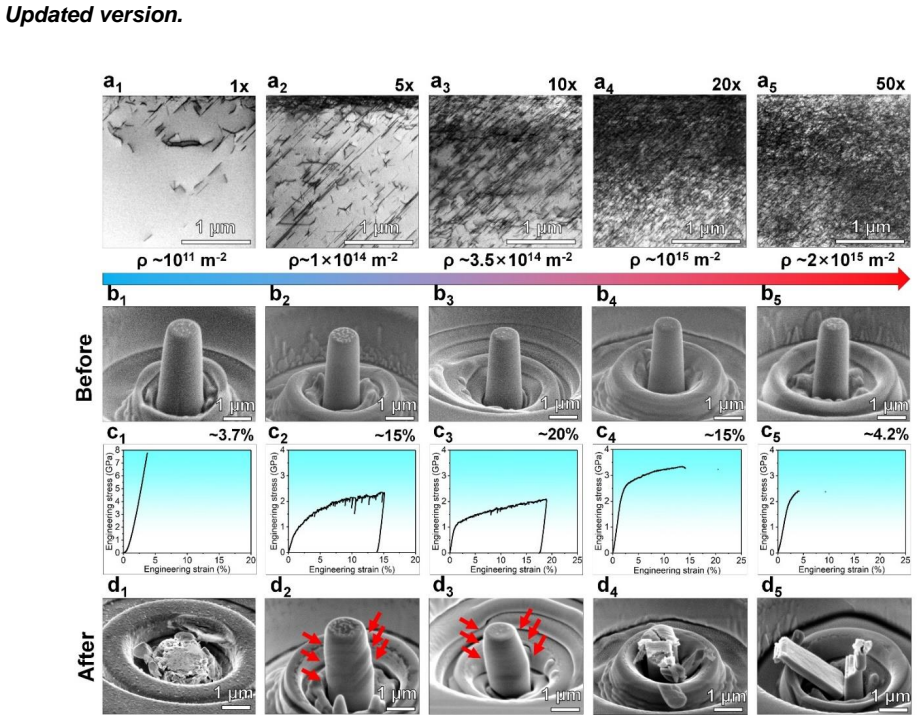
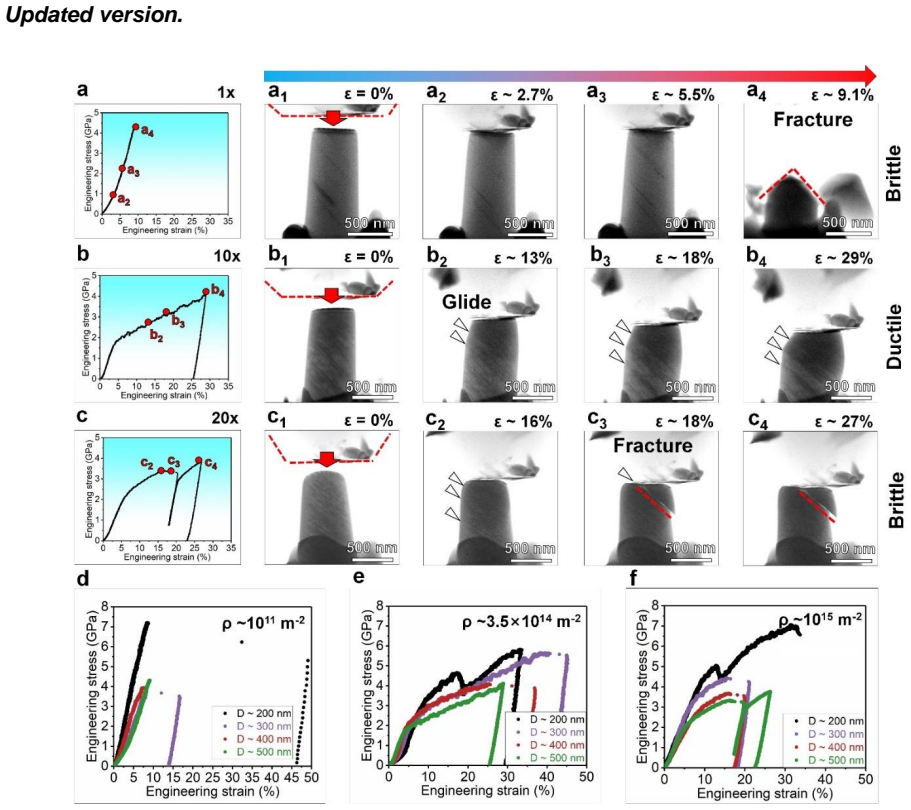
We uncover a novel brittle-ductile-brittle transition in KTaO3: low dislocation densities lead to brittle failure, intermediate densities (~10^14 m^{-2}) enable superior ductility with strains over 20%, and high dislocation densities (~10^15 m^{-2}) induce again brittle fracture. Dislocation densities can monotonically decrease thermal conductivity, revealing a tradeoff between mechanical strength and functionality.
What carries the argument
Dislocation density as the tunable parameter that drives the brittle-ductile-brittle transition and produces a monotonic drop in thermal conductivity.
If this is right
- Ceramics can reach room-temperature ductility exceeding 20% when dislocation density is set to an intermediate window.
- Thermal conductivity in functional oxides can be lowered in a controlled way by raising dislocation density.
- Optimal material performance requires tuning to a critical dislocation-density threshold rather than maximizing or minimizing it.
- Dislocation engineering supplies a new route to design oxides where mechanical durability and thermal functionality are deliberately balanced.
Where Pith is reading between the lines
- The same density-tuning strategy may extend to other perovskite oxides that currently lack room-temperature plasticity.
- The observed mechanical-thermal tradeoff implies that dislocation density could also affect electrical or optical properties in related compounds.
- Practical devices could use controlled plastic deformation to introduce the optimal dislocation density without separate processing steps.
Load-bearing premise
The non-monotonic mechanical response and monotonic thermal-conductivity drop are caused primarily by the introduced dislocation density rather than by secondary effects such as stoichiometry changes or surface damage.
What would settle it
An experiment that varies dislocation density while holding stoichiometry, surface finish, and test conditions fixed, then checks whether the brittle-ductile-brittle transition and thermal-conductivity trend disappear.
Figures


read the original abstract
Recent advancements in dislocation engineering are reshaping the traditional view towards ceramics being brittle. Here, we use KTaO3 (KTO), a perovskite oxide that is newly discovered with room-temperature bulk plasticity, and demonstrate that the seeded dislocations can effectively tune both mechanical and functional properties. We uncover a novel brittle-ductile-brittle (BDB) transition: low dislocation densities lead to brittle failure, intermediate densities (~10*14 m-2) enable superior ductility with strains over 20%, and high dislocation densities (~10*15 m-2) induce again brittle fracture. This dislocation density-dependent non-monotonic mechanical response challenges the traditional behavior of ceramics and offers new design opportunities. Furthermore, dislocation densities can monotonically decrease thermal conductivity, revealing a tradeoff between mechanical strength and functionality. The findings reveal a critical threshold of dislocation density in optimizing the performance of functional oxides, and provide a new framework for using dislocations to design advanced materials where mechanical durability and enhanced functionality are intertwined.
Editorial analysis
A structured set of objections, weighed in public.
Referee Report
Summary. The manuscript reports experimental results on KTaO3 (KTO) perovskite oxide demonstrating that seeded dislocations at controlled densities produce a brittle-ductile-brittle (BDB) transition: brittle failure at low densities (~10^{12}-10^{13} m^{-2}), superior ductility (>20% strain) at intermediate densities (~10^{14} m^{-2}), and brittle fracture again at high densities (~10^{15} m^{-2}). Thermal conductivity is reported to decrease monotonically with increasing dislocation density, suggesting a tunable tradeoff between mechanical and functional properties.
Significance. If the trends are robustly attributable to dislocation density, the work would advance dislocation engineering in functional ceramics by showing room-temperature bulk plasticity in KTO and a non-monotonic mechanical response that challenges conventional ceramic behavior. The monotonic thermal-conductivity reduction offers a concrete route to decouple strength and functionality, with potential design implications for oxide devices.
major comments (2)
- [Abstract and Results (BDB transition)] The abstract states clear numerical thresholds for the BDB transition and >20% strain but provides no raw stress-strain data, error bars, sample statistics, or description of how dislocation density was measured (e.g., TEM, etch-pit counting) or controlled. This absence makes it impossible to evaluate whether post-hoc selection or measurement variability affects the reported non-monotonic trend.
- [Experimental Methods and Discussion] The central claim requires that dislocation density is the primary causal variable for both the BDB transition and the monotonic thermal-conductivity drop. The manuscript does not describe post-seeding annealing, chemical analysis (XPS, TGA, or equivalent) for oxygen stoichiometry, or control samples processed identically but without net dislocation increase, leaving open the possibility that secondary effects from the seeding process (point defects, surface damage) produce the observed trends.
minor comments (2)
- [Abstract] Dislocation densities are written as ~10*14 m-2; use standard notation ~10^{14} m^{-2} for clarity and consistency.
- [Figures] Figures showing mechanical and thermal data should include explicit legends for each dislocation density, scale bars, and error bars derived from multiple samples.
Simulated Author's Rebuttal
We thank the referee for the constructive and detailed comments, which have helped us improve the clarity and rigor of the manuscript. We address each major comment point by point below and have incorporated revisions to provide the requested data, protocols, and controls.
read point-by-point responses
-
Referee: [Abstract and Results (BDB transition)] The abstract states clear numerical thresholds for the BDB transition and >20% strain but provides no raw stress-strain data, error bars, sample statistics, or description of how dislocation density was measured (e.g., TEM, etch-pit counting) or controlled. This absence makes it impossible to evaluate whether post-hoc selection or measurement variability affects the reported non-monotonic trend.
Authors: We agree that the abstract and main text should include supporting raw data for transparency. In the revised manuscript, we will add representative stress-strain curves (with error bars) for each dislocation density regime, along with sample statistics (n ≥ 5 per condition) and a clear description of how dislocation densities were quantified and controlled. Densities were measured via a combination of TEM imaging for local confirmation and etch-pit counting for statistical averaging over larger areas; the seeding process parameters (temperature, time, and load) were calibrated against these measurements to achieve the target ranges. These additions will be placed in the Results section and Methods, with full datasets in the supplementary information, to allow direct evaluation of the non-monotonic trend. revision: yes
-
Referee: [Experimental Methods and Discussion] The central claim requires that dislocation density is the primary causal variable for both the BDB transition and the monotonic thermal-conductivity drop. The manuscript does not describe post-seeding annealing, chemical analysis (XPS, TGA, or equivalent) for oxygen stoichiometry, or control samples processed identically but without net dislocation increase, leaving open the possibility that secondary effects from the seeding process (point defects, surface damage) produce the observed trends.
Authors: We acknowledge the need to explicitly rule out secondary effects from the seeding process. The revised manuscript will include a detailed description of the post-seeding annealing protocol (performed at 800 °C in air for 2 hours) used to relax point defects. We have conducted additional XPS measurements confirming that oxygen stoichiometry remains unchanged across the dislocation density series (within experimental error of ±0.5 at.%). We will also add data from identically processed control samples without net dislocation introduction, which exhibit neither the BDB transition nor the monotonic thermal conductivity reduction. These controls, together with the annealing and chemical analysis, support dislocation density as the primary variable; the new results will be presented in the Methods and Discussion sections. revision: yes
Circularity Check
No circularity: experimental claims rest on direct measurements
full rationale
The manuscript reports experimental observations of a brittle-ductile-brittle transition and monotonic thermal-conductivity reduction as functions of measured dislocation density in KTaO3. No equations, fitted parameters, or derivations appear in the provided text that would reduce any reported result to a quantity defined by the same data or by a self-citation chain. The central claims are presented as outcomes of seeding and testing procedures rather than as predictions derived from prior assumptions within the paper itself. Any self-citations are incidental and not load-bearing for the reported trends.
Axiom & Free-Parameter Ledger
axioms (1)
- domain assumption Dislocation density can be independently controlled and measured in bulk KTaO3 single crystals without introducing confounding defects.
Reference graph
Works this paper leans on
-
[1]
P.M. Anderson, J.P . Hirth, J. Lothe, Theory of dislocations, 2nd ed., Cambridge University Press, 2017
work page 2017
-
[2]
D. Munz, T. Fett, Ceramics-Mechanical properties, failure behaviour, material selection, Springer, 1999
work page 1999
-
[3]
R.O. Ritchie, Toughening materials:enhancing resistance to fracture, Philosophical Transactions A 379 (2021) 20200437
work page 2021
-
[4]
Ritchie, The conflicts between strength and toughness, Nature Materials 10(11) (2011) 817-822
R.O. Ritchie, The conflicts between strength and toughness, Nature Materials 10(11) (2011) 817-822
work page 2011
-
[5]
Smyth, The defect chemistry of metal oxide, Oxford University Publisher, Oxford, 2000
D.M. Smyth, The defect chemistry of metal oxide, Oxford University Publisher, Oxford, 2000
work page 2000
-
[6]
D. Schweke, Y . Mordehovitz, M. Halabi, L. Shelly, S. Hayun, Defect Chemistry of Oxides for Energy Applications, Advanced Materials 30 (2018) 1706300
work page 2018
- [7]
-
[8]
K. Hayashi, T. Yama moto, Y . Ikuhara, T. Sakuma, Formation of Potential Barrier Related to Grain - Updated version. 26 Boundary Character in Semiconducting Barium Titanate, Journal of the American Ceramic Society 83(11) (2000) 2684-2688
work page 2000
-
[9]
F. Li, B. Wang, X. Gao, D. Damjanovic, L. -Q. Chen, S. Zh ang, Ferroelectric materials toward next - generation electromechanical technologies, Science 389(6755) (2025)
work page 2025
-
[10]
X. Fang, Mechanical tailoring of dislocations in ceramics at room temperature: A perspective, Journal of the American Ceramic Society 107(3) (2024) 1425-1447
work page 2024
-
[11]
X. Fang, W. Lu, J. Zhang, C. Minnert, J. Hou, S. Bruns, U. Kunz, A. Nakamura, K. Durst, J. Rödel, Harvesting room-temperature plasticity in ceramics by mechanically seeded dislocations, Materials Today 82 (2025) 81-91
work page 2025
-
[12]
M. Höfling, X. Zhou, L.M. Riemer, E. Bruder, B. Liu, L. Zhou, P.B. Groszewicz, F. Zhuo, B. -X. Xu, K. Durst, X. Tan, D. Damjanovic, J. Koruza, J. Rödel, Control of polarization in bulk ferroelectrics by mechanical dislocation imprint, Science 372 (2021) 961-964
work page 2021
-
[13]
Y . Ikuhara, Nanowire design by dislocation technology, Progress in Materials Science 54(6) (2009) 770- 791
work page 2009
- [14]
-
[15]
P. Gao, S. Yang, R. Ishikawa, N. Li, B. Feng, A. Kumamoto, N. Shibata, P. Yu, Y . Ikuhara, Atomic-scale measurement of flexoelectric polarization at SrTiO 3 dislocations, Physical Review Letters 120(26) (2018) 267601
work page 2018
-
[16]
S. Hameed, D. Pelc, Z.W. Anderson, A. Klein, R.J. Spieker, L. Yue, B. Das, J. Ramberger, M. Lukas, Y . Liu, M.J. Krogstad, R. Osborn, Y . Li, C. Leighton, R.M. Fernandes, M. Greven, Enhanced su perconductivity and ferroelectric quantum criticality in plastically deformed strontium titanate, Nature Materials 21 (2022) 54- 61
work page 2022
-
[17]
M. -W. Chu, D. H esse, I. S zafraniak, M. Alexe, R. S cholz, C. H arnagel, U. G ösele, Impact of misfit dislocations on the p olarization instability of epitaxial nanostructured ferroelectric perovskites, Nature Materials (2004)
work page 2004
- [18]
-
[19]
P. Gumbsch, S. Taeri-Baghbadrani, D. Brunner, W. Sigle, M. Ruhle, Plasticity and an inverse brittle -to- ductile transition in strontium titanate, Physical Review Letters 87(8) (2001) 085505
work page 2001
-
[20]
D. Brunner, S. Taeri -Baghbadrani, W. Sigle, M. Rühle, Surprising results of a study on the plasticity in strontium titanate, Journal of the American Ceramic Society 84(5) (2001) 1161-1163
work page 2001
-
[21]
X. Fang, J. Zhang, A. Frisch, O. Preuß, C. Okafor, M. Setvin, W. Lu, Room‐temperature bulk plasticity and tunable dislocation densities in KTaO3, Journal of the American Ceramic Society 107 (2024) 7054-7061
work page 2024
- [22]
-
[23]
P . Hirel, F.J. Kakdeu Yewou, J. Zhang, W. Lu, X. Fang, P. Carrez, Dislocations and plasticity of KTaO 3 perovskite modeled with an interatomic potential, Physical Review Materials 9(5) (2025)
work page 2025
- [24]
-
[25]
E.T. Lilleodden, W.D. Nix, Microstr uctural length-scale effects in the nanoindentation behavior of thin gold films, Acta Materialia 54 (2006) 1583-1593. Updated version. 27
work page 2006
-
[26]
L. Johnson, M.F. Ashby, The stress at which dislocations multiply in well -annealed metal crystals, Acta Metallurgica 16 (1968) 219-225
work page 1968
-
[27]
J.A. El -Awady, Unravelling the physics of size -dependent dislocation -mediated plasticity, Nature Communications 6 (2015) 5926
work page 2015
-
[28]
X. Fang, A. Nakamura, J. Rödel, Deform to perform: Dislocation -tuned properties of ceramics, ACerS Bulletin 102(5) (2023) 24-29
work page 2023
-
[29]
A. Nakamura, K. Matsunaga, J. Tohma, T. Yamamoto, Y . Ikuhara, Conducting nanowires in insulating ceramics, Nature Materials 2(7) (2003) 453-6
work page 2003
-
[30]
Y . Zhang, K. Feng, M. Song, S. Xiang, Y . Zhao, H. Gong, F. Ni, F. Dietrich, L. Fulanović, F. Zhuo, G . Buntkowsky, T. Frömling, D. Zhang, C. Bowen, J. Rödel, Dislocation -engineered piezocatalytic water splitting in single-crystal BaTiO3, Energy & Environmental Science (2025)
work page 2025
-
[31]
K. Szot, G . Bihlmayer, W. Speier, Nature of the resistive switching phenomena in TiO2 and SrTiO3, Solid State Physics 65 (2014) 353-559
work page 2014
-
[32]
J.M. Börgers, J. Kler, K. Ran, E. Larenz, T.E. Weirich, R. Dittmann, R.A. De Souza, Faster diffusion of oxygen along dislocations in (La,Sr)MnO 3+δ is a space‐charge phenomenon, Advanced Functional Materials (2021) 2105647
work page 2021
-
[33]
J. Ding, J. Zhang, J. Dong, K. Higuchi, A. Nakamura, W. Lu, B. Sun, X. Fang, Effective reduction in thermal conductivity by high-density dislocations in SrTiO3, Applied Physics Letters 126(25) (2025)
work page 2025
-
[34]
L. Abdellaoui, Z. Chen, Y . Yu, T. Luo, R. Hanus, T. Schwarz, R. Bueno Villoro, O. Cojocaru‐Mirédin, G .J. Snyder, D. Raabe, Y . Pei, C. Scheu, S. Zhang, Parallel dislocation networks and Cottrell atmospheres reduce thermal conductivity of PbTe thermoelectrics, Advanced Functional Materials (2021) 2101214
work page 2021
-
[35]
Z. Yin, H. Zhang, Y . Wang, Y . Wu, Y . Xing, X. Wang, X. Fang, Y . Yu, X. Guo, Ultrahigh‐ pressure structural modification in BiCuSeO ceramics: dense dislocations and exceptional thermoelectric performance, Advanced Energy Materials (2024) 2403174
work page 2024
- [36]
- [37]
-
[38]
M.D. Uchic, D.M. Dimiduk, J.N. Florando, W.D. Nix, Sample dimensions influence strength and crystal plasticity, Science 305 (2004) 986
work page 2004
-
[39]
J.R. Greer, J.T.M. De Hosson, Plasticity in small -sized metallic systems: Intrinsic versus extrinsic size effect, Progress in Materials Science 56(6) (2011) 654-724
work page 2011
- [40]
-
[41]
R.L. Sproull, M. Moss, H. Weinstock, Effect of dislocations on the thermal conductivity of lithium fluoride, Journal of Applied Physics 30 (1959) 334
work page 1959
-
[42]
M. Moss, Effect of Plastic Deformation on the Thermal conductivity of calcium fluoride and lithium fluoride, Journal of Applied Physics 36 (1965) 3308
work page 1965
-
[43]
Moss, Scattering of Phonons by Dislocations, Journal of Applied Physics 37(4168) (1966)
M. Moss, Scattering of Phonons by Dislocations, Journal of Applied Physics 37(4168) (1966)
work page 1966
- [44]
-
[45]
P. Gumbsch, J. Riedle, A. Hartmaier, H.F. Fischmeister, Controlling factors for the brittle -to-ductile Updated version. 28 transition in tungsten single crystals, Science 282 (1998)
work page 1998
-
[46]
C. Shen, J. Li1, T. Niu, J. Cho, Z. Shang, Y . Zhang, A. Shang, B. Yang, K. Xu, R.E. García, H. Wang, X. Zhang, Achieving room temperature plasticity in brittle ceramics through elevated temperature preloading, Science Advances 10 (2024) eadj4079
work page 2024
- [47]
-
[48]
X. Fang, H. Bishara, K. Ding, H. Tsybenko, L. Porz , M. Höfling, E. Bruder, Y . Li, G . Dehm, K. Durst, Nanoindentation pop‐in in oxides at room temperature: dislocation activation or crack formation?, Journal of the American Ceramic Society 104 (2021) 4728-4741
work page 2021
- [49]
- [50]
-
[51]
X. Fang, K. Ding, C. Minnert, A. Nakamura, K. Durst, Dislocation-based crack initiation and propagation in single-crystal SrTiO3, Journal of Materials Science 56 (2021) 5479-5492
work page 2021
-
[52]
A.S. Keh, J.C.M. Li, Y .T. Chou, Cracks due to the pilling -up of dislocations on two intersecting slip planes in MgO crystals, Acta Metallurgica 7 (1959) 694-696
work page 1959
-
[53]
X. Fang, O. Preuß, P. Breckner, J. Zhang, W. Lu, Engineering dislocation‐rich plastic zones in ceramics via room‐temperature scratching, Journal of the American Ceramic Society 106 (2023) 4540-4545
work page 2023
- [54]
-
[55]
B. Sun, G . Haunschild, C. Polanco, J.Z. Ju, L. Lindsay, G . Koblmuller, Y .K. Koh, Dislocation -induced thermal transport anisotropy in single-crystal group-III nitride films, Nature Materials 18(2) (2019) 136-140
work page 2019
discussion (0)
Sign in with ORCID, Apple, or X to comment. Anyone can read and Pith papers without signing in.