REVIEW 4 major objections 5 minor 50 references
Cross-Chirality Generalization by Axial Vectors for Hetero-Chiral Protein-Peptide Interaction Design
T0 review · 4 major / 5 minor · reviewed 2026-08-02 · deepseek-v4-flash
Pith's one-line read A generative model trained only on L–L complexes can design D-peptide binders for L-protein targets, the paper argues, by injecting axial vectors into the equivariant features and inverting both target and output.
desk verdict First wet-lab-validated generative AI for D-peptide binders, with a clean chirality-injection idea and honest theory; but the theory's key assumption is unverified on the trained net and the wet-lab evidence is thin. read the letter →
The pith
A machine-rendered reading of the paper's core claim, the machinery that carries it, and where it could break.
The reading
What carries the argument
Axial Feature Injection (AFI): a channel-wise linear mixing of polar vector features v with axial vector features a, written as ev = A^T v + B^T a. The axial channels are built from low-order geometric couplings—u×v, (w·(u×v))w, and (u·v)(u×v)—which remain unchanged under mirror inversion. This changes the network's equivariance class from E(3) to SE(3), making it chirality-aware while preserving rotation and translation equivariance, and the mixing coefficients are what carry the theoretical guarantee.
What would settle it
Compute the correlation matrix C = ⟨v_k, a_l⟩ on actual PepMirror encoder outputs over LNR test residues: if its Frobenius norm is near zero for most residues, the predicted inversion-induced discrepancy should be negligible, contradicting the theorem's applicability. Equivalently, one could initialize the mixing coefficients to be orthogonal and check whether the L/D chirality discrepancy drops to zero.
Extended reading notes
Core claim
The central claim is that injecting axial features into polar vector features suffices to achieve cross-chirality generalization from homo-chiral L–L training data to hetero-chiral D–L design tasks. The paper proves that without axial features an E(3)-equivariant network cannot distinguish a structure from its mirror image, while with channel-wise mixed axial features the latent-code norm differs between X and −X with high probability, provided the polar–axial correlations are non-degenerate. It further argues that latent codes of enantiomers stay close—so the model still recognizes them as the same residue type—while codes of different residue types separate, which keeps conditional diffusi
Load-bearing premise
The load-bearing premise is that, after training, the polar and axial feature channels keep a non-negligible, non-orthogonal overlap so that inversion changes the latent code; the paper assumes this rather than measuring it directly, and without it the theoretical guarantee collapses.
Editorial extensions
If this is right
- A model trained exclusively on L–L complexes can be asked to design D–L interfaces through a deterministic inversion of target and output, with no hetero-chiral training samples.
- Chirality control becomes a representational property: residue-level chirality is preserved at roughly 99.9% after relaxation, unlike E(3)-equivariant baselines that invert the entire structure with the target.
- The usual L-to-D performance cliff shrinks: PepMirror keeps affinity, success rate, and interface-energy improvement on D-tasks close to its L-task numbers.
- The pipeline yields a first wet-lab validated generative-AI D-peptide binder: D-1412, a 10-mer against CD38, with KD ≈ 10 µM consistent between kinetic and steady-state fits.
Reading between the lines
- Editorial extension: the same AFI plug-in should transfer to other E(3)-equivariant structure generators; the prerequisite is only that their latent codes cluster by residue type, which can be checked with the paper's distance-heatmap test.
- The theory implies a tuning knob: the chirality discrepancy scales with polar–axial correlation, so designers could deliberately shape mixing coefficients to maximize effective rank rather than relying on generic initialization.
- The stability argument suggests a stress test: evaluate per-residue chirality consistency on achiral or nearly achiral positions, such as glycine, and on residues where the 'enantiomer closer than different types' assumption may fail; those are the likely first failure modes.
- If the mechanism generalizes, mirror-image display could be largely replaced by in silico inversion for many therapeutic targets, making D-peptide discovery faster and cheaper—an inference beyond the paper's own evidence.
Editorial analysis
A structured set of objections, weighed in public.
Referee Report
Summary. The paper proposes AFI (Axial Feature Injection), a lightweight modification that injects axial vector features into the polar vector features of an E(3)-equivariant encoder, making the model SE(3)-equivariant and chirality-aware. The authors integrate AFI into a latent diffusion peptide design framework (PepMirror) and argue that, by two-step spatial inversion, the model can generate D-peptide binders for L-protein targets despite being trained only on homo-chiral L–L complexes. The theoretical component proves a generic lower bound on the inversion-induced latent discrepancy under random Gaussian mixing coefficients and a non-degenerate polar–axial correlation assumption. The empirical component reports latent-space analyses, in silico comparisons against several peptide design baselines, and a wet-lab validation identifying one D-peptide binder (D-1412) against CD38 with KD ≈ 10 µM.
Significance. If the claims hold, this is the first wet-lab validated generative-AI system for de novo D-peptide binder design, and AFI is a simple, practical mechanism for adding chirality awareness to efficient E(3)-equivariant backbones. The paper has notable strengths: the two-step inversion protocol does not train on hetero-chiral D–L data, so the setting is genuinely zero-shot; the theoretical derivation is explicit rather than a black-box claim; the in silico evaluation covers a broad set of baselines and includes a careful diagnosis of Rosetta's enantiomer inconsistency, with Vina justified as an alternative; and code is released. The wet-lab result, while modest, is a plausible proof-of-concept. However, some load-bearing theoretical assumptions are not verified on the trained model, and the empirical evidence is partly single-seed and limited to one binder.
major comments (4)
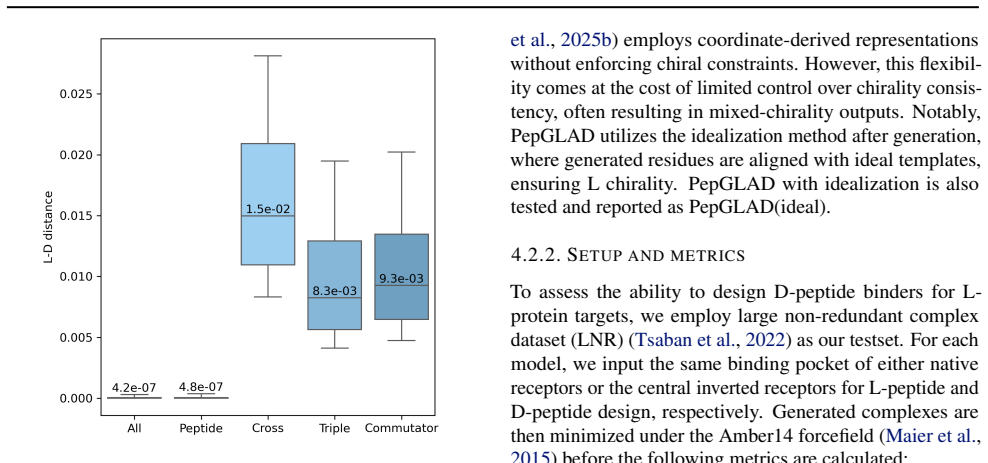
- [§3.3, Theorem 3.1 / Appendix B.3, Assumption B.4] Theorem B.8's lower bound depends critically on Assumption B.4 (||C||_F ≥ τ, reff ≥ r0), but this assumption is never measured on the trained PepMirror encoder. The paper itself notes in Eqs. (6)–(7) that when polar–axial orthogonality (v·a = 0) holds, the discrepancy vanishes, and the cross and commutator axial features (Algorithm 1) are by construction orthogonal to their source polar channels. The proof is a generic statement over Gaussian mixing coefficients at initialization (Assumption B.2); it does not cover trained coefficients. The sentence in Appendix B.3 saying that 'learned parameters fall into the discrepancy-inducing regime with high probability' is therefore unsupported. Please verify B.4 empirically on the trained model (report C, reff, and Δ per channel/layer), or explicitly reframe the theorem as an initialization/architecture-level guarantee rather than a guarantee abo
- [§3.4, Eq. (14)] Eq. (14), d(X,X') > d(X,−X), is an assumption, not a consequence of the architecture. The only support offered is the indirect Tanimoto shape-similarity analogy in Fig. 2, but amino-acid shape similarity is not the trained latent metric, and the step from Eq. (14) to Eq. (15) additionally assumes that φ preserves the ordering of embedding distances. Fig. 4 provides direct empirical evidence for this ordering in the trained encoder, but it is single-model and mean-pooled. Please state explicitly that Eq. (14) is an empirical assumption and add direct verification on the trained encoder, e.g., report within-type L/D distances versus between-type distances with error bars.
- [§4.2.3, Tables 1–2; §C.4] All in silico results are single-seed point estimates (random seed 12) with no error bars or significance tests. The central empirical claims—PepMirror consistently outperforms baselines on D-peptide design and has the smallest L-to-D degradation—rely on differences that could be within run-to-run variability (e.g., Table 2 D-task Avg: −4.15 vs −3.38; IMP D: 63.44 vs 50.54). Please report results over multiple seeds as mean ± std, or otherwise quantify variability. This is important because the paper's headline is a cross-chirality generalization advantage, not merely a new architecture.
- [§4.3 Wet-lab validation] The claim of 'efficacy in wet-lab validation' rests on a single peptide (D-1412, KD ≈ 10 µM) out of 12 tested candidates, with no control confirming that binding requires the D-stereochemistry. For example, the L-enantiomer of D-1412 could be tested as a negative control, or chiral purity could be established by chiral HPLC/optical rotation. Without such a control, the observed signal is consistent with a non-specific or chirality-independent interaction. Please add an enantiomer control or temper the claim to 'a D-peptide binder candidate with micromolar affinity was identified, but stereochemical specificity remains to be confirmed.'
minor comments (5)
- [Throughout] Typos: 'immunogenecity' (Section 1) should be 'immunogenicity'; 'chiraliity' (§4.2.2); 'Ramachadran' (Fig. S7 caption and §A.3); 'devided' (§C.6); Table 2 caption contains 'of of generated'.
- [Figure 3] The box plots summarize distances across samples but do not show the distribution across channels/layers or across seeds. Reporting these would directly address whether the nonzero discrepancy is concentrated in a few channels or is a robust effect.
- [§3.3 vs Algorithm 1] The theoretical notation uses channel-wise mixing vectors A_k, B_k, while Algorithm 1 implements a single unbiased Linear layer applied to the concatenated polar–axial channels. Please clarify the exact correspondence between the two descriptions, including how the linear layer's rows relate to A_k and B_k.
- [§4.2.2 and Appendix A.4] The Rosetta enantiomer inconsistency table (Table S4) is important because it justifies the choice of Vina over Rosetta as the primary interface-affinity metric. Consider moving a concise version into the main text or summarizing the numbers there.
- [§3.4, Eq. (16)] The diffusion SDE in Eq. (16) is written in forward time, but the proof in Appendix B.4 couples two solutions backwards from time T. The notation is understandable, but a one-sentence clarification that the SDE is run backwards in practice would help.
Circularity Check
No significant circularity: the central theory is a conditional theorem, and the D-binder pipeline is validated against external wet-lab data.
full rationale
The derivation chain is not circular. The two-step inversion protocol (Section 3.1, Gb = P(fθ(P(Gt)))) is a geometric identity, not a fitted prediction, and no hetero-chiral D–L data are used in training. Theorem 3.1 / Theorem B.8 derives chirality-induced latent discrepancy from explicitly stated Assumptions B.2–B.4; the proof is a genuine probabilistic derivation, and the paper explicitly acknowledges the A=B=I orthogonal case (Eqs. 6–7) where the effect vanishes, so the theorem is conditional rather than tautological. The stability argument in Section 3.4 relies on the explicit assumption Eq. (14), which is not derived from the model; this is a robustness gap, not a circular reduction, because the paper does not claim to derive Eq. (14) from the target conclusion. The latent-space experiments and wet-lab CD38 binder validation provide independent, external evidence, and the framework citations (UniMoMo, EPT, D-Flow) are prior work by other author groups rather than self-citations that carry the argument. The paper itself concedes the theory is not end-to-end, stating it focuses on 'the feature-mixing mechanism under simplifying assumptions, rather than providing an end-to-end theory of the trained network.' Unverified assumptions such as B.4 and Eq. (14) are correctness risks, not circularity.
Assumptions & free parameters
free parameters (2)
- Channel-mixing coefficients A_k, B_k =
Learned during training; no explicit values given
- Wet-lab candidate filtering thresholds =
absBSA>400, 0.20<relBSA<0.85, vina<-4.0, BuriedHBonds<10, ShapeComplementarity>0.65, ElectrostaticComplementarity>0.65,
assumptions (7)
- domain assumption Assumption B.2: mixing coefficients A_k, B_k are independent Gaussian/sub-Gaussian
- domain assumption Assumption B.3: bounded polar and axial vector features (∥v_i,:∥_F ≤ S_v, ∥a_i,:∥_F ≤ S_a)
- domain assumption Assumption B.4: non-degenerate polar–axial correlation ∥C∥_F ≥ τ and efficient rank reff ≥ r0
- domain assumption Eq. (14): inter-type embedding distance exceeds inversion distance, d(X,X′) > d(X,−X)
- domain assumption Assumption 3.3: Lipschitz drift of the diffusion model in state and condition
- domain assumption Coercivity of φ in the norm coordinate (Corollary B.9)
- standard math Standard SO(3) representation theory, Clebsch–Gordan decomposition, Hanson–Wright and Grönwall inequalities
Cite this review
Pith. "Pith review of Cross-Chirality Generalization by Axial Vectors for Hetero-Chiral Protein-Peptide Interaction Design." pith.science (2026). https://pith.science/paper/MOCPZ3WS
@misc{pith2026260220176,
  author       = {Pith},
  title        = {Pith review of: Cross-Chirality Generalization by Axial Vectors for Hetero-Chiral Protein-Peptide Interaction Design},
  year         = {2026},
  howpublished = {\url{https://pith.science/paper/MOCPZ3WS}},
  note         = {Machine review of arXiv:2602.20176}
}
abstract
D-peptide binders targeting L-proteins have promising therapeutic potential. Despite rapid advances in machine learning-based target-conditioned peptide design, generating D-peptide binders remains largely unexplored. In this work, we show that by injecting axial features to $E(3)$-equivariant (polar) vector features, it is feasible to achieve cross-chirality generalization from homo-chiral (L--L) training data to hetero-chiral (D--L) design tasks. By implementing this method within a latent diffusion model, we achieved D-peptide binder design that not only outperforms existing tools in \textit{in silico} benchmarks, but also demonstrates efficacy in wet-lab validation. To our knowledge, our approach represents the first wet-lab validated generative AI for the \textit{de novo} design of D-peptide binders, offering new perspectives on handling chirality in protein design. Codes are available at https://github.com/YZY010418/PepMirror
Figures


Figures from the paper (2 more)


Reference graph
Works this paper leans on
-
[1]
write newline
" write newline "" before.all 'output.state := FUNCTION n.dashify 't := "" t empty not t #1 #1 substring "-" = t #1 #2 substring "--" = not "--" * t #2 global.max substring 't := t #1 #1 substring "-" = "-" * t #2 global.max substring 't := while if t #1 #1 substring * t #2 global.max substring 't := if while FUNCTION format.date year duplicate empty "emp...
-
[2]
Adams, K., Pattanaik, L., and Coley, C. W. Learning 3d representations of molecular chirality with invariance to bond rotations. arXiv preprint arXiv:2110.04383, 2021
arXiv 2021
-
[3]
Blackmond, D. G. The origin of biological homochirality. Cold Spring Harbor perspectives in biology, 2 0 (5): 0 a002147, 2010
2010
-
[4]
S., Jude, K
Cao, L., Coventry, B., Goreshnik, I., Huang, B., Sheffler, W., Park, J. S., Jude, K. M., Markovi \'c , I., Kadam, R. U., Verschueren, K. H., et al. Design of protein-binding proteins from the target structure alone. Nature, 605 0 (7910): 0 551--560, 2022
2022
-
[5]
Blocking of the pd-1/pd-l1 interaction by ad-peptide antagonist for cancer immunotherapy
Chang, H.-N., Liu, B.-Y., Qi, Y.-K., Zhou, Y., Chen, Y.-P., Pan, K.-M., Li, W.-W., Zhou, X.-M., Ma, W.-W., Fu, C.-Y., et al. Blocking of the pd-1/pd-l1 interaction by ad-peptide antagonist for cancer immunotherapy. Angewandte Chemie International Edition, 54 0 (40): 0 11760--11764, 2015
2015
-
[6]
P., and Geiger, A
Coors, B., Condurache, A. P., and Geiger, A. Spherenet: Learning spherical representations for detection and classification in omnidirectional images. In Proceedings of the European conference on computer vision (ECCV), pp.\ 518--533, 2018
2018
-
[7]
Pretrained graph transformers for chirality-related tasks
Du, Y., Chen, J., and Schwaller, P. Pretrained graph transformers for chirality-related tasks. In AI for Accelerated Materials Design-Vienna, 2024
2024
-
[8]
findr: A web server for in silico d-peptide ligand identification
Engel, H., Guischard, F., Krause, F., Nandy, J., Kaas, P., Hoefflin, N., Koehn, M., Kilb, N., Voigt, K., Wolf, S., et al. findr: A web server for in silico d-peptide ligand identification. Synthetic and Systems Biotechnology, 6 0 (4): 0 402--413, 2021
2021
Show all 50 references
-
[9]
Foster, M. S. Rotations in 3d, so (3) , and su (2) , version 2.1. Lecture notes, Rice University, 2021
2021
-
[10]
SE (3)- Transformers : 3D Roto-Translation Equivariant Attention Networks
Fuchs, F., Worrall, D., Fischer, V., and Welling, M. SE (3)- Transformers : 3D Roto-Translation Equivariant Attention Networks . In Advances in Neural Information Processing Systems , volume 33, pp.\ 1970--1981. Curran Associates, Inc., 2020
1970
-
[11]
and Harris, J
Fulton, W. and Harris, J. Representation Theory , volume 129 of Graduate Texts in Mathematics . Springer New York, New York, NY, 2004. ISBN 978-3-540-00539-1 978-1-4612-0979-9
2004
-
[12]
Chienn: Embracing molecular chirality with graph neural networks
Gai \'n ski, P., Koziarski, M., Tabor, J., and \'S mieja, M. Chienn: Embracing molecular chirality with graph neural networks. In Joint European Conference on Machine Learning and Knowledge Discovery in Databases, pp.\ 36--52. Springer, 2023
2023
-
[13]
A., Wang, K
Garton, M., Nim, S., Stone, T. A., Wang, K. E., Deber, C. M., and Kim, P. M. Method to generate highly stable d-amino acid analogs of bioactive helical peptides using a mirror image of the entire pdb. Proceedings of the National Academy of Sciences, 115 0 (7): 0 1505--1510, 2018
2018
-
[14]
and Smidt, T
Geiger, M. and Smidt, T. E3nn: Euclidean Neural Networks , 2022
2022
-
[15]
Hall, B. C. Lie Groups , Lie Algebras , and Representations : An Elementary Introduction , volume 222 of Graduate Texts in Mathematics . Springer International Publishing, Cham, 2015. ISBN 978-3-319-13466-6 978-3-319-13467-3
2015
-
[16]
A survey of geometric graph neural networks: Data structures, models and applications
Han, J., Cen, J., Wu, L., Li, Z., Kong, X., Jiao, R., Yu, Z., Xu, T., Wu, F., Wang, Z., et al. A survey of geometric graph neural networks: Data structures, models and applications. Frontiers of Computer Science, 19 0 (11): 0 1911375, 2025
2025
-
[17]
Classical Electrodynamics
Jackson, J. Classical Electrodynamics. Wiley, 2021. ISBN 978-1-119-77076-3
2021
-
[18]
Equivariant pretrained transformer for unified geometric learning on multi-domain 3d molecules
Jiao, R., Kong, X., Yu, Z., Huang, W., and Liu, Y. Equivariant pretrained transformer for unified geometric learning on multi-domain 3d molecules. In ICLR 2024 Workshop on Generative and Experimental Perspectives for Biomolecular Design, 2024
2024
-
[19]
J., and Dror, R
Jing, B., Eismann, S., Suriana, P., Townshend, R. J., and Dror, R. Learning from protein structure with geometric vector perceptrons. arXiv preprint arXiv:2009.01411, 2020
2009 arXiv
-
[20]
Highly accurate protein structure prediction with AlphaFold
Jumper, J., Evans, R., Pritzel, A., et al. Highly accurate protein structure prediction with AlphaFold . Nature, 596: 0 583--589, 2021
2021
-
[21]
Kingma, D. P. and Welling, M. Auto-encoding variational bayes. arXiv preprint arXiv:1312.6114, 2013
2013 arXiv
-
[22]
O., Willett, E., Martinkus, K., Kleinhenz, J., Makowski, E., Watkins, A., Gligorijevic, V., Bonneau, R., and Saremi, S
Kirchmeyer, M., Pinheiro, P. O., Willett, E., Martinkus, K., Kleinhenz, J., Makowski, E., Watkins, A., Gligorijevic, V., Bonneau, R., and Saremi, S. Unified all-atom molecule generation with neural fields. In The 39th Annual Conference on Neural Information Processing Systems, 2025
2025
-
[23]
Full-atom peptide design with geometric latent diffusion
Kong, X., Jia, Y., Huang, W., and Liu, Y. Full-atom peptide design with geometric latent diffusion. Advances in Neural Information Processing Systems, 37: 0 74808--74839, 2025 a
2025
-
[24]
Unimomo: Unified generative modeling of 3d molecules for de novo binder design
Kong, X., Zhang, Z., Zhang, Z., Jiao, R., Ma, J., Huang, W., Liu, K., and Liu, Y. Unimomo: Unified generative modeling of 3d molecules for de novo binder design. In The 42nd International Conference on Machine Learning, 2025 b
2025
-
[25]
B., Tran, H
Kremsmayr, T., Aljnabi, A., Blanco-Canosa, J. B., Tran, H. N., Emidio, N. B., and Muttenthaler, M. On the utility of chemical strategies to improve peptide gut stability. Journal of medicinal chemistry, 65 0 (8): 0 6191--6206, 2022
2022
-
[26]
J., Jin, Y., and Luk, L
Lander, A. J., Jin, Y., and Luk, L. Y. D-peptide and d-protein technology: recent advances, challenges, and opportunities. ChemBioChem, 24 0 (4): 0 e202200537, 2023
2023
-
[27]
Levin, D. A. and Peres, Y. Markov chains and mixing times, volume 107. American Mathematical Soc., 2017
2017
-
[28]
Joint design of protein surface and backbone using a diffusion bridge model
Li, G., Zhao, X., Wu, F., and Laue, S. Joint design of protein surface and backbone using a diffusion bridge model. In The 39th Annual Conference on Neural Information Processing Systems, 2025 a
2025
-
[29]
Full-atom peptide design based on multi-modal flow matching
Li, J., Cheng, C., Wu, Z., Guo, R., Luo, S., Ren, Z., Peng, J., and Ma, J. Full-atom peptide design based on multi-modal flow matching. In Proceedings of the 41st International Conference on Machine Learning (ICML 2024), pp.\ 27615–27640, 2024
2024
-
[30]
E2Former : An Efficient and Equivariant Transformer with Linear-Scaling Tensor Products
Li, Y., Huang, L., Ding, Z., Wei, X., Wang, C., Yang, H., Wang, Z., Liu, C., Shi, Y., Jin, P., Qin, T., Gerstein, M., and Zhang, J. E2Former : An Efficient and Equivariant Transformer with Linear-Scaling Tensor Products . In The Thirty-ninth Annual Conference on Neural Informa...
2025
-
[31]
Lin, H., Zhang, O., Zhao, H., Jiang, D., Wu, L., Liu, Z., Huang, Y., and Li, S. Z. PPFlow : target-aware peptide design with torsional flow matching. In Proceedings of the 41st International Conference on Machine Learning, pp.\ 30510–30528, 2024
2024
-
[32]
A., Martinez, C., Kasavajhala, K., Wickstrom, L., Hauser, K
Maier, J. A., Martinez, C., Kasavajhala, K., Wickstrom, L., Hauser, K. E., and Simmerling, C. ff14sb: improving the accuracy of protein side chain and backbone parameters from ff99sb. Journal of chemical theory and computation, 11 0 (8): 0 3696--3713, 2015
2015
-
[33]
and Cheng, J
Morehead, A. and Cheng, J. Geometry-complete perceptron networks for 3d molecular graphs. Bioinformatics, 40 0 (2): 0 btae087, 2024
2024
-
[34]
J., Gal, Y., Sander, C., and Marks, D
Notin, P., Rollins, N. J., Gal, Y., Sander, C., and Marks, D. Machine learning for functional protein design. Nature Biotechnology, 42: 0 216--228, 2024
2024
-
[35]
Memoires sur la relation qui peut exister entre la forme crystalline et al composition chimique, et sur la cause de la polarization rotatoire
Pasteur, L. Memoires sur la relation qui peut exister entre la forme crystalline et al composition chimique, et sur la cause de la polarization rotatoire. Compt. rend., 26: 0 535--538, 1848
-
[36]
Atom-level generative foundation model for molecular interaction with pockets
Peng, X., Guo, F., Guo, R., Sun, J., Guan, J., Jia, Y., Xu, Y., Huang, Y., Zhang, M., Peng, J., Wang, X., Han, C., Wang, Z., and Ma, J. Atom-level generative foundation model for molecular interaction with pockets. bioRxiv, 2025. bioRxiv:2024.10.17.618827
2025
-
[37]
Mirror-image protein and peptide drug discovery through mirror-image phage display
Qi, Y.-K., Zheng, J.-S., and Liu, L. Mirror-image protein and peptide drug discovery through mirror-image phage display. Chem, 10 0 (8): 0 2390--2407, 2024
2024
-
[38]
High-resolution image synthesis with latent diffusion models
Rombach, R., Blattmann, A., Lorenz, D., Esser, P., and Ommer, B. High-resolution image synthesis with latent diffusion models. In Proceedings of the IEEE/CVF conference on computer vision and pattern recognition, pp.\ 10684--10695, 2022
2022
-
[39]
G., Hoogeboom, E., and Welling, M
Satorras, V. G., Hoogeboom, E., and Welling, M. E(n) Equivariant Graph Neural Networks , 2022
2022
-
[40]
A., Fechner, N., and Ertl, P
Schneider, N., Lewis, R. A., Fechner, N., and Ertl, P. Chiral cliffs: Investigating the influence of chirality on binding affinity. ChemMedChem, 13 0 (13): 0 1315--1324, 2018
2018
-
[41]
E., Geiger, M., and Miller, B
Smidt, T. E., Geiger, M., and Miller, B. K. Finding symmetry breaking order parameters with Euclidean neural networks. Physical Review Research, 3 0 (1): 0 L012002, 2021
2021
-
[42]
Accurate de novo design of heterochiral protein--protein interactions
Sun, K., Li, S., Zheng, B., Zhu, Y., Wang, T., Liang, M., Yao, Y., Zhang, K., Zhang, J., Li, H., et al. Accurate de novo design of heterochiral protein--protein interactions. Cell Research, 34 0 (12): 0 846--858, 2024
2024
-
[43]
Tensor field networks: Rotation- and translation-equivariant neural networks for 3D point clouds, 2018
Thomas, N., Smidt, T., Kearnes, S., Yang, L., Li, L., Kohlhoff, K., and Riley, P. Tensor field networks: Rotation- and translation-equivariant neural networks for 3D point clouds, 2018
2018
-
[44]
K., Avraham, O., Ben-Aharon, Z., Khramushin, A., and Schueler-Furman, O
Tsaban, T., Varga, J. K., Avraham, O., Ben-Aharon, Z., Khramushin, A., and Schueler-Furman, O. Harnessing protein folding neural networks for peptide--protein docking. Nature communications, 13 0 (1): 0 176, 2022
2022
-
[45]
High- Dimensional Probability : An Introduction with Applications in Data Science
Vershynin, R. High- Dimensional Probability : An Introduction with Applications in Data Science . Cambridge University Press, 2018. ISBN 978-1-108-41519-4
2018
-
[46]
Target-specific de novo peptide binder design with DiffPepBuilder
Wang, F., Wang, Y., Feng, L., Zhang, C., and Lai, L. Target-specific de novo peptide binder design with DiffPepBuilder . Journal of Chemical Information and Modeling, 64 0 (24): 0 9135--9149, 2024
2024
-
[47]
L., Juergens, D., Bennett, N
Watson, J. L., Juergens, D., Bennett, N. R., et al. De novo design of protein structure and function with RFdiffusion . Nature, 620: 0 1089--1100, 2023
2023
-
[48]
Wedig, S., Elijo s ius, R., Schran, C., and Schaaf, L. L. Rem3di: Learning smooth, chiral 3d molecular representations from equivariant atomistic foundation models. In NeurIPS 2025 Workshop on Symmetry and Geometry in Neural Representations, 2025
2025
-
[49]
D-Flow : Multi-modality flow matching for D -peptide design
Wu, F., Jin, S., Tang, X., Xu, J., Gerstein, M., and Zou, J. D-Flow : Multi-modality flow matching for D -peptide design. arXiv preprint arXiv:2411.10618, 2024
2024 arXiv
-
[50]
A novel d-peptide identified by mirror-image phage display blocks tigit/pvr for cancer immunotherapy
Zhou, X., Zuo, C., Li, W., Shi, W., Zhou, X., Wang, H., Chen, S., Du, J., Chen, G., Zhai, W., et al. A novel d-peptide identified by mirror-image phage display blocks tigit/pvr for cancer immunotherapy. Angewandte Chemie International Edition, 59 0 (35): 0 15114--15118, 2020
2020
Reviewed August 2, 2026 · model on record in the stance chip above.
Discussion (0). Sign in to comment.