Recognition: 1 theorem link
· Lean TheoremAmbient-Pressure Organic Dirac Electron State in α-(BETS)₂AuCl₂
Pith reviewed 2026-05-15 19:29 UTC · model grok-4.3
The pith
A new organic conductor shows a Dirac electron state at ambient pressure, identified as a quasi-three-dimensional massive Dirac semimetal with residual Fermi pockets.
A machine-rendered reading of the paper's core claim, the machinery that carries it, and where it could break.
Core claim
α-(BETS)₂AuCl₂ is a quasi-three-dimensional massive Dirac semimetal with residual Fermi pockets that realizes a Dirac electron state at ambient pressure, as shown by large positive in-plane and anomalous negative interlayer magnetoresistance together with first-principles calculations including spin-orbit coupling.
What carries the argument
First-principles calculations including spin-orbit coupling that map the band structure onto a quasi-three-dimensional massive Dirac semimetal with residual Fermi pockets.
If this is right
- The material can be studied with standard cryogenic and magnetic-field equipment without pressure cells.
- Interlayer magnetoresistance measurements become a practical probe of the Dirac state in organic conductors.
- Residual Fermi pockets coexist with the Dirac dispersion, allowing tests of how pockets modify transport and quantum oscillations.
- Spin-orbit coupling is shown to be essential for correctly opening the gap in the Dirac spectrum.
Where Pith is reading between the lines
- The same calculation protocol could be applied to other ambient-pressure organic salts to screen for additional Dirac candidates.
- The quasi-three-dimensional character may permit studies of Dirac physics in the presence of weak interlayer coupling that are difficult in strictly two-dimensional systems.
- Because the state is stable at ambient pressure, temperature-dependent transport or doping experiments become straightforward.
Load-bearing premise
The observed magnetoresistance signatures and density-functional results together uniquely identify the Dirac semimetal state without direct high-pressure comparison or angle-resolved photoemission data.
What would settle it
Angle-resolved photoemission spectroscopy on single crystals that either shows or fails to show Dirac cones crossing at the Fermi level with the predicted residual pockets.
Figures
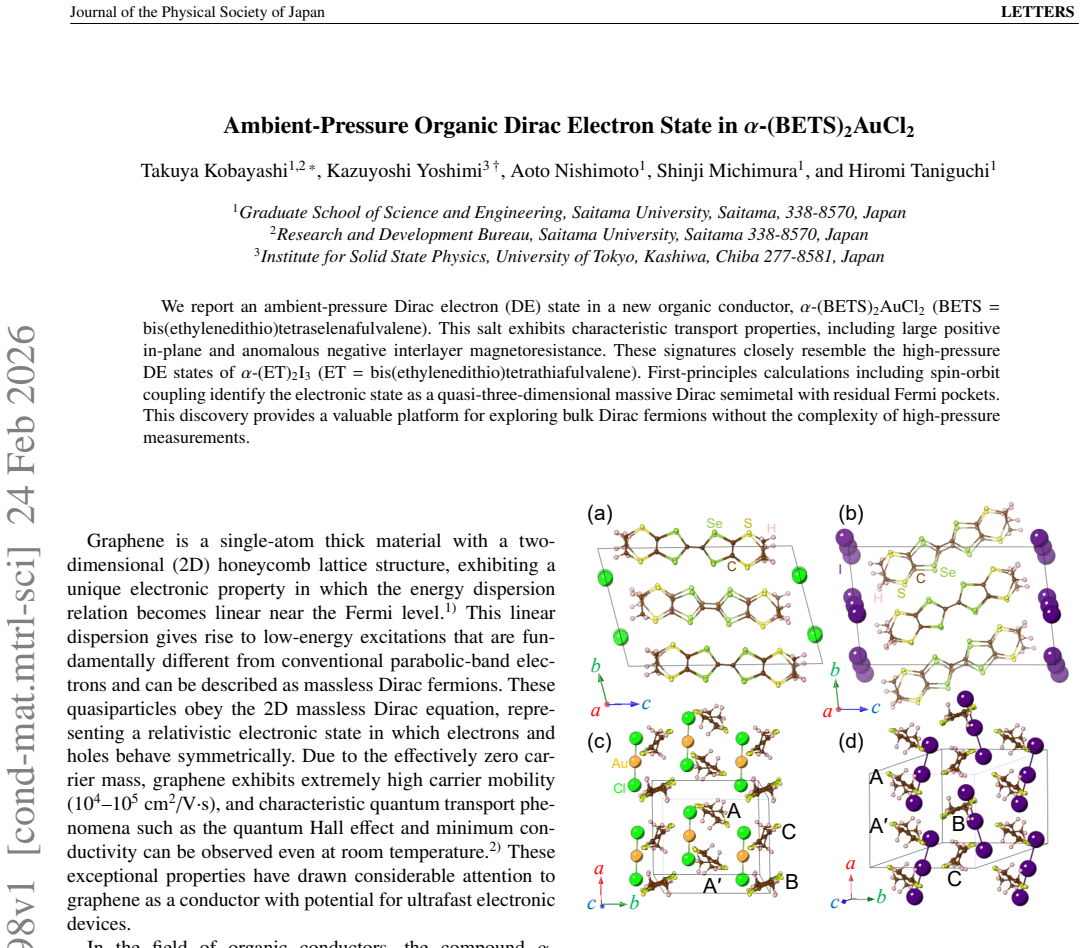


read the original abstract
We report an ambient-pressure Dirac electron (DE) state in a new organic conductor, $\alpha$-(BETS)$_2$AuCl$_2$ (BETS = bis(ethylenedithio)tetraselenafulvalene). This salt exhibits characteristic transport properties, including large positive in-plane and anomalous negative interlayer magnetoresistance. These signatures closely resemble the high-pressure DE states of $\alpha$-(ET)$_2$I$_3$ (ET = bis(ethylenedithio)tetrathiafulvalene). First-principles calculations including spin-orbit coupling identify the electronic state as a quasi-three-dimensional massive Dirac semimetal with residual Fermi pockets. This discovery provides a valuable platform for exploring bulk Dirac fermions without the complexity of high-pressure measurements.
Editorial analysis
A structured set of objections, weighed in public.
Referee Report
Summary. The manuscript reports an ambient-pressure Dirac electron state in the organic conductor α-(BETS)₂AuCl₂. Transport measurements show large positive in-plane magnetoresistance and negative interlayer magnetoresistance that qualitatively resemble the high-pressure Dirac state in α-(ET)₂I₃. First-principles DFT calculations including spin-orbit coupling are used to identify the electronic structure as a quasi-three-dimensional massive Dirac semimetal with residual Fermi pockets, positioning the material as a platform for bulk Dirac fermion studies without high-pressure requirements.
Significance. If the central identification holds, the work would be significant for establishing a new ambient-pressure organic conductor hosting a massive Dirac semimetal state, thereby providing easier experimental access to Dirac fermion physics in molecular systems compared to pressurized analogs. The combination of presented transport data and DFT+SOC calculations constitutes a useful starting point; the explicit inclusion of spin-orbit coupling in the band-structure analysis is a clear strength that supports the quasi-3D character.
major comments (2)
- [Transport measurements and discussion] The central claim that the observed negative interlayer magnetoresistance establishes the massive Dirac semimetal state rests on qualitative resemblance to pressurized α-(ET)₂I₃. However, the manuscript does not report any semiclassical or quantum transport calculation performed on the DFT-derived Fermi surface (with its specific pocket topology and warping) to demonstrate that this MR signature uniquely requires the Dirac dispersion rather than generic orbital effects possible in other quasi-2D warped surfaces.
- [First-principles calculations] In the first-principles calculations, the identification of Dirac crossings and residual pockets is presented without explicit robustness checks: no comparison is made to results obtained with alternative exchange-correlation functionals, without SOC, or for a gapped scenario. Such tests would be required to confirm that the massive Dirac character is not an artifact of the chosen computational setup and to strengthen the link to the transport observations.
minor comments (1)
- [Abstract] The abstract refers to 'anomalous negative interlayer magnetoresistance' and 'characteristic transport properties' without providing quantitative measures, error bars, or references to raw data files or supplementary figures that would allow readers to assess the strength of the resemblance to the ET salt.
Simulated Author's Rebuttal
We thank the referee for the constructive review and positive assessment of the significance of our work. We address the two major comments point by point below, indicating planned revisions where appropriate.
read point-by-point responses
-
Referee: [Transport measurements and discussion] The central claim that the observed negative interlayer magnetoresistance establishes the massive Dirac semimetal state rests on qualitative resemblance to pressurized α-(ET)₂I₃. However, the manuscript does not report any semiclassical or quantum transport calculation performed on the DFT-derived Fermi surface (with its specific pocket topology and warping) to demonstrate that this MR signature uniquely requires the Dirac dispersion rather than generic orbital effects possible in other quasi-2D warped surfaces.
Authors: We agree that a quantitative semiclassical or quantum transport simulation on the calculated Fermi surface would provide a stronger link between the observed MR and the Dirac dispersion. However, such calculations for the specific quasi-3D warped pocket topology are computationally demanding and lie beyond the scope of the present study, which focuses on experimental identification and first-principles band-structure analysis. In the field of organic conductors, qualitative resemblance to the established high-pressure Dirac state in α-(ET)₂I₃ has been accepted as supporting evidence when combined with DFT results. We will revise the discussion to explicitly note this limitation and state that the MR signatures are consistent with the massive Dirac semimetal state rather than claiming they uniquely establish it. revision: partial
-
Referee: [First-principles calculations] In the first-principles calculations, the identification of Dirac crossings and residual pockets is presented without explicit robustness checks: no comparison is made to results obtained with alternative exchange-correlation functionals, without SOC, or for a gapped scenario. Such tests would be required to confirm that the massive Dirac character is not an artifact of the chosen computational setup and to strengthen the link to the transport observations.
Authors: We thank the referee for this important suggestion. In the revised manuscript we will add explicit robustness tests, including band-structure calculations with the PBE functional for direct comparison, results without SOC to illustrate its role in opening the gap at the Dirac points, and a brief discussion of sensitivity to computational parameters. These additions will confirm that the quasi-3D massive Dirac character with residual pockets persists across the tested setups. revision: yes
Circularity Check
No significant circularity; derivation is self-contained via independent DFT and transport data
full rationale
The paper identifies the ambient-pressure Dirac semimetal state through first-principles DFT+SOC band calculations that directly compute the quasi-3D massive Dirac dispersion with residual pockets, cross-checked against experimental in-plane positive and interlayer negative magnetoresistance that resemble (but are not defined by) the high-pressure α-(ET)₂I₃ case. No equations, fitted parameters, or self-citations reduce the central claim to its own inputs by construction; the DFT output is an independent numerical result from standard exchange-correlation methods, and the transport signatures are measured observables rather than predictions forced by the target classification. The derivation chain therefore remains externally grounded and non-circular.
Axiom & Free-Parameter Ledger
axioms (1)
- domain assumption Standard density-functional theory with spin-orbit coupling accurately captures the band structure near the Fermi level
Lean theorems connected to this paper
-
IndisputableMonolith/Foundation/AlexanderDuality.leanalexander_duality_circle_linking echoes?
echoesECHOES: this paper passage has the same mathematical shape or conceptual pattern as the Recognition theorem, but is not a direct formal dependency.
First-principles calculations including spin-orbit coupling identify the electronic state as a quasi-three-dimensional massive Dirac semimetal with residual Fermi pockets.
What do these tags mean?
- matches
- The paper's claim is directly supported by a theorem in the formal canon.
- supports
- The theorem supports part of the paper's argument, but the paper may add assumptions or extra steps.
- extends
- The paper goes beyond the formal theorem; the theorem is a base layer rather than the whole result.
- uses
- The paper appears to rely on the theorem as machinery.
- contradicts
- The paper's claim conflicts with a theorem or certificate in the canon.
- unclear
- Pith found a possible connection, but the passage is too broad, indirect, or ambiguous to say the theorem truly supports the claim.
Reference graph
Works this paper leans on
-
[1]
S. Y amamoto and T. Naito, Acta Crystallogr., Sect. C: Struct. Chem. 81 (2025)
work page 2025
-
[2]
G. M. Sheldrick, Acta Crystallogr., Sect. A: Found. Adv. 71, 3 (2015)
work page 2015
-
[3]
G. M. Sheldrick, Acta Crystallogr., Sect. C: Struct. Chem. 71, 3 (2015)
work page 2015
-
[4]
O. V . Dolomanov, L. J. Bourhis, R. J. Gildea, J. A. K. Howard, and H. Puschmann, J. Appl. Crystallogr. 42, 339 (2009)
work page 2009
-
[5]
P . Giannozzi, O. Andreussi, T. Brumme, O. Bunau, M. B. Nardelli, M. Calandra, R. Car, C. Cavazzoni, D. Ceresoli, M. Cococcioni, et al., J. Phys. Condens. Matter 29, 465901 (2017)
work page 2017
-
[6]
J. P . Perdew, K. Burke, and M. Ernzerhof, Phys. Rev. Lett. 77, 3865 (1996)
work page 1996
-
[7]
D. R. Hamann, Phys. Rev. B 88, 085117 (2013)
work page 2013
- [8]
-
[9]
G. Pizzi, V . Vitale, R. Arita, S. Bl ¨ugel, F. Freimuth, G. G ´eranton, M. Gibertini, D. Gresch, C. Johnson, T. Koretsune, J. Iba ˜nez-Azpiroz, H. Lee, J.-M. Lihm, D. Marc- hand, A. Marrazzo, Y . Mokrousov, J. I. Mustafa, Y . Nohara, Y . Nomura, L. Paulatto, S. Ponc ´e, T. Ponweiser, J. Qiao, F. Th ¨ole, S. S. Tsirkin, M. Wierzbowska, N. Marzari, D. V an...
work page 2020
- [10]
-
[11]
K. Nakamura, Y . Y oshimoto, Y . Nomura, T. Tadano, M. Kawamura, T. Kosugi, K. Y oshimi, T. Misawa, and Y . Motoyama, Comput. Phys. Commun. 261, 107781 (2021)
work page 2021
-
[12]
D. Ohki, K. Y oshimi, A. Kobayashi, and T. Misawa, Phys. Rev. B 107, L041108 (2023)
work page 2023
- [13]
-
[14]
K. Y oshimi and collaborators. Electronic structure data for α-(BETS)2X salts. https: //isspns-gitlab.issp.u-tokyo.ac.jp/k-yoshimi/alpha-salts , 2023. 30 K data used for band dispersion of α-(BETS)2I3. 6/6
work page 2023
discussion (0)
Sign in with ORCID, Apple, or X to comment. Anyone can read and Pith papers without signing in.