REVIEW 3 major objections 4 minor 44 references
A Maxwell Fish-Eye Lens in a Bose-Einstein Condensate
T0 review · 3 major / 4 minor · reviewed 2026-08-02 · deepseek-v4-flash
Pith's one-line read A Bose–Einstein condensate with a specific density profile makes phonons obey the Maxwell fish-eye lens metric, refocusing any localized excitation at its antipodal point after a universal time.
desk verdict A genuinely new BEC realization of a Maxwell fish-eye lens with a parameter-free focusing time that checks out; the fidelity gap and missing control are the real flaws, not the boundary. read the letter →
The pith
A machine-rendered reading of the paper's core claim, the machinery that carries it, and where it could break.
The reading
What carries the argument
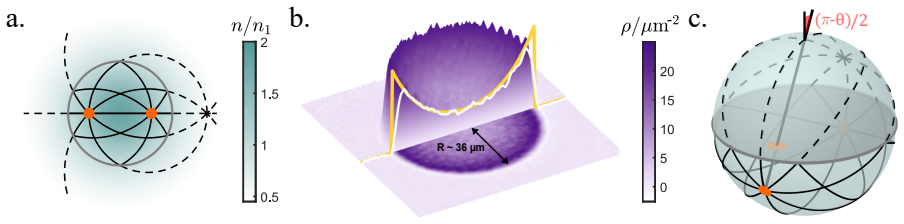
The central object is the density profile of Eq. (2.5), which transforms the phonon acoustic metric into the Maxwell fish-eye metric. Its power comes from the conformal stereographic mapping r=R cot(θ/2) that converts the planar lens with a mirror at r=R into a free spherical surface with constant refractive index, making the focusing time T=πR/(2c0) a simple geometric statement: every ray travels half a great circle. The mirror boundary condition—a sharp density edge at r=R—is the second essential piece; it provides the reflection that sends every ray back to the antipode, and the paper argues that for long-wavelength phonons the healing-length fall-off of the density acts as a Neumann boun
What would settle it
Launch a wavepacket radially outward from the center and measure the time and amplitude of its return after reflection at r=R; if the reflection is not total and phase-preserving, the round-trip time will deviate from the predicted value and the image contrast at the antipode will degrade below the level expected from dispersion alone.
Extended reading notes
Core claim
The core claim is that a quasi-2D Bose–Einstein condensate with an engineered density profile ρ(r)=ρ0(1+2r²/R²+r⁴/R⁴) makes the speed of sound cs(r)=√(gρ/m) exactly match the refractive index profile of a Maxwell fish-eye lens, n(r)=2n1/(1+(r/R)²). Under the stereographic projection r=R cot(θ/2), the phonon ray trajectories are mapped to great circles on a virtual sphere of radius R, and the reflecting edge at r=R corresponds to the equator. Consequently, any localized excitation launched inside the lens refocuses at its antipodal point after time T=πR/(2c0), independent of source location. The experiment confirms the predicted focusing time and shows a clear, though imperfect, focusing peak
Load-bearing premise
The load-bearing premise is that the condensate edge at r=R acts as a perfect, dispersionless mirror for phonons of all relevant wavelengths; if the edge reflects imperfectly or with wavelength-dependent phase shifts, the point-to-point image is smeared or lost.
Editorial extensions
If this is right
- If the claim holds, BECs become a flexible platform for realizing other perfect-imaging instruments (Luneburg, Eaton lenses) by inverse-designing the density profile.
- The virtual-sphere mapping gives an experimental route to simulating wave propagation on curved (spherical) backgrounds, with potential connections to analogue gravity.
- Antipodal impurity atoms in the condensate would experience strong, long-range phonon-mediated interactions, potentially enabling coupling between distant quantum emitters.
- The time-reversal symmetry of the focusing suggests a way to create phonon 'echoes' and could be used to measure the sound speed profile non-invasively.
- The demonstrated method of engineering a spatially varying speed of sound through density control provides a general tool for gradient-index acoustic devices.
Reading between the lines
- The measured fidelity F≈0.36 leaves room for improvement; using shallower, spectrally narrow excitations (e.g., Bragg pulses) to stay within the linear phonon regime should raise fidelity toward the GPE-simulation values.
- The boundary reflection is the least controlled element; an interference experiment with two counter-propagating wavepackets could directly measure the reflection phase and amplitude, testing the Neumann boundary assumption.
- The sphere mapping suggests that phonon wavefronts on the plane are conformal projections of spherical waves; measuring the angular dependence of the focusing time for off-center sources would test the claim that T is exactly independent of source position.
- The framework could be inverted: instead of fixing the lens, one could measure the density profile from the phonon focusing time, providing a phonon-based density diagnostic.
Signed reviews
Editorial analysis
A structured set of objections, weighed in public.
Referee Report
Summary. The manuscript reports an experimental realization of an acoustic analogue of the Maxwell fish-eye lens (MFEL) in a quasi-2D Bose-Einstein condensate of potassium-39. The authors establish the correspondence between the optical MFEL metric and the phonon metric in a BEC, deriving the required density profile ρ(r)=ρ0(1+2r²/R²+r⁴/R⁴) (Eq. 2.5) and the corresponding trapping potential (Eq. 2.7). They predict the point-to-point refocusing time T=πR/(2c0) (Eq. 2.8) and observe a fidelity peak near t=31.5 ms for three different initial source positions, consistent with the prediction using R=36 µm and measured c0≈1.8 µm/ms. The paper also presents GPE simulations, including one that starts from the experimental background density. The central claim is that phonons in this engineered density profile realize the MFEL with a reflecting boundary at r=R, leading to perfect imaging in the acoustic regime.
Significance. If the result holds, this is a valuable new experimental platform: it demonstrates a parameter-free analogue of perfect focusing, connects BEC acoustics to conformal geometry on a virtual sphere, and extends the analogue-gravity toolkit to gradient-index lenses. The key strengths are the clean analytical derivation from metric to density and potential, the fact that T is predicted from independently measured c0 and R, and the observation of a timing peak for three source positions. The main weakness is that the load-bearing assumption of a perfectly reflecting, non-dispersive boundary at r=R is not directly validated, and the experimental fidelity is far from the ideal value. The current evidence supports the focusing-time claim, but the mechanism—true MFEL imaging versus a generic edge echo—remains somewhat open.
major comments (3)
- [§2, after Eq. (2.7); §3] The perfect-imaging property in the fish-eye-with-mirror geometry relies critically on reflection at r=R. The manuscript states that 'for phonons with wavelength greater than the healing length this effectively realizes a Neumann boundary condition' and cites [35], but no measurement or simulation of the phonon reflection coefficient or phase shift at the realized edge is provided. The experimental edge is blurred over ~3.4 µm (90%-to-10% density fall), roughly ten times ξ(R)≈0.35 µm, and the 70%-deep initial density dip excites high-k Bogoliubov modes outside the linear regime. A partially transmitting or dispersive edge could produce an apparent peak near the same time without implementing exact point-to-point focusing. Please test this directly, e.g., by comparing GPE simulations with a sharp hard-wall boundary versus the experimental blurred-edge density profile, or by measuring the
- [§3, fidelity discussion] The experimental fidelity F≈0.36 is far from the ideal value of 1, and the paper's own GPE simulation using the experimental background density reaches only F≈0.58. The authors attribute the remaining discrepancy to 'finite temperature effects and phonon damping, or other experimental imperfections', but no quantitative estimate, model, or control experiment is given. Since the central evidence is the fidelity peak, the paper should provide a concrete expectation for F under realistic thermal/damping conditions, or an experimental control with a non-MFEL density profile (e.g., a uniform or wrong-gradient density) showing that the observed peak is specific to the MFEL. Without such a control, the evidence that the peak is due to the intended lensing mechanism rather than a generic reflection/echo is incomplete.
- [§3, Fig. 3] For the largest source offset (r0=16 µm), the fidelity peak is reported to shift slightly toward later times, but this shift is not explained. This is potentially informative: if the focusing time T were exactly independent of source position, a systematic shift with r0 may indicate dispersion, finite-size effects, or imperfect boundary reflection. Please provide a quantitative comparison of the measured peak times with the predicted T for each r0, and discuss whether the observed peak shift is consistent with the GPE simulations or with a simple ray-optics/echo model. This would strengthen the claim that the focusing time is universal.
minor comments (4)
- [§2] Typo: 'prerequisit' should be 'prerequisite'.
- [§3, experimental platform] The sentence 'groups of 2×2 camera pixels were binned, corresponding to the optical resolution σ∼0.4 µm of the imaging objective' is ambiguous: binning usually degrades resolution, so clarify whether the quoted σ is the pre- or post-binning resolution.
- [Fig. 2 caption] The first row is described as 'analytic wave-fronts represented on the surface of a sphere', but the main text does not explain how these analytic wave-fronts are computed. A brief description or reference would improve reproducibility.
- [§3, GPE simulations] The numerical methods section states the split-step-Fourier method but does not specify the grid size, time step, or numerical boundary treatment. Adding these details would make the simulations reproducible.
Circularity Check
No significant circularity: the density profile is a construction from the phonon metric, the focusing time is a parameter-free prediction given separately measured R and c0, and the cited phonon-metric/Neumann support is external standard literature.
full rationale
The derivation chain does not reduce to its inputs. The MFEL density profile Eq. (2.5) is obtained by substituting the phonon speed cs(r)=sqrt(gρ(r)/m) into the optical metric (2.1)-(2.2) and identifying c/2n1 with c0=cs(0); this is a direct algebraic construction, not a fit to the focusing outcome. The trapping potential (2.7) follows from the Thomas-Fermi condition V(r)=μ−gρ(r), and the focusing time Eq. (2.8) is an integral over that constructed cs(r), giving T=πR/(2c0). The experimental check uses R=36 μm and an independently quoted c0≈1.8 μm/ms, and the fidelity peak at 31.5 ms is then a genuine comparison rather than a fitted prediction. The boundary-condition assertion and phonon-metric correspondence cite [33]-[35]; even if one of those references were self-authored, the claim is not uniquely forced by that citation and is independently derivable from the GPE/eikonal argument within the paper. The acknowledged softness of the r=R mirror edge (about 3.4 μm, §3) and the 70%-deep density dip are real limitations that affect the realized fidelity and the validity of the Neumann idealization, but those are correctness/robustness concerns, not circular reductions: no fitted parameter is renamed as a prediction, and no equation equals its own input by construction. Therefore no circularity.
Assumptions & free parameters
free parameters (2)
- Interaction-strength boost in GPE simulation =
g increased by ~30%
- Initial density-indent parameters =
σx = σy ≈ 3.5 µm, amplitude A ≈ 0.195 µm⁻¹ (ideal); ~70% density dip (experiment)
assumptions (5)
- domain assumption In the acoustic (linear-dispersion) regime, phonons in a BEC obey the metric equation (2.1) with local speed of sound c_s(r) = sqrt(gρ(r)/m)
- domain assumption Quasi-2D regime: dynamics restricted to the plane, with gρ ≪ ℏωz and effective 2D coupling g = g3D/√(2π lz)
- domain assumption Thomas-Fermi approximation holds in-plane: µ = gρ(r) + V(r), with V(0) = 0
- domain assumption The condensate edge at r = R gives an effective Neumann boundary condition for phonons with wavelength greater than the healing length
- standard math Stereographic projection is conformal and maps great circles on the sphere to circles (or lines) in the plane
Cite this review
Pith. "Pith review of A Maxwell Fish-Eye Lens in a Bose-Einstein Condensate." pith.science (2026). https://pith.science/paper/OBDZ3I3R
@misc{pith2026260223125,
  author       = {Pith},
  title        = {Pith review of: A Maxwell Fish-Eye Lens in a Bose-Einstein Condensate},
  year         = {2026},
  howpublished = {\url{https://pith.science/paper/OBDZ3I3R}},
  note         = {Machine review of arXiv:2602.23125}
}
read the original abstract
We experimentally realize an analogue of the optical Maxwell fish-eye lens (MFEL) using phononic excitations in a Bose-Einstein condensate (BEC). A MFEL is characterized by a radially symmetric, spatially varying refractive index with the remarkable property that rays emitted from any point within the lens are perfectly focused at their antipodal points. While the implementation of such gradient-index lenses is challenging in conventional optical systems, BECs offer a highly tunable platform in which the spatially varying speed of sound of collective excitations -- phonons, the acoustic analogues of photons -- can be engineered and their dynamics observed in real time. Time-resolved measurements of phonon wavefronts reveal focusing behavior that shows good agreement with analytical theory and numerical simulations. This work provides both a geometric and physical framework for engineering effective refractive indices using ultracold atoms, and simulating wave propagation on effective spherical geometries.
Figures


Reference graph
Works this paper leans on
-
[35]
Dynamical response of Bose–Einstein condensates to oscillating gravitational fields
D. R¨ atzel et al. “Dynamical response of Bose–Einstein condensates to oscillating gravitational fields”. In:New Journal of Physics20.7 (2018), p. 073044
2018
-
[1]
J. C. Maxwell.The Scientific Letters and Papers of James Clerk Maxwell, Volume 1, 1846–1862. CUP Archive, 1990
1990
-
[2]
R. K. Luneburg.Mathematical Theory of Optics. University of California Press, 1944
1944
-
[3]
The Enigma of Imaging in the Maxwell Fisheye Medium
S. Sahebdivan. “The Enigma of Imaging in the Maxwell Fisheye Medium”. PhD thesis. St Andrews, UK: University of St Andrews, 2016
2016
-
[4]
New perfect optical instrument
D. Shafer. “New perfect optical instrument”. In:Optical Society of America Annual Meeting. Optica Publishing Group, 1991, MN1.doi:10.1364/OAM.1991.MN1
-
[5]
D. Shafer. “Doing more with less”. In:Proc. SPIE2537(1) (1995), pp. 2–12.doi: 10.1117/12.216370
-
[6]
Perfect imaging without negative refraction
U. Leonhardt. “Perfect imaging without negative refraction”. In:New Journal of Physics11.9 (2009), p. 093040
2009
-
[7]
Maxwell’s fish eye treated by Maxwell equations
C. T. Tai. “Maxwell’s fish eye treated by Maxwell equations”. In:Nature182 (1958), p. 1600
1958
Show all 44 references
-
[8]
The optics of the spherical fish lens
W. S. Jagger. “The optics of the spherical fish lens”. In:Optical Materials1 (1992), pp. 3–11
1992
-
[9]
Quantization of the Maxwell fish-eye problem and the quantum-classical correspondence
A. J. Makowski and K. J. G´ orska. “Quantization of the Maxwell fish-eye problem and the quantum-classical correspondence”. In:Phys. Rev. A79 (5 May 2009), p. 052116.doi:10.1103/PhysRevA.79.052116
2009 doi
-
[11]
Reply to “Comment on ‘Perfect imaging with positive refraction in three dimensions’
U. Leonhardt and T. G. Philbin. “Reply to “Comment on ‘Perfect imaging with positive refraction in three dimensions’ ””. In:Phys. Rev. A82 (5 Nov. 2010), p. 057802.doi:10.1103/PhysRevA.82.057802
2010 doi
-
[12]
Reply to comment on ‘Perfect imaging without negative refraction’
U. Leonhardt. “Reply to comment on ‘Perfect imaging without negative refraction’”. In:New Journal of Physics13.2 (Feb. 2011), p. 028002.doi:10 . 1088 / 1367 - 2630/13/2/028002
2011
-
[13]
Maxwell Fisheye Lens Based Retrodirective Array
M. A. B. Abbasi et al. “Maxwell Fisheye Lens Based Retrodirective Array”. In: Scientific Reports9 (2019).doi:10.1038/s41598-019-52779-1
2019 doi
-
[14]
Maxwell’s fish-eye lens and the mirage of perfect imaging
R. Merlin. “Maxwell’s fish-eye lens and the mirage of perfect imaging”. In:Journal of Optics13.2 (2011), p. 024017.doi:10.1088/2040-8978/13/2/024017
2011 doi
-
[15]
Theory of Maxwell’s fish eye with mutually interacting sources and drains
U. Leonhardt. “Theory of Maxwell’s fish eye with mutually interacting sources and drains”. In:Physical Review A92 (2015), p. 053848.doi:10.1103/PhysRevA.92. 053848
2015 doi
-
[16]
A Simple Model Explaining Super-Resolution in Absolute Optical Instruments
U. Leonhardt et al. “A Simple Model Explaining Super-Resolution in Absolute Optical Instruments”. In:New Journal of Physics17.5 (May 7, 2015), p. 053007. issn: 1367-2630.doi:10.1088/1367-2630/17/5/053007
2015 doi
-
[17]
Is the Maxwell–Shafer fish eye lens able to form super-resolved images?
M. A Alonso. “Is the Maxwell–Shafer fish eye lens able to form super-resolved images?” In:New Journal of Physics17.7 (July 2015), p. 073013.doi:10.1088/ 1367-2630/17/7/073013. 11
2015
-
[18]
Acoustic Super-Resolution Imaging Based on Solid Immersion 3D Maxwell’s Fish-Eye Lens
C. Hu et al. “Acoustic Super-Resolution Imaging Based on Solid Immersion 3D Maxwell’s Fish-Eye Lens”. In:Applied Physics Letters120.19 (May 9, 2022), p. 192202. issn: 0003-6951, 1077-3118.doi:10.1063/5.0093339
2022 doi
-
[19]
Super-Resolution Imaging of Maxwell’s Fish-Eye Lens Based on Surface Polaritons
S. Chen et al. “Super-Resolution Imaging of Maxwell’s Fish-Eye Lens Based on Surface Polaritons”. In:Europhysics Letters139.6 (Sept. 2022), p. 60005.issn: 0295- 5075, 1286-4854.doi:10.1209/0295-5075/ac8fb1
2022 doi
-
[20]
Roadmap on Label-Free Super-Resolution Imaging
V. N. Astratov et al. “Roadmap on Label-Free Super-Resolution Imaging”. In:Laser & Photonics Reviews17.12 (2023), p. 2200029.doi:https://doi.org/10.1002/ lpor.202200029
2023
- [21]
-
[22]
Evidence for subwavelength imaging with positive refraction
Y. G. Ma et al. “Evidence for subwavelength imaging with positive refraction”. In:New Journal of Physics13.3 (Mar. 2011), p. 033016.doi:10 . 1088 / 1367 - 2630/13/3/033016
2011
-
[23]
Subwavelength Imaging with Materials of In-Principle Arbitrarily Low Index Contrast
Y G Ma et al. “Subwavelength Imaging with Materials of In-Principle Arbitrarily Low Index Contrast”. In:New Journal of Physics14.2 (Feb. 2012), p. 025001.issn: 1367-2630.doi:10.1088/1367-2630/14/2/025001
2012 doi
-
[24]
Metamaterial-based half Maxwell fish-eye lens for broadband directive emissions
A. Dhouibi et al. “Metamaterial-based half Maxwell fish-eye lens for broadband directive emissions”. In:Applied Physics Letters102.2 (2013), p. 024102.doi:10. 1063/1.4776662
2013
-
[25]
Lucas H. G., U. Leonhardt, and M. Lipson.Perfect imaging in the optical domain using dielectric materials. 2012. arXiv:1007.2564 [physics.optics]
2012 arXiv
-
[26]
A Maxwell’s fish eye lens for the terahertz region
J. Liu, R. Mendis, and D. M. Mittleman. “A Maxwell’s fish eye lens for the terahertz region”. In:Applied Physics Letters103.3 (2013), p. 031104.doi:10 . 1063 / 1 . 4818036
2013
-
[27]
Two-Dimensional Maxwell Fisheye for Integrated Optics
O. Bitton et al. “Two-Dimensional Maxwell Fisheye for Integrated Optics”. In: Physical Review Applied10 (2018), p. 044059.doi:10.1103/PhysRevApplied.10. 044059
2018 doi
-
[28]
Experiments on Maxwell’s Fish-Eye Dynamics in Elastic Plates
G. Lefebvre et al. “Experiments on Maxwell’s Fish-Eye Dynamics in Elastic Plates”. In:Applied Physics Letters106.2 (Jan. 2015), p. 024101.issn: 0003-6951, 1077-3118. doi:10.1063/1.4905730
2015 doi
-
[29]
Subwavelength Pulse Focusing and Perfect Absorption in the Maxwell Fish-Eye
G. Lefebvre et al. “Subwavelength Pulse Focusing and Perfect Absorption in the Maxwell Fish-Eye”. In:Applied Physics Letters123.13 (Sept. 2023), p. 132203. issn: 0003-6951, 1077-3118.doi:10.1063/5.0170815
2023 doi
-
[30]
Ultrafast Excitation Exchange in a Maxwell Fish-Eye Lens
O. Diekmann, D. O. Krimer, and S. Rotter. “Ultrafast Excitation Exchange in a Maxwell Fish-Eye Lens”. In:Phys. Rev. Lett.132 (1 Jan. 2024), p. 013602.doi: 10.1103/PhysRevLett.132.013602
2024 doi
-
[31]
Quantum optics in Maxwell’s fish eye lens with single atoms and photons
J. Perczel, P. K´ om´ ar, and M. D. Lukin. “Quantum optics in Maxwell’s fish eye lens with single atoms and photons”. In:Phys. Rev. A98 (3 Sept. 2018), p. 033803.doi: 10.1103/PhysRevA.98.033803
2018 doi
-
[32]
Pitaevskii and S
L. Pitaevskii and S. Stringari.Bose-Einstein condensation and superfluidity. Vol. 164. Oxford University Press, 2016
2016
-
[33]
Analogue gravity
C. Barcelo, S. Liberati, and M. Visser. “Analogue gravity”. In:Living reviews in relativity14.1 (2011), p. 3.doi:10.12942/lrr-2011-3. 12
2011 doi
-
[34]
Curved and expanding spacetime geometries in Bose-Einstein condensates
M. -Sime´ on et al. “Curved and expanding spacetime geometries in Bose-Einstein condensates”. In:Physical Review A106.3 (2022), p. 033313.doi:10.1103/PhysRevA. 106.033313
2022 doi
-
[36]
Springer International Publishing, 2020.doi:10.1007/978- 3-030-54967-1
G Guillaume.Transport and Turbulence in Quasi-Uniform and Versatile Bose- Einstein Condensates. Springer International Publishing, 2020.doi:10.1007/978- 3-030-54967-1
2020 doi
-
[37]
Absolute instruments and perfect imaging in geometrical optics
T. Tyc et al. “Absolute instruments and perfect imaging in geometrical optics”. In:New Journal of Physics13.11 (Nov. 2011), p. 115004.doi:10 . 1088 / 1367 - 2630/13/11/115004
2011
-
[38]
Elliptical generalized Maxwell fish-eye lens using conformal mapping
H. Eskandari et al. “Elliptical generalized Maxwell fish-eye lens using conformal mapping”. In:New Journal of Physics21.6 (June 2019), p. 063010.doi:10.1088/ 1367-2630/ab2471
2019
-
[39]
Conformal optical devices based on geodesic lenses
L. Xu, T.Tyc, and H. Chen. “Conformal optical devices based on geodesic lenses”. In:Opt. Express27.20 (Sept. 2019), pp. 28722–28733.doi:10.1364/OE.27.028722
2019 doi
-
[40]
Multiple drains in generalized Maxwell fisheye lenses
Y. Yin, J. Li, and H. Chen. “Multiple drains in generalized Maxwell fisheye lenses”. In:Opt. Express28.25 (Dec. 2020), pp. 37218–37225
2020
-
[41]
Snell’s Law for a vortex dipole in a Bose-Einstein condensate
M. M. Cawte et al. “Snell’s Law for a vortex dipole in a Bose-Einstein condensate”. In:SciPost Phys.6 (2019), p. 032.doi:10.21468/SciPostPhys.6.3.032
2019 doi
-
[42]
Superfluid vortex dynamics on a spherical film
S. J. Bereta, M. A. Caracanhas, and A. L. Fetter. “Superfluid vortex dynamics on a spherical film”. In:Phys. Rev. A103 (5 May 2021), p. 053306.doi:10.1103/ PhysRevA.103.053306
2021
-
[43]
Superfluid vortex dynamics on an ellipsoid and other surfaces of revolution
M. A. Caracanhas, P. Massignan, and A. L. Fetter. “Superfluid vortex dynamics on an ellipsoid and other surfaces of revolution”. In:Phys. Rev. A105 (2 Feb. 2022), p. 023307.doi:10.1103/PhysRevA.105.023307
2022 doi
-
[44]
Born and E
M. Born and E. Wolf.Principles of optics: electromagnetic theory of propagation, interference and diffraction of light. Elsevier, 1980
1980
-
[45]
Needham.Visual complex analysis
T. Needham.Visual complex analysis. Oxford University Press, 2023. 13
2023
Reviewed August 2, 2026 · model on record in the stance chip above.
Discussion (0). Continue with ORCID to comment.