Landau level spectroscopy in current solid state physics
Pith reviewed 2026-05-15 18:58 UTC · model grok-4.3
The pith
Landau level spectroscopy extracts precise electronic parameters such as effective mass, carrier density, mobility, and band gap from solids in magnetic fields.
A machine-rendered reading of the paper's core claim, the machinery that carries it, and where it could break.
Core claim
Landau level spectroscopy subjects electrons in a solid to quantizing magnetic fields and probes them experimentally, often through optical methods, obtaining direct and detailed insights into the electronic properties of crystalline materials, particularly those related to their band structure; it enables the precise extraction of parameters such as effective mass, carrier density, mobility, and band gap and serves as a tool for studying interactions between electrons and other quasiparticles, with historical application mainly to semiconductors and semimetals but current scope including graphene-based systems, surface and bulk states in topological materials, and other emergent systems.
What carries the argument
Quantized Landau levels formed by electrons in a magnetic field, which are probed optically to map band dispersions and extract material parameters.
If this is right
- Direct extraction of effective mass, carrier density, mobility, and band gap from optical data in magnetic fields.
- Quantitative study of electron interactions with phonons, magnons, or other quasiparticles.
- Application of the same analysis framework to graphene, topological surface states, and narrow-gap systems.
- Continued refinement of band-structure models for both conventional and emergent solids.
- Parameter values obtained serve as input for device design and many-body calculations.
Where Pith is reading between the lines
- The same Landau-level framework could be combined with time-resolved probes to track how parameters evolve under external drives.
- Systematic application across families of topological materials might reveal common patterns in their interaction strengths.
- Numerical values extracted by the method can be fed directly into transport simulations to predict device performance.
Load-bearing premise
The selected literature examples are representative and the fundamentals are summarized without major omissions or coverage bias.
What would settle it
A well-characterized material in which Landau level spectroscopy returns incorrect values for independently known parameters such as effective mass or band gap would falsify the claim of precise extraction.
Figures


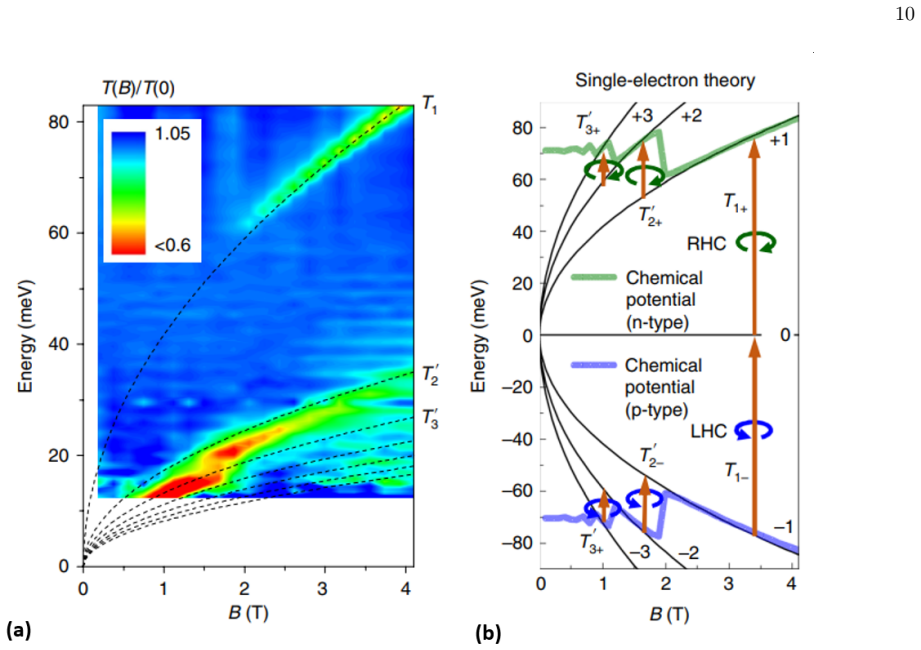


read the original abstract
Landau level spectroscopy plays an important role in modern condensed-matter physics. In this technique, electrons in a solid are subjected to quantizing magnetic fields and probed experimentally, often through optical methods. Direct and detailed insights into the electronic properties of crystalline materials are obtained, particularly the properties related to their band structure. Landau level spectroscopy enables the precise extraction of key parameters such as effective mass, carrier density, mobility, and band gap, and serves as a powerful tool for studying interactions between electrons and other quasiparticles in solids. Over its more than seventy-year history, Landau level spectroscopy has been applied mainly to semiconductors and semimetals. Today, its scope also includes graphene-based systems, surface and bulk states in topological materials, and other emergent systems with a narrow or vanishing band gap. In this work, we review the fundamentals of Landau level spectroscopy and illustrate them with selected examples from the literature.
Editorial analysis
A structured set of objections, weighed in public.
Referee Report
Summary. The manuscript reviews Landau level spectroscopy as a technique in condensed-matter physics, in which electrons in solids are subjected to quantizing magnetic fields and probed (often optically) to obtain direct information on band-structure properties. It summarizes the method's more than seventy-year history of application to semiconductors and semimetals, its extension to graphene-based systems, surface and bulk states in topological materials, and other narrow- or zero-gap systems, and illustrates the fundamentals with selected literature examples. The central claims restate that the technique enables extraction of effective mass, carrier density, mobility, and band gap while also serving as a tool for studying electron-quasiparticle interactions.
Significance. As a review that consolidates established results without introducing new derivations or data, the manuscript's significance is primarily pedagogical and consolidative. If the selected examples are representative and the fundamentals are summarized without material omissions, the work could serve as a convenient reference for researchers entering the field of magneto-optical studies of 2D and topological materials. No machine-checked proofs, reproducible code, or parameter-free predictions are present, so the assessment rests on the accuracy and balance of the synthesis.
minor comments (3)
- [Abstract] Abstract: the statement that the technique 'enables the precise extraction' of parameters such as effective mass and band gap is standard but should be qualified in the main text (e.g., §2 or §3) by noting the experimental conditions (low temperature, high mobility, low disorder) under which the extraction remains quantitative.
- [Fundamentals] Fundamentals section: the relation between Landau-level spacing and effective mass is described qualitatively; a short explicit formula (e.g., E_n = ħω_c (n + 1/2) with ω_c = eB/m*) together with a citation to the original Landau or Luttinger references would improve clarity for readers new to the technique.
- [Examples] Examples section: when illustrating applications to topological materials, the text should explicitly note which features (e.g., Dirac vs. parabolic dispersion) are directly read from the Landau-level fan diagram versus those inferred after additional modeling.
Simulated Author's Rebuttal
We thank the referee for their positive assessment of our manuscript as a pedagogical and consolidative review of Landau level spectroscopy. We appreciate the recommendation for minor revision and will use the opportunity to improve clarity, update references where appropriate, and ensure the selected examples remain representative.
Circularity Check
No significant circularity: review paper with no new derivations
full rationale
This is a review article summarizing over seventy years of established Landau level spectroscopy techniques applied to semiconductors, semimetals, graphene, and topological materials. The text presents no original derivations, equations, or quantitative predictions; all claims restate standard results from prior literature without introducing fitted parameters, self-definitional loops, or load-bearing self-citations that reduce to the paper's own inputs. The abstract and structure explicitly frame the work as a summary of fundamentals illustrated by selected examples, with no internal derivation chain to inspect for circularity. The reader's assessment of score 0.0 is confirmed by the absence of any new theoretical content.
Axiom & Free-Parameter Ledger
Lean theorems connected to this paper
-
IndisputableMonolith/Cost/FunctionalEquation.leanwashburn_uniqueness_aczel unclear?
unclearRelation between the paper passage and the cited Recognition theorem.
Landau level spectroscopy enables the precise extraction of key parameters such as effective mass, carrier density, mobility, and band gap...
-
IndisputableMonolith/Foundation/DimensionForcing.leanreality_from_one_distinction unclear?
unclearRelation between the paper passage and the cited Recognition theorem.
The √B dependence... is a hallmark of conical bands
What do these tags mean?
- matches
- The paper's claim is directly supported by a theorem in the formal canon.
- supports
- The theorem supports part of the paper's argument, but the paper may add assumptions or extra steps.
- extends
- The paper goes beyond the formal theorem; the theorem is a base layer rather than the whole result.
- uses
- The paper appears to rely on the theorem as machinery.
- contradicts
- The paper's claim conflicts with a theorem or certificate in the canon.
- unclear
- Pith found a possible connection, but the passage is too broad, indirect, or ambiguous to say the theorem truly supports the claim.
Reference graph
Works this paper leans on
-
[1]
L. Schubnikow and W. J. de Haas, Magnetic resistance increase in single crystals of bismuth at low tempera- tures, Proceedings of the Royal Netherlands Academy of Arts and Science33, 130– (1930)
work page 1930
-
[2]
W. J. de Haas and P. M. van Alphen, The dependence of the susceptibility of diamagnetic metals upon the field, Proceedings of the Netherlands Royal Academy of Sci- ences33, 1106 (1930)
work page 1930
-
[3]
Landau, Diamagnetismus der metalle, Zeitschrift f¨ ur Physik64, 629 (1930)
L. Landau, Diamagnetismus der metalle, Zeitschrift f¨ ur Physik64, 629 (1930)
work page 1930
-
[4]
N. W. Ashcroft and N. D. Mermin,Solid State Physics (Holt, Rinehart and Winston, New York, 1976)
work page 1976
-
[5]
J. Singleton, Band theory and electronic properties of solids, inBand Theory and Electronic Properties of Solids(Oxford University Press, 2001)
work page 2001
-
[6]
G. Dresselhaus, A. F. Kip, and C. Kittel, Cyclotron res- onance of electrons and holes in silicon and germanium crystals, Physical Review98, 368 (1955)
work page 1955
-
[7]
G. Dresselhaus, A. F. Kip, and C. Kittel, Observation of cyclotron resonance in germanium crystals, Physical Review92, 827 (1953). 15
work page 1953
-
[8]
I. M. Lifshitz and A. M. Kosevich, Theory of mag- netic susceptibility in metals at low temperatures, So- viet Physics JETP2, 636 (1954)
work page 1954
-
[9]
M. L. Cohen, Cyclotron resonance and quasiparticles, AIP Conference Proceedings772, 3 (2005)
work page 2005
-
[10]
J. K. Galt, W. A. Yager, F. R. Merritt, B. B. Cetlin, and H. W. Dah, Cyclotron resonance in metals: Bismuth, Phys. Rev.100, 748 (1955)
work page 1955
-
[11]
G. Dresselhaus, A. F. Kip, C. Kittel, and G. Wagoner, Cyclotron and spin resonance in indium antimonide, Physical Review98, 556 (1955)
work page 1955
-
[12]
J. K. Galt, W. A. Yager, and H. W. Dail, Cyclotron res- onance effects in graphite, Phys. Rev.103, 1586 (1956)
work page 1956
-
[13]
E. Burstein and G. S. Picus, Interband magneto-optic effects in semiconductors, Phys. Rev.105, 1123 (1957)
work page 1957
-
[14]
S. Zwerdling, B. Lax, L. M. Roth, and K. J. Button, Ex- citon and magneto-absorption of the direct and indirect transitions in germanium, Phys. Rev.114, 80 (1959)
work page 1959
-
[15]
S. Zwerdling, B. Lax, and L. M. Roth, Oscillatory magneto-absorption in semiconductors, Phys. Rev.108, 1402 (1957)
work page 1957
-
[16]
E. R. G. Landwehr, ed.,Landau Level Spectroscopy (North Holland, 1990)
work page 1990
-
[17]
E. I. Rashba, Combined resonance in semiconductors, Soviet Physics Uspekhi7, 823 (1965)
work page 1965
-
[18]
E. D. Palik and J. Furdyna, Infrared and microwave magnetoplasma effects in semiconductors, Rep. Prog. Phys.33, 1193 (1970)
work page 1970
-
[19]
B. D. McCombe, S. G. Bishop, and R. Kaplan, Com- bined resonance and electrongvalues in InSb, Phys. Rev. Lett.18, 748 (1967)
work page 1967
-
[20]
T. Ando, A. B. Fowler, and F. Stern, Electronic prop- erties of two-dimensional systems, Rev. Mod. Phys.54, 437 (1982)
work page 1982
-
[21]
Y. Guldner, J. P. Vieren, P. Voisin, M. Voos, L. L. Chang, and L. Esaki, Cyclotron resonance and far- infrared magneto-absorption experiments on semimetal- lic InAs-GaSb superlattices, Phys. Rev. Lett.45, 1719 (1980)
work page 1980
- [22]
-
[23]
D. Heitman, M. Ziesmann, and L. L. Chang, Cyclotron- resonance oscillations in InAs quantum wells, Phys. Rev. B34, 7463 (1986)
work page 1986
- [24]
-
[25]
J. Singleton, R. Nicholas, D. Rogers, and C. Foxon, Cyclotron resonance of electrons in a narrow GaAs/(Ga,Al)As quantum well: Polaron effects and non-parabolicity, Surface Science196, 429 (1988)
work page 1988
-
[26]
A. M. Shuvaev, V. Dziom, N. N. Mikhailov, Z. D. Kvon, Y. Shao, D. N. Basov, and A. Pimenov, Band structure of a two-dimensional Dirac semimetal from cyclotron resonance, Phys. Rev. B96, 155434 (2017)
work page 2017
-
[27]
A. F. Kip, D. N. Langenberg, and T. W. Moore, Cy- clotron resonance in copper, Phys. Rev.124, 359 (1961)
work page 1961
-
[28]
C. C. Grimes and A. F. Kip, Cyclotron resonance in sodium and potassium, Phys. Rev.132, 1991 (1963)
work page 1991
-
[29]
M. Kimata, T. Terashima, N. Kurita, H. Satsukawa, A. Harada, K. Kodama, K. Takehana, Y. Imanaka, T. Takamasu, K. Kihou, C.-H. Lee, H. Kito, H. Eisaki, A. Iyo, H. Fukazawa, Y. Kohori, H. Harima, and S. Uji, Cyclotron resonance and mass enhancement by electron correlation in KFe 2As2, Phys. Rev. Lett.107, 166402 (2011)
work page 2011
-
[30]
W. Xiaoguang, F. M. Peeters, and J. T. Devreese, The- ory of the cyclotron resonance spectrum of a polaron in two dimensions, Phys. Rev. B34, 8800 (1986)
work page 1986
-
[31]
C. Faugeras, G. Martinez, A. Riedel, R. Hey, K. J. Fried- land, and Y. Bychkov, Fr¨ ohlich mass in GaAs-based structures, Phys. Rev. Lett.92, 107403 (2004)
work page 2004
-
[32]
C. Neumann, S. Reichardt, M. Dr¨ ogeler, B. Terr´ es, K. Watanabe, T. Taniguchi, B. Beschoten, S. V. Rotkin, and C. Stampfer, Low B-field magneto-phonon reso- nances in single-layer and bilayer graphene, Nano Let- ters15, 1547 (2015)
work page 2015
-
[33]
C. Faugeras, M. Orlita, and M. Potemski, Raman scattering of graphene-based systems in high magnetic fields, Journal of Raman Spectroscopy49, 146 (2018)
work page 2018
- [34]
-
[35]
D. A. Bandurin, E. M¨ onch, K. Kapralov, I. Y. Phin- ney, K. Lindner, S. Liu, J. H. Edgar, I. A. Dmitriev, P. Jarillo-Herrero, D. Svintsov, and S. D. Ganichev, Cy- clotron resonance overtones and near-field magnetoab- sorption via terahertz Bernstein modes in graphene, Na- ture Physics18, 462–467 (2022)
work page 2022
-
[36]
R. Battesti, J. Beard, S. B¨ oser, N. Bruyant, D. Bud- ker, S. A. Crooker, E. J. Daw, V. V. Flambaum, T. In- ada, I. G. Irastorza, F. Karbstein, D. L. Kim, M. G. Kozlov, Z. Melhem, A. Phipps, P. Pugnat, G. Rikken, C. Rizzo, M. Schott, Y. K. Semertzidis, H. H. ten Kate, and G. Zavattini, High magnetic fields for fundamental physics, Physics Reports765-766,...
work page 2018
-
[37]
F. Herlach and J. A. Perenboom, Magnet laboratory facilities worldwide—an update, Physica B: Condensed Matter211, 1–16 (1995)
work page 1995
-
[38]
Bitter, The design of powerful electromagnets part iv
F. Bitter, The design of powerful electromagnets part iv. the new magnet laboratory at m. i. t., Review of Scientific Instruments10, 373–381 (1939)
work page 1939
-
[39]
R. Pauthenet and K. Dransfeld, Research with high magnetic fields at Grenoble, Europhysics News5, 1–5 (1974)
work page 1974
-
[40]
W. B. Sampson, P. P. Craig, and M. Strongin, Advances in superconducting magnets, Scientific American216, 114–123 (1967)
work page 1967
-
[41]
M. Orlita, I. Crassee, C. Faugeras, A. B. Kuzmenko, F. Fromm, M. Ostler, T. Seyller, G. Martinez, M. Polini, and M. Potemski, Classical to quantum crossover of the cyclotron resonance in graphene: a study of the strength of intraband absorption, New Journal of Physics14, 095008 (2012)
work page 2012
-
[42]
I. Crassee, J. Levallois, A. L. Walter, M. Ostler, A. Bost- wick, E. Rotenberg, T. Seyller, D. van der Marel, and A. B. Kuzmenko, Giant faraday rotation in single- and multilayer graphene, Nature Physics7, 48–51 (2010)
work page 2010
-
[43]
A. M. Witowski, M. Orlita, R. St¸ epniewski, A. Wysmo lek, J. M. Baranowski, W. Strupi´ nski, C. Faugeras, G. Martinez, and M. Potemski, Quasiclas- sical cyclotron resonance of Dirac fermions in highly doped graphene, Phys. Rev. B82, 165305 (2010). 16
work page 2010
-
[44]
M. O. Goerbig, Electronic properties of graphene in a strong magnetic field, Rev. Mod. Phys.83, 1193 (2011)
work page 2011
-
[45]
L. Onsager, Interpretation of the de Haas-van Alphen effect, The London, Edinburgh, and Dublin Philosoph- ical Magazine and Journal of Science43, 1006 (1952)
work page 1952
-
[46]
V. B. Berestetskii, E. M. Lifshitz, and L. P. Pitaevskii,Quantum Electrodynamics, Course of Theo- retical Physics, Vol. 4 (Pergamon Press / Butterworth & Heinemann, Oxford / Burlington, MA, 1971) pp. 616– 680, 2nd revised English edition
work page 1971
-
[47]
W. Zawadzki, Semirelativity in semiconductors: a re- view, Journal of Physics: Condensed Matter29, 373004 (2017)
work page 2017
-
[48]
M. O. Goerbig, G. Montambaux, and F. Pi´ echon, Mea- sure of Diracness in two-dimensional semiconductors, Europhysics Letters105, 57005 (2014)
work page 2014
- [49]
-
[50]
E. O. Kane, Band structure of indium antimonide, Jour- nal of Physics and Chemistry of Solids1, 249 (1957)
work page 1957
-
[51]
M. Orlita, D. M. Basko, M. S. Zholudev, F. Teppe, W. Knap, V. I. Gavrilenko, N. N. Mikhailov, S. A. Dvoretskii, P. Neugebauer, C. Faugeras, A.-L. Barra, G. Martinez, and M. Potemski, Observation of three- dimensional massless Kane fermions in a zinc-blende crystal, Nat. Phys.10, 233 (2014)
work page 2014
-
[52]
E. I. Rashba, Properties of semiconductors with an ex- treme loop .1. cyclotron and combinational resonnce in a magnetic field perpendicular to the plane of the loop, Soviet Physics–solid state2, 1109 (1960)
work page 1960
-
[53]
S. Bord´ acs, J. G. Checkelsky, H. Murakawa, H. Y. Hwang, and Y. Tokura, Landau level spectroscopy of Dirac electrons in a polar semiconductor with giant Rashba spin splitting, Phys. Rev. Lett.111, 166403 (2013)
work page 2013
-
[54]
Diracness is not a property of dispersion, but a property of the wave function
-
[55]
B. B¨ uttner, C. X. Liu, G. Tkachov, E. G. Novik, C. Br¨ une, H. Buhmann, E. M. Hankiewicz, P. Recher, B. Trauzettel, S. C. Zhang, and L. W. Molenkamp, Sin- gle valley Dirac fermions in zero-gap HgTe quantum wells, Nature Physics7, 418 (2011)
work page 2011
-
[56]
J. I. A. Li, C. Tan, S. Chen, Y. Zeng, T. Taniguchi, K. Watanabe, J. Hone, and C. R. Dean, Even- denominator fractional quantum Hall states in bilayer graphene, Science358, 648 (2017)
work page 2017
-
[57]
G. Li, A. Luican, and E. Y. Andrei, Scanning tunneling spectroscopy of graphene on graphite, Phys. Rev. Lett. 102, 176804 (2009)
work page 2009
-
[58]
T. Hanaguri, K. Igarashi, M. Kawamura, H. Takagi, and T. Sasagawa, Momentum-resolved Landau-level spec- troscopy of Dirac surface state in Bi 2Se3, Phys. Rev. B82, 081305 (2010)
work page 2010
-
[59]
This excludes, among other, the large body of work with Raman scattering and photoluminescence studies of Landau-quantized solids, see, e.g., [33, 108, 128–130]
-
[60]
Y. Shao, S. Moon, A. N. Rudenko, J. Wang, J. Herzog- Arbeitman, M. Ozerov, D. Graf, Z. Sun, R. Queiroz, S. H. Lee, Y. Zhu, Z. Mao, M. I. Katsnelson, B. A. Bernevig, D. Smirnov, A. J. Millis, and D. N. Basov, Semi-Dirac fermions in a topological metal, Phys. Rev. X14, 041057 (2024)
work page 2024
-
[61]
Kubo, Statistical-mechanical theory of irreversible processes
R. Kubo, Statistical-mechanical theory of irreversible processes. I. General theory and simple applications to magnetic and conduction problems, Journal of the Phys- ical Society of Japan12, 570 (1957)
work page 1957
-
[62]
D. A. Greenwood, The Boltzmann equation in the the- ory of electrical conduction in metals, Proceedings of the Physical Society71, 585 (1958)
work page 1958
-
[63]
L. L. Moseley and T. Lukes, A simplified derivation of the Kubo-Greenwood formula, American Journal of Physics46, 676 (1978)
work page 1978
-
[64]
M. B. Schilling, L. M. Schoop, B. V. Lotsch, M. Dressel, and A. V. Pronin, Flat optical conductivity in ZrSiS due to two-dimensional Dirac bands, Physical Review Letters119, 187401 (2017)
work page 2017
- [65]
-
[66]
M. Orlita, B. A. Piot, G. Martinez, N. K. S. Ku- mar, C. Faugeras, M. Potemski, C. Michel, E. M. Hankiewicz, T. Brauner, C. Drasar, S. Schreyeck, S. Grauer, K. Brunner, C. Gould, C. Br¨ une, and L. W. Molenkamp, Magneto-optics of massive Dirac fermions in bulk Bi 2Se3, Phys. Rev. Lett.114, 186401 (2015)
work page 2015
-
[67]
B. A. Assaf, T. Phuphachong, V. V. Volobuev, A. In- hofer, G. Bauer, G. Springholz, L. A. de Vaulchier, and Y. Guldner, Massive and massless Dirac fermions in Pb1−xSnxTe topological crystalline insulator probed by magneto-optical absorption, Scientific Reports6, 20323 (2016)
work page 2016
-
[68]
B. A. Assaf, T. Phuphachong, V. V. Volobuev, G. Bauer, G. Springholz, L.-A. de Vaulchier, and Y. Guldner, Magnetooptical determination of a topo- logical index, npj Quantum Materials2, 26 (2017)
work page 2017
- [69]
-
[70]
F. Le Mardel´ e, J. Wyzula, I. Mohelsky, S. Nasrallah, M. Loh, S. Ben David, O. Toledano, D. Tolj, M. Novak, G. Eguchi, S. Paschen, N. Bariˇ si´ c, J. Chen, A. Kimura, M. Orlita, Z. Rukelj, A. Akrap, and D. Santos-Cottin, Evidence for three-dimensional Dirac conical bands in TlBiSSe by optical and magneto-optical spectroscopy, Physical Review B107, L241101 (2023)
work page 2023
-
[71]
I. Mohelsky, F. Le Mardel´ e, J. Dzian, J. Wyzula, X. D. Sun, C. W. Cho, B. A. Piot, M. Shankar, R. Sankar, A. Ferguson, D. Santos-Cottin, P. Marsik, C. Bernhard, A. Akrap, M. Potemski, and M. Orlita, Dynamics of sur- face electrons in a topological insulator: Cyclotron reso- nance at room temperature, Phys. Rev. B113, L041201 (2026)
work page 2026
-
[72]
M. L. Sadowski, G. Martinez, M. Potemski, C. Berger, and W. A. de Heer, Landau level spectroscopy of ultra- thin graphite layers, Phys. Rev. Lett.97, 266405 (2006)
work page 2006
- [73]
-
[74]
R. S. Deacon, K.-C. Chuang, R. J. Nicholas, K. S. Novoselov, and A. K. Geim, Cyclotron resonance study of the electron and hole velocity in graphene monolay- ers, Phys. Rev. B76, 081406 (2007). 17
work page 2007
- [75]
-
[76]
B. Q. Lv, H. M. Weng, B. B. Fu, X. P. Wang, H. Miao, J. Ma, P. Richard, X. C. Huang, L. X. Zhao, G. F. Chen, Z. Fang, X. Dai, T. Qian, and H. Ding, Experi- mental discovery of Weyl semimetal TaAs, Phys. Rev. X5, 031013 (2015)
work page 2015
-
[77]
N. P. Armitage, E. J. Mele, and A. Vishwanath, Weyl and Dirac semimetals in three-dimensional solids, Rev. Mod. Phys.90, 015001 (2018)
work page 2018
-
[78]
Z. Lu, P. Hollister, M. Ozerov, S. Moon, E. D. Bauer, F. Ronning, D. Smirnov, L. Ju, and B. J. Ramshaw, Weyl fermion magneto-electrodynamics and ultralow field quantum limit in TaAs, Science Advances8, eabj1076
-
[79]
D. Santos-Cottin, J. Wyzula, F. Le Mardel´ e, I. Crassee, E. Martino, J. Nov´ ak, G. Eguchi, Z. Rukelj, M. Novak, M. Orlita, and A. Akrap, Addressing shape and extent of Weyl cones in TaAs by Landau level spectroscopy, Phys. Rev. B105, L081114 (2022)
work page 2022
-
[80]
Kohn, Cyclotron resonance and de Haas-van Alphen oscillations of an interacting electron gas, Phys
W. Kohn, Cyclotron resonance and de Haas-van Alphen oscillations of an interacting electron gas, Phys. Rev. 123, 1242 (1961)
work page 1961
discussion (0)
Sign in with ORCID, Apple, or X to comment. Anyone can read and Pith papers without signing in.