PACIFIER: Pacing Opinion Depolarization via a Unified Graph Learning Framework
Pith reviewed 2026-05-15 20:21 UTC · model grok-4.3
The pith
Opinion polarization can be moderated by reformulating it as sequential graph intervention planning.
A machine-rendered reading of the paper's core claim, the machinery that carries it, and where it could break.
Core claim
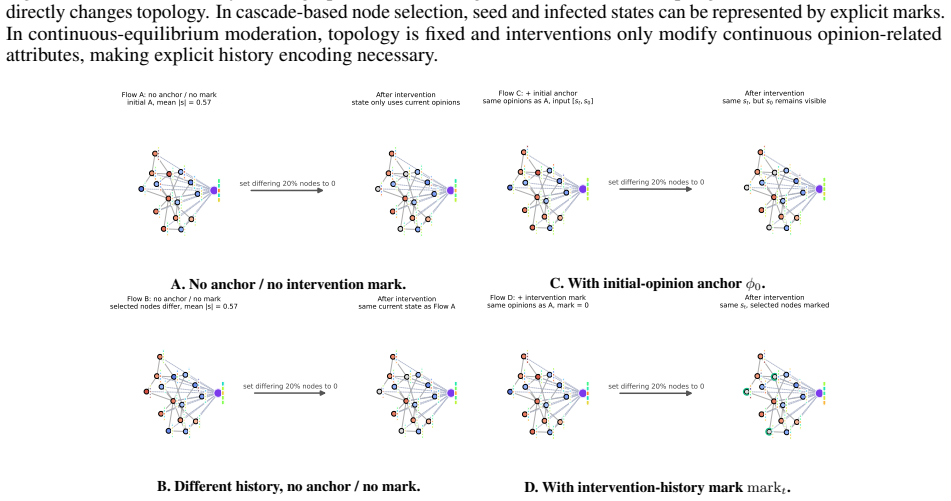
PACIFIER reformulates minimum intervention and maximum effort problems for the Friedkin-Johnsen model as ordered graph-intervention tasks evaluated by accumulated normalized polarization. It introduces PACIFIER-RL for long-horizon value learning and PACIFIER-Greedy for myopic ranking, using a two-echo-chamber training distribution, anchor-and-mark history encoding, normalized global features, and residual-polarization rewards to achieve reliable transfer from small synthetic graphs to large real-world networks.
What carries the argument
The PACIFIER framework that converts FJ moderation into sequential graph-intervention planning scored by accumulated normalized polarization, enabled by four scale-compatible designs for small-to-large transfer.
Load-bearing premise
The four scale-compatible designs enable reliable transfer from synthetic graphs under 50 nodes to large real-world networks without major performance loss.
What would settle it
Applying the trained model to a new large Twitter network and obtaining minimum intervention scores substantially below those of analytical solvers would falsify the transfer claim.
Figures






read the original abstract
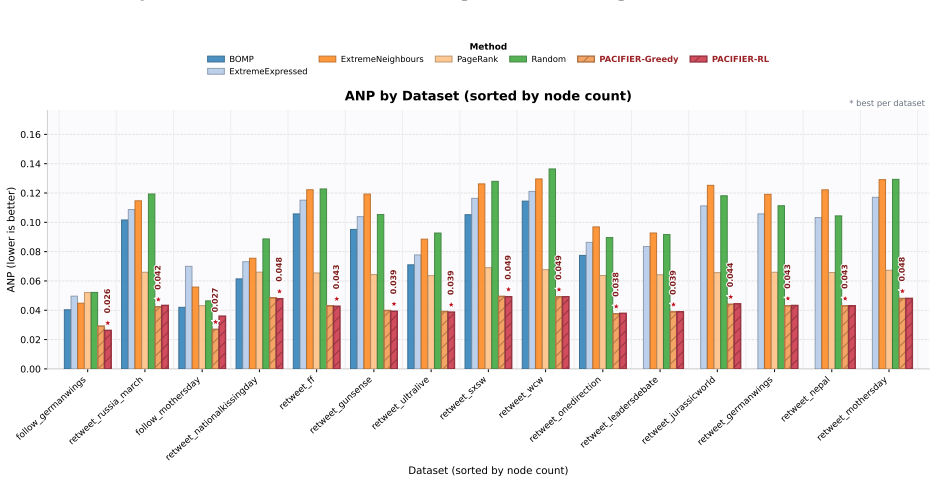
PACIFIER: Pacing Opinion Depolarization via a Unified Graph Learning Framework Opinion polarization moderation under the Friedkin-Johnsen (FJ) model is typically treated as an analytical optimization problem. Existing algorithms rely on linear steady-state analysis and repeated equilibrium recomputation, leading to poor scalability and limited adaptability to rich intervention regimes. This paper explores whether polarization moderation can be reformulated as a graph-based sequential planning problem. We propose PACIFIER, the first unified graph-learning and graph reinforcement learning framework for FJ-based intervention. It reformulates canonical MI and ME problems as ordered graph-intervention tasks evaluated by Accumulated Normalized Polarization (ANP). The framework includes PACIFIER-RL for long-horizon value learning and PACIFIER-Greedy for efficient myopic ranking, supporting cost-aware moderation, continuous opinions, and topology-altering node removal. The core challenge is small-to-large transfer. PACIFIER is trained on synthetic graphs with fewer than 50 nodes but must generalize to large real-world networks. To achieve this, we integrate four scale-compatible designs: a two-echo-chamber training distribution, anchor-and-mark history encoding, normalized global features, and residual-polarization rewards. These components make topology-preserving FJ moderation observable and learnable across graph scales. Experiments on 15 real-world Twitter networks (up to 155,599 nodes) show that PACIFIER matches analytical solvers in MI and consistently outperforms baselines in ME, continuous-ME, cost-ME, and node removal. PACIFIER-RL proves especially effective when long-horizon costs or structural consequences dominate immediate gains.
Editorial analysis
A structured set of objections, weighed in public.
Referee Report
Summary. The paper proposes PACIFIER, the first unified graph-learning and graph reinforcement learning framework for moderating opinion polarization under the Friedkin-Johnsen (FJ) model. It reformulates minimum intervention (MI) and maximum entropy (ME) problems as sequential graph-intervention tasks evaluated by a new Accumulated Normalized Polarization (ANP) metric. PACIFIER-RL handles long-horizon value learning while PACIFIER-Greedy provides efficient myopic ranking; both support cost-aware moderation, continuous opinions, and node removal. The framework is trained exclusively on synthetic graphs with fewer than 50 nodes using four scale-compatible designs (two-echo-chamber training distribution, anchor-and-mark history encoding, normalized global features, residual-polarization rewards) and is evaluated on 15 real-world Twitter networks up to 155,599 nodes, claiming to match analytical solvers on MI and outperform baselines on ME variants.
Significance. If the scale-transfer results are substantiated, the work would provide a scalable learning-based alternative to repeated linear steady-state optimization for FJ interventions, enabling richer regimes (cost, continuous, structural) on networks too large for analytical methods. The unified RL-plus-greedy formulation and ANP metric constitute concrete contributions that could influence computational social science approaches to depolarization.
major comments (2)
- [Abstract] Abstract: the central claim that the four scale-compatible designs enable reliable transfer from <50-node synthetics to 155k-node Twitter graphs without major performance loss is load-bearing, yet no ablation that removes each design individually and re-evaluates the resulting policy on the real-world instances (especially the largest graph) is reported; without this evidence the observed parity with analytical MI solvers and gains on ME variants could arise from other factors such as graph structure or the ANP definition itself.
- [Experiments] Experiments section: the abstract states that PACIFIER 'matches analytical solvers in MI and consistently outperforms baselines' on 15 networks, but provides neither error bars, standard deviations, nor statistical significance tests for any of the reported metrics (MI, ME, continuous-ME, cost-ME, node removal), rendering the empirical superiority unverifiable from the given text.
minor comments (1)
- [Abstract] Abstract: the precise mathematical definition of Accumulated Normalized Polarization (ANP) is not supplied, which is needed to understand how the metric aggregates polarization across intervention steps.
Simulated Author's Rebuttal
We thank the referee for their constructive and detailed feedback. We address each major comment point by point below and will incorporate revisions to strengthen the empirical support for our claims.
read point-by-point responses
-
Referee: [Abstract] Abstract: the central claim that the four scale-compatible designs enable reliable transfer from <50-node synthetics to 155k-node Twitter graphs without major performance loss is load-bearing, yet no ablation that removes each design individually and re-evaluates the resulting policy on the real-world instances (especially the largest graph) is reported; without this evidence the observed parity with analytical MI solvers and gains on ME variants could arise from other factors such as graph structure or the ANP definition itself.
Authors: We agree that individual ablations of each of the four scale-compatible designs would provide stronger evidence that they are necessary for reliable small-to-large transfer. In the revised manuscript we will add a dedicated ablation study that removes each component in turn (two-echo-chamber training distribution, anchor-and-mark history encoding, normalized global features, residual-polarization rewards) and re-evaluates the resulting policies on all 15 real-world Twitter networks, with explicit reporting for the largest graph (155,599 nodes). These additional results will isolate the contribution of each design and rule out alternative explanations such as graph structure or the ANP metric itself. revision: yes
-
Referee: [Experiments] Experiments section: the abstract states that PACIFIER 'matches analytical solvers in MI and consistently outperforms baselines' on 15 networks, but provides neither error bars, standard deviations, nor statistical significance tests for any of the reported metrics (MI, ME, continuous-ME, cost-ME, node removal), rendering the empirical superiority unverifiable from the given text.
Authors: We acknowledge that the lack of error bars, standard deviations, and statistical tests makes the reported superiority difficult to verify. In the revision we will recompute all metrics over multiple independent runs (different random seeds) and report means together with standard deviations for every setting (MI, ME, continuous-ME, cost-ME, node removal) across the 15 networks. We will also include appropriate statistical significance tests (paired t-tests or Wilcoxon signed-rank tests with p-values) comparing PACIFIER variants against both analytical solvers and baselines. revision: yes
Circularity Check
No circularity: PACIFIER introduces novel scale-transfer designs and evaluates them independently on real networks
full rationale
The paper reformulates FJ moderation as a graph RL planning task and introduces four explicit scale-compatible components (two-echo-chamber distribution, anchor-and-mark encoding, normalized global features, residual-polarization rewards) to enable training on <50-node synthetics and deployment on 155k-node Twitter graphs. These designs are presented as new engineering choices rather than derived from or fitted to the target performance metrics. No equations reduce a claimed prediction to a previously fitted parameter by construction, no uniqueness theorem is imported via self-citation, and the reported MI/ME parity is measured on held-out real-world instances. The derivation chain therefore remains self-contained against external benchmarks.
Axiom & Free-Parameter Ledger
invented entities (1)
-
Accumulated Normalized Polarization (ANP)
no independent evidence
Reference graph
Works this paper leans on
- [1]
-
[2]
R. Kelly Garrett. Echo chambers online?: Politically motivated selective exposure among internet news users. Journal of Computer-Mediated Communication, 14(2):265–285, 2009
work page 2009
-
[3]
Eytan Bakshy, Solomon Messing, and Lada A. Adamic. Exposure to ideologically diverse news and opinion on facebook.Science, 348(6239):1130–1132, 2015
work page 2015
-
[4]
Michael D. Conover, Jacob Ratkiewicz, Matthew Francisco, Bruno Gonçalves, Alessandro Flammini, and Filippo Menczer. Political polarization on twitter. InProceedings of the Fifth International AAAI Conference on Weblogs and Social Media, ICWSM ’11, 2011
work page 2011
-
[5]
Lada A. Adamic and Natalie Glance. The political blogosphere and the 2004 u.s. election: Divided they blog. In Proceedings of the 3rd International Workshop on Link Discovery, LinkKDD ’05, pages 36–43. ACM, 2005
work page 2004
-
[6]
Quantifying controversy on social media.ACM Transactions on Social Computing, 1(1):3:1–3:27, 2018
Kiran Garimella, Gianmarco De Francisci Morales, Aristides Gionis, and Michael Mathioudakis. Quantifying controversy on social media.ACM Transactions on Social Computing, 1(1):3:1–3:27, 2018
work page 2018
-
[7]
Social influence and opinions.Journal of Mathematical Sociology, 15(3-4):193–206, 1990
Noah E Friedkin and Eugene C Johnsen. Social influence and opinions.Journal of Mathematical Sociology, 15(3-4):193–206, 1990
work page 1990
-
[8]
Morris H. DeGroot. Reaching a consensus.Journal of the American Statistical Association, 69(345):118–121, 1974
work page 1974
-
[9]
How bad is forming your own opinion?Games and Economic Behavior, 92:248–265, 2015
David Bindel, Jon Kleinberg, and Sigal Oren. How bad is forming your own opinion?Games and Economic Behavior, 92:248–265, 2015
work page 2015
-
[10]
Antonis Matakos, Evimaria Terzi, and Panayiotis Tsaparas. Measuring and moderating opinion polarization in social networks.Data Mining and Knowledge Discovery, 31(5):1480–1505, 2017
work page 2017
-
[11]
Cameron Musco, Christopher Musco, and Charalampos E. Tsourakakis. Minimizing polarization and disagreement in social networks. InProceedings of the 2018 World Wide Web Conference (WWW ’18), 2018
work page 2018
-
[12]
Quantifying and minimizing risk of conflict in social networks
Xi Chen, Jefrey Lijffijt, and Tijl De Bie. Quantifying and minimizing risk of conflict in social networks. In Proceedings of the 24th ACM SIGKDD International Conference on Knowledge Discovery & Data Mining, pages 1197–1206, 2018
work page 2018
-
[13]
Reducing controversy by connecting opposing views
Kiran Garimella, Gianmarco De Francisci Morales, Aristides Gionis, and Michael Mathioudakis. Reducing controversy by connecting opposing views. InProceedings of the Tenth ACM International Conference on Web Search and Data Mining (WSDM ’17), 2017
work page 2017
-
[14]
Minimizing polarization and disagreement in social networks via link recommendation
Liwang Zhu, Qi Bao, and Zhongzhi Zhang. Minimizing polarization and disagreement in social networks via link recommendation. InAdvances in Neural Information Processing Systems, volume 34, pages 29047–29058, 2021
work page 2021
-
[15]
A nearly-linear time algorithm for minimizing risk of conflict in social networks
Liwang Zhu and Zhongzhi Zhang. A nearly-linear time algorithm for minimizing risk of conflict in social networks. InProceedings of the 28th ACM SIGKDD Conference on Knowledge Discovery and Data Mining, pages 2648–2656, 2022
work page 2022
-
[16]
Miklos Z. Rácz and Daniel E. Rigobon. Towards consensus: Reducing polarization by perturbing social networks. IEEE Transactions on Network Science and Engineering, 2023
work page 2023
-
[17]
Minimizing polarization in noisy leader-follower opinion dynamics
Wanyue Xu and Zhongzhi Zhang. Minimizing polarization in noisy leader-follower opinion dynamics. In Proceedings of the 32nd ACM International Conference on Information and Knowledge Management, pages 2856–2865, 2023
work page 2023
-
[18]
Online minimization of polarization and disagreement via low-rank matrix bandits
Federico Cinus, Yuko Kuroki, Atsushi Miyauchi, and Francesco Bonchi. Online minimization of polarization and disagreement via low-rank matrix bandits. InInternational Conference on Learning Representations, 2026. 43 Running Title for Header Table 6: Full ablation results under MI with PACIFIER-Greedy on real-world datasets. Method follow_germanwings follo...
work page 2026
-
[19]
V olodymyr Mnih, Koray Kavukcuoglu, David Silver, Andrei A. Rusu, Joel Veness, Marc G. Bellemare, Alex Graves, Martin Riedmiller, Andreas K. Fidjeland, Georg Ostrovski, Stig Petersen, Charles Beattie, Amir Sadik, Ioannis Antonoglou, Helen King, Dharshan Kumaran, Daan Wierstra, Shane Legg, and Demis Hassabis. Human- level control through deep reinforcement...
work page 2015
-
[20]
Khalil, Yuyu Zhang, Bistra Dilkina, and Le Song
Hanjun Dai, Elias B. Khalil, Yuyu Zhang, Bistra Dilkina, and Le Song. Learning combinatorial optimization algorithms over graphs. InAdvances in Neural Information Processing Systems, volume 30, 2017
work page 2017
-
[21]
Thomas N. Kipf and Max Welling. Semi-supervised classification with graph convolutional networks. In International Conference on Learning Representations, 2017
work page 2017
-
[22]
Hamilton, Rex Ying, and Jure Leskovec
William L. Hamilton, Rex Ying, and Jure Leskovec. Inductive representation learning on large graphs. InAdvances in Neural Information Processing Systems, volume 30, pages 1024–1034, 2017
work page 2017
-
[23]
Changjun Fan, Li Zeng, Yizhou Sun, and Yang-Yu Liu. Finding key players in complex networks through deep reinforcement learning.Nature Machine Intelligence, 2(6):317–324, 2020
work page 2020
-
[24]
Gcomb: Learning budget-constrained combinatorial algorithms over billion-sized graphs
Sahil Manchanda, Akash Mittal, Anuj Dhawan, Sourav Medya, Sayan Ranu, and Ambuj Singh. Gcomb: Learning budget-constrained combinatorial algorithms over billion-sized graphs. InAdvances in Neural Information Processing Systems, volume 33, pages 20000–20011, 2020
work page 2020
-
[25]
Maximizing the spread of influence through a social network
David Kempe, Jon Kleinberg, and Éva Tardos. Maximizing the spread of influence through a social network. In Proceedings of the ninth ACM SIGKDD international conference on Knowledge discovery and data mining, pages 137–146, 2003
work page 2003
-
[26]
Thai, Renhao Xue, James Song, Meikang Qiu, and Liang Zhao
Chen Ling, Junji Jiang, Junxiang Wang, My T. Thai, Renhao Xue, James Song, Meikang Qiu, and Liang Zhao. Deep graph representation learning and optimization for influence maximization. InProceedings of the 40th International Conference on Machine Learning, 2023
work page 2023
-
[27]
Opinion de-polarization in social networks with GNNs
Nicholas Mylonas and Thanassis Spyropoulos. Opinion depolarization in social networks with graph neural networks.arXiv preprint arXiv:2412.09404, 2024
work page internal anchor Pith review Pith/arXiv arXiv 2024
-
[28]
Opinion optimization in directed social networks
Haoxin Sun and Zhongzhi Zhang. Opinion optimization in directed social networks. InProceedings of the AAAI Conference on Artificial Intelligence, volume 37, pages 4623–4630, 2023
work page 2023
-
[29]
Flaviano Morone and Hernán A. Makse. Influence maximization in complex networks through optimal percolation. Nature, 524(7563):65–68, 2015
work page 2015
-
[30]
Network dismantling.Proceed- ings of the National Academy of Sciences, 113(44):12368–12373, 2016
Alfredo Braunstein, Luca Dall’Asta, Guilhem Semerjian, and Lenka Zdeborová. Network dismantling.Proceed- ings of the National Academy of Sciences, 113(44):12368–12373, 2016
work page 2016
-
[31]
Arpita Ghosh and Stephen Boyd. Growing well-connected graphs. InProceedings of the 45th IEEE Conference on Decision and Control, pages 6605–6611, 2006
work page 2006
-
[32]
Rainer Hegselmann and Ulrich Krause. Opinion dynamics and bounded confidence models, analysis, and simulation.Journal of Artificial Societies and Social Simulation, 5(3):2, 2002
work page 2002
-
[33]
Mixing beliefs among interacting agents.Advances in Complex Systems, 3(1–4):87–98, 2000
Guillaume Deffuant, David Neau, Frederic Amblard, and Gerard Weisbuch. Mixing beliefs among interacting agents.Advances in Complex Systems, 3(1–4):87–98, 2000
work page 2000
-
[34]
Pranav Dandekar, Ashish Goel, and David T. Lee. Biased assimilation, homophily, and the dynamics of polarization.Proceedings of the National Academy of Sciences, 110(15):5791–5796, 2013
work page 2013
-
[35]
Claudio Altafini. Consensus problems on networks with antagonistic interactions.IEEE Transactions on Automatic Control, 58(4):935–946, 2013. 45
work page 2013
discussion (0)
Sign in with ORCID, Apple, or X to comment. Anyone can read and Pith papers without signing in.