REVIEW 5 major objections 4 minor 2 cited by
Stellar-mass black holes, not stars, explain quasi-periodic eruptions.
Reviewed by Pith at T0; open to challenge. T0 means a machine referee read the full paper against a public rubric. the ladder, T0–T4 →
T0 review · deepseek-v4-flash
2026-08-02 19:59 UTC pith:YMMC2IJU
load-bearing objection Genuinely novel global simulations that make the star/sBH asymmetry case well, but the 'full QPE energy range' claim rests on an ad hoc normalization that the referee should push on. the 5 major comments →
Quasi-periodic Eruptions from Stellar-mass Black Holes Impacting Accretion Disks in Galactic Nuclei
The pith
A machine-rendered reading of the paper's core claim, the machinery that carries it, and where it could break.
Core claim
The paper establishes that the standard way of estimating the energy released when a stellar-mass black hole crosses an accretion disk—taking its Bondi radius as the shocked region—underestimates the interaction by a large margin. In global simulations that include the full gravitational potential of the central supermassive black hole, the effective radius over which the intruder gravitationally heats disk gas follows R_eff ≈ 0.5 (R_B^{1/3} R_H^{2/3}), an interpolation between the Bondi and Hill radii with the previously ignored Hill radius dominating. The measured ejecta masses and energies match this scaling, and the paper shows that an sBH of roughly 50–100 solar masses crossing a disk w
What carries the argument
The central object is an ad hoc effective interaction radius R_eff = 0.5 R_B^{1/3} R_H^{2/3}, where R_B is the Bondi radius (the scale at which the intruder's gravity overcomes the gas's thermal and kinetic energy) and R_H is the Hill radius (the scale at which the supermassive black hole's tidal gravity strips gas away). This radius quantifies the region over which a stellar-mass black hole gravitationally focuses, heats, and ejects disk gas during a crossing. It is validated and calibrated by global 3D meshless finite-mass hydrodynamic simulations that resolve the Bondi-to-Hill scales and measure the forward and backward ejecta masses and energies.
Load-bearing premise
The entire energy budget rests on treating the disk as an adiabatic polytropic gas with a fixed vertical scale height of one solar radius and no radiative cooling: if the shocked gas cools quickly in real tidal-disruption disks, the heated ejecta would be less massive and slower, and the calibrated effective radius—and with it the computed energies—would shrink.
What would settle it
Re-run the sBH-disk collision with a radiation-hydrodynamic scheme that allows the shocked gas to cool and radiate during the ~1 hour simulated interaction. If including cooling reduces the ejecta mass or expansion speed by a large factor, the claimed energy range of 10^44–10^48 erg and the R_eff calibration would not survive. Alternatively, a QPE source with a well-measured disk surface density whose flare energy requires an impactor above ~100 solar masses at any inclination would falsify the paper's central claim that no intermediate-mass black hole is needed.
If this is right
- Stellar-mass black holes of roughly 50–100 solar masses on low-inclination orbits become a viable explanation for QPEs such as GSN 069, without requiring intermediate-mass black holes.
- The observed alternating long–short recurrence intervals and strong–weak flare contrasts can arise naturally from two mildly asymmetric impacts per orbit of an sBH, whereas the star model predicts only one detectable burst per orbit.
- The sBH model predicts eruption durations spanning roughly an order of magnitude through its inclination-dependent interaction radius, matching the observed diversity of QPE durations.
- Several short-period QPE sources lie within twice the tidal-disruption radius for a solar-mass star, so the star model faces a severe stability problem; the sBH model has no corresponding lifetime limit.
- The formula R_eff ≈ 0.5 (R_B R_H^2)^{1/3}, if correct, boosts the predicted sBH-disk energy budget by orders of magnitude at low inclinations relative to the Bondi-only estimates used in earlier work.
Where Pith is reading between the lines
- If the sBH picture is correct, QPEs become an electromagnetic tracer of stellar-mass black holes at galactic centers, potentially the same population that space-based gravitational-wave observatories aim to detect—a connection the paper raises but does not develop.
- The R_eff scaling is an empirical fit from adiabatic runs; a testable extension is that faster radiative cooling of the shocked gas should shrink the effective radius and steepen the inclination dependence of flare energy.
- The same gravitational-drag enhancement across Bondi-to-Hill scales may apply to other disk-embedded bodies, such as compact objects in AGN disks or planets in protoplanetary disks, where energy-budget estimates currently use only the Bondi or physical radius.
- Because the paper fixes the vertical scale height and uses an adiabatic equation of state, a natural next step is to vary H and the cooling time; the claimed 10^44–10^48 erg range could then be refined into a sharper, source-specific prediction.
Editorial analysis
A structured set of objections, weighed in public.
Referee Report
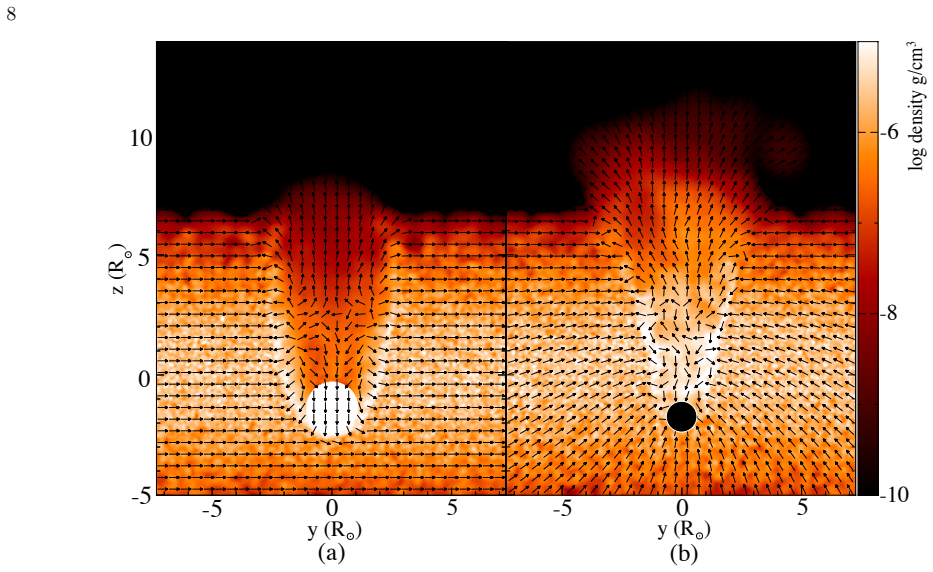
Summary. The paper uses global 3D meshless finite-mass (MFM) simulations with GIZMO to compare stellar-mass black hole (sBH) and stellar impactors crossing TDE accretion disks around an SMBH, including the SMBH potential. It reports that stellar impacts produce strongly asymmetric, forward-dominated ejecta and face tidal stability problems, while 100 Msun sBH impacts produce nearly symmetric ejecta with energies that grow at low inclination. The paper introduces an ad hoc effective interaction radius R_eff ~ 0.5 R_B^{1/3} R_H^{2/3}, uses it in a semi-analytical model, and claims that sBH-disk collisions can power the full QPE energy range (10^44-10^48 erg) without invoking intermediate-mass black holes.
Significance. If the quantitative central claim holds, this is a potentially important contribution: the global setup including the SMBH potential is a genuine step beyond local box simulations, and the qualitative distinction between asymmetric stellar ejecta and quasi-symmetric sBH ejecta is directly relevant to the QPE debate. The paper is also commendably transparent that Eq. (10) is ad hoc and that radiative transfer is not included. However, the central quantitative claim rests on a dimensional normalization in Eq. (19) and on an empirical radius calibrated to only four sBH runs; the confirmation in Section 5.3 is therefore partly circular. The strengths are the qualitative simulation findings and the honest discussion of limitations; the weakness is the unanchored absolute energy scale in the semi-analytical model.
major comments (5)
- [§1 vs §5.4/§6] The paper states in the Introduction that QPE flare energies are 10^40-10^42 erg, but the abstract, §5.4, and §6 base the central claim on a 'full QPE energy range (10^44-10^48 erg)'. These differ by four orders of magnitude. Since the claimed viability of sBH impacts depends on covering the observed energy range, this inconsistency must be resolved. If the two numbers refer to different quantities (e.g., emitted soft X-ray energy versus total energy budget), define them explicitly.
- [§5.3, Eq. (19)] Eq. (19) is not derived from the simulations or from a standard gravitational-drag calculation. The R_sun^2 normalization is introduced as a 'characteristic normalization scale' because the physical scales fall between 0.03 and 10 R_sun. That is a dimensional choice, not a physical result: replacing R_sun^2 by R_eff^2, R_B R_H, or an integrated drag expression changes E_sBH by factors of order (R_eff/R_sun)^2, which across the explored parameter range can shift the claimed 10^44-10^48 erg interval substantially. Because this equation, rather than the simulation data, generates the central quantitative claim, the absolute energy scale is unanchored. Please derive the rate from a controlled calculation (e.g., a calibrated version of Eq. 6) or present the simulation kinetic energies with uncertainties as the primary evidence.
- [§5.2, Eq. (10); Table 1] The empirical R_eff relation is explicitly ad hoc and is calibrated to only four sBH runs: two inclinations (π/10 and π/2) and three surface densities, all with m_sBH=100 Msun, M_SMBH=10^6 Msun, and H=1 Rsun. The same relation is then used in §5.3 to 'confirm' the simulation trends and to produce the full 10^44-10^48 erg range, so the confirmation is partly circular. No error bars or convergence tests are reported for the ejecta masses and energies in Table 1. Independent runs with different masses, scale heights, and inclinations, and a clear separation between calibration and validation, are needed before extrapolation to the observed QPE population.
- [§3, §5.4] The simulations use a polytropic gamma=4/3 disk with no radiative transfer, so shocked gas retains all thermal energy over the hour-long runs. The measured ejecta masses, expansion speeds, and hence the calibration of R_eff may change if radiative cooling is efficient in real TDE disks. The paper acknowledges this in §5.4 but does not quantify the effect on the energy budget. Since the central claim depends on these simulation-derived quantities, the magnitude of the cooling uncertainty should be estimated or bounded.
- [Table 1 vs §5.3] The simulation energies in Table 1 are estimated as (1/2) M_sh v_rel^2, whereas the semi-analytical model in §5.3 uses the gravitational energy rate in Eq. (19). The 'qualitative reproduction' of the simulation trend therefore compares two different energy definitions. The paper should state which energy channel is meant by 'burst energy' and should show that the semi-analytical model and the simulations measure the same quantity before using the model to extend the simulation results to the full QPE range.
minor comments (4)
- [Figures] In §4.2, references to 'Fig. 2(a)' and 'Fig. 2(b)' appear to refer to Fig. 5(a) and Fig. 5(b); please correct the cross-references.
- [References] There are duplicated or incomplete entries (e.g., Chakraborty et al. 2025 appears twice; multiple Zhou et al. 2025 entries with abbreviated author lists) and some line breaks in the reference list should be cleaned up.
- [§1] The sentence 'flare energies of 10^40-10^42 erg' should be cross-checked with the later 10^44-10^48 claim; if they denote different quantities, define them explicitly.
- [§5.3] Eq. (15) uses v_k sin i for the residence time while Eq. (13) uses 2 v_k sin(i/2) for the relative velocity; the near-equality at low i is coincidental and the notation should state which velocity enters each step.
Circularity Check
Quantitative 'confirmation' of the 10^44–10^48 erg range reduces to the ad hoc R_eff fit (Eq. 10) plus the R_sun-normalized energy rate (Eq. 19); the qualitative symmetry/Hill-radius claims remain independent.
specific steps
-
fitted input called prediction
[Sec. 5.2 Eq. (10); Sec. 5.3 Eqs. (17)-(20); Sec. 6 Summary]
"We propose the following empirical scaling of the effective radius R_eff ... R_eff ≃ 0.5 R_B^{1/3} R_H^{2/3}. This ad hoc relation is not rigorously derived from the simulations but serves as a guess ... reproducing the measured ejecta mass and energy budgets more accurately than the estimation with the Bondi radius. ... Our semi-analytical model, calibrated to simulations, confirms that sBH impacts can power the full QPE energy range (10^44-10^48 erg)."
The effective radius R_eff, the key input of the semi-analytical model, is explicitly calibrated to the measured ejecta masses/energies of the same simulations that the model is then said to 'confirm'. The claimed full energy range is therefore a restatement of the fit plus an extrapolation, not an independent prediction. The independent content lies in the qualitative statements (Hill-radius dominance, near-symmetric ejecta), not in the quantitative energy-budget confirmation.
-
other
[Sec. 5.3, Eq. (19)]
"where we adopt R_⊙^2 as a characteristic normalization scale to simplify the calculation of order-of-magnitude estimates of the gravitational pull effect. The choice is justified because the key physical length scales involved ... all fall within a range from ~0.03 R_⊙ to ~10 R_⊙ depending on the inclination and other parameters."
The absolute energy scale entering the derived E_sBH is set by this freely chosen 1/R_sun^2 normalization rather than by the simulated hydrodynamics or a standard gravitational-drag formula. Because E_sBH ∝ M_sBH R_eff/R_sun^2 by construction, replacing R_sun with R_eff changes the 'predicted' energies by factors (R_sun/R_eff)^2. The 10^44–10^48 erg range is thus partly an artifact of this input choice, so the quantitative confirmation is not independent of the model's own normalization.
full rationale
The paper contains genuine, independent numerical work: global 3D MFM simulations, the measured ejecta masses and energy asymmetries in Table 1, and the qualitative physical distinction between star-disk (asymmetric, wake-dominated) and sBH-disk (near-symmetric, Hill-radius-limited) impacts. These are not circular. The circularity concerns the quantitative central claim. Section 5.2 introduces R_eff as an 'ad hoc' empirical formula chosen to reproduce the measured ejecta mass and energy budgets; Section 5.3 then builds the semi-analytical model on this calibrated R_eff and the paper's Summary states that this 'calibrated to simulations' model 'confirms' the full 10^44–10^48 erg QPE range. That is a fitted input being presented as a confirming prediction. The separate Eq. (19) normalization by R_sun^2 is likewise a freely chosen scale that directly sets the absolute energy range. No load-bearing self-citation was found: the few self-references are to earlier methods/data or observational energy estimates and do not substitute for the derivation. The paper is transparent about the ad hoc nature and the lack of radiative transfer, which mitigates but does not remove the partial circularity of the quantitative confirmation.
Axiom & Free-Parameter Ledger
free parameters (5)
- Effective interaction radius R_eff = 0.5 R_B^{1/3} R_H^{2/3} =
coefficient 0.5 and exponents 1/3, 2/3
- Gravitational energy normalization distance in Eq. (19) =
1 R_sun
- Coulomb logarithm ln Lambda in Eq. (6) =
5
- Disk surface density and scale height =
Sigma = 10^4-10^6 g/cm^2; H = 1 R_sun
- Ejecta energy estimator =
E = 1/2 M_sh v_rel^2
axioms (6)
- domain assumption The disk is a polytropic gamma=4/3 gas with no radiative cooling or radiative transfer.
- domain assumption The disk has a Gaussian vertical profile with fixed scale height H=1 R_sun and remains in near-Keplerian motion outside the Hill sphere.
- domain assumption The sBH is treated as a point mass and accretion onto it is neglected.
- ad hoc to paper The empirical R_eff scaling transfers from the four simulated cases to the full observed QPE population and the claimed 1e44-1e48 erg range.
- domain assumption The observed QPE recurrence time can be identified with the orbital period or half-period for the stellar tidal-stability argument.
- standard math Standard tidal-disruption-radius criteria for a 1 M_sun main-sequence star apply to the QPE hosts.
Cite this review
Pith. "Pith review of Quasi-periodic Eruptions from Stellar-mass Black Holes Impacting Accretion Disks in Galactic Nuclei." pith.science (2026). https://pith.science/paper/YMMC2IJU
@misc{pith2026260300226,
  author       = {Pith},
  title        = {Pith review of: Quasi-periodic Eruptions from Stellar-mass Black Holes Impacting Accretion Disks in Galactic Nuclei},
  year         = {2026},
  howpublished = {\url{https://pith.science/paper/YMMC2IJU}},
  note         = {Machine review of arXiv:2603.00226}
}
read the original abstract
We investigate the origins of quasi-periodic eruptions (QPEs) in galactic nuclei using global three-dimensional meshless finite-mass (MFM) simulations. By modeling stellar and black-hole impactors traversing accretion disks under various inclinations and surface densities, we evaluate their consistency with the observed properties of QPEs. Stellar impacts produce highly asymmetric bipolar ejecta with forward outbursts dominating by over an order of magnitude in energy and luminosity due to the star blocking downstream flow and creating a low-density wake. This shock-compression mechanism often renders backward events unobservable, implying one detectable burst per orbit, and challenging the standard assumption of two bursts. It also fails to explain alternating long--short recurrence patterns and places several sources near or within twice the tidal disruption radius for solar-mass stars, raising severe stability concerns. Whereas a stellar-mass black hole (sBH) gravitationally focuses and heats disk gas over an effective interaction scale that extends beyond its Bondi radius $R_{\rm B}$ and is naturally bounded by its Hill radius $R_{\rm H}$ during an impact, yielding nearly symmetric ejecta with mild contrasts. This gravitational-drag mechanism generates higher energy budgets at low inclinations due to enhanced mass accumulation. We suggest an ad hoc effective interaction radius $ R_{\rm eff} \simeq 0.5\, R_{\rm B}^{1/3} R_{\rm H}^{2/3} $ to quantify this trend. Incorporating this effective radius substantially increases the energy that sBH-disk collisions can produce compared to previous Bondi-only estimates, improving the viability of stellar-mass black holes as the impactors for a wide range of observed QPE energies and properties.
Figures




Forward citations
Cited by 2 Pith papers
-
QPEs from Warped Disk Collisions with EMRIs: Brightness-Recurrence Diagram and Gravitational-Wave Follow-up
A warped-disk EMRI collision model reproduces QPE patterns in GSN 069 via a new Brightness-Recurrence Diagram and predicts possible LISA detection for a retrograde stellar-mass black hole secondary.
-
Extreme Mass Ratio Inspirals in Light of Quasi-periodic Eruptions: Milli-Hertz Gravitational Wave Background
QPE observations yield EMRI rates of 2.88e-6 (stellar) and 6.07e-6 (black hole) per galaxy per year, with only black hole EMRIs potentially exceeding LISA sensitivity in the 1-10 mHz band.
Reference graph
Works this paper leans on
-
[1]
2021, Nature, 592, 704, doi: 10.1038/s41586-021-03394-6
Arcodia, R., Merloni, A., Nandra, K., et al. 2021, Nature, 592, 704, doi: 10.1038/s41586-021-03394-6
-
[2]
2024, A&A, 684, A64, doi: 10.1051/0004-6361/202348881
Arcodia, R., Liu, Z., Merloni, A., et al. 2024, A&A, 684, A64, doi: 10.1051/0004-6361/202348881
-
[3]
2025, ApJ, 989, 13, doi: 10.3847/1538-4357/adec9b
Arcodia, R., Baldini, P., Merloni, A., et al. 2025, ApJ, 989, 13, doi: 10.3847/1538-4357/adec9b
-
[4]
2026, doi: 10.1051/0004-6361/202558241
Baldini, P., et al. 2026, doi: 10.1051/0004-6361/202558241
-
[5]
2021, ApJL, 921, L40, doi: 10.3847/2041-8213/ac313b
Chakraborty, J., Kara, E., Masterson, M., et al. 2021, ApJL, 921, L40, doi: 10.3847/2041-8213/ac313b
-
[7]
Chakraborty, J., et al. 2025, Astrophys. J. Lett., 983, L39, doi: 10.3847/2041-8213/adc2f8
-
[8]
2026, https://arxiv.org/abs/2602.16776
Chakraborty, J., et al. 2026, https://arxiv.org/abs/2602.16776
arXiv 2026
-
[9]
2024, A&A, 691, A313, doi: 10.1051/0004-6361/202348635
Chashkina, A., Bromberg, O., Levinson, A., & Nakar, E. 2024, A&A, 691, A313, doi: 10.1051/0004-6361/202348635
-
[10]
Dai, L. J., Fuerst, S. V., & Blandford, R. 2010, MNRAS, 402, 1614, doi: 10.1111/j.1365-2966.2009.16038.x
arXiv 2010
- [11]
-
[12]
F., & Bai, X.-N
Deng, H., Mayer, L., Latter, H., Hopkins, P. F., & Bai, X.-N. 2019, The Astrophysical Journal Supplement Series, 241, 26
2019
-
[13]
Evans, P. A., Nixon, C. J., Campana, S., et al. 2023, Nature Astronomy, 7, 1368, doi: 10.1038/s41550-023-02073-y
-
[14]
2023, A&A, 675, A100, doi: 10.1051/0004-6361/202346565
Franchini, A., Bonetti, M., Lupi, A., et al. 2023, A&A, 675, A100, doi: 10.1051/0004-6361/202346565
-
[15]
Giustini, M., Miniutti, G., & Saxton, R. D. 2020, A&A, 636, L2, doi: 10.1051/0004-6361/202037610
-
[16]
2011, ApJ, 732, 74, doi: 10.1088/0004-637X/732/2/74
Guillochon, J., Ramirez-Ruiz, E., & Lin, D. 2011, ApJ, 732, 74, doi: 10.1088/0004-637X/732/2/74
-
[17]
Guo, W., & Shen, R.-F. 2026, ApJ, 998, 78, doi: 10.3847/1538-4357/ae3562 Hern´ andez-Garc ´ ıa, L., Chakraborty, J., S´ anchez-S´ aez, P., et al. 2025a, Nature Astronomy, 9, 895, doi: 10.1038/s41550-025-02523-9 Hern´ andez-Garc ´ ıa, L., S´ anchez-S´ aez, P., Chakraborty, J., et al. 2025b, arXiv e-prints, arXiv:2509.16304, doi: 10.48550/arXiv.2509.16304
-
[18]
Hopkins, P. F. 2015, MNRAS, 450, 53, doi: 10.1093/mnras/stv195
-
[19]
2025, ApJ, 993, 186, doi: 10.3847/1538-4357/ae07ca
Huang, X., Linial, I., & Jiang, Y.-F. 2025, ApJ, 993, 186, doi: 10.3847/1538-4357/ae07ca
-
[20]
Ivanov, P. B., Igumenshchev, I. V., & Novikov, I. D. 1998, ApJ, 507, 131, doi: 10.1086/306324
-
[21]
Jiang, N., & Pan, Z. 2025, Astrophys. J. Lett., 983, L18, doi: 10.3847/2041-8213/adc456
-
[22]
Kaur, K., Stone, N. C., & Gilbaum, S. 2023, MNRAS, 524, 1269, doi: 10.1093/mnras/stad1894
-
[23]
2020, MNRAS, 493, L120, doi: 10.1093/mnrasl/slaa020
King, A. 2020, MNRAS, 493, L120, doi: 10.1093/mnrasl/slaa020
-
[24]
Krolik, J. H., & Linial, I. 2022, ApJ, 941, 24, doi: 10.3847/1538-4357/ac9eb6
-
[25]
Linial, I., & Metzger, B. D. 2023, ApJ, 957, 34, doi: 10.3847/1538-4357/acf65b
-
[26]
Linial, I., & Metzger, B. D. 2024, ApJL, 963, L1, doi: 10.3847/2041-8213/ad2464
-
[27]
Linial, I., Metzger, B. D., & Quataert, E. 2025, arXiv e-prints, arXiv:2506.10096, doi: 10.48550/arXiv.2506.10096
-
[28]
Liu, S.-F., Guillochon, J., Lin, D. N. C., & Ramirez-Ruiz, E. 2013, ApJ, 762, 37, doi: 10.1088/0004-637X/762/1/37
-
[29]
2023, MNRAS, 524, 6247, doi: 10.1093/mnras/stad2203
Lu, W., & Quataert, E. 2023, MNRAS, 524, 6247, doi: 10.1093/mnras/stad2203
-
[30]
Lui, L., Torres-Orjuela, A., Chowdhury, R. K., & Dai, L. 2025, arXiv e-prints, arXiv:2508.07961, doi: 10.48550/arXiv.2508.07961
-
[31]
Metzger, B. D., Stone, N. C., & Gilbaum, S. 2022, ApJ, 926, 101, doi: 10.3847/1538-4357/ac3ee1 16
-
[32]
2023, A&A, 670, A93, doi: 10.1051/0004-6361/202244512
Miniutti, G., Giustini, M., Arcodia, R., et al. 2023, A&A, 670, A93, doi: 10.1051/0004-6361/202244512
-
[33]
Miniutti, G., Saxton, R. D., Giustini, M., et al. 2019, Nature, 573, 381, doi: 10.1038/s41586-019-1556-x
-
[34]
Nicholl, M., Pasham, D. R., Mummery, A., et al. 2024, Nature, 634, 804, doi: 10.1038/s41586-024-08023-6
-
[35]
2023, ApJ, 952, 32, doi: 10.3847/1538-4357/acd180
Pan, X., Li, S.-L., & Cao, X. 2023, ApJ, 952, 32, doi: 10.3847/1538-4357/acd180
-
[36]
2022, ApJL, 928, L18, doi: 10.3847/2041-8213/ac5faf
Pan, X., Li, S.-L., Cao, X., Miniutti, G., & Gu, M. 2022, ApJL, 928, L18, doi: 10.3847/2041-8213/ac5faf
-
[37]
2026, https://arxiv.org/abs/2601.22465
Pan, Z., & Lai, D. 2026, https://arxiv.org/abs/2601.22465
Pith/arXiv arXiv 2026
-
[38]
Repeated Partial Tidal Disruptions and Quasi-Periodic Eruptions in SwJ023017.0+283603
Pasham, D., Coughlin, E., Nixon, C., et al. 2024, arXiv e-prints, arXiv:2411.05948, doi: 10.48550/arXiv.2411.05948
work page internal anchor Pith review Pith/arXiv arXiv doi:10.48550/arxiv.2411.05948 2024
-
[39]
Raj, A., & Nixon, C. J. 2021, ApJ, 909, 82, doi: 10.3847/1538-4357/abdc25
-
[40]
Rein, H., & Liu, S.-F. 2012, A&A, 537, A128, doi: 10.1051/0004-6361/201118085 ´Sniegowska, M., Grz¸ edzielski, M., Czerny, B., & Janiuk, A. 2023, A&A, 672, A19, doi: 10.1051/0004-6361/202243828 Sukov´ a, P., Zajaˇ cek, M., Witzany, V., & Karas, V. 2021, ApJ, 917, 43, doi: 10.3847/1538-4357/ac05c6
-
[41]
2013, ApJ, 768, 167, doi: 10.1088/0004-637X/768/2/167
Sun, L., Shu, X., & Wang, T. 2013, ApJ, 768, 167, doi: 10.1088/0004-637X/768/2/167
-
[42]
2023, MNRAS, 526, 69, doi: 10.1093/mnras/stad2616
Tagawa, H., & Haiman, Z. 2023, MNRAS, 526, 69, doi: 10.1093/mnras/stad2616
-
[43]
Thun, D., Kuiper, R., Schmidt, F., & Kley, W. 2016, A&A, 589, A10, doi: 10.1051/0004-6361/201527629 Tsz-Lok Lam, A., Shibata, M., Kawaguchi, K., & Pelle, J. 2025, arXiv e-prints, arXiv:2504.17016, doi: 10.48550/arXiv.2504.17016
-
[44]
Vurm, I., Linial, I., & Metzger, B. D. 2025, ApJ, 983, 40, doi: 10.3847/1538-4357/adb74d
-
[45]
2022, ApJ, 933, 225, doi: 10.3847/1538-4357/ac75e6
Wang, M., Yin, J., Ma, Y., & Wu, Q. 2022, ApJ, 933, 225, doi: 10.3847/1538-4357/ac75e6
-
[46]
Wevers, T., & French, K. D. 2024, ApJL, 969, L17, doi: 10.3847/2041-8213/ad5725
-
[47]
2022, A&A, 659, L2, doi: 10.1051/0004-6361/202243143
Arcodia, R. 2022, A&A, 659, L2, doi: 10.1051/0004-6361/202243143
-
[48]
Wu, M., Jiang, N., Zhu, J., et al. 2025, Astrophys. J. Lett., 988, L77, doi: 10.3847/2041-8213/adf229
-
[49]
2021, ApJL, 921, L32, doi: 10.3847/2041-8213/ac31aa
Xian, J., Zhang, F., Dou, L., He, J., & Shu, X. 2021, ApJL, 921, L32, doi: 10.3847/2041-8213/ac31aa
-
[50]
Xiong, Y., Jiang, N., Pan, Z., Hao, L., & Li, Z. 2025, Astrophys. J., 989, 49, doi: 10.3847/1538-4357/ade2d7
-
[51]
Z., Quataert, E., Jiang, Y.-F., Lu, W., & White, C
Yao, P. Z., Quataert, E., Jiang, Y.-F., Lu, W., & White, C. J. 2025, ApJ, 978, 91, doi: 10.3847/1538-4357/ad8911
-
[52]
Zalamea, I., Menou, K., & Beloborodov, A. M. 2010, MNRAS, 409, L25, doi: 10.1111/j.1745-3933.2010.00930.x
arXiv 2010
-
[53]
2025, The Astrophysical Journal, 993, 244
Zhang, M., Zhang, W., Deng, H., Guo, H., & Sun, J. 2025, The Astrophysical Journal, 993, 244
2025
-
[54]
Zhao, Z. Y., Wang, Y. Y., Zou, Y. C., Wang, F. Y., & Dai, Z. G. 2022, A&A, 661, A55, doi: 10.1051/0004-6361/202142519
-
[55]
2024a, PhRvD, 109, 103031, doi: 10.1103/PhysRevD.109.103031
Zhou, C., Huang, L., Guo, K., Li, Y.-P., & Pan, Z. 2024a, PhRvD, 109, 103031, doi: 10.1103/PhysRevD.109.103031
-
[56]
Zhou, C., Pan, Z., Jiang, N., & Zhao, W. 2025, Mon. Not. Roy. Astron. Soc., 543, 1816, doi: 10.1093/mnras/staf1580
-
[57]
2025, ApJ, 985, 242, doi: 10.3847/1538-4357/adcee2
Zhou, C., Zeng, Y., & Pan, Z. 2025, ApJ, 985, 242, doi: 10.3847/1538-4357/adcee2
-
[58]
2024b, PhRvD, 110, 083019, doi: 10.1103/PhysRevD.110.083019
Zhou, C., Zhong, B., Zeng, Y., Huang, L., & Pan, Z. 2024b, PhRvD, 110, 083019, doi: 10.1103/PhysRevD.110.083019
-
[59]
2025, ApJL, 994, L16, doi: 10.3847/2041-8213/ae19ea
Zhu, J., Jiang, N., Wang, Y., et al. 2025, ApJL, 994, L16, doi: 10.3847/2041-8213/ae19ea
discussion (0)
Sign in with ORCID, Apple, or X to comment. Anyone can read and Pith papers without signing in.