Recognition: no theorem link
ReloQate: Transient Drift Detection and In-Situ Recalibration in Surface Code Quantum Error Correction
Pith reviewed 2026-05-15 17:31 UTC · model grok-4.3
The pith
Surface code quantum error correction can predict logical error rates from detector fire rates and remap drifted qubits to fresh tiles in real time.
A machine-rendered reading of the paper's core claim, the machinery that carries it, and where it could break.
Core claim
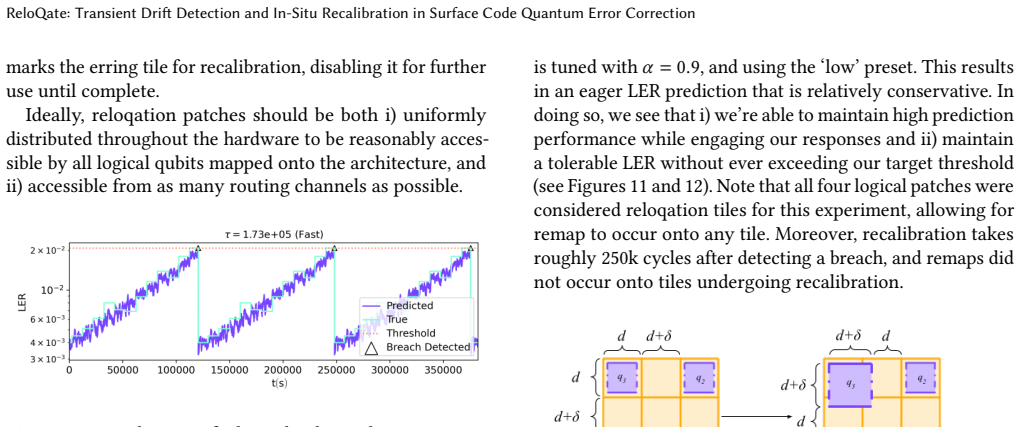
By sampling physical error rates from real hardware, a prediction model is inferred that maps detector fire rate, or parity of stabilizer measurements across QEC rounds, to logical error rates. This mapping allows on-the-fly LER predictions without the typical characterization overhead. The predictor is paired with a remapping scheme that moves drifted logical qubits to fresh tiles while original tiles are recalibrated. Results demonstrate DFR-based prediction to be an effective LER predictor and remapping as a spatially efficient and timely mitigation response for small code distances.
What carries the argument
Detector fire rate (DFR) from parity of stabilizer measurements across rounds, fitted to predict logical error rate (LER) from sampled physical errors and trigger remapping to fresh tiles.
If this is right
- Real-time LER estimates become available without pausing for full error characterization.
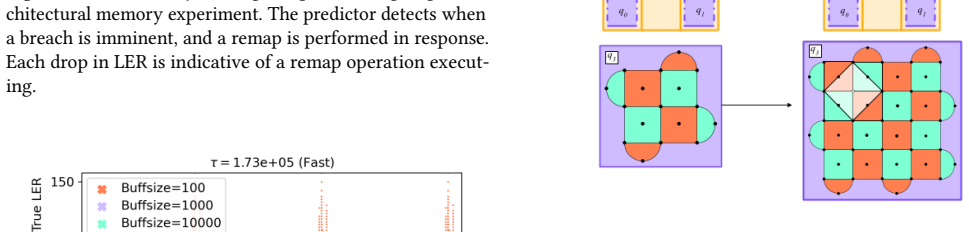
- Remapping uses space efficiently in patch-based architectures while drifted tiles are recalibrated.
- Conservative timing of predictions gives enough margin for responses to complete before error rates exceed tolerance.
- The same DFR-to-LER mapping extends to other stabilizer codes beyond surface codes.
- Drift mitigation becomes feasible at small code distances where full recalibration overhead is high.
Where Pith is reading between the lines
- Frequent full-system calibrations could be reduced by handling local drifts through targeted remapping.
- The approach may combine with other adaptive strategies for non-stationary noise in larger quantum processors.
- Controlled drift-injection experiments on current devices could test how well the fitted model generalizes beyond the sampled data.
- This addresses a practical barrier to scaling where hardware noise changes over time rather than staying fixed.
Load-bearing premise
That a prediction model fitted from sampled physical error rates will produce accurate yet conservative real-time LER estimates on live hardware without additional characterization overhead or post-hoc adjustments.
What would settle it
A direct comparison on hardware showing that DFR predictions deviate substantially from measured logical error rates during a controlled drift, or that remapping fails to keep logical errors below threshold for small distances.
Figures




read the original abstract
Quantum error correction (QEC) promises to exponentially suppress qubit noise, but typically assumes spatially-uniform and temporally-constant noise rates. However, real quantum hardware exhibits variation in noise levels over time, which will be amplified by QEC if not addressed. To mitigate this drift in error rates, we leverage transient information readily available in surface code quantum error correction to predict logical error rates (LER) in real time. We infer a prediction model by sampling physical error rates from real hardware, and mapping detector fire rate (DFR), or parity of stabilizer measurements across QEC rounds, to LER. This allows for on-the-fly LER predictions without the typical characterization overhead required to determine LER. This method can easily be extended to other stabilizer codes. Importantly, we observe that this prediction should be accurate yet conservative (i.e. give an upper estimate) to enable appropriately fast responses to real-time physical error changes. That is, responses should be executed marginally ahead of time to allow for their execution to complete, and minimize time spent (ideally none) above intolerable error rates. More importantly, we pair this predictor with a scheme which remaps drifted logical qubits to fresh tiles in a patch-based architecture while their original tiles are recalibrated. Our results demonstrate DFR-based prediction to be an effective LER predictor, and remapping as a spatially efficient and timely mitigation response for small code distances, both of which are significant steps in furthering practical QEC.
Editorial analysis
A structured set of objections, weighed in public.
Referee Report
Summary. The manuscript presents ReloQate, a method for transient drift detection and mitigation in surface code quantum error correction. It infers a DFR-to-LER prediction model by sampling physical error rates on hardware and uses this for real-time LER estimates without standard characterization overhead. The approach is paired with a remapping scheme that relocates logical qubits to fresh tiles in a patch-based architecture while recalibrating drifted tiles. The central claim is that DFR-based prediction is effective for LER and that remapping is spatially efficient and timely for small code distances.
Significance. If the mapping proves accurate and conservative under live transient drift, the work could meaningfully advance practical QEC by enabling in-situ responses to time-varying noise using only existing stabilizer data. The avoidance of extra characterization overhead and the focus on conservative upper-bound predictions to permit timely remapping are conceptually attractive strengths for hardware-constrained settings.
major comments (2)
- [Abstract] Abstract: the claim that 'our results demonstrate DFR-based prediction to be an effective LER predictor' is unsupported by any quantitative metrics, error bars, baseline comparisons, or validation details against transient drift. This is load-bearing for the central effectiveness assertion.
- [Abstract] Abstract: the DFR-to-LER mapping is obtained by sampling physical error rates, yet no evidence or analysis is provided on whether the fitted relationship remains accurate and conservative when noise becomes non-stationary or spatially correlated, which is required for the timely-remapping guarantee.
minor comments (1)
- [Abstract] Abstract: 'patch-based architecture' is referenced without a definition or citation to prior work on tile-based surface-code layouts.
Simulated Author's Rebuttal
We thank the referee for the constructive feedback on our manuscript. The comments highlight areas where the abstract can be strengthened to better reflect the quantitative results and validation details presented in the main text. We address each point below and will incorporate revisions to ensure the claims are appropriately supported.
read point-by-point responses
-
Referee: [Abstract] Abstract: the claim that 'our results demonstrate DFR-based prediction to be an effective LER predictor' is unsupported by any quantitative metrics, error bars, baseline comparisons, or validation details against transient drift. This is load-bearing for the central effectiveness assertion.
Authors: We agree that the abstract statement is broad and would benefit from explicit reference to supporting metrics. The main text (Sections 4 and 5) presents quantitative evaluations, including mean prediction error, error bars from multiple simulation runs, and comparisons against baseline LER estimation methods under transient drift conditions. To address this, we will revise the abstract to briefly note these metrics and the observed conservativeness of the predictions. revision: yes
-
Referee: [Abstract] Abstract: the DFR-to-LER mapping is obtained by sampling physical error rates, yet no evidence or analysis is provided on whether the fitted relationship remains accurate and conservative when noise becomes non-stationary or spatially correlated, which is required for the timely-remapping guarantee.
Authors: The manuscript evaluates the DFR-to-LER mapping under non-stationary noise models that incorporate transient drifts, showing that predictions remain conservative (upper bounds) in the tested scenarios to enable timely remapping. However, explicit analysis of spatially correlated noise is limited to the cases considered. We will revise the abstract to clarify the validation conditions and conservativeness results. We can expand the spatial correlation analysis in a revision if the referee recommends specific additional tests. revision: partial
Circularity Check
No significant circularity; DFR-LER mapping is a fitted predictor with independent validation claims
full rationale
The paper infers a DFR-to-LER mapping by sampling physical error rates on hardware and then applies the resulting model for real-time predictions under transient drift. This is a standard empirical fitting procedure whose outputs are not equivalent to the inputs by construction; the model is trained on sampled data and tested for generalization to new, time-varying conditions. No equations, self-citations, or uniqueness theorems are invoked in the abstract or description that would reduce the central claim to a tautology or prior self-result. The derivation chain remains self-contained against external benchmarks (hardware sampling and observed remapping performance), so the score is 0.
Axiom & Free-Parameter Ledger
free parameters (1)
- DFR-to-LER mapping parameters
axioms (1)
- domain assumption Surface code stabilizer measurements provide transient information sufficient to infer logical error rates
Reference graph
Works this paper leans on
-
[1]
A., Aghababaie-Beni, L., Aleiner, I., Ander- sen, T
Acharya, R., Abanin, D. A., Aghababaie-Beni, L., Aleiner, I., Ander- sen, T. I., Ansmann, M., Arute, F., Arya, K., Asfaw, A., Astrakhant- sev, N., Atalaya, J., Babbush, R., Bacon, D., Ballard, B., Bardin, J. C., Bausch, J., Bengtsson, A., Bilmes, A., Blackwell, S., Boixo, S., Bortoli, G., Bourassa, A., Bovaird, J., Brill, L., Broughton, M., Browne, D. A.,...
work page 2024
-
[2]
Carroll, M. S., Wootton, J. R., and Cross, A. W.Subsystem surface and compass code sensitivities to non-identical infidelity distributions on heavy-hex lattice, 2024
work page 2024
-
[3]
D., Kang, C., Viszlai, J., Lin, S
Chadwick, J. D., Kang, C., Viszlai, J., Lin, S. F., and Chong, F. T. Averting multi-qubit burst errors in surface code magic state factories. In2024 IEEE International Conference on Quantum Computing and Engineering (QCE)(Sept. 2024), IEEE, p. 1089–1101
work page 2024
-
[4]
Chamberland, C., Zhu, G., Yoder, T. J., Hertzberg, J. B., and Cross, A. W.Topological and subsystem codes on low-degree graphs with flag qubits.Physical Review X 10, 1 (Jan. 2020)
work page 2020
-
[5]
Choi, Y., Coppersmith, S. N., and Joynt, R.Using stochastic reso- nance of two-level systems to increase qubit decoherence times, 2024
work page 2024
-
[6]
Day, M. L., Low, P. J., White, B. M., Islam, R., and Senko, C.Limits on atomic qubit control from laser noise, 2021
work page 2021
-
[7]
Fang, X., Yin, K., Zhu, Y., Ruan, J., Tullsen, D., Liang, Z., Sorn- borger, A., Li, A., Humble, T., Ding, Y., and Shi, Y.Caliscalpel: In-situ and fine-grained qubit calibration integrated with surface code quantum error correction, 2024
work page 2024
-
[8]
Gidney, C.Stim: a fast stabilizer circuit simulator.Quantum 5(July 2021), 497
work page 2021
-
[9]
Gümüş, E., Majidi, D., Nikolić, D., Raif, P., Karimi, B., Peltonen, J. T., Scheer, E., Pekola, J. P., Courtois, H., Belzig, W., and Winkelmann, C. B.Calorimetry of a phase slip in a josephson junction.Nat. Phys. 19, 2 (Jan. 2023), 196–200
work page 2023
-
[10]
M., Li, M., Hays, M., Pontseele, W
Harrington, P. M., Li, M., Hays, M., Pontseele, W. V. D., Mayer, D., Pinckney, H. D., Contipelli, F., Gingras, M., Niedzielski, B. M., Stickler, H., Yoder, J. L., Schwartz, M. E., Grover, J. A., Serniak, K., Oliver, W. D., and Formaggio, J. A.Synchronous detection of cosmic rays and correlated errors in superconducting qubit arrays, 2024
work page 2024
-
[11]
R.Using detector likelihood for benchmarking quantum error correction, 2024
Hesner, I., Hetényi, B., and Wootton, J. R.Using detector likelihood for benchmarking quantum error correction, 2024
work page 2024
-
[12]
Hetényi, B., and Wootton, J. R.Creating entangled logical qubits in the heavy-hex lattice with topological codes.PRX Quantum 5(Dec 2024), 040334
work page 2024
-
[13]
Klimov, P. V., Kelly, J., Chen, Z., Neeley, M., Megrant, A., Burkett, B., Barends, R., Arya, K., Chiaro, B., Chen, Y., Dunsworth, A., Fowler, A., Foxen, B., Gidney, C., Giustina, M., Graff, R., Huang, T., Jeffrey, E., Lucero, E., Mutus, J. Y., Naaman, O., Neill, C., Quintana, C., Roushan, P., Sank, D., V ainsencher, A., Wenner, J., White, T. C., Boixo, S....
work page 2018
-
[14]
Li, X., Wang, J., Jiang, Y.-Y., Xue, G.-M., Cai, X., Zhou, J., Gong, M., Liu, Z.-F., Zheng, S.-Y., Ma, D.-K., Chen, M., Sun, W.-J., Yang, S., Yan, F., Jin, Y.-R., Zhao, S. P., Ding, X.-F., and Yu, H.-F.Cosmic- ray-induced correlated errors in superconducting qubit array.Nature Communications 16, 1 (May 2025)
work page 2025
-
[15]
Lin, S. F., Viszlai, J., Smith, K. N., Ravi, G. S., Yuan, C., Chong, F. T., and Brown, B. J.Codesign of quantum error-correcting codes and modular chiplets in the presence of defects. InProceedings of the 29th ACM International Conference on Architectural Support for Programming Languages and Operating Systems, Volume 2(Apr. 2024), ASPLOS ’24, ACM, p. 216–231
work page 2024
-
[16]
Litinski, D.A game of surface codes: Large-scale quantum computing with lattice surgery.Quantum 3(Mar. 2019), 128
work page 2019
-
[17]
McEwen, M., Faoro, L., Arya, K., Dunsworth, A., Huang, T., Kim, S., Burkett, B., Fowler, A., Arute, F., Bardin, J. C., Bengtsson, 14 ReloQate: Transient Drift Detection and In-Situ Recalibration in Surface Code Quantum Error Correction A., Bilmes, A., Buckley, B. B., Bushnell, N., Chen, Z., Collins, R., Demura, S., Derk, A. R., Erickson, C., Giustina, M.,...
work page 2021
-
[18]
C., Bengtsson, A., Bilmes, A., Buckley, B
McEwen, M., Faoro, L., Arya, K., Dunsworth, A., Huang, T., Kim, S., Burkett, B., Fowler, A., Arute, F., Bardin, J. C., Bengtsson, A., Bilmes, A., Buckley, B. B., Bushnell, N., Chen, Z., Collins, R., Demura, S., Derk, A. R., Erickson, C., Giustina, M., Harrington, S. D., Hong, S., Jeffrey, E., Kelly, J., Klimov, P. V., Kostritsa, F., Laptev, P., Locharla, ...
work page 2021
-
[19]
M., Seiler, A., Lisenfeld, J., Ustinov, A
Meissner, S. M., Seiler, A., Lisenfeld, J., Ustinov, A. V., and Weiss, G.Probing individual tunneling fluctuators with coherently controlled tunneling systems.Physical Review B 97, 18 (2018)
work page 2018
-
[20]
Müller, C., Cole, J. H., and Lisenfeld, J.Towards understanding two- level-systems in amorphous solids: insights from quantum circuits. Reports on Progress in Physics 82, 12 (Oct. 2019), 124501
work page 2019
-
[21]
Poster, M., Sethi, S., and Baker, J. M.Cqm: Cyclic qubit mappings. In2024 IEEE International Conference on Quantum Computing and Engineering (QCE)(2024), vol. 01, pp. 1058–1064
work page 2024
-
[22]
Proctor, T., Revelle, M., Nielsen, E., Rudinger, K., Lobser, D., Maunz, P., Blume-Kohout, R., and Young, K.Detecting and tracking drift in quantum information processors.Nature Communications 11, 1 (Oct. 2020)
work page 2020
-
[23]
Remm, A., Lacroix, N., Bödeker, L., Genois, E., Hellings, C., Swiadek, F., Norris, G. J., Eichler, C., Blais, A., Müller, M., Krin- ner, S., and Wallraff, A.Experimentally informed decoding of stabilizer codes based on syndrome correlations, 2025
work page 2025
-
[24]
Schlör, S., Lisenfeld, J., Müller, C., Bilmes, A., Schneider, A., Pap- pas, D. P., Ustinov, A. V., and Weides, M.Correlating decoherence in transmon qubits: Low frequency noise by single fluctuators.Physical Review Letters 123, 19
-
[25]
Siegel, A., Strikis, A., Flatters, T., and Benjamin, S.Adaptive sur- face code for quantum error correction in the presence of temporary or permanent defects.Quantum 7(July 2023), 1065
work page 2023
-
[26]
In2022 55th IEEE/ACM International Symposium on Microarchitecture (MICRO)(2022), pp
Suzuki, Y., Sugiyama, T., Arai, T., Liao, W., Inoue, K., and Tanimoto, T.Q3de: A fault-tolerant quantum computer architecture for multi-bit burst errors by cosmic rays. In2022 55th IEEE/ACM International Symposium on Microarchitecture (MICRO)(2022), pp. 1110–1125
work page 2022
-
[27]
R.Estimating decoding graphs and hyper- graphs of memory qec experiments, 2025
Takou, E., and Brown, K. R.Estimating decoding graphs and hyper- graphs of memory qec experiments, 2025
work page 2025
-
[28]
Thorbeck, T., Eddins, A., Lauer, I., McClure, D. T., and Carroll, M.Two-level-system dynamics in a superconducting qubit due to background ionizing radiation.PRX Quantum 4, 2 (June 2023)
work page 2023
-
[29]
W ang, H., Liu, P., Liu, Y., Gu, J., Baker, J., Chong, F. T., and Han, S. Dgr: Tackling drifted and correlated noise in quantum error correction via decoding graph re-weighting, 2024
work page 2024
-
[30]
Wilen, C. D., Abdullah, S., Kurinsky, N. A., Stanford, C., Car- dani, L., D’Imperio, G., Tomei, C., Faoro, L., Ioffe, L. B., Liu, C. H., Opremcak, A., Christensen, B. G., DuBois, J. L., and McDermott, R.Correlated charge noise and relaxation errors in superconducting qubits.Nature 594, 7863 (June 2021), 369–373
work page 2021
-
[31]
Xiao, X., Hangleiter, D., Bluvstein, D., Lukin, M. D., and Gullans, M. J.In-situ benchmarking of fault-tolerant quantum circuits. i. clifford circuits, 2026
work page 2026
-
[32]
Yin, K., Fang, X., Shi, Y., Humble, T., Li, A., and Ding, Y.Surf- deformer: Mitigating dynamic defects on surface code via adaptive deformation, 2024
work page 2024
-
[33]
G., un Lee, S., Zhou, S., and Jiang, L.Efficient learning of logical noise from syndrome data, 2026
Zheng, H., Chu, C.-T., Chen, S., Manes, A. G., un Lee, S., Zhou, S., and Jiang, L.Efficient learning of logical noise from syndrome data, 2026
work page 2026
-
[34]
Zhou, J., Li, S., Pan, G.-Z., Zhang, G., Chen, T., and Xue, Z.-Y.Nonadi- abatic geometric quantum gates that are insensitive to qubit-frequency drifts.Physical Review A 103, 3 (Mar. 2021). 15
work page 2021
discussion (0)
Sign in with ORCID, Apple, or X to comment. Anyone can read and Pith papers without signing in.