REVIEW 2 major objections 4 minor 1 cited by
Weighted clipped Q-learning target yields the lowest overestimation bias among five hybrid RL variants.
Reviewed by Pith at T0; open to challenge. T0 means a machine referee read the full paper against a public rubric. the ladder, T0–T4 →
T0 review · deepseek-v4-flash
2026-08-02 19:39 UTC pith:PLYFZSCD
load-bearing objection Modest but useful hybrid-action TD3 variant; the cross-platform training result is solid, but the 'complete bias ordering' is over-claimed — the paper's own data contradict it for two of five variants. the 2 major comments →
Hybrid TD3: Overestimation Bias Analysis and Stable Policy Optimization for Hybrid Action Space
The pith
A machine-rendered reading of the paper's core claim, the machinery that carries it, and where it could break.
Core claim
The paper's central claim is Theorem 2.1: under Assumption 1 (Gaussian, synchronized, independent critic errors), the expected estimation bias of the Bellman target satisfies δQ_Hybrid TD3 < δQ_HyACC ≈ δQ_HyTQC < δQ_HyDARC < δQ_HyDATD3. This ordering is achieved by the weighted clipped Q-learning target, which replaces the greedy discrete action in the target with a sum over discrete modes weighted by the target policy's probabilities. The paper argues this soft marginalization preserves the bias-reduction property of standard clipped double Q-learning while smoothing the policy-gradient signal, particularly when the discrete policy is diffuse early in training. Empirically, the paper report
What carries the argument
The central object is the weighted clipped Q-learning target (Eq. 4), which computes y = r + γ Σ_k π_d(a_d^(k)|s') min_{i=1,2} Q_{φ_i'}(s', a_c', a_d^(k)). It replaces the hard arg-max over discrete actions in the standard TD3 target with a distribution-weighted average of the clipped minimum over the two target critics. The analysis machinery includes a Gaussian min-max lemma that gives E[min(X,Y)] ≈ μ - σ/√π for independent Gaussian errors, a nested min-max approximation for the HyDARC and HyDATD3 variants, and the Blom approximation for order statistics used in the HyTQC and HyACC bias calculations. This target does the work of bounding the bias while avoiding the high variance of a greed
Load-bearing premise
The whole bias ordering rests on the assumption that the two critics' estimation errors are Gaussian, synchronous, and independent across critics, and that the min/max of their sums is well approximated by a Gaussian; if real critic errors are correlated or non-Gaussian, the ordering could fail.
What would settle it
Compute the empirical estimation bias of the five variants in an environment where the two critics are intentionally correlated—e.g., by sharing the same replay buffer and initialization seeds—and check whether the ordering δQ_Hybrid TD3 < δQ_HyACC ≈ δQ_HyTQC < δQ_HyDARC < δQ_HyDATD3 still holds. Alternatively, train HyACC and HyTQC with a deterministic actor to remove the SAC-induced stochasticity and see if their observed bias ordering then matches the theorem's prediction.
If this is right
- If the bias ordering is correct, algorithm selection for hybrid-action RL can be guided by the theorem: clipped double-Q methods should be preferred when critic errors are roughly Gaussian and independent.
- The weighted target implies that early training, when the discrete policy is diffuse, has smoother gradient signals, accelerating convergence in high-dimensional discrete-continuous spaces.
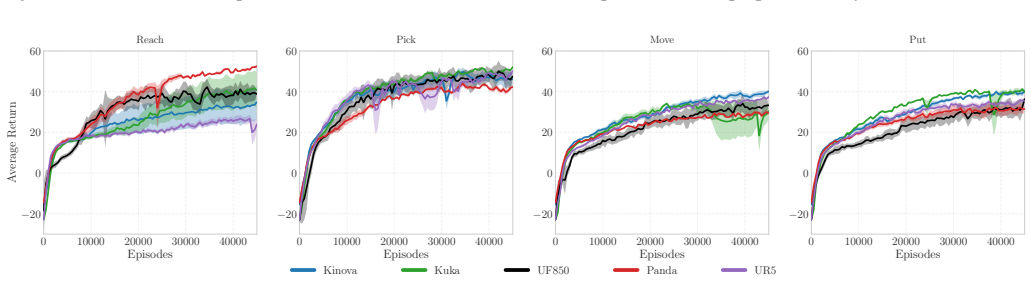
- The reported zero-shot transfer to unseen object categories and five robot platforms suggests Hybrid TD3 could serve as a general-purpose manipulation controller without platform-specific tuning.
- The deterministic actor structure is predicted to be more robust than stochastic actor structures under domain randomization, because actor stochasticity is an independent source of overestimation bias.
- The bias ordering formalizes why clipped double Q-learning, despite producing underestimation, is more stable than distributional truncation methods (HyTQC/HyACC) under heavy randomization.
Where Pith is reading between the lines
- Stepping beyond the paper, the ordering in Theorem 2.1 likely breaks down when critics are strongly correlated, since Assumption 1 treats them as independent; a testable extension is to measure bias with shared-replay critics and see if clipped double-Q still dominates.
- The paper's own empirical observation that HyACC and HyTQC show positive bias (contradicting the ordering) suggests that actor approximation error, which the theorem does not bound, is a first-order effect; an inference is that any practical bias analysis must fold actor stochasticity into the error model.
- The weighted-marginalization trick could be applied to other clipped estimators, such as distributional quantile critics, to smooth their targets without sacrificing bias control.
- If the stability results transfer to physical hardware—a step the paper does not take—Hybrid TD3 could become a default baseline for contact-rich manipulation under randomized conditions.
Editorial analysis
A structured set of objections, weighed in public.
Referee Report
Summary. The paper proposes Hybrid TD3, an extension of TD3 to discrete-continuous hybrid action spaces, with a weighted clipped Q-learning target that marginalizes the Bellman backup over the discrete action distribution. The authors claim a complete theoretical ordering of expected estimation bias across five hybrid variants (Hybrid TD3, HyACC, HyTQC, HyDARC, HyDATD3) under synchronized Gaussian error assumptions, and they report experiments on four manipulation tasks and five robot platforms showing superior training stability and competitive performance. The central contribution is framed as both a bias-ordering result that guides algorithm selection and a practical stable default for hybrid-action manipulation under full domain randomization.
Significance. If the bias ordering and stability claims were fully supported, Hybrid TD3 would be a useful default for hybrid-action robotic manipulation, and the ordering would provide practical guidance for choosing among bias-mitigation variants. The paper also contributes a systematic comparison of hybrid RL baselines, a large-scale empirical study across five robot platforms, and a transparent statement of the assumptions underlying the theoretical analysis. However, the theoretical ordering is not validated by the paper's own empirical results: the observed bias of HyACC and HyTQC reverses the predicted ordering, and the proof depends on approximations and an unstated independence assumption. The empirical stability results across platforms are useful but are not sufficient to establish the theoretical claims as stated.
major comments (2)
- [Appendix C, HyDATD3/HyDARC analysis] The derivation of δQ_HyDATD3 and δQ_HyDARC uses Var(η_j)=σ²(1−1/π)Σ p_k², where η_j = Σ_k p_d(k) min(ϵ_{j,k}^{φ1}, ϵ_{j,k}^{φ2}). This formula requires that the critic errors ϵ_{j,k} for different discrete actions k are independent, but this independence is not stated in Assumption 1, which only assumes independence across critics. This unstated assumption is load-bearing because it determines the magnitude of τ used to separate HyDATD3 and HyDARC from Hybrid TD3. The proof should either state this as an explicit assumption and justify it, or derive the result without it. Currently, the proof is incomplete as written.
- [Appendix C, Lemma 2] The proof of the HyDATD3 and HyDARC bias terms relies on Lemma 2, which 'approximates' the minimum of two nested min statistics as Gaussian and applies Lemma 1 to the pair (W1,W2). This is an approximation, not a formal bound or equality. The paper presents Theorem 2.1 as a 'rigorous' and 'formal' ordering, but the ordering's placement of HyDATD3 and HyDARC depends on an approximate Gaussian closure. The manuscript should either provide a rigorous analysis of the nested min/max distribution or explicitly state that the ordering for HyDATD3 and HyDARC is heuristic. As written, the proof does not meet the standard of a formal theorem.
minor comments (4)
- [Appendix C, Eq. (21)] The phrase 'The expected 10 target' appears to be a typo; it should read 'The expected target' or similar.
- [Section III-B, 'Baseline Bias' paragraph] The phrase 'in action 1 column has indicated that these two methods have large overestimation bias below HyACC and HyTQC' is unclear and grammatically broken. Please rephrase to describe what the column actually shows.
- [Section I, Contributions] The paper claims a 'rigorous theoretical bias ordering' but the proof relies on Assumption 1 and Lemma 2 approximations. Consider softening 'rigorous' to 'theoretical' or 'analytical' in the contribution statement to align with the actual proof style.
- [Section IV, Conclusion] The conclusion states 'Experiments on four manipulation tasks confirmed theoretical bias ordering,' but as noted in the major comments, Fig. 4 does not confirm the ordering for HyACC and HyTQC. This sentence should be revised to avoid overclaiming.
Circularity Check
No significant circularity: Theorem 2.1 is derived from explicit assumptions, and the empirical mismatch is a validity issue, not a circular one.
full rationale
The paper's core derivation, Theorem 2.1 / Eq. (6), is obtained in Appendix C from an explicit Assumption 1 (synchronized Gaussian critic errors, independence) via standard Gaussian min/max and order-statistic calculations. The Hybrid TD3 bias is computed as E[Σ_k p_d(k) min(ϵ_ϕ1, ϵ_ϕ2)] = μ − σ/√π, not fitted to any empirical curve; the other four bias expressions are likewise derived from the same stated error model plus the target definitions in Appendix B. There are no fitted parameters later renamed as predictions, no uniqueness theorem imported from the authors, and no ansatz whose validity is presupposed only by self-citation. The only self-citation is [19] for the reward/penalty design, which is descriptive and not load-bearing for the theorem. The empirical section's admission that HyACC/HyTQC show positive bias ('the SAC-induced positive bias effectively shifts HyACC and HyTQC into the overestimation regime') and that the theorem 'characterizes the bias of the Bellman target in isolation' is a scope/validity problem with the claimed empirical validation, not a circular reduction: the predicted ordering was not manufactured from the data. Therefore no circular step is established.
Axiom & Free-Parameter Ledger
free parameters (2)
- Reward weights W_i (i=0..2) and W_j (j=0..5) =
not disclosed
- Domain randomization ranges (object pose, mass, friction) =
not disclosed
axioms (5)
- domain assumption Assumption 1: Critic estimation errors are Gaussian with synchronized statistics (mean μ, variance σ²) and independent across the two critics.
- ad hoc to paper Independence of critic errors across different discrete actions k (implicit).
- ad hoc to paper Lemma 2: The minimum of two Gaussians is approximately Gaussian for the nested min/max computation.
- standard math Blom approximation for expected order statistics of normal samples.
- domain assumption Contextual MDP: domain randomization context ω sampled iid per episode from P(Ω) and held fixed.
read the original abstract
Reinforcement learning in discrete-continuous hybrid action spaces presents fundamental challenges for robotic manipulation, where high-level task decisions and low-level joint-space execution must be jointly optimized. Existing approaches either discretize continuous components or relax discrete choices into continuous approximations, which suffer from scalability limitations and training instability in high-dimensional action spaces and under domain randomization. In this paper, we propose Hybrid TD3, an extension of Twin Delayed Deep Deterministic Policy Gradient (TD3) that natively handles parameterized hybrid action spaces in a principled manner. We conduct a rigorous theoretical analysis of overestimation bias in hybrid action settings, deriving formal bounds under twin-critic architectures and establishing a complete bias ordering across five algorithmic variants under synchronized Gaussian error assumptions. Building on this analysis, we introduce a weighted clipped Q-learning target that marginalizes over the discrete action distribution, achieving equivalent bias reduction to standard clipped minimization while improving policy smoothness. Experimental results demonstrate that Hybrid TD3 achieves superior training stability and competitive performance against state-of-the-art hybrid action baselines.
Figures







Forward citations
Cited by 1 Pith paper
-
Mitigating Bias in Low-SNR Financial Reinforcement Learning via Quantum Representations
FPQC-SAC adds a bounded parameterized quantum circuit to SAC to constrain representations in low-SNR financial environments, reporting 66.89% higher cumulative returns than standard SAC on real portfolio tasks.
Reference graph
Works this paper leans on
-
[1]
Joint space control via deep reinforcement learning,
V . Kumar, D. Hoeller, B. Sundaralingam, J. Tremblay, and S. Birchfield, “Joint space control via deep reinforcement learning,” in2021 IEEE/RSJ International Conference on Intelligent Robots and Systems (IROS). IEEE, 2021, pp. 3619–3626
2021
-
[2]
Half field offense: An environment for multiagent learning and ad hoc teamwork,
M. Hausknecht, P. Mupparaju, S. Subramanian, S. Kalyanakrishnan, and P. Stone, “Half field offense: An environment for multiagent learning and ad hoc teamwork,” inAAMAS Adaptive Learning Agents (ALA) Workshop, vol. 3. sn, 2016
2016
-
[3]
Deep reinforcement learning in parame- terized action space,
M. Hausknecht and P. Stone, “Deep reinforcement learning in parame- terized action space,”arXiv preprint arXiv:1511.04143, 2015
Pith/arXiv arXiv 2015
-
[4]
Neural ordinary differential equation value networks for parametrized action spaces,
S. Massaroli, M. Poli, S. Bakhtiyarov, A. Yamashita, H. Asama, and J. Park, “Neural ordinary differential equation value networks for parametrized action spaces,” inICLR 2020 Workshop on Integration of Deep Neural Models and Differential Equations, 2020
2020
-
[5]
J. Xiong, Q. Wang, Z. Yang, P. Sun, L. Han, Y . Zheng, H. Fu, T. Zhang, J. Liu, and H. Liu, “Parametrized deep q-networks learning: Reinforcement learning with discrete-continuous hybrid action space,” arXiv preprint arXiv:1810.06394, 2018
Pith/arXiv arXiv 2018
-
[6]
Discretionary lane-change decision and control via parameterized soft actor–critic for hybrid action space,
Y . Lin, X. Liu, and Z. Zheng, “Discretionary lane-change decision and control via parameterized soft actor–critic for hybrid action space,” Machines, vol. 12, no. 4, p. 213, 2024
2024
-
[7]
Discrete and continu- ous action representation for practical rl in video games,
O. Delalleau, M. Peter, E. Alonso, and A. Logut, “Discrete and continu- ous action representation for practical rl in video games,”arXiv preprint arXiv:1912.11077, 2019
Pith/arXiv arXiv 1912
-
[8]
Action decoupled sac reinforcement learning with discrete-continuous hybrid action spaces,
Y . Xu, Y . Wei, K. Jiang, L. Chen, D. Wang, and H. Deng, “Action decoupled sac reinforcement learning with discrete-continuous hybrid action spaces,”Neurocomputing, vol. 537, pp. 141–151, 2023
2023
-
[9]
Double q-learning,
H. Hasselt, “Double q-learning,”Advances in neural information pro- cessing systems, vol. 23, 2010
2010
-
[10]
Exploiting estimation bias in clipped double q-learning for continous control reinforcement learning tasks,
N. Turcato, A. Sinigaglia, A. Dalla Libera, R. Carli, and G. A. Susto, “Exploiting estimation bias in clipped double q-learning for continous control reinforcement learning tasks,”IFAC-PapersOnLine, vol. 59, no. 26, pp. 1–6, 2025
2025
-
[11]
Addressing function approxi- mation error in actor-critic methods,
S. Fujimoto, H. Hoof, and D. Meger, “Addressing function approxi- mation error in actor-critic methods,” inInternational conference on machine learning. PMLR, 2018, pp. 1587–1596
2018
-
[12]
Soft actor-critic: Off- policy maximum entropy deep reinforcement learning with a stochastic actor,
T. Haarnoja, A. Zhou, P. Abbeel, and S. Levine, “Soft actor-critic: Off- policy maximum entropy deep reinforcement learning with a stochastic actor,” inInternational conference on machine learning. Pmlr, 2018, pp. 1861–1870
2018
-
[13]
Continuous control with deep reinforcement learning,
T. P. Lillicrap, J. J. Hunt, A. Pritzel, N. Heess, T. Erez, Y . Tassa, D. Silver, and D. Wierstra, “Continuous control with deep reinforcement learning,”arXiv preprint arXiv:1509.02971, 2015
Pith/arXiv arXiv 2015
-
[14]
Prox- imal policy optimization algorithms,
J. Schulman, F. Wolski, P. Dhariwal, A. Radford, and O. Klimov, “Prox- imal policy optimization algorithms,”arXiv preprint arXiv:1707.06347, 2017
Pith/arXiv arXiv 2017
-
[15]
Q-learning,
C. J. Watkins and P. Dayan, “Q-learning,”Machine learning, vol. 8, no. 3, pp. 279–292, 1992
1992
-
[16]
Adaptively cal- ibrated critic estimates for deep reinforcement learning,
N. Dorka, T. Welschehold, J. B ¨odecker, and W. Burgard, “Adaptively cal- ibrated critic estimates for deep reinforcement learning,”IEEE Robotics and Automation Letters, vol. 8, no. 2, pp. 624–631, 2022
2022
-
[17]
Controlling overestimation bias with truncated mixture of continuous distributional quantile critics,
A. Kuznetsov, P. Shvechikov, A. Grishin, and D. Vetrov, “Controlling overestimation bias with truncated mixture of continuous distributional quantile critics,” inInternational conference on machine learning. PMLR, 2020, pp. 5556–5566
2020
-
[18]
Efficient continuous control with double actors and regularized critics,
J. Lyu, X. Ma, J. Yan, and X. Li, “Efficient continuous control with double actors and regularized critics,” inProceedings of the AAAI Conference on Artificial Intelligence, vol. 36, no. 7, 2022, pp. 7655– 7663
2022
-
[19]
Human-to-robot interaction: Learning from video demonstration for robot imitation,
T. N. Canh, T.-T. Tran, H. Zhang, Z. Gao, N. Y . Chong, and X. Hoang- Van, “Human-to-robot interaction: Learning from video demonstration for robot imitation,”arXiv preprint arXiv:2602.19184, 2026
arXiv 2026
-
[20]
Pybullet, a python module for physics simulation for games, robotics and machine learning,
E. Coumans and Y . Bai, “Pybullet, a python module for physics simulation for games, robotics and machine learning,” 2016
2016
-
[21]
J. Xu and Y . Lin, “Mixed-integer optimal control via reinforcement learning: A case study on hybrid vehicle energy management,”arXiv: 2305.01461, 2023
Pith/arXiv arXiv 2023
-
[22]
Learning insertion primitives with discrete-continuous hybrid action space for robotic assembly tasks,
X. Zhang, S. Jin, C. Wang, X. Zhu, and M. Tomizuka, “Learning insertion primitives with discrete-continuous hybrid action space for robotic assembly tasks,” in2022 International conference on robotics and automation (ICRA). IEEE, 2022, pp. 9881–9887
2022
discussion (0)
Sign in with ORCID, Apple, or X to comment. Anyone can read and Pith papers without signing in.