REVIEW 4 major objections 4 minor 66 references
Decentralized Federated Learning by Partial Message Exchange
T0 review · 4 major / 4 minor · reviewed 2026-08-02 · deepseek-v4-flash
Pith's one-line read A decentralized learning algorithm that sends only random coordinate slices can converge linearly under just local smoothness and a doubly stochastic mixing matrix.
desk verdict The PME mechanism and the milder-assumption proof attempt are genuinely interesting, but the headline linear-rate guarantee is to an unproven limit point, not to a solution, and the enabling condition (12) is never verified for any admissible setting. read the letter →
The pith
A machine-rendered reading of the paper's core claim, the machinery that carries it, and where it could break.
The reading
What carries the argument
The mechanism carrying the argument is the partial message exchange (PME) averaging rule. Each neighbor sends s randomly chosen coordinates of its current parameter; the receiver aggregates coordinate ℓ by dividing by the number of received nonzero copies of ℓ, and substitutes its own coordinate when λ_{i,ℓ}=0. Theorem 1 shows this conditional averaging is an unbiased estimate of the true neighbor average, unlike naive sparse averaging, which shrinks toward zero by factor s/n. Lemma 5 bounds the resulting perturbation by C1‖W^k−Π^k‖²_F with C1 < (γ^{-k0/2}−ζ)^2, which feeds a consensus-error recursion decaying like β^{-k} with β>γ; combined with the monotone descent of the augmented objectiv
What would settle it
Find any connected graph and real parameters (p, ν, γ, k0) satisfying (12) with all t_i≥1, or verify (12) on the paper's own experiments by reporting ζ and degrees; if no such configuration exists, Theorem 4's parameter setup is empty. Alternatively, on a small quadratic problem, check whether the limit ϖ∞ has ∇f(ϖ∞)=0 when the algorithm is run with the claimed settings.
Extended reading notes
Core claim
The central claim is that PaME generates sequences W^k, V^k and averages ϖ^k for which E‖W^k−W∞‖²_F=O(γ^{-k}), E‖V^k−W∞‖²_F=O(γ^{-k}), and E|f(ϖ^k)−f(ϖ∞)|=O(γ^{-k/2}), under Assumptions 1 and 2. Assumption 1 requires only that the initial communication matrix B be doubly stochastic with spectral gap ζ<1; later rounds may use dynamic, sparse, even non-doubly-stochastic matrices. Assumption 2 requires only that each local gradient be Lipschitz on the bounded box N(2δ), not globally. The authors attribute the relaxation to a deterministic boundedness result for the iterates, obtained by growing the penalty parameter geometrically (σ_k=σ0 γ^k), so stochastic-gradient noise never needs independen
Load-bearing premise
The proof's load-bearing premise is that every node can fix t_i=⌊ν_i|N_i|⌋≥1 while satisfying inequality (12), (1−p)^{t_i}(1+ζ)^2+2pΣ_{j∈N_i}ν_j < (γ^{-k0/2}−ζ)^2; the paper sketches a limiting parameter choice that seems not to meet this premise, and no explicit feasible instance is provided.
Editorial extensions
If this is right
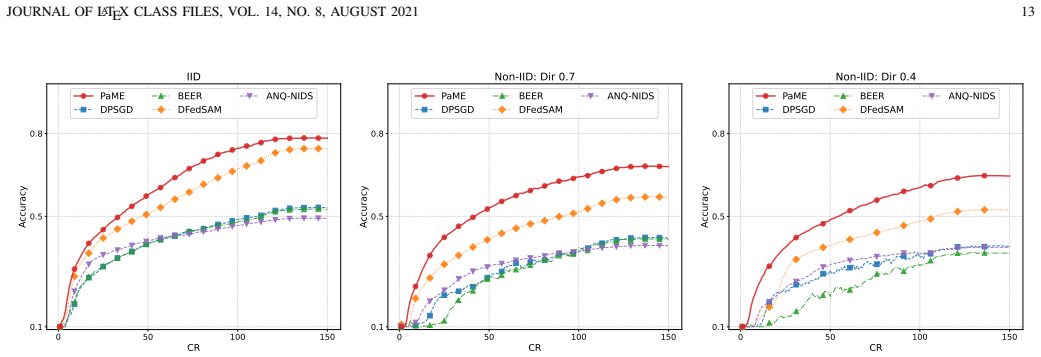
- Per-round transmission drops from 64n to 63s+n bits; at s/n=0.1–0.2 the paper reports accuracy comparable to full communication and, on its benchmarks, the fewest communication rounds among compared algorithms.
- Because no convexity, PL-condition, bounded-gradient, or bounded-variance assumptions are used, the convergence theorem applies to heterogeneous local objectives and to stochastic gradients without extra moment control.
- Only the initial mixing matrix needs doubly stochasticity, so the algorithm tolerates time-varying, sparse, or asynchronous communication graphs—a regime many existing analyses forbid.
- If the claimed rates hold, the objective gap decays geometrically, so for any target accuracy the required communication budget can be estimated from γ and the initial gap.
Reading between the lines
- The theorems stop at f(ϖ^k)→f(ϖ∞); they do not show ∇f(ϖ∞)=0. If a stronger claim of linear convergence to an optimizer is intended, a stationarity argument would need to be added; otherwise the linear rate is about reaching some consensus point, not about solving the original problem.
- The existence of parameters satisfying condition (12) with t_i=⌊ν_i|N_i|⌋≥1 is asserted via 'p close to 1 and ν_i close to 0', but that direction likely fails: ν→0 kills t_i, and p→1 makes the left side at least 2 while the right side is at most (1−ζ)²<1. No concrete graph and parameter set satisfying (12) is exhibited, and the experimental settings do not report the ζ and degrees needed to verify
- A natural testbed extension: run the same update on a small strongly convex problem, record the limit ϖ∞, and check whether ∇f(ϖ∞)=0; this would tell readers how much of the advertised linear convergence is convergence to a solution rather than merely to a limit.
- The privacy claim is qualitative (random sparsification complicates inference). A concrete measure—e.g., gradient-inversion success rate versus s/n—would let practitioners set transmission rates by a privacy budget.
Editorial analysis
A structured set of objections, weighed in public.
Referee Report
Summary. The paper proposes PaME, a decentralized federated learning algorithm in which each node averages only randomly selected coordinates received from a random subset of neighbors, using an inexact-ADMM-type local update with a geometrically increasing penalty parameter. The main theoretical claim is that, under only local Lipschitz continuity of the gradients on a bounded region and a doubly stochastic communication matrix with spectral gap, the iterates and objective values converge linearly to a limit (Theorems 2–4). The paper also reports extensive experiments on linear regression, logistic regression, Fashion-MNIST, and CIFAR-10, claiming favorable communication efficiency and accuracy relative to several decentralized baselines.
Significance. If the theoretical claim were valid, the result would be significant: linear convergence under local rather than global smoothness, with no bounded-gradient, bounded-variance, or unbiased-compression assumptions, would be a notable advance over existing DFL analyses. The paper contains a clean derivation of the sparse-exchange estimator (Theorem 1), substantial supplemental proofs, and broad numerical comparisons. However, the central guarantee is not established: the enabling condition (Setup 1(4), Eq. (12)) is never instantiated and the supplied existence argument is invalid, and the proved linear rates target a limit whose stationarity or optimality is not shown. As it stands, the paper does not substantiate the advertised convergence of PaME to a solution of problem (1).
major comments (4)
- [Setup 1(4), Eq. (12)] The contraction condition (12) is never verified and the stated existence argument fails. For any γ∈(1,ζ^{-2/k0}) the RHS satisfies (γ^{-k0/2}-ζ)^2 < (1-ζ)^2 <1. The text after (11) proposes 'p close to 1 and ν_i close to 0'. But ν_i close to 0 makes t_i=⌊ν_i|N_i|⌋=0, so Algorithm 1 (line 13) divides by zero; for a connected graph, t_i≥1 requires ν_i≥1/|N_i|, so ν_i cannot be arbitrarily small. For p→1 the LHS of (12) tends to 2Σ_{j∈N_i}ν_j, which on a regular graph is at least 2 because each ν_j≥1/|N_i|. No admissible instance is exhibited, and the experimental settings (Table II, ν=0.2, p=0.2) are not checked against (12). Lemma 4, Lemma 6, and Theorems 2–4 all rely on this condition, so the theory is conditional on an uninstantiated and apparently infeasible setup.
- [Theorem 4 / Lemma 8] The advertised 'linear convergence' is convergence to a limit, not to an optimum. Theorem 4 bounds E∥W^k−W∞∥²_F and E|f(ϖ^k)−f(ϖ∞)|, but no result proves ∇f(ϖ∞)=0 or f(ϖ∞)=min f; Lemma 8 only gives L2 convergence to the iterate limit. Since σ^k=σ_0γ^k, the effective step size 1/(σ^k t_i) is summable, so the recursion can freeze away from stationarity. For identical quadratics f_i(w)=L/2∥w−c∥² with B=J and full-batch gradients, w^{k+1}-c=(1-L/(σ_0γ^k t))(w^k-c); the infinite product is positive, so w^k→w∞≠c with ∇f(w∞)≠0 while Theorem 4's rates hold. Thus the paper does not establish linear convergence to a solution of (1), only to a limit whose optimality is unresolved.
- [Assumption 1, Eq. (7)] The definition B_ji=1/m_i for j∈N_i makes B column-stochastic by construction; row-stochasticity (and hence double stochasticity) holds only for regular graphs, or with a transposed definition. Assumption 1 asserts B is doubly stochastic, and the subsequent proofs use both B1=1 and 1^T B=1^T (Supplement Eq. (8)). As written, the analysis either silently restricts to regular graphs or needs a different B. This contradicts the paper's claim of an arbitrary connected communication topology and weakens the 'mildest assumptions' statement.
- [Setup 1(1) vs. §V-B] The theory assumes κ_i=k_0 for all nodes, so all nodes communicate at the same global times k∈K_0. The experiments choose κ_i randomly from e.g. [3,7] per node (Table II). The statement that taking k_0 as an LCM makes the analysis 'similar' does not cover the asynchronous case: at a time that is a multiple of one node's period but not another's, only a subset of nodes communicates, which is not the synchronized k∈K_0 versus k∉K_0 dichotomy used in Lemma 6. Hence the experimental validation of asynchronous/heterogeneous periods is not supported by the theorems.
minor comments (4)
- [Algorithm 2] Line 3 of Algorithm 2 has a typo: both branches read 'ℓ∈T_j^k'; the second branch should be 'ℓ∉T_j^k'.
- [Theorem 1] In the supplemental statement of Theorem 1, 'uniformly selecting s coordinates of w_i without replacement from [q]' should be 'from [n]'.
- [Setup 1(2)] The setup should explicitly require t_i≥1 (i.e., ν_i|N_i|≥1). As written, ν_i∈(0,1] and |N_i|=1 give t_i=0 unless ν_i=1, causing division by zero in Algorithm 1.
- [Figures/Tables] The caption and surrounding text for Fig. 7 appear garbled in the reviewed version. Also, Table II is used both for the assumption comparison and for experimental parameter choices, which is confusing.
Circularity Check
No significant circularity; the convergence proof is self-contained and no fitted quantity is fed back as a prediction.
full rationale
I walked the derivation chain from Setup 1 through Lemmas 1–8 and Theorems 2–4 in the main text and supplement. The convergence proof is a genuine derivation: Theorem 2 establishes a Lyapunov descent inequality for H^k, Lemma 6 proves consensus-error contraction under the doubly-stochastic mixing and the explicit parameter condition (12), and Lemma 8 converts the resulting geometric increment bound E∥Δw^k∥² ≤ c²/γ^k into L2 convergence and the stated O(γ^{-k}) / O(γ^{-k/2}) rates. No fitted parameter is renamed as a prediction; the constants (σ, C, D, η, C2, β) are all constructed from problem data, not calibrated to observed outputs. The self-citations [17,24,43] are used for background, algorithm lineage, and examples; none of the theorems relies on them as an external proof or uniqueness claim. The advertised convergence is explicitly to a limit point ϖ∞ rather than to a stationary point, and the feasibility of condition (12) is asserted with an invalid 'p→1, ν→0' argument; these are substantive correctness/interpretation concerns, but they are not circularity because the theorem is conditional on (12) and the limit is defined rather than assumed equal to the optimum. The derivation does not reduce, by definition or by self-citation, to its own inputs.
Assumptions & free parameters
free parameters (7)
- σ_0 (initial penalty parameter) =
σ_0 ≥ max{4α_max, ε(2δ)γ/((γ−1)δ t_min)}; experiments use 1.0 or 5.0
- γ (penalty growth rate) =
1.005 (Ex. 1–2), 1.001 (Ex. 3–4); theory requires γ ∈ (1, ζ^{−2/k0})
- p = s/n (coordinate transmission rate) =
0.2 (Ex. 1–2), 0.1 (Ex. 3–4)
- ν_i (neighbor participation rate) =
0.2 or 0.5 in experiments
- δ (radius of local-Lipschitz region) =
not specified
- k_0 (communication period) =
[3,7] or [5,10] in experiments
- ζ (spectral gap bound) =
not reported for experimental graphs
assumptions (6)
- domain assumption Assumption 1: the m×m communication matrix B (B_ji = 1/|N_i| if j∈N_i, else 0) is doubly stochastic with ζ = max{|λ_2(B)|, |λ_m(B)|} < 1; the graph is connected and undirected.
- domain assumption Assumption 2: each ∇f_i is α_i-Lipschitz on N(2δ) = {w : ‖w‖∞ ≤ 2δ} for a given δ ∈ (0,∞).
- domain assumption Each f_i is continuously differentiable and bounded below, with finite f*; batches B ⊆ D_i are i.i.d. samples.
- ad hoc to paper ε_i(t) := sup_{B,B′⊆D_i, w∈N(t)} ‖∇f_i(w;B) − ∇f_i(w;B′)‖∞ is finite and bounded by a known constant (Supplement Eq. (12)).
- ad hoc to paper Setup 1(4): γ ∈ (1, ζ^{−2/k0}), p = s/n, ν_i ∈ (0,1] satisfy (12) for all i, and σ_0 ≥ σ = max{4α_max, ε(2δ)γ/((γ−1)δt_min)}.
- domain assumption Setup 1(1): all nodes share a common communication period κ_i = k_0.
Cite this review
Pith. "Pith review of Decentralized Federated Learning by Partial Message Exchange." pith.science (2026). https://pith.science/paper/ODVQ64GW
@misc{pith2026260301730,
  author       = {Pith},
  title        = {Pith review of: Decentralized Federated Learning by Partial Message Exchange},
  year         = {2026},
  howpublished = {\url{https://pith.science/paper/ODVQ64GW}},
  note         = {Machine review of arXiv:2603.01730}
}
read the original abstract
Decentralized federated learning (DFL) has emerged as a transformative server-free paradigm that enables collaborative learning over large-scale heterogeneous networks. However, it continues to face fundamental challenges, including data heterogeneity, restrictive assumptions for theoretical analysis, and degraded convergence when standard communication- or privacyenhancing techniques are applied. To overcome these drawbacks, this paper develops a novel algorithm, PaME (DFL by Partial Message Exchange). The central principle is to allow only randomly selected sparse coordinates to be exchanged between two neighbor nodes. Consequently, PaME achieves substantial reductions in communication costs while still preserving a high level of privacy, without sacrificing accuracy. Moreover, grounded in rigorous analysis, the algorithm is shown to converge at a linear rate under the gradient to be locally Lipschitz continuous and the communication matrix to be doubly stochastic. These two mild assumptions not only dispense with many restrictive conditions commonly imposed by existing DFL methods but also enables PaME to effectively address data heterogeneity. Furthermore, comprehensive numerical experiments demonstrate its superior performance compared with several representative decentralized learning algorithms.
Figures


Figures from the paper (9 more)


Reference graph
Works this paper leans on
-
[1]
Decentralized federated learning: Fundamentals, state of the art, frameworks, trends, and challenges,
E. T. M. Beltrán, M. Q. Pérez, P. M. S. Sánchez, S. L. Bernal, G. Bovet, M. Gil, G. Martínez, and A. H. Cel- drán, “Decentralized federated learning: Fundamentals, state of the art, frameworks, trends, and challenges,” IEEE Commun. Surveys Tuts., 2023
2023
-
[2]
Decentralized federated learning: A survey on security and privacy,
E. Hallaji, R. Razavi-Far, M. Saif, B. Wang, and Q. Yang, “Decentralized federated learning: A survey on security and privacy,”IEEE Trans. Big Data, vol. 10, no. 2, pp. 194–213, 2024
2024
-
[3]
An innovative decentralized and distributed deep learning framework for predictive maintenance in the industrial internet of things,
M. Alabadi, A. Habbal, and M. Guizani, “An innovative decentralized and distributed deep learning framework for predictive maintenance in the industrial internet of things,”IEEE Internet Things J., vol. 11, no. 11, pp. 20 271–20 286, 2024
2024
-
[4]
Decentralized navigation with heterogeneous federated reinforcement learning for uav- enabled mobile edge computing,
P. Wang, H. Yang, G. Han, R. Yu, L. Yang, G. Sun, H. Qi, X. Wei, and Q. Zhang, “Decentralized navigation with heterogeneous federated reinforcement learning for uav- enabled mobile edge computing,”IEEE Trans. Mobile JOURNAL OF LATEX CLASS FILES, VOL. 14, NO. 8, AUGUST 2021 12 m=32 m=64 m=1280 20 40 60 80 100 120CR n=1000 PaME DPSGD BEER DFedSAM ANQ-NIDS m...
2021
-
[5]
Federated learning-based energy fore- casting and trading platform for decentralized renewable energy markets,
R. S. Nuvvula, P. P. Kumar, P. Akki, S. R. Ahammed, A. Aliet al., “Federated learning-based energy fore- casting and trading platform for decentralized renewable energy markets,” inInt. Conf. Smart Grid. IEEE, 2024, pp. 277–283
2024
-
[6]
Federated learning meets blockchain in decentralized data sharing: Healthcare use case,
S. H. Alsamhi, R. Myrzashova, A. Hawbani, S. Kumar, S. Srivastava, L. Zhao, X. Wei, M. Guizan, and E. Curry, “Federated learning meets blockchain in decentralized data sharing: Healthcare use case,”IEEE Internet Things J., vol. 11, no. 11, pp. 19 602–19 615, 2024
2024
-
[7]
Can decentralized algorithms outperform centralized algorithms? a case study for decentralized parallel stochastic gradient descent,
X. Lian, C. Zhang, H. Zhang, C.-J. Hsieh, W. Zhang, and J. Liu, “Can decentralized algorithms outperform centralized algorithms? a case study for decentralized parallel stochastic gradient descent,”Adv. Neural Inf. Process. Syst., vol. 30, 2017
2017
-
[8]
Improving the model consistency of decentral- ized federated learning,
Y . Shi, L. Shen, K. Wei, Y . Sun, B. Yuan, X. Wang, and D. Tao, “Improving the model consistency of decentral- ized federated learning,” inProc. Int. Conf. Mach. Learn., 2023, pp. 31 269–31 291
2023
Show all 66 references
-
[9]
Topology-aware generalization of decentralized sgd,
T. Zhu, F. He, L. Zhang, Z. Niu, M. Song, and D. Tao, “Topology-aware generalization of decentralized sgd,” in Proc. Int. Conf. Mach. Learn., 2022, pp. 27 479–27 503
2022
-
[10]
Decentralized optimiza- tion with edge sampling,
C. Zhang, Q. Li, and P. Zhao, “Decentralized optimiza- tion with edge sampling,” inProc. Int. Joint Conf. Artif. Intell., 2019, pp. 658–664
2019
-
[11]
De V os, S
M. De V os, S. Farhadkhani, R. Guerraoui, A.-M. Ker- marrec, R. Pires, and R. Sharma, “Epidemic learning: JOURNAL OF LATEX CLASS FILES, VOL. 14, NO. 8, AUGUST 2021 13 0 50 100 150 CR 0.1 0.5 0.8Accuracy IID PaME DPSGD BEER DFedSAM ANQ-NIDS 0 50 100 150 CR 0.1 0.5 0.8Accuracy N...
2021
-
[12]
Smart sam- pling: Helping from friendly neighbors for decentralized federated learning,
L. Wang, Y . Chen, Y . Guo, and X. Tang, “Smart sam- pling: Helping from friendly neighbors for decentralized federated learning,”arXiv preprint arXiv:2407.04460, 2024
2024 arXiv
-
[13]
Personalized decentralized federated learning: A privacy-enhanced and byzantine-resilient approach,
A. Zhang, P. Zhao, W. Lu, and G. Zhang, “Personalized decentralized federated learning: A privacy-enhanced and byzantine-resilient approach,”IEEE Trans. Comput. So- cial Syst., 2025
2025
-
[14]
Distributed subgradient methods for multi-agent optimization,
A. Nedic and A. Ozdaglar, “Distributed subgradient methods for multi-agent optimization,”IEEE Trans. Au- tom. Control, vol. 54, no. 1, pp. 48–61, 2009
2009
-
[15]
Com- munication compression for decentralized training,
H. Tang, S. Gan, C. Zhang, T. Zhang, and J. Liu, “Com- munication compression for decentralized training,”Adv. Neural Inf. Process. Syst., vol. 31, 2018
2018
-
[16]
The convergence of spar- sified gradient methods,
D. Alistarh, T. Hoefler, M. Johansson, N. Konstantinov, S. Khirirat, and C. Renggli, “The convergence of spar- sified gradient methods,”Adv. Neural Inf. Process. Syst., vol. 31, 2018
2018
-
[17]
Sparse decen- tralized federated learning,
S. Sha, S. Zhou, L. Kong, and G. Y . Li, “Sparse decen- tralized federated learning,”IEEE Trans. Signal Process., vol. 73, pp. 3406–3420, 2025
2025
-
[18]
Decentralized learning with unreliable communications,
H. Ye, L. Liang, and G. Y . Li, “Decentralized learning with unreliable communications,”IEEE J. Sel. Top. Sig- nal Process, vol. 16, no. 3, pp. 487–500, 2022
2022
-
[19]
Decentralized multi-client functional encryption for in- ner product with applications to federated learning,
X. Qian, H. Li, M. Hao, G. Xu, H. Wang, and Y . Fang, “Decentralized multi-client functional encryption for in- ner product with applications to federated learning,” IEEE Trans. Depend. Sec. Comput., vol. 21, no. 6, pp. 5781–5796, 2024
2024
-
[20]
Securing decentral- ized federated learning: cryptographic mechanisms for privacy and trust,
A. Saidi, A. Amira, and O. Nouali, “Securing decentral- ized federated learning: cryptographic mechanisms for privacy and trust,”Cluster Comput., vol. 28, no. 2, p. 144, 2025
2025
-
[21]
Decentralized nonconvex opti- mization with guaranteed privacy and accuracy,
Y . Wang and T. Ba¸ sar, “Decentralized nonconvex opti- mization with guaranteed privacy and accuracy,”Auto- matica, vol. 150, p. 110858, 2023
2023
-
[22]
Differentially private linearized admm algorithm for decentralized nonconvex optimization,
X.-Y . Yue, J.-W. Xiao, X.-K. Liu, and Y .-W. Wang, “Differentially private linearized admm algorithm for decentralized nonconvex optimization,”IEEE Trans. Inf. Forensics Security, 2025
2025
-
[23]
Dp-norm: Differential privacy primal-dual algorithm for decen- tralized federated learning,
T. Fukami, T. Murata, K. Niwa, and I. Tyou, “Dp-norm: Differential privacy primal-dual algorithm for decen- tralized federated learning,”IEEE Trans. Inf. Forensics Security, vol. 19, pp. 5783–5797, 2024
2024
-
[24]
Federated learning via inexact admm,
S. Zhou and G. Y . Li, “Federated learning via inexact admm,”IEEE Trans. Pattern Anal. Mach. Intell., vol. 45, no. 8, pp. 9699–9708, 2023
2023
-
[25]
Decentralized federated averaging,
T. Sun, D. Li, and B. Wang, “Decentralized federated averaging,”IEEE Trans. Pattern Anal. Mach. Intell., vol. 45, no. 4, pp. 4289–4301, 2022
2022
-
[26]
Decentralized feder- ated learning: Balancing communication and computing costs,
W. Liu, L. Chen, and W. Zhang, “Decentralized feder- ated learning: Balancing communication and computing costs,”IEEE Trans. Signal Inf. Process. Netw., vol. 8, pp. 131–143, 2022
2022
-
[27]
De- centralized deep learning with arbitrary communication compression,
A. Koloskova, T. Lin, S. U. Stich, and M. Jaggi, “De- centralized deep learning with arbitrary communication compression,” inInt. Conf. Learn. Represent., 2020
2020
-
[28]
Squarm- sgd: Communication-efficient momentum sgd for decen- tralized optimization,
N. Singh, D. Data, J. George, and S. Diggavi, “Squarm- sgd: Communication-efficient momentum sgd for decen- tralized optimization,”IEEE J. Sel. Areas Inf. Theory, vol. 2, no. 3, pp. 954–969, 2021
2021
-
[29]
Beer: Fasto(1/t)rate for decentralized nonconvex optimiza- tion with communication compression,
H. Zhao, B. Li, Z. Li, P. Richtárik, and Y . Chi, “Beer: Fasto(1/t)rate for decentralized nonconvex optimiza- tion with communication compression,”Adv. Neural Inf. Process. Syst., vol. 35, pp. 31 653–31 667, 2022
2022
-
[30]
Decentralized sum-of- nonconvex optimization,
Z. Liu and B. K. H. Low, “Decentralized sum-of- nonconvex optimization,” inProc. AAAI Conf. Artif. Intell., vol. 38, no. 13, 2024, pp. 14 088–14 096
2024
-
[31]
A decentralized proximal- gradient method with network independent step-sizes and separated convergence rates,
Z. Li, W. Shi, and M. Yan, “A decentralized proximal- gradient method with network independent step-sizes and separated convergence rates,”IEEE Trans. Signal Process., vol. 67, no. 17, pp. 4494–4506, 2019
2019
-
[32]
Finite-bit quantization for distributed algorithms with linear con- vergence,
N. Michelusi, G. Scutari, and C.-S. Lee, “Finite-bit quantization for distributed algorithms with linear con- vergence,”IEEE Trans. Inf. Theory, vol. 68, no. 11, pp. 7254–7280, 2022
2022
-
[33]
Private and communication-efficient edge learning: A sparse differ- ential gaussian-masking distributed sgd approach,
X. Zhang, M. Fang, J. Liu, and Z. Zhu, “Private and communication-efficient edge learning: A sparse differ- ential gaussian-masking distributed sgd approach,” in Int. Symp. Theory, Algorithmic Found., Protoc. Design Mobile Netw. Mobile Comput., 2020, pp. 261–270. JOURNAL OF LA...
2020
-
[34]
Federated learning with sparsified model perturbation: Improving accuracy under client-level differential privacy,
R. Hu, Y . Guo, and Y . Gong, “Federated learning with sparsified model perturbation: Improving accuracy under client-level differential privacy,”IEEE Trans. Mobile Comput., vol. 23, no. 8, pp. 8242–8255, 2023
2023
-
[35]
Secure aggregation meets spar- sification in decentralized learning,
S. Biswas, A.-M. Kermarrec, R. Pires, R. Sharma, and M. Vujasinovic, “Secure aggregation meets spar- sification in decentralized learning,”arXiv preprint arXiv:2405.07708, 2024
2024 arXiv
-
[36]
Numerical optimization,
J. Nocedal, “Numerical optimization,”Springer Ser. Oper. Res. Financ. Eng./Springer, 2006
2006
-
[37]
Asynchronous stochastic gradient descent with delay compensation for distributed deep learning,
S. Zheng, Q. Meng, T. Wang, W. Chen, N. Yu, Z. Ma, and T.-Y . Liu, “Asynchronous stochastic gradient descent with delay compensation for distributed deep learning,” arXiv preprint arXiv:1609.08326, 2016
2016 arXiv
-
[38]
Parallel restarted sgd with faster convergence and less communication: Demystify- ing why model averaging works for deep learning,
H. Yu, S. Yang, and S. Zhu, “Parallel restarted sgd with faster convergence and less communication: Demystify- ing why model averaging works for deep learning,” in Proc. AAAI Conf. Artif. Intell., vol. 33, no. 1, 2019, pp. 5693–5700
2019
-
[39]
Cooperative sgd: A unified framework for the design and analysis of local-update sgd algorithms,
J. Wang and G. Joshi, “Cooperative sgd: A unified framework for the design and analysis of local-update sgd algorithms,”J. Mach. Learn. Res., vol. 22, no. 213, pp. 1–50, 2021
2021
-
[40]
Communication-efficient learning of deep networks from decentralized data,
B. McMahan, E. Moore, D. Ramage, S. Hampson, and B. Aguera y Arcas, “Communication-efficient learning of deep networks from decentralized data,” inArtif. Intell. Stat., 2017, pp. 1273–1282
2017
-
[41]
On the convergence of fedavg on non-iid data,
X. Li, K. Huang, W. Yang, S. Wang, and Z. Zhang, “On the convergence of fedavg on non-iid data,”arXiv preprint arXiv:1907.02189, 2019
1907 arXiv
-
[42]
Federated optimization in heterogeneous networks,
T. Li, A. K. Sahu, M. Zaheer, M. Sanjabi, A. Talwalkar, and V . Smith, “Federated optimization in heterogeneous networks,”Proc. Mach. Learn. Syst., vol. 2, pp. 429–450, 2020
2020
-
[43]
Fedgia: An efficient hybrid algorithm for federated learning,
S. Zhou and G. Y . Li, “Fedgia: An efficient hybrid algorithm for federated learning,”IEEE Trans. Signal Process., vol. 71, pp. 1493–1508, 2023
2023
-
[44]
The sparse vector technique, revisited,
H. Kaplan, Y . Mansour, and U. Stemmer, “The sparse vector technique, revisited,” inConf. Learn. Theory (COLT), 2021, pp. 2747–2776
2021
-
[45]
Improving sparse vector tech- nique with renyi differential privacy,
Y . Zhu and Y .-X. Wang, “Improving sparse vector tech- nique with renyi differential privacy,”Adv. Neural Inf. Process. Syst., vol. 33, pp. 20 249–20 258, 2020
2020
-
[46]
Secure federated averaging algorithm with differential privacy,
Y . Li, T.-H. Chang, and C.-Y . Chi, “Secure federated averaging algorithm with differential privacy,” inIEEE Int. Workshop Mach. Learn. Signal Process.IEEE, 2020, pp. 1–6
2020
-
[47]
Federated stochastic primal-dual learning with differential privacy,
Y . Li, S. Wang, T.-H. Chang, and C.-Y . Chi, “Federated stochastic primal-dual learning with differential privacy,” arXiv preprint arXiv:2204.12284, 2022
2022 arXiv
-
[48]
Fashion-mnist: a novel image dataset for benchmarking machine learning algorithms,
H. Xiao, K. Rasul, and R. V ollgraf, “Fashion-mnist: a novel image dataset for benchmarking machine learning algorithms,”arXiv preprint arXiv:1708.07747, 2017
2017 arXiv
-
[49]
Deep residual learning for image recognition,
K. He, X. Zhang, S. Ren, and J. Sun, “Deep residual learning for image recognition,” inProc. IEEE Conf. Comput. Vis. Pattern Recognit., 2016, pp. 770–778
2016
-
[50]
Learning multiple layers of features from tiny images,
A. Krizhevsky, G. Hintonet al., “Learning multiple layers of features from tiny images,” 2009. Shan Shareceived the B.S. degree from the School of Mathematics and Statistics, Beijing Jiaotong Uni- versity, Beijing, China, in 2019, where she is cur- rently working toward the Ph...
2009
-
[51]
This is adopted for analytical convenience without loss of generality
SetW 0 =0andκ i =k 0 for alli∈[m]. This is adopted for analytical convenience without loss of generality. In fact, one can always letk 0 be the least common multiple of{κ 1, κ2,· · ·, κm}, then the subsequent analysis remains similar to the case ofκ i =k 0
-
[52]
That is, at every iteration, nodeiselects the same number of neighbor nodes to join in the training
Setm k i =t i =⌊ν i|Ni|⌋for allk≥0andi∈[m], whereν i ∈(0,1]is the participation rate and⌊a⌋is the floor ofa. That is, at every iteration, nodeiselects the same number of neighbor nodes to join in the training
-
[53]
Again, this is adopted for analytical convenience without loss of generality
Setσ 0 i =σ 0 andγ i =γ,s i =sfor alli∈[m]. Again, this is adopted for analytical convenience without loss of generality. In fact, for differentσ 0 i andγ i, we can conduct similar analysis by considering σ0 = min{σ0 1,· · ·, σ0 m}, γ= min{γ 1,· · ·, γm}, s= min{s 1,· · ·, sm}...
2021
-
[54]
wk iℓ − 1 r X j∈N k i,ℓ wk jℓ !2 λk i,ℓ =r # +P(λ k i,ℓ = 0)E h (wk iℓ −w k iℓ)2 λk i,ℓ = 0 i = tiX r=1 P(λk i,ℓ =r)E
In the sequel, givenζ∈(0,1)defined in (6) and integersk 0 and(t 1,· · ·, tm), initialize p:= s n ∈(0,1), γ∈ 1, ζ−2/k0 , ν i ∈(0,1],∀i∈[m],(10) to satisfy (1−p) ti (1 +ζ) 2 + 2p X j∈Ni νj < 1 γk0/2 −ζ 2 ,∀i∈[m].(11) Moreover, define a useful constant by εi(t) := sup n ∥∇fi (w;B...
2021
-
[55]
For anyk≥0andi∈[m],w k i ∈N(2δ)and vk i ∈N(2δ)
-
[56]
Proof.Since 1) has been shown in Lemma 3, we only prove 2)
For anyk≥0, eH k − eH k+1 ≥ mX i=1 σk i ti 8 ∥∆wk+1 i ∥2 +∥∆ vk+1 i ∥2 ,(75) where eH k is defined by (72) and the involved constants are defined by (73). Proof.Since 1) has been shown in Lemma 3, we only prove 2). Byη=β/γ >1in (73) andγ∈(1, ζ −1/k0 )in (10), 1 γk = γ γ−1 1 γk...
2021
-
[57]
Sequence{w k}converges (tow ∞) inL 2 space and sequence{Ew k}converges, i.e., lim k→∞ E∥wk −w ∞∥2 = 0,lim k→∞ Ewk =Ew ∞.(88)
-
[58]
The nonlinear expectation converges to the function evaluated at the limit: lim k→∞ E|f(w k)−f(w ∞)|= 0
-
[59]
Proof.1) By the triangle inequality and Cauchy-Schwarz: ∥Ewk+1 −Ew k∥ ≤E∥wk+1 −w k∥ ≤ q E∥wk+1 −w k∥2 ≤ c γk/2
The sequence satisfies E∥wk −w ∞∥2 =O(γ −k),E|f(w k)−f(w ∞)|=O(γ −k/2). Proof.1) By the triangle inequality and Cauchy-Schwarz: ∥Ewk+1 −Ew k∥ ≤E∥wk+1 −w k∥ ≤ q E∥wk+1 −w k∥2 ≤ c γk/2 . Since P∞ k=0 γ−k/2 <∞, the sequence of means{Ew k}has summable increments and is thus Cauchy...
-
[60]
This implies that there is a constantc >0such that |f(w k)−f(w ∞)| ≤c∥wk −w ∞∥
It is noted that{w k}is bounded inN(2δ)andfis continuously differentiable, sofis Lipschitz continuous on a bounded region containingN(2δ)andw ∞. This implies that there is a constantc >0such that |f(w k)−f(w ∞)| ≤c∥wk −w ∞∥. Taking the expectation leads to lim k→∞ E|f(w k)−f(w...
-
[61]
We first showlim N→∞ ∆N = 0
LetN > kand consider the difference, ∆N := E∥wN −w k∥2 −E∥w ∞ −w k∥2 . We first showlim N→∞ ∆N = 0. By linearity of expectation and the triangle inequality, ∆N ≤E ∥wN −w k∥2 − ∥w∞ −w k∥2 ≤E ∥wN −w k∥ − ∥w∞ −w k∥ (∥wN −w k∥+∥w ∞ −w k∥) ≤E ∥wN −w ∞∥(∥wN −w k∥+∥w ∞ −w k∥) . Takin...
2021
-
[62]
For anyi∈[m], lim k→∞ E ∆wk i = lim k→∞ E ∆vk i = lim k→∞ E∥wk i − vk i ∥= 0.(93)
-
[63]
Sequence{ϖ k}converges toϖ ∞ in the sense ofL 2 convergence and expectation, namely, lim k→∞ E∥ϖk −ϖ ∞∥2 = 0,lim k→∞ Eϖk =Eϖ ∞.(94) Moreover, sequence{(EW k,EV k)}converges and satisfies lim k→∞ EWk = lim k→∞ EVk = (Eϖ∞,· · ·,Eϖ∞) =:W ∞
-
[64]
Proof.1) From (75) and (74), sequence{ eH k}is non-increasing and bounded from below
Three sequences{H k},{ eH k}, and{Ef(ϖ k)}converge to the same value, namely, lim k→∞ eH k = lim k→∞ H k = lim k→∞ Ef(ϖ k) =Ef(ϖ ∞). Proof.1) From (75) and (74), sequence{ eH k}is non-increasing and bounded from below. Therefore, it converges. Taking the limit of the both side...
2021
-
[65]
It is easy to checkϖ k ∈N(2δ) for allk≥0
By (95), we conclude that E∥∆wk+1 i ∥2 =o(σ k) =o γ−k ,∀i∈[m], which indicates that there exists a constantc i >0such that E∥∆wk+1 i ∥2 ≤ c2 i γk ,∀i∈[m].(97) Recall (25) thatϖ k = 1 m Pm i=1 wk i and Lemma 3 thatw k i ∈N(2δ)for alli∈[m]andk≥0. It is easy to checkϖ k ∈N(2δ) fo...
-
[66]
The convergence of sequence{ eH k}and (72) can lead to the convergence of sequence{H k}and lim k→∞ eH k = lim k→∞ H k (72) = lim k→∞ E mX i=1 fi(wk i ) + σkti 2 wk i − vk i 2 (77) = lim k→∞ E mX i=1 fi(wk i ). (100) From 2), we have shown that{ϖ k}converges (toϖ ∞) in the sens...
2021
Reviewed August 2, 2026 · model on record in the stance chip above.
Discussion (0). Continue with ORCID to comment.