REVIEW 4 major objections 6 minor 96 references
Symmetry-protected topology and deconfined solitons in a multi-link $\mathbb{Z}_2$ gauge theory
T0 review · 4 major / 6 minor · reviewed 2026-08-04 · deepseek-v4-flash
Pith's one-line read In a Z2 gauge theory with three links per bond, gauge fluxes spontaneously form a topological bond-order wave, and doping creates deconfined solitons carrying charge 1/2.
desk verdict Smart construction and a clean h=0 SSH mapping, but the whole phase diagram sits in an unproven maximal-spin sector; worth refereeing if that gap is addressed. read the letter →
The pith
A machine-rendered reading of the paper's core claim, the machinery that carries it, and where it could break.
The reading
What carries the argument
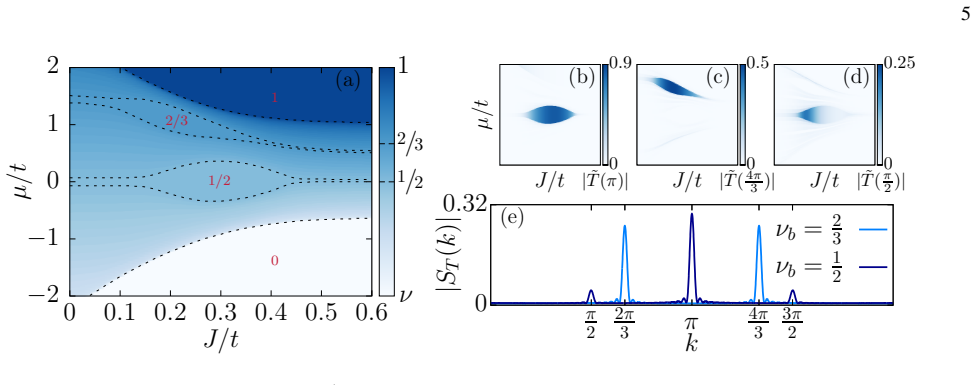
The key object is the flux-dependent tunneling amplitude: for the three-link case the amplitude for a fermion to hop across a bond is t/2 when the bond carries a pi-flux on two of its three caps and 3t/2 when it carries zero flux. These two values arise from projecting the gauge-field spins onto the maximal-spin sector and symmetrizing into even/odd superpositions with definite parity under the local Z2 symmetry; they are the analogue of alternating hoppings in a dimerized chain. The binary flux variable enters as a dynamically chosen background, and the low-energy sector becomes a tight-binding model with alternating t/2-3t/2 hoppings, the topology of which is captured by a quantized geomet
What would settle it
The decisive test is to compute, for a chain of length about 200, the ground-state energy of the doped system as a function of the distance between two pinned solitons: deconfinement predicts a flat E(d) apart from small four-site-periodic oscillations, while a linear rise with d would refute the claim. A second decisive check is to exact-diagonalize a small system allowing all spin sectors; if the ground state lies outside s=N_b/2, the effective model used throughout is inapplicable.
Extended reading notes
Core claim
The central discovery is that for an odd number of links per bond the gauge-flux degrees of freedom act as a discrete lattice distortion: the magnetic term favors pi-flux threading pairs of links, while the tunneling energy favors uniform zero flux, and the compromise is a periodic flux pattern whose wave vector is set by the filling fraction. Switching off the electric field, this reduces the matter sector to a dimerized tight-binding chain with alternating hoppings t/2 and 3t/2, whose filled band has a quantized geometric phase of pi for one of the two degenerate dimer patterns. The paper establishes analytically that this topological phase persists in the h=0 limit and, via matrix product
Load-bearing premise
The paper's results assume that the true ground state of the multi-link model lies in the maximal-spin sector s=N_b/2 of every link; if the full Hilbert space selects a lower spin sector for any parameters, the effective tunneling amplitudes t/2 and 3t/2 and the entire phase diagram would need revision.
Editorial extensions
If this is right
- If the claims are correct, a Z2 lattice gauge theory in 1+1D can realize a symmetry-protected topological phase stabilized by spontaneous breaking of translational invariance, independent of fractionalizing the gauge charges themselves.
- The deconfinement of half-charge solitons means that the standard confining behavior of a Z2 chain is avoided: a doped system can conduct fractional charge without a linearly rising potential, observable as a flat energy-versus-distance curve.
- The incompressible plateaus at fillings 1/2 and 2/3 provide quantized density signatures that could be probed directly in a quantum gas microscope or trapped-ion simulator.
- Because the magnetic term is a sum of two-body products of Pauli operators, the model is implementable in current analog simulators, making the predicted phase diagram and soliton deconfinement experimentally testable in the near term.
Reading between the lines
- We infer that the mechanism is not specific to N_b=3: for any odd number of links the same competition between flux and kinetic energy should produce a flux superlattice with period set by the filling, and the solitonic defects should still bind fractional charge. Testing N_b=5 or 7 would show whether the deconfinement is generic.
- The four-site periodicity at h>0 suggests a hidden inversion symmetry around weak bonds; measuring the local geometric phase pattern would confirm the topological nature, and the alternating 0-pi pattern could serve as a spatially resolved order parameter in experiments.
- If the restriction to the maximal-spin sector is relaxed, lower-spin sectors might support different effective hoppings; we suspect these sectors are gapped out at the parameters studied, but exact diagonalization on small chains would settle this assumption and could reveal a richer phase diagram.
- We hypothesize that the fractional-charge deconfinement reflects a general principle: in a 1D system where a spontaneously broken discrete symmetry supports domain walls, the fractional charge bound to a wall is not confined if the bulk remains gapped and the wall is mobile, potentially applying to other gauge-matter models with spontaneously dimerized flux backgrounds.
Editorial analysis
A structured set of objections, weighed in public.
Referee Report
Summary. The paper introduces a (1+1)-dimensional Z2 lattice gauge theory defined on a multigraph with an odd number (Nb=3) of parallel gauge-field links per matter bond. The authors show that the gauge-flux degrees of freedom, encoded in Wilson-loop operators, lead to flux-dependent tunneling amplitudes, and argue that competition between magnetic and kinetic terms produces a Peierls-type spontaneous breaking of translational invariance. At half filling, the resulting bond-order wave is claimed to coexist with symmetry-protected topological (BDI-class) order, characterized by a quantized local Berry phase and fractional edge charges. Doping above half filling is claimed to create soliton/anti-soliton pairs carrying fractional charge q_f=1/2 that are deconfined. The h=0 analysis is analytic (energy comparison of uniform and dimerized flux patterns); the h>0 and doped regimes are studied with DMRG/MPS on chains up to L=180 sites.
Significance. If the central claims hold, the paper offers a novel and potentially important mechanism: a local gauge symmetry does not preclude spontaneous breaking of translational symmetry, and the resulting topological bond-order wave plus fractionalized deconfined solitons would be a genuinely new phenomenon in 1D Z2 gauge theories. The h=0 derivation of an SSH-like effective model from a gauge-invariant Hamiltonian is elegant and fully analytic within the chosen sector. The numerical study is extensive for a 1D system (L up to 180) and includes order parameters, structure factors, finite-size scaling, Berry-phase probes, and energy landscapes. However, the significance is conditional on one crucial assumption: that the true ground state of the original Hamiltonian (1) lies in the maximal-spin sector s_iℓ = N_b/2 of each link. The paper does not establish this, and the entire phenomenology (Peierls instability, SPT phase, deconfined solitons) is absent in the lower-spin sector.
major comments (4)
- [Sec. II, Eq. (5)–(10); Sec. V] The restriction to the maximal-spin sector s_iℓ = N_b/2 is not justified. The authors state: 'we resort to the local conservation of S^2_iℓ and restrict our attention to the highest-weight states' (Sec. II), and later 'we have studied the phase diagram in the maximal spin sector' (Sec. V). Since [H, S^2_iℓ] = 0, the full Hilbert space decomposes into independent sectors, and the ground state of the original Hamiltonian (1) is the lowest energy over all sectors. In the spin-1/2 sector for N_b=3, the flux operator T_iℓ is frozen at -1, the tunneling amplitude is uniformly t/2, and no τ=+1 links exist to form the alternating pattern that drives the Peierls instability and the topological phase. The paper never compares energies across sectors or gives an argument why the maximal-spin sector is favored for J>0, h≥0. Without such a comparison, the central claims apply only to a truncated mode
- [Sec. IV A, Eqs. (28)–(33)] The h=0 analytic proof of the Peierls instability compares only two flux configurations: the homogeneous (ferromagnetic) ordering and the period-2 dimerized ordering. It does not prove that these minimize the energy among all possible flux patterns compatible with Gauss' law. Since the flux sectors are conserved at h=0, a systematic comparison over periodic patterns (e.g., period 3, 4, etc.) is in principle possible and would be necessary to establish the claimed ground state. The numerical results for h>0 (Fig. 2) show a period-4 sub-modulation at ν=1/2, which is not captured by the h=0 analysis. This gap weakens the statement that the Peierls-type instability is analytically demonstrated; at present it is only demonstrated within a restricted set of candidates.
- [Sec. IV B, Fig. 5] The SPT characterization at h≠0 relies on the quantization of the local Berry phase γ_iℓ. The authors note that the anti-unitary symmetry KI_W ensures quantization only on weak bonds, yet the numerical result (Fig. 5(b)) shows |γ_iℓ|/π ≈ 0.99 on strong bonds and 0 on weak bonds. They explicitly state: 'The almost-perfect Berry phase quantization on strong bonds might suggest that there is another anti-unitary symmetry... and it will be interesting if future works can identify it.' The claim that the BOW phase is symmetry-protected for h>0 depends on the unexplained quantization of these strong-bond Berry phases. The authors should either identify the protecting symmetry or qualify the SPT claim.
- [Sec. V, Fig. 9] The deconfinement claim is based on the energy landscape E(d) for pinned solitons, which shows almost constant energy over distances up to d≈94 in a chain of L=120. This is a finite-size, pinned calculation: the pinning potential V_pin (39) may itself affect the interaction between solitons, and distances beyond d≈94 are not accessible because of boundary repulsion. No finite-size scaling of E(d) is presented, and the abstract states 'we prove that charge deconfinement emerges' without quantifying numerical accuracy or extrapolation. The authors should provide convergence data (e.g., bond dimensions, truncation errors) and a scaling analysis to support the 'arbitrarily separated' statement.
minor comments (6)
- [Abstract] Typo: 'performining' should be 'performing'.
- [Conclusions] Typo: 'experiemts' should be 'experiments'.
- [Fig. 8 caption] Typo: 'highltight' should be 'highlight'.
- [Fig. 7 caption] Typo: 'raging' should be 'ranging'.
- [Sec. II, Eq. (21)] The definition of N_s as '3L/5' is not intuitive. It would help to explain more clearly how the sampled sites are chosen and why only the bulk is sampled.
- [Sec. IV B, Eq. (17)–(20)] The notation ε^±_iℓ(ρ_iℓ) and c^α_τ(ρ_iℓ) is somewhat dense; a short derivation of the eigenvalues (18) would improve readability.
Circularity Check
No significant circularity: the h=0 Peierls/SSH derivation and the MPS phase diagram are self-contained within the declared maximal-spin sector; the sector truncation is an unproved assumption but not a circular reduction.
full rationale
The paper’s central derivation chain is not circular. At h=0, the flux sectors are exactly conserved ([T_iℓ,H]=0); the dressed-fermion mapping (Eq. 12) and the flux-dependent tunneling amplitudes t(τ_iℓ)=(1+τ_iℓ/2)t (Eq. 14) are derived from the spin-3/2 representation (Eq. 8), not fitted. The Peierls-type dimerization is obtained by comparing analytic ground-state energies of homogeneous (Eq. 28) versus dimerized (Eq. 31) flux configurations, yielding critical couplings Jc1,Jc2 (Eq. 33) with no fitted parameter renamed as a prediction. The h>0 and doped-soliton results are obtained by MPS/DMRG, and the order parameters (e.g. the structure-factor peaks at k_F=2πν, the BOW structure factor, the local Berry phases, and the flat E(d) energy landscape) are computed observables, not imposed inputs. The self-citations in the paper—Ref. [65] for N_b=2 AB caging, Ref. [71] for the pinning strategy, Ref. [94] for soliton-induced deconfinement in a different model—are contextual or methodological and are not load-bearing for the new claims; none invokes a self-authored uniqueness theorem to force the result. The one substantive caveat is the explicit restriction to the maximal-spin sector s_iℓ=N_b/2 (Sec. II: 'we resort to the local conservation of S^2_iℓ and restrict our attention to the highest-weight states'; Sec. V: 'we have studied the phase diagram in the maximal spin sector'). This is an unproved assumption about which sector of the full multi-link Hilbert space contains the ground state; if the true ground state lay in a lower-spin sector, the effective tunneling amplitudes, the Peierls mechanism, and the deconfinement conclusion would not apply. However, this is a correctness/domain risk rather than a circularity: the paper does not define the model through the result it claims to derive, and the calculations within the declared sector are internally consistent. The score of 2 reflects these minor caveats (self-citations plus the explicit sector restriction), not any load-bearing circular step.
Assumptions & free parameters
free parameters (3)
- critical exponents nu, beta at J/t=0.25 =
nu ~ 2.464, beta ~ 0.828
- pinning strength lambda in V_pin =
5e-3 t
- soliton pinning strength epsilon in V_pin =
0.05 t
assumptions (4)
- ad hoc to paper The ground state lies in the maximal-spin sector s_iell=N_b/2 of each link.
- domain assumption The system is studied in the neutral gauge sector q_i=0 for all i, with a specially deformed Gauss law at the edge when doping.
- domain assumption The MPS/DMRG simulations are converged to the ground state.
- domain assumption At h>0, the anti-unitary symmetry KI_W protects quantization of the local Berry phase on weak bonds.
Cite this review
Pith. "Pith review of Symmetry-protected topology and deconfined solitons in a multi-link $\mathbb{Z}_2$ gauge theory." pith.science (2026). https://pith.science/paper/XTRIDHL5
@misc{pith2026260303374,
  author       = {Pith},
  title        = {Pith review of: Symmetry-protected topology and deconfined solitons in a multi-link $\mathbbZ_2$ gauge theory},
  year         = {2026},
  howpublished = {\url{https://pith.science/paper/XTRIDHL5}},
  note         = {Machine review of arXiv:2603.03374}
}
abstract
With the advent of quantum simulators, exploring exotic collective phenomena in lattice models with local symmetries and unconventional geometries is at reach of near-term experiments. Motivated by recent progress in this direction, we study a $\mathbb{Z}_2$ lattice gauge theory defined on a multi-graph with links that can be visualized as great circles of a spherical shell hosting the $\mathbb{Z}_2$ gauge fields. Elementary Wilson loops along pairs of these bonds allow to identify a dynamical gauge-invariant flux, responsible for Aharonov-Bohm-like interference effects in the tunneling dynamics of charged matter residing on the vertices. Focusing on an odd number of links, we show that this leads to state-dependent tunneling amplitudes underlying a phenomenon analogous to the Peierls instability. We find inhomogeneous phases in which an ordered pattern of the gauge fluxes spontaneously breaks translational invariance, and intertwines with a bond order wave for the gauge-invariant kinetic matter operators. Long-range order is shown to coexist with symmetry protected topological order, which survives the quantum fluctuations of the gauge flux induced by an external electric field. Doping the system above half filling leads to the formation of topological soliton/anti-soliton pairs interpolating between different inhomogeneous orderings of the gauge fluxes. By performining a detailed analysis based on matrix product states, we prove that charge deconfinement emerges as a consequence of charge-fractionalization. Quasiparticles carrying fractional charge and bound at the soliton centers can be arbitrarily separated without feeling a confining force, in spite of the long-range attractive interactions set by the small electric field on the individual integer charges.
Figures


Figures from the paper (6 more)


Reference graph
Works this paper leans on
-
[1]
K. G. Wilson, Phys. Rev. D10, 2445 (1974)
1974
-
[2]
Let us now discuss this SSB in more detail
or 3 (ν= 2 3). Let us now discuss this SSB in more detail. The lattice translational symmetry in the formulation (5) is captured by 7 the cyclic groupG={T n :n∈ {1,· · ·,L}} ≃ZL, where Tc iT −1 =c i+1, andTS SSiℓ T −1 =SSS(i+1)ℓ, and we have as- sumed periodic boundary conditionsT L =I. This symmetry is spontaneously broken down to the subgroupsH ℓ ={T ℓn...
-
[3]
a bond-order wave (BOW)
Here, the system manifests SSB of the lattice translational symmetry and develops a long-range ordered pattern of the gauge-invariant bond kinetic operators ⟨Biℓ ⟩, i.e. a bond-order wave (BOW). At half-filling, the breakdown of translational symmetry is manifest as a spon- taneous dimerization of the gauge-flux and bond strengths which, ath=0, is describ...
2024
-
[4]
J. B. Kogut, Rev. Mod. Phys.55, 775 (1983)
1983
-
[5]
Carroll, J
A. Carroll, J. Kogut, D. K. Sinclair, and L. Susskind, Phys. Rev. D13, 2270 (1976)
1976
-
[6]
H. S. Sharatchandra, Phys. Rev. D18, 2042 (1978)
-
[7]
R. P. Feynman, International Journal of Theoretical Physics21, 467–488 (1982)
1982
-
[8]
H. P. B ¨uchler, M. Hermele, S. D. Huber, M. P. A. Fisher, and P. Zoller, Phys. Rev. Lett.95, 040402 (2005)
2005
Show all 96 references
-
[9]
Weimer, M
H. Weimer, M. M ¨uller, I. Lesanovsky, P. Zoller, and H. P. B¨uchler, Nature Physics6, 382–388 (2010)
2010
-
[10]
Zohar and B
E. Zohar and B. Reznik, Phys. Rev. Lett.107, 275301 (2011)
2011
-
[11]
Zohar, J
E. Zohar, J. I. Cirac, and B. Reznik, Phys. Rev. Lett.109, 125302 (2012)
2012
-
[12]
Zohar, J
E. Zohar, J. I. Cirac, and B. Reznik, Phys. Rev. Lett.110, 125304 (2013)
2013
-
[13]
Zohar, J
E. Zohar, J. I. Cirac, and B. Reznik, Phys. Rev. Lett.110, 055302 (2013)
2013
-
[14]
Zohar, J
E. Zohar, J. I. Cirac, and B. Reznik, Reports on Progress in Physics79, 014401 (2015)
2015
-
[15]
Banerjee, M
D. Banerjee, M. Dalmonte, M. M ¨uller, E. Rico, P. Stebler, U.-J. Wiese, and P. Zoller, Phys. Rev. Lett.109, 175302 (2012)
2012
-
[16]
Banerjee, M
D. Banerjee, M. B ¨ogli, M. Dalmonte, E. Rico, P. Stebler, U.-J. Wiese, and P. Zoller, Phys. Rev. Lett.110, 125303 (2013)
2013
-
[17]
Carmen Ba ˜nuls and K
M. Carmen Ba ˜nuls and K. Cichy, Reports on Progress in Physics83, 024401 (2020)
2020
-
[18]
M. C. Ba ˜nuls, R. Blatt, J. Catani, A. Celi, J. I. Cirac, M. Dalmonte, L. Fallani, K. Jansen, M. Lewenstein, S. Mon- tangero, C. A. Muschik, B. Reznik, E. Rico, L. Tagliacozzo, K. Van Acoleyen, F. Verstraete, U.-J. Wiese, M. Wingate, J. Za- krzewski, and P. Zoller, The Europe...
2020 doi
-
[19]
Tagliacozzo, A
L. Tagliacozzo, A. Celi, A. Zamora, and M. Lewenstein, An- nals of Physics330, 160 (2013)
2013
-
[20]
Tagliacozzo, A
L. Tagliacozzo, A. Celi, P. Orland, M. W. Mitchell, and M. Lewenstein, Nature Communications4(2013), 10.1038/ncomms3615
2013 doi
-
[21]
Wiese, Annalen der Physik525, 777–796 (2013)
U. Wiese, Annalen der Physik525, 777–796 (2013)
2013
-
[22]
Dalmonte and S
M. Dalmonte and S. Montangero, Contemporary Physics57, 388 (2016), https://doi.org/10.1080/00107514.2016.1151199
2016
-
[23]
Aidelsburger, L
M. Aidelsburger, L. Barbiero, A. Bermudez, T. Chanda, A. Dauphin, D. Gonz´alez-Cuadra, P. R. Grzybowski, S. Hands, F. Jendrzejewski, J. J ¨unemann, G. Juzeli ¯unas, V . Kasper, A. Piga, S.-J. Ran, M. Rizzi, G. Sierra, L. Tagliacozzo, E. Tir- rito, T. V . Zache, J. Zakrzewski, ...
2021
-
[24]
E. A. Martinez, C. A. Muschik, P. Schindler, D. Nigg, A. Er- hard, M. Heyl, P. Hauke, M. Dalmonte, T. Monz, P. Zoller, and R. Blatt, Nature534, 516–519 (2016)
2016
-
[25]
H.-N. Dai, B. Yang, A. Reingruber, H. Sun, X.-F. Xu, Y .- A. Chen, Z.-S. Yuan, and J.-W. Pan, Nature Physics13, 1195–1200 (2017)
2017
-
[26]
N. Klco, E. F. Dumitrescu, A. J. McCaskey, T. D. Morris, R. C. Pooser, M. Sanz, E. Solano, P. Lougovski, and M. J. Savage, Phys. Rev. A98, 032331 (2018)
2018
-
[27]
Schweizer, F
C. Schweizer, F. Grusdt, M. Berngruber, L. Barbiero, E. Dem- ler, N. Goldman, I. Bloch, and M. Aidelsburger, Nature Physics 15, 1168–1173 (2019)
2019
-
[28]
Kokail, C
C. Kokail, C. Maier, R. van Bijnen, T. Brydges, M. K. Joshi, P. Jurcevic, C. A. Muschik, P. Silvi, R. Blatt, C. F. Roos, and P. Zoller, Nature569, 355–360 (2019)
2019
-
[29]
F. M. Surace, P. P. Mazza, G. Giudici, A. Lerose, A. Gambassi, and M. Dalmonte, Phys. Rev. X10, 021041 (2020)
2020
-
[30]
N. Klco, M. J. Savage, and J. R. Stryker, Phys. Rev. D101, 074512 (2020)
2020
-
[31]
A. Mil, T. V . Zache, A. Hegde, A. Xia, R. P. Bhatt, M. K. Oberthaler, P. Hauke, J. Berges, and F. Jendrzejewski, Science 367, 1128–1130 (2020)
2020
-
[32]
B. Yang, H. Sun, R. Ott, H.-Y . Wang, T. V . Zache, J. C. Halimeh, Z.-S. Yuan, P. Hauke, and J.-W. Pan, Nature587, 392–396 (2020)
2020
-
[33]
Zhou, G.-X
Z.-Y . Zhou, G.-X. Su, J. C. Halimeh, R. Ott, H. Sun, P. Hauke, B. Yang, Z.-S. Yuan, J. Berges, and J.-W. Pan, Science377, 311–314 (2022)
2022
-
[34]
Y . Y . Atas, J. Zhang, R. Lewis, A. Jahanpour, J. F. Haase, and C. A. Muschik, Nature Communications12(2021), 10.1038/s41467-021-26825-4
2021 doi
-
[35]
C. W. Bauer, B. Nachman, and M. Freytsis, Phys. Rev. Lett. 127, 212001 (2021)
2021
-
[36]
N. H. Nguyen, M. C. Tran, Y . Zhu, A. M. Green, C. H. Alderete, Z. Davoudi, and N. M. Linke, PRX Quantum3, 020324 (2022)
2022
-
[37]
Ciavarella, N
A. Ciavarella, N. Klco, and M. J. Savage, Phys. Rev. D103, 094501 (2021)
2021
-
[38]
Mildenberger, W
J. Mildenberger, W. Mruczkiewicz, J. C. Halimeh, Z. Jiang, and P. Hauke, Nature Physics21, 312–317 (2025)
2025
-
[39]
A Rahman, R
S. A Rahman, R. Lewis, E. Mendicelli, and S. Powell, Phys. Rev. D104, 034501 (2021). 15
2021
-
[40]
A. N. Ciavarella and I. A. Chernyshev, Phys. Rev. D105, 074504 (2022)
2022
-
[41]
Wang, Z.-Y
Z. Wang, Z.-Y . Ge, Z. Xiang, X. Song, R.-Z. Huang, P. Song, X.-Y . Guo, L. Su, K. Xu, D. Zheng, and H. Fan, Phys. Rev. Res.4, L022060 (2022)
2022
-
[42]
Y . Y . Atas, J. F. Haase, J. Zhang, V . Wei, S. M.-L. Pfaendler, R. Lewis, and C. A. Muschik, Phys. Rev. Res.5, 033184 (2023)
2023
-
[43]
R. C. Farrell, I. A. Chernyshev, S. J. M. Powell, N. A. Zem- levskiy, M. Illa, and M. J. Savage, Phys. Rev. D107, 054512 (2023)
2023
-
[44]
R. C. Farrell, I. A. Chernyshev, S. J. M. Powell, N. A. Zem- levskiy, M. Illa, and M. J. Savage, Phys. Rev. D107, 054513 (2023)
2023
-
[45]
G.-X. Su, H. Sun, A. Hudomal, J.-Y . Desaules, Z.-Y . Zhou, B. Yang, J. C. Halimeh, Z.-S. Yuan, Z. Papi ´c, and J.-W. Pan, Phys. Rev. Res.5, 023010 (2023)
2023
-
[46]
Charles, E
C. Charles, E. J. Gustafson, E. Hardt, F. Herren, N. Hogan, H. Lamm, S. Starecheski, R. S. Van de Water, and M. L. Wag- man, Phys. Rev. E109, 015307 (2024)
2024
-
[47]
Observation of microscopic confinement dynamics by a tunable topologicalθ-angle,
W.-Y . Zhang, Y . Liu, Y . Cheng, M.-G. He, H.-Y . Wang, T.-Y . Wang, Z.-H. Zhu, G.-X. Su, Z.-Y . Zhou, Y .-G. Zheng, H. Sun, B. Yang, P. H. an d Wei Zheng, J. C. Halimeh, Z.-S. Yuan, and J.-W. Pan, “Observation of microscopic confinement dynamics by a tunable topologicalθ-ang...
2023 arXiv
-
[48]
T. A. Cochran and et al., Nature642, 315–320 (2025)
2025
-
[49]
Observation of string-breaking dynamics in a quantum simulator,
A. De and et al., “Observation of string-breaking dynamics in a quantum simulator,” (2024), arXiv:2410.13815 [quant-ph]
2024 arXiv
-
[50]
Gonz ´alez-Cuadra, M
D. Gonz ´alez-Cuadra, M. Hamdan, T. V . Zache, B. Braver- man, M. Kornja ˇca, A. Lukin, S. H. Cant ´u, F. Liu, S.-T. Wang, A. Keesling, M. D. Lukin, P. Zoller, and A. Bylinskii, Nature 642, 321–326 (2025)
2025
-
[51]
String breaking mechanism in a lattice schwinger model simulator,
Y . Liu, W.-Y . Zhang, Z.-H. Zhu, M.-G. He, Z.-S. Yuan, and J.-W. Pan, “String breaking mechanism in a lattice schwinger model simulator,” (2024), arXiv:2411.15443 [cond-mat.quant- gas]
2024 arXiv
-
[52]
Real-time ob- servation of aharonov-bohm interference in aZ 2 lattice gauge theory on a hybrid qubit-oscillator quantum computer,
S. Saner, O. B ˘az˘avan, D. J. Webb, G. Araneda, C. J. Ballance, R. Srinivas, D. M. Lucas, and A. Berm ´udez, “Real-time ob- servation of aharonov-bohm interference in aZ 2 lattice gauge theory on a hybrid qubit-oscillator quantum computer,” (2025), arXiv:2507.19588 [quant-ph]
2025 arXiv
-
[53]
Real-time dynamics in a (2+1)-d gauge theory: The stringy nature on a superconducting quantum simulator,
J. Cobos, J. Fraxanet, C. Benito, F. di Marcantonio, P. Rivero, K. Kap ´as, M. A. Werner, ¨Ors Legeza, A. Bermudez, and E. Rico, “Real-time dynamics in a (2+1)-d gauge theory: The stringy nature on a superconducting quantum simulator,” (2025), arXiv:2507.08088 [quant-ph]
2025 arXiv
-
[54]
Aharonov and D
Y . Aharonov and D. Bohm, Phys. Rev.115, 485 (1959)
1959
-
[56]
Borla, R
U. Borla, R. Verresen, F. Grusdt, and S. Moroz, Phys. Rev. Lett. 124, 120503 (2020)
2020
-
[57]
M. c. v. Kebriˇc, L. Barbiero, C. Reinmoser, U. Schollw¨ock, and F. Grusdt, Phys. Rev. Lett.127, 167203 (2021)
2021
-
[58]
Elitzur, Phys
S. Elitzur, Phys. Rev. D12, 3978 (1975)
1975
-
[59]
R. E. Peierls,Quantum Theory of Solids(Oxford University Press, Great Clarendon Street, Oxford, OX2 6DP, United King- dom, 2001)
2001
-
[60]
Chen, Z.-C
X. Chen, Z.-C. Gu, and X.-G. Wen, Phys. Rev. B83, 035107 (2011)
2011
-
[61]
Chen, Z.-C
X. Chen, Z.-C. Gu, Z.-X. Liu, and X.-G. Wen, Science338, 1604 (2012), https://www.science.org/doi/pdf/10.1126/science.1227224
2012 doi
-
[62]
Wen, Phys
X.-G. Wen, Phys. Rev. B85, 085103 (2012)
2012
-
[63]
Senthil, Annual Review of Condensed Matter Physics6, 299–324 (2015)
T. Senthil, Annual Review of Condensed Matter Physics6, 299–324 (2015)
2015
-
[64]
C.-K. Chiu, J. C. Y . Teo, A. P. Schnyder, and S. Ryu, Rev. Mod. Phys.88, 035005 (2016)
2016
-
[65]
Friedenauer, H
A. Friedenauer, H. Schmitz, J. T. Glueckert, D. Porras, and T. Schaetz, Nature Phys.4, 757 (2008)
2008
-
[66]
Monroe, W
C. Monroe, W. C. Campbell, L.-M. Duan, Z.-X. Gong, A. V . Gorshkov, P. W. Hess, R. Islam, K. Kim, N. M. Linke, G. Pagano, P. Richerme, C. Senko, and N. Y . Yao, Rev. Mod. Phys.93, 025001 (2021)
2021
-
[67]
E. C. Domanti, A. Bermudez, and L. Amico, Communications Physics8(2025), 10.1038/s42005-025-02284-x
2025 doi
-
[68]
Vidal, R
J. Vidal, R. Mosseri, and B. Douc ¸ot, Phys. Rev. Lett.81, 5888 (1998)
1998
-
[69]
Lipkin, N
H. Lipkin, N. Meshkov, and A. Glick, Nuclear Physics62, 188 (1965)
1965
-
[70]
Ribeiro, J
P. Ribeiro, J. Vidal, and R. Mosseri, Phys. Rev. E78, 021106 (2008)
2008
-
[71]
Mølmer and A
K. Mølmer and A. Sørensen, Phys. Rev. Lett.82, 1835 (1999)
1999
-
[73]
Gonz ´alez-Cuadra, A
D. Gonz ´alez-Cuadra, A. Dauphin, P. R. Grzybowski, P. W´ojcik, M. Lewenstein, and A. Bermudez, Phys. Rev. B99, 045139 (2019)
2019
-
[74]
Gonz ´alez-Cuadra, A
D. Gonz ´alez-Cuadra, A. Dauphin, P. R. Grzybowski, M. Lewenstein, and A. Bermudez, Phys. Rev. B102, 245137 (2020)
2020
-
[75]
Schollw ¨ock, Annals of Physics326, 96 (2011), January 2011 Special Issue
U. Schollw ¨ock, Annals of Physics326, 96 (2011), January 2011 Special Issue
2011
-
[76]
Fishman, S
M. Fishman, S. R. White, and E. M. Stouden- mire, SciPost Phys. Codebases , 4 (2022), https://doi.org/10.21468/SciPostPhysCodeb.4
2022 doi
-
[77]
Fishman, S
M. Fishman, S. R. White, and E. M. Stoudenmire, SciPost Phys. Codebases , 4 (2022)
2022
-
[78]
Kumar and Z
M. Kumar and Z. G. Soos, Phys. Rev. B82, 155144 (2010)
2010
-
[79]
Sengupta, A
P. Sengupta, A. W. Sandvik, and D. K. Campbell, Phys. Rev. B 65, 155113 (2002)
2002
-
[80]
Loida, J.-S
K. Loida, J.-S. Bernier, R. Citro, E. Orignac, and C. Kollath, Phys. Rev. Lett.119, 230403 (2017)
2017
-
[81]
H ¨uckel, Zeitschrift f¨ur Physik70, 204–286 (1931)
E. H ¨uckel, Zeitschrift f¨ur Physik70, 204–286 (1931)
1931
-
[82]
W. P. Su, J. R. Schrieffer, and A. J. Heeger, Phys. Rev. Lett.42, 1698 (1979)
1979
-
[83]
C. L. Kane and E. J. Mele, Phys. Rev. Lett.95, 146802 (2005)
2005
-
[84]
C. L. Kane and E. J. Mele, Phys. Rev. Lett.95, 226801 (2005)
2005
-
[85]
B. A. Bernevig and T. L. Hughes,Topological Insulators and Topological Superconductors(Princeton University Press, Princeton, 2013)
2013
-
[86]
Hohenadler and F
M. Hohenadler and F. F. Assaad, Journal of Physics: Condensed Matter25, 143201 (2013)
2013
-
[87]
J. K. Asb ´oth, L. Oroszl ´any, and A. P ´alyi,A Short Course on Topological Insulators(Springer International Publishing, 2016)
2016
-
[88]
Rachel, Reports on Progress in Physics81, 116501 (2018)
S. Rachel, Reports on Progress in Physics81, 116501 (2018)
2018
-
[89]
Barford,Electronic and Optical Properties of Conjugated Polymers(Oxford University Press, 2013)
W. Barford,Electronic and Optical Properties of Conjugated Polymers(Oxford University Press, 2013)
2013
-
[90]
Zak, Phys
J. Zak, Phys. Rev. Lett.62, 2747 (1989)
1989
-
[91]
Kourtis and M
S. Kourtis and M. Daghofer, Phys. Rev. Lett.113, 216404 (2014)
2014
-
[92]
Hatsugai, Journal of the Physical Society of Japan75, 123601 (2006), https://doi.org/10.1143/JPSJ.75.123601
Y . Hatsugai, Journal of the Physical Society of Japan75, 123601 (2006), https://doi.org/10.1143/JPSJ.75.123601
2006 doi
-
[93]
Binder, Zeitschrift f ¨ur Physik B Condensed Matter43, 119–140 (1981)
K. Binder, Zeitschrift f ¨ur Physik B Condensed Matter43, 119–140 (1981)
1981
-
[94]
Binder and D
K. Binder and D. P. Landau, Phys. Rev. B30, 1477 (1984)
1984
-
[95]
Jackiw and C
R. Jackiw and C. Rebbi, Phys. Rev. D13, 3398 (1976). 16
1976
-
[96]
Gonz ´alez-Cuadra, L
D. Gonz ´alez-Cuadra, L. Tagliacozzo, M. Lewenstein, and A. Bermudez, Phys. Rev. X10, 041007 (2020)
2020
-
[97]
Peierls, Proceedings of the Physical Society52, 34 (1940)
R. Peierls, Proceedings of the Physical Society52, 34 (1940)
1940
-
[98]
F. R. N. Nabarro, Proceedings of the Physical Society59, 256 (1947)
1947
Reviewed August 4, 2026 · model on record in the stance chip above.
Discussion (0). Continue with ORCID to comment.