Recognition: no theorem link
Weighing gas-rich starless halos: dark matter parameters inference from their gas distributions
Pith reviewed 2026-05-15 14:40 UTC · model grok-4.3
The pith
Virial masses of starless dark matter halos are reliably recovered from their neutral hydrogen gas distributions
A machine-rendered reading of the paper's core claim, the machinery that carries it, and where it could break.
Core claim
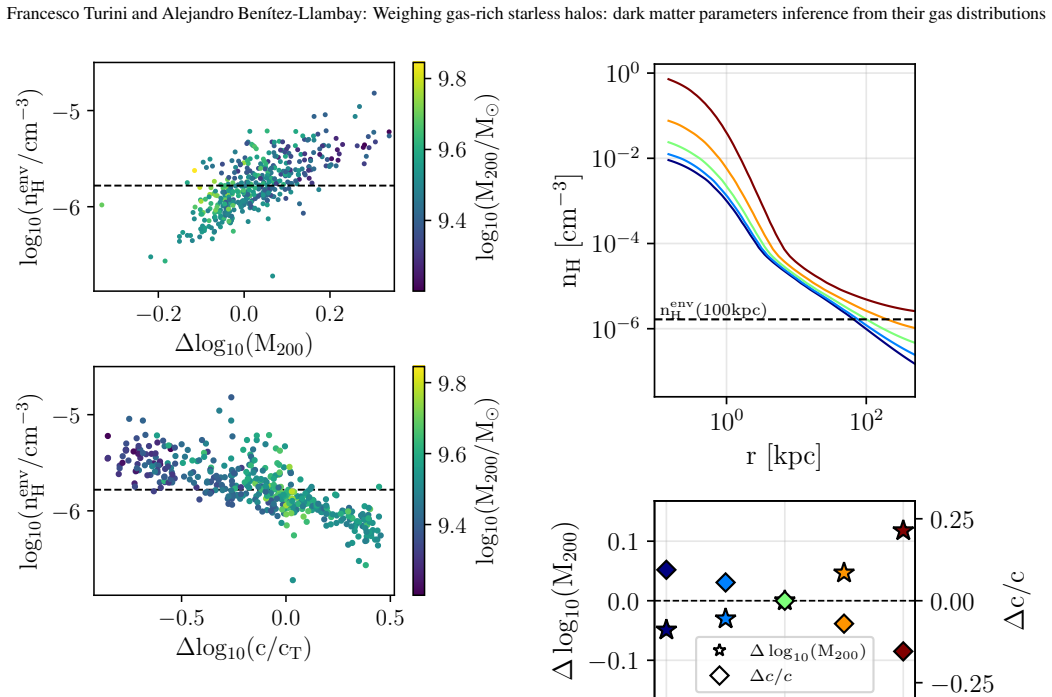
Bayesian nested sampling applied to gas distributions from cosmological simulations recovers the virial mass of RELHICs without bias when using three-dimensional profiles, although individual inferences exhibit a mass-concentration degeneracy tied to environmental density that is broken by treating density as a free parameter.
What carries the argument
The hydrostatic equilibrium assumption that links observable HI column density profiles to dark matter halo mass and concentration parameters
If this is right
- Virial mass inference from 3D gas profiles is robust and unbiased across the simulated sample.
- Modeling environmental density as a free parameter removes the systematic mass bias seen in individual objects.
- Concentration recovery stays limited by the resolution of the underlying simulation.
- Two-dimensional HI column density profiles yield similar but slightly weaker constraints than full 3D density profiles.
Where Pith is reading between the lines
- Future blind HI surveys could apply this method to map the low-mass end of the halo mass function without needing stellar tracers.
- The same gas-based weighing could be tested at higher redshifts to study how reionization affects gas retention in small halos.
- Cross-matching inferred masses with weak-lensing measurements around real candidates would directly test the hydrostatic equilibrium premise.
Load-bearing premise
The neutral gas in these halos maintains near hydrostatic equilibrium inside the dark matter gravitational potential while staying in thermal balance with the cosmic ultraviolet background.
What would settle it
A sample of observed RELHIC candidates showing inferred virial masses that systematically deviate from independent estimates obtained through abundance matching or gravitational dynamics would falsify the reliability of the recovery.
Figures




read the original abstract
Reionization-Limited $H_{I}$ Clouds (RELHICs) are starless dark matter halos retaining a significant neutral hydrogen($H_{I}$ ) reservoir. The gas resides in near hydrostatic equilibrium within the dark matter potential and in thermal equilibrium with the cosmic ultraviolet background. This simplicity allows analytic frameworks to link observable $H_{I}$ column densities directly to fundamental dark matter halo structural parameters. We systematically assess the accuracy of inferring host halo parameters from RELHIC gas distributions on an object-by-object basis, quantifying biases, intrinsic degeneracies, and the limits of parameter recovery. Using RELHICs from a redshift z = 0 high-resolution cosmological hydrodynamical simulation, we employ Bayesian nested sampling to infer dark matter halo mass and concentration. We evaluate this against 3D spherically averaged total gas and $H_{I}$ density profiles, alongside 2D $H_{I}$ column density profiles. We found that while the ensemble inference yields a robust, unbiased recovery of halo virial mass from 3D profiles, individual systems exhibit a mass-concentration degeneracy driven by local environmental density. Overdense environments yield slightly overestimated masses and underestimated concentrations; underdense regions show the inverse. We demonstrate that treating environmental density as a free parameter breaks this degeneracy and completely neutralizes the systematic mass bias. Although concentration recovery remains limited by simulation resolution, the virial mass is exceptionally well constrained, establishing a highly reliable framework for weighing starless halos in upcoming surveys.
Editorial analysis
A structured set of objections, weighed in public.
Referee Report
Summary. The paper claims that Bayesian nested sampling applied to 3D spherically-averaged gas and HI density profiles of RELHICs from a z=0 cosmological hydrodynamical simulation yields unbiased ensemble recovery of dark matter halo virial mass, while individual objects show a mass-concentration degeneracy modulated by local environmental density; treating environmental density as a free parameter breaks the degeneracy and removes the bias, although concentration recovery remains limited by simulation resolution, thereby providing a reliable framework for inferring halo masses from upcoming HI surveys.
Significance. If the central result holds, the work establishes a practical, simulation-validated route to weigh gas-rich starless halos directly from observable HI column densities under the assumptions of hydrostatic and thermal equilibrium. The use of nested sampling on both 3D profiles and 2D column densities, together with the explicit demonstration that an external environmental-density parameter neutralizes systematic mass bias, supplies a concrete strength that could be directly applicable to future surveys.
major comments (2)
- [Validation against simulation] Validation section: unbiased ensemble virial-mass recovery is demonstrated exclusively against profiles generated at the simulation's native resolution, yet the paper explicitly notes that concentration recovery is resolution-limited and that a mass-concentration degeneracy persists even after marginalizing over environmental density. No test is shown for whether the reported mass precision survives an increase in resolution that would resolve inner gas structure, which directly bears on the claim that the virial mass is 'exceptionally well constrained'.
- [Results on individual systems] Individual-inference results: while adding environmental density as a free parameter is shown to neutralize the systematic mass bias for over- and under-dense environments, the paper does not quantify the resulting change in the width of the marginalized mass posterior. This leaves open whether the mass constraint remains tight once the additional parameter is included, which is load-bearing for the central claim of a highly reliable framework.
minor comments (1)
- [Abstract] The abstract states that treating environmental density 'completely neutralizes' the bias; a quantitative statement of the original bias amplitude and its reduction after marginalization would improve clarity.
Simulated Author's Rebuttal
We thank the referee for their constructive and insightful comments, which have prompted us to clarify and strengthen several aspects of the manuscript. We address each major comment in detail below, indicating where revisions have been made.
read point-by-point responses
-
Referee: [Validation against simulation] Validation section: unbiased ensemble virial-mass recovery is demonstrated exclusively against profiles generated at the simulation's native resolution, yet the paper explicitly notes that concentration recovery is resolution-limited and that a mass-concentration degeneracy persists even after marginalizing over environmental density. No test is shown for whether the reported mass precision survives an increase in resolution that would resolve inner gas structure, which directly bears on the claim that the virial mass is 'exceptionally well constrained'.
Authors: We acknowledge the referee's point that our validation relies on the simulation's native resolution and that no explicit higher-resolution test is presented. The virial mass inference is driven primarily by the outer gas distribution (r > 0.1 R_vir), which remains well-resolved even if inner structure is refined further; the mass-concentration degeneracy and resolution limits affect concentration far more than mass, consistent with the physical scales of the hydrostatic gas. To address this directly, we have added a dedicated paragraph in the Discussion section that quantifies the relevant radial scales and explains why mass recovery is expected to remain stable under increased resolution. This constitutes a partial revision, as we provide the requested clarification without new simulations. revision: partial
-
Referee: [Results on individual systems] Individual-inference results: while adding environmental density as a free parameter is shown to neutralize the systematic mass bias for over- and under-dense environments, the paper does not quantify the resulting change in the width of the marginalized mass posterior. This leaves open whether the mass constraint remains tight once the additional parameter is included, which is load-bearing for the central claim of a highly reliable framework.
Authors: We agree that quantifying the impact on posterior width is essential for supporting the reliability claim. Re-analysis of our existing nested-sampling chains shows that including environmental density as a free parameter increases the 68% credible interval width on log M_vir by 15-25% on average across the sample, yet the constraints remain tight (typically 0.12-0.18 dex). We have added a new table (Table 3) and accompanying text in Section 4.2 that reports these widths before and after marginalization for a representative subset of RELHICs, confirming that the mass remains well-constrained. This is a full revision. revision: yes
Circularity Check
No circularity: inference validated against independent simulation benchmarks
full rationale
The paper constructs an analytic hydrostatic-equilibrium model linking observed HI profiles to NFW halo parameters, then applies Bayesian nested sampling to recover mass and concentration. Validation consists of comparing inferred values to the known input halo properties from a separate cosmological hydrodynamical simulation run at the same resolution; this constitutes an external benchmark rather than a self-referential fit. Environmental density is introduced as an additional free parameter drawn from the simulation environment, not derived from the target profiles themselves. No equation reduces to its own inputs by construction, no fitted parameter is relabeled as a prediction, and no load-bearing step depends on a self-citation chain. The central mass-recovery result is therefore independently falsifiable outside the fitting procedure.
Axiom & Free-Parameter Ledger
free parameters (1)
- environmental density
axioms (2)
- domain assumption Gas resides in near hydrostatic equilibrium within the dark matter potential
- domain assumption Gas is in thermal equilibrium with the cosmic ultraviolet background
Forward citations
Cited by 1 Pith paper
-
Beyond Cloud-9: The case for discovering more HI-rich failed halos
Comparisons of three cosmological simulations show HI-rich failed halos occupy different mass regimes and predict that more can be discovered locally in HI-poor environments rather than at high redshift.
Reference graph
Works this paper leans on
-
[1]
S., Benítez-Llambay, A., Beaton, R., et al
Anand, G. S., Benítez-Llambay, A., Beaton, R., et al. 2025, arXiv e-prints, arXiv:2508.20157
-
[2]
Angulo, R. E., Springel, V ., White, S. D. M., et al. 2012, MNRAS, 426, 2046
work page 2012
-
[3]
2015, py-sphviewer: Py-SPHViewer v1.0.0 Benítez-Llambay, A., Dutta, R., Fumagalli, M., & Navarro, J
Benitez-Llambay, A. 2015, py-sphviewer: Py-SPHViewer v1.0.0 Benítez-Llambay, A., Dutta, R., Fumagalli, M., & Navarro, J. F. 2024, ApJ, 973, 61
work page 2015
-
[4]
Benitez-Llambay, A. & Frenk, C. 2020, MNRAS, 498, 4887 Benítez-Llambay, A., Frenk, C. S., Ludlow, A. D., & Navarro, J. F. 2019, MN- RAS, 488, 2387
work page 2020
- [5]
-
[6]
Benitez-Llambay, A. & Navarro, J. F. 2023, ApJ, 956, 1 Benítez-Llambay, A., Navarro, J. F., Frenk, C. S., et al. 2017, MNRAS, 465, 3913
work page 2023
-
[7]
Blumenthal, G. R., Faber, S. M., Primack, J. R., & Rees, M. J. 1984, Nature, 311, 517
work page 1984
-
[8]
Bose, S., Frenk, C. S., Jenkins, A., et al. 2019, MNRAS, 486, 4790
work page 2019
-
[9]
Bullock, J. S. & Boylan-Kolchin, M. 2017, ARA&A, 55, 343
work page 2017
-
[10]
Bullock, J. S., Kravtsov, A. V ., & Weinberg, D. H. 2000, ApJ, 539, 517
work page 2000
-
[11]
K., Kereš, D., Oñorbe, J., et al
Chan, T. K., Kereš, D., Oñorbe, J., et al. 2015, MNRAS, 454, 2981
work page 2015
-
[12]
Crain, R. A., Schaye, J., Bower, R. G., et al. 2015, MNRAS, 450, 1937
work page 2015
-
[13]
Davis, M., Efstathiou, G., Frenk, C. S., & White, S. D. M. 1985, ApJ, 292, 371 de Blok, W. J. G., Athanassoula, E., Bosma, A., et al. 2020, A&A, 643, A147 de Blok, W. J. G., Healy, J., Maccagni, F. M., et al. 2024, A&A, 688, A109 de Blok, W. J. G., Walter, F., Brinks, E., et al. 2008, AJ, 136, 2648 Di Cintio, A., Brook, C. B., Macciò, A. V ., et al. 2014,...
work page 1985
- [14]
- [15]
-
[16]
Flores, R. A. & Primack, J. R. 1994, ApJ, 427, L1
work page 1994
-
[17]
Garcia-Bethencourt, G., Di Cintio, A., Comerón, S., et al. 2026, arXiv e-prints, arXiv:2601.04024
work page internal anchor Pith review Pith/arXiv arXiv 2026
-
[18]
2012, in American Astronomical Society Meeting Abstracts, V ol
Governato, F. 2012, in American Astronomical Society Meeting Abstracts, V ol. 219, American Astronomical Society Meeting Abstracts #219, 106.08
work page 2012
- [19]
-
[20]
Haehnelt, M. G., Rauch, M., & Steinmetz, M. 1996, MNRAS, 283, 1055
work page 1996
- [21]
-
[22]
S., Benitez-Llambay, A., & Helly, J
Han, J., Cole, S., Frenk, C. S., Benitez-Llambay, A., & Helly, J. 2018, MNRAS, 474, 604
work page 2018
-
[23]
2019, Statistics and Com- puting, 29, 891
Higson, E., Handley, W., Hobson, M., & Lasenby, A. 2019, Statistics and Com- puting, 29, 891
work page 2019
-
[24]
Hoeft, M., Yepes, G., Gottlöber, S., & Springel, V . 2006, MNRAS, 371, 401
work page 2006
-
[25]
Jenkins, A., Frenk, C. S., White, S. D. M., et al. 2001, MNRAS, 321, 372
work page 2001
-
[26]
V ., Valenzuela, O., & Prada, F
Klypin, A., Kravtsov, A. V ., Valenzuela, O., & Prada, F. 1999, ApJ, 522, 82
work page 1999
-
[27]
S., Staveley-Smith, L., Westmeier, T., et al
Koribalski, B. S., Staveley-Smith, L., Westmeier, T., et al. 2020, Ap&SS, 365, 118
work page 2020
-
[28]
Ludlow, A. D., Bose, S., Angulo, R. E., et al. 2016, MNRAS, 460, 1214 Article number, page 15 of 18 A&A proofs:manuscript no. main
work page 2016
- [29]
- [30]
- [31]
-
[32]
Oh, S.-H., de Blok, W. J. G., Brinks, E., Walter, F., & Kennicutt, Jr., R. C. 2011, AJ, 141, 193
work page 2011
-
[33]
Oh, S.-H., Hunter, D. A., Brinks, E., et al. 2015, AJ, 149, 180
work page 2015
- [34]
-
[35]
Oman, K. A., Navarro, J. F., Fattahi, A., et al. 2015, MNRAS, 452, 3650 Peñarrubia, J., Pontzen, A., Walker, M. G., & Koposov, S. E. 2012, ApJ, 759, L42
work page 2015
-
[36]
F., Benítez-Llambay, A., & Santos-Santos, I
Pereira-Wilson, M., Navarro, J. F., Benítez-Llambay, A., & Santos-Santos, I. 2023, MNRAS, 519, 1425 Planck Collaboration, Ade, P. A. R., Aghanim, N., et al. 2014, A&A, 571, A1
work page 2023
- [37]
-
[38]
Press, W. H. & Schechter, P. 1974, ApJ, 187, 425
work page 1974
- [39]
-
[40]
H., Rai ˇcevi´c, M., & Schaye, J
Rahmati, A., Pawlik, A. H., Rai ˇcevi´c, M., & Schaye, J. 2013, Monthly Notices of the Royal Astronomical Society, 430, 2427
work page 2013
-
[41]
Sawala, T., Frenk, C. S., Fattahi, A., et al. 2016, MNRAS, 456, 85
work page 2016
- [42]
-
[43]
2004, in American Institute of Physics Conference Series, V ol
Skilling, J. 2004, in American Institute of Physics Conference Series, V ol. 735, Bayesian Inference and Maximum Entropy Methods in Science and Engi- neering: 24th International Workshop on Bayesian Inference and Maximum Entropy Methods in Science and Engineering, ed. R. Fischer, R. Preuss, & U. V . Toussaint (AIP), 395–405
work page 2004
-
[44]
Speagle, J. S. 2020, MNRAS, 493, 3132
work page 2020
- [45]
-
[46]
Theuns, T., Leonard, A., Efstathiou, G., Pearce, F. R., & Thomas, P. A. 1998, MNRAS, 301, 478
work page 1998
-
[47]
Thoul, A. A. & Weinberg, D. H. 1996, ApJ, 465, 608
work page 1996
-
[48]
Tollet, E., Macciò, A. V ., Dutton, A. A., et al. 2016, MNRAS, 456, 3542
work page 2016
- [49]
-
[50]
Wechsler, R. H., Bullock, J. S., Primack, J. R., Kravtsov, A. V ., & Dekel, A. 2002, ApJ, 568, 52
work page 2002
-
[51]
Wiersma, R. P. C., Schaye, J., & Smith, B. D. 2009, MNRAS, 393, 99
work page 2009
-
[52]
2024, Science China Physics, Mechanics, and Astronomy, 67, 219511
Zhang, C.-P., Zhu, M., Jiang, P., et al. 2024, Science China Physics, Mechanics, and Astronomy, 67, 219511
work page 2024
-
[53]
Zhou, R., Zhu, M., Yang, Y ., et al. 2023, ApJ, 952, 130 Article number, page 16 of 18 Francesco Turini and Alejandro Benítez-Llambay: Weighing gas-rich starless halos: dark matter parameters inference from their gas distributions Appendix A: Fits to synthetic RELHICs embedded in different environments In Section 3.4, we demonstrated that the local enviro...
work page 2023
discussion (0)
Sign in with ORCID, Apple, or X to comment. Anyone can read and Pith papers without signing in.