REVIEW 3 major objections 5 minor 72 references
The X-ray states of the nearby galaxy NGC 4278 are explained by a radiatively inefficient accretion flow whose rate changes, while its TeV gamma rays likely escape from a jet or wind rather than the inner disk.
Reviewed by Pith at T0; open to challenge. T0 means a machine referee read the full paper against a public rubric. the ladder, T0–T4 →
T0 review · deepseek-v4-flash
2026-08-02 18:37 UTC pith:XFSHCA6H
load-bearing objection First NuSTAR hard X-ray spectrum of NGC 4278 is a solid observational result, but the RIAF interpretation and the TeV escape conclusion lean on model-derived inputs that need to be flagged as such. the 3 major comments →
Interpreting Swift and NuSTAR Observations of the Low-Luminosity Active Galactic Nucleus NGC 4278 with Radiatively Inefficient Accretion Flows and Implications for Neutrino Emission
The pith
A machine-rendered reading of the paper's core claim, the machinery that carries it, and where it could break.
Core claim
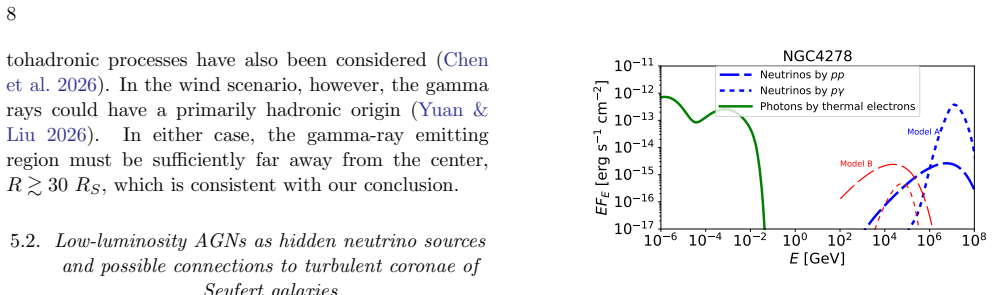
Using a single-zone radiatively inefficient accretion flow model with viscosity parameter α=0.4, plasma β=0.7, and an accretion rate that increases from 6×10⁻⁴ to 10⁻³ of the Eddington rate between the quiescent and moderate states, the paper reproduces the Swift-XRT and NuSTAR X-ray spectra of NGC 4278, including the hard power-law shape and the observed variability. The same model predicts a two-photon annihilation optical depth greater than unity for TeV gamma rays inside roughly 30 Schwarzschild radii, so the LHAASO-detected 1–25 TeV emission cannot emerge from the RIAF disk and must instead come from a jet or wind. The paper also computes RIAF neutrino spectra and argues that NGC 4278 s
What carries the argument
The central object is the radiatively inefficient accretion flow (RIAF) model: a hot, geometrically thick, optically thin inflow in which thermal electrons emit through synchrotron and Comptonization. The paper uses the analytic scalings of this model—density, electron temperature, magnetic field, and Thomson depth as functions of radius, viscosity α, plasma β, and accretion rate ṁ—to fit the X-ray spectral energy distribution. The pair-production optical depth formula for γγ→e⁺e⁻ (Eq. 7) is then used to determine the minimum radius from which TeV gamma rays can escape, providing the key constraint that pushes the TeV emission region outward.
Load-bearing premise
The conclusion that TeV gamma rays cannot escape the inner disk rests on the model-derived infrared luminosity of ∼3×10³⁹ erg/s at 0.1 eV; if the true IR field is more than about a factor of 20 weaker, the pair-production opacity falls below unity and 1–25 TeV photons could escape from within 30 Schwarzschild radii.
What would settle it
Measure the nuclear infrared luminosity of NGC 4278 at ∼0.1 eV (e.g., with ALMA or JWST); if it is below ∼1.5×10³⁸ erg/s, the optical depth in Eq. 7 becomes less than one in the LHAASO energy band, so the inner RIAF would no longer be ruled out as the TeV source.
If this is right
- The first NuSTAR detection above 10 keV establishes the hard X-ray spectrum of NGC 4278 and rules out an exponential cutoff below roughly 30 keV, constraining the electron energy distribution in the inner flow.
- A single variable parameter—the accretion rate—can explain both the factor-of-two month-scale X-ray variability and the roughly fivefold higher X-ray flux during the 2021 active state, without invoking an additional soft X-ray component.
- If the TeV gamma rays originate in a jet or wind at radii beyond ∼30 Schwarzschild radii, the RIAF's infrared photons naturally serve as target photons for external inverse-Compton scattering, making the jet interpretation self-consistent with the X-ray modeling.
- The predicted RIAF neutrino flux is comparable to the observed TeV gamma-ray flux, providing a concrete target for neutrino telescopes and strengthening the case for a hard X-ray/neutrino luminosity correlation connecting LLAGNs and Seyferts.
Where Pith is reading between the lines
- If the true sub-mm/far-IR luminosity of NGC 4278 is more than roughly a factor of 20 lower than the model's ∼3×10³⁹ erg/s at 0.1 eV, the pair-production opacity would drop below unity and 1–25 TeV photons could escape from the inner RIAF, removing the need for a jet/wind origin. This could be tested with ALMA or JWST measurements of the nuclear IR–sub-mm SED.
- A direct measurement of the IR field would also sharpen the neutrino flux prediction, since the photohadronic and hadronuclear neutrino yields depend on the same target-photon population; a lower IR luminosity would shift the relative importance of pp versus pγ channels.
- If future simultaneous X-ray and TeV observations catch a flare that tracks the accretion-rate timescale, the inner-disk versus jet/wind distinction could be settled decisively; a lag or lack of correlation would support the two-zone picture, while rapid correlated variability would favor a compact inner origin.
- The same single-zone RIAF fitting strategy could be applied to other LLAGNs with sparse hard-X-ray coverage to identify which are hidden TeV sources and the most promising targets for IceCube and future neutrino telescopes; extending the L_X–L_ν relation to lower luminosities is a testable prediction for stacked LLAGN searches.
Editorial analysis
A structured set of objections, weighed in public.
Referee Report
Summary. The paper presents the first NuSTAR hard X-ray observations of the LLAGN NGC 4278, clearly detecting the source beyond 10 keV with a power-law spectrum (photon index ~2.2–2.5) and no evidence for a high-energy cutoff. Two NuSTAR epochs separated by about a month show a factor-of-two flux change, and quasi-simultaneous Swift-XRT data define a moderate state; comparison with a 2021 Swift-XRT exposure during the LHAASO-reported active period shows a higher, harder X-ray state. The authors interpret the X-ray and archival broadband SED with a single-zone RIAF model (Kimura et al. 2019a, 2021), varying the accretion rate mdot from 6e-4 (quiescent) to 1e-3 (moderate) with fixed alpha=0.4, beta=0.7, and R=10 R_S. They argue that TeV gamma rays observed by LHAASO cannot escape from the inner RIAF because of two-photon pair-production opacity against IR disk photons, and therefore likely originate in an outer jet or wind. They further estimate RIAF neutrino fluxes and place NGC 4278 on a hypothetical hard-X-ray/neutrino correlation extending from Seyferts to LLAGNs.
Significance. The NuSTAR data are new and valuable: they provide the first hard X-ray spectrum of NGC 4278 above 10 keV, and the variability analysis is carefully done with standard HEASOFT/NuSTARDAS reduction and a fractional variability measurement. If the RIAF interpretation is robust, it would support hot accretion-flow models as the dominant hard X-ray source in LLAGNs and tie X-ray state changes to accretion-rate variations. The pair-production opacity argument, if secure, would locate the LHAASO TeV emission outside the inner disk, favoring jet/wind scenarios, and the neutrino discussion is a useful, clearly speculative extension. However, the central conclusions are currently conditional on model-dependent quantities and lack quantitative fit diagnostics, so the paper's strongest contribution is the data themselves, while the interpretive claims need further support or explicit hedging.
major comments (3)
- [Sec. 5.1, Eq. (7)] The TeV-opacity conclusion that the RIAF disk is transparent only for R >~ 30 R_S rests on the IR target luminosity L_disk ~ 3e39 erg/s at ~0.1 eV. As the paper itself notes in Sec. 4.2, the archival 0.1 eV IR excess is dominated by heated dust, so the nuclear RIAF IR component is a model output, not a measured quantity; it is degenerate with alpha, beta, and mdot and was rescaled by up to a factor of 4.1 to accommodate the lower NuSTAR flux. Since tau_gamma_gamma is proportional to L_IR, a nuclear IR luminosity lower by only ~20 would drop tau below unity at R=10 R_S, allowing 1-25 TeV photons to escape from R < 30 R_S. The claim that LHAASO gamma rays 'cannot escape from the RIAF disk' is therefore not empirically anchored. The authors should either provide an observational upper limit on the nuclear IR luminosity or explicitly reframe the conclusion as conditional with the scaling sho
- [Sec. 4.3 and Table 2] The best-fit RIAF parameters are quoted without uncertainties, and no goodness-of-fit statistic is reported. The model is explicitly acknowledged to have large degeneracy (Sec. 4.2), and the claimed fit to the broadband SED involves rescaling the optical flux by up to a factor of 4.1. Thus the statement 'We find the best-fit values' is not quantitatively supported. A grid-search with confidence regions, or at least a chi-square/delta-chi-square analysis over the parameter ranges stated in Sec. 4.3, is needed to justify the RIAF interpretation and the inferred mdot values. As written, the fit cannot be distinguished from a visual overlay.
- [Sec. 4.3] The inference that the flow is magnetically arrested (MAD) is based mainly on the chosen beta=0.7, which is described as typical of MAD-like disks, while the paper also notes that beta alone is not enough to determine the magnetic topology. This claim is used later to support consistency with jet models, but the supporting evidence is thin. The authors should soften this or provide additional diagnostics (e.g., variability properties or jet-power comparison) before asserting that the model 'favors' a MAD.
minor comments (5)
- [Abstract/Introduction] Typographical issues: 'lager viewing angle' should be 'larger viewing angle' (Sec. 1), and 'comsic-ray' should be 'cosmic-ray' (Sec. 5.2).
- [Sec. 3.1] The phrase 'almost flat X-ray spectrum' is slightly misleading for a photon index of 2.2-2.5 in E F_E space; consider saying 'hard power-law spectrum' or explicitly defining 'flat' in nu F_nu space.
- [Eq. (7)] The notation with tildes (e.g., L_tilde_disk, epsilon_tilde) is not defined in the text. Define these quantities explicitly before use.
- [Fig. 2] The top panel's shaded 'LHAASO-quiet period' and 'LHAASO-active period' regions are helpful but the boundary definitions should be stated in the caption or text for reproducibility.
- [Sec. 5.2] The discussion of the L_nu-L_X correlation is clearly labeled as speculative, but the figure caption for Fig. 9 should also explicitly repeat the caveat that no neutrino detection from NGC 4278 exists; currently this is only in the text.
Circularity Check
No significant circularity: the RIAF model is an external framework, and model-dependent neutrino/opacity statements are clearly conditional, not identity-level reductions.
full rationale
The paper's central X-ray interpretation is a fit of a previously published multi-purpose RIAF model (Kimura et al. 2019a, 2021) to new Swift/NuSTAR spectra; the model is not derived from the NGC 4278 data, and the fit parameters (α=0.4, β=0.7, ṁ=6×10⁻⁴/10⁻³) are presented as best-fit values, not as predictions forced by a prior step. The TeV-opacity argument (Sec. 5.1, Eq. 7) uses a model-derived IR luminosity (L̃_disk ~3×10³⁹ erg/s at 0.1 eV) rather than a direct measurement; this makes the gamma-ray escape conclusion model-dependent, but it is not circular because L̃_disk is an output of the SED model, not a quantity tuned to the LHAASO detection, and the paper explicitly notes the attenuation could be compensated by increasing dissipation power. The neutrino flux estimate and the Lν–LX point (Sec. 5.2, Fig. 9) are computed from the same ṁ fitted to the X-ray data, so they are not an independent empirical confirmation; however, the authors label this a 'rough estimation' and explicitly caveat that no neutrino emission from NGC 4278 has ever been reported. This is model extrapolation, not an equation-level identity or a fitted parameter renamed as a prediction. Self-citations to the authors' RIAF/neutrino methodology are present, but they cite a published framework with stated assumptions; no uniqueness theorem or unverified ansatz is imported under disguise. No step in the derived chain reduces, by the paper's own equations, to its own input, so no circular step is established.
Axiom & Free-Parameter Ledger
free parameters (8)
- Viscosity parameter alpha =
0.4
- Plasma beta (gas-to-magnetic pressure ratio) =
0.7
- Normalized accretion rate mdot (quiescent) =
6e-4
- Normalized accretion rate mdot (moderate) =
1e-3
- Multi-zone radial index s =
0.5
- Cosmic-ray injection efficiency eta_CR =
0.01
- Acceleration efficiency eta_acc =
10 (Model A), 1e4 (Model B)
- Emission radius R =
10 R_S (single-zone)
axioms (6)
- domain assumption The RIAF model of Kimura et al. (2019a, 2021) correctly describes the accretion flow structure and radiative processes in NGC 4278.
- domain assumption Electron heating fraction f_e follows the Chael et al. (2018) fitting formula; half of released gravitational energy heats the plasma.
- domain assumption Black hole mass M_BH = 3e8 M_sun (Wang & Zhang 2003).
- ad hoc to paper The quiescent and moderate/active states differ only by the accretion rate mdot, with alpha and beta fixed.
- ad hoc to paper Cosmic rays are injected with a power-law spectral index 1 and do not affect the thermal electron spectrum except through a subdominant cascade.
- domain assumption The IR photon field for pair-production opacity is dominated by RIAF disk emission with L_disk ~ 3e39 erg/s at ~0.1 eV and Gamma_disk ~ 1.
read the original abstract
We report the first NuSTAR hard X-ray observations of the low-luminosity active galactic nucleus NGC 4278. The source is clearly detected beyond 10 keV with a hard X-ray spectrum consistent with a power law of photon index between 2.2 and 2.5 without evidence for a high-energy cutoff. The X-ray flux is low compared to the active state in 2021, but exhibits variability by a factor of ~2 on a timescale of a month. We discuss the origin of the hard X-ray emission and explore its connection to gamma rays and high-energy neutrinos. We explain the X-ray data, including both quiescent and active states, using a radiatively inefficient accretion flow (RIAF) model with a variable accretion rate. We also show that TeV gamma rays cannot escape from the RIAF disk, and very high-energy gamma rays observed in LHAASO are likely to originate from outer regions such as jets and winds, which is consistent with our results favoring a magnetically arrested disk. We also discuss hidden neutrino emission from RIAFs together with possible connections to coronae of active galactic nuclei with standard, radiatively efficient disks.
Figures



Reference graph
Works this paper leans on
-
[1]
, " * write output.state after.block = add.period write newline
ENTRY address archivePrefix author booktitle chapter doi edition editor eprint howpublished institution journal key month number organization pages publisher school series title misctitle type volume year version url label extra.label sort.label short.list INTEGERS output.state before.all mid.sentence after.sentence after.block FUNCTION init.state.consts ...
-
[2]
write newline
" write newline "" before.all 'output.state := FUNCTION format.url url empty "" new.block "" url * "" * if FUNCTION format.eprint eprint empty "" archivePrefix empty "" archivePrefix "arXiv" = new.block " " eprint * " " * new.block " " eprint * " " * if if if FUNCTION format.doi doi empty "" " " doi * " " * if FUNCTION format.pid doi empty eprint empty ur...
-
[3]
thebibliography [1] 20pt to REFERENCES 6pt =0pt \@twocolumntrue 12pt -12pt 10pt plus 3pt =0pt =0pt =1pt plus 1pt =0pt =0pt -12pt =13pt plus 1pt =20pt =13pt plus 1pt \@M =10000 =-1.0em =0pt =0pt 0pt =0pt =1.0em @enumiv\@empty 10000 10000 `\.\@m \@noitemerr \@latex@warning Empty `thebibliography' environment \@ifnextchar \@reference \@latexerr Missing key o...
arXiv 2017
-
[4]
Astropy Collaboration , Robitaille , T. P., Tollerud , E. J., et al. 2013, , 558, A33, 10.1051/0004-6361/201322068
-
[5]
Astropy Collaboration , Price-Whelan , A. M., Sip o cz , B. M., et al. 2018, , 156, 123, 10.3847/1538-3881/aabc4f
-
[6]
Balbus, S. A., & Hawley, J. F. 1998, Rev. Mod. Phys., 70, 1, 10.1103/RevModPhys.70.1
-
[7]
2021, The Astrophysical Journal Supplement Series, 256, 13
Baldini, L., Ballet, J., Bastieri, D., et al. 2021, The Astrophysical Journal Supplement Series, 256, 13
2021
-
[8]
Bandyopadhyay, B., Xie, F.-G., Nagar, N. M., et al. 2019, Monthly Notices of the Royal Astronomical Society, 490, 4606, 10.1093/mnras/stz2874
-
[9]
Blandford, R. D., & Begelman, M. C. 1999, Monthly Notices of the Royal Astronomical Society, 303, L1, 10.1046/j.1365-8711.1999.02358.x
arXiv 1999
-
[10]
Boller , T., Freyberg , M. J., Tr ""u mper , J., et al. 2016, aap, 588, A103, 10.1051/0004-6361/201525648
-
[11]
2024, , 977, L16, 10.3847/2041-8213/ad93cf
Bronzini , E., Grandi , P., Torresi , E., & Buson , S. 2024, , 977, L16, 10.3847/2041-8213/ad93cf
-
[12]
Burrows , D. N., Hill , J. E., Nousek , J. A., et al. 2005, , 120, 165, 10.1007/s11214-005-5097-2
-
[13]
2024 a , , 271, 25, 10.3847/1538-4365/acfd29
Cao , Z., Aharonian , F., An , Q., et al. 2024 a , , 271, 25, 10.3847/1538-4365/acfd29
-
[14]
2024 b , , 971, L45, 10.3847/2041-8213/ad5e6d
Cao , Z., Aharonian , F., Axikegu , et al. 2024 b , , 971, L45, 10.3847/2041-8213/ad5e6d
-
[15]
A., Kheirandish, A., & Murase, K
Carpio, J. A., Kheirandish, A., & Murase, K. 2026, to be submitted
2026
-
[16]
Chael, A., Rowan, M. E., Narayan, R., Johnson, M. D., & Sironi, L. 2018, Mon. Not. Roy. Astron. Soc., 478, 5209, 10.1093/mnras/sty1261
- [17]
-
[18]
Condon , J. J., Cotton , W. D., Greisen , E. W., et al. 1998, , 115, 1693, 10.1086/300337
doi:10.1086/300337 1998
-
[19]
Das, A., Zhang, B. T., & Murase, K. 2024, The Astrophysical Journal, 972, 44, 10.3847/1538-4357/ad5a04
-
[20]
Dermer, C. D., Murase, K., & Inoue, Y. 2014, JHEAp, 3-4, 29, 10.1016/j.jheap.2014.09.001
-
[21]
Dixon , R. S. 1970, , 20, 1, 10.1086/190216
doi:10.1086/190216 1970
-
[22]
2004, , 611, 1005, 10.1086/422091
Gehrels , N., Chincarini , G., Giommi , P., et al. 2004, , 611, 1005, 10.1086/422091
doi:10.1086/422091 2004
-
[23]
Giroletti , M., Taylor , G. B., & Giovannini , G. 2005, , 622, 178, 10.1086/427898
-
[24]
Gregory , P. C., Scott , W. K., Douglas , K., & Condon , J. J. 1996, , 103, 427, 10.1086/192282
doi:10.1086/192282 1996
-
[25]
Guo, M., Stone, J. M., Quataert, E., & Kim, C.-G. 2024, Astrophys. J., 973, 141, 10.3847/1538-4357/ad5fe7
-
[26]
H. E. S. S. Collaboration , Aharonian , F., Ait Benkhali , F., et al. 2022, Science, 376, 77, 10.1126/science.abn0567
-
[27]
Harrison, F. A., Craig, W. W., Christensen, F. E., et al. 2013, , 770, 103, 10.1088/0004-637x/770/2/103
-
[28]
Healey , S. E., Romani , R. W., Taylor , G. B., et al. 2007, , 171, 61, 10.1086/513742
doi:10.1086/513742 2007
-
[29]
Hunter, J. D. 2007, Computing in Science and Engineering, 9, 90, 10.1109/MCSE.2007.55
-
[30]
Jackson , N., Battye , R. A., Browne , I. W. A., et al. 2007, , 376, 371, 10.1111/j.1365-2966.2007.11442.x
arXiv 2007
-
[31]
Joint Iras Science , W. G. 1994, VizieR Online Data Catalog, 2125, 0
1994
-
[32]
2001, SciPy : Open source scientific tools for Python
Jones, E., Oliphant, T., Peterson, P., et al. 2001, SciPy : Open source scientific tools for Python . http://www.scipy.org/
2001
-
[33]
Kheirandish, A., Murase, K., & Kimura, S. S. 2021, Astrophys. J., 922, 45, 10.3847/1538-4357/ac1c77
-
[34]
S., Kashiyama, K., & Hotokezaka, K
Kimura, S. S., Kashiyama, K., & Hotokezaka, K. 2021, Astrophys. J. Lett., 922, L15, 10.3847/2041-8213/ac35dc
-
[35]
S., Murase, K., & M\'esz\'aros, P
Kimura, S. S., Murase, K., & M\'esz\'aros, P. 2019 a , Phys. Rev. D, 100, 083014, 10.1103/PhysRevD.100.083014
-
[36]
S., Murase , K., & M \'e sz \'a ros , P
Kimura , S. S., Murase , K., & M \'e sz \'a ros , P. 2021, Nature Communications, 12, 5615, 10.1038/s41467-021-25111-7
-
[37]
Kimura, S. S., Murase, K., & Toma, K. 2015, Astrophys.J., 806, 159, 10.1088/0004-637X/806/2/159
-
[38]
Kimura, S. S., & Toma, K. 2020, Astrophys. J., 905, 178, 10.3847/1538-4357/abc343
-
[39]
Kimura, S. S., Tomida, K., & Murase, K. 2019 b , Mon. Not. Roy. Astron. Soc., 485, 163, 10.1093/mnras/stz329
-
[40]
2024, arXiv e-prints, arXiv:2404.06867, 10.48550/arXiv.2404.06867
Kun , E., Bartos , I., Becker Tjus , J., et al. 2024, arXiv e-prints, arXiv:2404.06867, 10.48550/arXiv.2404.06867
-
[41]
Mahadevan, R. 1997, Astrophys. J., 477, 585, 10.1086/303727
-
[42]
1990, in IRAS Faint Source Catalogue, version 2.0 (1990), 0
Moshir , M., & et al. 1990, in IRAS Faint Source Catalogue, version 2.0 (1990), 0
1990
-
[43]
2022, , 941, L17, 10.3847/2041-8213/aca53c
Murase , K. 2022, , 941, L17, 10.3847/2041-8213/aca53c
-
[44]
Murase, K., Inoue, Y., & Dermer, C. D. 2014, Phys. Rev. D, 90, 023007, 10.1103/PhysRevD.90.023007
-
[45]
Murase, K., Karwin, C. M., Kimura, S. S., Ajello, M., & Buson, S. 2024, Astrophys. J. Lett., 961, L34, 10.3847/2041-8213/ad19c5
-
[46]
Murase, K., Kimura, S. S., & Meszaros, P. 2020, Phys. Rev. Lett., 125, 011101, 10.1103/PhysRevLett.125.011101
-
[47]
S., Mukhopadhyay, M., & Bhattacharya, M
Murase, K., Kimura, S. S., Mukhopadhyay, M., & Bhattacharya, M. 2026. 2602.20145
arXiv 2026
-
[49]
Narayan, R., Igumenshchev, I. V., & Abramowicz, M. A. 2003, Publications of the Astronomical Society of Japan, 55, L69, 10.1093/pasj/55.6.L69
-
[50]
Narayan, R., Sadowski, A., Penna, R. F., & Kulkarni, A. K. 2012, Monthly Notices of the Royal Astronomical Society, 426, 3241, 10.1111/j.1365-2966.2012.22002.x
arXiv 2012
-
[51]
1994, , 428, L13, 10.1086/187381
Narayan , R., & Yi , I. 1994, , 428, L13, 10.1086/187381
doi:10.1086/187381 1994
-
[52]
2014, HEAsoft: Unified Release of FTOOLS and XANADU , Astrophysics Source Code Library, record ascl:1408.004
Nasa High Energy Astrophysics Science Archive Research Center (Heasarc) . 2014, HEAsoft: Unified Release of FTOOLS and XANADU , Astrophysics Source Code Library, record ascl:1408.004. 1408.004
2014
-
[53]
S., Storchi-Bergmann, T., & Eracleous, M
Nemmen, R. S., Storchi-Bergmann, T., & Eracleous, M. 2014, Monthly Notices of the Royal Astronomical Society, 438, 2804, 10.1093/mnras/stt2388
-
[54]
S., Storchi-Bergmann, T., Eracleous, M., & Yuan, F
Nemmen, R. S., Storchi-Bergmann, T., Eracleous, M., & Yuan, F. 2009, Proceedings of the International Astronomical Union, 5, 313–318, 10.1017/S1743921310006538
-
[55]
2012, , 758, 94, 10.1088/0004-637X/758/2/94
Pellegrini , S., Wang , J., Fabbiano , G., et al. 2012, , 758, 94, 10.1088/0004-637X/758/2/94
-
[56]
Pesce, D. W., Palumbo, D. C. M., Narayan, R., et al. 2021, Astrophys. J., 923, 260, 10.3847/1538-4357/ac2eb5
-
[57]
2011, arXiv e-prints, arXiv:1103.0749, 10.48550/arXiv.1103.0749
Stratta , G., Capalbi , M., Giommi , P., et al. 2011, arXiv e-prints, arXiv:1103.0749, 10.48550/arXiv.1103.0749
-
[58]
1987, Mon
Svensson, R. 1987, Mon. Not. Roy. Astron. Soc., 227, 403
1987
-
[59]
2011, Monthly Notices of the Royal Astronomical Society, 414, 1827, 10.1111/j.1365-2966.2011.18267.x
Tang, Y., Gu, Q., Zhang, S., & Tang, B. 2011, Monthly Notices of the Royal Astronomical Society, 414, 1827, 10.1111/j.1365-2966.2011.18267.x
arXiv 2011
-
[60]
Tchekhovskoy , A., Narayan , R., & McKinney , J. C. 2011, , 418, L79, 10.1111/j.1745-3933.2011.01147.x
arXiv 2011
-
[61]
Tremblay , S. E., Taylor , G. B., Ortiz , A. A., et al. 2016, , 459, 820, 10.1093/mnras/stw592
-
[62]
van der Walt, S., Colbert, S. C., & Varoquaux, G. 2011, Computing in Science Engineering, 13, 22, 10.1109/MCSE.2011.37
-
[63]
Vaughan , S., Edelson , R., Warwick , R. S., & Uttley , P. 2003, , 345, 1271, 10.1046/j.1365-2966.2003.07042.x
arXiv 2003
-
[64]
1999, , 349, 389
Voges , W., Aschenbach , B., Boller , T., et al. 1999, , 349, 389
1999
-
[65]
2003, , 340, 793, 10.1046/j.1365-8711.2003.06336.x
Wang , T.-G., & Zhang , X.-G. 2003, , 340, 793, 10.1046/j.1365-8711.2003.06336.x
arXiv 2003
-
[66]
White , R. L., & Becker , R. H. 1992, , 79, 331, 10.1086/191656
-
[67]
L., Becker , R
White , R. L., Becker , R. H., Helfand , D. J., & Gregg , M. D. 1997, , 475, 479
1997
-
[68]
Willingale , R., Starling , R. L. C., Beardmore , A. P., Tanvir , N. R., & O'Brien , P. T. 2013, , 431, 394, 10.1093/mnras/stt175
-
[69]
Wright , E. L., Eisenhardt , P. R. M., Mainzer , A. K., et al. 2010, , 140, 1868, 10.1088/0004-6256/140/6/1868
-
[70]
Younes, G. , Porquet, D. , Sabra, B. , et al. 2010, , 517, A33, 10.1051/0004-6361/201014371
-
[71]
Yuan, C., & Liu, R.-Y. 2026, TeV Gamma-Rays from the Low-Luminosity Active Galactic Nucleus NGC 4278: Implications for the Diffuse Neutrino Background. 2601.21411
Pith/arXiv arXiv 2026
-
[72]
Yuan, F., Quataert, E., & Narayan, R. 2003, Astrophys. J., 598, 301, 10.1086/378716
doi:10.1086/378716 2003
-
[73]
2012, The Astrophysical Journal, 761, 129, 10.1088/0004-637X/761/2/129
Yuan, F., Wu, M., & Bu, D. 2012, The Astrophysical Journal, 761, 129, 10.1088/0004-637X/761/2/129
discussion (0)
Sign in with ORCID, Apple, or X to comment. Anyone can read and Pith papers without signing in.